Showing posts with label demonstrations. Show all posts

Wednesday, November 22, 2023

Shape memory alloys

Recently I bought a small wire of NiTinol to have fun with and use in demonstrations to kids. This video gives a spectacular demonstration and attempts to explain how it works. I did not know about their use in stents for heart surgery.


I am still struggling to understand exactly how shape-memory alloys work. According to Wikipedia

The shape memory effect occurs because a temperature-induced phase transformation reverses deformation...Typically the martensitic (low-temperature) phase is monoclinic or orthorhombic . Since these crystal structures do not have enough slip systems for easy dislocation motion, they deform by twinning—or rather, detwinning.

Martensite is thermodynamically favored at lower temperatures, while austenite (B2 cubic) is thermodynamically favored at higher temperatures. Since these structures have different lattice sizes and symmetry, cooling austenite into martensite introduces internal strain energy in the martensitic phase. To reduce this energy, the martensitic phase forms many twins—this is called "self-accommodating twinning" and is the twinning version of geometrically necessary dislocations. 

In different words, I think the essential idea may be the following. In most metals large strains are accomodated by topological defects such as dislocations. These become entangled leading to work hardening and irreversible changes is macroscopic shapes. Shape memory alloys are different because of the low symmetry unit cell. The most natural defects are twinning domain walls and they are not topological and so their formation is reversible.

I am looking forward to reading the book chapter Shape memory alloys by Vladimir Buljak, Gianluca Ranzi


Another fascinating phenomena that is related to shape-memory is "superelasticity", which I discussed in an earlier post on organic molecular crystals, and has recently been reviewed.

I welcome clarification  of the essential physics.

Wednesday, June 14, 2023

Demonstrating polymer entanglement

From Steve Spangler I learnt this "party trick" demonstration of how the polymer molecules (polyethylene) in a plastic bag are entangled with one another. 

I was not sure that it would work as easily as it did for him. But it did!


Thursday, September 15, 2022

The wonders of gallium

 A friend recently showed me that solid gallium can melt in your hand.

I did not know this. I was quite familiar with liquid mercury, but not gallium. 

The existence of elemental gallium was predicted by Mendeleev in 1869 after he constructed the periodic table. It was discovered within six years. He was able to predict that it would have a low-melting temperature, based on extrapolations from the known melting temperatures of elements close to it in the periodic table.

Solid gallium is soft enough to be cut with a knife.

Three different stable crystal structures for solid gallium are shown below.


The phase diagram of pure gallium is shown below.

Note the negative slope of the phase boundary between the liquid and the solid alpha-Ga. This is like water. It follows from the Clausius-Clapeyron equation that the solid state has lower density than the liquid state. Gallium is the only elemental metal with this property. (The semi-metals antinomy and bismuth also do).

Gallium remains liquid over a wider range of temperatures (2373 K) than any other known substance.

The figures above are taken from the following paper from 2020.

Ab initio phase diagram and nucleation of gallium  Haiyang Niu, Luigi Bonati, Pablo M. Piaggi, and Michele Parrinello

Unfortunately, that paper does not provide much insight into the low melting temperature. The key is that the solid state contains dimers of Ga, that are weakly bonded to each other. A helpful discussion is the introduction to the following paper.

On the bonding of Ga2, structures of Gan clusters and the relation to the bulk structure of gallium 

N. Gaston and A.J. Parker

The image above is from the entry on Gallium in the beautiful book The Elements by Theodore Gray.

I thank my young friend Alexey for introducing me to the wonders of gallium.

Friday, July 2, 2021

Sweet demonstrations of phase transitions

This week my wife and I did some science experiments with kids, aged about 8-12, at a holiday kids club organised by our church. The first day we did rockets, using the old standbys of baking soda rockets and mentos and coke.

On the second day, we did the science of chocolate. Ten years ago (!) we had done this based on some demonstrations developed at Harvard, described in this paper The Science of Chocolate: Interactive Activities on Phase Transitions, Emulsification, and Nucleation

Teaching kids about phase transitions with ice and steam is not quite as exciting or memorable as them melting chocolate in their mouths. An important scientific idea is:

Physical properties of matter (such as melting temperature) change with differences in chemical composition.

This is illustrated by the different melting temperatures of white, milk, and dark chocolate.

We also tried to mix water and oil, with and without the presence of detergent. This illustrates ideas about emulsification, including hydrophobic interactions. This is relevant to the production of nice smooth and uniform chocolate because the cocoa powder can only dissolve in the cocoa butter when an emulsifier is present.

Discussing chocolate is also an opportunity to discuss Milton Hershey (USA) and the Cadbury family (UK). They were not only philanthropists but were proactive in taking care of employees and their families, e.g. constructing schools, parks, and affordable housing. Richard and George Cadbury developed the garden village of Bournville; now a major suburb of Birmingham. I particularly like this sentence in the Wikipedia entry on George Cadbury, showing how he was far ahead of his time.

In 1901, disgusted by the imperialistic policy of the Balfour government and opposed to the Boer War, Cadbury bought the Daily News and used the paper to campaign for old age pensions and against the war and sweatshop labour.[4]

Other scientific articles of interest include the following. The first two discuss how there are six different polymorphs (crystal structures) of chocolate. The competition between these states comes into play with tempering, snapping, shine, and smoothness. [Aside: In general, calculating the relative energies of different polymorphs of molecular materials is a major scientific challenge.]

Chocolate: A Marvelous Natural Product of Chemistry, Ginger Tannenbaum

Using Differential Scanning Calorimetry To Explore the Phase Behavior of Chocolate Michael J. Smith

The kitchen as a physics classroom Amy C Rowat, Naveen N Sinha, Pia M Sörensen, Otger Campàs, Pere Castells, Daniel Rosenberg, Michael P Brenner and David A Weitz

Monday, September 10, 2018

What can students learn from an Ising model simulation?

Computer simulations can provide significant insight into different physical phenomena. Two decades ago the best one could do in a class or seminar was show screen shots of simulations and try and explain what was going on. Now one can show a simulation live and even vary parameters in real time to provide insight. I have done this quite a bit with Solid State Simulations.

One simulation I like but have never used effectively is that of the Ising model.
See for example, Daniel Schroeder's simulation or James Sethna or Matt Bierbaum.
What does it help me understand?
The main ideas are the concept of symmetry breaking, the correlation length, and the divergence of the correlation length at the critical point.


1. Watching the different configurations changing with time illustrates the notion of an ensemble.
2. At high temperatures one sees the paramagnetic phase where the spins are independent of each other and so there are no domains.
3. As the temperature approaches the critical temperature (T=2.27J) from above the correlation length increases and large fluctuating domains form.
4. Below the critical temperature large domains form and fluctuate less and less as the temperature lowers.
5. The ferromagnetic ground state (blue or yellow, up or down spin) in zero external field depends on the history. This illustrates symmetry breaking

Any other things?

Saturday, August 5, 2017

Who was the greatest theoretical chemist of the 19th century?

Dimitri Mendeleev, who proposed the periodic table of the elements, purely from phenomenology and without quantum mechanics!
He even successfully predicted the existence of new elements and their properties.

A friend who is a high school teacher [but not a scientist] asked me about how he should teach the periodic table to chemistry students. It is something that students often memorise, especially in rote-learning cultures, but have little idea about what it means and represents. It makes logical sense, even without quantum mechanics. This video nicely captures both how brilliant Mendeleev was and the logic behind the table.


A key idea is how each column contains elements with similar chemical and physical properties and that as one goes down the column there are systematic trends.
It is good for students to see this with their own eyes.
This video from the Royal Society of Chemistry shows in spectacular fashion how the alkali metals are all highly reactive and that as one goes down the column the reactivity increases.


The next amazing part of the story is how once quantum theory came along it all started to make sense!

Saturday, April 1, 2017

A fascinating thermodynamics demonstration: the drinking bird

I am currently helping teach a second year undergraduate course Thermodynamics and Condensed Matter Physics. For the first time I am helping out in some of the lab sessions. Two of the experiments are based on the drinking bird.


This illustrates two important topics: heat engines and liquid-vapour equilibria.

Here are a few observations fo in random order.

* I still find it fascinating to watch. Why isn't it a perpetual motion machine?

* Several more surprising things are:
a. it operates on such a small temperature difference,
b. that there is a temperature difference between the head and bulb,
c. it is so sensitive to perturbations such as warming with your fingers or changes in humidity.

* It took me quite a while to understand what is going on, which makes me wonder about the students doing the lab. How much are they following the recipe and saying the mantra...

* I try to encourage the students to think critically and scientifically about what is going on, asking some basic questions, such as "How do you know the head is cooler than the bulb? What experiment can you do right now to test your hypothesis? How can you test whether evaporative cooling is responsible for cooling the head?" Such an approach is briefly described in this old paper.

* Understanding and approximately quantifying the temperature of the head involves the concept of humidity, wet-bulb temperature and a psychometric chart. Again I find this challenging.

* This lab is a great example of how you don't necessarily need a lot of money and fancy equipment to teach a lot of important science and skills.

Monday, February 6, 2017

A changing dimension to public outreach about science

I think it is worth noting that there are many distinct goals for public outreach activities concerning science. These include the following:

Show that science is fun, cool, and beautiful.

Teach about science, both with regard to how it is done and what we know from it.

Recruit students to study science, possibly at a particular institution.

Lobby for increased funding for science.

Enhance the public visibility of a specific institution (lab, university).

Defend scientific knowledge as reliable. 
This is particularly true of areas which have become politicised (partisan) such as climate change, childhood vaccinations, and evolutionary biology, and for which there are significant enterprises promoting "denial", "skepticism", or "alternative" views.

First, given these distinct goals, I think one needs to design activities that are tailored to a specific goal. Previously, I have discussed the problem of doing demonstrations for school kids that actually teach something about science rather than being like a magic show.
Perhaps one can achieve more than one goal, but I think it is unlikely.

Second, what is interesting and of great concern is that the last goal is a relatively new one. There are now sizeable (and sometimes very vocal) sections of the community who think science cannot be trusted. This is well highlighted in a recent Op-Ed piece in the New York Times, A Scientist's March on Washington is a Bad Idea by Robert S. Young. I agree with his argument that given the nature of the problem a march may be counter-productive, particularly as it will be painted as just another "liberal" political lobby group. A better strategy is for scientists to engage with a diverse range of community groups at a more grass roots level. Sometimes this means using subtle and diplomatic strategies such as described in this NYT article and by Katharine Hayhoe.

Third, this problem is very challenging because it is part of a much larger political and social problem, particularly in the USA. There is now a significant fraction of the population who have become disenfranchised from and distrustful of a broad range of public institutions: government, multi-national companies, universities, mainstream media, Wall street, "elites", ..... and science gets lumped in with all that.


Postscript (April 25).
The Marches for Science have now happened around the world. There are broader concerns, beyond those raised by the NYT article, that are eloquently presented by Vinoth Ramachandra.

Monday, December 12, 2016

Bouncing soap bubbles

My wife and I are often looking for new science demonstrations to do with children. The latest one she found was "bouncing soap bubbles".


For reasons of convenience [laziness?] we actually bought the kit from Steve Spangler.
It is pretty cool.

A couple of interesting scientific questions are:

Why do the gloves help?

The claim is that the grease on your hands makes bursting the bubbles easier.

Why does glycerin make the soap bubbles stronger?

Why does "ageing" the soap solution for 24 hours lead to stronger bubbles?

Journal of Chemical Education is often a source of good ideas and science discussions. Here are two relevant articles.

Clean Chemistry: Entertaining and Educational Activities with Soap Bubbles 
Kathryn R. Williams

Soap Films and the Joy of Bubbles
Mary E. Saecker

Monday, November 21, 2016

A video illustrating the length scales of the universe

Sometimes when I speak about science to church groups I show the old (1977) video Powers of Ten which nicely illustrates the immense scale of the universe and orders of magnitude.
I often wished there was a more polished modern version.
Yesterday it was pointed out to me there is, Cosmic Eye.


The phone app can be purchased here for $1.

Tuesday, October 25, 2016

A nice demonstration of classical chiral symmetry breaking

I like concrete classroom demonstrations.

Andrew Boothroyd recently showed me a very elegant demonstration based on this paper
Spontaneous Chirality in Simple Systems
Galen T. Pickett, Mark Gross, and Hiroko Okuyama

It considers hard spheres confined to a cylinder. Different phases depending on the value of D, the ratio of the diameters of the cylinder and the spheres. The phase diagram is below.


Andrew has a nice demonstration using ping pong balls and a special transparent plastic cylinder that has the right diameter to produce a chiral phase. He shows it during a colloquium and sometimes even gets an applause!

I found a .ppt that has the nice pictures below.

Wednesday, August 10, 2016

Science shows for kids

On sunday I went to the Science Street Fair hosted by the Aspen Science Center. It featured booths from a diverse range of organisations, many offering hands on activities for children.
I was on the look out for new ideas for demonstrations to do with kids. A new one for my dry ice repertoire is the smoke ring device featured in the video below.


There were public performances by Doctor Kaboom and Mr. Freeze from Fermilab.

One challenge of such performances is to go beyond "wow" and "gee whiz" to trying to teach something about how science works.
Dr. Kaboom tries to do this by testing a hypothesis about why the catapult was invented (video). However, I thought it was a little drawn out and was not sure if the point got through.

Mr. Freeze has a host of demonstrations based on liquid nitrogen. The one with the exploding cardboard box is pretty cool (video).

He also has a nice demonstration to show how the volume of a gas is about one thousand times larger than the volume of the liquid of the same amount of material. This involves using a 44 gallon garbage bag, shown below.


The demonstration is important and useful for at least two reasons.
For kids demonstrations this important fact is the key to many demonstrations involving rockets or explosions. One example, is baking soda rockets which are based on the production of CO2 gas.
For undergraduates, this thousand fold difference is the basis for using the Clausius-Clapeyron relation to explain why the slope of liquid-gas phase boundaries is much less than solid-liquid phase boundaries in pressure-temperature diagrams.

Trivia I learnt was that Fermilab uses thousands of gallons of liquid nitrogen per day, but this is less than McDonalds!

I find it a little ironic that one major part of Fermilab's public outreach involves condensed matter demonstrations.

Thursday, October 22, 2015

Engaging school students in real science experiments

Science education in schools in the Majority World faces many challenges including lack of resources, poorly trained teachers, and a fixation on rote learning from textbooks. Even at “good” schools students rarely ever do experiments or hands-on demonstrations. The focus is on preparing standard answers for exam questions.

One recent big change in school education in the Majority World is the proliferation of low-cost private schools, even in extremely poor communities. Most of these are English medium. A recent cover story in The Economist chronicled this development.

When visiting India, I enjoy reading The Hindu newspaper each day. I think the quality of journalism and the substance of the issues covered is much higher than most Western newspapers. More than once a week there is an op-ed piece or article about the problems with school education. Topics covered include the stifling of critical and creative thinking, the lack of autonomy given to teachers by all-knowing and controlling principals, …

Here is roughly what I have done for the science lesson in a school in the Majority World.

The main goal is to give a hands-on experience that will help the students see that what they read in the textbook or memorise for the exam actually has something to do with the real world.
It is centred around a baking soda and vinegar film canister rocket. Since this involves cheap household chemicals the hope is the children and/or their teachers might do it again.

I begin with a brief discussion of the scientific "method": ask a question, make a hypothesis (a big idea), design an experiment, make measurements, record data, analysis data, conclusion, and communicate results. I then illustrate this by sticking a wooden skewer in a balloon then show how you can actually put the skewer through the balloon.

I do the film canister rocket experiment. I then just mix a little vinegar and baking soda so they can see gas is being produced. Why is there gas? What gas is it?

I then explain what chemistry is and illustrate with the chemical reaction of baking soda and vinegar,  using full chemical names and chemical formula. Since carbon dioxide is a product we briefly discuss global warming. I highlight that different compounds in the chemical reaction are gas, solid, or liquid.


I then turn to physics. There are two relevant ideas here:
1. Newton's third law [which they all know word perfect!] and that drives the rocket.
2. When you convert a fixed mass of liquid or solid to gas the total volume increases by a thousandfold. A few grams of carbon dioxide has a volume of several hundred millilitres. Compressing that into the film canister produces a huge pressure.

Now the fun and most important part. We go outside and the students work in pairs where they systematically vary the amount of vinegar they add to the film canister and measure (estimate) the height the rocket goes to. Does more vinegar increase or decrease the height? Why or why not? They record their results. The quicker students I get to repeat their measurements.

After a lot of fun, we return to the classroom. I review the chemistry and physics again. Then we compare measurements between different groups, discuss measurement error, and try and draw some conclusions.

The second week I was really happy because a local friend came who just finished a Ph.D. He came from a similar socio-economic background to many of the students. I asked him to tell his life story to the class in the hope it would inspire the students. I don't think a wealthy white Western guy telling poor kids they should study hard and have a lofty goal such as to become a scientist is particularly effective or appropriate.

Follow up. The following week I did the same session with three high school students who were being home schooled by their parents. I was very impressed by their creativity and critical thinking. On their own initiative, they realised that it was difficult to make accurate measurements of the height that the rocket went to. Their solution was within about ten minutes to construct the launch device below. Instead of measuring the vertical distance they used a tape measure to measure the horizontal distance the rocket travelled.


Tuesday, June 30, 2015

Cool experiments with dry ice

Yesterday my wife and I did our latest kids science demo gig, at a holidays kid club at our church. My son has encouraged us to come up with some new demonstrations since some of the kids have already seen some of the old favourites, such as Elephants toothpaste, coke and mentos rocket, and a few others here.

At first I was pretty excited when I saw this Youtube video of an LED powered by a lemon. Watch it and see what you think. I even got some LEDs to tried and do it. At the end of the post I tell the rest of the story.

We settled on a few demos with dry ice [solid carbon dioxide]. The unique feature is that at atmospheric pressure the solid does not melt [become liquid] but sublimates [becomes vapour]. This is because in the phase diagram the pressure of the triple point [5 atm] is above atmospheric pressure.

Here are some of the demonstrations. Many of them rely on the simple fact that the volume of one gram of vapour is of the order of five hundred times larger than the volume of one gram of solid. A good exercise for high school and college students [and you!] is to come up with a simple "back of the envelope" argument as to why this is so.

A. Put a few pellets of dry ice in a zip lock bag and seal it.
After a few minutes the pressure build up due to sublimation causes the bag to "pop". I quite like this because the pop is not so loud that it scares little children and the bag is usually not damaged and so you can keep doing this again and again. Each kid gets to have bag.

B. Dry ice in a balloon. Just add a few pellets to a balloon and tie it up. Wait a few minutes and it will expand, and perhaps pop.

C. Smash a gummy bear [snake in Australia]. Make as slurry of dry ice and car antifreeze. Add a gummy bear. Take it out and smash it with a hammer. Aside: a technical discussion is here.

D. The cauldron. Simply add dry ice to some water and watch it "boil". This should actually lead to a good discussion of the difference between "bubbling" and "boiling".

Here is one compilation including a massive soap bubble by the "Crazy Russian Hacker". I did not do all of these!

In the USA I believe you can buy dry ice at some grocery stores. In Australia, it is harder; we had to go to a BOC Gas and Gear store in Brisbane and buy 1 kg of pellets for $10. They last about half a day before they completely sublimate. Pellets are easier to work with, but they don't last as long.

Postscript. The Youtube video of the LED lighting up when it is stuck in a lemon is a hoax. Because I saw it with my eyes I thought it was real. I am embarrassed; I really should have realised it could not be true. The key feature of a battery [electrochemical cell] is that the anode and the cathode have to be different materials so they have a different electrochemical potential.
But, I think making a real lemon battery would be cool. But it does require 3 to 4 lemons hooked up in series to produce the necessary minimum voltage to light the LED. I want to think about how this could be done in thermodynamics class to illustrate certain important concepts such as the chemical potential.

Saturday, August 23, 2014

Seeing enzyme catalysis with the naked eye

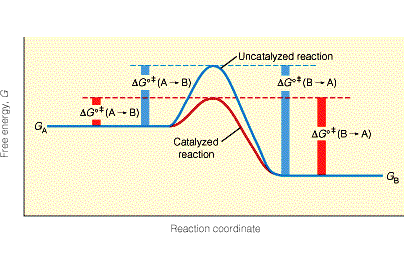
For my latest celebrity scientist speaking gig [at a small church youth group] my glamorous assistant [my wife] found a new demonstration to add to my repertoire, Elephants toothpaste. It is described in this Journal of Chemical Education paper.

Hydrogen peroxide is thermodynamically unstable. However, you can buy bottles of it and they will remain useful for months. It will slowly decompose into water and oxygen.
H
2
O
2
 → 2 H
2
O
 + O
2


However, if you add some iron chloride it acts as a catalyst and increases the decomposition rate by a factor of a thousand. You will see some amount of "bubbling" due to the oxygen gas produced. If blood [which contains haemoglobin] is added the rate increases by a factor of a million. Even better, if you add the enzyme catalase, the rate increases by a factor of a billion. In the demonstration the catalase is present in the yeast that is added. Catalase is one of the fastest catalysts known. It performs an incredibly important biochemical function, that is essential to life existing. Hydrogen peroxide is a strong oxidant  that could destroy many biomolecules. It is also an unwanted byproduct of many biochemical reactions. Biological systems use catalase to rapidly destroy the hydrogen peroxide before it can do harm.

The demonstration I did (and described in the JCE article) makes use of a dilute aqueous solution [a few per cent] of hydrogen peroxide. The spectacular video below makes use of a highly concentrated solution that is quite dangerous because it can cause chemical burns of the skin.


The above discussion follows the beautiful introduction to enzymes in chapter 11 of my favourite biochemistry text by Matthews, van Holde, Appling, and Anthony-Cahill 
It contains the figure below, illustrating the key idea of how catalysts work: by lowering the energy barrier [the transition state] for a chemical reaction.

Thursday, January 16, 2014

Experiencing the heat of solution

It is always fascinating to me when one can experience some scientific concept in everyday life. I particularly like it when one can see things with the naked eye. Recently I realised that a macroscopic manifestation of spin-orbit coupling is ferromagnetic domains and hysteresis. This is because they arise from spin anisotropy which is due to spin-orbit coupling. But I digress.

The other day I was maintaining my pool [a bain of my existence] and I mixed some solid "Hardness increaser" in water. It got really warm! I had noticed this before but not thought about it much. Why does this happen? The chemical is mostly Calcium chloride. It turns out that this has a particularly large "heat of solution" [the enthalpy change associated with dissolving it in water] of -83 kJ/mol. For this reason it is used in "hot packs" and some undergraduate chemistry labs to illustrate heat of solution. [See articles one and two in the Journal of Chemical Education]. In thermal isolation dissolving 100 grams in 1 liter of water should raise the water by 18 degrees C. This is why I experienced it directly.

I am embarrassed that much of the chemistry involved in swimming pool maintenance remains a mystery to me. [e.g. What is the point of increasing the alkalinity and decreasing the pH at the same time?] But hopefully once I read this J. Chem. Ed. paper it will all become crystal clear.


Wednesday, August 21, 2013

Copper sulphate is a spin liquid

It is amazing since a common science project for school children is to make blue crystals of copper sulphate [CuSO4.5H2O]!
[Although I was surprised and disappointed when my son just told me he never did it].

Perhaps, one may not have to look so hard for quantum materials.

The first X-ray crystallography experiment [by von Laue] was also performed on copper sulphate pentahydrate.


It turns out that the Cu2+ ions (spin-1/2) form chains that are very weakly coupled to one another and so are effectively one-dimensional antiferromagnetic Heisenberg chains above the three-dimensional Neel ordering temperature of about 100 mK.
[Caveat: strictly speaking half of the Cu2+ ions form chains; the other half are essentially isolated and non-interacting].

Minor caveat: the relevant intrachain exchange interaction J ~ 0.25 meV and so one only sees the spinons for temperatures of order a Kelvin.

I first learned all this in the introduction of this Nature Physics paper.

Thursday, August 1, 2013

Science outreach to young school kids

I recently went and did some science demonstrations to several grade 3 classes at the local primary school [elementary school in the USA]. I mostly did it because a friend from church, who is a teacher at the school, asked my wife if we could do it. The students were studying a unit on heat transfer.

Here are a few random observations from the experience.

The kids think scientists are like rock stars! You are so cool!
I was asked to wear the white coat and wild hair and so obliged.

The teachers really appreciate it. I was told I could not do just one or two classes because it would not be fair for some of the teachers and students to miss out! I had to do all!

These kids have had an incredible "diet" of computer games and special effects in movies. But, seeing something simple LIVE such as the baking soda rocket or coke can crush really wows them. They are not at all jaded, unlike the kids in this scene from Big Bang Theory!

The kids love it if they can help. Even, just measuring a temperature from a thermometer.

I really want to avoid the "magic show" dimension and try and communicate something about what science is really about, e.g. taking measurements, keeping records, making comparisons, developing concepts.
I also had a go at the "3 states of matter: gas, liquid, solid" myth by asking them about liquid crystals.
It was impressive how some got the point.

I feel we should all make more of an effort to do this sort of thing.
But, I really only felt could do it because my dear wife took care of all the logistics including all the materials for the demonstrations. My main time investment was showing up on the day. Hence, I am mindful that for many of us it may be unrealistic.

Here are some of the demonstrations
Baking soda rocket using a film canister
Tea bag rocket
Coke can crush

Thursday, July 25, 2013

The formidable challenge of science in the majority world

I am very proud to have my first paper published in the Journal of Chemical Education!

Moreover, I believe it concerns a very important topic
Connecting Resources for Tertiary Chemical Education with Scientists and Students in Developing Countries

The paper was written with Ross Jansen-van Vuuren (UQ) and Malcolm Buchanan (St. John's University, Tanzania)

The abstract is
The ability of developing countries to provide a sound tertiary chemical education is a key ingredient to the improvement of living standards and economic development within these countries. However, teaching undergraduate experimental chemistry and building research capacity in institutions based within these countries involves formidable challenges. These are not just a lack of funding and skilled teachers and technicians, but also take the form of cultural and language barriers. In the past three decades a diverse range of initiatives have aimed to address the situation. This article provides a summary of these while conveying realistic and concrete suggestions for how scientists based in industrialized nations can get involved, based on low-cost solutions with existing resources. The first step is being well informed about what has already been tried and what currently works.
Many of the same issues apply in physics. But, since my co-authors were chemists with relevant experience we focused on chemistry. In preparing the article I was struck by just how much is being done, how great the challenges are, and how people sometimes dive into this challenging enterprise without considering what else is going on and what has been tried before.  This is why we wrote the review. Hopefully, it will stimulate more efforts.

Monday, June 24, 2013

Back to buying nappies/diapers

On the weekend I did something I had not done for about 16 years. I went to the supermarket and bought a packet of disposable nappies (diapers). Why? It was all for science outreach!

This week I am doing a few demos at a kids club run by our church. Last year I did mentos and coke rockets. My glamorous assistant, my darling wife, found this video, which inspired us to increase our repertoire.


The key material is sodium polyacrylate which is a superabsorbent polymer. It is amazing that they can increase their volume by a factor of as much as 500. This is a phase transition analogous to a liquid-gas transition.

A nice follow up is to add salt which destroys the cross-linking and reduces the polymers ability to absorb water. This is shown in the video below.


A nice mean-field theory of the salt induced volume-collapse is given in this PRL from 1980.

Macroscopic quantum effects in superconductors and superfluids

Quantisation of magnetic flux in a superconductor Magnets and electrical currents produce magnetic fields, regions of space where other magn...