Showing posts with label topological insulators. Show all posts

Thursday, September 8, 2022

Very Short Introduction can be pre-ordered


I am currently working on the proofs and index for Condensed Matter Physics: A Very Short Introduction. It is wonderful to have got to this stage.

It is slated for release on December 29. It can be pre-ordered from Oxford UP (GDP 9) , Amazon (US $12), Book Depository (US $16), ...

Thursday, March 17, 2022

Predicting new states of quantum matter is highly unlikely

Last year New Scientist published a nice article by Jon Cartwright

States of matter: The unthinkable forms beyond solid, liquid and gas

From time crystals to supersolids, we keep discovering extraordinary new kinds of matter – now the true challenge is being able to predict what we'll find next

Unlike the typical New Scientist article, this one is a measured and reasonable discussion about reality, rather than the latest wild and breathless speculations that the magazine is rife with. Unfortunately, it is behind a paywall.

I was interviewed for the article, which ends (see below) by contrasting my pessimism with the optimism of Andrei Bernevig. His optimism is based on this recent paper that reports a systematic identification of stoichiometric compounds that have topological bands and so can support topological states of matter. That is important and wonderful work. But, it is looking at what can be considered a "one-electron" problem, and so does not shake my pessimism. I do hope I am wrong.


Wednesday, March 2, 2022

Unusual metal-insulator transitions arising from interplay of frustration, flat bands, and strong correlations

My colleagues and I recently posted a preprint

C3 symmetry breaking metal-insulator transitions near a flat band in the half-filled Hubbard model on the decorated honeycomb lattice

H. L. Nourse, Ross H. McKenzie, B. J. Powell

We study the single-orbital Hubbard model on the half-filled decorated honeycomb lattice. In the non-interacting theory at half-filling, the Fermi energy lies within a flat band where strong correlations are enhanced and the lattice exhibits frustration. We find a correlation driven first-order metal-insulator transition to two different insulating ground states - a dimer valence bond solid Mott insulator when inter-triangle correlations dominate, and a broken C3 symmetry antiferromagnet that arises from frustration when intra-triangle correlations dominate.

The metal-insulator transitions into these two phases have very different characters. 

The metal-broken C3 antiferromagnetic transition is driven by spontaneous C3 symmetry breaking that lifts the topologically required degeneracy at the Fermi energy and opens an energy gap in the quasiparticle spectrum. 

The metal-dimer valence bond solid transition breaks no symmetries of the Hamiltonian. It is caused by strong correlations renormalizing the electronic structure into a phase that is adiabatically connected to both the trivial band insulator and the ground state of the spin-1/2 Heisenberg model in the relevant parameter regime. 

Therefore, neither of these metal-insulator transitions can be understood in either the Brinkmann-Rice or Slater paradigms.

We welcome comments.

Tuesday, May 25, 2021

Superconductivity in kagome metals

Condensed matter physics is driven by fashion (too much). Is it fair to say that the latest fashion is the vanadium-based kagome metals  AV3Sb3 (A=K,Rb,Cs)?

[The PRL reporting superconductivity was published less than six months ago and has already been cited 44 times.]

These are certainly fascinating materials and have probably attracted attention for the following reasons.

-Kagome lattices support rich physics such as flat bands, Dirac metals, massively degenerate ground states, and (possibly) spin liquids.

-unlike other Kagome metals these compounds have both inversion and time-reversal symmetries, there is a Z2 topological invariant associated with bands near the Fermi surface, and topologically non-trivial surface states

-they are superconducting; furthermore, there are two superconducting domes as a function of pressure

-an anomalous Hall effect has been observed, which may result from topological physics

-there may be several types of charge order, including chiral charge density wave order

-the materials may be a topological superconductor [which MAY mean that it can be used to construct qubits that are "topologically protected].

Here are a few papers that I have looked at to get a better feel for this topic. I add a few things I gleaned from the papers and some basic questions I have. I welcome suggestions of other papers, that may be more helpful introductions. 

CsV3Sb5: A Z2 Topological Kagome Metal with a Superconducting Ground State 

Brenden R. Ortiz, Samuel M. L. Teicher, Yong Hu, Julia L. Zuo, Paul M. Sarte, Emily C. Schueller, A. M. Milinda Abeykoon, Matthew J. Krogstad, Stephan Rosenkranz, Raymond Osborn, Ram Seshadri, Leon Balents, Junfeng He, and Stephen D. Wilson

The figure below shows a top-down view of a single layer. The V atoms (red) form a Kagome lattice. There are three V atoms per unit cell.


The authors present DFT-based band structure calculations, which are compared to ARPES data. The good agreement suggests to me that strong correlations are not important. 

The authors use their band structures to construct Wannier orbitals and a tight-binding model for the band structure. However, even in the Supplementary information, they provide no details of this. I would like to know answers to the following.

For bands near the Fermi energy what is the composition of the underlying atomic orbitals (especially, how much d on V and p on Sb)?
How much of the band structure is described by a simple tight-binding model on a Kagome lattice with only next-nearest neighbour hopping?
Is the hopping between V sites via the p orbitals on the intermediate Sb atoms (superexchange in chemistry language)?

What is the band filling? 
Simple charge counting suggests there is one electron per triangle (1/6 band filling).

At a temperature of 100 K the intralayer resistivity is about 10 microohm-cm, well below the Mott-Ioffe-Regel limit (where the mean-free path is comparable to the lattice spacing), also suggesting that strong correlations are not significant.

Section V. A. discusses a tight-binding model. I think it is for the Kagome lattice with only nearest-neighbour hopping.

Double-dome superconductivity under pressure in the V-based Kagome metals AV3Sb5 (A = Rb and K)

C. C. Zhu, X. F. Yang, W. Xia, Q. W. Yin, L. S. Wang, C. C. Zhao, D. Z. Dai, C. P. Tu, B. Q. Song, Z. C. Tao, Z. J. Tu, C. S. Gong, H. C. Lei, Y. F. Guo, S. Y. Li

Answers to the following questions may determine whether interest in these materials is sustained.

Is the superconductivity topological?

Is the superconductivity unconventional? There are two independent parts to this question: does the superconductivity result from electron-phonon coupling or purely electronic interactions? Is the order parameter s-wave?

[On the related question of whether there are nodes in the superconducting energy gap there are already preprints with contradictory conclusions].

Is there any significant connection between any of the following: the topological character of the metal, the superconductivity, charge density orderings, and electron correlations?


Thursday, February 25, 2021

Introducing topological quantum matter

 I just completed my first draft of Chapter 8: Topology Matters for Condensed Matter Physics: A Very Short Introduction.

Any comments and suggestions would be appreciated. I learned a lot writing the chapter, but imagine it needs to be made more accessible.

Tuesday, October 6, 2020

Nobel Prize predictions for 2020

It is that time of year again. My physics predictions are the same as last year.

For physics this year I predict
Experiments for testing Bell inequalities and elucidating the role of entanglement in quantum physics
Alain Aspect, John Clauser, and Anton Zeilinger
They received the Wolf Prize in 2010, a common precursor to the Nobel. 

My personal preference for the next Nobel for CMP would be centred around Kondo physics since that is such a paradigm for many-body physics, maybe even comparable to BCS.

Kondo effect and heavy fermions
Jun KondoFrank Steglich, David Goldhaber-Gordon

Arguably the latter two might be replaced with others who worked on heavy fermions and/or Kondo in quantum dots.
Steglich discovered heavy fermion superconductivity.
Goldhaber-Gordon realised tuneable Kondo and Anderson models in quantum dots (single-electron transistors).

Unlike many, I still remain to be convinced that topological insulators are worthy of a Nobel.

How about other prizes?

The nomination deadline was January 31, before most people appreciated the significance of covid-19. I predict next year that their will be at least one prize (Chemistry, Medicine, Economics, or Peace) relating to public health and/or viruses. One possibility would be Bill and Melinda Gates for Peace.

Here are a few unusual suggestions.

Literature: Lin-Manuel Miranda for Hamilton

Peace (more likely next year): Colin Kaepernick and/or Black Lives Matter, Joshua Wong and/or other Hong Kong protestors, Jacinda Ardern.

On peace, here are some other ideas.

What do you think?

Tuesday, September 8, 2020

What's the big deal about twisted bilayer graphene?

 Twisted bilayer graphene seems to be the hottest topic in condensed matter physics right now. I tend to not follow fashion, both in clothing and science, for a multitude of reasons. However, I recently tried to catch up and read several of the nice perspectives on the topic at the Journal Club for Condensed Matter Physics.

Electronic bands of twisted graphene layers by Francisco Guinea

New correlated phenomena in magic-angle twisted bilayer graphene/s by Michael Zaletel.

What drives superconductivity in twisted bilayer graphene? by T. Senthil

Here are just a few big picture comments. I welcome feedback. I am just dipping into the subject.

Why is this attracting so much interest?

It is a playground for both experimentalists and theorists. There is some beautiful mathematics, even at the level of Moire patterns, large unit cells for the crystal structure (7204 carbon atoms!), and electronic band structure. For experimentalists, it presents a tuneable system with a rich phase diagram.

The band structure is unique in having topological features (Chern numbers), Wannier orbitals with subtle features, and non-abelian gauge fields.

The discovery of superconductivity and ferromagnetism was unexpected (I think).

There is a subtle competition between many different strongly correlated phases: Mott insulators, ferromagnetism, superconductivity, Dirac metals, ...

The possibility that superconductivity is associated with (i.e. in close proximity in the phase diagram) a Mott insulator suggests some possible similarities to cuprate superconductors.

What are some outstanding issues?

All the theory has a precise and uniform twist angle between the two sheets of graphene. However, there will inevitably be some spatial inhomogeneity in the twist angle across any real laboratory sample. How much does this inhomogeneity matter in the experiments that have been reported so far?

What is the role of the substrate that the twisted bilayer sits on?

Is the superconductivity always "derived" from a Mott insulator?

Is the superconductivity unconventional in being non-phononic and/or having non-s-wave pairing?

Can we achieve consensus on a model effective Hamiltonian and what its phase diagram is?

Will this interest last?

Interest may fade if further and more careful experiments on better samples can never definitely answer the questions above OR if the experiments do find some of the following to be true.

The sample inhomogeneity matters and some of the exciting results reported do not survive in better samples.

The superconductivity is not intimately connected to the Mott insulator.

The superconductivity is conventional.

Some caution and skepticism are in order. Many results published in luxury journals do not stand the test of time. Furthermore, condensed matter physics is a field that rapidly goes through fashions that attract a crowd that quickly moves onto to the next ``big thing,'' i.e. exotic phenomena.

I welcome comments and corrections. I do want to learn more about this fascinating subject.

Tuesday, October 8, 2019

2019 Nobel Predictions

It is that time of year again. I have not made predictions for a few years.

For physics this year I predict
Experiments for testing Bell inequalities and elucidating the role of entanglement in quantum physics
Alan Aspect, John Clauser, and Anton Zeilinger
They received the Wolf Prize in 2010, a common precursor to the Nobel.

My personal preference for the next Nobel for CMP would be centred around Kondo physics, since that is such a paradigm for many-body physics, maybe even comparable to BCS.

Kondo effect and heavy fermions
Jun Kondo, Frank Steglich, David Goldhaber-Gordon

Arguably the latter two might be replaced with others who worked on heavy fermions and/or Kondo in quantum dots.
Steglich discovered heavy fermion superconductivity.
Goldhaber-Gordon realised tuneable Kondo and Anderson models in quantum dots (single-electron transistors).

Unlike many, I still remain to be convinced that topological insulators is worthy of a Nobel.

For chemistry, my knowledge is more limited. However, I would go for yet another condensed matter physicist to win the chemistry prize: John Goodenough, inventor of the lithium battery.
He also made seminal contributions to magnetism, random access memories, and strongly correlated electron materials.

What do you think?

Postscripts (October 10).

I got confused about the day of the physics prize and I think when I posted my ``prediction'' the prize may have already been announced.

A few years ago I read Goodenough's fascinating autobiography. It was actually in that book that I learned about U. Chicago requiring PhD students to publish a single author paper. This observation featured in my much commented on recent post about PhD theses.

I also have a prediction for the Peace Prize. First, I hope it is not Greta Thunberg, as much as I admire her and agree with the importance of her cause. I worry whether it may ruin her life.
My wife suggested the Prime Minister of Ethiopia, Abiy Ahmed and the President of Eritrea, Isaias Afwerki. I find it truly amazing what Ahmed has achieved.
Another great choice would be some of the leaders of Armenia, which has seen significant increases in human rights, political freedoms, and freedom the press. It was selected as The Economist's country of the year in 2018.

Postscript (October 30).
I was really happy about the economics prize. Six years ago, I read Poor Economics, by Banerjee and Duflo, with my son (an economics student), and blogged about it. Below a respond to a commenter who was critical of this prize.

Thursday, March 21, 2019

Mental health in academia

Even though I have not posted about it for a while, mental health continues to be on my radar. I monitor my own mental health carefully and generally things are going well. Tragically, I still meet many in academia struggling with the issue. It is also in the news because of the recent death by suicide of Princeton economist, Alan Krueger. A few months ago, Stanford theoretical physicist, Shoucheng Zhang, also died by suicide.

The Chronicle of Higher Education has an article about how Krueger's death is prompting conversations about how the culture of academia can be unconducive to mental health.

Last week there was an excellent New York Times Opinion piece by Lisa Pryor
Mental Illness Isn’t All in Your Head 
A “formulation” gathers the biological, psychological and social factors that lead to a mental illness — and offers clues to the way out of suffering.

Thursday, October 11, 2018

Key ideas in solid state physics

I have had some interesting discussions with an editor at Oxford University Press about the Very Short Introductions series. The upshot is that I have been asked to write a VSI Condensed Matter Physics. I find it amazing and concerning that after 500 titles there wasn't one about CMP. There are excellent ones on Magnetism, Superconductivity, Complexity, and Crystallography.
I am very happy about this and will post more about it later. At first, we discussed a VSI on Solid State Physics. Here is my outline for that.

1. Introduction
    Solid state physics
   - is central to technology (diodes, transistors, LEDs, photovoltaic cells, and computer memories)
   - provides important lessons in scientific model building
   - is one of the largest fields of physics
   - is a rich source of ideas and concepts that have cross-fertilised with other fields of science

2. Solids are quantum matter
Solids are made of atoms (nuclei and electrons).
Electrons are waves. Electrons are fermions. Quantum degeneracy
How is a metal like a white dwarf star?

3. Symmetry matters
Crystal structures. Think in reciprocal space, not in real space.
Why is it possible to determine a crystal structure from x-ray diffraction?
Internal symmetries of electrons: spin, gauge symmetries.

4. Electron waves in a crystal
Bragg scattering. Extended states.
Energy gaps: metals, semiconductors, and insulators
Why is copper a metal while diamond is an insulator?
Why can an electron go through a crystal and pass millions of atoms without being scattered?

5. Multitudes of solid phases
Phase diagrams. Allotropes.
When is graphite less stable than diamond?
Magnetic and superconducting phases
Classifications of phases through "broken symmetry"

6. Emergence
Quasi-particles: electrons and holes, phonons, magnons
How does structure (chemical and crystal) determines electronic and structural properties?
Why does magnesium seem to have positively charged electrical currents?

7. Beyond perfect infinite crystals
a. Impurities, disorder, localisation, glasses: the value of imperfection
b. Flatland. Surfaces and dimensionality

8. Topology matters
Quantum Hall effects, Topological insulators, Quantum magnetism

9. Solid state technology
 Diodes, transistors, LEDs, photovoltaic cells, and computer memories

10. Solid concepts
What have we learned about scientific model building?

This is too much. But what would you add or subtract?

Friday, April 27, 2018

Relating frustrated spin models and flat bands in tight-binding models

What kind of theory paper to I enjoy?
Here are some personal tastes
- "simple" enough I can understand it
- physical insight
- some analytical results
- some pretty pictures that illuminate

This week I read the following paper which I consider nicely meets these criteria.

Band touching from real-space topology in frustrated hopping models
Doron L. Bergman, Congjun Wu, and Leon Balents

The quantum spin antiferromagnetic Heisenberg model on the kagome lattice attracts a lot of attention because it may have a spin liquid ground state, for spin-1/2 and spin 1. This is arguably driven by the large spin frustration. A reflection of this frustration is that the classical model has a non-zero entropy at zero temperature due to a manifold of degenerate states. For this reason, the kagome lattice is sometimes said to be "maximally frustrated". This is in contrast to the triangular lattice for which their is a unique classical ground state and the spin-1/2 model exhibits long-range order.

The kagome lattice is also of interest because of the band structure for the tight-binding model has a flat band, i.e. it is dispersionless. This means that in the presence of interactions the electrons in this band may be strongly correlated and susceptible to instability to new states of matter.

The question arises as to whether there is any connection between these two properties of models on a particular "frustrated" lattice: flat bands and a manifold of degenerate classical ground states.

The purpose of this paper is to show that for a whole class of lattices, in two and three dimensions, that there is an close relationship between these properties.
It turns out that a key feature is that the flat bands touch a dispersive band at one point in k-space.

My interest was stimulated by the work of some of my UQ colleagues on a class of organometallic compounds that exhibit a kagomene lattice (that interpolates between kagome and honeycomb (graphene). The associated band structure (taken from this paper) is shown below.

The abstract states:
We demonstrate that this band touching is related to states which exhibit nontrivial topology in real-space. Specifically, these states have support [i.e. non-zero values] on one-dimensional loops which wind around the entire system 􏰀with periodic boundary conditions􏰁. A counting argument is given that determines, in each case, whether there is band touching or none, in precise correspondence to the result of straightforward diagonalization. When they are present, the topological structure protects the band touchings in the sense that they can only be removed by perturbations, which also split the degeneracy of the flat band.
I know illustrate this with the kagome lattice.

It has a three site basis (mu=1,2,3) and so there are three bands. If q is the Bloch wave vector, the Bloch states for the flat band can be written

One of these plaquette states is shown on the left below. 
A key point is that there is constructive interference between these plaquette states. Thus, one can take superpositions of them. On the right is the superposition of three neighbouring plaquette states.

A whole line of plaquette states can lead to visualising something with nontrivial topology.

The authors then show how similar physics occurs in other two- and three-dimensional lattice models. The one below is the dice lattice.
Finally, they show that the corresponding Hubbard model leads to a Heisenberg model in the classical limit does have macroscopic degeneracy.

I thank Ben Powell for bringing the paper to my attention.

Tuesday, August 1, 2017

The role of the Platonic ideal in solid state physics

In the book Who Got Einstein's Office?, about the Institute for Advanced Study at Princeton, the author Ed Regis, mocks it as the "One True Platonic Heaven" because he claims its members are Platonic idealists, who are interested in pure theory, and disdain such "impurities" as computers and applied mathematics.


This stimulated me to think about the limited but useful role of pure mathematics, Platonic idealism, and aesthetics in solid state theory. People seem particularly excited when topology and/or geometry plays a role.

The first example I could think of is the notion of a perfect crystal.

Then comes Bloch's theorem, which surely is the central idea of introductory solid state physics.

Beautiful examples where advanced pure maths plays are role are
Chern-Simons theory of edge states in the Quantum Hall Effect
and topological terms in the action for quantum spin chains, as elucidated by Haldane.

As I have said before I think topological insulators is a beautiful, fascinating, and important topic. However, I am concerned by the disproportionately large number of people working on the topic and the associated hype. I wonder if some of the appeal and infatuation is driven by Platonic idealism.

For a classic example of how Platonism leads to imperfect theory is Kepler's Platonic solid model of the Solar System from Mysterium Cosmographicum (1596).


Good theory finds a balance between beauty and the necessity of dirty details.

Can you think of other examples where Platonic idealism plays a positive role in condensed matter theory?

Monday, July 3, 2017

A molecular material and a model Hamiltonian with rich physics

Some of my UQ colleagues and Jaime Merino have written a series of nice papers inspired by an organometallic molecular material Mo3S7(dmit)3. They have considered possible model effective Hamiltonians to describe it and the different ground states that arise depending on the model parameters.
There is a rich interplay of strong correlations, Hund's rule coupling, spin frustration, spin-orbit coupling, flat bands, and Dirac cone physics.
Possible ground states include some sort of Mott insulator, a Haldane phase, semi-metal, ...

A good place to start is the following paper
Low-energy effective theories of the two-thirds filled Hubbard model on the triangular necklace lattice 
C. Janani, J. Merino, Ian P. McCulloch, and B. J. Powell

The figure below (taken from this paper) shows some of the molecular structure and some of the hopping integrals that are associated with an underlying decorated honeycomb lattice.


This model could be called kagomene, because it interpolates between the kagome lattice and the honeycomb lattice (graphene). The figure below is taken from this paper, which uses DFT and Wannier orbitals to estimate the tight-binding parameters and the spin-orbit coupling. Interaction driven topological insulator states are possible on this lattice.


There are a few things that are not "normal" about the physics, arising from the 4/3 band filling and the molecular orbitals that are delocalised over the triangles. Specifically, the orbital degeneracy does not arise from atomic orbital degeneracy (cf. d orbitals, or t2g and eg), but rather the E representation associated with C3 symmetry of the triangles.

Hund's rule coupling. 
This involves the E orbitals and arises purely from the Hubbard U on the non-degenerate orbital on a single lattice site.

Spin-orbital coupling.
This is Spin Molecular Orbital Coupling, where the electron spin couples to the angular momentum associated with motion around the triangle, not the angular momentum of degenerate atomic orbitals.

Haldane phase.
The associated spin-1's arise from the triplet ground state of four electrons on a triangle.
A DMRG study shows that this is the ground state of a three leg-ladder Hubbard model at 2/3 filling.

Many interesting and important open questions remain about the general phase diagram of the Hubbard model on the kagomene lattice. For example, the nature of the Mott insulator, different types of topological order, the possibility of superconductivity.....

Hopefully, these studies will stimulate new experimental studies and synthesis of new chemical compounds in this fascinating class of materials.

Wednesday, March 15, 2017

The power and limitations of ARPES

The past two decades have seen impressive advances in Angle-Resolved PhotoEmission Spectroscopy (ARPES). This technique has played a particularly important role in elucidating the properties of the cuprates and topological insulators. ARPES allows measurement of the one-electron spectral function, A(k,E) something that can be calculated from quantum many-body theory. Recent advances have included the development of laser-based ARPES, which makes synchrotron time unnecessary.

A recent PRL shows the quality of data that can be achieved.

Orbital-Dependent Band Narrowing Revealed in an Extremely Correlated Hund’s Metal Emerging on the Topmost Layer of Sr2RuO4 
Takeshi Kondo, M. Ochi, M. Nakayama, H. Taniguchi, S. Akebi, K. Kuroda, M. Arita, S. Sakai, H. Namatame, M. Taniguchi, Y. Maeno, R. Arita, and S. Shin

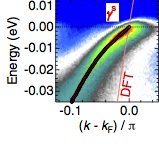
The figure below shows a colour density plot of the intensity [related to A(k,E)] along a particular direction in the Brillouin zone.  The energy resolution is of the order of meV, something that would not have been dreamed of decades ago.
Note how the observed dispersion of the quasi-particles is much smaller than that calculated from DFT, showing how strongly correlated the system is.

The figure below shows how with increasing temperature a quasi-particle peak gradually disappears, showing the smooth crossover from a Fermi liquid to a bad metal, above some coherence temperature.
The main point of the paper is that the authors are able to probe just the topmost layer of the crystal and that the associated electronic structure is more correlated (the bands are narrower and the coherence temperature is lower) than the bulk.
Again it is impressive that one can make this distinction.

But this does highlight a limitation of ARPES, particularly in the past. It is largely a surface probe and so one has to worry about whether one is measuring surface properties that are different from the bulk. This paper shows that those differences can be significant.

The paper also contains DFT+DMFT calculations which are compared to the experimental results.

Friday, February 24, 2017

Excellent notes on the Quantum Hall Effect

In the condensed matter theory group at UQ we regularly run reading groups, where we work through a book, review article, or some lecture notes. This is particularly important as our PhD students don't take any courses.

Currently we are working through some nice lecture notes on the Quantum Hall effect, written by David Tong. They are very accessible and clear, particularly in putting the QHE in the context of topology, edge states, Berry's phase, Chern insulators, TKNN, ...

On his website he also has lectures on a wide range of topics from kinetic theory to string theory.

Wednesday, October 5, 2016

2016 Nobel Prize in Physics: Topology matters in condensed matter

I was delighted to see this year's Nobel Prize in Physics awarded to Thouless, Haldane, and Kosterlitz 
”for theoretical discoveries of topological phase transitions and topological phases of matter”.

A few years ago I predicted Thouless and Haldane, but was not sure they would ever get it. I am particularly glad they were not bypassed, but rather pushed forward, by topological insulators.

There is a very nice review of the scientific history on the Nobel site.

Here are a few random observations, roughly in order of decreasing importance.

First, it is important to appreciate that there are two distinct scientific discoveries here. They do both involve Thouless and topology, but they really are distinct and so Thouless’ contribution in both is all the more impressive.
The “topological phase transition” concerns the Kosterlitz-Thouless transition which is a classical phase transition (i.e. driven by thermal fluctuations) which is driven by vortices (topological objects,
which can also be viewed as non-linear excitations).
The KT transition and the low temperature phase is remarkably different from other phase transitions and phases of matter. It is a truly continuous transition in that all the derivatives of the free energy are continuous and a Taylor expansion about the critical temperature is not defined.
Yet the superfluid density undergoes a jump at the KT transition temperature.
The low temperature phase has power law correlations with an exponent which is not only irrational but non-universal (i.e. it depends on the coupling constant and temperature).
There are deep connections to quantum phase transitions in one-dimensional systems, e.g. in a spin-1/2 XXZ spin chain, but that is another story.

Topological states of matter are strictly quantum.
Having done the KT transition there is no reason why Thouless would have been led to the formulation of the quantum Hall effect in terms of topological invariants.
That is really an independent discovery. Furthermore, the topology and maths is much more abstract because it is not in real space but involves fibre bundles, Chern numbers, and Berry connections.


All of this phenomena are striking examples of emergence in physics: surprising new phenomena, entities, and concepts.
But, here there is a profound issue about theory preceding experiment.
Almost always emergent phenomena are discovered experimentally and later theory scrambles to explain what is going on.
But, here it seems to be different. KT was predicted and then observed.
The Haldane phase was predicted and then observed in real materials.
When I give my emergent quantum matter talk, I sometimes say: “I can’t think of an example of where a new quantum state of matter was predicted and then observed. Sometimes people give the example of BEC in ultracold atomic gases and of topological insulators but they are essentially non-interacting systems."

On the other hand, it is important to acknowledge that all of this was done with effective Hamiltonians (XY models and Heisenberg spin chains). No one started with a specific material (chemical composition) and then predicted what quantum state it would have without any input from experiment.

The background article helped me better appreciate the unique contributions of Kosterlitz. I was in error not to suggest him before. By himself he worked out the renormalisation group (RG) equations for the transition. Also with Nelson he predicted the universal jump in the superfluid density.
As an aside, it is fascinating that the same RG equations appear in the anisotropic Kondo model and were discovered earlier by Phil Anderson, which was also before Wilson did RG.

The background article also notes how it took a while for Haldane’s 1983 conjecture (that integer spin chains had an energy gap to the lowest excited triplet state) to be accepted, and suggests experiment decided.  It should be pointed out that on the theory side that the numerics was not clear (see e.g., this 1989 review by Ian Affleck) until Steve White developed the DMRG (Density Matrix Renormalisation Group) for one-dimensional quantum many-body systems and laid the matter to rest in 1994 by calculating the energy gap and correlation length to five significant figures!

Later I have some minor sociology comments, but don’t want to spoil all the lovely science in this post.

Tuesday, June 28, 2016

The challenge of non-equilibrium thermodynamics

This week I am in Telluride at the bi-annual workshop on Condensed Phase Dynamics. I really enjoyed the talks today. A common topic was that of non-equilibrium thermodynamics, particularly in nanoscale systems.

Abe Nitzan began his talk mentioning a recent PRL, Quantum Thermodynamics: A Nonequilibrium Green’s Function Approach, which unfortunately, is not valid because the expressions it gives do not give the correct result in the equilibrium limit. This is shown in

Quantum thermodynamics of the driven resonant level model 
 Anton Bruch, Mark Thomas, Silvia Viola Kusminskiy, Felix von Oppen, and Abraham Nitzan

What is striking to me about both papers is that they consider a non-interacting model, i.e. the Hamiltonian is quadratic in fermion operators and exactly soluble.
This shows just how far we are from any sort of theory of a realistic system, i.e. one with interactions and which is not integrable.

Phil Geissler gave a nice introduction to different theorems for fluctuations in the dissipation (defined as the difference between the entropy change and heat/temperature). The most general theorem is that due to Gavin Crooks and implies the Jarzynski inequality, the fluctuation theorem, and the second law of thermodynamics.
A key question is what sorts of non-equilibrium processes (protocols) minimise the dissipation and whether the distribution is Gaussian (it often is).
He then described near optimal protocols to invert the magnetisation in a two-dimensional Ising model.

Suri Vaikuntanathan talked about coupled (classical) master equation models for biomolecular networks that have mathematical similarities to an electronic Su-Schrieffer-Heeger model which is an one-dimensional example of a topological insulator.
The work is described  in a preprint with A. Murugan,  "Topologically protected modes in non-equilibrium stochastic systems".
This is potentially  important because it may provide  "a framework for how biochemical systems can use non equilibrium driving to achieve robust function."

David Limmer gave a nice talk which considered thermodynamics as a large deviation theory and how that can even have meaning out of equilibrium and there is a notion of an entropy, a "free energy" and a "temperature". His slides are here.
A key notion is to focus on ensembles of trajectories rather than a probability distribution function. There are two alternative computational strategies: transition path sampling and diffusion Monte Carlo (the cloning algorithm).
He considered several concrete examples, such as thermal conductivity in carbon nanotubes, and electrochemical processes at electrode-water interfaces.

Wednesday, February 17, 2016

Linear magnetoresistance in Dirac semi-metals turns out to be boring

An enduring theme on this blog is that one should always consider "boring" explanations for "surprising" experimental results before invoking the exotica beloved and promoted by luxury journals. An example was the extremely large magnetoresistance materials.

In most metals the magnetoresistance [change in electrical resistance with external magnetic field B] depends quadratically on the B.
The past few years there have been a plethora of papers about linear magnetoresistance in topological insulators, iron pnictide superconductors, and Dirac semi-metals. I wrote a post which discusses the issue and also links to an earlier post that considers different theoretical explanations.
Many of these papers, particularly those in the baby Natures, want to link the linear magnetoresistance to the Dirac cone and possibly the Berry geometric phase associated with it.

However, there are some critical and constructive papers. For example,
Magnetotransport of proton-irradiated BaFe2As2 and BaFe1.985Co0.015As2 single crystals 
D. A. Moseley, K. A. Yates, N. Peng, D. Mandrus, A. S. Sefat, W. R. Branford, and L. F. Cohen
By using proton-beam irradiation to change the defect scattering density, we find that the dependence of the magnitude of the linear magnetoresistance on scattering quite clearly contravenes this prediction [of Abrikosov's quantum model].
There is a nice paper that gives a rather mundane explanation for the experiments.
Linear magnetoresistance in metals: Guiding center diffusion in a smooth random potential
Justin C. W. Song, Gil Refael, and Patrick A. Lee
We predict that guiding center (GC) diffusion yields a linear and nonsaturating (transverse) magnetoresistance in 3D metals. Our theory is semiclassical and applies in the regime where the transport time is much greater than the cyclotron period and for weak disorder potentials which are slowly varying on a length scale much greater than the cyclotron radius. Under these conditions, orbits with small momenta along magnetic field B are squeezed and dominate the transverse conductivity. When disorder potentials are stronger than the Debye frequency, linear magnetoresistance is predicted to survive up to room temperature and beyond. We argue that magnetoresistance from GC diffusion explains the recently observed giant linear magnetoresistance in 3D Dirac materials.
In their calculations the Berry phase plays no role.

Monday, February 8, 2016

The case for quantum materials

Nature Physics has an editorial The Rise of Quantum Materials.
In a refreshing change for the Nature Publishing Group, it is devoid of hype.
The editorial nicely gives the scientific background to the sociological observation:

 As it has become clear that the study of emergent properties is no longer restricted to strongly correlated electron systems, a new, broader description has become necessary. And the term that seems to be gaining currency on departmental websites and research programmes is quantum materials. 

[Indeed, I just got a grant with a title "The bad metallic state in quantum materials"]

My only minor comment is that the editorial does not quite explain why "quantum" is appropriate nomenclature.
I would say that is because on some level they have macroscopic properties [e.g. quantised magnetic flux in superconducting vortices and quantised Hall resistance] that are quantum mechanical in sense that they involve Planck's constant. This is the point I try to bring out in my colloquium on emergent quantum matter.

Monday, February 1, 2016

Novel spin-orbit coupling in the absence of local inversion symmetry

Normally we associate spin-orbit coupling with degenerate atomic orbitals (or energy bands) associated with d- or f-orbitals. However, in solid state physics a quite distinct type of spin-orbit coupling can occur and has attracted a lot of interest over the past decade.

In a seminal 2005 paper [which took 12 months for PRL to publish!] Kane and Mele proposed that in graphene a spin quantum Hall effect could occur due to spin-orbit coupling. Moreover, this paper proposed that this state was a topological insulator, starting a whole industry. I want to just focus on the spin-orbit coupling term in the Hamiltonian that is the first step in their argument.

This term arises because there are two carbon atoms per primitive unit cell in the crystal lattice. [A and B sub lattice]. It does not have local inversion symmetry.


How large is Delta_so ?
Kane and Mele estimated, based on a crude argument, that is was about 1.2 Kelvin. But, then they gave a renormalisation group argument, claiming that electron-electron interactions would increase the value to something like 7.5 K.
However, much more sophisticated analysis, such as this one, showed that Delta_so arose from subtle pi-sigma orbital mixing and was orders of magnitude smaller! Hence, the chance of seeing a quantum spin Hall effect in graphene are extremely unlikely.

Aside. This illustrates you can be wrong about something but still stimulate a whole new field. But, in fairness, everything is correct about the paper, except the parameter estimate for graphene. This is quite different to people who publish papers that are just plain wrong, but still stimulate positive outcomes.

What about other systems?
A nice example is monolayer MoS2, as discussed here.


A full three-dimensional crystal of MoS2 has inversion symmetry. However, a monolayer does not.
If you take a Mo atom as an inversion centre, a S atom is mapped onto an empty location.
Delta_so is estimated to be about 500 K.
It is orders of magnitude larger than graphene because the bare-spin orbit coupling is much larger due to the heavy Mo atoms.

A similar spin-orbit coupling has been proposed to occur in a quasi-one-dimensional metal, Li0.9Mo6O17.

Topology matters in condensed matter physics

Topology is the field of mathematics describing the properties of geometric objects that do not change when they are smoothly deformed. Thes...