Showing posts with label organometallics. Show all posts

Tuesday, September 30, 2025

Elastic frustration in molecular crystals

Crystals of large molecules exhibit diverse structures. In other words, the geometric arrangements of the molecules relative to one another are complex. Given a specific molecule, theoretically predicting its crystal structure is a challenge and is the basis of a competition.

One of the reasons the structures are rich and the theoretical problem is so challenging is that there are typically many different interactions between different molecules, including electrostatic, hydrogen bonding, pi-pi,...

Another challenge is to understand the elastic and plastic properties of the crystals.

Some of my UQ colleagues recently published a paper that highlights some of the complexity.

Origins of elasticity in molecular materials

Amy J. Thompson, Bowie S. K. Chong, Elise P. Kenny, Jack D. Evans, Joshua A. Powell, Mark A. Spackman, John C. McMurtrie, Benjamin J. Powell, and Jack K. Clegg

They used calculations based on Density Functional Theory (DFT) to separate the contributions to the elasticity from the different interactions between the molecules. The figure below shows the three dominant interactions in the family of crystals that they consider.

The figure below shows the energy of interaction between a pair of molecules for the different interactions.
Note the purple vertical bar, which is the value of the coordinate in the equilibrium geometry of the whole crystal. The width of the bar represents variations in both lengths that occur in typical elastic experiments.
What is striking to me is the large difference between the positions of the potential minima for the individual interactions and the minima for the combined interactions.

This is an example of frustration: it is not possible to simultaneously minimise the energy of all the individual pairwise interactions. They are competing with one another.

A toy model illustrates the essential physics. I came up with this model partly motivated by similar physics that occurs in "spin-crossover" materials.


The upper (lower) spring has equilibrium length a (b) and spring constant k (k'). In the harmonic approximation, the total elastic energy is

The equilibrium separation of the two molecules is given by

which is intermediate between a + 2R and b. This illustrates the elastic frustration. Neither of the springs (bonds) is at its optimum length.

The system is stable provided that k + k' is positive. Thus, it is not necessary that both k and k' be positive. The possibility that one of the k's is negative is relevant to reality. Thompson et al. showed that the individual molecular interaction energies are described by Morse potentials. If one is far enough from the minimum of the potential, the local curvature can be negative. 

Monday, September 8, 2025

Multi-step spin-state transitions in organometallics and frustrated antiferromagnetic Ising models

In previous posts, I discussed how "spin-crossover" material is a misnomer because many of these materials do not undergo crossovers but phase transitions due to collective effects. Furthermore, they exhibit rich behaviours, including hysteresis, incomplete transitions, and multiple-step transitions. Ising models can capture some of these effects.

Here, I discuss how an antiferromagnetic Ising model with frustrated interactions can give multi-step transitions. This has been studied previously by Paez-Espejo, Sy and Boukheddaden, and my UQ colleagues Jace Cruddas and Ben Powell. In their case, they start with a lattice "balls and spring" model and derive Ising models with an infinite-range ferromagnetic interaction and short-range antiferromagnetic interactions. They show that when the range of these interactions (and thus the frustration) is increased, more and more steps are observed.

Here, I do something simpler to illustrate some key physics and some subtleties and cautions.

fcc lattice

Consider the antiferromagnetic Ising model on the face-centred-cubic lattice in a magnetic field. 

[Historical trivia: the model was studied by William Shockley back in 1938, in the context of understanding alloys of gold and copper.]

The picture below shows a tetrahedron of four nearest neighbours in the fcc lattice.

Even with just nearest-neighbour interactions, the lattice is frustrated. On a tetrahedron, you cannot satisfy all six AFM interactions. Four bonds are satisfied, and two are unsatisfied.

The phase diagram of the model was studied using Monte Carlo by Kammerer et al. in 1996. It is shown above as a function of temperature and field. All the transition lines are (weakly) first-order.

The AB phase has AFM order within the [100] planes. It has an equal number of up and down spins.

The A3B phase has alternating FM and AFM order between neighbouring planes. Thus, 3/4 of the spins have the same direction as the magnetic field.

The stability of these ordered states is subtle. At zero temperature, both the AB and A3B states are massively degenerate. For a system of 4 x L^3 spins, there are 3 x 2^2L AB states, and 6 x 2^L   A3B states. At finite temperature, the system exhibits “order by disorder”.

On the phase diagram, I have shown three straight lines (blue, red, and dashed-black) representing a temperature sweep for three different spin-crossover systems. The "field" is given by h=1/2(Delta H - T Delta S). In the lower panel, I have shown the temperature dependence of the High Spin (HS) population for the three different systems. For clarity, I have not shown the effects of the hysteresis associated with the first-order transitions.

If Delta H is smaller than the values shown in the figure, then at low temperatures, the spin-crossover system will never reach the complete low-spin state.

Main points.

Multiple steps are possible even in a simple model. This is because frustration stabilises new phases in a magnetic field. Similar phenomena occur in other frustrated models, such as the triangular lattice, the J1-J2 model on a chain or a square lattice.

The number of steps may change depending on Delta S. This is because a temperature sweep traverses the field-temperature phase diagram asymmetrically.

Caution.

Fluctuations matter.
The mean-field theory phase diagram was studied by Beath and Ryan. Their phase diagram is below. Clearly, there are significant qualitative differences, particularly in the stability of the A3B phase.
The transition temperature at zero field is 3.5 J, compared to the value of 1.4J from Monte Carlo.


Monte Carlo simulations may be fraught.
Because of the many competing ordered states associated with frustration, Kammerer et al. note that “in a Monte Carlo simulation one needs unusually large systems in order observe the correct asymptotic behaviour, and that the effect gets worse with decreasing temperature because of the proximity of the phase transition to the less ordered phase at T=0”. 

Open questions.

The example above hints at what the essential physics may be how frustrated Ising models may capture it. However, to definitively establish the connection with real materials, several issues need to be resolved.

1. Show definitively how elastic interactions can produce the necessary Ising interactions. In particular, derive a formula for the interactions in terms of elastic properties of the high-spin and low-spin states. How do their structural differences, and the associated bond stretches or compressions, affect the elastic energy? What is the magnitude, range, and direction of the interactions?

[n.b. Different authors have different expressions for the Ising interactions for a range of toy models, using a range of approximations. It also needs to be done for a general atomic "force field".]

2. For specific materials, calculate the Ising interactions from a DFT-based method. Then show that the relevant Ising model does produce the steps and hysteresis observed experimentally.


Tuesday, September 2, 2025

"Ferromagnetic" Ising models for spin-state transitions in organometallics

In recent posts, I discussed how "spin crossover" is a misnomer for the plethora of organometallic compounds that undergo spin-state phase transitions (abrupt, first-order, hysteretic, multi-step,...)

In theory development, it is best to start with the simplest possible model and then gradually add new features to the model until (hopefully) arriving at a minimal model that can describe (almost) everything. Hence, I described how the two-state model can describe spin crossover. An Ising "spin" has values of +1 or -1, corresponding to high spin (HS) and low spin (LS) states. The "magnetic" field is half of the difference in Gibbs free energy between the two states. 

The model predicts equal numbers of HS and LS at a temperature

The two-state model is modified by adding Ising-type interactions between the “spins” (molecules). The Hamiltonian is then of the form

 The temperature dependence in the field arises because this is an effective Hamiltonian.

The Ising-type interactions are due to elastic effects. The spin-state transition in the iron atom leads to changes in the Fe-N bond lengths (an increase of about 10 per cent in going from LS to HS), changing the size of the metal-ligand (ML6 ) complex. This affects the interactions (ionic, pi-pi, H-bond, van der Waals) between the complexes. The volume of the ML6 complex changes by about 30 per cent, but typically the volume of the crystal unit cell changes by only a few per cent. The associated relaxation energies are related to the J’s. Calculating them is non-trivial and will be discussed elsewhere. There are many competing and contradictory models for the elastic origin of the J’s.

In this post, I only consider nearest-neighbour ferromagnetic interactions. Later, I will consider antiferromagnetic interactions and further-neighbour interactions that lead to frustration. 

Slichter-Drickamer model

This model was introduced in 1972 is beloved by experimentalists, especially chemists, because it provides a simple analytic formula that can be fit to experimental data.

The system is assumed to be a thermodynamic mixture of HS and LS. x=n_HS(T) is the fraction of HS. The Gibbs free energy is given by

This is minimised as a function of x to give the temperature dependence of the HS population.

The model is a natural extension of the two-state model, by adding a single parameter, Gamma, which is sometimes referred to as the cooperativity parameter.

The model is equivalent to the mean-field treatment of a ferromagnetic Ising model, with Gamma=2zJ, where z is the number of nearest neighbours. Some chemists do not seem to be aware of this connection to Ising. The model is also identical to the theory of binary mixtures, such as discussed in Thermal Physics by Schroeder, Section 5.4.

Successes of the model.

good quantitative agreement with experiments on many materials.

a first-order transition with hysteresis for T_1/2 < Tc =z J.

a steep and continuous (abrupt) transition for T_1/2 slightly larger than Tc.

Values of Gamma are in the range 1-10 kJ/mol. Corresponding vaules of J are in the range 10-200 K, depending on what value of z is assumed.

Weaknesses of the model.

It cannot explain multi-step transitions.

Mean-field theory is quantitatively, and sometimes qualitatively, wrong, especially in one and two dimensions.

The description of hysteresis is an artefact of the mean-field theory, as discussed below.

Figure. Phase diagram of a ferromagnetic Ising model in a magnetic field. (Fig. 8.7.1, Chaikin and Lubensky). Vertical axis is the magnetic field, and the horizontal axis is temperature. Tc denotes the critical temperature, and the double-line denotes a first-order phase transition between paramagnetic phases where the magnetisation is parallel to the direction of the applied field.

Curves show the free energy as a function of the order parameter (magnetisation) in mean-field theory. The dashed lines are the lines of metastability deduced from these free-energy curves. Inside these lines, the free energy has two minima: the equilibrium one and a metastable one. The lines are sometimes referred to as spinodal curves.

The consequences of the metastability for a field sweep at constant temperature are shown in the Figure below, taken from Banerjee and Bar.

How does this relate to thermally induced spin-state transitions?

Consider the phase diagram shown above of a ferromagnetic Ising model in a magnetic field. The red and blue lines correspond to temperature scans for two SCO materials that have different values of the parameters Delta H and DeltaS.

The occurrence of qualitatively different behaviour is determined by where the lines intercept the temperature and field axes, i.e. the values of T_1/2 /J and Delta H/J. If the former is larger than Tc/J, as it is for the blue line, then no phase transition is observed. 

The parameter Delta H/J determines whether at low temperatures, the complete HS state is formed.

The figure below is a sketch of the temperature dependence of the population of HS for the red and blue cases.


Note that because of the non-zero slope of the red line, the temperature  T_1/2 is not the average of the temperatures at which the transition occurs on the up and down temperature sweeps.

Deconstructing hysteresis.

The physical picture above of metastability is an artefact (oversimplification) of mean-field theory. It predicts that an infinite system would take an infinite time to reach the equilibrium state from the metastable state.

(Aside: In the context of the corresponding discrete-choice models in economics, this has important and amusing consequences, as discussed by Bouchaud.)

In reality, the transition to the equilibrium state can occur via nucleation of finite domains or in some regimes via a perturbation with a non-zero wavevector. This is discussed in detail by Chaikin and Lubensky, chapter 4.

The consequence of this “metastability” for a first-order transition in an SCO system is that the width of the hysteresis region (in temperature) may depend on the rate at which the temperature is swept and whether the system is allowed to relax before the magnetisation (fraction of HS) is measured at any temperature. Emprically, this is observed and has been highlighted by Brooker, albeit without reference to the theoretical subtleties I am highlighting here. She points out that up to 2014, chemists seemed to have been oblivious to these issues and reported results without testing whether their observations depended on the sweep rate or whether they waited for relaxation.

(Aside. The dynamics are different for conserved and non-conserved order parameters. In a binary liquid mixture, the order parameter is conserved, i.e., the number of A and B atoms is fixed. In an SCO material, the number of HS and LS is not conserved.)

In the next post, I will discuss how an antiferromagnetic Ising model can give a two-step transition and models with frustrated interactions can give multi-step transitions.

Friday, August 22, 2025

The two-state model for spin crossover in organometallics

Previously, I discussed how spin-crossover is a misnomer for organometallic compounds and proposed that an effective Hamiltonian to describe the rich states and phase transitions is an Ising model in "magnetic field".

I introduce the two-state model that defines the model without the Ising interactions. To save me time on formatting in HTML, here is a pdf file that describes the model and what comparisons with experimental data (such as that below) tells us.

Future posts will consider how elastic interactions produce the Ising interaction and how frustrated interactions can produce multi-step transitions.

Wednesday, August 13, 2025

Spin crossover is a misnomer

There are hundreds of organometallic compounds that are classified as spin-crossover compounds. As the temperature is varied the average spin per molecule can undergo a transition between low-spin and high-spin states.

The figure below shows several classes of transitions that have been observed. The vertical axis represents the fraction of molecules in the high-spin state, and the horizontal axis represents temperature.


a) A smooth crossover. At the temperature T_{1/2} there are equal numbers of high and low spins.

b) There is sharp transition with the curve having a very large slope at T_{1/2}.

c) There is a discontinuous change in the spin fraction at the transition temperature, the value of which depends on whether the temperature is increasing or decreasing, i.e., there is hysteresis. The discontinuity and hysteresis are characteristic of a first-order phase transition.

d) There is a step in the curve when the high-spin fraction is close to 0.5. This is known as a two-step transition.

e) Although a crossover occurs, the system never contains only low- or high-spins.

But, there is more. Over the past decade, multiple-step transitions have been observed. An example of a four-step transition is below.
Hysteresis is present and is larger at lower temperatures.

In a few cases of multiple-step transitions on the down-temperature sweep, the first step is missing compared to the up-temperature step.

Given the diverse behaviour described above, including sharp transitions and first-order phase transitions, spin "crossover" is a misnomer.

More importantly, given the chemical and structural complexity materials involved, is there a simple model effective Hamiltonian that can capture all this diverse behaviour?

Yes. An Ising model in a field. A preliminary discussion is here. I hope to discuss this in future posts. But first I need to introduce the simple two-state model and show what it can and cannot explain.

Monday, January 23, 2023

The green comet and quantum chemistry

The comet C/2022 E3 (ZTF) getting a lot of attention, pointed out to me by my friend Alexey. Why is it green? This basic question turns out to be scientifically rich and has only recently been answered.

The green glow comes from a triplet excited state of diatomic carbon, C2. This got my interest because a decade ago I blogged on debates by quantum chemists about whether C2 involves a quadruple bond. Back in 1995, Roald Hoffmann wrote an interesting column in The American Scientist (and reproduced in his beautiful book Same and Not the Same) about the molecule and how it is present in various organometallic compounds and inorganic crystals.

Recent advances in understanding the photophysics of C2 were reported in 2021 in this paper.

Photodissociation of dicarbon: How nature breaks an unusual multiple bond

Jasmin Borsovszky, Klaas Nauta, Jun Jiang, Christopher S. Hansen, Laura K. McKemmish, Robert W. Field, John F. Stanton, Scott H. Kable, and Timothy W. Schmidt 


Here is a summary of the significance and content of the paper from Chemistry World.

..as dicarbon streams out of the comet core, it is destroyed by sunlight – this is why the comet tail, unlike the coma, is colourless. However, the precise mechanism of this supposed photodissociation had remained unclear.

Researchers in Australia and the US have now for the first time observed diatomic carbon’s photodissociation in the lab. The team produced dicarbon by photolysing tetrachloroethylene, and then breaking it apart with laser pulses. This allowed them to determine its bond dissociation energy with the same precision as for oxygen and nitrogen. Previous measurements for dicarbon had uncertainties an order of magnitude higher than for other diatomic molecules.

To break its quadruple bond, the molecule must absorb two photons and undergo two ‘forbidden’ transitions, those that break spectroscopic rules. Cometary dicarbon, the researchers calculated, has a lifetime of around two days until sunlight breaks it apart – the reason why its colour is visible in the coma but not in the tail.

Tuesday, June 14, 2022

A model for light-induced spin-state trapping in spin-crossover materials

 An important challenge required to understand the physical properties of materials that are chemically and structurally complex is to ascertain which microscopic details are important. A related question is at what scale (length, number of atoms, energy) models should be developed.

A specific example is understanding the magnetic properties and state transitions of spin-crossover materials. This is difficult for equilibrium properties, let alone for non-equilibrium properties such as Light-Induced Excited Spin-State Trapping (LIESST). At low temperatures irradiation with light can induce a transition from the equilibrium low-spin state to a long-lived high-spin state, which is only an equilibrium state at higher temperatures. (LIESST gets a lot of attention because of the potential to make optical memories for information storage).

Some of my UQ colleagues recently published a nice paper that elucidates some of the key physics with the proposal and analysis of a (relatively simple) model that captures many details of the experimental data.

Toward High-Temperature Light-Induced Spin-State Trapping in Spin-Crossover Materials: The Interplay of Collective and Molecular Effects

M. Nadeem, Jace Cruddas, Gian Ruzzi, and Benjamin J. Powell

Thursday, August 12, 2021

Springy stringy molecular crystals

Perfect crystals are elastic. When a stress is applied and then removed the crystal will bounce back to its original shape. However, in reality no crystal is perfect. If the applied stress is too large the crystal will fracture. Understanding fracture is a big deal in materials science and involves some fascinating physics, including the role of topological defects. 

There are two distinct properties: elasticity and plasticity. They are associated with temporary and permanent changes in shape in response to an applied stress.
They are quantified by the elastic stiffness and the tensile strength, respectively. They reflect material properties at quite different length scales. 

A beautiful and accessible short introduction is 
Bart Kahr & Michael D. Ward 

This is a commentary of some work by a few of my UQ chemistry colleagues, who have made and studied a molecular crystal that is incredibly flexible, as seen in this movie.


Anna Worthy, Arnaud Grosjean, Michael C. Pfrunder, Yanan Xu, Cheng Yan, Grant Edwards, Jack K. Clegg & John C. McMurtrie 

A particular advance is that they use a synchrotron to perform spatially resolved X-ray crystallography to determine how the crystal structure varies spatially within a bent crystal. 

The material of interest has quasi-one-dimensional antiferromagnetic interactions and has been studied theoretically by my condensed matter theory colleagues.

Elise P. Kenny, Anthony C. Jacko, Ben J. Powell

But there is more...
A recent Science paper describes ice fibers that were particularly flexible.


Peizhen Xu, Bowen Cui, Yeqiang Bu, Hongtao Wang, Xin Guo, Pan Wang, Y. Ron Shen, Limin Tong

Friday, August 21, 2020

Minimal effective Hamiltonian for spin-crossover materials

My colleagues and I just put a preprint on the arXiv. I am particularly proud of it.  As always, comments would be appreciated.

Equivalence of elastic and Ising models for spin-crossover materials

Gian Ruzzi, Jace Cruddas, Ross H. McKenzie, Ben J. Powell 

Spin crossover (SCO) materials are reversible molecular switches; and occur in a wide range of near octahedral transition metal complexes and frameworks with d4−d7 electron configurations. SCO systems present collective spin-state phase transitions that show hysteresis, multistep transitions, gradual transitions, and anti-ferroelastic phases. Ising models have often been employed to model these behaviors, as they are far easier to solve than more realistic elastic models. However, previously Ising models have required phenomenological parameters that do not have a clear physical origin. 

We present an exact mapping from an elastic model of balls and springs to the Ising model. The resulting Ising coupling constants arise only from the elastic interactions, and are independent of the lattice dynamics, i.e., there are no isotope effects. The elastic interactions, and hence the Ising coupling constants can be determined from the measurements of the bulk and shear moduli. The Ising coupling constants can be frustrated, their signs can be negative or positive, and their magnitude agrees well with previous estimates from fits of experimental spin-transition curves. The Ising coupling constants follow a power law for large separations between metal centers, in particular an inverse square law for the square lattice. For the square lattice with nearest neighbor elastic interactions this model predicts a diverse range of spin-state orders including multistep transitions.


Wednesday, March 11, 2020

Single orbital + multiple sites = Rich physics

Since the discovery of the iron-based superconductors, it has become clear that the combination of multiple orbitals and strong correlations can lead to rich physics, beyond what one sees in single orbital routes.
An alternative route to rich physics is a single orbital model on a lattice with multiple sites in a unit cell.

Henry Nourse, Ben Powell, and I just posted a preprint
Multiple insulating phases due to the interplay of strong correlations and lattice geometry in a single-orbital Hubbard model
We find ten distinct ground states for the single-orbital Hubbard model on the decorated honeycomb lattice, which interpolates between the honeycomb and kagome lattices and is the simplest two-dimensional net. The rich phase diagram includes a real-space Mott insulator, dimer, and trimer Mott insulators, a spin-triplet Mott insulator, flat band ferromagnets, and Dirac metals. It is determined as a function of interaction strength, band filling, and hopping anisotropy, using rotationally invariant slave boson mean-field theory.

We welcome comments.

Monday, November 11, 2019

Tuning the dimensionality of spin-crossover compounds

An important question concerning spin-crossover compounds concerns the origin and the magnitude of the interactions between the individual molecular units.

There is a nice paper
Evolution of cooperativity in the spin transition of an iron(II) complex on a graphite surface
Lalminthang Kipgen, Matthias Bernien, Sascha Ossinger, Fabian Nickel, Andrew J. Britton, Lucas M. Arruda, Holger Naggert, Chen Luo, Christian Lotze, Hanjo Ryll, Florin Radu, Enrico Schierle, Eugen Weschke, Felix Tuczek, and Wolfgang Kuch

An impressive achievement is the control of the number of monolayers (ML) of SCO molecules deposited on a highly oriented surface pyrolytic graphite. The coverage varies between 0.35 and 10 ML. The shape of the spin-crossover curve changes significantly as the number of monolayers varies, as shown in the upper panel below.

The natural interpretation is that as the number of monolayers increases the interaction between molecules (co-operativity) increases. This can be quantified in terms of the parameter Gamma in the Slichter-Drickamer model [which is equivalent to a mean-field treatment of an Ising model], with Gamma = 4 z J where z=number of nearest-neighbours and J=Ising interaction.
The blue curve in the lower panel shows the variation of Gamma with ML.

The figure above and Table 1 shows that for ML=0.35, Gamma=-0.44 kJ/mol is almost zero for ML=0.7, and then monotonically increases to 2.1 kJ/mol for the bulk.

Does that make sense?

The magnitude of the Gamma values is comparable to those found in other compounds.

The negative value of Gamma for ML=0.35 might be explained as follows. Suppose a monolayer consists of SCO molecules arranged in a square lattice. Then ML=0.33 will consist of chains of SCO molecules that interact in the diagonal direction. If the J_nnn for this next-nearest neighbour interaction is negative then the Gamma value will be negative.

For a monolayer on a square lattice, Gamma= 16 (J_nn + J_nnn). J_nn will be positive and so if it is comparable in magnitude to J_nnn then Gamma will be small for a monolayer.

For a bilayer, Gamma = 16 (J_nn + J_nnn) + 4 J_perp, where J_perp is the interlayer coupling.
For the bulk, Gamma = 16 (J_nn + J_nnn) + 8 J_perp.

This qualitatively explains the trends, but not quantitatively.

The authors also note that the values of Delta E and Delta S obtained from their data vary little with the coverage, as they should since these parameters are single-molecule properties. This also means that the crossover temperature, T_sco also varies little with coverage.

A more rigorous approach is to not use mean-field theory, but rather consider a slab of layers of Ising models. The ratio of the transition temperature T_c to J_nn increases from 2.27 for a single layer to 4.5 as the dimensionality increases from d=2 to d=3.
[In contrast, for mean-field theory the ratio increases from 4 to 6].

If the crossover temperature T_sco is larger than T_c, [as it must be if there is no hysteresis] and assuming J_nn does not change with coverage, then as the coverage increases the crossover temperature becomes closer to the critical temperature and the transition curve will become steeper, reflected in a smaller transition width Delta T (and a correspondingly larger effective Gamma in the Slichter-Drikamer fit). This claim can be understood by looking at the last Figure in this post.

Tuesday, April 9, 2019

Coupling of the lattice to spin-crossover transitions

There is a very nice paper
Complete Set of Elastic Moduli of a Spin-Crossover Solid: Spin-State Dependence and Mechanical Actuation 
Mirko Mikolasek, Maria D. Manrique-Juarez, Helena J. Shepherd, Karl Ridier, Sylvain Rat, Victoria Shalabaeva, Alin-Ciprian Bas, Ines E. Collings, Fabrice Mathieu, Jean Cacheux, Thierry Leichle, Liviu Nicu, William Nicolazzi, Lionel Salmon, Gábor Molnár, and Azzedine Bousseksou

It investigates the spin-crossover in a specific compound with a suite of techniques, including x-ray diffraction, inelastic neutron scattering, and micro-electromechanical systems (MEMS).

The nice results reflect significant advances over the past few decades in neutron scattering and microfabrication.

The graph below shows the vibrational density of states of the Fe nuclei and the low-spin (LS) and high-spin (HS) states. Note how the LS modes around 50 meV (400 cm-1) soften significantly in the HS state. These modes are the Fe-N stretches in the octahedron. This softening is associated with a significant increase in entropy which helps drive the spin-crossover transition.
Note that there is a small parabolic part at low energies of a few meV.


The figure below is a "blow up" of the low energy data. 
The energy resolution is amazing! 
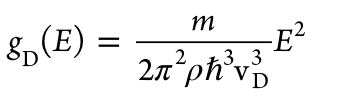
The graph shows the density of states divided by E^2. 
Why?
In an isotropic solid (or a powder such as used here) in the Debye model for phonons, the density of states is proportional to E^2 and the proportionality is determined by the speed of sound, v_D.


One clearly sees several things.
1. For E less than about 3 meV, the DOS is quadratic in E, as predicted by Debye.
2. The lattice softens with the spin-crossover.
3. The deviation from quadratic occurs at a smaller E for HS than LS.

The values of the speed of sound can be combined with the lattice constant to estimate the Debye frequency, which is roughly where the deviation from quadratic dependence should occur.
I have done this (since the authors don't appear to have) and one gets values of the order of a few meV, consistent with experiment.

From the speed of sound, one can also determine the Young's modulus. This can then be compared to the bulk modulus, which can be determined from MEMS. The values obtained by these different methods are consistent with one another.
Overall, the values of the bulk modulus for different spin-crossover complexes, of order 5-10 GPa, are comparable to those for organic molecular crystals.

Thursday, February 7, 2019

A critique of DFT calculations for spin crossover materials

A basic question concerning spin crossover compounds is what are the energy difference and entropy difference between the low spin (LS) and high spin (HS) states.


The relative magnitude of these two quantities determines the crossover temperature from the LS to HS state.
From experiment typical values of the energy difference Delta H are of the order of 1-5 kcal/mol (4-20 kJ/mol). Entropy differences are typically about 30-60 kJ/mol/K. (See table 1 in the Kepp paper below).
This relatively small difference in energy presents a challenge for computational quantum chemistry,
such as calculations based on density functional theory, because of the strong electron correlations associated with the transition metal ions,

Over the past few years some authors have done nice systematic studies of a wide range of compounds with a wide range of DFT exchange-correlation (XC) functionals. Here I will focus on two papers.

Benchmarking Density Functional Methods for Calculation of State Energies of First Row Spin-Crossover Molecules 
Jordi Cirera, Mireia Via-Nadal, and Eliseo Ruiz

Theoretical Study of Spin Crossover in 30 Iron Complexes 
Kasper P. Kepp

First, these studies are refreshing and important. Too many computational chemistry calculations are dubious because they do not do systematics. 
Here I will just discuss the first paper.

Cirera et al. use 8 different XC functionals to study 20 different compounds. They find that only one (!) functional (TPSSh) correctly gives a low spin ground state for all the compounds, i.e. Delta H is positive.

The figure below nicely summarises the results.

Before one gets too excited that one has now found the "right" functional, one should note that when one uses TPSSh to calculate the crossover temperature there is little correlation with the experimental values.

To put all this in a broader context consider the hierarchal figure below which is in the spirit of the metaphor of Jacob's ladder proposed by John Perdew. [The figure is from here]. However, I do not think Jacob's ladder is the best Biblical metaphor.


This highlights the ad hoc nature of DFT based calculations and that one is a long way from anything that should seriously be considered to be a true ab initio calculation.

It should also be noted that all these calculations are for a single molecule in vacuum. However, the experiments are in the solid state (or solution) and so the energetics can be shifted by electrostatic screening and/or solvation. The crossover temperature (which can become a first-order phase transition) may also be shifted by intermolecular elastic interactions.

Friday, February 1, 2019

My biggest questions about spin crossover compounds

Most of the questions are inter-related. Most have been discussed in earlier posts.

How do we tune physical properties (e.g. hysteresis width) by varying chemical composition?

How do we understand two-step transitions? Are they associated with spatially inhomogeneous arrangements of the spin?

Are spin ice phases possible?

What is the physical origin of the intermolecular interactions that lead to a first-order transition?
Is it electronic (magnetic) and/or elastic?
Are there long-range interactions? Are they crucial?

Is there a simple way to understand the change in vibrational spectra (and thus entropy) associated with the transition?

What is the role of spatial anisotropy?

What is the simplest possible effective model Hamiltonian that captures the physical properties above?
Can the elastic degrees of freedom be "integrated out" to give a "simple" Ising model?
How do the model parameters depend on structural and chemical composition?

Friday, January 18, 2019

First-order transitions and critical points in spin-crossover compounds

An interesting feature of spin-crossover compounds is that the transition from low-spin to high-spin with increasing temperature is usually a first-order phase transition. This is associated with hysteresis and the temperature range of the hysteresis varies significantly between compounds.
If there was no interaction between the transition metal ions the transition would be a smooth crossover. This is nicely illustrated in a figure taken from the paper below.

Abrupt versus Gradual Spin-Crossover in FeII(phen)2(NCS)2 and FeIII(dedtc)3 Compared by X-ray Absorption and Emission Spectroscopy and Quantum-Chemical Calculations 
Stefan Mebs, Beatrice Braun, Ramona Kositzki, Christian Limberg, and Michael Haumann


For the first compound, the transition is abrupt [much earlier work found a narrow hysteresis region of about 0.15 K]. For the second compound, the transition is a crossover.

The authors fit their data to an empirical equation that has a parameter n, describing the "interactions". You have to read the Supplementary Material to find the details. This equation cannot describe hysteresis.

 However, there is an elegant analytical theory going back to a paper by Wajnflasz and Pick from 1971. This is nicely summarised in the first section of a paper by Kamel Boukheddaden, Isidor Shteto, Benoit Hôo, and François Varret.
The system can be described by the Ising model

where the Ising spin denotes the high- and low-spin states. Delta is the energy difference between them and ln g the entropy difference.
The mean-field Hamiltonian for q nearest neighbours is

There are two independent dimensionless variables, d and r. Solving for the fraction of high-spin states (HS) versus temperature gives the graphs below for different values of d.
The vertical arrows show the hysteresis region for a specific value of d=2. 
As d increases the hysteresis region gets smaller. Above the critical value of d=r/2, the crossover temperature T0=Delta/ln g is larger than the mean-field critical temperature Tc= qJ, and the transition is no longer first-order but a crossover.
Using DFT-based quantum chemistry, the authors calculate the change in vibrational frequencies and the associated entropy change for the SCO transition in a single molecule. The values for compounds 1 and 2 are 0.68  and 0.21 meV/K, respectively. The spin entropy changes are 0.21 and 0.22 meV/K respectively. The total entropy changes are thus 0.89 and 0.43 meV/K respectively. The values of Delta are 175 and 125 meV, respectively. The corresponding crossover temperatures are 210 and 360 K, compared to the experimental values of 176 and 285 K.

If we assume that J is roughly the same for both compounds, then the fact that the entropy change is half as big for compound 2, means r is twice as big. This naturally explains why the second compound has a smooth crossover, compared to the first, which is very close to the critical point.

Friday, June 15, 2018

Quantum spin liquid on the hyper-honeycomb lattice

Two of my UQ colleagues have a nice preprint that brings together many fascinating subjects including strong electron correlations and MOFs. Again it highlights an ongoing theme of this blog, how chemically complex materials can exhibit interesting physics. A great appeal of MOFs is the possibility of using chemical "tuneability" to design materials with specific physical properties.

A theory of the quantum spin liquid in the hyper-honeycomb metal-organic framework [(C2H5)3NH]2Cu2(C2O4)3 from first principles 
A. C. Jacko, B. J. Powell

What is a hyper-honeycomb lattice?
It is a three-dimensional version of the honeycomb lattice.
A simple tight-binding model on the lattice has Dirac cones, just like graphene.

The preprint is a nice example how one can start with a structure that is chemically and structurally complex and then use calculations based on Density Functional Theory (DFT) to derive a "simple" effective Hamiltonian (in this case an antiferrromagnetic Heisenberg model of coupled chains) to describe the low-energy physics of the material.
We construct a tight-binding model of [(C2H5)3NH]2Cu2(C2O4)3 from Wannier orbital overlaps. Including interactions within the Jahn-Teller distorted Cu-centered eg Wannier orbitals leads to an effective Heisenberg model. The hyper-honeycomb lattice contains two symmetry distinct sublattices of Cu atoms arranged in coupled chains. One sublattice is strongly dimerized, the other forms isotropic antiferromagnetic chains. Integrating out the strongest (intradimer) exchange interactions leaves extremely weakly coupled Heisenberg chains, consistent with the observed low temperature physics.
There is some rather subtle physics involved in the superexchange processes that determine the magnitude of the antiferromagnetic interactions J between neighbouring spins. In particular, there are destructive quantum interference effects that reduce one of the J's by an order of magnitude and increases another by an order of magnitude. To illustrate this effect, the authors also evaluate the J's when one flips the sign of some of the matrix elements in the tight-binding model. Similar subtle physics has also been observed in different families of organic charge transfer salts.

As an aside, there is some similarity (albeit many differences) with the basic chemistry of the insulating phase of cuprates: the parent compound involves a lattice of copper ions (d9) where there are three electrons in eg orbitals that are split by a Jahn-Teller distortion. The differences here are first, that the interactions between the frontier orbitals on the Cu sites is not via virtual processes involving oxygen p-orbitals but rather via pi-orbitals on the oxalate bridging orbitals. Second, the lattice of Cu orbitals is not a square but the hyper-honeycomb lattice.

The preprint is motivated by a recent experimental paper in JACS
Quantum Spin Liquid from a Three-Dimensional Copper-Oxalate Framework 
Bin Zhang, Peter J. Baker, Yan Zhang, Dongwei Wang, Zheming Wang, Shaokui Su, Daoben Zhu, and Francis L. Pratt

Monday, May 14, 2018

Conducting metallic-organic frameworks

Update. 14 Jan. 2026. I just learned that the paper discussed in this post was retracted last year.

"following concerns raised about the temperature-dependent resistivity data. The authors recharacterized the samples and determined that the anomalous temperature-dependent maxima reported were not due to metallic conductivity. Instead, it was found that ohmic contact was lost during cooling. This resulted in a significant reduction to the current passing between the electrodes, which could not be detected using the equipment available at the time."

--------

Thanks to the ingenuity of synthetic chemists metallic-organic frameworks (MOFs) represent a fascinating class of materials with many potential technological applications.
Previously, I have posted about spin-crossover, self-diffusion of small hydrocarbons, and the lack of reproducibility of CO2 absorption measurements in these materials.

At the last condensed matter theory group meeting we had an open discussion about this JACS paper.
Metallic Conductivity in a Two-Dimensional Cobalt Dithiolene Metal−Organic Framework 
Andrew J. Clough, Jonathan M. Skelton, Courtney A. Downes, Ashley A. de la Rosa, Joseph W. Yoo, Aron Walsh, Brent C. Melot, and Smaranda C. Marinescu

The basic molecular unit is shown below. These molecules stack on top of one another, producing a layered crystal structure. DFT calculations suggest that the largest molecular overlap (and conductivity) is in the stacking direction.
Within the layers the MOF has the structure of a honeycomb lattice.


The authors measured the resistivity of several different samples as a function of temperature. The results are shown below. The distances correspond to the size of the compressed powder pellets.


Based on the observation that the resistivity is a non-monotonic function of temperature they suggest that as the temperature decreases there is a transition from an insulator to a metal. Since there is no hysteresis they rule out a first-order phase transition, as is observed in vanadium oxide, VO2.
They claim that the material is an insulator about about 150 K, based on fitting the resistivity versus temperature to an activated form, deducing an energy gap of about 100 meV. However, one should note the following.

1. It is very difficult to accurately measure the resistivity of materials, particularly anisotropic ones. Some people spend their whole career focussing on doing this well.

2. Measurements on powder pellets will contain a mixture of the effects of the crystal anisotropy, random grain directions, intergrain conductivity, and contact resistances. This is reflected in how sample dependent the results are above.

3. The measured resistivity is orders of magnitude larger than the Mott-Ioffe-Regel limit. suggesting the samples are very "dirty" or one is not measuring the intrinsic conductivity or this is a very bad metal due to electron correlations.

4. It is debatable whether one can deduce activated behaviour from only an order of magnitude variation in resistance, due to the narrow temperature range considered.

The temperature dependence of the magnetic susceptibility is shown below, and taken from the Supplementary material.


The authors fit this to a sum of several terms, including a constant term and a Curie-Weiss term. The latter gives a magnetic moment associated with S=1/2, as expected for the cobalt ions, and an antiferromagnetic exchange interaction J ~ 100 K. This is what you expect if the system is a Mott insulator or a very bad metal, close to a Mott transition.

Again, there a few questions one should be concerned about.

1. How does this relate to the claim of a metal at low temperatures?

2. The problem of curve fitting. Can one really separate out the different contributions?

3. Are the low moments due to magnetic impurities?

The published DFT-based calculations suggest the material should be a metal because the bands are partially full. Electron correlations could change that. The band structure is quasi-one-dimensional with the most conducting direction perpendicular to the plane of the molecules.

All these questions highlight to me the problem of multi-disciplinary papers. Should you believe physical measurements published by chemists? Should you believe chemical compositions claimed by physicists? Should you believe theoretical calculations performed by experimentalists? We need each other and due diligence, caution, and cross-checking.

Having these discussions in group meetings is important, particularly for students to see they should not automatically believe what they read in "high impact" journals?

An important next step is to come up with a well-justified effective lattice Hamiltonian.

Friday, April 27, 2018

Relating frustrated spin models and flat bands in tight-binding models

What kind of theory paper to I enjoy?
Here are some personal tastes
- "simple" enough I can understand it
- physical insight
- some analytical results
- some pretty pictures that illuminate

This week I read the following paper which I consider nicely meets these criteria.

Band touching from real-space topology in frustrated hopping models
Doron L. Bergman, Congjun Wu, and Leon Balents

The quantum spin antiferromagnetic Heisenberg model on the kagome lattice attracts a lot of attention because it may have a spin liquid ground state, for spin-1/2 and spin 1. This is arguably driven by the large spin frustration. A reflection of this frustration is that the classical model has a non-zero entropy at zero temperature due to a manifold of degenerate states. For this reason, the kagome lattice is sometimes said to be "maximally frustrated". This is in contrast to the triangular lattice for which their is a unique classical ground state and the spin-1/2 model exhibits long-range order.

The kagome lattice is also of interest because of the band structure for the tight-binding model has a flat band, i.e. it is dispersionless. This means that in the presence of interactions the electrons in this band may be strongly correlated and susceptible to instability to new states of matter.

The question arises as to whether there is any connection between these two properties of models on a particular "frustrated" lattice: flat bands and a manifold of degenerate classical ground states.

The purpose of this paper is to show that for a whole class of lattices, in two and three dimensions, that there is an close relationship between these properties.
It turns out that a key feature is that the flat bands touch a dispersive band at one point in k-space.

My interest was stimulated by the work of some of my UQ colleagues on a class of organometallic compounds that exhibit a kagomene lattice (that interpolates between kagome and honeycomb (graphene). The associated band structure (taken from this paper) is shown below.

The abstract states:
We demonstrate that this band touching is related to states which exhibit nontrivial topology in real-space. Specifically, these states have support [i.e. non-zero values] on one-dimensional loops which wind around the entire system 􏰀with periodic boundary conditions􏰁. A counting argument is given that determines, in each case, whether there is band touching or none, in precise correspondence to the result of straightforward diagonalization. When they are present, the topological structure protects the band touchings in the sense that they can only be removed by perturbations, which also split the degeneracy of the flat band.
I know illustrate this with the kagome lattice.

It has a three site basis (mu=1,2,3) and so there are three bands. If q is the Bloch wave vector, the Bloch states for the flat band can be written

One of these plaquette states is shown on the left below. 
A key point is that there is constructive interference between these plaquette states. Thus, one can take superpositions of them. On the right is the superposition of three neighbouring plaquette states.

A whole line of plaquette states can lead to visualising something with nontrivial topology.

The authors then show how similar physics occurs in other two- and three-dimensional lattice models. The one below is the dice lattice.
Finally, they show that the corresponding Hubbard model leads to a Heisenberg model in the classical limit does have macroscopic degeneracy.

I thank Ben Powell for bringing the paper to my attention.

What is condensed matter physics?

 Every day we encounter a diversity of materials: liquids, glass, ceramics, metals, crystals, magnets, plastics, semiconductors, foams, … Th...