Showing posts with label organic charge transfer salts. Show all posts

Sunday, March 15, 2026

Tony Leggett (1938-2026): condensed matter theorist

Tony Leggett died last week. The New York Times has a nice obituary. One measure of his influence on me is that more than 20 posts on this blog feature his work. He received the Nobel Prize in 2003 for developing the theory of superfluid 3He.

In 1972, a graduate student at Cornell, Doug Osheroff, discovered a phase transition around a temperature of 2 mK in liquid 3He. In the 1960s liquid 3He was established to be a Fermi liquid that was beautifully described by Landau's theory. Osheroff and his advisors, David Lee and Robert Richardson, incorrectly identified the phase transition as arising from antiferromagnetic order in the solid phase of 3He.

However, Leggett argued that it was actually due to superfluidity that there were two distinct superfluid phases, A and B, with different order parameters. 

Lee, Osheroff, and Richardson shared the Nobel Prize in 1996 for their discovery.

Leggett was primed to make rapid progress, as in 1965 and 1966 he had written three papers about superfluidity in liquid 3He, albeit assuming s-wave pairing. Indeed, by 1975 he wrote a comprehensive review article on the two superfluid phases.

For many reasons superfluid 3He was significant for the broader field of condensed matter. BCS showed that in elemental metals, superconductivity resulted from Cooper pairing of electrons due to an attractive electron-phonon interaction.  The order parameter (Cooper pair wave function) had s-wave spin singlet symmetry.

In contrast, superfluid 3He showed that Cooper pairing could also occur in a neutral Fermi liquid, and have non-trivial symmetry, i.e., p-wave symmetry and spin triplet. The order parameter has 18 components, compared to only 2 for elemental superconductors. There is spontaneous symmetry breaking of the local gauge symmetry, and spin or orbital rotational symmetries. 

The Cooper pairing in superfluid 3He is not due to a fermion-phonon interaction but due to spin fluctuations.

The fact that Cooper pairing was possible for different symmetries and mechanisms than for elemental superconductors was significant in that it meant it was reasonable to consider this possibility for superfluidity in neutron stars, and superconductivity in cuprates, strontium ruthenate, heavy fermions, and organic charge transfer salts.

There is rich physics associated with the symmetry breaking: 18 collective modes of the order parameter, textures such as boojums, and exotic vortex cores. For vortices, there is also some (controversial) connection to cosmic strings, including experiments that test the Kibble-Zurek mechanism and the electro-weak phase transition in the early universe.

Aside: My Ph.D. thesis was on the theory of the non-linear interaction of zero sound with the order parameter collective modes in the B-phase.

Leggett's development of the theory of superfluid 3He was amazing and certainly worthy of a Nobel. However, I think he made an even greater contribution to physics through his work on the theory of macroscopic quantum effects in Josephson junctions. This work was the basis for the experimental work that was honoured with the Nobel Prize last year.

With his student Amir Caldeira, Leggett performed concrete calculations of the effects of decoherence on quantum tunnelling in Josephson junctions.

[The NY Times obituary mistakenly says this work began after Leggett moved to Urbana. It was done while he was still at Sussex].

The formalism they developed involving the spectral density is the basis for most theoretical treatments of decoherence in superconducting qubits. A relevant toy model is the spin-boson model, and in 1987 Leggett published a seminal (but rather dense) review on the subject.

Leggett aided our understanding of cuprate superconductors. He contributed to the theoretical ideas that were the basis of the phase-sensitive measurements that established the d-wave nature of the order parameter. He also showed that experiments with inconsistent with  Anderson's interlayer tunneling theory.

I recommend reading Leggett's own scientific autobiography, Matchmaking Between Condensed Matter and Quantum Foundations, and Other Stories: My Six Decades in Physics and his book, The Problems of Physics

Thursday, February 5, 2026

The legacy of 40 years of cuprate superconductivity

In February 1986, Bednorz and Müller made a stunning discovery: superconductivity at a temperature of 35 K in a doped copper oxide (cuprate). Arguably, this discovery changed condensed matter physics. In April 1986, they submitted their results to Z. Phys. B. Only nineteen months later, they were awarded the Nobel Prize in Physics, the shortest time ever between a discovery and the award. A nice and short review of the history is here.

One measure of my estimate of the influence of this discovery is that it received about 5 pages of coverage in my Condensed Matter Physics: A Very Short Introduction. (See Chapter 5, Adventures in Flatland).

How things have developed over the past forty years, for better and worse, may be representative of how science advances: discovery by serendipity, hype about applications, unexpected secondary benefits, foundational questions, new concepts, unification, and incremental advances.

Hype about technological applications

On March 20, 1987, The New York Times had a front-page article, DISCOVERIES BRING A 'WOODSTOCK' FOR PHYSICS, by James Gleick. This followed the 1987 APS March meeting. It began 

"Physicists from three continents converged on the New York Hilton for a hastily scheduled special conference on a string of discoveries that seem certain to produce a rapid cascade of commercial applications in electricity, magnetism and electronics.There are many things we know and understand that we did not when they were first discovered."

This has largely been unfulfilled. There are a few niche applications, but cuprates are not used in electricity distribution or even in the superconducting magnets in hospital MRI machines, which are probably the main commercial application of superconductors. One of the significant obstacles is that it is hard to make wires from these materials, as they are ceramics. This is an example of the common gap between research laboratory science and commercially viable technology.

After 40 years, do we have a successful theory?

It depends on who you ask. But I would say there is a lot we do understand.

We have a phenomenological theory for all the macroscopic phenomena associated with the superconducting state: Ginzburg-Landau theory!

Properties of the superconducting state are well-described by a BCS wavefunction with a d-wave order parameter and the associated Bogoliubov quasiparticles. [This is somewhat puzzling, as in the metallic state quasi-particles are not well defined].

Although not everyone agrees, I think it is fair to say that the essential physics is in a one-band Hubbard model, and the key physics is:

strong electronic correlations,

a doped antiferromagnetic Mott insulator,

d-wave pairing that is "mediated"/caused from some mixture/variant of antiferromagnetic spin fluctuations or RVB spin singlets,.....

We certainly don't understand the cuprates at the same level as elemental superconductors. But we do understand the essential physics.

What is harder to describe and understand are the states adjacent to the superconducting state in the phase diagram: the pseudogap state and the strange metal.


Strongly correlated electron materials became a large, vibrant and unified field

Before 1986, there were small, disconnected communities intermittently interested in transition metal oxides, rare earths, Kondo impurities, Mott metal-insulator transitions, organic superconductors, heavy fermions, and quantum antiferromagnets.

The discovery of the cuprates brought together these communities as they found common interests, challenges, questions, concepts, and techniques.

The discovery of superconductivity in strontium ruthenate, alkali fullerides, iron pnictides and chalcogenides, twisted bilayer graphene and more cuprates, organic charge-transfer salts, and heavy fermions has shown how rich these systems are. The challenge is to understand the similarities and differences between these chemically and structurally diverse systems. In many of them, superconductivity is proximate to a Mott insulating state.

The unity and excitement were probably stimulated and enhanced by the activities and ideas of high-profile theorists such as Anderson, Schrieffer, Scalapino, Pines, Rice, and Varma. On the other hand, their acrimonious disagreements probably did not help.

Secondary theoretical benefits

The things I list below were not new ideas when the cuprate discovery happened. However, interest in the cuprates led them to become major research themes and ideas.

Importance of phase diagrams, including as a function of interaction parameters in toy models

Highlighting the limitations of electronic structure methods based on Density Functional Theory with approximate Exchange-Correlation functionals (i.e., anything computational). In the presence of strong correlations, DFT methods have spectacular failures. For example, predicting a metallic state instead of the Mott insulator.

Low dimensionality leads to qualitatively different behaviour, including the possibility of new types of order and quasiparticles. This is most dramatic in one dimension, where one has Luttinger liquids and spin-charge separation.

Spin liquids. Landau was wrong. Spontaneous symmetry breaking does not always occur in antiferromagnets.

Non-Fermi liquids. Landau was wrong. Not all metals are Fermi liquids.

Quantum criticality. Although this is a robust concept for certain toy models, whether it is relevant to the cuprates remains contentious.

Systematic improvements in approximation schemes and numerical techniques - exact diagonalisation, DMRG, DMFT, quantum Monte Carlo,...

Emergence. Chemical complexity and strong interactions can lead to new states of matter.

Secondary experimental benefits

Better probes. The desire to characterise the cuprates helped drive significant improvements in the resolution of ARPES (Angle-Resolved PhotoEmission Spectroscopy), STM (Scanning Tunnelling Microscopy), and inelastic neutron scattering. These advances have born fruit in the study of a wide range of other materials, beyond the cuprates.

Growth of single crystals. The early days of the cuprates produced a lot of junk experimental results because of the poor quality of the samples produced by "shake and bake". However, the involvement of solid-state chemists has improved things. The techniques have also led to the production of single crystals for a wide range of strongly correlated materials.

Why is there so little research on cuprates today?

Today, there is little research directly on cuprates, both theoretically and experimentally. It is hard to get funding to work on them, even though there is a lot we don't understand really well.

This is because of the problem of fashion in science. The low-lying fruit has been picked. There is a continuous new stream of materials being discovered with exotic properties, the latest being twisted bilayer van der Waals compounds.

Monday, January 24, 2022

Angle-Dependent Magnetoresistance as a probe of Fermi surface properties in cuprates

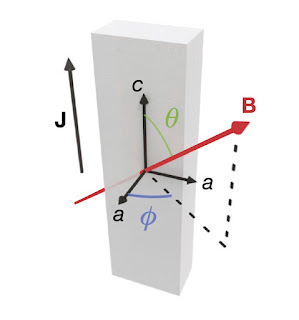
About twenty-five years ago I became interested in how the Fermi surface of the metallic state of organic charge-transfer salts could be mapped out by measuring the interlayer resistance as a function of the direction of a large applied magnetic field. [A nice review from 2004 is by Mark Kartsovnik]. Later this technique was used for a range of other metals including strontium ruthenate, iron pnictides, semiconductor heterostructures, and finally cuprates, mostly in the overdoped region.

For the cuprates, it was discovered that one could not only map out the shape of the intralayer Fermi surface, but also anisotropies in the scattering rate and the interlayer hopping integral. Of particular interest was the finding that the overdoped cuprates were not simple Fermi liquids, as usually claimed, but more like anisotropic marginal Fermi liquids.

It should be stressed that the Fermi surface information is extracted indirectly by comparing experimental curves of angle-dependence to calculations based on different models for the shape of the Fermi surface, anisotropies in the scattering rate, and interlayer hopping. Thus, there is a fair bit of curve fitting to determine the parameters of the model. However, when one has observations at several magnetic fields, temperatures, and curves for the angle dependence in all directions, there are a lot of constraints, and specific anisotropies tend to produce some specific qualitative features in the shapes of the curves. Examples are shown below, taken from the Nature paper referenced below.

Recently, measurements have been reported on samples of the cuprate Nd-LSCO 

[La1.6xNd0.4SrxCuO4] at dopings of p=0.21 and p=0.24, lying on both sides of the putative quantum critical point at p=0.23. 

The differences between the ADMR at these two dopings are analysed quantitatively in a preprint, which claims to show that at p=0.21 the Fermi surface is reconstructed due to (pi,pi) ordering. This is important as it relates to the fundamental question as to the origin of the pseudogap state.

Fermi surface transformation at the pseudogap critical point of a cuprate superconductor

Yawen Fang, Gael Grissonnanche, Anaelle Legros, Simon Verret, Francis Laliberte, Clement Collignon, Amirreza Ataei, Maxime Dion, Jianshi Zhou, David Graf, M. J. Lawler, Paul Goddard, Louis Taillefer, B. J. Ramshaw

Submitted on 3 Apr 2020 (v1), last revised 26 Nov 2020 (v2)

Aside: There is also a Nature paper, Linear-in temperature resistivity from an isotropic Planckian scattering rate, by the same group that compares the p=0.24 observations to those on the overdoped cuprate Tl2201 [p=0..29]. The arxiv notes "substantial text overlap" between the preprint above and the preprint for the Nature paper. [Figure 2 in v1 of the preprint above is in the Nature paper].

Here I focus on the first preprint as it stimulated a nice theory preprint

Interpreting Angle Dependent Magnetoresistance in Layered Materials: Application to Cuprates

Seth Musser, Debanjan Chowdhury, Patrick A. Lee, T. Senthil

They present a strong case against the main claim of Fang et al. that their ADMR data supports a reconstructed Fermi surface for the p=0.21 system.

There are several nice things about this preprint.

1. It shows how one should be careful about interpreting ADMR

2. It highlights the possible role of an anisotropic quasi-particle weight, Z(phi), where phi denotes the position on the intralayer Fermi surface, not the direction of the field. Anisotropy can arise from correlation effects and or "coherence factors" associated with Fermi surface reconstruction due to an ordered state. 

2. In their modeling, Fang et al. did not include the effects of Z(phi) and Musser et al. show that when it is included the qualitative differences in the ADMR that they claim arise due to the ordered state do not appear.

3. The authors consider a "toy" model for which some analytical results can be obtained. 

4. This provides some physical insight into the origins of the different features in the data, such as the peak around theta=40 degrees [It is just the magic angle associated with the average radius of the Fermi surface] and how the behaviour near theta=90 degrees depends on the relative size of different parameters [see especially equation (16)].

5. What is happening in this material may not be generic to the cuprates. "The van Hove filling in Nd-LSCO is located between the two dopings, p = 0.21 and p = 0.24, respectively. Thus what was a large Fermi surface centered at the Γ-point on the overdoped side will become a Fermi surface centered at (π, π) on the underdoped side, assuming no reconstruction occurs"

6. The most important insight is at the beginning of Section V. When the value of of the interlayer hopping integral t_perp(phi) averaged over the Fermi surface, changes from non-zero to zero an upturn in the ADMR at low angles (i.e. fields almost parallel to the layers) to a downturn. This suggests an alternative explanation for the transition seen in the preprint.

7. It highlights the often overlooked fact that observation of ADMR is not conclusive evidence of a three-dimensional Fermi surface. Using the parameters from the experimental preprint gives typical values of t_perp * tau ~ 0.1, and so the materials are far from the regime of a coherent three-dimensional Fermi surface.

I have a few minor comments

a. Like many others, the authors incorrectly credit with Yamaji explaining the magic angles associated with ADMR. However, Yamaji's explanation is not the correct one because it involves quantised orbits, whereas the effect is semi-classical, as explained by Kartsovnik, Laukhin, Pesotskii, Schegolev, and Yakovenko. 

b. Investigation of the role of small closed orbits when the magnetic field is almost parallel to the layers is credited to Schofield and Cooper. However, there was earlier and more detailed work by Hanasaki et al. Albeit, both of these papers consider the clean high field limit and so are of debatable relevance.

c. It would be nice to know the status of Fang et al., preprint on which this paper is based, particularly as the first authors of both are in the same department.

Tuesday, August 13, 2019

J.R. Schrieffer (1931-2019): quantum many-body theorist

Bob Schrieffer died last month, as reported in a New York Times obituary.

Obviously, Schrieffer's biggest scientific contribution was coming up with the variational wave-function for the BCS theory of superconductivity. BCS theory was an incredible intellectual achievement on many levels. Many great theoretical physicists had failed to crack the problem. The elegance of the theory was manifest in the fact that it was analytically tractable, yet could give a quantitative description of diverse physical properties in a wide range of materials. BCS also showed the power of using quantum-field-theory techniques in solid state theory. This was a very new thing in the late 50s. Then there was the following cross-fertilisation with nuclear physics and particle physics (e.g. Nambu).

Another significant contribution was the two-page paper from 1966 that used a unitary transformation to connect the Kondo model Hamiltonian to that of the Anderson single impurity model. In particular, it gave a physical foundation for the Kondo model, which at the time was considered somewhat ad hoc.
John Wilkins wrote a nice commentary on the background history and significance of the Schrieffer-Wolff transformation.

The SW transformation is an example of a general strategy of finding an effective Hamiltonian for a reduced Hilbert space. This can also be done via quasi-degenerate perturbation theory. In different words, when one ``integrates out'' the charge degrees of freedom in the Anderson model one ends up with the Kondo model.

There is also the Su-Schrieffer-Heeger model, that is related to Heeger's Nobel Prize in Chemistry. However, although this spawned a whole industry (that I worked in as a postdoc with Wilkins) its originality and significance is arguably not comparable to BCS and SW.

Because of when he was born, like many of the pioneers of quantum many-body theory, Schrieffer may have been born for success?

I am somewhat (scientifically) descended from Schrieffer because I did a postdoc with John Wilkins, who was one of Schrieffer's first PhD students. My main interaction with Schrieffer was during 1995-2000. Each year I would visit my collaborator, Jim Brooks, at the National High Magnetic Field Laboratory, and would have some helpful discussions with Schrieffer. During one of those visits, I stumbled across a compendium of reprints from a Japanese lab. [This was back in the days when some people snail-mailed out such things to colleagues]. It had been sent to Schrieffer and contained a copy of a paper by Kino and Fukuyama on a Hubbard model for organic charge transfer salts. That was the starting point for my work on that topic.

Thursday, March 7, 2019

Why is quantum matter so interesting?

Last year Ben Powell wrote a Perspective for Science, The Expanding Materials Multiverse. It begins with a nice statement about why quantum condensed matter is so interesting, exciting, and challenging.
High-energy physicists are limited to studying a single vacuum and its excitations, the particles of the standard model. For condensed-matter physicists, every new phase of matter brings a new “‘vacuum.” Remarkably, the low-energy excitations of these new vacua can be very different from the individual electrons, protons, and neutrons that constitute the material. The materials multiverse contains universes where the particle-like excitations carry only a fraction of the elementary electronic charge, are magnetic monopoles, or are their own antiparticles. None of these properties have ever been observed in the particles found in free space. Often, emergent gauge fields accompany these “fractionalized” particles, just as electromagnetic gauge fields accompany charged particles. On page 1101 of this issue, Hassan et al. provide a glimpse of the emergent behaviors of a putative new phase of matter, the dipole liquid. What particles live in this universe, and what new physics is found in this and neighboring parts of the multiverse?
There is also a nice figure which makes an everyday analogy to illustrate different states of matter.


Tuesday, February 19, 2019

Superconducting order in organic charge transfer salts

A long-standing question for superconductivity in organic charge transfer salts concerns the symmetry of the superconducting order parameter. Is it unconventional (i.e. not s-wave) and if so are there nodes in the energy gap? Over the years there have been a wide range of claims, both theoretical and experimental.

Most recently a combined theory-STM experiment claimed the symmetry was d + s and that there were 8 nodes on the Fermi surface.

Two of my UQ colleagues recently posted a nice preprint that comes to a different conclusion.
Microwave Conductivity Distinguishes Between Different d-wave States: Umklapp Scattering in Unconventional Superconductors 
D. C. Cavanagh, B. J. Powell

Microwave conductivity experiments can directly measure the quasiparticle scattering rate in the superconducting state. We show that this, combined with knowledge of the Fermi surface geometry, allows one to distinguish between closely related superconducting order parameters, e.g., dx2y2 and dxy superconductivity. We benchmark this method on YBa2Cu3O7δ and, unsurprisingly, confirm that this is a dx2y2 superconductor. We then apply our method to κ-(BEDT-TTF)2Cu[N(CN)2]Br, which we discover is a dxy superconductor.
In 2005 Ben Powell  (and others) showed that the simplest RVB theory gives such an order parameter with nodes required by symmetry.
[Aside: in our paper, this is denoted d_x2-y2, but that is because of how the x-y axes are defined].

Friday, June 15, 2018

Quantum spin liquid on the hyper-honeycomb lattice

Two of my UQ colleagues have a nice preprint that brings together many fascinating subjects including strong electron correlations and MOFs. Again it highlights an ongoing theme of this blog, how chemically complex materials can exhibit interesting physics. A great appeal of MOFs is the possibility of using chemical "tuneability" to design materials with specific physical properties.

A theory of the quantum spin liquid in the hyper-honeycomb metal-organic framework [(C2H5)3NH]2Cu2(C2O4)3 from first principles 
A. C. Jacko, B. J. Powell

What is a hyper-honeycomb lattice?
It is a three-dimensional version of the honeycomb lattice.
A simple tight-binding model on the lattice has Dirac cones, just like graphene.

The preprint is a nice example how one can start with a structure that is chemically and structurally complex and then use calculations based on Density Functional Theory (DFT) to derive a "simple" effective Hamiltonian (in this case an antiferrromagnetic Heisenberg model of coupled chains) to describe the low-energy physics of the material.
We construct a tight-binding model of [(C2H5)3NH]2Cu2(C2O4)3 from Wannier orbital overlaps. Including interactions within the Jahn-Teller distorted Cu-centered eg Wannier orbitals leads to an effective Heisenberg model. The hyper-honeycomb lattice contains two symmetry distinct sublattices of Cu atoms arranged in coupled chains. One sublattice is strongly dimerized, the other forms isotropic antiferromagnetic chains. Integrating out the strongest (intradimer) exchange interactions leaves extremely weakly coupled Heisenberg chains, consistent with the observed low temperature physics.
There is some rather subtle physics involved in the superexchange processes that determine the magnitude of the antiferromagnetic interactions J between neighbouring spins. In particular, there are destructive quantum interference effects that reduce one of the J's by an order of magnitude and increases another by an order of magnitude. To illustrate this effect, the authors also evaluate the J's when one flips the sign of some of the matrix elements in the tight-binding model. Similar subtle physics has also been observed in different families of organic charge transfer salts.

As an aside, there is some similarity (albeit many differences) with the basic chemistry of the insulating phase of cuprates: the parent compound involves a lattice of copper ions (d9) where there are three electrons in eg orbitals that are split by a Jahn-Teller distortion. The differences here are first, that the interactions between the frontier orbitals on the Cu sites is not via virtual processes involving oxygen p-orbitals but rather via pi-orbitals on the oxalate bridging orbitals. Second, the lattice of Cu orbitals is not a square but the hyper-honeycomb lattice.

The preprint is motivated by a recent experimental paper in JACS
Quantum Spin Liquid from a Three-Dimensional Copper-Oxalate Framework 
Bin Zhang, Peter J. Baker, Yan Zhang, Dongwei Wang, Zheming Wang, Shaokui Su, Daoben Zhu, and Francis L. Pratt

Friday, December 22, 2017

Postdoc available for strongly correlated electron systems

Ben Powell and I have just advertised for a new postdoc position to work with us at the University of Queensland on strongly correlated electron systems.

The full ad is here and people should apply before January 28 through that link.

Wednesday, August 9, 2017

Subtle paths to effective Hamiltonians in complex materials

Many of the most interesting materials involve significant chemical and structural complexity. Indeed, it is not unusual for a unit cell for a crystal to contain the order of one hundred atoms.
Yet, for a given class of materials, one would like to find an effective Hamiltonian involving as few degrees of freedom and parameters as possible.

Following Kino and Fukuyama, twenty years ago I argued that the simplest possible effective Hamiltonian for a large class of superconducting organic charge transfer salts was a one-band Hubbard model on an anisotropic triangular lattice at half filling.
It seemed natural to then argue that the relevant model for the spin degrees of freedom in the Mott insulating phase is the corresponding frustrated Heisenberg model with spatial anisotropy determined by the anisotropy in the tight-binding model.

However, it turns out this is not the case.
There are some subtle quantum interference effects that I overlooked in the "derivation"  of these effective models, leading to a different spatial anisotropy.
This is shown by some of my colleagues in a nice recent paper, accepted for PRL.

Dynamical reduction of the dimensionality of exchange interactions and the "spin-liquid" phase of κ-(BEDT-TTF)2X 
B. J. Powell, E. P. Kenny, J. Merino


This raises questions about what the relevant effective Hamiltonian is for the metallic, superconducting, and (possibly) ferroelectric phases.

The paper's significance goes beyond organic charge transfer salts to the general problem of finding effective Hamiltonians in complex materials.

Similar interference effects have been found to arise in quite a different class of materials.

Heisenberg and Dzyaloshinskii-Moriya interactions controlled by molecular packing in trinuclear organometallic clusters 
B. J. Powell, J. Merino, A. L. Khosla, and A. C. Jacko

This also reminds me of subtleties (and debates) that occur in the Zhang-Rice "derivation" of the t-J model from a three-band Hubbard model.

Monday, July 3, 2017

A molecular material and a model Hamiltonian with rich physics

Some of my UQ colleagues and Jaime Merino have written a series of nice papers inspired by an organometallic molecular material Mo3S7(dmit)3. They have considered possible model effective Hamiltonians to describe it and the different ground states that arise depending on the model parameters.
There is a rich interplay of strong correlations, Hund's rule coupling, spin frustration, spin-orbit coupling, flat bands, and Dirac cone physics.
Possible ground states include some sort of Mott insulator, a Haldane phase, semi-metal, ...

A good place to start is the following paper
Low-energy effective theories of the two-thirds filled Hubbard model on the triangular necklace lattice 
C. Janani, J. Merino, Ian P. McCulloch, and B. J. Powell

The figure below (taken from this paper) shows some of the molecular structure and some of the hopping integrals that are associated with an underlying decorated honeycomb lattice.


This model could be called kagomene, because it interpolates between the kagome lattice and the honeycomb lattice (graphene). The figure below is taken from this paper, which uses DFT and Wannier orbitals to estimate the tight-binding parameters and the spin-orbit coupling. Interaction driven topological insulator states are possible on this lattice.


There are a few things that are not "normal" about the physics, arising from the 4/3 band filling and the molecular orbitals that are delocalised over the triangles. Specifically, the orbital degeneracy does not arise from atomic orbital degeneracy (cf. d orbitals, or t2g and eg), but rather the E representation associated with C3 symmetry of the triangles.

Hund's rule coupling. 
This involves the E orbitals and arises purely from the Hubbard U on the non-degenerate orbital on a single lattice site.

Spin-orbital coupling.
This is Spin Molecular Orbital Coupling, where the electron spin couples to the angular momentum associated with motion around the triangle, not the angular momentum of degenerate atomic orbitals.

Haldane phase.
The associated spin-1's arise from the triplet ground state of four electrons on a triangle.
A DMRG study shows that this is the ground state of a three leg-ladder Hubbard model at 2/3 filling.

Many interesting and important open questions remain about the general phase diagram of the Hubbard model on the kagomene lattice. For example, the nature of the Mott insulator, different types of topological order, the possibility of superconductivity.....

Hopefully, these studies will stimulate new experimental studies and synthesis of new chemical compounds in this fascinating class of materials.

Thursday, June 8, 2017

A lucid lecture on the last 50 years of superconductivity

At the weekly condensed matter theory cake meeting today we watched a video of a KITP blackboard talk given by Piers Coleman in 2015.
Superconducting Surprises: five decades of discovery, in both temperature and time!

It is a very nice exposition of the history and some of the key physics.

A couple of minor comments.

Organic superconductors were discovered in 1980 not 1973.

Piers claims that the difference between the thermodynamic entropy of the superconducting and metallic states (determined from integrating the temperature dependent specific heat) is related to the quantum entanglement entropy of the superconducting ground state.
The relationship between entanglement entropy (defined on a pure quantum state (at zero temperature) which is divided in two) and thermal entropies (defined for a bulk system in a mixed state at finite temperature) is an incredibly subtle and complex issue that I don't think is resolved. See for example the discussion in this paper.

What is your experience of using AI for research in condensed matter theory?

 I have been dabbling a little with using AI (at a very basic level) to help me with some research problems. For example, in a recent prepr...