Showing posts with label Fermi liquids. Show all posts

Wednesday, April 15, 2026

The disappointing story of superconductivity in Strontium Ruthenate

In 1994 superconductivity was discovered in strontium ruthenate (Sr2RuO4). This attracted considerable interest because it had a perovskite crystal structure, just like the cuprates. Furthermore, it was a stoichiometric compound and so not plagued by impurities like the cuprates.

In 1998, things got more interesting when NMR Knight shift measurements were interpreted as evidence for triplet superconductivity.

Analogues were made with triplet Cooper pairing in superfluid 3He mediated by ferromagnetic spin fluctuations.

Triplet pairing is associated with odd-parity (spatial) and time-reversal symmetry breaking. Evidence for the latter was claimed from muon spin relaxation (muSR) and the polar Kerr effect.

There are subtle questions about whether a bulk sample of a triplet superconductor exhibits spontaneous magnetisation. Leggett discussed this in an Appendix of his textbook. It turns out the magnetisation probably only exists on the edges.

Aside. The metallic phase is of interest because (unlike the cuprates) it is a Fermi liquid. More recently, it has been argued to be a Hund's metal.

Fueled by hype about topological quantum computing, the past two decades have seen even greater interest in the material due to proposals that it may be a topological superconductor. See for example, this paper.

Now we come to the disappointment. It turns out that the original Knight shift measurements were flawed, probably due to a problem with thermometry.

Recent, careful Knight shift measurements suggest spin-singlet pairing. They were described in a Physics Today article by Alex Lopatka in 2021, An unconventional superconductor isn’t so odd after all. The article describes all the intricacies and challenges of these measurements. Stuart Brown is to be commended for persisting with this problem.

What about the Kerr effect and muSR measurements suggesting time-reversal symmetry breaking?

The polar Kerr effect involves rotation of the plane of polarisation of the electromagnetic radiation by an angle of 65 nanoradians! There is only one group in the world (at Stanford) that can detect these ultra-minute rotations.

muSR may also be problematic. It is not really known where the implanted muon sits in the crystal or what effect it has on the surrounding crystal structure. In particular, these perturbations may produce a small local magnetic field which is nothing to do with the claimed global field due to the magnetism associated with the triplet superconductivity. A recent preprint by Warren Pickett considers some of the challenges associated with interpreting these experiments as evidence for time-reversal symmetry breaking.

What is disappointing about this?
Obviously, it would be nice to have a triplet superconductor and even more a topological one.
However, for me, the big disappointment is that it took almost thirty years for the original NMR measurements to be checked and shown to be wrong. This may reflect several sociological problems.

Kauzmann's maxim: people will tend to believe what they want to believe rather than what the evidence before them might suggest.

The condensed matter community tends to be infatuated with exotica.

There is not enough application of Occam's razor. Luxury journals don't want simple explanations or authors to raise doubts or ambiguities.

As far as I am aware, the 1998 Nature paper on the NMR Knight shift has still not been retracted.

This post was stimulated by a helpful colloquium at UQ given recently by James Annett. He has worked on strontium ruthenate for many years and is a co-author of a relevant review article.

Update. 23 April. James Annett pointed out to me that the authors for the 1998 NMR published a paper in 2020 which acknowledges that their original paper was incorrect.

Reduction of the 17O Knight Shift in the Superconducting State and the Heat-up Effect by NMR Pulses on Sr2RuO4

Sunday, March 15, 2026

Tony Leggett (1938-2026): condensed matter theorist

Tony Leggett died last week. The New York Times has a nice obituary. One measure of his influence on me is that more than 20 posts on this blog feature his work. He received the Nobel Prize in 2003 for developing the theory of superfluid 3He.

In 1972, a graduate student at Cornell, Doug Osheroff, discovered a phase transition around a temperature of 2 mK in liquid 3He. In the 1960s liquid 3He was established to be a Fermi liquid that was beautifully described by Landau's theory. Osheroff and his advisors, David Lee and Robert Richardson, incorrectly identified the phase transition as arising from antiferromagnetic order in the solid phase of 3He.

However, Leggett argued that it was actually due to superfluidity that there were two distinct superfluid phases, A and B, with different order parameters. 

Lee, Osheroff, and Richardson shared the Nobel Prize in 1996 for their discovery.

Leggett was primed to make rapid progress, as in 1965 and 1966 he had written three papers about superfluidity in liquid 3He, albeit assuming s-wave pairing. Indeed, by 1975 he wrote a comprehensive review article on the two superfluid phases.

For many reasons superfluid 3He was significant for the broader field of condensed matter. BCS showed that in elemental metals, superconductivity resulted from Cooper pairing of electrons due to an attractive electron-phonon interaction.  The order parameter (Cooper pair wave function) had s-wave spin singlet symmetry.

In contrast, superfluid 3He showed that Cooper pairing could also occur in a neutral Fermi liquid, and have non-trivial symmetry, i.e., p-wave symmetry and spin triplet. The order parameter has 18 components, compared to only 2 for elemental superconductors. There is spontaneous symmetry breaking of the local gauge symmetry, and spin or orbital rotational symmetries. 

The Cooper pairing in superfluid 3He is not due to a fermion-phonon interaction but due to spin fluctuations.

The fact that Cooper pairing was possible for different symmetries and mechanisms than for elemental superconductors was significant in that it meant it was reasonable to consider this possibility for superfluidity in neutron stars, and superconductivity in cuprates, strontium ruthenate, heavy fermions, and organic charge transfer salts.

There is rich physics associated with the symmetry breaking: 18 collective modes of the order parameter, textures such as boojums, and exotic vortex cores. For vortices, there is also some (controversial) connection to cosmic strings, including experiments that test the Kibble-Zurek mechanism and the electro-weak phase transition in the early universe.

Aside: My Ph.D. thesis was on the theory of the non-linear interaction of zero sound with the order parameter collective modes in the B-phase.

Leggett's development of the theory of superfluid 3He was amazing and certainly worthy of a Nobel. However, I think he made an even greater contribution to physics through his work on the theory of macroscopic quantum effects in Josephson junctions. This work was the basis for the experimental work that was honoured with the Nobel Prize last year.

With his student Amir Caldeira, Leggett performed concrete calculations of the effects of decoherence on quantum tunnelling in Josephson junctions.

[The NY Times obituary mistakenly says this work began after Leggett moved to Urbana. It was done while he was still at Sussex].

The formalism they developed involving the spectral density is the basis for most theoretical treatments of decoherence in superconducting qubits. A relevant toy model is the spin-boson model, and in 1987 Leggett published a seminal (but rather dense) review on the subject.

Leggett aided our understanding of cuprate superconductors. He contributed to the theoretical ideas that were the basis of the phase-sensitive measurements that established the d-wave nature of the order parameter. He also showed that experiments with inconsistent with  Anderson's interlayer tunneling theory.

I recommend reading Leggett's own scientific autobiography, Matchmaking Between Condensed Matter and Quantum Foundations, and Other Stories: My Six Decades in Physics and his book, The Problems of Physics

Monday, November 3, 2025

Overdoped cuprates are not Fermi liquids

They are anisotropic marginal Fermi liquids.

A commenter on my recent AI blog post mentioned the following preprint, with a very different point of view.

Superconductivity in overdoped cuprates can be understood from a BCS perspective!

B.J. Ramshaw, Steven A. Kivelson

The authors claim:

" a theoretical understanding of the "essential physics" is achievable in terms of a conventional Fermi-liquid treatment of the normal state...

...observed features of the overdoped materials that are inconsistent with this perspective can be attributed to the expected effects of the intrinsic disorder associated with most of the materials being solid state solutions"

On the latter point, they mention two papers that found the resistivity versus temperature can have a linear component. But there is much more.

The authors appear unaware of the experimental data and detailed theoretical analysis showing that the overdoped cuprates are anisotropic marginal Fermi liquids. 

Angle-dependent magnetoresistance measurements by Nigel Hussey's group, reported in 2006, were consistent with a Fermi surface anisotropy in the scattering rate.

Papers in 2011 and 2012 pushed the analysis further.

Consistent Description of the Metallic Phase of Overdoped Cuprate Superconductors as an Anisotropic Marginal Fermi Liquid, J. Kokalj and Ross H. McKenzie

Transport properties of the metallic state of overdoped cuprate superconductors from an anisotropic marginal Fermi liquid model, J. Kokalj, N. E. Hussey, and Ross H. McKenzie 

The self-energy is the sum of two terms with characteristic dependencies on temperature, frequency, location on the Fermi surface, and doping. The first term is isotropic over the Fermi surface, independent of doping, and has the frequency and temperature dependence characteristic of a Fermi liquid. 

The second term is anisotropic over the Fermi surface (vanishing at the same points as the superconducting energy gap), strongly varies with doping (scaling roughly with 𝑇𝑐, the superconducting transition temperature), and has the frequency and temperature dependence characteristic of a marginal Fermi liquid. 

The first paper showed that this self-energy can describe a range of experimental data including angle-dependent magnetoresistance and quasiparticle renormalizations determined from specific heat, quantum oscillations, and angle-resolved photoemission spectroscopy. 

The second paper, showed, without introducing new parameters and neglecting vertex corrections, that this model self-energy can give a quantitative description of the temperature and doping dependence of a range of reported transport properties of Tl2Ba2CuO6+𝛿 samples. These include the intralayer resistivity, the frequency-dependent optical conductivity, the intralayer magnetoresistance, and the Hall coefficient. The temperature dependence of the latter two are particularly sensitive to the anisotropy of the scattering rate and to the shape of the Fermi surface.

For a summary of all of this, see slides from a talk I gave at Stanford back in 2013.

I am curious whether the authors can explain the anisotropic part of the self-energy in terms of disorder in samples.

Wednesday, January 22, 2025

Quantum states of matter and metrology

Two characteristics of states of matter are associated with them being referred to as quantum. One characteristic is the importance of quantum statistics of particles, i.e., that the system is composed of particles that obey Fermi-Dirac or Bose-Einstein statistics. The second characteristic is that a macroscopic property is quantized with values determined by Planck’s constant. I now discuss each of these with respect to emergence.

Quantum statistics. 

For a system of non-interacting  fermions and bosons at high temperatures the properties of the system are those of a classical ideal gas. As the temperature decreases there is a smooth crossover to low-temperature properties that are qualitatively different for fermions, bosons, and classical particles. This crossover occurs around a temperature, known as the degeneracy temperature, that is dependent on the particle density and Planck’s constant. 

Many of the properties resulting from quantum statistics also occur in systems of strongly interacting particles and this is central to the concept of Landau’s Fermi liquid and viewing liquid 4He as a boson liquid. If liquid 3He and the electron liquid in elemental metals are viewed as a gas of non-interacting fermions, the degeneracy temperature is about 1 K and 1000 K, respectively. Thermodynamic properties are qualitatively different above and below the degeneracy temperature. Low-temperature properties can have values that differ by orders of magnitude from classical values and have a different temperature dependence. In contrast to a classical ideal gas, a fermion gas has a non-zero pressure at zero temperature and its magnitude is determined by Planck’s constant. This degeneracy pressure is responsible for the gravitational stability of white dwarf and neutron stars.  

These properties of systems of particles can be viewed as emergent properties, in the sense of novelty, as they are qualitatively different from high-temperature properties. However, they involve a crossover as a function of temperature and so are not associated with discontinuity. They also are not associated with unpredictability as they are straightforward to calculate from a knowledge of microscopic properties.

Quantised macroscopic properties.

These provide a more dramatic illustration of emergence. Here I consider four specific systems: superconducting cylinders, rotating superfluids, Josephson junctions, and the integer Quantum Hall effect. All of these systems have a macroscopic property that is observed to have the following features.

i. As an external parameter is varied the quantity varies in a step-like manner with discrete values on the steps. This is contrast to the smooth linear variation seen when the material is not condensed into the quantum state of matter.

ii. The value on the steps is an integer multiple of some specific parameter.

iii. This parameter (unit of quantisation) only depends on Planck’s constant h and other fundamental constants. 

iv. The unit of quantisation does not depend on details of the material, such as chemical composition, or details of the device, such as its geometrical dimensions.

v. The quantisation has been observed in diverse materials and devices.

vi. Explanation of the quantisation involves topology.

Superconducting cylinders. A hollow cylinder of a metal is placed in a magnetic field parallel to the axis of the cylinder. In the metallic state the magnetic flux enclosed by the cylinder increases linearly with the magnitude of the external magnetic field. In the superconducting state, the flux is quantized in units of the magnetic flux quantum, Φ0 = h/2e where e is the charge on an electron. It is also found that in a type II superconductor the vortices that occur in the presence of an external magnetic field enclose a magnetic flux equal to Φ0.  

Rotating superfluids. When a cylinder containing a normal fluid is rotated about an axis passing down the centre of the cylinder the fluid rotates with a circulation proportional to the speed of rotation and the diameter of the cylinder. In contrast, in a superfluid, as the speed of rotation is varied the circulation is quantised in units of h/M where M is the mass of one atom in the fluid. This quantity is also the circulation around a single vortex in the superfluid. 

Josephson junctions. In the metallic state the current passing through a junction increases linearly with the voltage applied across the junction. In the superconducting state the AC Josephson effect occurs. If a beam of microwaves of constant frequency is incident on the junction, jumps occur in the current when the voltage is an integer multiple of h/2e. The quantisation is observed to better than one part in a million (ppm).

Integer Quantum Hall effect. In a normal conductor the Hall resistance increases linearly with the external magnetic field for small magnetic fields. In contrast, in a two-dimensional conductor at high magnetic fields the Hall resistance is quantized in units of h/2e^2. The quantisation is observed to better than one part in ten million. Reflecting universality, the observed value of the Hall resistance for each of the plateaus is independent of many details, including the temperature, the amount of disorder in the material, the chemical composition of system (silicon versus gallium arsenide), or whether the charge carriers are electrons or holes.

Other examples of macroscopic quantum effects are seen in SQUIDs (Superconducting Quantum Interference Devices). They exhibit quantum interference phenomena analogous to the double-slit experiment. The electrical current passing through the SQUID has a periodicity defined by the ratio of the magnetic flux inside the current loop of the SQUID and the quantum of magnetic flux.

The precision of the quantisation provides a means to accurately determine fundamental constants. Indeed, the title of the paper announcing the discovery of the integer quantum Hall effect was, “New Method for High-Accuracy Determination of the Fine-Structure Constant Based on Quantized Hall Resistance.” It is astonishing that a macroscopic measurement of a property of a macroscopic system, such as the electrical resistance, can determine fundamental constants that are normally associated with the microscale and properties of atomic systems. 

Laughlin and Pines claimed that the quantisation phenomena described above reflect organizing principles associated with emergent phenomena, and their universality supports their claim of the unpredictability of emergent properties. 

Quantum states of matter and metrology

The universality of these macroscopic quantum effects has practical applications in metrology, the study of measurement and the associated units and standards. In 1990 new international standards were defined for the units of voltage and electrical resistance, based on the quantum Hall effect and the AC Josephson effect, respectively.

Prior to 1990 the standard used to define one volt was based on a particular type of electrical battery, known as a Weston cell. The new standard using the AC Josephson effect allowed voltages to be defined with a precision of better than one part per billion. This change was motivated not only by improved precision, but also improved portability, reproducibility, and flexibility. The old voltage standard involved a specific material and device and required making duplicate copies of the standard Weston cell. In contrast, the Josephson voltage standard is independent of the specific materials used and the details of the device. 

Prior to 1990 the international standard for the ohm was defined by the electrical resistance of a column of liquid mercury with constant cross-sectional area, 106.3 cm long, a mass of 14.4521 grams and a temperature 0 °C. Like the Josephson voltage standard, the quantum Hall resistance standard has the advantage of precision, portability, reliability, reproducibility, and independence of platform. The independence of the new voltage and resistance standards from the platform used reflects the fact that the Josephson and quantum Hall effects have the universality characteristic of emergent phenomena.

This post is an adaptation of material in Condensed Matter Physics: A Very Short Introduction

Monday, January 24, 2022

Angle-Dependent Magnetoresistance as a probe of Fermi surface properties in cuprates

About twenty-five years ago I became interested in how the Fermi surface of the metallic state of organic charge-transfer salts could be mapped out by measuring the interlayer resistance as a function of the direction of a large applied magnetic field. [A nice review from 2004 is by Mark Kartsovnik]. Later this technique was used for a range of other metals including strontium ruthenate, iron pnictides, semiconductor heterostructures, and finally cuprates, mostly in the overdoped region.

For the cuprates, it was discovered that one could not only map out the shape of the intralayer Fermi surface, but also anisotropies in the scattering rate and the interlayer hopping integral. Of particular interest was the finding that the overdoped cuprates were not simple Fermi liquids, as usually claimed, but more like anisotropic marginal Fermi liquids.

It should be stressed that the Fermi surface information is extracted indirectly by comparing experimental curves of angle-dependence to calculations based on different models for the shape of the Fermi surface, anisotropies in the scattering rate, and interlayer hopping. Thus, there is a fair bit of curve fitting to determine the parameters of the model. However, when one has observations at several magnetic fields, temperatures, and curves for the angle dependence in all directions, there are a lot of constraints, and specific anisotropies tend to produce some specific qualitative features in the shapes of the curves. Examples are shown below, taken from the Nature paper referenced below.

Recently, measurements have been reported on samples of the cuprate Nd-LSCO 

[La1.6xNd0.4SrxCuO4] at dopings of p=0.21 and p=0.24, lying on both sides of the putative quantum critical point at p=0.23. 

The differences between the ADMR at these two dopings are analysed quantitatively in a preprint, which claims to show that at p=0.21 the Fermi surface is reconstructed due to (pi,pi) ordering. This is important as it relates to the fundamental question as to the origin of the pseudogap state.

Fermi surface transformation at the pseudogap critical point of a cuprate superconductor

Yawen Fang, Gael Grissonnanche, Anaelle Legros, Simon Verret, Francis Laliberte, Clement Collignon, Amirreza Ataei, Maxime Dion, Jianshi Zhou, David Graf, M. J. Lawler, Paul Goddard, Louis Taillefer, B. J. Ramshaw

Submitted on 3 Apr 2020 (v1), last revised 26 Nov 2020 (v2)

Aside: There is also a Nature paper, Linear-in temperature resistivity from an isotropic Planckian scattering rate, by the same group that compares the p=0.24 observations to those on the overdoped cuprate Tl2201 [p=0..29]. The arxiv notes "substantial text overlap" between the preprint above and the preprint for the Nature paper. [Figure 2 in v1 of the preprint above is in the Nature paper].

Here I focus on the first preprint as it stimulated a nice theory preprint

Interpreting Angle Dependent Magnetoresistance in Layered Materials: Application to Cuprates

Seth Musser, Debanjan Chowdhury, Patrick A. Lee, T. Senthil

They present a strong case against the main claim of Fang et al. that their ADMR data supports a reconstructed Fermi surface for the p=0.21 system.

There are several nice things about this preprint.

1. It shows how one should be careful about interpreting ADMR

2. It highlights the possible role of an anisotropic quasi-particle weight, Z(phi), where phi denotes the position on the intralayer Fermi surface, not the direction of the field. Anisotropy can arise from correlation effects and or "coherence factors" associated with Fermi surface reconstruction due to an ordered state. 

2. In their modeling, Fang et al. did not include the effects of Z(phi) and Musser et al. show that when it is included the qualitative differences in the ADMR that they claim arise due to the ordered state do not appear.

3. The authors consider a "toy" model for which some analytical results can be obtained. 

4. This provides some physical insight into the origins of the different features in the data, such as the peak around theta=40 degrees [It is just the magic angle associated with the average radius of the Fermi surface] and how the behaviour near theta=90 degrees depends on the relative size of different parameters [see especially equation (16)].

5. What is happening in this material may not be generic to the cuprates. "The van Hove filling in Nd-LSCO is located between the two dopings, p = 0.21 and p = 0.24, respectively. Thus what was a large Fermi surface centered at the Γ-point on the overdoped side will become a Fermi surface centered at (π, π) on the underdoped side, assuming no reconstruction occurs"

6. The most important insight is at the beginning of Section V. When the value of of the interlayer hopping integral t_perp(phi) averaged over the Fermi surface, changes from non-zero to zero an upturn in the ADMR at low angles (i.e. fields almost parallel to the layers) to a downturn. This suggests an alternative explanation for the transition seen in the preprint.

7. It highlights the often overlooked fact that observation of ADMR is not conclusive evidence of a three-dimensional Fermi surface. Using the parameters from the experimental preprint gives typical values of t_perp * tau ~ 0.1, and so the materials are far from the regime of a coherent three-dimensional Fermi surface.

I have a few minor comments

a. Like many others, the authors incorrectly credit with Yamaji explaining the magic angles associated with ADMR. However, Yamaji's explanation is not the correct one because it involves quantised orbits, whereas the effect is semi-classical, as explained by Kartsovnik, Laukhin, Pesotskii, Schegolev, and Yakovenko. 

b. Investigation of the role of small closed orbits when the magnetic field is almost parallel to the layers is credited to Schofield and Cooper. However, there was earlier and more detailed work by Hanasaki et al. Albeit, both of these papers consider the clean high field limit and so are of debatable relevance.

c. It would be nice to know the status of Fang et al., preprint on which this paper is based, particularly as the first authors of both are in the same department.

Thursday, December 12, 2019

John Wilkins (1936-2019): condensed matter leader

I was sad to hear last week of the death of John Wilkins. He was a mentor to a whole generation of condensed matter physicists and a generous servant, both individuals and institutions. This obituary and memories from some colleagues gives a nice description of his many contributions.

I was privileged to do a postdoc with Wilkins at Ohio State University in the early 1990s. He had a significant influence on me, both scientifically and professionally. Much of the practical advice I write on this blog relating to jobs, writing, and giving talks, I learned from Wilkins. Even ten years after I worked with him I would still occasionally phone him for advice, particularly with negotiating and deciding on job offers.

Real leadership does not involve having a position, but rather having influence. Servant leaders are not concerned with advancing their own interests, but rather those of others in their community. They do this by investing in people and institutions. Wilkins did this in many ways. He invested heavily in his own graduate students and postdocs. He advised and mentored countless other students, postdocs, and young faculty, for whom he had no formal responsibility or anything to gain from their success. He was proud of the fact that he never held an administrative position in a university. Nevertheless, his influence was far greater than most department chairs and deans. He served the American Physical Society in countless ways, particularly their publishing activities and the Division of Condensed Matter Physics. He wrote innumerable reference letters, referee reports, and grant reviews.

Reflecting on Wilkins, I was reminded of these recent words of David Brooks, written in a different context.
I had a feeling of going back in time. Why did it feel so strange? It was because I was looking at people who are not self-centered. They’ve dedicated themselves to the organization that formed them, and which they serve.
A few other basic but important things I learned from Wilkins:
Write clearly. Rewrite. Talk to people. Theory should relate to real materials and real experiments. Defining the problem clearly can be an important contribution. A concrete calculation on a concrete model is valuable.

Wilkins did have significant scientific achievements, but they tend to get dwarfed in comparison to his influence over people. Perhaps, the most significant relate to the Kondo problem. This began with his student Krishnamurthy, who used Wilson's numerical renormalisation group to understand all the different regimes of the Anderson single impurity model. Later with his students Dan Cox and Gene Bickers, Wilkins applied slave boson techniques to describe a wide range of experimental properties of valence fluctuation associated with magnetic impurities in metals.

In classic Wilkins style, he convened a group of distinguished theorists to meet in Los Alamos one summer to write a definitive early review article on heavy fermions.

Wilkins was larger than life. He laughed a lot and was a tease. He could also be intimidating. Before his groups' annual pilgrimage to the APS March meeting, everyone had to give a practice talk to the group and Wilkins. A fellow postdoc confided to me that each year he was more nervous about giving the practice talk than the real talk! One time, Wilkins got frustrated that too many of us had small fonts on our overhead transparencies. He made us all chant together: ``22 point type is the smallest! 22 point type is the smallest! ...."  again and again until we got the point.

It was well known that Wilkins did not like his picture taken. On his department web page he put a picture of another John Wilkins, one of the founders of the Royal Society. However, my wife did not know his aversion. In 1992? Kevin Ingersent hosted a group Thanksgiving dinner at his house. Later to my shock, I discovered my wife took the photo below. ``What?! You took a photo of Wilkins?!"


Wilkins was a great role model as a scientist, a faculty member, and a servant of a professional community.

Tuesday, October 8, 2019

2019 Nobel Predictions

It is that time of year again. I have not made predictions for a few years.

For physics this year I predict
Experiments for testing Bell inequalities and elucidating the role of entanglement in quantum physics
Alan Aspect, John Clauser, and Anton Zeilinger
They received the Wolf Prize in 2010, a common precursor to the Nobel.

My personal preference for the next Nobel for CMP would be centred around Kondo physics, since that is such a paradigm for many-body physics, maybe even comparable to BCS.

Kondo effect and heavy fermions
Jun Kondo, Frank Steglich, David Goldhaber-Gordon

Arguably the latter two might be replaced with others who worked on heavy fermions and/or Kondo in quantum dots.
Steglich discovered heavy fermion superconductivity.
Goldhaber-Gordon realised tuneable Kondo and Anderson models in quantum dots (single-electron transistors).

Unlike many, I still remain to be convinced that topological insulators is worthy of a Nobel.

For chemistry, my knowledge is more limited. However, I would go for yet another condensed matter physicist to win the chemistry prize: John Goodenough, inventor of the lithium battery.
He also made seminal contributions to magnetism, random access memories, and strongly correlated electron materials.

What do you think?

Postscripts (October 10).

I got confused about the day of the physics prize and I think when I posted my ``prediction'' the prize may have already been announced.

A few years ago I read Goodenough's fascinating autobiography. It was actually in that book that I learned about U. Chicago requiring PhD students to publish a single author paper. This observation featured in my much commented on recent post about PhD theses.

I also have a prediction for the Peace Prize. First, I hope it is not Greta Thunberg, as much as I admire her and agree with the importance of her cause. I worry whether it may ruin her life.
My wife suggested the Prime Minister of Ethiopia, Abiy Ahmed and the President of Eritrea, Isaias Afwerki. I find it truly amazing what Ahmed has achieved.
Another great choice would be some of the leaders of Armenia, which has seen significant increases in human rights, political freedoms, and freedom the press. It was selected as The Economist's country of the year in 2018.

Postscript (October 30).
I was really happy about the economics prize. Six years ago, I read Poor Economics, by Banerjee and Duflo, with my son (an economics student), and blogged about it. Below a respond to a commenter who was critical of this prize.

Thursday, August 9, 2018

Emergent temperature scales and spin-orbital separation in the Hund's metal

An important and fascinating issue in many-body physics is the emergence of new energy scales, particularly scales that are orders of magnitude smaller than the energy scales in the underlying Hamiltonian. One example is the coherence temperature associated with the crossover from a Fermi liquid (with coherent quasi-particles) to a bad metal.

Recently, I posted about the crossover from a Hund's metal to a bad metal, seen in the collapse of the Drude peak in the optical conductivity, and the issue of capturing this slave-particle theories. One commenter mentioned the relevance of the paper below and another asked about the claim that the Kondo effect is associated with the collapse.

I agree that Kondo physics is associated with the crossover. Although, far from obvious this is also the case in the single-band Hubbard model. The Kondo effect was first studied with isolated magnetic impurities in metals and can be described by a single-impurity Anderson model (SIAM). Although there are no magnetic impurities in the Hubbard model, it turns out that when studied at the level of Dynamical-Mean-Field Theory (DMFT), the model is described by a self-consistent SIAM and close to the Mott metal-insulator transition Kondo physics does emerge. Specifically, the Kondo temperature for the self-consistent SIAM corresponds to the temperature at which there is a crossover from local unscreened local magnetic moments (associated with the almost-localised electrons near the Mott phase; the bad metal) to a Fermi liquid where the "magnetic moments" are screened.

What happens in a two-band Hubbard-Kanamori model with Hund's rule coupling?
The physics is richer because there is now the possibility screening of spin and/or orbital degrees of freedom, and of a orbital-selective Mott phase (or bad metal). 
This is nicely investigated in the following paper.

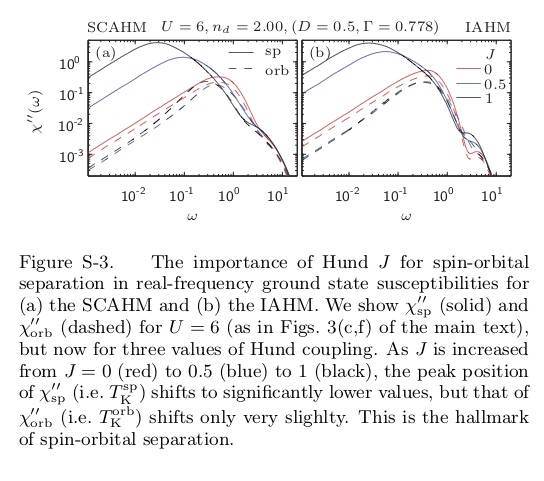
Dynamical Mean-Field Theory Plus Numerical Renormalization-Group Study of Spin-Orbital Separation in a Three-Band Hund Metal
K. M. Stadler, Z. P. Yin, J. von Delft, G. Kotliar, and A. Weichselbaum

For me, the figure below is the most interesting and illuminating. It shows how due to the Hund's rule coupling, two distinct energy scales (differing by about two orders of magnitude) emerge and associated with screening the spin and orbital degrees of freedom, respectively.

This is Kondo physics, but there are no magnetic impurties.

Monday, July 30, 2018

Experimental observation of the Hund's metal to bad metal crossover

A definitive experimental signature of the crossover from a Fermi liquid metal to a bad metal is the disappearance of a Drude peak in the optical conductivity. In single band systems this occurs in proximity to a Mott insulator and is particularly clearly seen in organic charge transfer salts and is nicely captured by Dynamical Mean-Field Theory (DMFT).

An important question concerning multi-band systems with Hund's rule coupling, such as iron-based superconductors, is whether there is a similar collapse of the Drude peak. This is clearly seen in one material in a recent paper

Observation of an emergent coherent state in the iron-based superconductor KFe2As2 
Run Yang, Zhiping Yin, Yilin Wang, Yaomin Dai, Hu Miao, Bing Xu, Xianggang Qiu, and Christopher C. Homes


Note how as the temperature increases from 15 K to 200 K that the Drude peak collapses. 
The authors give a detailed analysis of the shifts in spectral weight with varying temperature by fitting the optical conductivity (and reflectivity from which it is derived) at each temperature to a model consisting of three Drude peaks and two Lorentzian peaks. Note this involves twelve parameters and so one should always worry about the elephants trunk wiggling.
On the other hand, they do the fit without the third peak, which is of the greatest interest as it is the sharpest and most temperature dependent, and claim it cannot describe the data.

The authors also perform DFT+DMFT calculations of the one-electron spectral function (but not the optical conductivity) and find it does give a coherent-incoherent crossover consistent with the experiment. However, the variation in quasi-particle weight with temperature is relatively small.

Saturday, July 21, 2018

Questions about slave-particle mean-field theories of Hund's metals

One of most interesting new ideas about quantum matter from the last decade is that of a Hund's metal. This is a strongly correlated metal that can occurs in a multi-orbital material (model) as a result of the Hund's rule (exchange interaction) J that favours parallel spins in different orbitals.
Above some relatively low temperature (i.e. compared to the bare energy scales such as non-interacting band-widths, J, and Hubbard U) the metal becomes a bad metal, associated with incoherent excitations.
An important question concerns the extent to which slave mean-field theories can capture the stability of the Hund's metal, and its properties including the emergence of a bad metal above some coherence temperature, T*.

In a single-band Hubbard model, the strongly correlated metallic phase that occurs in proximity to a Mott insulator is associated with a small quasi-particle weight and suppression of double occupancy, reflecting suppressed charge fluctuations. This is captured by slave-boson mean-field theory, including the small coherence temperature.

In contrast, to a "Mott metal", a Hund's metal is associated with suppression of singlet spin fluctuations on different orbitals, without suppression of charge fluctuations and is seen in a Z_2 slave-spin mean-field theory at zero temperature.

Specific questions are whether slave mean-field theories at finite temperature can capture the following?
  • The coherence temperature, T*.
  • A suppression of spin singlet fluctuations at T increases towards T*.
  • An orbital-selective bad metal may occur in proximity to an orbital selective Mott transition. This is where at least one band (orbital) is a Fermi liquid and another is a bad metal. This would mean that there are two different coherence temperatures. 
  • The emergence of a single low-energy scale, common in both bands, as is seen in DMFT.
  • The spin-freezing temperature.
Finally, how does the stability of the Hund's metal change with the number of orbitals?
Figures in this post suggest that the Hund's physics is more pronounced with increasing the number of orbitals. However, that may be because the critical U (and thus proximity to the Mott insulator) changes with the number of orbitals and all the curves are for the same U.

Thursday, July 19, 2018

It's not complicated. It's Complex!

When is a system "complex"?
Even though we have intuition (e.g. complexity is associated with many interacting degrees of freedom) coming up with definitive criteria for complexity is not easy.

I just finished reading, Complexity: A Very Short Introduction, by John Holland.
His perspective is that a system is "complicated" if it has many interacting degrees of freedom, but is "complex" if in addition it exhibits emergent properties.
The criteria for emergence is the existence of new hierarchies, containing new entities or agents (defined by the formation of boundaries) that are coupled by new interactions, and described by new "laws".

Holland distinguishes complex physical systems (CPS) from complex adaptive systems (CAS).
The latter involve elements (agents) that can change (learn or adapt) in response to interactions with other agents.
Cellular automata and pattern formation in biology are CPS, whereas genetic algorithms, economics, and sociology are examples of CAS.

The book gives a rather dense (but worthwhile) introduction to key concepts in complexity theory including the emergence of specialists (e.g., division of labor, according to Adam Smith in economics), the role of diversity, co-evolution (e.g. Darwin's orchid and moth), and evolutionary niches (fixed points of Markov matrices!).

Holland smoothly flits backwards and forwards between examples in biology, economics, linguistics, and computer science.

Holland's definition of emergence is consistent with how I think in condensed matter. For example, the formation of weakly interacting quasi-particles in a Fermi liquid. The emergent "boundaries" define the spatial size of the quasi-particle.
What struck me is that the interactions should be viewed as emergent, just as much as the quasi-particles.
For example, if we start with quarks and QCD (quantum chromodynamics), then at "low" temperatures and densities, nucleons form and the nuclear force emerges.

Thursday, May 10, 2018

David Pines (1924-2018): quantum-many body theorist

I learnt today that David Pines died last week. He was a pioneer in quantum many-body theory, applying it not just to solid state physics but also to nuclear physics and astrophysics (neutron stars).  Furthermore, he was a great advocate of the importance of emergence in science, writing a classic paper, "The Theory of Everything," together with Bob Laughlin.

David also left a legacy of creative new institutions, being a co-founder of the Sante Fe Institute and the International Institute for Complex Adaptive Matter (I2CAM). Indeed, starting this blog was stimulated by David Pines and I2CAM. In January 2009, I attended the annual meeting of I2CAM in Cambridge and David organised a session on public outreach, including a presentation on blogging.

Piers Coleman, a current co-Director of I2CAM, has written a nice obituary which gives more details about David's contributions, both scientific and institutional.

Wednesday, April 4, 2018

What do you call a mixture of a bad metal and a good metal?

It is fun to come up with clever names for new physical phenomena: quark, big bang, Janus, slepton,  chromodynamics, inflation, squashon, ...
There is an amusing article by David Mermin about how he managed to get boojum  accepted as a scientific term.
Can you think of others?

What is a good synonym for something that has both good and bad qualities?
A curate's egg?

I was wondering about this because of thinking about a metal that is a mixture of a good metal and a bad metal. This is relevant close to an orbital-selective Mott transition. There it may be possible to have multiple Fermi liquids (associated with multiple bands) at low temperatures with different coherence temperatures. For example, this does occur in strontium ruthenate.  As a result, when the temperature is increased one can enter a state in which one of the bands has coherent quasi-particles (and a well-defined Fermi surface) and another does not, i.e. it is a bad metal.

A relevant paper is
Observation of Temperature-Induced Crossover to an Orbital-Selective Mott Phase in AxFe2-ySe2 (A 1⁄4 K, Rb) Superconductors 
M. Yi, D. H. Lu, R. Yu, S. C. Riggs, J.-H. Chu, B. Lv, Z. K. Liu, M. Lu, Y.-T. Cui, M. Hashimoto, S.-K. Mo, Z. Hussain, C. W. Chu, I. R. Fisher, Q. Si, and Z.-X. Shen

They present ARPES data, including that below, that shows how the spectral intensity changes as the temperature increases. The blue and red curves are identified with different d-orbital bands.


Being cautious, I am a bit wary about how clearly the data do support the conclusions. Nevertheless, ...
The authors also present a slave-spin theory calculation for a five-band Hubbard-Kanamori model that is consistent with the experimental data.

I thank Alejandro Mezio for helpful discussions about this topic.

Wednesday, March 28, 2018

Low energy scales near the orbital-selective Mott transition

One of the most fundamental and profound concepts in quantum many-body theory is the emergence of low energy scales that are much smaller than the energy scales in the "bare" Hamiltonian.
For example, in a metallic phase near the Mott transition in a single band system, there is the energy scale associated with a Fermi liquid. Studies using Dynamical Mean-Field Theory (DMFT) have shown how this scale is associated with ``kinks'' in the quasi-particle dispersion relation and is related to the energy scale for spin fluctuations.

The problem of the Mott transition in multi-band systems (degenerate orbitals) is fascinating and of renewed interest since the discovery of iron-based superconductors. A basic question concerns how the Mott transition is qualitatively different from in single band systems. More specifically, how does a Hund's rule coupling change things?

One new concept is that of an orbital-selective Mott transition. This is where one or more of the bands remains metallic but others become Mott insulators. This concept was originally introduced to explain the intriguing properties of Ca_xSr_2-xRuO4 with x ~ 0.5: it is metallic but has localised spin-1/2 magnetic moments.
[For a critical discussion see the  nice review Strong correlations from Hund's coupling by Antoine Georges, Luca de' Medici, and Jernej Mravlje.]

One might expect that near this transition there are separate low energy scales associated with each of the bands and that these scales are quite different for the bands that become insulator.
However, this is not the case.

There is a nice paper
Emergence of a Common Energy Scale Close to the Orbital-Selective Mott Transition 
Markus Greger, Marcus Kollar, and Dieter Vollhardt

They use DMFT to study a two-band Hubbard model with different bandwidths. They calculate the one-electron spectral functions, the electronic self energy, and the dynamical spin susceptibilities.

The left panel below shows the spectral functions for the two bands. Note how for one the quasi-particle peak width is much smaller than the other.
The right panel (top) shows the energy dependence of the real part of the self-energy for the two bands. Surprisingly, the kink occurs at the same energy.
Furthermore, the bottom of the right panel shows that this peak corresponds to the peak in the dynamical spin susceptibility for both bands.


The figure below shows that "If the Hund’s rule coupling is sufficiently strong, one common energy scale emerges which characterizes both the location of kinks in the self-energy and extrema of the diagonal spin susceptibilities."


The authors then give a physical explanation of this energy scale from a two-impurity Kondo model.

Wednesday, March 14, 2018

"Bad fluids" near the superfluid transition

There is an interesting preprint
Viscosity Bound Violation in Viscoelastic Fermi Liquids 
 Matthew P. Gochan, Hua Li, Kevin S. Bedell

They consider the unitary Fermi gas within the framework of Fermi liquid theory. This system undergoes a superfluid transition at a temperature of about 0.17 times T_F (the Fermi temperature). They calculate the shear viscosity as a function of temperature. (I think) the complete temperature dependence is obtained by interpolating between the low-temperature and high-temperature limits.

The motivation for the study is the conjectured universal bound for the ratio of the shear viscosity to the entropy density, based on the AdS-CFT conjecture, beloved by string theorists.

The authors find that the conjectured bound is violated because the viscosity can become arbitrarily small near the superfluid transition due to large scattering from superfluid fluctuations. This is because the mean free path becomes arbitrarily small, i.e. the system is similar to a bad metal.
Unfortunately, the preprint does not reference some earlier relevant work on the shear viscosity of the unitary Fermi gas or on the bad metal near a Mott transition.

I thank Alejandro Mezio for bringing the preprint to my attention.

Friday, January 19, 2018

Observation of renormalised quasi-particle excitations

A central concept of quantum-many body theory is that of coherent quasi-particles. Their key property is a well-defined relationship between energy and momentum (dispersion relation). Prior to the rise of ARPES (Angle-Resolved Photo-Emission Spectroscopy) over the past three decades, the existence of electronic quasi-particles was only inferred indirectly.

A very nice paper just appeared which shows a new way of measuring quasi-particle excitations in a
strongly correlated electron system. Furthermore, the experimental results are compared quantitatively to state-of-the-art theory, showing several subtle many-body effects.

Coherent band excitations in CePd3: A comparison of neutron scattering and ab initio theory 
Eugene A. Goremychkin, Hyowon Park, Raymond Osborn, Stephan Rosenkranz, John-Paul Castellan, Victor R. Fanelli, Andrew D. Christianson, Matthew B. Stone, Eric D. Bauer, Kenneth J. McClellan, Darrin D. Byler, Jon M. Lawrence

The mixed valence compound studied is of particular interest because with increasing temperature it exhibits a crossover from a Fermi liquid with coherent quasi-particle excitations to incoherent excitations, an example of a bad metal.

The figure below shows a colour intensity plot of the dynamical magnetic susceptibility
at a fixed energy omega, and a function of the wavevector Q. The top three panels are from the calculations of DFT+DMFT (Density Functional Theory + Dynamical Mean-Field Theory).

The bottom three panels are the corresponding results from inelastic neutron scattering.
A and B [D and E] are both at omega=35 meV and in two different momentum planes. C [F] is at omega=55 meV.
The crucial signal of coherence (i.e. dispersive quasi-particles) is that the shift of the maxima between the G and R points at 35 meV to the M and X points at 55 meV.

It should be stressed that these dispersing excitations are not due to single (charged) quasi-particles, but rather spin excitations which are particle-hole excitations.

The figure below shows how the dispersion [coherence] disappears as the temperature is increased from 6 K (top) to 300 K (bottom). The solid lines are theoretical curves.
The figure below shows that the irreducible vertex corrections associated with the particle-hole are crucial to the quantitative agreement of theory and experiment. The top (bottom) panel in the figure below shows the calculation at low (high) temperatures. The black (blue) curves are with (without) vertex corrections. The red curves are a rescaling of the blue curves by a numerical factor.
The correction has two effects: First, it smooths out some of the fine structure in the energy dependence of the spectra while broadly preserving both the Q variation and the overall energy scale; and second, it produces a strong enhancement of the intensity that is both energy and temperature dependent, for example, by a factor of ~6.5 at w = 60 meV at 100 K. This shows that the Q dependence of the scattering is predomi- nantly determined by the one-electron joint density of states, as expected for band transitions, whereas the overall intensity is amplified by the strong electron correlations. 
This landmark study is only possible due to recent parallel advances in theory, computation, and experiment. 
On the theory side, it is not just DMFT but also including particle-hole interactions in DMFT.
On computation, it is new DMFT algorithms and increasing computer speed. 
On the experimental side, it is pulsed neutron sources, and improvements in the sensitivity and spatial and energy resolution of neutron detectors.

Wednesday, March 15, 2017

The power and limitations of ARPES

The past two decades have seen impressive advances in Angle-Resolved PhotoEmission Spectroscopy (ARPES). This technique has played a particularly important role in elucidating the properties of the cuprates and topological insulators. ARPES allows measurement of the one-electron spectral function, A(k,E) something that can be calculated from quantum many-body theory. Recent advances have included the development of laser-based ARPES, which makes synchrotron time unnecessary.

A recent PRL shows the quality of data that can be achieved.

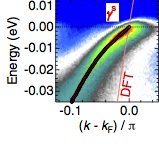
Orbital-Dependent Band Narrowing Revealed in an Extremely Correlated Hund’s Metal Emerging on the Topmost Layer of Sr2RuO4 
Takeshi Kondo, M. Ochi, M. Nakayama, H. Taniguchi, S. Akebi, K. Kuroda, M. Arita, S. Sakai, H. Namatame, M. Taniguchi, Y. Maeno, R. Arita, and S. Shin

The figure below shows a colour density plot of the intensity [related to A(k,E)] along a particular direction in the Brillouin zone.  The energy resolution is of the order of meV, something that would not have been dreamed of decades ago.
Note how the observed dispersion of the quasi-particles is much smaller than that calculated from DFT, showing how strongly correlated the system is.

The figure below shows how with increasing temperature a quasi-particle peak gradually disappears, showing the smooth crossover from a Fermi liquid to a bad metal, above some coherence temperature.
The main point of the paper is that the authors are able to probe just the topmost layer of the crystal and that the associated electronic structure is more correlated (the bands are narrower and the coherence temperature is lower) than the bulk.
Again it is impressive that one can make this distinction.

But this does highlight a limitation of ARPES, particularly in the past. It is largely a surface probe and so one has to worry about whether one is measuring surface properties that are different from the bulk. This paper shows that those differences can be significant.

The paper also contains DFT+DMFT calculations which are compared to the experimental results.

Friday, February 10, 2017

Instability of the Fermi liquid near the Mott transition

In the metallic state of many strongly correlated electron materials, Fermi liquid properties are only observed at relatively low temperatures, at a scale (the coherence temperature T_coh) that can be orders of magnitude less than the Fermi temperature that is estimated from the relevant electronic band structure. Above T_coh one observes a "bad metal" and the absence of quasi-particles.

These features are nicely captured by Dynamical Mean-Field Theory (DMFT).
An interesting question is whether this low-temperature scale can be captured in simpler theories.

Alejandro Mezio and I just finished a paper


The phase diagram at half filling is shown below. Note how near the Mott insulator T_coh is orders of magnitude smaller than W/2, the scale of the Fermi temperature for U=0. It is also much smaller than this scale multiplied by Z, the band renormalisation due to interactions.
We welcome comments.

Wednesday, February 8, 2017

Emergence of the Hubbard bands near the Mott transition

Dynamical Mean-Field Theory (DMFT) has given many insights into the Mott metal-insulator transition in strongly correlated electron materials. In the metallic phase, DMFT nicely describes the interplay between the quasi-particles associated with Fermi liquid behaviour and the Hubbard bands that also exist in the insulating phase. DMFT gives a first-order phase transition and captures the emergence of bad metallic behaviour and the associated transfer of spectral weight.

On the down side DMFT is computationally expensive, particularly close to the Mott transition, as it requires solution of a self-consistent Anderson impurity problem. [If Quantum Monte Carlo is used one also has to do a tricky imaginary time continuation]. When married with atomistic electronic structure calculations (such as based on (Density Functional Theory) DFT-based approaches) DMFT becomes even more expensive. Sometimes I also feel DMFT can be a bit of a "black box."

Slave boson mean-field theory (SBMT) (and equivalently the Gutzwiller approximation (GA) to the Gutzwiller variational wave function) is computationally cheaper and also gives some insight. However, these approaches only describe the quasi-particles, completely miss the Hubbard bands and the associated physics, and give a second-order phase transition. This is sometimes known as the Brinkman-Rice picture.

There is a nice preprint that solves these problems.

Emergent Bloch Excitations in Mott Matter 
Nicola Lanatà, Tsung-Han Lee, Yongxin Yao, Vladimir Dobrosavljević

In addition to the physical orbitals they introduce "ghost orbitals" that are dispersionless (i.e. a flat band) and non-interacting. However, one starts with a Gutzwiller variational wave function that includes the "ghost orbitals". This enables capturing the charge fluctuations in the physical orbitals.
One sees that the Hubbard bands emerge naturally (as a bonus they are dispersive) provided one includes at least two ghost orbitals in the metallic phase and on in the Mott insulating phase.
There is a simple "conservation" of numbers of bands at play here.
The authors state that the Mott transition is a topological transition because of the change in the number of bands.

The metallic (insulating) phase is characterised by three (two) variational parameters.

The results compare well, both qualitatively and quantitatively, with DMFT.

The figure below shows plots of the spectral function A(E,k) for different values of the Hubbard U. The Mott transition occurs at U=2.9.
The color scale plots are DMFT results.
The green curves are from the ghost orbital approach with the size of the points proportional to the spectral weight of the pole in the one-electron Greens function.

Friday, September 30, 2016

Why are quantum gases called degenerate?

In my recent tutorial on bad metals at IISER Pune a student asked me a basic question that I could not answer:
"Why is the degenerate Fermi gas called "degenerate"?
Is it anything to do with degenerate energy levels?"

So, I went in search for answers.

The Wikipedia entry on Degenerate matter is a bit rambling and I found it unhelpful.

I then went to the library and looked at a few textbooks and found a range of answers. Some books use the term "degenerate" without any elaboration.

In the discussion below it seems looking at the Oxford dictionary is helpful:
Having lost the physical, mental, or moral qualities considered normal and desirable; showing evidence of decline. 
technical: Lacking some usual or expected property or quality, in particular.
Here are a few entries
degenerate. (This use of the word is completely unrelated to its other use to describe a set of quantum states that have the same energy).
Daniel V. Schroeder, An Introduction to Thermal Physics, page 272.
[my favourite undergraduate text on statistical mechanics]
... a bit of terminology. At low temperature, quantum ideal gases behave very differently from the way a classical ideal gas behaves. ..... The quantum gases are said to be degenerate at low temperatures. This is not a moral judgement. Rather, the word "degenerate" is used in the sense of departing markedly from the properties of an "ordinary" classical gas.
Ralph Baierlein, Thermal Physics, page 192.
Gas degeneration proper. The quantitative study of the deviations from the classical gas laws when xi is not very small ...
Erwin Schrodinger, Statistical Thermodynamics (1936)

Here xi is the product of the particle density and the thermal deBroglie wave length cubed.

The definition of a quantum gas is one where xi becomes larger than one. (This occurs for "high" densities and "low" temperatures).


But then there is an interpretation in terms of degeneracy of energy levels because one can consider the case where each energy level has degeneracy g and condition for a non-degenerate gas (i.e. Maxwell-Boltzmann statistics to apply) is
g >> n_i ~ exp ((mu-Ei)/kB T) = number of particles in level i

I welcome comments.

The emergence of hadronic matter from interacting quarks and gluons

 A characteristic of emergent phenomena is how novel and complex properties can emerge from apparently simple laws. Quantum ChromoDynamics (...