Showing posts with label double proton transfer. Show all posts

Tuesday, December 13, 2016

The challenge of an optimal enzyme

Carbonic anhydrase is a common enzyme that performs many different physiological functions including maintaining acid-base equilibria. It is one of the fastest enzymes known and its rate is actually limited not by the chemical reaction at the active site but by diffusion of the reactants and products to the active site.

Understanding the details of its mechanism presents several challenges, both experimentally and theoretically. A key issue is the number and exact location of the water molecules near the active site. The most recent picture (from a 2010 x-ray crystallography study) is shown below.

The "water wire" is involved in the proton transfer from the zinc cation to the Histidine residue. Of particular note is the short hydrogen bond (2.4 Angstroms) between the OH- group and a neighbouring water molecule.

Such a water network near an active site is similar to what occurs in the green fluorescent protein and KSI.

Reliable knowledge of the finer details of this water network really does matter.

This ties in with theoretical challenges that are related to several issues I have blogged about before. Basic questions concerning proton transport along the wire include:

A. Is the proton transfer sequential or concerted?

B. Is quantum tunnelling involved?

C. What role (if any) does the dynamics of the surrounding protein play?

A 2003 paper by Cui and Karplus considers A., highlighting the sensitivity to the details of the water wire.
Another 2003 paper by Smedarchina, Siebrand, Fernández-Ramos, and Cui looks at the both questions through kinetic isotope effects and suggests tunnelling plays a role.

In 2003 it was not even clear how many water molecules were in the wire and so the authors considered different alternatives.

One can only answer these questions definitively if one has extremely accurate potential energy surfaces. This is challenging because:

Barrier heights and quantum nuclear effects vary significantly with small changes (even 0.05 Angstroms) in H-bond donor-acceptor distances.

The potential surface can vary significantly depending on the level of quantum chemistry theory or density functional that is used in calculations.

I thank Srabani Taraphder for introducing me to this enzyme. She has recently investigated question C.

Wednesday, September 10, 2014

Double proton transfer rates vs. distance

There is a nice paper
Tautomerism in Porphycenes: Analysis of Rate-Affecting Factors
Piotr Ciąćka, Piotr Fita, Arkadiusz Listkowski, Michał Kijak, Santi Nonell, Daiki Kuzuhara, Hiroko Yamada, Czesław Radzewicz, and Jacek Waluk

They look at nineteen different porphycenes, which means that R, the distance between the nitrogen atoms that donate and accept a proton varies.
[This is a testimony to the patience and skill of synthetic organic chemists to produce 19 different compounds.]

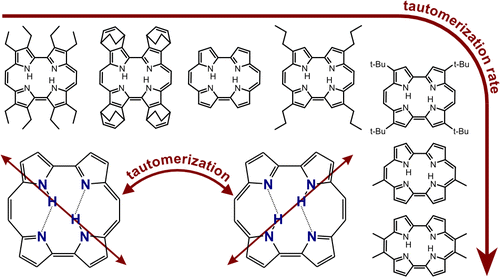
The rate of tautomerization [i.e. double proton transfer] can be measured my monitoring the time dependence of the fluorescence anisotropy because the transition dipole moment of the two tautomers is in different directions, as illustrated below, in the graphical abstract of the paper.

The key result is below: the rate of tautomerization [i.e. double proton transfer] versus R. Note the vertical scale varies by three orders of magnitude.


For single hydrogen bonds many correlations between R and observables such as bond lengths and vibrational frequencies have been observed.

The natural explanation for this correlation is that as R decreases so does the energy barrier for double proton transfer. At least at the qualitative level this is captured by my simple diabatic state model for double proton transfer [which just appeared in J. Chem. Phys.]. However, my model only predicts a correlation is the ratio of the proton affinity of the donor with one and two protons on the donor does not change as one makes the chemical substitutions that change R.

(I think) all these experiments are done at room temperature in a solvent.
Two open questions concern whether the double proton transfer is sequential or concerted, and whether it is activated or involves tunnelling. At low temperatures in supercooled jets there is evidence of tunnel splitting and concerted transfer.

Wednesday, July 16, 2014

A simple model for double proton transfer

I just finished a paper

Here is the abstract.

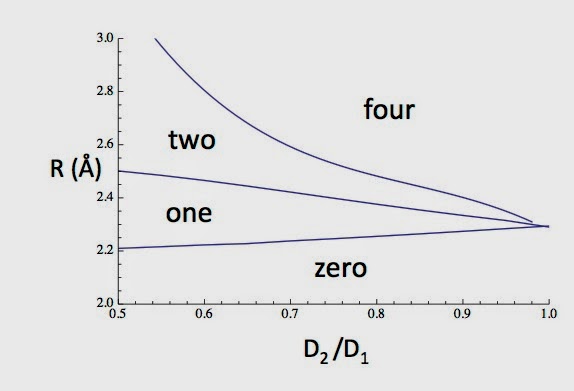
Four diabatic states are used to construct a simple model for double proton transfer in hydrogen bonded complexes. Key parameters in the model are the proton donor-acceptor separation R and the ratio, D1/D2, between the proton affinity of a donor with one and two protons. Depending on the values of these two parameters the model describes four qualitatively different ground state
potential energy surfaces, having zero, one, two, or four saddle points. In the limit D2=D1 the model reduces to two decoupled hydrogen bonds. As R decreases a transition can occur from a concerted to a sequential mechanism for double proton transfer.

I welcome comments and suggestions.

Tuesday, May 20, 2014

How many transition states are there on a potential energy surface?

Much of chemistry can be described in terms of potential energy surfaces. They describe the energy of an electronic state of a set of molecules as a function of the positions of the atoms in the molecules. Local minima on the surface describe stable molecules (reactants and products of chemical reactions). Chemical reactions proceed by thermal activation over saddle points (transition states). Hence, an interesting and important question concerns how many possible transition states there might be on a surface? How are the number of transition states related to the number of local minima?

In the process of writing a paper on double proton transfer I have stumbled across a very general result that I have never seen stated before. For me there is some curious personal history because the result uses a theorem in the first paper I ever published, thirty years ago, resulting from my undergraduate honours [final year] thesis on general relativity! More on that below.

Here is the result. Consider a smooth surface, i.e. one with no conical intersections, and with isolated extremal points.

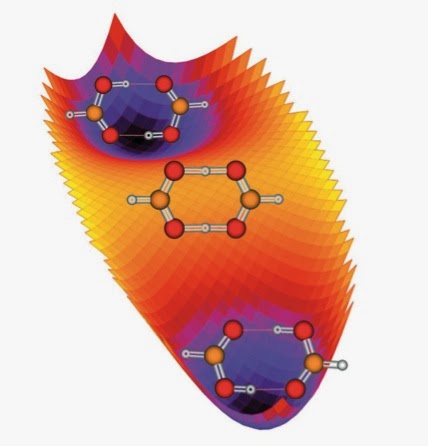
I illustrate this below with two model surfaces for double proton transfer.

For example, in the bottom figure, 4+1-4=1.

Hence, if varying the system parameters introduces an extra maxima or minima then one additional saddle point must also appear. One can intuitively see how this works in two dimensions but it turns out it is true in any dimension.
This relation is a consequence of differential topology [essentially the Poincare-Hopf index theorem]. The minima and maxima are associated with an index +1 and saddle points with -1.
The general theorem I proved 30 years ago states that if a smooth function f(r) (where r is a vector) tends to infinity as the magnitude of r tends to infinity or if the gradient of f points outward
over a closed surface (curve in two dimensions), then the extrema of f inside that closed surface, must satisfy the above relation.

How might a potential energy surface satisfy this general requirement on f(r)=Energy(bond lengths)? Essentially it is because as one greatly stretches or compresses chemical bonds the energy of the system will become large.

Aside: it was really strange for me looking at my old paper, published in the Journal of the Australian Mathematical Society. I actually can't believe I wrote it! It is so formal and mathematical. There are parts of it I now struggle to understand. The theorem was not motivated by chemistry but rather proving a general theorem in general relativity that a gravitational lens must produce an odd number of images.

So, has anyone seen this result for potential energy surfaces stated before? I could not find it in David Wales' nice book Energy Landscapes.

Tuesday, March 18, 2014

Nanoscale Schrodinger kittens and double proton transfer

I think double proton transfer can be pretty amazing. The picture below shows two possible quantum states of a porphycene molecule. Note two things.

First, the two states differ by the location of the two hydrogen atoms [protons].
Second, the location of eight of the double bonds is different.


At low temperatures the ground state of the molecule is a linear superposition of the two states.
The definitive signature of this is the tunnel splitting of the vibrational states, as shown above.
This is seen experimentally, as reported here.
At higher temperatures does not see a splitting and there is a temperature activated conversion between the two tautomers.

The ground state can be written as a superposition of two Born-Oppenheimer states [products of nuclear and electronic wave functions]

 Psi = |L>|A> + |R>|B>

where |L> and |R> are the two nuclear states and |A> and |B> the two electronic states. 
These are approximately orthogonal to each other.

What is impressive about this?
Each electronic state involves about 28 valence electrons. Roughly each double bond can be described by a valence bond state consistent of a pair of electrons in a maximally entangled singlet state.

This is not quite a Schrodinger cat state. But it is a nanoscale kitten!

How is such a state possible? The key is that the two electronic states are very strongly coupled. They have a Hamiltonian matrix element of order of electron volts [10,000 cm^-1] . Yet the tunnel splittings are only a few cm^-1 due to the small overlap of nuclear states.
Hence, these superposition states are very fragile and will be easily destroyed at a few kelvin and/or any sort of polar solvent. So don't even start thinking about quantum biology!

Tuesday, February 25, 2014

A simple model potential energy surface for double proton transfer

I love simple models.

There is a very nice paper
Correlated double-proton transfer. I. Theory
Zorka Smedarchina, Willem Siebrand, and Antonio Fernández-Ramos

It considers an incredibly simple potential energy surface to describe double proton transfer.
x_1 is the (dimensionless) position of one proton relative to the middle of its donor and acceptor.
x_2 is the corresponding position for the second proton.
The first term describes a quartic potential with an energy barrier for transfer of the proton between the donor and acceptor.

The dimensionless parameter G describes the extent of correlation or coupling between the two hydrogen bonds. The coupling term is chosen to have the important property that it is symmetric in the two co-ordinates but sensitive to their sign. This is an important difference to earlier [rather nice] work by Benderskii et al. who considered competition between two dimensional quantum tunneling paths [instantons] associated with concerted and sequential transfer.

Three types of Potential Energy surface (PES) can occur, depending on the value of G.
The three cases shown below correspond to
a) 0 < G < 1/2
b) 1/2 < G < 1
c)  G > 1.
The coordinates x_a=1/2(x_1-x_2) and x_s=1/2(x_1+x_2). The horizontal line between the left and right minimum corresponds to a concerted path.
For the top PES a sequential proton transfer is possible via one of the two intermediate (INT) states.

These three cases correspond to the different types of PES's seen for double proton transfer for different molecules.

Monday, February 17, 2014

Three types of double proton transfer

I previously posted about how double proton transfer is a concrete example of a chemical reaction that can occur via either a concerted or sequential process?
Precisely defining this question and answering it is a subtle issue.

There is a nice classification of types of potential energy surfaces for double proton transfer, summarised on the website of Antonio Fernandez-Ramos. It is based on a very simple model potential energy surface described here and compared to surfaces from computational quantum chemistry [at the DFT level] here [source of the figures below].

There are three qualitatively different potential energy surfaces, depending on the strength of the coupling of the motion of the two protons.

(1) One transition state and two minima, as in the formic acid dimer;

(2) Two equivalent transition states, one maxima and two minima, as in the pyrazole dimer;

(3) Four transition states, one maxima and four minima, as in porphine.


I am pretty happy because I am developing a simple diabatic state model that captures all of the above cases.

Tuesday, January 28, 2014

Concerted vs sequential processes in chemistry

A basic but important and interesting question in physical chemistry concerns a chemical reaction or process that involves two steps: A to B to C.
Do they occur sequentially or can they occur simultaneously, i.e., in a concerted or co-operative manner?
Two examples of particular interest are coupled electron-proton transfer and double proton transfer.
The figure below shows a carboxylic acid dimer involving two hydrogen bonds
The configuration above has the same energy as the tautomer with the top H moved to the right and the bottom H moved to the left. But, does this reaction occur by simultaneously moving the protons or first moving one and then the second.

For the case of double proton transfer in dimers of a model of a DNA base pair [shown in the picture below] there has been some controversy about whether the process is concerted or sequential. This brief letter by Kwon and Zewail in PNAS gives the relevant references. They stress that some of the controversy seems to stem from confusion about clearly defining what one means by the two options. They argue the weight of the evidence is for sequential.


I am interested in exploring simple effective Hamiltonians that might be used to come up with some general criteria and experimental signatures for discriminating between concerted and sequential processes.

What is your experience of using AI for research in condensed matter theory?

 I have been dabbling a little with using AI (at a very basic level) to help me with some research problems. For example, in a recent prepr...