Showing posts with label conference. Show all posts

Thursday, November 25, 2021

Role of quantum nuclear motion in biomolecular systems

 Total I am giving a talk, "Effect of quantum nuclear motion on hydrogen bonds in complex molecular materials" at Light-matter Interactions from scratch: Theory and Experiments at the Border with Biology 

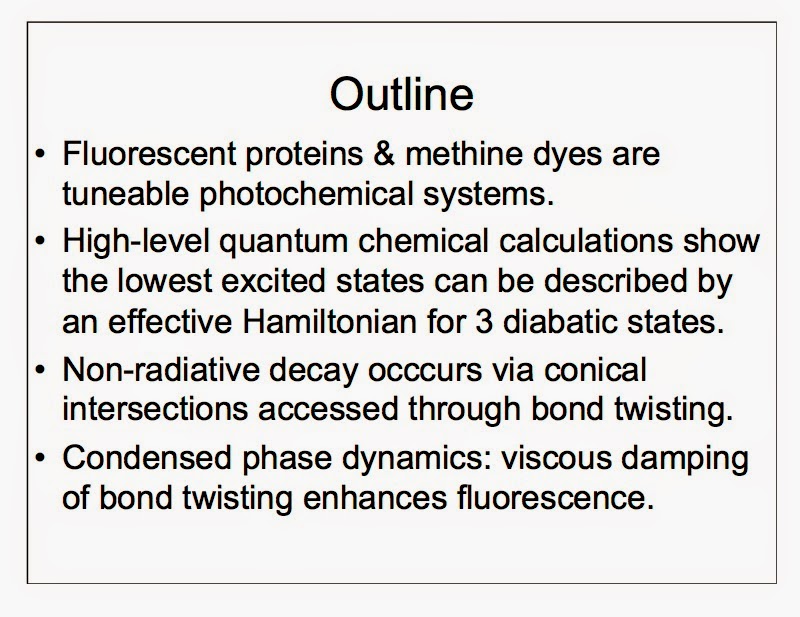
Here are the slides

The talk provides a concrete example of the tutorial on constructing simple model Hamiltonians for complex materials that I give before the talk. It relates to the bio theme of the meeting through work on isotopic fractionation in proteins and the recent paper below. It makes use of the simple model that I talk about.

Unusual Spectroscopic and Electric Field Sensitivity of Chromophores with Short Hydrogen Bonds: GFP and PYP as Model Systems

Chi-Yun Lin and Steven G. Boxer

Tuesday, November 23, 2021

Tutorial on modelling quantum dynamics in biomolecules

This week I am giving two (virtual) talks at a meeting

Light-matter Interactions from scratch: Theory and Experiments at the Border with Biology 

supported by the ICTP (International Center for Theoretical Physics) in Trieste.

In the ICTP tradition, one talk is a tutorial and the second talk is about my research.

Here are the slides for the tutorial on Effective Model Hamiltonians for Quantum Dynamics in Complex Molecular Materials. Feedback is welcome.

The research talk is about hydrogen bonding. I will post slides for that later.


Thursday, April 15, 2021

Fifty years ago: three big discoveries in condensed matter

For the marketing plan for my Very Short Introduction, I was recently asked whether there were any significant anniversaries happening in condensed matter physics (and associated conferences). This is not something I normally think about.

I realised that fifty years ago there were three big discoveries. All eventually led to Nobel Prizes. Each discovery had a profound effect on the formation of condensed matter as a distinct discipline built around a few unifying concepts. At the time the discoveries and ideas appeared quite independent, but there are deep connections between them.

Renormalisation group and critical phenomena

In 1971 Ken Wilson published two papers  [PRB 4, 3174, and PRB 4, 3184] laying the foundations, followed by two PRLs in 1972, including one with the provocative title, Critical Exponents in 3.99 Dimensions

Wilson received the Nobel Prize in 1982. This work had many implications and applications. 

Explained universality in critical phenomena.

Highlighted how spatial dimensionality changes physics.

Illustrates why effective Hamiltonians work (so well).

Showed the power of quantum field theory techniques.

Defined concepts of scaling and fixed points.

Superfluidity in liquid 3He

In 1972,  Osheroff, Richardson, and Lee reported new phase transitions in liquid/solid 3He. Tony Leggett identified these transitions as due a superfluid phases and also identified the order parameters. The experimentalists shared the Nobel Prize in 1996 and Leggett in 2003. The discovery was significant for many reasons, beyond just being a new state of matter.

It provided a rich example of a state of matter with multiple broken symmetries. The order parameter has eighteen components, which can be viewed as a combined superfluid, ferromagnet, and liquid crystal.

The rich order parameter led to an exploration of diverse topological defects, from superfluid vortices with magnetic cores to boojums. This highlighted the concepts of broken symmetry, rigidity, and topological defects.

This was the first example of an unconventional fermionic superfluid. Specifically, it could be described by BCS theory, but not with s-wave pairing nor with the pairing mechanism of the electron-phonon interaction in elemental superconductors. This showed the adaptability of BCS theory. It laid the groundwork for understanding unconventional superconductivity in heavy fermions, organics, and cuprates.

Berezinskii-Kosterlitz-Thouless phase transitions

In Berezinskii published papers in 1970 and 1971, and Kosterlitz and Thouless published papers in 1972 and 1973. This work was significant for reasons including the following.

It showed states of matter and phase transitions were qualitatively different in two and three dimensions.

New concepts such as topological order, quasi-long-range order, essential singularities, and defect-mediated phase transitions were introduced.

Like that of Wilson, this work highlighted universality. There were connections between superfluids, superconductors, and XY magnets.

Scaling equations provided insight.

Kosterlitz and Thouless were awarded the Nobel Prize in 2016

We should celebrate!

Wow! Quite the Golden Jubilee!

Does anyone know of any conferences, events, or books that are planned to mark these anniversaries?

Saturday, November 5, 2016

The role of simple models and concepts in computational materials science

Today I am giving the first talk in a session on Computational materials science at the 4th International Conference on Advances in Materials and Materials Processing.

Here are the slides for my talk "The role of simple models and concepts in computational materials science".

I will be referring the audience to the article such as those mentioned here, here and here that give a critical assessment of computer simulations and stress the importance of concepts.

I welcome comments, particularly as I think the talk could be stronger and clearer.

Monday, August 15, 2016

Aspen versus Telluride

The Aspen Center for Physics is a unique and wonderful institution offering relaxed and stimulating workshops in the midst of great scenery. It has been the setting for many famous collaborations and papers.
Maybe it is an apocryphal story, but I heard that the theoretical chemists got jealous and so started the Telluride Science Research Center.

This (northern) summer I was privileged to spend time at both, and so I offer some friendly comparisons. Both are excellent and so if you have opportunity to attend either, I would encourage you to.

Participation. 
This is highly selective and mostly restricted to faculty, with a few postdocs. Workshops are small, with typically only about twenty participants. For Telluride you have to be invited and for Aspen you apply and are then selected.

Duration.
For Telluride most workshops run for 5 days. For Aspen they run for 3-4 weeks and participants must come for a minimum of two weeks. Apparently, in the good old days people used to stay for longer

Program.
For Telluride this is closer to a small conference with many talks during each day; although, some mornings or afternoons, and sometimes whole days are free. In contrast, in Aspen there are usually at most a couple of hours of talks, and sometimes none, on each day. The emphasis is really on informal interactions.

Housing.
In both cases this is arranged by the Center. In Aspen it is subsidised by an (NSF grant and so more affordable (e.g. $75 per week for "bachelor" housing = shared apartment).

Organisation.
Both Centers are run by very professional staff who take care of all the logistics. So, organisers sole responsibility is selecting participants and setting the program. Thus, if you want to organise a small workshop this is a very easy way to do it.

Offices.
Aspen has their own building with offices, so all participants have a desk in a shared office. Telluride meets in a local school and there are no desks for participants, which is fine since the programs are so busy.

Powerpoint vs. blackboards.
Something unique about Aspen is that most talks are on a blackboard. Generally, only experimentalists are allowed to use powerpoint. I really think this is a very positive thing as it significantly increases clarity and focuses on the key points.

Local scenery.
Although it is spectacular in both towns, I do think that Telluride is superior, because you can see massive snow covered peaks from within the town.

Gondola.
Again Telluride wins. The gondola is free.  Most days I take it to the top of the mountain just to bask in the views. In Aspen I have never taken the gondola because I am too cheap...

Hiking.
In both towns there are nice short hikes literally from the town. Both have trails along the river running through the town. However, for Telluride there are serious hikes you can do starting from the town or the top of the gondola. For Aspen, you have to drive out of town or pay to get the bus to Maroon Bells, which takes about an hour.

Altitude sickness.
Both towns are above 8,000 feet and so this is not unusual. It is strange that I have been to Telluride six times but never had a problem, but my last two times in Aspen I did have had a mild case. One important preventative measure is to drink lots of water.

Travel and accessibility.
The scenic locations in the Rocky mountains come with a cost. Neither is easy or cheap to get to. For both, one may have to fly through Denver, where flight delays and missed connections are not unusual. Some participants drive from Denver.

Public lectures.
Both Centers run regular lectures during one evening throughout the summer, given by some participant. These are often quite well attended by the local community or tourists. Given the demographics of both towns (the rich and powerful) I think this is a wise investment. You never know if there will be the next Moore, Gates, or Kavli in the audience...

Colloquia.
In Aspen there is a weekly colloquium, given by someone from one of the current workshops, that all participants are required to attend, in the hope of encouraging interaction between workshops. In the past two weeks I heard two excellent talks on biological physics, by K.C. Huang and Lucy Colwell.
Telluride does not do this. Maybe it should.

Physics versus chemistry.
Most of the Telluride workshops are on chemistry or biology, with a smattering on materials science, involving physicists. As far as I am aware Aspen doesn't do much to encourage interactions between physics and chemistry. I think both Centers could benefit from trying to facilitate this more.

Tuesday, August 9, 2016

Overdoped cuprates are marginal Fermi liquids

I am giving a talk tomorrow at the Superconductivity workshop at the Aspen Center for Physics.
Here is the current version of the slides. I will only cover the first half of the slides in the talk. The rest are from a longer version.

Often it is claimed that the overdoped cuprates are Fermi liquids. However, work with Jure Kokalj and Nigel Hussey, has shown that a wide range of experimental results can be described in terms of an electronic self energy that includes a marginal Fermi liquid component which has the same angular dependence as the pseudogap, i.e. there are cold spots near the nodes of the superconducting state.
What is particularly interesting to me is that this shows that even in the overdoped region one sees precursors of the distinct signatures of the strange metal and the pseudogap regions, that occur at optimal and underdoping, respectively.

The talk is largely based on this PRL and this PRB.


Wednesday, August 3, 2016

Superconductivity in Aspen

For the next two weeks I am at the Aspen Center for Physics participating in a workshop on Superconductivity. A blog for the meeting captures its flavour, spanning a diverse range of systems and debates. I was not here for the first two weeks. Here are two related experimental results for the underdoped cuprates that have generated a lot of discussion.

1. A charge density wave (CDW) phase.

This has been observed directly with X-rays. The figure below is taken from this paper.


2. A jump in the charge carrier density versus doping.

Hall resistance measurements at high magnetic fields imply that for small doping the charge density scales with the doping p [p=0 corresponds to the Mott insulator that occurs at half filling] and at higher dopings, 1+p. This is summarised in the figure below from this paper.


A few comments.

1. Is the CDW phase relevant to understanding the pseudogap, superconductivity, and the strange metal phase?
There is debate about this. On the one hand it does compete with superconductivity. It could provide the much sought after quantum critical point below the superconducting dome in the phase diagram. CDW fluctuations could produce the pseudogap and/or strange metal properties. On the other hand, it may just be an "artefact" due to residual interactions that only become important when the magnetic field suppresses the interactions that determine the zero field phase diagram.
Why does it generate so much interest?
Well it is a concrete result and we are desperate for them and some clue to these long standing puzzles.

2. The large Fermi surface and carrier density equal to 1+ p at large doping is what one expects from a simple Fermi liquid and Luttinger's theorem. The fact that at small doping the charge density is proportional to p may have a boring explanation or an interesting one.
Boring: the antiferromagnetic (AFM) order that occurs for small p reconstructs the Fermi surface due to the periodicity associated with AFM.
Interesting: this is a strongly correlated effect associated with doping a Mott insulator.

3. In a strongly correlated metal deducing information about the charge carrier density and the Fermi surface from measurements of the Hall coefficient and/or the thermoelectric power is subtle, as emphasised by Shastry, and discussed here.

Friday, July 1, 2016

Clouds, climate change, and emergence

On tuesday the Telluride Science Research Center hosted a nice public lecture, "Clouds in a bowl of soup," by Graham Feingold, an atmospheric scientist.

He emphasised how the atmosphere is a complex system that exhibits emergent phenomena, particularly pattern formation and synchronisation. He discussed how one sees these phenomena in other systems, such as soup (Rayleigh-Benard convection cells) and fire flies.
Aside: in a similar vein there is a nice Physics Today, Quick Study, The universe in a cup of coffee by John Wettlaufer.

Emergent behaviour results from simple rules. The four rules for clouds are

1. Drops form on aerosols (suspended particles) and grow by vapour diffusion.

2. Drop coalescence generates rain. (Aerosols can influence rain).

3. Drops fall and evaporate.

4. Continuity of air flow.

Some of the work he described is in this paper, which includes the figure below.

Some key physics relevant to climate change is that clouds generally reflect sunlight and have a cooling effect. The big question is whether global warming then increases or decreases cloud formation. Is the feedback positive or negative? It seems people aren't really sure. Intuitively, you might think that the increased water in the atmosphere means more clouds but (as is often the case) it turns out to be more complicated than that.

Tuesday, June 28, 2016

The challenge of non-equilibrium thermodynamics

This week I am in Telluride at the bi-annual workshop on Condensed Phase Dynamics. I really enjoyed the talks today. A common topic was that of non-equilibrium thermodynamics, particularly in nanoscale systems.

Abe Nitzan began his talk mentioning a recent PRL, Quantum Thermodynamics: A Nonequilibrium Green’s Function Approach, which unfortunately, is not valid because the expressions it gives do not give the correct result in the equilibrium limit. This is shown in

Quantum thermodynamics of the driven resonant level model 
 Anton Bruch, Mark Thomas, Silvia Viola Kusminskiy, Felix von Oppen, and Abraham Nitzan

What is striking to me about both papers is that they consider a non-interacting model, i.e. the Hamiltonian is quadratic in fermion operators and exactly soluble.
This shows just how far we are from any sort of theory of a realistic system, i.e. one with interactions and which is not integrable.

Phil Geissler gave a nice introduction to different theorems for fluctuations in the dissipation (defined as the difference between the entropy change and heat/temperature). The most general theorem is that due to Gavin Crooks and implies the Jarzynski inequality, the fluctuation theorem, and the second law of thermodynamics.
A key question is what sorts of non-equilibrium processes (protocols) minimise the dissipation and whether the distribution is Gaussian (it often is).
He then described near optimal protocols to invert the magnetisation in a two-dimensional Ising model.

Suri Vaikuntanathan talked about coupled (classical) master equation models for biomolecular networks that have mathematical similarities to an electronic Su-Schrieffer-Heeger model which is an one-dimensional example of a topological insulator.
The work is described  in a preprint with A. Murugan,  "Topologically protected modes in non-equilibrium stochastic systems".
This is potentially  important because it may provide  "a framework for how biochemical systems can use non equilibrium driving to achieve robust function."

David Limmer gave a nice talk which considered thermodynamics as a large deviation theory and how that can even have meaning out of equilibrium and there is a notion of an entropy, a "free energy" and a "temperature". His slides are here.
A key notion is to focus on ensembles of trajectories rather than a probability distribution function. There are two alternative computational strategies: transition path sampling and diffusion Monte Carlo (the cloning algorithm).
He considered several concrete examples, such as thermal conductivity in carbon nanotubes, and electrochemical processes at electrode-water interfaces.

Monday, July 20, 2015

Quantum nuclear effects in condensed phase chemistry

I am currently in Telluride for a meeting on Quantum effects in condensed phase systems. Two years ago I attended a similar meeting and in preparing it has been helpful to re-read several posts I wrote stimulated by that meeting.

In my first post, I listed possible quantum effects [zero-point motion, tunnelling, geometric phases, entanglement, ...] and pointed how generally one expects a condensed phase environment [protein, glass, solvent] for a molecular system will tend to reduce these quantum effects by decoherence.

I then asked two big questions.
Are there any instances where the environment can
A. enhance quantum effects?
B. lead to qualitatively new effects (e.g. associated with collective degrees of freedom) that are absent in the gas phase?

I clarified what I meant by a trivial vs. non-trivial enhancement of a quantum effect, from a physics point of view. An example of a "trivial" enhancement is where the environment changes the molecular geometry to enhance the effect. But I stressed that such an enhancement may be highly valuable from a chemistry or biochemistry point of view.

In a comment, Gautam Menon suggested that the Surface Enhanced Raman scattering was a nice example of a non-trivial enhancement. It is certainly spectacular, with enhancements as large as 10^11. However, I am not sure this is the type of quantum effect I am thinking of. The actual mechanism of the effect is still debated [see this paper] and I am not qualified to consider the relative merits of the alternative explanations, but it does look to me like it could be viewed as a semi-classical effect.

Tom Miller suggested to me that the solvation of single electrons and the associated polarons may be a suitable example of B.

I suggested that there were two important organising principles for describing and understanding quantum nuclear effects
1. Competing quantum effects
2. Rate processes can be dominated by rare quantum events.

I am looking forward to the meeting.

Friday, March 27, 2015

Future challenges with nuclear quantum effects in water

Last October I enjoyed attending a meeting, Water: the most anomalous liquid at NORDITA. One of the goals of the workshop was to produce a review article, co-authored by about a dozen working groups, each covering a specific aspect of water. I was in the group on "Nuclear quantum effects in water", led by Tom Markland. I was worried that this goal was a bit too ambitious. After all, I am into modest goals! However, it is all coming together, a great credit to the organisers. Our group is now finalising our "chapter". An important and difficult task is to write something concrete and useful about future challenges and directions.

Here I give a few of my own biased tentative thoughts. Comments and suggestions would be very welcome.

Over the past decade there have been several significant advances that are relevant to understanding nuclear quantum effects in water. It was only by writing this summary that I realised just how tangible and significant these advances are. I am not sure other fields I am familiar with have experienced comparable advances.

Experiment.
Deep inelastic neutron scattering reveals the momentum distribution of protons, and can be compared to path integral simulations, as described here. Furthermore, this has illuminated competing quantum effects, as described here.

Quantum chemistry.
New accurate intermolecular potential energy surfaces and force fields, such as MB-pol.

Computational.
Path integral simulations. Besides significant increases in computational power [Moore's law] making simulation of much larger systems and better "statistics" possible, there have been significant methodological advances, such as Ring Polymer Molecular Dynamics, and PIGLET.

New concepts and organising principles.
Competing quantum effects associated with the zero-point energy of O-H stretching and bending modes. The competition is particularly subtle in water, to the point that it can change the sign of isotope effects.
Dynamical properties such as proton transport being dominated by extremely rare events, associated with short hydrogen bonds.

Simple models.
The coarse-grained monatomic Water (mW) model captures many anomalies of classical water, showing their origin is in the tetrahedral bonding. A diabatic state model captures essential features of the potential energy surface of single hydrogen bonds, particularly the variation with the distance between oxygen atoms. The model does describes competing quantum effects.

These advances present some significant opportunities and challenges.

Experiment.
Resolving the ambiguity associated with interpreting the deep inelastic neutron scattering experiments. Going from the data to robust (i.e. non-controversial) spatial probability distributions for protons, particularly ones involving proton delocalisation would be nice.

Simulation.
The path integral simulations will only be as good at the potential energy surfaces that they use. For example, recent work shows how calculated isotope effects vary significantly with the DFT functional that is used. This is because the potential energy surface, particularly with respect to the proton transfer co-ordinate, is quite sensitive to the oxygen atom separation, and to the level of quantum chemical theory. This becomes particularly important for properties that are determined by rare events [i.e. thermal and quantum fluctuations to short hydrogen bonds].

Simple models.
Monatomic Water (mW) is completely classical. It would be nice to have a quantum generalisation that can describe how the water phase diagram changes with isotope (H/D substitution). Note there is already a problem because mW is so coarse-grained that it does not contain the O-H stretch. On the other hand, mW does describe the librational modes, and these do make a significant contribution to quantum nuclear effects in water, as described here.

I welcome suggestions and comments.

Sunday, November 23, 2014

An introduction to emergent quantum matter

Here are the slides for my talk, "An introduction to emergent quantum matter" that I am giving tomorrow at the Australasian Workshop on Emergent Quantum Matter.


A good discussion of some of the issues is Laughlin and Pines article The Theory of Everything and Piers Coleman's article Many-body Physics: Unfinished Revolution.

A more extensive and introductory discussion by Pines is at Physics for the 21st Century.

I welcome any comments.

Saturday, October 18, 2014

Water: anomalies, challenges, and controversies

I really enjoyed this week's meeting Water: the most anomalous liquid at NORDITA. This is the first time I have ever been to a workshop or conference that is solely about water. Here are some impressions and a few things I learnt as a newcomer to the field.

Just how unique and anomalous is water?
Not as unique as I thought. Some other tetrahedral liquids have similar properties.

Hydrogen bonding is not what makes water unique
Rather it is the tetrahedral character of the intermolecular interactions that arise from hydrogen bonding. This distinction can be seen from the fact that the mW (monatomic water) model captures many of the unusual properties of water.

DFT is a nightmare
I have written a number of posts that express caution/concern/alarm/skepticism about attempts to use Density functional theory (DFT) to describe properties of complex materials. Trying to use it to calculate properties of a liquid water in thermal equilibrium is particularly adventurous/ambitious/reckless. First, there is the basic question: can it even get the properties of a water dimer in the gas phase correct? But, even if you choose a functional and basis set so you get something reasonable for a dimer there is another level of complexity/fakery/danger associated with "converging" a molecular dynamics simulation with DFT producing the Born-Oppenheimer surface. This was highlighted by several speakers. Simulations need to give error bars!

A physically realistic force field (at last!)
A plethora of force fields [TIP3P, SPC/E, TIP4P/2005, ST2, ....] have been developed for classical molecular dynamic simulations. They are largely based on electrostatic considerations and involve many parameters. The latter are chosen in order to best fit a selection of experimental properties [melting temperature, temperature of maximum density, pair correlation function, dielectric constant, ....]. Some models use different force fields for ice and liquid water. On the positive side it is impressive how some of these models can capture qualitative features of the phase diagram including different ice phases and give a number of experimental properties within a factor of two. On the negative side: they involve many parameters, it is hard to justify including some "forces" and not others, and give very poor values for some experimental observables [e.g. TIP3P has ice melting at 146 K!]. How often do people get the right answer for the wrong reason?

An alternative strategy is to actually calculate an ab initio force field using state of the art quantum chemistry and a many-body expansion that includes not just two-body interactions (i.e. forces between pairs of molecules) but three-body and beyond interactions. This was discussed by Sotiris Xantheas and Francesco Paesani. An end result is MB-pol.

Quantum zero-point energy is (not) important
Sotiris Xantheas emphasised that semi-empirical force fields are effective Hamiltonians that implicitly include quantum nuclear effects at some effective classical potential [e.g. a la Feynman-Hibbs]. Thus, if one then does a path integral simulation using one of these force fields one is  "double counting" the quantum nuclear effects at some level. Xantheas and Paesani also emphasised that MB-pol should not be expected to agree with experiment unless nuclear quantum effects are included.
On the other hand, due to competing quantum effects classical simulations for water give better results than one might expect.

The elusive liquid-liquid critical point
Some of this controversy reminded me of high-Tc cuprate superconductors where the elusive quantum critical point [under the superconducting dome?] may (or may not) exist. It is also interesting that there is a proposal of a Widom line in the cuprates, perhaps inspired by water.
Some of the arguments and sociology seemed like the cuprates. There are true believers and non-believers. Each camp interprets (and criticises) complicated and ambiguous experimental results and large computer simulations according to their prior beliefs. Kauzmann's maxim is relevant: people will often believe what they want to believe rather than what the evidence before them suggests they should believe.

Perhaps this critical point does not appear in the physical phase diagram of bulk water but can be accessed via "negative pressure" in some force field models. A key observable to calculate is the heat capacity, experimentally it appears to diverge. But its calculation will require inclusion of nuclear quantum effects. [It is not clear to me why you can't just input the classical vibrational spectrum into a non-interacting quantum partition function.]

I felt this issue dominated some discussions at the meeting too much.

The O-O radial distribution function is over-emphasised
In any liquid this pair correlation function is an important observable that is a measure of the amount of structure in the liquid. For water the O-O radial function has been "accurately" measured and provides a benchmark for theories. Getting it correct is a necessary but not a sufficient condition for having a correct theory. But water is an anisotropic molecular liquid not a Lennard-Jones monatomic fluid. Angular correlations are very important for water. Also, unfortunately, other pair correlation functions such as the O-H and H-H radial distribution functions are not well characterised experimentally.

When are the many-body effects quantum?
One can make many-body expansions in electrostatics, classical statistical mechanics, and quantum many-body theory. A profound question is: are there situations, criteria, or properties that can make the latter distinctly different from the former?


Thursday, October 16, 2014

Talk on nuclear quantum effects in water

On thursday I am giving a talk "Quantum nuclear effects on hydrogen bonding in water" at the Nordita workshop, "Water: the most anomalous liquid". Here are the slides. It is mostly based on this paper.

Tuesday, October 14, 2014

Classifying quantum effects in water

This week I am in Stockholm at a NORDITA workshop, Water: the most anomalous liquid.
I am in a working group on Quantum effects in water. The workshop runs for 4 weeks. There will be about 12 working groups. Each is meant to produce a ten page review that will be then be combined into a review article, co-authored by all the participants.

Today we discussed a possible classification of different quantum effects.
They are manifested in H/D [hydrogen/deuterium] isotope substitution experiments.
For equilibrium properties these isotope effects would be non-existent if the nuclear dynamics is treated classically. This is because at the level of the Born-Oppenheimer approximation the potential energy surface for H and D is identical.
For dynamical properties such as the water self-diffusion constant there is a trivial classical effect from the scaling of vibrational frequencies with H/D substitution.

As I mentioned before, most quantum nuclear effects are associated with vibrational zero-point energy. But, there are effects associated with tunnelling and quantum delocalisation such as a in high pressure phases of ice such as ice X.
Here is one possible classification.

Trivial effects.
These arise simply because the H/D substitution changes vibrational frequencies by a scaling factor of sqrt(2)=1.414. An example, is the large difference between the specific heat of heavy and regular water. This simply arises because the thermal population of the vibrational excited states changes because of the change in hbar omega/k_B T. One would observe such a change in almost any solid or liquid.

Significant or non-trivial effects.
Examples are the pH of heavy water, and liquid-vapour isotopic fractionation ratio. The non-trivial dependence of this on temperature [taken from this paper] is shown below. It is intimately connected with competing quantum effects.


Anomalous effects.
These have the opposite sign to what one expects and sees in simple solids and liquids. For example,
the volume expansion from solid H20 and D2O, is the opposite to the contraction that occurs in most solids, as described here.

It would nice to make these classifications a bit sharper.

Thursday, August 21, 2014

Should I join this professional scientific society?

Why are they important?
Why should you join? not join?
Why are the membership numbers of some societies declining (some dramatically)?

It seems every month the American Chemical Society (ACS) sends me a letter asking me to join. I am not sure who recommended me for membership. I find it ironic because I once tried to join the Royal Australian Chemical Institute but was rejected because they did not seem to think I was a real chemist. [ouch!] Over the years I have belonged to several societies. But, some of these memberships have lapsed. Recently, I was personally asked by one, "What do we have to do to get you to rejoin?"
I did not have an answer, stimulating this post.

First, let me say why these societies can be incredibly important. They can
  • Publish good journals that are owned and run by scientists. These can avoid the problems of commercial outfits such as Nature [sensationalism over substance] and Elsevier [quantity over quality, dubious business practises].
  • Organise useful conferences.
  • Give prizes and awards to recognise excellence.
  • Provide career services, particularly for younger members.
  • Represent science and scientists to government, industry, and the community. This is not just lobbying for more funding but making important public statements on issues such as climate change.
If we don't join, we end up with the Tragedy of the Commons, whereby our long-term collective interests suffer because we prioritise our individual self-interest.

So, why not join?
  • Membership is expensive, particularly if you belong to several.
  • Your mail box (both hard and soft) will be clogged with magazines, newsletters, fund-raising appeals, announcements, elections, ...
  • You may be asked to serve on committees.
  • There are many societies to choose from, particularly if you live outside the USA and you work  at the interface of two or more disciplines [physics, chemistry, biophysics, materials science, ...]. APS, ACS, RACI, AIP, IoP, MRS, ...
  • Smaller national societies are struggling for viability in an era of internationalisation. It is not clear why some still publish journals.
  • Society conferences compete with a multitude of other conferences. Some national society conferences may not have a critical mass of people or seem a magnet for mediocrity.
  • If you don't go to the society conferences and can read their magazine online via a library subscription there is less personal incentive to join.
So, how do you decide who to join? or not join? or let your membership lapse?
What would a society have to do to convince you to join?

Tuesday, August 19, 2014

Future directions for physical chemistry

At the American Chemical Society meeting last week J.T. Hynes gave a talk
Some modest proposals for 21st century physical chemists 
Here are his three main points.

(1) The most familiar problems/phenomena may in fact not be at all already understood, and can provide fertile areas for discovery;

(2) Just an experiment or a theory because it is 'old' (e.g. of a certain vintage) does not mean it is inferior/wrong despite the lack of novelty and modernity;

(3) Simple, well-constructed analytic models have a significant role to play in comprehending and advancing both theory and experiment.

Unfortunately, I was not at the meeting, but my colleague Seth Olsen was and told me I would have enjoyed the talk. These points certainly resonate with my own views.

Thursday, July 24, 2014

NORDITA workshop on water

I have written many posts about what a fascinating, difficult, and important subject water is. I think it is one of the classic hard problems that does not get the attention it deserves. Science increasingly follows the latest fashionable topic that has "low-lying fruit" to pick.
Hence, I was delighted to learn last year that NORDITA [Nordic Institute for Theoretical and Atomic Physics] is planning a month long program this year on Water - the Most Anomalous Liquid.

I was even happier when I was invited to be part of a "Working Group" in week one to focus on "Quantum effects", led by Tom Markland. Hopefully this will generate some interesting discussions, science, and blog posts!

To increase the visual appeal of this post I searched on Google Images for "water quantum" and got some scary results, including this video marketing the "Quantum BioEnergy water clamp". I am not sure whether we should laugh or cry!

Wednesday, June 25, 2014

Condensed phase dynamics in Telluride

Last night I was stranded at Denver airport en route to the bi-annual Condensed phase dynamics meeting at the Telluride Science Research Center.  This is the third time I have been to this wonderful meeting. Getting there can be a real hassle. But, then you look at the scenery and enjoy the science and it seems worth it.


Unfortunately, due to the travel delays I missed the first two talks, by Joe Subotnik and Nandini Ananth.

Dominika Zgid gave a chemist's perspective on "How to make dynamical mean theory quantitative". Some of her work was discussed in a my last post. Today she mostly discussed a generalisation of iterative perturbation theory as an "impurity solver" for DMFT problems with multiple orbitals. See this preprint.

Peter Rossky discussed quantum chemical simulations of exciton dynamics in conjugated polymers.

This was motivated by an experiment reported in Science that claimed evidence for quantum coherent transport of excitons along a polymer chain at room temperature. Several oscillations were seen in the fluorescence polarisation anisotropy  as it decays in about a picosecond. These oscillations were identified with quantum inference [Rabi oscillations] between different exciton states delocalised over the polymer chain.

It turns out the experimental results have a much more mundane explanation.
The simulations of Adam Willard and Rossky are of classical dynamics on the adiabatic excited state potential energy surface calculated from a parameterised PPP [Pariser-Parr-Pople] model [basically a Hubbard model with long-range Coulomb interactions. They see oscillations similar to those in the experiment and can identified simply with classical nuclear motion associated with the polymer backbone stretching [phonons] in response to photo-excitation.

Much-hyped experiments claiming to show quantum coherence in photosynthetic complexes, probably also have a similar classical explanation in terms of nuclear dynamics rather than electronic coherences. A concrete interpretation in terms of vibrational coherences is in this PNAS paper. My skepticism of these "quantum biology" experiments has been expressed in many earlier posts.

Hopefully, tomorrow I will blog about talks from Eran Rabani, Todd Martinez, and Dvira Segal.

The emergence of hadronic matter from interacting quarks and gluons

 A characteristic of emergent phenomena is how novel and complex properties can emerge from apparently simple laws. Quantum ChromoDynamics (...