Showing posts with label dimensionless ratios. Show all posts

Wednesday, September 5, 2018

Superconductivity in a Hund's metal

The BCS theory of superconductivity is one of the towering intellectual achievements of the twentieth century. There are many ingredients to the theory and many significant results. One key step is to consider an effective interaction that is responsible for the Cooper pairing. A key result is that many properties are universal in that one can rescale temperatures and energies by the energy gap (at zero temperature), Delta(0) or the transition temperature Tc. In the limit of weak-coupling there is a universal ratio
2 Delta(0)/kTc = 3.5
Most elemental superconductors are consistent with this value. Some such as Hg and Pb have larger values, but these can actually be calculated when strong coupling effects are taken into account, via the Eliashberg equations.

Unconventional superconductors (cuprate, organic, heavy fermion, iron based) have resisted a simple unifying theory and universal trends, comparable to the stellar success of BCS theory. For example, the gap/Tc ratio is all over the place. However, there has been some progress for the iron-based superconductors. Recent ARPES results (summarised in the figure at the bottom below) have shown a universal ratio, of about 7.2 for a wide range of materials.

A fascinating feature of these iron-based materials is the nature of the metallic state that undergoes the superconducting instability. I have written several blog posts about the Hund's metal. One important feature is that there is relatively low coherence temperature below which a Fermi liquid metal forms, and there is a correspondingly low energy scale Omega0 associated with spin fluctuations, which become very slow. This arises from the rich Kondo physics associated with the multi-orbital character of the system. Furthermore, the spin fluctuation spectrum has a power law dependence above Omega0.

The above ideas come together in an interesting preprint
On the Superconductivity of Hund's Metals 
Tsung-Han Lee, Andrey Chubukov, Hu Miao, Gabriel Kotliar

They consider a single band superconductor described by the strong-coupling Eliashberg equations where the frequency dependence of the (effective) electron-electron attraction is given by
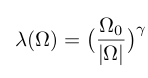
where the exponent gamma is treated as a variable. The Eliashberg equations are solved (for a single band) and give the following relationship between the gap ratio and the exponent gamma.
The value of gamma=1.2 is that associated with the relevant Kondo problem above the coherence temperature. The gap ratio corresponds to the black dashed line in the graph below.

One thing should be stressed here is that one is observing a transition from an incoherent metal into a superconductor, unlike in the BCS situation where the transition is from a coherent Fermi liquid.
I thank Alejandro Mezio for bringing the paper to my attention.

Thursday, March 23, 2017

Units! Units! Units!

I am spending more time with undergraduates lately: helping in a lab (scary!), lecturing, marking assignments, supervising small research projects, ...

One issue keeps coming up: physical units!
Many of the students struggle with this. Some even think it is not important!

This matters in a wide range of activities.

  • Giving a meaningful answer for a measurement or calculation. This includes canceling out units.
  • Using dimensional analysis to find possible errors in a calculation or formula.
  • Writing equations in dimensionless form to simplify calculations, whether analytical or computational.
  • Making order of magnitude estimates of physical effects.

Any others you can think of?

Any thoughts on how we can do better at training students to master this basic but important skill?

Friday, September 2, 2016

The mysterious origin of resistivity in Fermi liquids

It is hard to believe that we really don't understand the basic issues that I am going to discuss.

Resitivity occurs in a metal because scattering causes decay of charge currents. This means that the total momentum of the electrons in the presence of an electric field decays.
However, in a Fermi liquid metal with strong electron-electron interactions the main scattering of electrons is due to electron-electron scattering. But, in such collisions the total momentum of the two electrons is the same before and after the collision.
One can calculate the life time of the quasi-particles and it is inversely proportional to the temperature squared. The quasi-particle scattering rate ~ T^2.
Suppose one makes the relaxation time approximation in the Boltzmann equation or equivalently, neglects vertex corrections in the corresponding current-current correlation function associated with the Kubo formula for the conductivity. Then the resistivity is proportional to the quasi-particle scattering rate and one has resistivity ~ T^2. We say the transport lifetime is the same as the quasi-particle lifetime.
However, these are approximations, and strictly speaking there is no decay of the total electron momentum (or current) by electron-electron scattering and so the resistivity should be zero!
One way to save the situation is when there is Umklapp scattering. However, this requires a special relation between the shape of the Fermi surface and the Brillouin zone, as illustrated below.

These issues and puzzles are highlighted in a beautiful paper

Scalable T^2 resistivity in a small single-component Fermi surface 
Xiao Lin, Benoît Fauqué, Kamran Behnia

By chemical doping they tune the charge density and Fermi energy by several orders of magnitude, with the size of the Fermi surface increasing from some very small fraction of the Brilloiun zone.
In all cases the resistivity equals A T^2, characteristic of electron-electron scattering.
The figure below shows how the proportionality factor A scales with the density.
They also find A scales with the inverse of the effective mass squared as one expects from the Kadowaki-Woods ratio.


Yet for small densities (and Fermi surfaces) it is just not clear how one can have electron-electron scattering since Umklapp scattering is not relevant.

This major puzzle awaits an explanation.

I thank David Cavanagh, Jure Kokalj, Jernez Mravlje, and Peter Prevlosek for stimulating discussions about this topic.

Note added. The theoretical issues are nicely reviewed in
Resistivity of non-Galilean-invariant Fermi- and non-Fermi liquids 
 H. K. Pal, V. I. Yudson, D. L. Maslov

Thursday, May 19, 2016

Strong electron correlations in geophysics

There is some fascinating solid state physics in geology, particularly associated with phase transitions between different crystal structures under high pressure. This provides some interesting examples and problems when teaching undergraduate thermodynamics. One of many nice features of the text by Schroeder is that it has discussions and problems associated with these phase transitions.

However, I would not have thought that the electronic transport properties, and particularly the role of electron correlations, would be that relevant to geophysics. But, I recently learnt this is not the case. A really basic unanswered question in geophysics is the origin and stability of the earths magnetic field due to the geodynamo. It turns out that the magnitude of the thermal conductivity of solid iron at high pressures and temperatures matters. One must consider not just the relative stability of different crystal structures but also the relative contributions of electron-phonon and electron-electron scattering to the thermal conductivity.

There is a nice preprint
Fermi-liquid behavior and thermal conductivity of ε-iron at Earth's core conditions 
L. V. Pourovskii, J. Mravlje, A. Georges, S.I. Simak, I. A. Abrikosov

They report results that contradict those of a recent Nature paper that has now been retracted.
A few minor observations stimulated by the paper.

a. This highlights the power and success of the marriage of Dynamical Mean-Field Theory (DMFT)  with electronic structure calculations based on Density Functional Theory (DFT) approximations. It impressive that people can now perform calculations to address such subtle issues as the relative stability and relative strength of electronic correlations in different crystal structures.

b. The disagreement between the two papers boils down to thorny issues associated with numerically performing the analytic continuation from imaginary time to real frequency. This is a whole can of worms that requires a lot of caution.

c. Subtle issues such as the value of the Lorenz ratio (Wiedemann-Franz law) for impurities compared to that for a Fermi liquid turn out to matter.

d. I have semantic issues about the use of the term "non-Fermi liquid" in both papers. The authors associate it with a resistivity (for high temperatures) that is not quadratic in temperature. The system still has quasi-particles that adiabatically connect to those in a non-interacting fermion system, and to me it is a Fermi liquid.

Thursday, September 17, 2015

Desperately seeking triplet superconductors, II

Previously, I posted about the tricky problem of establishing experimentally that an unconventional superconductor that the Cooper pairs are in a spin triplet state. One basic (but far from definitive) signature is that the upper critical magnetic field is larger than the Clogston-Chandreshakar limit [this is often called the Pauli paramagnetic limit but I think that is a scientific misnomer].

I am particularly interested in this problem because of recent theoretical work showing how triplet superconductivity may arise in a particular quasi-one-dimensional metal.

A new family of materials A2Cr3As3 [A=K,Rb,Cs] is attracting significant interest because some experiments show the desired high upper critical field.

I think the "first" paper is a Phys. Rev. X article with the title Superconductivity in Quasi-One-Dimensional K2Cr3As3 with Significant Electron Correlations

I am slowly trying to work through some of the literature. Here are a few observations. I welcome comments and corrections.

Sample quality.
This is usually a big issue in newly discovered strongly correlated electron materials. Unfortunately, this does not stop the rush to publish and make bold claims.
Many of the reported measurements are on polycrystalline samples not single crystals. A "Note added" in the Phys. Rev. X article concedes that the linear in T resistivity that they observed in polycrystalline samples is not seen by other authors. Nevertheless the abstract states
A linear temperature dependence of resistivity in a broad temperature range from 7 to 300 K is observed, which suggests non-Fermi liquid behavior.

Furthermore, this preprint notes
The different low temperature behavior observed in samples which have deteriorated after being exposed to air, emphasises that it is necessary to properly handle the samples prior to being measured because the A2Cr3As3 compounds are extremely air sensitive and evidence for nodal superconductivity from penetration depth measurements is only observed in the samples which display a sharp superconducting transition.

Quasi-one-dimensionality.
This is subtle. The crystal structure does contain chains of Cr3As3 with C_3 symmetry. [Double walled sub-nanotubes!]
However, electronic structure calculations suggest one three-dimensional Fermi surface sheet in addition to two quasi-one-dimensional Fermi surface sheets.
Unfortunately, this is not stopping people already claiming experimental results "consistent with a Tomonaga-Luttinger liquid."

Strong correlations.
The abstract of the Phys. Rev. X article states
The material has a large electronic specific-heat coefficient of  70–75  mJ K−2 mol−1, indicating significantly strong electron correlations.
This is a weak statement. This coefficient is certainly large compared to elemental metals. However, the key issue is how large is this value compared to the value found from the density of states at the Fermi energy calculated in a "weakly correlated" band structure method such as a DFT approximation. In the text the authors report that the enhancement calculated this way is slightly larger than three. Some might say this is "moderate" rather than "strong" correlations.

Hund's rule coupling and minimal model effective Hamiltonian.
A three band model has been constructed and found to exhibit triplet p_z superconductivity at the RPA level.

NMR and spin fluctuations.
The measurements have been interpreted as evidence for Luttinger liquid behaviour,  antiferromagnetic spin fluctuations, and unconventional superconductivity. On the second, it is pity they don't have Knight shift data. Then one could have discussed the magnitude of the Korringa ratio.

Proximity to magnetism and possible parent compounds.
One might consider K2Cr3As3 as an electron doped version of  KCr3As3. The latter has been studied both experimentally (with the magnetic susceptibility exhibiting Curie-Weiss behaviour suggesting the present of antiferromagnetic magnetic moments; it remains metallic with no superconductivity) and theoretically (leading to a "spin tube" model). There are some interesting and subtle issues associated of the coupling of Cr spins, within the triangles, somewhat reminiscent of an organic system some my UQ colleagues have been studying.
Mike Norman briefly mentions K2Cr3As3 in a nice Physics article discussing the broader context of the interplay of helical magnetism and superconductivity in (three-dimensional) CrAs and MnP. Aside: They were the first Cr an Mn compounds ever found to superconduct.

Spin-locked superconductivity?
A paper reporting measurements of the anisotropic upper critical magnetic field up to 60 tesla claims that
The paramagnetically limited behavior of H∥c2(T) is inconsistent with triplet superconductivity but suggests a form of singlet superconductivity with the electron spins locked onto the direction of Cr chains.
I don't follow this at all. Surely, if you have a spin singlet there is no preferred direction for the electron spins. I must be missing something. Can someone explain?

Spin-orbit coupling
Electronic structure calculations suggest that 
Despite of the relatively small atomic numbers, the antisymmetric spin-orbit coupling splitting is sizable (≈ 60 meV) on the 3D Fermi surface sheet as well as on one of the quasi-1D sheets.
I welcome discussion as I am finding my way. 

Thursday, March 26, 2015

A basic but important research skill, 5: solving homework problems

Carl Caves has a helpful two pager, tips for solving physics homework problems. It nicely emphasises the importance of drawing a clear diagram, dimensional analysis, thinking before you calculate, and checking the answer.

He also discusses moving from homework problems to "real world" problems, e.g. research. Then, just formulating the problem is crucial.

I wonder if the goals of some Ph.D projects might be revised if the supervisor and/or student simply combined dimensional analysis with a realistic order of magnitude estimate. Just doing the exercise might also significantly increase the students understanding of the underlying physics.

Thursday, August 14, 2014

Scale of the Nernst effect in a bad metal

A science fiction fantasy is that we should be able to make "materials by design" that have any physical property (density, thermal conductivity, hardness, thermoelectric figure of merit, heat capacity...)  that we desire. However, it seems that there are certain physical constraints that determine the overall scale of many physical properties.

I find it helpful to have a feel for typical orders of magnitude. What is particularly interesting is that sometimes these magnitudes are related to fundamental constants [electronic charge (e), Boltzmann's constant (k_B), Planck's constant (hbar)] and basic length scales such as the lattice constant a of a crystal.

Here are three scales I have emphasised before

Resistivity ~ hbar a / e^2 ~ 100 microohm-cm  which is associated with the Mott-Ioffe-Regel limit.

Thermoelectric power,  S ~ k_B/e ~ 86 microvolt/K

Mobility, mu ~ e a^2/ hbar ~ 1 cm^2 V/sec

One can find these scales by dimensional analysis or by doing things like looking a formulas from transport theory and (assuming a bad metal) setting the mean-free path comparable to the lattice constant. One can debate whether one uses hbar or h, but for little purpose.

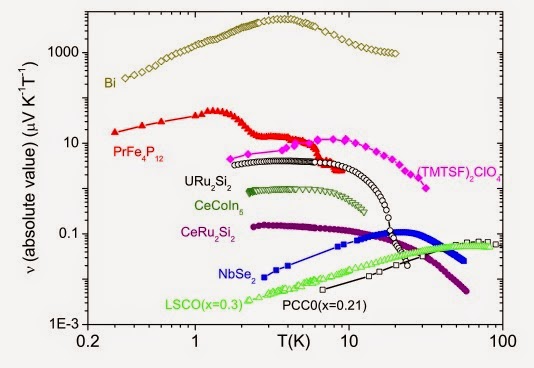
How about the Nernst signal, nu?

nu ~ k_B a^2 / hbar ~ 0.01 microV/KT

A few minor notes.

1. One can get this scale from the above expressions for S and mu if one uses the observation that in some strongly correlated materials
nu ~ S * Hall mobility.

2. One Volt/Tesla = m^2/sec  [One can see this easily from F = q(E + vxB)].

3. Given that the Nernst effect involves charge transport I find it surprising that the electronic charge does not appear.

The figure below, taken from a nice review by Behnia, shows that this is the right scale for bad metals such as cuprates, and heavy fermions above the coherence temperature.

One also sees this scale in recent DMFT calculations for a doped Hubbard model (see Figure 2d in this PRL ) and recent measurements (see Figure 4) on organic charge transfer salts.

Monday, March 10, 2014

Getting a feel for orders of magnitude

Each time I teach a course I realise there is some particular intellectual challenge for students that I take for granted because the issue has become so second nature to me.

As an undergraduate I don't think I really learnt, or was taught, to make orders of magnitude estimates and then consider their consequences. I never took a course in solid state physics. I learnt every subject in a precise manner, more like applied mathematics. Perhaps, physics was not taught that way. But that is certainly how I learnt it. It was only when I went to graduate school in the US, that I had to learn to deal with orders of magnitude estimates. Indeed in the General Exam [qualifying Ph.D exam after 2 years] at Princeton there was a whole section called General Physics that did this kind of stuff. You can see some of the questions in this book. I actually think that learning to solve these type of problems was one of the most useful things I learnt during my whole Ph.D. This is the first step in theoretical model building.

Dealing with orders of magnitude and the associated approximations is one of the reasons why condensed matter is so hard for undergraduates.

Even in the first few weeks of a solid state physics course students are confronted with a plethora of energy, time, and length scales:

Lengths.
Size of an atom, separation of atoms in a crystal, mean free path, Fermi wavelength, wavelengths of different types of electromagnetic radiation, ...

Energies.
Thermal energy [k_B T], Fermi energy, Coulomb repulsion between electrons, uncertainty due to scattering, ...

Times.
Scattering time, Cyclotron period, ...

Students need to get a feel for all these scales and remember them.
But this is not just an exercise in mindless memorisation, such as a random historical dates or the Latin names of different flora and fauna. Rather, they need to learn and understand the significance and implications of the relative magnitudes of these numbers. Here are a few examples of increasing profundity.

1. For the electrons in an elemental metal the Fermi temperature is orders of magnitude larger than room temperature.

Consequently, the electrons can be treated as a degenerate gas of fermions and most of their thermodynamic and transport properties are determined by the properties of the Fermi surface.

2. At low temperatures the electronic mean free path can be orders of magnitude larger than the spacing of atoms in a crystal.

This is completely inconsistent with the Drude and Sommerfeld models where the electrons scatter off the ions in the crystal. How can they "miss" thousands of atoms? This problem is resolved by the Bloch model: Bloch states do not scatter off the periodic potential of the crystal. The Bloch wavevector is a "good quantum number."

3. In elemental metals the average electronic kinetic energy is comparable to the Coulomb repulsion energy between electrons.

Yet, the Drude, Sommerfeld, and Bloch models all ignore interactions between the electrons. So, why do they work so well? This turns out to because of Landau's Fermi liquid theory.

4. The thermal energy at the superconducting transition temperature is orders of magnitude smaller than other energy scales in the problem [phonon energies, Fermi energy, ...].

This turns out to be because superconductivity is an emergent phenomena that leads to a new emergent energy scale, also reflecting the non-pertubative nature of the problem.

Besides emphasising the above issues in lectures and assigning relevant homework problems are their particular ways to help students learn this important skill and concept?

Friday, November 1, 2013

Quantum of thermal conductance

Here are a couple of things I find surprising about the electronic transport properties of materials.

1. One cannot simply have materials, particularly metals, that have any value imaginable for a transport coefficient. For example, one cannot make the conductance or the thermopower as large as one wishes by designing some fantastic material.

2. Quantum mechanics determines what these fundamental limits are. Furthermore, the limiting values of transport coefficients are often set in terms of fundamental constants [Planck's constant, Boltzmann's constant, charge on an electron].

The fact that this is profound is indicated by the fact that this was not appreciated until about 25 years ago. A nice clean example is the case of a quantum point contact with N channels. The conductance must be N times the quantum of conductance, 2e^2/h. This result was proposed by Rolf Landauer in 1957 but many people did not believe it until the first experimental confirmation in 1988.

The thermal conductance through a point contact should also be quantised. The quantum of thermal conductance is
Asides:
1. note that the Wiedemann-Franz ratio is satisfied.
2. this sets the scale for the thermal conductivity of a bad metal.

A paper in Science this week reports the experimental observation of this quantisation.

Saturday, August 31, 2013

Relating non-Fermi liquid transport properties to thermodynamics

On tuesday I had nice discussion with Raghu Mahajan, Maissam Barkeshli, and Sean Hartnoll about their recent preprint Non-Fermi liquids and the Wiedemann-Franz law.

Aside: I generally find that discussing a paper with the authors before/after I have read it greatly increases my understanding. Here are a few things that became clearer to me.

In this paper "almost conserved quantities" means quantities for which the relaxation time is very long. Thus in a Fermi liquid the quasi-particles have very long lifetimes and so one can think of the quasi-particle number for every wave-vector near the Fermi surface as being "almost conserved". This means there are many conserved quantities.

However, they consider a system in which there is a Drude peak in the frequency dependent conductivity but fermionic quasi-particles are poorly defined due to large scattering. Optimally doped cuprates might be an example of a real material with this property. I thought that one dimensional models that exhibit this are Luttinger liquids. They have a Drude peak due to a collective bosonic mode but no fermionic quasi-particles. However, they are close to integrability which corresponds to having an infinite number of conserved quantities.

Note, this is different from most of the bad metals I discuss on this blog: they have no Drude peak and no quasi-particles. Although Aristomenis Donos and Sean recently considered a model (based on the holographic correspondence) that does have this property.

A Drude peak but no quasi-particles means there is one dominant relaxation timescale, that for momentum relaxation. This is what they mean by only one almost conserved quantity. This is a bit like hydrodynamics.

Central to the paper is a "memory matrix formalism" for transport properties. Some justification (and an intuitive understanding) for that is given in this paper. Central to that is the real part of static correlation functions [thermodynamic quantities] between the total momentum P and the electrical current J and heat current Q.

A Wiedemann-Franz type ratio can given in terms of these thermodynamic functions. The actual Lorenz ratio is much less than one.
This is because of a cancellation of the two terms in 
where the first term obeys the modified ratio
This is the central result of the paper. The ratio of two transport quantities is determined by the ratio of two thermodynamic quantities.

It will be nice to see extensions of this approach to give the thermopower (alpha/sigma=Seebeck coefficient) and the Hall coefficient. Both these quantities are fairly independent of scattering time in a Fermi liquid.

I think that in the absence of thermal conductivity due to phonons (unrealistic) the thermoelectric figure of merit could be larger than one.

In some sense this work is similar in spirit to that of Shastry on the Hall coefficient and thermopower. He considered the high frequency limits of these quantities for strongly correlated electron models and showed they could be related to equal time expectation values of operators (thermodynamic quantities).
He also considered Kelvin's formula for the thermopower.

I have one minor quibble. They say that CeCoIn5 violates Wiedemann-Franz (WF) at low temperatures. However, in a PRL Michael Smith and I showed that the relevant experimental paper in Science involves a spurious extrapolation to low temperatures. At sufficiently low temperatures we claim WF will hold. I think this alternative point of view should be stated in the paper.
It does seem awfully hard to find violations of Wiedemann-Franz.

Wednesday, March 13, 2013

Exact solution of the Kondo model

This week in the Kondo reading group we are working through chapter 6 of Hewson, entitled "Exact solutions and the Bethe Ansatz."

The exact solution [i.e. finding analytic equations for thermodynamic properties for a model Hamiltionian] by Andrei and Wiegmann in 1980 was a remarkable and unanticipated achievement. First, it showed that the "solution" of the Kondo problem in the 1970s via numerical renormalisation group and Fermi liquid approaches was correct. Second, it gave analytic formula for thermodynamic properties in weak and strong magnetic fields. Third, it gave an explicit form for the scaling function for the specific heat over the full temperature range.

On the more mathematical side it was of interest because it used Bethe ansatz techniques previously used for quite different one dimensional lattice models (Heisenberg, Hubbard, Bose gas with delta function repulsion, ice-type....). This may have also stimulated the connection of the Kondo problem to boundary conformal field theory pioneered by Affleck and Ludwig around 1990.

Calculation of the Wilson number was one impressive result which really helped convince people that the Bethe ansatz solution was correct. This dimensionless ratio connects the Kondo energy scale at high and low energies, as discussed in my earlier post summarising chapter 4.

Some important physics. The first figure below shows the impurity magnetic moment versus magnetic field at zero temperature. The second figure shows the temperature dependence (on a logarithmic scale) of the magnetic susceptibility.
First, it is worth remembering the amazing fact that everything is universal and there is only ONE energy scale, the Kondo temperature.

Second, note how slowly one approaches the high energy limit where the impurity spin is decoupled from the conduction electrons. This is due to logarithmic terms. Even when the temperature or field is several orders of magnitude larger than the Kondo temperaure the effective moment of the impurity is still of order only 90 per cent of its non-interacting value.

Monday, December 10, 2012

A key concept in condensed matter: energy scales

To the experienced this post may seem a bit basic but I think it does concern something really important that students must learn and researchers should not forget.
It is a very simple idea but when continually applied it can be quite fruitful. Understanding and teaching condensed matter became a lot easier when I began to appreciate this.

In considering any phenomena in condensed matter it is important to have good estimates (at least within an order of magnitude) of the different energy scales associated with different interactions and effects.

I give several concrete examples to illustrate.

To understand why Fermi liquid theory works so well for elemental metals (sodium, magnesium, tin, ...) the first step is estimating the Fermi energy, the thermal energy (k_B T), the Zeeman energy in a typical laboratory field, ...

A step towards the BCS theory of superconductivity was appreciation of the profound disparity of energy scales, condensation energy much less than k_B T_c comparable to the energy gap, much less than a phonon energy, which in turn is much less than the Fermi energy.
Similarily in the Kondo effect one has the emergence of a low energy scale that is much less than the Fermi energy and the antiferromagnetic Kondo coupling J.

In my own research this issue was a key step in realising that the metallic phase of organic charge transfer salts was a bad metal and could be described by dynamical mean-field theory of the Hubbard model. Specifically it was a puzzle as to why the thermal energy at which the Drude peak disappeared was so much less than the Fermi energy. I first discussed the issues here.

Furthermore, I often find that this simple approach can often rule out exotic phenomena that theorists propose or simplistic explanations that experimentalists make. For example, this post discusses how phenomena discussed in several theory papers require magnetic fields orders of magnitude larger than laboratory fields.

Some may say this skill and approach is important in any area of physics (e.g. fluid dynamics, nuclear physics, optics, ...). However, I suspect it is even more crucial in condensed matter because of the incredible diversity of interactions and emergent phenomena and the associated diversity of energy scales,

Tuesday, December 4, 2012

Wilson's ratio for strongly correlated electrons

The (Sommerfeld-)Wilson ratio is an important quantity to characterise strongly correlated Fermi liquids.

Chapter 5 of Hewson's book The Kondo Problem to Heavy Fermions describes the Fermi liquid theory of the Anderson single impurity model. One can derive the identity
which relates the impurity spin susceptibility, charge susceptibility, and the specific heat coefficient gamma.

In the Kondo regime the charge susceptibility is zero and this leads to the fact that the Wilson ratio has the universal value of exactly two.

It is interesting that one can derive the same identity for the exact (Bethe ansatz) solution to the Hubbard model in one dimension. See equation (7) in this paper by Tatsuya Usuki, Norio Kawakami, and Ayao Okiji. As a result one finds the Wilson ratio is always less than 2. As the band filling tends towards one-half the Mott insulator is approached, the charge susceptibility diverges and the Wilson ratio W tends to zero. See the Figure below.

Friday, March 2, 2012

Deconstructing Kondo universality

At the cake meeting this week I gave a talk on Nozieres' classic 1974 paper, A "Fermi liquid" description of the Kondo Problem at low temperatures. He gives a very elegant (but hard to follow) argument as to why the Wilson ratio should have the universal value 2, independent of the strength of the Kondo coupling J.

There is actually a clearer restatement of Nozieres' argument in a review article by Piers Coleman (see section 2.6). [I thank Ben Powell for pointing this out]. Hewson's book (Section 5.1) also has an equivalent argument but I found that even harder to follow. But, I did like the connection to Friedel's sum rule and the emphasis that the charge compressibility on the impurity site is zero.

Key assumptions (and physical insights) required in the argument seem to be:
  • A Fermi liquid fixed point (J=infinity).
  • An analytic dependence of the phase shift on energy.
  • The Kondo singlet acts as a spinless, elastic scattering centre with phase shift pi/2 at the Fermi energy.
  • The Kondo-Suhl resonance is pinned to the chemical potential.
  • For quasi-particles away from the Fermi energy only interact with quasi-particles of opposite spin.

Monday, January 30, 2012

Can strongly correlated electrons save the planet II?

Several earlier posts discussed the thermoelectric effect in strongly correlated electron materials. The Seebeck coefficient S is a quantitative measure of the effect. At low temperatures it can be orders of magnitude larger than in elemental metals. 
The figure above illustrates how thermoelectric couples can be used to either perform refrigeration or generate electrical power from waste heat. It is taken from a nice Perspective in Science Smaller is Cooler by Brian Sales which reviews state of the art materials in 2002.

The thermoelectric figure of merit, ZT is a dimensionless ratio which is a good measure of how useful a material will be in thermoelectric applications.
sigma is the conductivity and kappa the thermal conductivity.

Currently used materials such as Bi2Te3 [also a topological insulator!] have values of ZT ~1. If materials can be found with ZT~4 then thermoelectric refrigerators will be competitive with traditional compressor refrigerators, which are less reliable and environmentally dirtier.

So how good are strongly correlated electron materials?

It is important to note that the thermal conductivity is the sum of electronic and phonon contributions. If one neglects the latter (for the moment) and uses the Wiedemann-Franz ratio then ZT ~ S^2 where S is in units of k_B/e. This is indeed its magnitude near the coherence temperature in strongly correlated electron materials. Hence, ZT ~ 1 (but not larger) seems possible.

BUT, this argument neglects the thermal conductivity due to phonons which is much larger that the electronic contribution in this temperature regime. So one needs to find a way to reduce this. This leads to the idea of a Phonon Glass Electron Crystal.
Candidate strongly correlated materials may be skutterudites which exhibit heavy fermion behaviour (e.g. SmPt4Ge12).

Monday, January 23, 2012

Strongly correlated electron systems in high magnetic fields III

Metamagnetism occurs when the magnetic susceptibility increases with increasing magnetic field. This generally does not occur in weakly interacting systems. For example, if the susceptibility is enhanced by magnetic fluctuations, these are generally decreased by a magnetic field. However, DMFT calculations show this can occur for intermediate coupling. This is discussed in detail in the following paper:

Quasiparticle properties of strongly correlated electron systems with itinerant metamagnetic behavior by J. Bauer

In a Fermi liquid picture the susceptibility can either increase due to an increase in the effective mass or increase due to the quasi-particle interaction F0a (the Landau Fermi liquid parameter which determines the Sommerfeld-Wilson ratio).

Possibly the most promising candidate material for some of this physics is CeRu2Si2. The susceptibility increasses by a factor of more than 8, whereas the specific heat coefficient gamma only increases by a factor of 1.6.

Other candidate heavy fermion materials include YbT2Zn20 (T : Co, Rh, Ir) which is the same family described in an earlier post because it has particularly interesting thermopower.

Tuesday, October 18, 2011

Deconstructing Transport properties of strongly correlated electron metals

I have been working through a really nice article Electrothermal transport coefficients at finite frequencies by Sriram Shastry. The key idea is that there are certain transport coefficients [the Hall coefficient (Hall resistivity), Lorenz ratio, and Thermopower] for which have a weak frequency dependence and so one can obtain a reliable estimate of the dc value from the high frequency value. This greatly simplifies the computation because the latter is determined by the expectation value of a specific operator in the ground state (or thermal ensemble). Unlike the dc transport coefficient this expectation value is not particularly sensitive to finite size effects and so can be evaluated from Lanczos (exact diagonalization) on a small lattice. Alternatively it can be evaluated from a high temperature series expansion.

Is this high frequency approximation justified? It can motivated in a heuristic manner from the fact that in the Drude model the relevant transport coefficients [the Hall coefficient, Lorenz ratio, and Thermopower] are all independent of the relaxation time.
For the t-J model on the triangular lattice Shastry also compares explicit evaluations of the Hall coefficient at zero, non-zero, and infinite frequency and finds there is little variation between them.
Here are a few highlights of the paper.

1. Strong correlations cause qualitative differences. Consider the Hubbard model as a function of doping. There are three changes in the sign of the Hall and Seebeck coefficients, in contrast to the one change in sign (at half filling) that occurs for the uncorrelated (U=0) band. In particular one can have a "hole-like" band structure and Fermi surface but an "electron-like" Hall coefficient.
[I think the solid line in the above graph is the Heikes formula which holds in the infinite temperature limit and is related to the entropy of the charge carriers in the Hubbard model in the atomic limit U >> |t|].

2. On the triangular lattice changing the sign of the hopping t can lead to significant changes in the magnitude and temperature dependence of the thermopower. [Although I wonder if some of this difference is related to the relative proximity to van Hove singularities and the associated differences in the non-interacting density of states near the Fermi energy as discussed here].

3. On the triangular lattice at high temperatures there are contributions to the thermopower and Hall resistance which are first order in t/T. In contrast on the square lattice the leading terms are of order (t/T)^2. This arises because on the triangular lattice one can perform closed loop hops involving only 3 lattice sites.

4. A connection is made [with some interesting history] to the expression of Thomson [Lord Kelvin] for the thermopower in terms of entropy. This is relevant to this post.

I thank Subroto Mukerjee for helping me gain a better understanding of Shastry's work.

Thursday, July 21, 2011

Thermoelectric power in strongly correlated Fermi liquids

Finding universal dimensionless ratios has proven key in understanding both elemental metals and strongly correlated Fermi liquids. Examples of important ratios include those associated with the names Sommerfeld-Wilson, Korringa,  Lorenz, and Kadowaki-Woods. Here is another one...

Today I read I nice article On the thermoelectricity of correlated electrons in the zero-temperature limit by Kamran Behnia, Didier Jaccard and Jacques Flouquet. The graph below shows evidence for a universal ratio for a wide range of materials. The ratio of the slope of the thermopower S(T) versus temperature to the specific heat coefficient gamma equals +/-1/eNA where NA is Avagadro's number and the sign depends on whether the charge transport is via electrons or holes.
Note the log-log scale which covers three decades.

This is the value of the ratio expected for a non-interacting fermion gas. It would be slightly different in Mott's formula for the thermopower with an energy dependent scattering rate [such subtleties are probably lost on the log-log scale]. 
A universal ratio for an Anderson impurity model was predicted by Houghton, Read, and Won [amongst others and discussed in Appendix E of Hewson's book on the Kondo effect].
A discussion of the temperature dependence of the thermopower for a DMFT (Dynamical-Mean-Field-Theory) treatment of the Hubbard model is here.

Wednesday, July 6, 2011

Fermi liquid transport properties without quasi-particles

Today I encountered the following apparent puzzle. Suppose one has system with a self energy which is the sum of an impurity term and a marginal Fermi liquid self energy. One consequence is that the real part of the self energy is logarithmically divergent at low temperatures. Consequently, the quasi-particle weight vanishes for energies at the chemical potential.
If transport properties (such as the dc conductivity and thermal conductivity) are calculated from bubble diagrams ignoring vertex corrections then it seems the resulting expression only depends on the imaginary part (and not the real part) of the self energy. Consequently, at low temperatures the transport is dominated by impurity scattering and universal Fermi liquid properties such the Wiedemann-Franz law (and the Lorenz ratio) are obeyed.
Thus it seems one can have traditional Fermi liquid signatures without quasi-particles!

This was all stimulated by reading a nice 2002, PRL Heat Transport in a Strongly Overdoped Cuprate: Fermi liquid and a Pure d-wave BCS Superconductor. They observe that the Lorenz ratio has its universal value (to within about 1 %). I was wondering whether these observations at low temperatures had implications for recent work I did with Jure Kokalj, Consistent description of the metallic phase of overdoped cuprate superconductors as an anisotropic marginal Ferm liquid. My current view is that these experiments cannot be used to rule out a marginal Fermi liquid contribution to the self energy, but I welcome comments.

Thursday, April 28, 2011

Long live Fermi liquid theory!

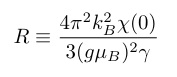
Two important signatures of a Fermi liquid metal are that at low temperatures (i.e. much less than the Fermi temperature) the specific heat is proportional to temperature and the magnetic susceptibility is independent of temperature. Both are proportional to the density of states at the Fermi energy and one can form a dimensionless ratio, the Sommerfeld-Wilson ratio:
R is unity for a non-interacting gas of fermions and is 2 for the impurity contribution in the single impurity Kondo model [Yamada proposed this highly non-trivial result and Wilson confirmed it with the numerical renormalization group].

An important property of heavy fermion metals both the specific heat and susceptibility are enhanced by approximately the same amount. This can be seen in the plot below, where the solid line corresponds to a Wilson ratio of unity.


The plot was first made in Barbara Jones 1985 Cornell Ph.D thesis. 
This version is from Piers Coleman's review article Heavy Fermions: Electrons at the edge of Magnetism.

More than 10 years ago I wrote a paper Wilson's ratio and the spin splitting of magnetic oscillations in quasi-two dimensional metals.
I failed to get it published because of subtle issues about vertex corrections. Nevertheless, the preprint still seems to be of some use to people. See for example, the recent preprint Direct observation of multiple spin zeroes in the underdoped high temperature superconductor YBa2Cu3O6+x

The emergence of hadronic matter from interacting quarks and gluons

 A characteristic of emergent phenomena is how novel and complex properties can emerge from apparently simple laws. Quantum ChromoDynamics (...