Showing posts with label organic photonics. Show all posts

Tuesday, July 21, 2026

Rudolph Marcus (1923-2026): theoretical chemical physicist

Rudolph Marcus died last week. He was 102. There is a nice obituary in The New York Times. He was best known for his theory of electron transfer, for which he was the sole recipient of the Nobel Prize in Chemistry in 1992.

Although the theory was proposed for electron transfer in a polar solvent it applies to a wide range of other systems, where two quantum states are coupled to one another and to an environment. One example is for Forster transfer of excitons between molecules, which is central to photosynthesis.

I will give a physics perspective, based on a talk I gave in Slovenia back in 2013. Slides are here.

Basically, Marcus proposed an effective Hamiltonian for two diabatic states and calculated a transition rate in a limit that is relevant to most chemical contexts.

The Hamiltonian can be viewed as the spin-boson model, in which a two-level system is coupled to a bath of harmonic oscillators. 

[The dense book by Weiss on Quantum Dissipative Systems makes the connection explicit in detail. A more accessible treatment may be chapter 16 in the book Chemical Dynamics in Condensed Phases by Nitzan.]

The Hamiltonian is 

This defines a spectral density, which is important for quantum decoherence, but not so much here, except it defines a timescale that determines the classical limit, which Marcus assumed.


This can be used to define a quantity central to Marcus' theory, the reorganisation energy.


The transition rate between the two quantum states is given by

I consider this to be one of the most important equations in chemical physics, particularly for the understanding and design of functional materials.

Aside. Much of this is equivalent to Holstein's 1959 treatment of incoherent polaron transport (see Mahan, Many-body physics).

A key experiment by John R. Miller, Lidia T. Calcaterra and Gerhard L. Closs in 1984 showed how good the theory was and how its predictions were counter-intuitive. The authors considered a family of molecules that allowed them to tune epsilon, the energy difference between the two electronic states. [On the graph below epsilon = - Delta G].


The vertical scale is the reaction rate on a logarithmic scale. It varies by four orders of magnitude.

What is surprising? As stated at the Nobel prize award ceremony:

"The quadratic equation predicts that electron transfer reactions will occur more slowly the larger the driving force of the reaction is. This phenomenon received its own name, “the inverted region.” To a chemist, the phenomenon is just as unexpected as when a skier finds himself gliding more slowly down a slope the steeper it is."

The theory implies an important design principle for functional materials: if optimising functionality means maximising the reaction rate, then tune the energy difference epsilon to equal the reorganisation energy E_R.

The theory illustrates two important aspects of emergence: effective theories and universality. Many different systems can be described by the same theory. The environment may involve many degrees of freedom and its coupling to the system is characterised by many parameters (the M_alpha above). However, only one parameter matters, the reorganisation energy.

For Australians, there is some ambivalence about the way Marcus' name is often solely associated with electron transfer theory. We often refer to it as Marcus-Hush or Hush-Marcus theory because Noel Hush did similar work around the same time. Some of the history is recounted here by Ian Rae and Jeff Reimers. There are also subtle debates about whether the electron transfer is adiabatic or non-adiabatic.

My only personal interaction with Marcus was in 2011 when I visited the chemistry department at Caltech. Marcus kindly took me to lunch at the faculty club, along with his research group. Then he was 84 years old. He kept publishing papers until he died.

Friday, December 9, 2022

The wonders and mysteries of bioluminescence

 Members of my family have been reading Phosphorescence: On awe, wonder, and things that sustain you when the world goes dark, a personal memoir by Julia Baird.

This reminded me of how amazing and fascinating bioluminescence is, stimulating me to read more on the science side. One of the first things is to distinguish between bioluminescence, fluorescence, and phosphorescence.

Bioluminescence is chemical luminescence whereby a biomolecule emits a photon through the radiative decay of a singlet excited state that is produced by a chemical reaction. 

In contrast, fluorescence occurs when the singlet excited state is produced by the molecule absorbing a photon.

Phosphorescence occurs when a molecule emits a photon through the radiative decay of an excited triplet state, that was produced by the absorption of a photon.

Bioluminescence can occur in the dark. Fluorescence cannot as there are no photons to absorb. Phosphorescence is sometimes seen in the dark but this is because the molecule absorbs invisible UV light which produces the triplet state which has a very long radiative lifetime.

Baird gives beautiful and enchanted descriptions of seeing "phosphorescence" on her daily early morning ocean swim. She acknowledges that this is actually bioluminescence not phosphorescence. I should stress that in pointing this out I am not "unweaving the rainbow", as for literary purposes using "bioluminescent" would be clunky.


There is a useful webpage from a research group at UC Santa Barbara. They also have a detailed review article from which I took the image above.

Steven H.D. HaddockMark A. MolineJames F. Case

A much shorter review that I read this morning is

Bioluminescence in the Ocean: Origins of Biological, Chemical, and Ecological Diversity, by E.A. Widder

An article in Quanta magazine, In the Deep, Clues to How Life Makes Light by Stephanie Yin

So what is the underlying photophysics and quantum chemistry? The following review is helpful.

The Chemistry of Bioluminescence: An Analysis of Chemical Functionalities 

Isabelle Navizet, Ya-Jun Liu, Nicolas Ferré, Daniel Roca-Sanjuán, Roland Lindh

Almost all currently known chemiluminescent substrates have the peroxide bond, -O-O-, in common as a chemiluminophore. This chemical system facilitates the essential mechanism of chemiluminescence—providing a route for a thermally activated chemical ground-state reaction to produce a product in an electronically excited state. The basics of this process can be understood from studies of ... dioxetanone. [it] contains a peroxide bond, [and] fragments like the firefly luciferin system to carbon dioxide.

The squiggly line denotes the bond that is broken to produce the excited singlet state.
The figure below shows the potential energy surface that describes the dynamics leading to the emissive state. Note the presence of two conical intersections.


Much of this photophysics can be understood in terms of a "two-site Hubbard model" discussed in this classic paper that I love.

Neutral and Charged Biradicals, Zwitterions, Funnels in S1, and Proton Translocation: Their Role in Photochemistry, Photophysics, and Vision

Vlasta Bonačić-Koutecký, Jaroslav Koutecký, Josef Michl

In simple terms, all that is different in the biomolecular system is that the enzyme and the larger chromophore tune energy levels so that the energy barriers are much smaller so that the steps needed for bioluminescence become accessible at room temperature.

This highlights two fundamental things. 

Chemistry is local. This is relevant to understanding Wannier orbitals in solid state physics, to hydrogen bonding, and how protein structure aids function.

"Biochemistry is the search for the chemistry that works" [in water at room temperature].

Tuesday, June 14, 2022

A model for light-induced spin-state trapping in spin-crossover materials

 An important challenge required to understand the physical properties of materials that are chemically and structurally complex is to ascertain which microscopic details are important. A related question is at what scale (length, number of atoms, energy) models should be developed.

A specific example is understanding the magnetic properties and state transitions of spin-crossover materials. This is difficult for equilibrium properties, let alone for non-equilibrium properties such as Light-Induced Excited Spin-State Trapping (LIESST). At low temperatures irradiation with light can induce a transition from the equilibrium low-spin state to a long-lived high-spin state, which is only an equilibrium state at higher temperatures. (LIESST gets a lot of attention because of the potential to make optical memories for information storage).

Some of my UQ colleagues recently published a nice paper that elucidates some of the key physics with the proposal and analysis of a (relatively simple) model that captures many details of the experimental data.

Toward High-Temperature Light-Induced Spin-State Trapping in Spin-Crossover Materials: The Interplay of Collective and Molecular Effects

M. Nadeem, Jace Cruddas, Gian Ruzzi, and Benjamin J. Powell

Friday, March 25, 2022

Anthony Jacko (1985-2022): condensed matter theorist

I was very sad when last week I learned of the death of Anthony Jacko, a former member of the Condensed Matter Theory group at UQ. He was only 36 years old, having been diagnosed with stage 4 cancer at the end of last year.

Jacko's funeral was this week. Family and friends spoke warmly of his intelligence, humour, faithfulness, passion for life, and endearing quirkiness. There were both tears and laughs.

I will say something here about his scientific contributions, though at times like this what we achieve professionally does not really seem that important.

I first met Jacko as an undergraduate at UQ when he took an advanced undergraduate condensed physics course with me in 2006. That year he did an undergraduate honours (fourth year) project with Ben Powell and John Fjaerestad, on the Kadowaki-Woods ratio. This work eventually led to a Nature Physics paper, that I discussed in this blog post.

In 2007 I was quite happy when Jacko decided to do a Ph.D. with me and Ben Powell. We tried to come up with simple effective Hamiltonians for organometallic complexes that are used in organic LEDs and solar cells. Although we made some progress, I think the questions we tried to address have still not been answered definitively. The most progress has subsequently been made by Ben Powell.

For a postdoc, Jacko moved to Frankfurt to work with Roser Valenti and Harald Jeschke (now at Okayama University). I was really impressed how Jacko learned how to do reliable DFT-based electronic structure calculations and to use Wannier orbitals to extract tight-binding model parameters. Jacko brought this expertise back to Ben Powell's group at UQ, where he worked from 2013 to 2018.

During that time Jacko co-authored a string of really nice papers that inspired me to write multiple blog posts, such as those below. Looking back over that work I see how careful, solid, and systematic it is. Basically, good science, that we do not see enough of these days.

The broad issue is as follows. Understanding strong electron correlations in complex molecular materials requires effective Hamiltonians that are a realistic representation of the essential physics and chemistry. Sometimes next-nearest-neighbour interactions and subtleties in crystal structure really do matter. Other times they do not. The methods used by Jacko provided a robust way of doing this.


Faculty hope that former students will come to their funeral. We also hope that we won't have to attend the funeral of any of our students. It is very sad.

An endowment is being created at The University of Queensland, to fund an undergraduate physics prize that will be awarded each year in honour of Jacko.

My condolences to Jacko's partner, Alana, and to family and friends.

Thursday, March 5, 2020

The quantum physics of life in red and green

Life is truly amazing!
Life is beautiful!
...and it involves quantum many-body physics...

There is a beautiful (short) review
Heme: From quantum spin crossover to oxygen manager of life 
Kasper Kepp

The article involves a plethora of topics that I have discussed before on this blog. I have included relevant links.

Kepp starts with the unique (chemically fine-tuned) properties of both iron and porphyrin that enable them to play a central role in two of the most important processes in life: respiration and photosynthesis. He has a beautiful paragraph (perhaps in the style of Roald Hoffmann):
Such ligand-field transitions of iron in porphyrin were familiar to our ancestors as the characteristic red color of blood that largely defines the human psychological and cultural connotations of the color representing courage, war, danger, and suffering. 
Incidentally, pi-pi* transitions within the porphyrin-derived chlorophylls are also responsible for the green color of plants, associated with nature, life and hope, so the reader may perhaps agree that porphyrin has had vast (but alas! rarely appreciated) cultural consequences.
The oxygen molecule is a spin triplet.
Iron(II) porphyrin is in a triplet spin state (S=1). The Fe(II) is a d6 configuration in a D_4h crystal field.
When they bind together the ground state is a spin-singlet.

There are two fundamental quantum chemistry questions that are discussed.

1. What is the electronic structure (many-body wave function) of the ground state for oxygen bound to heme?

2. What is the mechanism for the ``spin-forbidden'' transition of the oxygen binding?

The first question has a long history. Like almost anything important and profound in quantum chemistry it goes back to Linus Pauling! In 1936 Pauling and Coryell argued that the ground state is
essentially a neutral O=O binding with two of its electrons to iron to produce a formally iron(II) if both the bonding electrons were confined to O2, corre- sponding to the non-bonding limit of neutral parts, but a formally iron(I) if the Fe–O bond were to be considered covalent. 
In 1960, McClure suggested a valence-bond formulation based on triplet–triplet coupling, which is appealing by the low promotion energies required to access these states, rather than the singlet states. In 1964, Weiss suggested, based on analogy to chemical reactions in aqueous solution, that the true ferrous hemeO2 adduct was mainly of the superoxo-iron(III) type caused by ‘‘electron transfer” from iron to O2. 
Goddard and Olafson suggested an ozone model of the adduct in 1975 which emphasized the four-electron three-center bond with maintained triplet state of dioxygen as in the McClure model with less electronic reorganization to explain the reversible binding. 
In 1977, Pauling maintained his original view again, the same year that Huynh, Case, and Karplus did a first attempt to bridge these views by performing early quantum chemical calculations that diplomatically emphasized the importance of both Weiss and Pauling resonance forms. 
However, interpretation depends on model language, orbital localization, and transformation between valence bond and orbital formalisms:  
In terms of molecular orbital theory, the wave function was a multi-configurational state dominated by the Pauling configuration; however, if one uses valence bond theory considerations, it can be interpreted as having large Weiss character. Thus, the multi-configurational state produced from CASPT2 is interpreted differently by different models. This partly explains why the trenches were so deeply dug during the exchange between Pauling, Goddard, McClure, and Weiss; all were right, and all were wrong. 
This is just another example of unnecessary conflicts about valence bond vs. molecular orbital (VB vs. MO). 
In terms of valence structures, the ground state was summarized by Shaik and Chen as having contributions from both Weiss, Pauling, and McClure forms, the first .. dominating. 
Ironically DFT ends up providing a useful language after all! 
The charge assignments to O2 are very dependent on calculation scheme, and both the orbitals, valence structures, and atomic charges that defined the Weiss-Pauling debate are non-observable. In contrast, the electron density is observable as are the geometries and spectroscopic data...
Molecular orbitals are not physical observables but calculational constructs. MO's don't exist.

In different words, one can take a many-body wave-function and make a linear unitary transformation of the molecular orbitals. The Slater determinants do not change. [The value of a determinant is invariant to a change of basis.]

Now. Question 2.
What is the mechanism for the ``spin-forbidden'' transition of the oxygen binding?

Kepp talks about spin-orbit coupling and the fact that it is small for oxygen, motivating a discussion of a "broad crossing mechanism".  However, I am not sure this is relevant. I don't see the binding as necessarily spin forbidden. As the oxygen approaches the heme the two triplet states can mix to form a total spin singlet.
This is analogous to bringing two hydrogen atoms (each of which is spin 1/2) together to form a hydrogen molecule (which is spin zero). A multi-configurational wavefunction has no problem with this. But DFT-based approximations, which use a single determinant cannot describe this smooth crossover.

Other things of particular interest to me that are discussed in the review include the central role of back bonding and the success of the TPSSh functional in DFT calculations for organometallics.

Unfortunately, the review does not mention recent work by Weber et al, applying DMFT to the problem of oxygen binding to haemoglobin.

Friday, January 27, 2017

What are the biggest discoveries in solid state electronic technology?

Watching an excellent video about the invention of the transistor stimulated to me to think about other big discoveries and inventions in solid state technology.

Who would have thought that huge device would become the basis of an amazing revolution (both technological, economic, and even social...)?


In particular, which are the most ubiquitous ones?
For which devices did both theory and experiment play a role, as they did for the transistor?

I find it worthwhile to think about this for two reasons. First, this semester I am again teaching solid state physics and it is nice to motivate students with examples.
 Second, there is too much hype about basic research in materials and device physics, that glosses over the formidable technical and economic obstacles, to materials and devices becoming ubiquitous. Can history give us some insight as to what is realistic?

Here is a preliminary list of some solid state devices that are ubiquitous.

transistor

inorganic semiconductor photovoltaic cell

liquid crystal display

semiconductor laser

optical fiber

giant magnetoresistance used in hard disk drives

blue LED used in solid state lighting

lithium battery

Some of these feature in a nice brochure produced by the USA National Academy of Sciences.

Here are a few that might be on the list but I am not sure about as I think they are more niche applications with limited commercial success. Of course, that may change...

thermoelectric refrigerators

organic LEDs

superconductors (in MRI magnets and as passive filters in mobile phone relay towers )

Is graphene in any commercial device?

What would you add or subtract from the list?

Tuesday, December 20, 2016

More subtleties in protein structure and function

Almost three years ago I posted about the controversy concerning whether the photoactive yellow protein has low-barrier hydrogen bonds [for these the energy barrier for proton transfer is comparable to the zero-point energy]. I highlighted just how difficult it is going to be, both experimentally and theoretically to definitively resolve the issue, just as for an enzyme I recently discussed.
A key issue concerns how to interpret large proton NMR chemical shifts.

Two recent papers weigh in on the issue

The Low Barrier Hydrogen Bond in the Photoactive Yellow Protein: A Vacuum Artifact Absent in the Crystal and Solution 
Timo Graen, Ludger Inhester, Maike Clemens, Helmut Grubmüller, and Gerrit Groenhof

A Dynamic Equilibrium of Three Hydrogen-Bond Conformers Explains the NMR Spectrum of the Active Site of Photoactive Yellow Protein 
Phillip Johannes Taenzler, Keyarash Sadeghian, and Christian Ochsenfeld

I think the caveats I have offered before need to kept in mind.
As with understanding the active sites of most proteins the problem is that we don't have very direct experimental probes, but have to use indirect probes which produce experimental results that require significant modelling and interpretation.


I thank Steve Boxer for bringing one of these papers to my attention.

Monday, November 21, 2016

The "twin" excited electronic state in strong hydrogen bonds

One of the key predictions of the diabatic state picture of hydrogen bonding is that there should be an excited electronic state (a twin state) which is the "anti-bonding" combination of the two diabatic states associated with the ground state H-bond.
Recently, I posted about a possible identification of this state in malonaldehyde.

The following recent paper is relevant.

Symmetry breaking in the axial symmetrical configurations of enolic propanedial, propanedithial, and propanediselenal: pseudo Jahn–Teller effect versus the resonance-assisted hydrogen bond theory
Elahe Jalali, Davood Nori-Shargh

The key figure is below. The lowest B2 state is the twin state.
In the diabatic state picture, Delta is half of the off-diagonal matrix element that couples the two diabatic states.
Similar diagrams occur when O is replaced with S or Se.


The paper does not discuss twin states, but interprets everything in terms of the framework of the
 (A1 + B2) ⊗ bpseudo-Jahn-Teller effect. 

Two minor issues might be raised about this work.
It uses TD-DFT (Time-dependent Density Functional Theory). It is contentious how reliable that is for excited states in organic molecules.
The diabatic states are not explicitly constructed.
These issues could be addressed by using higher level quantum chemistry and constructing the diabatic states by a systematic procedure, as was done by Seth Olsen for a family of methine dye molecules.

Saturday, November 5, 2016

The role of simple models and concepts in computational materials science

Today I am giving the first talk in a session on Computational materials science at the 4th International Conference on Advances in Materials and Materials Processing.

Here are the slides for my talk "The role of simple models and concepts in computational materials science".

I will be referring the audience to the article such as those mentioned here, here and here that give a critical assessment of computer simulations and stress the importance of concepts.

I welcome comments, particularly as I think the talk could be stronger and clearer.

Thursday, January 14, 2016

Stunning and creative microscope images where science meets fashion

The New York Times has a nice obituary Michael W. Davidson, a Success in Microscopes and Neckwear, Dies at 65

I did not know Davidson personally but I did benefit from his art. I visited the National High Magnetic Field Lab at Florida state several times in the 1990s. In appreciation my host Jim Brooks gave me a few of the neckties [which I still wear, on the rare event I actually wear a tie!] and a series of prints of images of  Australian products such as that of Vegemite below. I still have these prints on display in my office.


The website Molecular expressions contains not just a gallery of many beautiful microscope images but also more technical discussions about microscopy.

One thing I did not know about Davidson that I learnt from the obituary was the important role he played in the work for which the Chemistry Nobel Prize of 2014 was awarded.

Saturday, September 5, 2015

The challenge of excited state proton transfer

What is excited state proton transfer (ESPT)?
Consider a hydrogen bond A-H...B in a molecular system.
Suppose the system absorbs a photon (usually in the visible to near UV range) and undergoes a transition to an electronic excited state. In most cases A-H is an organic molecule containing conjugated bonds and the transition is a pi to pi* transition. Then on the time scale of picoseconds [within a factor of one thousand] the proton transfers from the donor A to the acceptor B,
i.e. (A-H)*...B evolves to something like (A-)*...(H-B)+.
If A and B are part of the same molecule then this is intramolecular ESPT.
If A and B are distinct molecules then this is intermolecular ESPT.
If A-H is dissolved in water, and significant ESPT occurs then A-H is called a photoacid.

I have started to work on this rich and diverse subject.
My goal is to develop several simple diabatic state models that might give a more unified picture of the phenomena and provide some physical insight. Given the chemical complexity, this may be a mistake, reflecting a physicists naivety and/or hubris. But I am encouraged by the "success" of the simple two diabatic state model that I have promoted for hydrogen bonding (and proton) transfer in the ground state.

I am working my way through the extensive chemical literature and so here is my attempt to organise some of what I have learnt. Comments and corrections are particularly welcome.

In a short review [focusing mostly on solvent effects] from 1986 Michael Kasha presented the following picture. It shows the energy of the ground state (S_0) and the excited state (S_1) as a function of the hydrogen co-ordinate Q_H. For example this might be an OH stretch.

One can clearly see that in the excited state proton transfer is both energetically and kinetically more favourable. What might a diabatic state model look like?
The ground state surface could be described in terms of the usual two diabatic states: A-H,B-  and
A-,H-B.   Similarily the excited state surface could be described in terms of a separate but analogous model involving two diabatic states that differ by transfer of a proton.
The difference between the two models is simply the relative energy of the two diabatic states, i.e. the relative proton affinity of the donor and acceptor is reversed between the ground and excited states.
Furthermore, the barrier to proton transfer could be reduced, or even removed, if the coupling of the two diabatic states increases in the excited electronic state. This could happen if the donor-acceptor distance is reduced in the excited state.

This natural "explanation" of ESPT was widely promoted for a long time, probably going back to Weller in 1952. The basic idea is that in the excited state there is charge redistribution leading to weakening of the O-H bond, making it easy for the H to "pop off". A related claim is that in a photoacid the pKa of the excited state is much less than that of the ground state.

However, there are multiple problems with the picture presented above.

A. It is arguably not really an explanation but a description. It almost says "ESPT happens because ESPT happens." Specifically, it does not really explain why the relative energy of the donor and acceptor diabatic states reverses upon photo excitation.

B. It assumes there is no relationship (or interaction) between the ground and excited electronic states. In reality they can be intimately connected. Striking examples include that of twin states or resonance assisted H-bonds, such as in malonaldehyde.

C. Based on the energy surfaces above Forster presented a simple equation relating the S0-S1 energy difference (and the associated absorption and emission frequencies) between the two tautomers [i.e. molecules differing in the location of the proton] and the pKa's [a measure of acidity] in the ground and excited states.
However, Tolbert and Solntsev report many violations of this equation.

D. Actual high level quantum chemistry calculations for specific molecules that do exhibit ESPT do find that for some there is little charge redistribution in the excited state relative to the ground state; or more importantly, the proton affinity does not necessarily change significantly.

E. It may be omitting a role for different excited states (e.g. charge transfer states or n-pi* states) and conical intersections.

D. and E. are emphasised this calculation by Grannuci, Hynes, Milli, and Tran-Thi.

E. is emphasised by Sobolewski and Domcke who present the diabatic state picture below for cases where the proton transfer is coupled to an electron transfer.


A particularly interesting and widely studied case of ESPT is in the green fluorescent protein (GFP). More on that later...

I thank Seth Olsen for introducing me to some of the literature. If some of the above is not as coherent as it might be that is because of my limited reading and understanding. But, I think it also reflects the diversity of the subject and the lack of a comprehensive picture.

I welcome comments.

Tuesday, August 4, 2015

Searching for conical intersections for singlet fission

Previously I have posted about the fascinating challenge of understanding singlet fission [and the inverse process of triplet-triplet annihilation] in large organic molecules.  A key feature to understand is how fission can occur in less than 100 femtoseconds, suggestive of a conical intersection between excited state potential energy surfaces.

In Telluride Nandini Ananth gave a nice talk about work described in the paper

The Low-Lying Electronic States of Pentacene and Their Roles in Singlet Fission 
Tao Zeng,  Roald Hoffmann , and Nandini Ananth

Diabatic states provide a natural and powerful approach to understanding what is going on.
The authors perform high level quantum chemistry calculations to describe the relevant electronic excited states. They claim that for a pair of pentacene molecules one needs to include at least six diabatic states. Their dominant electronic configuration is shown in the schematic below.
We find that only one of the two charge-transfer states, ac, is engaged in the SF [singlet fission] in pentacene; it is the low-lying charge-transfer state that gets closer to the multi- and single-exciton states. Moreover, the ac diabat can move into degeneracy with the single-exciton states, more effectively mediating the mixing of the bright single- to and dark multiexciton diabats. This finding is different from the basic assumption of high-lying charge-transfer states in the superexchange model, emphasizing the need to adapt the general SF model to specific cases.
Aside: I wonder if this is one the few papers that Hoffmann has co-authored where strong electron correlations are central.

In more recent work, the authors have tried to pin down what is the relevant nuclear co-ordinate [vibrational mode] associated with a conical intersection. It is not the intermolecular separation but may be instead the relative orientation [twisting] of the two penatacene molecules. This has included some constructive interaction with the experimental group of Luis Campos.

Monday, July 6, 2015

Genetically engineering short hydrogen bonds in a fluorescent protein

There is a very nice article in the new journal, ACS Central Science
Short Hydrogen Bonds and Proton Delocalization in Green Fluorescent Protein (GFP) 
Luke M. Oltrogge and Steven G. Boxer

This is an impressive piece of work spanning from molecular biology to chemistry to quantum physics.
There is also a commentary on the paper by Judith Klinman, placing it in the context of the controversial issue of low-barrier hydrogen bonds in enzymes.

An extensive study was made of mutants of the Green Fluorescent Protein with a short hydrogen bond between the chromophore and the amino acid Asp148. The donor-acceptor bond length estimated from X-ray structures was 2.4 +/- 0.2 Angstroms. This is in the range of low-barrier H-bonds.

What is particularly new here is that through ingenious molecular biology techniques [nonsense suppression] the acidity [pK_a = measure of tendency to give up protons] of the chromophore was systematically varied by 3.5 units through halogen substitutions.


This range covers the pK_a matching required for strongest H-bonds, as discussed in this earlier post. The experimental results were compared to calculations based on a one-dimensional proton transfer potential based on a diabatic state model I have advocated. It was very satisfying for me to see this simple model being used by experimentalists.

To me what is most striking about the paper is the UV absorption spectra below. It is very different from what one normally sees in GFP spectra.
There are generally two absorption bands, denoted A and B, associated with GFP. The A-state and B-state are identified with the neutral chromophore and anionic [i.e. deprotonated] chromophore, respectively. The corresponding spectra are similar to the black and grey curves shown above. The green spectrum above is for the Cl1Y substituted chromophore, which is close to pK_a matching, and is rather broad and intermediate between the A-state and B-state spectra. This is arguably because the proton is delocalised between the chromophore and neighbouring Asp amino acid.

The authors also substituted protons (H) with deuterium (D) to see the extent of quantum nuclear effects. These are normally very small in GFP. However, here they are noticeable.
The measured isotopic fractionation factors Phi (deduced from analysis of the UV absorption spectra) were in the range 0.54 - 0.9, taking a minimum value for pK_a matching. This observation and a value of Phi=0.54 for R=2.4 +/- 0.2 Angstroms are consistent with a recent theoretical analysis.

There is one point where I disagree with the theoretical analysis of the authors. I am confused that they average over the vibrational eigenstates to get an electronic absorption spectrum. This seems to me this goes against the Franck-Condon principle.  If one followed this same procedure for other molecules the UV spectra would all be much broader than they are, particularly in gas phase.
It is not clear to me how one should proceed in this situation where the proton is quite delocalised and the absorption spectra is significantly different for protonated and de-protonated chromophores. There may be significant Herzberg-Teller effects. One way forward to could be to combine the two-diabatic state H-bond model with a two-state resonance model for the chromophore, such as those advocated by Seth Olsen and I, and then do a full non-adiabatic treatment of the model.

I thank Luke Oltrogge and Seth Olsen for helpful discussions about this work.

Monday, December 15, 2014

Finding the twin state for hydrogen bonding in malonaldehyde


I was quite excited when I saw the picture above when I recently visited Susanta Mahapatra.

One of the key predictions of the diabatic state picture of hydrogen bonding is that there should be an excited electronic state (a twin state) which is the "anti-bonding" combination of the two diabatic states associated with the ground state H-bond.
Recently, I posted about how this state is seen in quantum chemistry calculations for the Zundel cation.

The figure above is taken from
Optimal initiation of electronic excited state mediated intramolecular H-transfer in malonaldehyde by UV-laser pulses 
K. R. Nandipati, H. Singh, S. Nagaprasad Reddy, K. A. Kumar, S. Mahapatra

The figure hinted to me that for malonaldehyde the twin state is the S2 excited state, because of the valence bond pictures shown at the bottom of the figure and because the shape of the two potential energy curves is similar to that given by the diabatic state model.
Below I have plotted the curves for a donor-acceptor distance of R=2.5 Angstroms, comparable to that in malonaldehyde.

The vertical scale is such that D=120 kcal/mol, leading to an energy gap between the ground and excited state of about 4 eV, comparable to that in the top figure [which is in atomic units, where Energy = 1 Hartree = 27.2 eV].
Note that in the first figure, there is a gap on the vertical scale and the top and bottom part of the figures involve a different linear scale.
Hence, to make a more meaningful comparison I took the potential energy curves and replotted them on a linear scale using the polynomial fits given in the paper. The results are below.


There is reasonable agreement, but only at the semi-quantitative level.
[With regard to units the distances are in atomic units (Bohr radius = 0.5 Angstroms] and comparable].

The figure below shows how the calculated transition dipole moment between the ground state and the first excited state. I was surprised that it only varied by about five per cent with change in nuclear geometry.
However, Seth Olsen pointed out to me that this small variation reflects the Franck- Condon approximation [which is very important and robust in molecular spectroscopy].
I also calculated this with the diabatic state model, assuming that the dipole moment of diabatic states did not vary with geometry and the Mulliken-Hush diabaticity condition [that the dipole operator is diagonal in the diabatic state basis] held (see Nitzan for an extensive discussion).
[The units here are 1 atomic unit = 2.6 Debye].


The vertical scale here is the magnitude of the dipole moment in one of the diabatic states. This is also the approximate value of the dipole moment of the molecule at "high" temperatures above which there is no coherent tunnelling between the two isomers, i.e. the proton is localised on the left or right side of the value. The experimental value reported here is about 2.6 Debye.
This is consistent with the claim that the diabatic state model gets the essential physics of the electronic transition.

But, of course the real molecule is more complex. For example, between the S0 and S1 states there is a "dark" S1 state, characterised as a n to pi* transition where n is the lone pair orbital on the oxygen. The three states and their associated conical intersections are discussed in a nice paper by Joshua Coe and Todd Martinez.

I think a good way to more rigorously test/establish/disprove the diabatic state picture is to use one of the "unbiased" recipes to construct diabatic states, such as that discussed here, from high-level computational chemistry.

Friday, November 14, 2014

Hyderabad talk on fluorescent protein chromophores

Today I am visiting the Chemistry department at Hyderabad Central University. My host is Susanta Mahapatra. He has done some very nice work on non-adiabatic dynamics in the excited states of organic molecules. A nice review is here. Some of this work is relevant to the puzzle of diffuse interstellar bands and is described in this PRL.

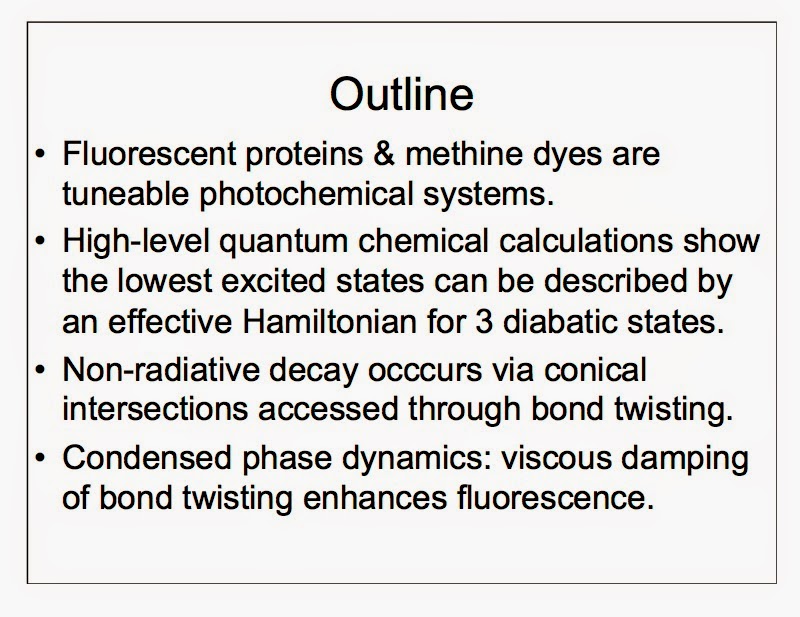
I am giving a talk "Effective Hamiltonians for excited states of fluorescent proteins and methine dyes". The slides are here. A relevant paper with Seth Olsen is here.


Thursday, October 30, 2014

Excited state potential energy surfaces for organic dyes

Sean McConnell, Seth Olsen, and I just finished a paper
A Valence-Bond Nonequilibrium Solvation Model for a Twisting Cyanine Dye


We study a two-state valence-bond electronic Hamiltonian model of non-equilibrium solvation during the excited-state twisting reaction of monomethine cyanines. These dyes are of interest because of the strong environment-dependent enhancement of their fluorescence quantum yield that results from suppression of competing non-radiative decay via twisted internal charge-transfer (TICT) states. For monomethine cyanines, where the ground state is a superposition of structures with different bond and charge localization, there are two twisting pathways with different charge localization in the excited state. The Hamiltonian designed to be as simple as possible consistent with a few well-enumerated assumptions. It is defined by three parameters and is a function of two π-bond twisting angle coordinates and a single solvation coordinate. For parameters corresponding to symmetric monomethines, there are two low-energy twisting channels on the excited-state surface that lead to a manifold of twisted intramolecular charge-transfer (TICT) states. For typical monomethines, twisting on the excited state will occur with small or no barrier. We show that changes in the solvation configuration can differentially stabilize TICT states in channels corresponding to different bonds, and that the position of a conical intersection between adiabatic states moves in response to solvent to stabilize either one channel or the other. We show that there is a conical intersection seam that grows along the bottom of the excited-state potential with increasing solvent polarity. For solvents of even moderate polarity, we predict that the intersection seam should completely span the bottom of the excited-state potential in these systems.

We welcome any comments.

Wednesday, June 25, 2014

Condensed phase dynamics in Telluride

Last night I was stranded at Denver airport en route to the bi-annual Condensed phase dynamics meeting at the Telluride Science Research Center.  This is the third time I have been to this wonderful meeting. Getting there can be a real hassle. But, then you look at the scenery and enjoy the science and it seems worth it.


Unfortunately, due to the travel delays I missed the first two talks, by Joe Subotnik and Nandini Ananth.

Dominika Zgid gave a chemist's perspective on "How to make dynamical mean theory quantitative". Some of her work was discussed in a my last post. Today she mostly discussed a generalisation of iterative perturbation theory as an "impurity solver" for DMFT problems with multiple orbitals. See this preprint.

Peter Rossky discussed quantum chemical simulations of exciton dynamics in conjugated polymers.

This was motivated by an experiment reported in Science that claimed evidence for quantum coherent transport of excitons along a polymer chain at room temperature. Several oscillations were seen in the fluorescence polarisation anisotropy  as it decays in about a picosecond. These oscillations were identified with quantum inference [Rabi oscillations] between different exciton states delocalised over the polymer chain.

It turns out the experimental results have a much more mundane explanation.
The simulations of Adam Willard and Rossky are of classical dynamics on the adiabatic excited state potential energy surface calculated from a parameterised PPP [Pariser-Parr-Pople] model [basically a Hubbard model with long-range Coulomb interactions. They see oscillations similar to those in the experiment and can identified simply with classical nuclear motion associated with the polymer backbone stretching [phonons] in response to photo-excitation.

Much-hyped experiments claiming to show quantum coherence in photosynthetic complexes, probably also have a similar classical explanation in terms of nuclear dynamics rather than electronic coherences. A concrete interpretation in terms of vibrational coherences is in this PNAS paper. My skepticism of these "quantum biology" experiments has been expressed in many earlier posts.

Hopefully, tomorrow I will blog about talks from Eran Rabani, Todd Martinez, and Dvira Segal.

Friday, February 7, 2014

Quantifying many-body effects in organic photovoltaics

Most papers about organic photovoltaics are full of discussion about HOMO's and LUMO's, their relative energies and spatial extents.  
In the early days of this blog, I asked Am I HOMO- and LUMO-phobic?

Molecular orbitals are beautiful intuitive concepts that are extremely valuable for qualitative understanding. However, they do not exist, i.e., there is no way to measure one, even in principle.
Furthermore, for typical organic molecules used in organic photonics and electronics the one-electron energies associated with these orbitals usually do not give reliable estimates of physically observable energies [associated with true many-body states] such as the ionisation energy, electron affinity, optical energy gap....

I was pleased to see that the above issues are nicely explained and quantified in a recent paper

Reassessing the use of one-electron energetics in the design and characterization of organic photovoltaics
Brett M. Savoie, Nicholas E. Jackson, Tobin J. Marks, and Mark A. Ratner
We present results showing that common approximations employed in the design and characterization of organic photovoltaic (OPV) materials can lead to significant errors in widely adopted design rules. First, we assess the validity of the common practice of using HOMO and LUMO energies in place of formal redox potentials to characterize organic semiconductors. We trace the formal justification for this practice and survey its limits in a way that should be useful for those entering the field. We find that while the HOMO and LUMO energies represent useful descriptive approximations, they are too quantitatively inaccurate for predictive material design. Second, we show that the excitonic nature of common organic semiconductors makes it paramount to distinguish between the optical and electronic bandgaps for materials design. Our analysis shows that the usefulness of the “LUMO–LUMO Offset” as a design parameter for exciton dissociation is directly tied to the accuracy of the one-electron approximation. In particular, our results suggest that the use of the “LUMO–LUMO Offset” as a measure of the driving force for exciton dissociation leads to a systematic overestimation that should be cautiously avoided.
Some of these issues were also highlighted in earlier work, led by my UQ colleague Ben Powell, but not referenced.

Monday, October 7, 2013

Tutorial on effective Hamiltonians for quantum dynamics in functional molecular materials

Today I am giving a seminar in the Theoretical Physics Department of the Stefan Institute. The abstract is below. The slides are here. The most important equation [the general form of the Hamiltonian] is missing (!) because I will write it on the white board and discuss at length. It is included below.

This informal tutorial will introduce some of the key concepts and approaches associated with modelling and understanding quantum dynamical processes in complex molecular materials.
This will provide background and motivation for understanding some of my work [1-4].

1. Examples of functional materials: optically active biomolecules, organic light emitting diodes and solar cells, enzymes, …
2. Examples of dynamical processes: charge separation, proton transfer, exciton transport, …
3. Partition: discrete quantum system + environment (solvent or protein)
4. Form of Model Hamiltonians
5. Diabatic states and potential energy surfaces
6. Example: spin boson model
7. Outstanding questions: quantum coherence, sequential vs. concerted, breakdown of Born-Oppenheimer, ...

[1] J. Gilmore and R.H. McKenzie, J. Phys. Chem. A 112, 2162 (2008).
[2] J. Bothma, J. Gilmore, and R.H. McKenzie, New. J. Phys. 12, 055002 (2010).
[3] S.C. Olsen and R.H. McKenzie, J. Chem. Phys. 130, 184302 (2009).
[4] R.H. McKenzie, Chem. Phys. Lett. 535, 196 (2012).

Topology matters in condensed matter physics

Topology is the field of mathematics describing the properties of geometric objects that do not change when they are smoothly deformed. Thes...