Showing posts with label conical intersection. Show all posts

Friday, December 9, 2022

The wonders and mysteries of bioluminescence

 Members of my family have been reading Phosphorescence: On awe, wonder, and things that sustain you when the world goes dark, a personal memoir by Julia Baird.

This reminded me of how amazing and fascinating bioluminescence is, stimulating me to read more on the science side. One of the first things is to distinguish between bioluminescence, fluorescence, and phosphorescence.

Bioluminescence is chemical luminescence whereby a biomolecule emits a photon through the radiative decay of a singlet excited state that is produced by a chemical reaction. 

In contrast, fluorescence occurs when the singlet excited state is produced by the molecule absorbing a photon.

Phosphorescence occurs when a molecule emits a photon through the radiative decay of an excited triplet state, that was produced by the absorption of a photon.

Bioluminescence can occur in the dark. Fluorescence cannot as there are no photons to absorb. Phosphorescence is sometimes seen in the dark but this is because the molecule absorbs invisible UV light which produces the triplet state which has a very long radiative lifetime.

Baird gives beautiful and enchanted descriptions of seeing "phosphorescence" on her daily early morning ocean swim. She acknowledges that this is actually bioluminescence not phosphorescence. I should stress that in pointing this out I am not "unweaving the rainbow", as for literary purposes using "bioluminescent" would be clunky.


There is a useful webpage from a research group at UC Santa Barbara. They also have a detailed review article from which I took the image above.

Steven H.D. HaddockMark A. MolineJames F. Case

A much shorter review that I read this morning is

Bioluminescence in the Ocean: Origins of Biological, Chemical, and Ecological Diversity, by E.A. Widder

An article in Quanta magazine, In the Deep, Clues to How Life Makes Light by Stephanie Yin

So what is the underlying photophysics and quantum chemistry? The following review is helpful.

The Chemistry of Bioluminescence: An Analysis of Chemical Functionalities 

Isabelle Navizet, Ya-Jun Liu, Nicolas Ferré, Daniel Roca-Sanjuán, Roland Lindh

Almost all currently known chemiluminescent substrates have the peroxide bond, -O-O-, in common as a chemiluminophore. This chemical system facilitates the essential mechanism of chemiluminescence—providing a route for a thermally activated chemical ground-state reaction to produce a product in an electronically excited state. The basics of this process can be understood from studies of ... dioxetanone. [it] contains a peroxide bond, [and] fragments like the firefly luciferin system to carbon dioxide.

The squiggly line denotes the bond that is broken to produce the excited singlet state.
The figure below shows the potential energy surface that describes the dynamics leading to the emissive state. Note the presence of two conical intersections.


Much of this photophysics can be understood in terms of a "two-site Hubbard model" discussed in this classic paper that I love.

Neutral and Charged Biradicals, Zwitterions, Funnels in S1, and Proton Translocation: Their Role in Photochemistry, Photophysics, and Vision

Vlasta Bonačić-Koutecký, Jaroslav Koutecký, Josef Michl

In simple terms, all that is different in the biomolecular system is that the enzyme and the larger chromophore tune energy levels so that the energy barriers are much smaller so that the steps needed for bioluminescence become accessible at room temperature.

This highlights two fundamental things. 

Chemistry is local. This is relevant to understanding Wannier orbitals in solid state physics, to hydrogen bonding, and how protein structure aids function.

"Biochemistry is the search for the chemistry that works" [in water at room temperature].

Tuesday, November 23, 2021

Tutorial on modelling quantum dynamics in biomolecules

This week I am giving two (virtual) talks at a meeting

Light-matter Interactions from scratch: Theory and Experiments at the Border with Biology 

supported by the ICTP (International Center for Theoretical Physics) in Trieste.

In the ICTP tradition, one talk is a tutorial and the second talk is about my research.

Here are the slides for the tutorial on Effective Model Hamiltonians for Quantum Dynamics in Complex Molecular Materials. Feedback is welcome.

The research talk is about hydrogen bonding. I will post slides for that later.


Saturday, February 3, 2018

Seth Olsen (1975-2018): theoretical chemist

I was very sad to learn last week of the tragic death of Seth Olsen in an accident. He was a former collaborator and colleague at UQ.

Seth was an outstanding and energetic scientist who easily crossed discipline boundaries, especially between chemistry, physics, and molecular biology.

Much of what I know about computational quantum chemistry, fluorescent proteins, conical intersections, and diabatic states, I learnt from Seth. He played a significant role in this blog. A search revealed that his name is mentioned in more than 70 posts. Many posts were stimulated by his work, his questions, or his suggestions. He often wrote comments, covering a wide range of topics. I found his interest helpful and stimulating.

Seth grew up in the USA. He was a physics major at the College of William and Mary. In 2004 he completed a Ph.D in in Biophysics and Computational Biology at The University of Illinois at Urbana-Champaign. His thesis was entitled, ` Electronic Excited States of Green Fluorescent Protein Chromophore Models,'' and his advisor was Todd Martínez, now at Stanford.

I first met Seth in 2005 when he was a postdoc with Sean Smith at the Centre for Computational Molecular Science at University of Queensland. During that time he met Louise Kettle, a Ph.D student in chemistry, who he later married.

I was very happy when in 2008 I was able to persuade Seth to join my group as a Research Fellow. He helped my group expand from condensed matter into chemical physics.  In 2010 I was pleased when Seth was awarded a 5-year Australian Research Fellowship. We continued to collaborate, although in many ways I was the junior author.

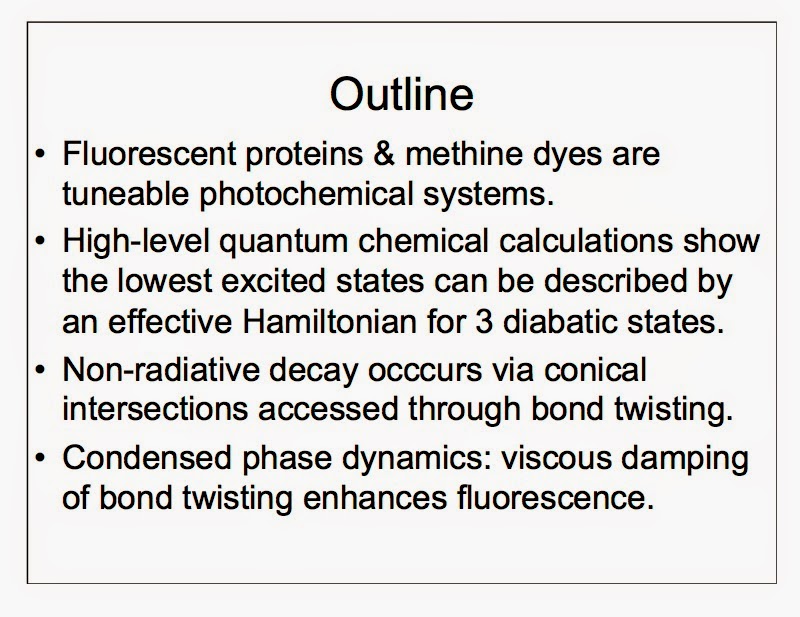
A significant contribution of Seth was to use high-level quantum chemistry calculations to show that the low-lying excited electronic states of the chromophore molecule in the green fluorescent protein has a natural description in terms of the resonant colour theory of organic dyes developed in the middle of the twentieth century by Brooker, Platt, and Moffitt. In different words, he used quantum chemistry to justify and parametrise a simple effective Hamiltonian for a complex system. Furthermore, he provided a rigorous quantum chemical justification for the colour theory description of a very wide class of organic dyes based on the methine motif. These results provide chemical and physical insight, an understanding of trends, elucidate design principles, and make modeling in condensed environments such as proteins, solvents, and glasses much more feasible.

I had great respect for Seth's integrity, both personal and scientific. He carefully checked calculations and arguments, would not rush to publish, and would not indulge in hype. Much of my skepticism and caution about computational materials science I gained from Seth's critiques.

Seth had his priorities right, putting family first.
My kids thought Seth was pretty cool, particularly when he came to a group social at our house with a backpack that contained a home brew beer set up!

My sincere condolences to Louise and their three young children.

Don't know what else to say. This is the saddest blog post I have had to write.

Friday, September 16, 2016

A basic quantum concept: energy level repulsion (avoided crossings)

When I learnt and later taught basic quantum mechanics I don't think the notion of energy level repulsion (or equivalently avoided crossings) was emphasised (or even discussed?).

Much later I encountered the idea in advanced topics in theoretical physics such as random matrix theory and in theoretical chemistry  (non-adiabatic transitions and conical intersections).

Yet level repulsion is a very simple phenomena that can be illustrated with just a two by two matrix describing two coupled quantum states, as nicely discussed on the Wikipedia page.


Last semester when I was teaching Solid State Physics I realised just how central and basic the phenomena is and that the students did not appreciate this.

Level repulsion is the origin of several key phenomena in chemistry and physics.

In solid state physics, it is the origin of the appearance of band gaps at the zone boundary and thus the all important distinction between metals and insulators.


Previously, I posted how Chemistry is quantum science because chemical bonding (the lowering of energy due to interacting atoms) arises due to the superposition principle. This could also be viewed as level repulsion.

Another key idea in chemistry is that of transition states and activation energies for chemical reactions. When one uses a diabatic state picture, particularly as emphasised by Shaik and Warshel, the transition state emerges naturally in terms of level repulsion.


The figure is taken from here.

Can you think of any other nice examples?

Tuesday, August 30, 2016

Bad metals, Mott insulators, and superconductivity in fullerenes

Last week in Ljubljana, I had a nice discussion with Denis Arčon about this paper concerning fullerenes, A3C60 where A = alkali metal.

Optimized unconventional superconductivity in a molecular Jahn-Teller metal
Ruth H. Zadik, Yasuhiro Takabayashi, Gyöngyi Klupp, Ross H. Colman, Alexey Y. Ganin, Anton Potočnik, Peter Jeglič, Denis Arčon, Péter Matus, Katalin Kamarás, Yuichi Kasahara, Yoshihiro Iwasa, Andrew N. Fitch, Yasuo Ohishi, Gaston Garbarino, Kenichi Kato, Matthew J. Rosseinsky and Kosmas Prassides

This is a rich system and is summarised in the (temperature vs. volume) phase diagram below. Superconductivity appears in proximity to a Mott (Jahn-Teller) insulator.

The JT metal is a bad metal. The novel signature here is that because the electrons are almost localised on individual molecules there is Jahn-Teller effect. This is seen in the Fano line shape of the associated vibrational spectra.

Aside: I have often wondered about a good theoretical description of the Fano line shape for vibrational spectra in metals because it is quite common in organic charge transfer salts. There is an old theory by Michael Rice.  However, it does not even mention Fano. 
Yesterday, Darko Tanaskovic brought to my attention a nice paper which explicitly relates the Rice theory, the relevant Feynman diagrams, to the Fano form for the spectral density. (See especially, Section III).

Charged-phonon theory and Fano effect in the optical spectroscopy of bilayer graphene 
 E. Cappelluti, L. Benfatto, M. Manzardo, and A. B. Kuzmenko

For these fullerenes the minimal effective Hamiltonian is a three band Hubbard model with Hund's rule coupling and electron-phonon interaction (which leads to the Jahn-Teller effect on isolated C60 molecules. Extensive calculations based on Dynamical Mean-Field Theory (DMFT) describe this phase diagram and have been reviewed by Massimo Capone, Michele Fabrizio, Claudio Castellani, and Erio Tosatti

Saturday, September 5, 2015

The challenge of excited state proton transfer

What is excited state proton transfer (ESPT)?
Consider a hydrogen bond A-H...B in a molecular system.
Suppose the system absorbs a photon (usually in the visible to near UV range) and undergoes a transition to an electronic excited state. In most cases A-H is an organic molecule containing conjugated bonds and the transition is a pi to pi* transition. Then on the time scale of picoseconds [within a factor of one thousand] the proton transfers from the donor A to the acceptor B,
i.e. (A-H)*...B evolves to something like (A-)*...(H-B)+.
If A and B are part of the same molecule then this is intramolecular ESPT.
If A and B are distinct molecules then this is intermolecular ESPT.
If A-H is dissolved in water, and significant ESPT occurs then A-H is called a photoacid.

I have started to work on this rich and diverse subject.
My goal is to develop several simple diabatic state models that might give a more unified picture of the phenomena and provide some physical insight. Given the chemical complexity, this may be a mistake, reflecting a physicists naivety and/or hubris. But I am encouraged by the "success" of the simple two diabatic state model that I have promoted for hydrogen bonding (and proton) transfer in the ground state.

I am working my way through the extensive chemical literature and so here is my attempt to organise some of what I have learnt. Comments and corrections are particularly welcome.

In a short review [focusing mostly on solvent effects] from 1986 Michael Kasha presented the following picture. It shows the energy of the ground state (S_0) and the excited state (S_1) as a function of the hydrogen co-ordinate Q_H. For example this might be an OH stretch.

One can clearly see that in the excited state proton transfer is both energetically and kinetically more favourable. What might a diabatic state model look like?
The ground state surface could be described in terms of the usual two diabatic states: A-H,B-  and
A-,H-B.   Similarily the excited state surface could be described in terms of a separate but analogous model involving two diabatic states that differ by transfer of a proton.
The difference between the two models is simply the relative energy of the two diabatic states, i.e. the relative proton affinity of the donor and acceptor is reversed between the ground and excited states.
Furthermore, the barrier to proton transfer could be reduced, or even removed, if the coupling of the two diabatic states increases in the excited electronic state. This could happen if the donor-acceptor distance is reduced in the excited state.

This natural "explanation" of ESPT was widely promoted for a long time, probably going back to Weller in 1952. The basic idea is that in the excited state there is charge redistribution leading to weakening of the O-H bond, making it easy for the H to "pop off". A related claim is that in a photoacid the pKa of the excited state is much less than that of the ground state.

However, there are multiple problems with the picture presented above.

A. It is arguably not really an explanation but a description. It almost says "ESPT happens because ESPT happens." Specifically, it does not really explain why the relative energy of the donor and acceptor diabatic states reverses upon photo excitation.

B. It assumes there is no relationship (or interaction) between the ground and excited electronic states. In reality they can be intimately connected. Striking examples include that of twin states or resonance assisted H-bonds, such as in malonaldehyde.

C. Based on the energy surfaces above Forster presented a simple equation relating the S0-S1 energy difference (and the associated absorption and emission frequencies) between the two tautomers [i.e. molecules differing in the location of the proton] and the pKa's [a measure of acidity] in the ground and excited states.
However, Tolbert and Solntsev report many violations of this equation.

D. Actual high level quantum chemistry calculations for specific molecules that do exhibit ESPT do find that for some there is little charge redistribution in the excited state relative to the ground state; or more importantly, the proton affinity does not necessarily change significantly.

E. It may be omitting a role for different excited states (e.g. charge transfer states or n-pi* states) and conical intersections.

D. and E. are emphasised this calculation by Grannuci, Hynes, Milli, and Tran-Thi.

E. is emphasised by Sobolewski and Domcke who present the diabatic state picture below for cases where the proton transfer is coupled to an electron transfer.


A particularly interesting and widely studied case of ESPT is in the green fluorescent protein (GFP). More on that later...

I thank Seth Olsen for introducing me to some of the literature. If some of the above is not as coherent as it might be that is because of my limited reading and understanding. But, I think it also reflects the diversity of the subject and the lack of a comprehensive picture.

I welcome comments.

Thursday, August 27, 2015

Conical intersections vs. Dirac cones, Chemistry vs. Physics: Similarities and differences

Conical intersections between potential energy surfaces get a lot of attention in the theoretical chemistry of electronic excited states (photochemistry) of molecules, particularly with regard as a mechanism for ultrafast (i.e. sub picosecond) non-radiative decay. The surfaces are functions of the spatial coordinates R=(x1,x2, ....) of the nuclei in the molecule.
In the past decade the (hard) condensed matter physics community has become obsessed(?) with Dirac cones [graphene, topological insulators, Weyl semimetals, ...]. They occur in the electronic band structure [one-electron spectrum] when two energy bands cross. Here the system has spatial periodicity and the k's are Bloch quantum numbers.
I want to highlight some similarities between conical intersections (CIs) and Dirac cones (DCs) but also highlight some important differences.

First the similarities.

A. Both CIs and DCs give rise to rich (topological) quantum physics associated with a geometric phase and the associated gauge field (a fictitious magnetic field), the Berry curvature, monopoles, ....

B. There are definitive experimental signatures associated with this Berry phase. However, obtaining actual experimental evidence is very nebulous. For example, this paper discusses the problem for extracting the Berry phase from quantum oscillations in a topological insulator. This post discusses the elusive experimental evidence for CIs.

C. A history of under appreciation. Both these concepts could have been elucidated in the 1930s, but were either ignored, or thought to be pathological or highly unlikely. CIs occur in the Jahn-Teller effect (1937) in systems with enough symmetry (e.g. C_s) to produce degenerate electronic states.
However, then people made the mistake of assuming that symmetry was a necessary, rather than a sufficient, condition for a CI. Given that most molecules, particularly large ones have little or no symmetry, it was assumed CIs were unlikely. It was not until the 1980s, with the rise of high-level computational quantum chemistry and femtosecond laser spectroscopy, that people discovered that symmetry was not only unnecessary, but CIs are quite ubiquitous in large molecules. This is facilitated by the large number of nuclear co-ordinates.
DCs have only become all the rage over the past decade because of new materials: graphene, topological insulators, ...

In spite of the similarities above it is important to appreciate some significant differences in the physics associated with these entities.

1. The role of symmetry. As a minimum DCs requires translational symmetry and an infinite system to ensure the existence of a Bloch wave vector. Most require further symmetries, e.g. the sub-lattice in graphene, or something else in a topological insulator. As mentioned, above, CIs don't involve any translational symmetry. One does not even need some local symmetry (e.g. C_3) as observed with some common structural motifs for CIs.

2. Good quantum numbers and quantum evolution. For DCs the Bloch wave vector k is a good quantum number. In the absence of scattering an electron in state k will stay there forever. For CIs R is a classical nuclear co-ordinate. If one starts on a particular surface one will "slide down" the surface and pass through the CI.

3. The role of correlations. DCs are generally associated with a band structure, an essentially one-electron picture. [Strictly, one could look at poles in spectral functions in a many-body system but that is not what one generally does here]. In contrast, CIs are associated with quantum many-body states not single electron states. In particular, although one can in principle have CIs associated with molecular orbital energies and find them with Hartree-Fock methods, in general one usually finds them with multi-reference [i.e. multiple Slater determinant] methods. For a nice clear discussion see this classic paper which explains everything in terms of what physicists would call a two-site extended Hubbard model.

4. Occupation of quantum states. For DCs one is generally dealing with a metal where all the k states below the Fermi energy are occupied. For CIs only one of the R's is "occupied".

The post was stimulated by Ben Levine and Peter Armitage.

Tuesday, August 4, 2015

Searching for conical intersections for singlet fission

Previously I have posted about the fascinating challenge of understanding singlet fission [and the inverse process of triplet-triplet annihilation] in large organic molecules.  A key feature to understand is how fission can occur in less than 100 femtoseconds, suggestive of a conical intersection between excited state potential energy surfaces.

In Telluride Nandini Ananth gave a nice talk about work described in the paper

The Low-Lying Electronic States of Pentacene and Their Roles in Singlet Fission 
Tao Zeng,  Roald Hoffmann , and Nandini Ananth

Diabatic states provide a natural and powerful approach to understanding what is going on.
The authors perform high level quantum chemistry calculations to describe the relevant electronic excited states. They claim that for a pair of pentacene molecules one needs to include at least six diabatic states. Their dominant electronic configuration is shown in the schematic below.
We find that only one of the two charge-transfer states, ac, is engaged in the SF [singlet fission] in pentacene; it is the low-lying charge-transfer state that gets closer to the multi- and single-exciton states. Moreover, the ac diabat can move into degeneracy with the single-exciton states, more effectively mediating the mixing of the bright single- to and dark multiexciton diabats. This finding is different from the basic assumption of high-lying charge-transfer states in the superexchange model, emphasizing the need to adapt the general SF model to specific cases.
Aside: I wonder if this is one the few papers that Hoffmann has co-authored where strong electron correlations are central.

In more recent work, the authors have tried to pin down what is the relevant nuclear co-ordinate [vibrational mode] associated with a conical intersection. It is not the intermolecular separation but may be instead the relative orientation [twisting] of the two penatacene molecules. This has included some constructive interaction with the experimental group of Luis Campos.

Wednesday, December 10, 2014

Strong non-adiabatic effects in a prototype chemical system

This post concerns what may be the fast known internal conversion process in a chemical system, non-radiative decay times in the range of 3-8 femtoseconds. Internal conversion is the process whereby in a molecule there is a non-radiative transition between electronic excited states (without change in spin quantum number). This is by definition a break-down of the Born-Oppenheimer approximation.

Much is rightly made of the fascinating and important fact that excited states of DNA and RNA undergo "ultra-fast" non-radiative decay to their electronic ground state. This photo-stability is important to avoid mutations and protect genetic information. Conical intersections are key. The time scale for comparison is the order of a picosecond.

The figure below is taken from

It shows the wavelength dependence of the intensity of emission from a 3d (Rydberg) excited state.

There are several things that are noteworthy about the experimental data, given that this is a gas phase spectra.

1. The large width of the spectra. In energy units this is of the order of an eV. Gas phase spectra for electronic transitions in typical molecules are usually extremely sharp (See here for a typical example). 

2. The two peaks, suggesting the presence of two electronic transitions.

3. The strong isotope effects. For strictly electronic transitions between adiabatic states, there should be no dependence on the nuclear masses. This suggests strong vibronic and quantum nuclear effects.

So what is going on?
The key physics is that of the Jahn-Teller effect, conical intersections, and non-adiabatic effects.
For H3 there is geometry of an equilateral triangle which has C3 symmetry. There are then two degenerate electronic ground states with E symmetry, and experience E x epsilon Jahn-Teller effect leading to the two adiabatic potential energy surfaces shown below. They touch at a conical intersection. The two peaks in the spectra above correspond to transitions to these two different surfaces.

Non-adiabatic coupling leads to rapid transitions between the surfaces leading to the ultra-ultra-fast internal conversion and the very broad spectra. This is calculated in the paper, leading to the theoretical curves shown in the top figure.


More recently, Susanta and some of his students, have considered the relative importance of (off-diagonal) non-adiabatic effects, the geometric phase [associated with the conical intersection], and Born-Huang (diagonal) corrections to explaining the spectra.
They find that the first has by far the most dominant effect. The latter two have very small effects that look like they will be difficult to disentangle from experiment. I discussed the elusiveness of experimental signatures of the geometric phase in an earlier post.
  
I thank Susanta Mahapatra for explaining this nice work to me, on my recent visit to his group.

Friday, November 14, 2014

Hyderabad talk on fluorescent protein chromophores

Today I am visiting the Chemistry department at Hyderabad Central University. My host is Susanta Mahapatra. He has done some very nice work on non-adiabatic dynamics in the excited states of organic molecules. A nice review is here. Some of this work is relevant to the puzzle of diffuse interstellar bands and is described in this PRL.

I am giving a talk "Effective Hamiltonians for excited states of fluorescent proteins and methine dyes". The slides are here. A relevant paper with Seth Olsen is here.


Thursday, October 30, 2014

Excited state potential energy surfaces for organic dyes

Sean McConnell, Seth Olsen, and I just finished a paper
A Valence-Bond Nonequilibrium Solvation Model for a Twisting Cyanine Dye


We study a two-state valence-bond electronic Hamiltonian model of non-equilibrium solvation during the excited-state twisting reaction of monomethine cyanines. These dyes are of interest because of the strong environment-dependent enhancement of their fluorescence quantum yield that results from suppression of competing non-radiative decay via twisted internal charge-transfer (TICT) states. For monomethine cyanines, where the ground state is a superposition of structures with different bond and charge localization, there are two twisting pathways with different charge localization in the excited state. The Hamiltonian designed to be as simple as possible consistent with a few well-enumerated assumptions. It is defined by three parameters and is a function of two π-bond twisting angle coordinates and a single solvation coordinate. For parameters corresponding to symmetric monomethines, there are two low-energy twisting channels on the excited-state surface that lead to a manifold of twisted intramolecular charge-transfer (TICT) states. For typical monomethines, twisting on the excited state will occur with small or no barrier. We show that changes in the solvation configuration can differentially stabilize TICT states in channels corresponding to different bonds, and that the position of a conical intersection between adiabatic states moves in response to solvent to stabilize either one channel or the other. We show that there is a conical intersection seam that grows along the bottom of the excited-state potential with increasing solvent polarity. For solvents of even moderate polarity, we predict that the intersection seam should completely span the bottom of the excited-state potential in these systems.

We welcome any comments.

Friday, July 12, 2013

Effect of decoherence on the Berry phase

The Berry (geometric) phase is a significant quantum effect which is associated with conical intersections on excited state potential energy surfaces in molecular photophysics.
An observable consequence is that if a wavepacket is split in two and the two parts traverse opposite sides of the conical intersection (CI) then they will interfere destructively when they meet again on the other side of the CI. [An earlier post considers this effect].

An important question is: what happens to this quantum interference in the presence of decoherence due to the environment?

This question is considered in a nice paper
Quantum-classical description of environmental effects on electronic dynamics at conical intersections
Aaron Kelly and Raymond Kapral

To answer the above question they calculate the probability density on the other side of the CI as a function of the distance from the maximum interference point. This is done for a range of different environment [harmonic oscillator bath] parameters. The key figure is below

In the lower left one sees that there is a dip in the probability at Y=0 due to the quantum interference. The minimum is gradually washed out as the ratio of the bath frequency omega_c to the oscillator frequency omega_x [a measure of the timescale of the semi-classical motion of the wavepackets on the potential energy surface].

I thank Aaron Kelly for helping me understand his work.

Friday, March 22, 2013

What is Herzberg-Teller coupling?

Is it something to do with breakdown of the Born-Oppenheimer approximation?

In molecular spectroscopy you occasionally hear this term thrown around. Google scholar yields more than 3000 hits. But I have found its precise meaning and the relevant physics hard to pin down. Quantum mechanics in chemistry by Schatz and Ratner is an excellent book, but the discussion on page 204 did not help me. "Herzberg-Teller" never appears in Atkins' Molecular quantum mechanics.

So here is my limited understanding.
Herzberg and Teller wanted to understand why one observed certain vibronic (combined electronic and vibrational) transitions that were not expected, particularly some that were expected to be forbidden on symmetry grounds. "Intensity borrowing" occurred.
Herzberg and Teller pointed out that his could be understood if the dipole transition moment for the electronic transition depended on the nuclear co-ordinate associated with the vibration. In the Franck-Condon approximation one assumes that there is no such dependence.

There is a nice clear discussion of this in Section 2.2 of
Spectroscopic effects of conical intersections of molecular potential energy surfaces
by Domcke, Koppel, and Cederbaum

They start with a simple Hamiltonian involving two diabatic states coupled to two vibrational modes. The diabatic states, by definition, do not depend on the nuclear co-ordinates.

They show how in the adiabatic approximation [which I would equate with Born-Oppenheimer] one neglects the nuclear kinetic energy operator and diagonalises the Hamiltonian to produce adiabatic states. But, the diagonalisation matrix depends on the nuclear co-ordinates. Hence, the adiabatic eigenstates depend on the nuclear co-ordinates. In the crude adiabatic approximation one ignores this dependence.

The photoelectron and optical absorption spectra depend on calculated the dipole transition
elements between electronic eigenstates. These depend on the nuclear co-ordinates via the diagonalisation matrix. In Franck-Condon (FC) one ignores this dependence. This dependence is the origin of the Herzberg-Teller coupling.

The figure below, taken from the paper, shows spectra for a model calculation for the butatriene cation. The curves from top to bottom are for Franck-Condon approximation, adiabatic approximation, and the exact result. (Note: the vertical scales are different). Comparing the top two curves on can clearly see intensity borrowing for the high energy transitions. Comparing to the bottom curve shows the importance of non-adiabatic effects; these are amplified by the presence of a conical intersection in the model.
Hence, it should be stressed that Herzberg-Teller and "intensity borrowing" are NOT non-adiabatic effects, i.e. they do NOT represent a breakdown of Born-Oppenheimer. This point is also stressed by John Stanton in footnote 3 of his paper I discussed in an earlier post.

Monday, December 17, 2012

My questions about condensed phase photochemistry?


For the excited state dynamics of a specific chromophore in a solvent what are the essential degrees of freedom (electronic, vibrational, and solvent) that must be included in a model Hamiltonian?

What determines if the excited state dynamics is classical, semi-classical, or fully quantum? Under what conditions does the Born-Oppenheimer approximation break down?

For a specific photochemical reaction what are the relevant vibrational degrees of freedom? What determines the relative importance of stretching, torsional, and pyramidal vibrations?

What determines the branching ratio for passage through a conical intersection? Relevant parameters may be the slope at the intersection, slanting, size of the wavepacket, and the distance of closest approach (impact parameter)

What is the interplay of the electronic, vibrational and solvent degrees of freedom in excited state dynamics?

What determines the relative importance of the viscosity and the polarity of the solvent for the dynamics? What is the role of the spatial inhomogeneity of the solvent?

In the presence of a solvent what are respective criteria for the localization/delocalization of electronic and/or vibrational excitations over different parts of the chromophore?
What are definitive experimental signatures of delocalization?

What are definitive experimental signatures of breakdown of the Born-Oppenheimer approximation?

What is the role of the solvent in non-adiabatic processes?

Tuesday, November 20, 2012

Postdoc in theoretical chemical physics at UQ

Seth Olsen and I are about to advertise for a postdoc to work with us at UQ. The flavour of our interests and approach can be seen in posts on this blog under labels such as organic photonicsquantum chemistry, conical intersections, and Born-Oppenheimer approximation.

A draft of the official position description is here. We anticipate an official advertisement will appear shortly. Please contact us if you are interested.

Tuesday, September 25, 2012

A twisted quantum chemical vision

There is an interesting paper in Science
The Molecular Mechanism of Thermal Noise in Rod Photoreceptors

Samer Gozem, Igor Schapiro, Nicolas Ferré,  and Massimo Olivucci

The abstract is quite clear.
Spontaneous electrical signals in the retina's photoreceptors impose a limit on visual sensitivity. Their origin is attributed to a thermal, rather than photochemical, activation of the transduction cascade. Although the mechanism of such a process is under debate, the observation of a relationship between the maximum absorption wavelength (λmax) and the thermal activation kinetic constant (k) of different visual pigments (the Barlow correlation) indicates that the thermal and photochemical activations are related. Here we show that a quantum chemical model of the bovine rod pigment provides a molecular-level understanding of the Barlow correlation. The transition state mediating thermal activation has the same electronic structure as the photoreceptor excited state, thus creating a direct link between λmax and k. Such a link appears to be the manifestation of intrinsic chromophore features associated with the existence of a conical intersection between its ground and excited states.

If you want a "spherical cow" view of the quantum physics read the beginning of this nice paper by Irene Burghardt and J.T. Hynes.

Monday, May 28, 2012

Born-Oppenheimer in nuclear physics

How do single nucleons and associated excitations couple to collective degrees of freedom such as rotations and shape deformations?
Is there a Born-Oppenheimer approximation in nuclear physics?
What is the origin of non-spherical nuclei and the associated symmetry breaking?
Is the notion of a Jahn-Teller effect and conical intersections relevant?

There issues go back to classic ideas in theoretical nuclear physics for which Aage Bohr, Mottelson, and Rainwater were awarded the Nobel Prize in Physics in 1975. This is discussed in an earlier post.
There is also a classic paper by Hill and Wheeler which does include a discussion of conical intersections [I thank Seth Olsen for bringing it to my attention].

The relevant physics is elegantly discussed in a nice review article The Nuclear Collective Motion by Witold Nazarewicz. Here is an extract

He then goes on to discuss how the deformations of nuclei can be understood in terms of the Jahn-Teller effect.

The figure below is a microscopic calculation from a density functional method of the energy as a function of the nuclear deformation of different Nd isotopes. As the mass number A=N+Z increases there is a transition from a spherical nuclei to an axially deformed one.
This figure is taken from a recent RMP Quantum phase transitions in the shape of atomic nuclei

Things I am still looking for discussions are 
1. using diabatic states
2. roles of conical intersections, particularly in dynamics
3. breakdown of Born-Oppenheimer.

Monday, May 14, 2012

The two-site Hubbard model and photochemistry

At the cake meeting I gave an informal talk on how a two-site Hubbard-Holstein model can illuminate some basic and important concepts in the photo-isomerisation of simple molecules such as ethylene. A previous post discusses how the two-site Hubbard models illustrates many basic concepts in quantum chemistry and many-body theory.

Here are a few of the key references and ideas I drew upon in my talk.

A PRA from 2000 (and largely uncited) by Aalberts et al.
Quantum coherent dynamics of molecules: A simple scenario for ultrafast photoisomerization

1. It points out that photoisomerisation only occurs if there are "steric" interactions. i.e. the sigma bonds (not included in the Hubbard model) do not favour a planar arrangement for the molecule. Thus, the ground state is only planar due to the delocalisation energy associated with the pi electrons included in the Hubbard model.

2. This then leads to a twist angle (phi) dependence of the energies of three singlet states similar to that shown below from ab initio calculations in
Photoinduced dynamics of the valence states of ethene: A six-dimensional potential-energy surface of three electronic states with several conical intersection
by Robert P. Krawczyk, Alexandra Viel, Uwe Manthe, and Wolfgang Domcke
Note that the potential energies surfaces of the S1 (V) and S2 (Z) states touch when the molecule is twisted (phi=90 degrees).

This paper also gives a complete parameterisation of an effective 3x3 matrix Hamiltonian for these three low-lying singlet states. The paper never mentions it but this can be compared to the corresponding Hamiltonian for the two-site Hubbard-Holstein model to extract parameters.

3. How does one get a conical intersection between the S0 and S1 (N and V) states?
One must introduce an asymmetry between the energies of the pi orbitals localised on the two carbon atoms. This can be done by pyramidalization, where the hydrogen atoms are moved out of plane (HOOP=hydrogen out of plane) so that the sp2 hybridisation of the sigma orbital is distorted towards the sp3 hybridisation (pyramid) characteristic of methane. The graph below shows the ab initio calculation of the eigenenergies for a twisted geometry (phi=90 degrees) as a  function of the pyramidalisation angle.
In the Hubbard Holstein model the co-ordinate on the horizontal axis is q=q1-q2, the difference in the on-site vibrational mode co-ordinate between the two sites.

Some of the above connections are aided by the classic paper
Neutral and Charged Biradicals, Zwitterions, Funnels in S1, and Proton Translocation: Their Role in Photochemistry, Photophysics, and Vision
Vlasta Bonačić-Koutecký, Jaroslav Koutecký, and Josef Michl

and a 1985 Journal of Chemical Education paper
Electronic structure in pi systems. Part I. Huckel theory with electron repulsion 
Marye Anne Fox and F. A. Matsen

The former does not mention the Hubbard model, but the latter does.

Thursday, May 10, 2012

Common structural motifs for conical intersections

Finding conical intersections between potential energy surfaces is key to understanding photochemistry, particular for ultrafast non-adiabatic reactions. An earlier post pointed out how often these conical intersections occur at a molecular geometry where there is a local triangular symmetry. This leads naturally to an effective Hamiltonian which has a C_3 (or higher) symmetry and the degenerate eigenstates are in the two-dimensional E representation.

However, there is more to the story...

There is a nice recent review Electronically excited states and photodynamics: a continuing challenge by Plasser, Barabatti, Aquino, and Lischka.
They present a Table of common motifs for "primitive conical intersections".
These do not have the "hidden" triangular symmetry discussed above.

The authors also suggest there are three distinct excited state pathways, summarised schematically in the diagram below. They respectively occur in the molecules shown:

The emergence of hadronic matter from interacting quarks and gluons

 A characteristic of emergent phenomena is how novel and complex properties can emerge from apparently simple laws. Quantum ChromoDynamics (...