Quantum entanglement is required for various "useful" quantum information processing tasks such a teleportation, dense coding, and quantum key distribution.
How crucial entanglement is for actual quantum computation turns out to be a subject of debate. For mixed states the presence of entanglement is a necessary but not a sufficient condition to violate Bell inequalities, as found in a classic paper by Werner.
In practice, if one builds some quantum information processing device in the laboratory one will never create maximal entanglement between qubits. For example, in a quantum dot computer the spin singlet-triplet splitting is switched on and off in order to swap electronic spins. But, the possibility of electronic double occupancy can reduce this entanglement, but not fatally, as discussed here.
So can we quantify how much entanglement is enough to be useful? Is there a lower bound on how much entanglement a gate must create to be useful? Is there some rough figure of merit?
I cannot find any discussion of this basic question in the literature. I scanned through the nice Reviews of Modern Physics article by Horodecki^4 but could not find anything.
Any ideas?
The above question was raised by one of the referees for a recent paper (with Laura McKemmish, Noel Hush, and Jeff Reimers) where we calculate the entanglement between the electronic and nuclear degrees of freedom in the low lying eigenstates of a model Hamiltonian for several simple molecules.
Thursday, August 25, 2011

Wednesday, August 24, 2011
Overdoped cuprates are an anisotropic marginal Fermi liquid
The paper Consistent description of the metallic phase of overdoped cuprate superconductors as an anisotropic marginal Fermi liquid that Jure Kokalj and I recently wrote has just been accepted for publication in Physical Review Letters.
We received two very detailed and helpful referee reports which led us to significantly improve the manuscript. Here I mention just one point. Both referees were surprised that we showed clear disagreement between the temperature dependence of the anisotropic scattering rate and the Hidden Fermi liquid theory of Casey and Anderson [which showed agreement in a recent PRL]. Both referees suggested that it was the manner in which we did our plots, which was different from Casey and Anderson. So we produced the plot below. The key difference is that we used a much larger vertical scale and we compared data at several different dopings.
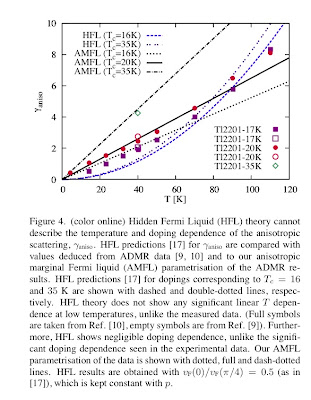
We received two very detailed and helpful referee reports which led us to significantly improve the manuscript. Here I mention just one point. Both referees were surprised that we showed clear disagreement between the temperature dependence of the anisotropic scattering rate and the Hidden Fermi liquid theory of Casey and Anderson [which showed agreement in a recent PRL]. Both referees suggested that it was the manner in which we did our plots, which was different from Casey and Anderson. So we produced the plot below. The key difference is that we used a much larger vertical scale and we compared data at several different dopings.

Tuesday, August 23, 2011
Quantum dynamics of protons on wet metal surfaces
Water is everywhere, even in the air. Consequently, many surfaces (metallic, oxide, and semiconducting) are covered in thin layers of water. It turns out that the first contact layer is actually not pure water, but a mixture of water and hydroxyl (OH-) ions. Furthermore, on a metal surface the separation of the oxygen atoms is largely determined by the lattice constant of substrate [presumably because the oxygen atom lone pairs have a relatively strong interaction with the metal atoms].
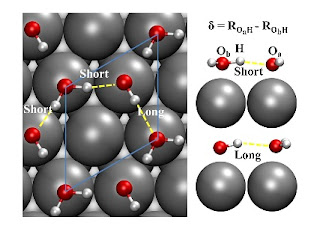 On some metals the oxygen atoms are close enough (as in ice under high pressures) that the hydrogen bond between water and hydroxyl ion takes on a covalent character and there is significant delocalisation of the shared proton between the two oxygen atoms.
The above is based on a nice PRL Quantum Nature of the Proton in Water-Hydroxyl Overlayers on Metal Surfaces by Xin-Zheng Li, Matthew I. J. Probert, Ali Alavi, and Angelos Michaelides.

The above is based on a nice PRL Quantum Nature of the Proton in Water-Hydroxyl Overlayers on Metal Surfaces by Xin-Zheng Li, Matthew I. J. Probert, Ali Alavi, and Angelos Michaelides.
Saturday, August 20, 2011
Do photosynthetic proteins protect quantum coherence?
A 2007 paper in Science Coherence Dynamics in Photosynthesis: Protein Protection of Excitonic Coherence by Lee, Cheng, and Fleming has attracted considerable interest, particularly from people enthusiastic about "quantum biology."
However, some recent papers based on molecular dynamics simulations cast doubt on the main claims of that paper.
The conclusion of the paper, Quest for Spatially Correlated Fluctuations in the FMO Light-Harvesting Complex by Carsten Olbrich, Johan Strumpfer, Klaus Schulten, and Ulrich Kleinekathofer
However, some recent papers based on molecular dynamics simulations cast doubt on the main claims of that paper.
The conclusion of the paper, Quest for Spatially Correlated Fluctuations in the FMO Light-Harvesting Complex by Carsten Olbrich, Johan Strumpfer, Klaus Schulten, and Ulrich Kleinekathofer
The comparison between present results and the reported experimental findings is difficult. It seems to be clear, though, that site correlations do not play a role at physiological conditions and that the biological function of the FMO complex is not affected by spatial site energy correlations. A similar conclusion has already been drawn for the light-harvesting II complex of Rhodospirillum molischianum in a similar study.
Friday, August 19, 2011
Signatures of a non-Fermi liquid
Two signatures of a Fermi liquid metal are:
There are now a diverse range of strongly correlated electron materials which do not have the first signature. In particular, many have a resistivity which is linear in temperature over a wide temperature range. However, this does not necessarily imply the absence of quasi-particles. For an illustration of some of the subtleties involved see this post.
In marginal Fermi liquid theory the scattering rate is linear in temperature but there is a non-zero quasi-particle weight, except at zero temperature.
As discussed in another post, Jan Zaanen claims that when the scattering rate (hbar/tau) has magnitude k_B T, one reaches the "Planckian limit" and there are no quasi-particles. It is not clear to me what is the basis of this claim. I welcome comments.
- the resistivity is quadratic in temperature at low temperatures.
- the one-electron Green function has a simple pole in the complex energy plane. The strength of this pole is the quasi-particle weight Z.
There are now a diverse range of strongly correlated electron materials which do not have the first signature. In particular, many have a resistivity which is linear in temperature over a wide temperature range. However, this does not necessarily imply the absence of quasi-particles. For an illustration of some of the subtleties involved see this post.
In marginal Fermi liquid theory the scattering rate is linear in temperature but there is a non-zero quasi-particle weight, except at zero temperature.
As discussed in another post, Jan Zaanen claims that when the scattering rate (hbar/tau) has magnitude k_B T, one reaches the "Planckian limit" and there are no quasi-particles. It is not clear to me what is the basis of this claim. I welcome comments.
Thursday, August 18, 2011
Reading student evaluations
How we read and respond to student evaluations of our teaching is an interesting question?
Here are a few preliminary thoughts on what we should and should not do.
We should
Here are a few preliminary thoughts on what we should and should not do.
We should
- read them all very carefully
- be willing to change how and what we teach
- take particular notice of comments (both positive and negative) that are repeated e.g., if 30 per cent of students say the textbook is terrible then we need to change it...
- realise that sometimes students comments may actually be more about them and their expectations than about your teaching
- make it our goal to keep everyone happy. the goal is to teach not to be popular.
- give particular credence to comments of just one or two students.
- take the comments (both positive and negative) too personally.
Wednesday, August 17, 2011
Covalent character of hydrogen bonds II
I finally read through the paper, Covalency of the Hydrogen Bond in Ice: A Direct X-Ray Measurement by E. D. Isaacs, A. Shukla, P. M. Platzman, D. R. Hamann, B. Barbiellini, and C. A. Tulk.
They do a Compton scattering experiment (X-rays are inelastically scattered of the electrons) on an ice crystal. The paragraph below explains the basic physics.
 The key figure in the paper is below. The red dots show the measured difference between the momentum dependence of the Compton scattering in different directions. The solid curve is the prediction of a band structure calculation which implicitly assumes complete quantum coherence (i.e. covalency). In contrast an electrostatic model (with no quantum coherence) gives the dot-dashed line which exhibits little anisotropy. The peaks in the inset at 1.7 and 2.85 Angstroms correspond to the H bond length and shortest Oxygen-Oxygen distance.
 Aside. With regard to the solid curve above, the authors state, "There are no adjustable parameters in the theory except that a 40% reduction of the theory is required". Sounds like one adjustable parameter, to me!
They do a Compton scattering experiment (X-rays are inelastically scattered of the electrons) on an ice crystal. The paragraph below explains the basic physics.


Subscribe to:
Posts (Atom)
What is the integer quantum Hall effect?
And why is it so amazing? Surprises [about physics in two dimensions] occurred in the 1980s when it became possible to study Landau levels ...

-
 This week Nobel Prizes will be announced. I have not done predictions since 2020 . This is a fun exercise. It is also good to reflect on w...
 -
 The Ising model is a paradigm in both statistical mechanics and condensed matter physics. Today for most theorists it is so familiar that so...
 -
 Nitrogen fluoride (NF) seems like a very simple molecule and you would think it would very well understood, particularly as it is small enou...