Computer simulations can provide significant insight into different physical phenomena. Two decades ago the best one could do in a class or seminar was show screen shots of simulations and try and explain what was going on. Now one can show a simulation live and even vary parameters in real time to provide insight. I have done this quite a bit with Solid State Simulations.
One simulation I like but have never used effectively is that of the Ising model.
See for example, Daniel Schroeder's simulation or James Sethna or Matt Bierbaum.
What does it help me understand?
The main ideas are the concept of symmetry breaking, the correlation length, and the divergence of the correlation length at the critical point.
1. Watching the different configurations changing with time illustrates the notion of an ensemble.
2. At high temperatures one sees the paramagnetic phase where the spins are independent of each other and so there are no domains.
3. As the temperature approaches the critical temperature (T=2.27J) from above the correlation length increases and large fluctuating domains form.
4. Below the critical temperature large domains form and fluctuate less and less as the temperature lowers.
5. The ferromagnetic ground state (blue or yellow, up or down spin) in zero external field depends on the history. This illustrates symmetry breaking
Any other things?
Monday, September 10, 2018
Wednesday, September 5, 2018
Superconductivity in a Hund's metal
The BCS theory of superconductivity is one of the towering intellectual achievements of the twentieth century. There are many ingredients to the theory and many significant results. One key step is to consider an effective interaction that is responsible for the Cooper pairing. A key result is that many properties are universal in that one can rescale temperatures and energies by the energy gap (at zero temperature), Delta(0) or the transition temperature Tc. In the limit of weak-coupling there is a universal ratio
2 Delta(0)/kTc = 3.5
Most elemental superconductors are consistent with this value. Some such as Hg and Pb have larger values, but these can actually be calculated when strong coupling effects are taken into account, via the Eliashberg equations.
Unconventional superconductors (cuprate, organic, heavy fermion, iron based) have resisted a simple unifying theory and universal trends, comparable to the stellar success of BCS theory. For example, the gap/Tc ratio is all over the place. However, there has been some progress for the iron-based superconductors. Recent ARPES results (summarised in the figure at the bottom below) have shown a universal ratio, of about 7.2 for a wide range of materials.
A fascinating feature of these iron-based materials is the nature of the metallic state that undergoes the superconducting instability. I have written several blog posts about the Hund's metal. One important feature is that there is relatively low coherence temperature below which a Fermi liquid metal forms, and there is a correspondingly low energy scale Omega0 associated with spin fluctuations, which become very slow. This arises from the rich Kondo physics associated with the multi-orbital character of the system. Furthermore, the spin fluctuation spectrum has a power law dependence above Omega0.
The above ideas come together in an interesting preprint
On the Superconductivity of Hund's Metals
Tsung-Han Lee, Andrey Chubukov, Hu Miao, Gabriel Kotliar
One thing should be stressed here is that one is observing a transition from an incoherent metal into a superconductor, unlike in the BCS situation where the transition is from a coherent Fermi liquid.
I thank Alejandro Mezio for bringing the paper to my attention.
2 Delta(0)/kTc = 3.5
Most elemental superconductors are consistent with this value. Some such as Hg and Pb have larger values, but these can actually be calculated when strong coupling effects are taken into account, via the Eliashberg equations.
Unconventional superconductors (cuprate, organic, heavy fermion, iron based) have resisted a simple unifying theory and universal trends, comparable to the stellar success of BCS theory. For example, the gap/Tc ratio is all over the place. However, there has been some progress for the iron-based superconductors. Recent ARPES results (summarised in the figure at the bottom below) have shown a universal ratio, of about 7.2 for a wide range of materials.
A fascinating feature of these iron-based materials is the nature of the metallic state that undergoes the superconducting instability. I have written several blog posts about the Hund's metal. One important feature is that there is relatively low coherence temperature below which a Fermi liquid metal forms, and there is a correspondingly low energy scale Omega0 associated with spin fluctuations, which become very slow. This arises from the rich Kondo physics associated with the multi-orbital character of the system. Furthermore, the spin fluctuation spectrum has a power law dependence above Omega0.
The above ideas come together in an interesting preprint
On the Superconductivity of Hund's Metals
Tsung-Han Lee, Andrey Chubukov, Hu Miao, Gabriel Kotliar
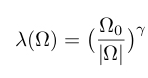
They consider a single band superconductor described by the strong-coupling Eliashberg equations where the frequency dependence of the (effective) electron-electron attraction is given by
where the exponent gamma is treated as a variable. The Eliashberg equations are solved (for a single band) and give the following relationship between the gap ratio and the exponent gamma.
The value of gamma=1.2 is that associated with the relevant Kondo problem above the coherence temperature. The gap ratio corresponds to the black dashed line in the graph below.One thing should be stressed here is that one is observing a transition from an incoherent metal into a superconductor, unlike in the BCS situation where the transition is from a coherent Fermi liquid.
I thank Alejandro Mezio for bringing the paper to my attention.
Monday, September 3, 2018
Absurd to the n'th degree, not chemical cricket
It is easy to take for granted many scientific ideas and results that seem commonplace and reasonable to us today. However, when some ideas were first proposed or discoveries made they were greeted with scepticism, and even ridicule.
In 1913 the Braggs determined the crystal structure of sodium chloride. They were awarded the Nobel Prize in Physics in 1915. However, as late as 1927, the following letter appeared in Nature.
[Double click if you want to read a larger version].
I recently became aware of this in Crystallography: A Very Short Introduction by A.M. Glazer.
Thursday, August 30, 2018
The mental health crisis among university students is going to get worse
For the past few months I have been travelling in North America and the UK, for a mixture of work and holiday. In a range of professional and social settings I have had conversations with different people associated with universities: faculty, students, parents, and NGOs. It is amazing (and disturbing) how many times one subject keeps coming come up: student mental health problems. It was never me who brought up the subject and I don't think any of the people who did bring it up knew that I am interested in the issue, partly because of my own struggles. Two important questions people have asked are:
Has the incidence of student mental health problems increased or is it just that reporting of problems has increased?
Is the situation likely to improve in the near future?
Unfortunately, I think the problems have substantially increased and that they unlikely to decrease in the near future. I hope I am wrong. But, I think that there are a multitude of inter-related social, economic, and political changes that form a toxic cocktail for students.
To illustrate the extent of the problem and some of the compounding issues it is worth reading these two articles, both of which almost have a (tragic) surreal feel.
Why are suburban super-students burning out in college? These Main Line therapists say anxiety is high – and all around us
Philadelphia Inquirer
Feeling Suicidal, Students Turned to Their College. They Were Told to Go Home
New York Times
[Comments are worth reading too]
What are the origins of the crisis?
I think it may be a combination of the factors below. In isolation I doubt one or two of them would create such a large problem, but when you put many together, life starts to get very difficult. To what extent you think some of them is a problem may also depend on what you believe is "normal" and "healthy". The factors are listed in random order. Some are inter-related.
A winner takes-all society.
Everyone wants to be a winner and a celebrity. But most people are not. At the crass level, this cultural shift is reflected in TV shows involving singing or cooking competitions. It is also reflected in increasing economic inequality, where the wealth of the upper class (the one per cent) is increasing dramatically and the lower middle class is ballooning, including graduates with massive debts from student loans. The pressure to succeed is immense and the despair of "failure" is greater.
Social media.
Students are comparing themselves to their "friends" and struggling to project a perfect and successful life. Interpersonal conflict is escalated because social media is a flawed medium for civil and meaningful communication. Rather that talking to other students before or after class students are staring at their phones.
Frustration from or fear of unfulfilled expectations.
University marketing departments portray life on campus as a collection of beautiful young people sitting around on lawns on bright sunny days having meaningful conversations before they graduate to high-paying and fulfilling jobs. A student at an over-crowded state university soon discovers they are sitting in a lecture hall with hundreds of students and no one seems to care whether they are there or not. Although they were told their degree would be a launching pad for a "career", many discover it is actually hard to get any sort of job, let alone something related to their major. No wonder they are depressed!
Excessive screen time.
It is bad for your brain and addictive. You get overstimulated. For some there is addictive content such as on-line games and pornography. It cuts into time for personal relationships.
Breakdown of family life.
Parents are increasingly absent, whether literally, emotionally, or practically, while children are growing up. This decreases students sense of identity, stability, ability to navigate life, including form meaningful relationships, and resolve conflict.
Alcohol and drug abuse.
This may actually be decreasing. However, it is still rampant, and compounds all of the other problems. Furthermore, mental health problems and substance abuse become intertwined.
Sexual harassment and assault.
Reporting has certainly increased. Again, the prevalence of this problem compounds all of the issues above.
What do you think? Have the problems increased? If so, what are the causes?
Has the incidence of student mental health problems increased or is it just that reporting of problems has increased?
Is the situation likely to improve in the near future?
Unfortunately, I think the problems have substantially increased and that they unlikely to decrease in the near future. I hope I am wrong. But, I think that there are a multitude of inter-related social, economic, and political changes that form a toxic cocktail for students.
To illustrate the extent of the problem and some of the compounding issues it is worth reading these two articles, both of which almost have a (tragic) surreal feel.
Why are suburban super-students burning out in college? These Main Line therapists say anxiety is high – and all around us
Philadelphia Inquirer
Feeling Suicidal, Students Turned to Their College. They Were Told to Go Home
New York Times
[Comments are worth reading too]
I think it may be a combination of the factors below. In isolation I doubt one or two of them would create such a large problem, but when you put many together, life starts to get very difficult. To what extent you think some of them is a problem may also depend on what you believe is "normal" and "healthy". The factors are listed in random order. Some are inter-related.
A winner takes-all society.
Everyone wants to be a winner and a celebrity. But most people are not. At the crass level, this cultural shift is reflected in TV shows involving singing or cooking competitions. It is also reflected in increasing economic inequality, where the wealth of the upper class (the one per cent) is increasing dramatically and the lower middle class is ballooning, including graduates with massive debts from student loans. The pressure to succeed is immense and the despair of "failure" is greater.
Social media.
Students are comparing themselves to their "friends" and struggling to project a perfect and successful life. Interpersonal conflict is escalated because social media is a flawed medium for civil and meaningful communication. Rather that talking to other students before or after class students are staring at their phones.
Frustration from or fear of unfulfilled expectations.
University marketing departments portray life on campus as a collection of beautiful young people sitting around on lawns on bright sunny days having meaningful conversations before they graduate to high-paying and fulfilling jobs. A student at an over-crowded state university soon discovers they are sitting in a lecture hall with hundreds of students and no one seems to care whether they are there or not. Although they were told their degree would be a launching pad for a "career", many discover it is actually hard to get any sort of job, let alone something related to their major. No wonder they are depressed!
Excessive screen time.
It is bad for your brain and addictive. You get overstimulated. For some there is addictive content such as on-line games and pornography. It cuts into time for personal relationships.
Parents are increasingly absent, whether literally, emotionally, or practically, while children are growing up. This decreases students sense of identity, stability, ability to navigate life, including form meaningful relationships, and resolve conflict.
Alcohol and drug abuse.
This may actually be decreasing. However, it is still rampant, and compounds all of the other problems. Furthermore, mental health problems and substance abuse become intertwined.
Sexual harassment and assault.
Reporting has certainly increased. Again, the prevalence of this problem compounds all of the issues above.
What do you think? Have the problems increased? If so, what are the causes?
Wednesday, August 22, 2018
Basic introductions to Condensed Matter Physics
Suppose a motivated and intelligent high school student or first year undergraduate comes to you and says, ``Condensed matter physics sounds really cool! What should I read or look at to learn more about it?"
Obviously, suggesting the student look at classic graduate texts such as Ashcroft and Mermin or Chaikin and Lubensky is not helpful. They need something that will inspire them to want to learn more as well as introduce them to some of the basic ideas and topics.
I would suggest the following.
David Pines, Unit 8 in Physics for the 21st Century, an on-line course
Emergent Behavior in Quantum Matter
Robert Laughlin, A Different Universe: Reinventing Physics from the Bottom Down
Stephen Blundell, Superconductivity: A Very Short Introduction
Rodney Cotterell, The Material World
But when then have read some of these it would be nice if the student could look at something more technical. To second year undergrads I give a series of lectures on Thermodynamics and Condensed Matter Physics. They don't need to know any quantum or stat. mech., just some thermo, and they can still get some of the flavour, excitement, and scope of the subject. But, I don't know a book that lays this material out clearly and simply. I draw on Schroeder, Thermal Physics, but it has no discussion of superfluids, order parameters, or symmetry breaking.
What do you think are good resources?
I thank Alex Agedah for asking this question.
Update. Here are some slides for a talk that Danielle McDermott gave on the subject. It lists many useful resources. (She mentions it in a comment below).
Sunday, August 19, 2018
Big changes in universities?
I was recently asked to give a talk to an NGO about how universities are changing.
There is no doubt that there are rapid changes, many for the worse, happening. For me the biggest change has been the rising influence of neoliberalism (free market ideology) in the values, goals, and decision making within universities. But that is another story...
In the past few weeks some relevant articles "came across my desk" [through my web browser...].
I would be particularly interested to hear readers comments on the first one.
My wife sent me this New York Times piece to read and I really despaired
The iGen Shift: Colleges Are Changing to Reach the Next Generation
The newest students are transforming the way schools serve and educate them, including sending presidents and deans to Instagram and Twitter.
Why do I despair?
I believe a university education should largely be about two things. The first goal is explicit and the second is implicit.
The first and primary goal of university education is to help students to learn to think: to think about specific disciplines, and to think about anything. Deep and valuable thinking does not come easily. It takes time, concentration, perseverance, and freedom from distractions. It a student is constantly checking their phone or just skimming the first material that comes up on a Google search or in the Twitter (for twits!) feed for their course, it is highly unlikely they are going to do much deep thinking.
Second, a university education is about helping students "grow up": to move towards adulthood, to learn to be responsible and independent, to create an identity that is more independent of their parents and their peers, to have a sense of direction and purpose, and a desire to be good citizens.
Unfortunately, too many students think "growing up" means getting really drunk and throwing up...
However, too many of the initiatives described in the article seem to be pandering to students (customers) and "hand holding" them through their university experience. For example, at some point in life students are going to have to learn to seek and find relevant information, regardless of whether it is nicely packaged in some cool app with great graphics and lots of "likes".
Oh, the Humanities!
New data on college majors confirms an old trend. Technocracy is crushing the life out of humanism.
Ross Douhat (NYT op-ed columnist)
The third article is more controversial and political, and raises questions about whether one purported change is as big or significant as often claimed (particularly in the right-wing press)
The free speech panic: how the right concocted a crisis
Snowflake students have become the target of a new rightwing crusade. But exaggerated claims of censorship reveal a deeper anxiety at the core of modern conservatism.
William Davies (A Long Read in The Guardian)
For balance here is a counter-view that there is a problem
The Problem of Hyper-liberalism
John Gray (Times Literary Supplement)
Comments welcome.
Wednesday, August 15, 2018
Solid State or Condensed Matter Physics?
The two terms are often used interchangeably, but that is not appropriate. Condensed matter physics does not just involve solids but also phenomena in liquids, liquid crystals, superfluids, and polymer melts. Solid state physics is a subset of condensed matter physics. The latter term was arguably coined by Phil Anderson, when he and Mott renamed their research group at Cambridge in the 1970s.
One can view research fields or course titles as a list of topics or as a way of thinking about certain parts of reality.
Solids exhibit rich phenomena including magnetism and superconductivity. However, it is best to actually view the solids as (an almost irrelevant) substrate for the phenomena.
Like many things, this perspective arguably started with Landau. His theory of phase transitions in the 1930s did not consider atomic structure or chemical composition. Even structural phase transitions were viewed in terms of symmetry change, not in terms of explicit microscopic details. In 1950 this led to the Ginzburg-Landau theory of superconductivity. This all suggested a unified approach to phase transitions.
Furthermore, Landau's Fermi liquid theory papers were originally concerned with understanding liquid 3He, not electrons in metallic crystals.
This idea was further highlighted in the 1970s with the study of critical phenomena and the associated idea of universality. Specifically, the critical behaviour of an XY magnet, a superconductor, and a superfluid, are the same (i.e. they have the same critical exponents). The critical behaviour of the liquid-gas transition, an Ising magnet, and the order-disorder transition in a binary alloy are the same. The view that the solid state might actually not be the key feature for understanding and describing superconductivity was highlighted in the 1950s by Fritz London in his two-volume book, Superfluids, which suggested the two phenomena were intimately connected. Beginning in 1968, De Gennes took a condensed matter perspective in applying order parameters and scaling ideas to “soft matter”: liquid crystals, polymers, wetting, …
The important element to this conceptual view of condensed matter is that it provides a unifying perspective on phenomena in a diverse range of materials. It also brings to the fore how a wide suite of powerful theoretical and experimental tools (esp. neutron and x-ray scattering) can be used to study diverse materials. One of the key theoretical strategies is that of effective Hamiltonians, which is not unique to condensed matter, because it just reflects the hierarchy of energy, length, and times scales that result from emergence. This then leads to an intellectually rich interchange of ideas and techniques from other fields of physics, particularly quantum field theory.
More recently, this unity is illustrated by ultracold atomic gases which can be used to study some phenomena that had previously only been studied in solids.
Subscribe to:
Posts (Atom)
What criteria should be used to evaluate theories of emergence properties?
What criteria do people use to decide if a theory in physics is successful? For special relativity, general relativity, and quantum theory, ...
-
An interesting and controversial question for Ph.D's in science and engineering is too what extent students should be expected to have ...
-
Some of my colleagues and I have started an interesting discussion about how to teach quantum theory to undergraduates. We have courses in t...
-
As years go by the PhD thesis in science and engineering is less and less of a ``thesis'' and more just a box to tick. There was a t...