Any worthwhile scientific project will be large, challenging, and ambitious. Even a small project, particularly for a beginner, can be intimidating and overwhelming. A key skill is to learn how to break a project down into small and manageable parts.
This applies whether one is trying to solve a particular scientific problem [how does a particular enzyme work? what is the origin of superconductivity in the iron pnictides?], write a large computer code, perform a multi-step chemical synthesis, solve a quantum many-body Hamiltonian with a specific approximation, fabricating a solar cell....
How does one do this? Are there some general principles?
I am not sure and I welcome comments and suggestions.
I also fear that current pressures to publish quickly lead to hastily put together projects without due attention to the robustness of the sub-projects.
My main suggestions are:
*be realistic. make sure each part/step is arguably manageable/doable.
* start with easy steps and processes that will build confidence and understanding. first trying to reproduce someone else's results is always a good thing!
*make sure that you have "control" of each step or "sub-module", i.e. you are sure it really does work and know what is going on. For example, if you have a large computer code using lots of sub-routines you need to be sure that each of them is numerically stable. Just, quickly throwing them together may produce garbage or be very hard to debug.
*plan steps that will produce publons.
*talk to others about how they do it, both in general and for specific projects.
Any suggestions?
Monday, May 12, 2014

Friday, May 9, 2014
Colloquium on Emergent states of quantum matter
Here are the slides for the talk I am giving today at the UQ Physics colloquium.
I will show the video Quantum levitation, and discuss what is and isn't quantum about it.
A good discussion of some of the issues raised is Laughlin and Pines article The Theory of Everything. A more extensive and introductory discussion by Pines is at Physics for the 21st Century.

Postscript.
Based on comments and questions afterwards, particularly from some undergraduates, there are few things I would do slightly differently.
I should have said what a Hamiltonian is: a function that defines the energy as a function of the system variables, e.g., the position and velocity of all of the particles.
The stratification of reality shown by my boxes is a simplification for schematic purposes. There is no clearly defined boundary between strata. For example, at the boundary between chemistry and physics one has chemical physics and physical chemistry. The boundary between biology and biochemistry is blurred. On the other hand, anatomy is qualitatively different to enzyme mechanisms. Acid-base equilibria is chemistry not physics.
Ben Powell emphasized to me that the claim that "superconductors exhibit broken U(1) gauge symmetry" is problematic and subtle. There is a long detailed paper, Superconductors are topologically ordered that I have read several times but don't really understand.
I will show the video Quantum levitation, and discuss what is and isn't quantum about it.
A good discussion of some of the issues raised is Laughlin and Pines article The Theory of Everything. A more extensive and introductory discussion by Pines is at Physics for the 21st Century.
Postscript.
Based on comments and questions afterwards, particularly from some undergraduates, there are few things I would do slightly differently.
I should have said what a Hamiltonian is: a function that defines the energy as a function of the system variables, e.g., the position and velocity of all of the particles.
The stratification of reality shown by my boxes is a simplification for schematic purposes. There is no clearly defined boundary between strata. For example, at the boundary between chemistry and physics one has chemical physics and physical chemistry. The boundary between biology and biochemistry is blurred. On the other hand, anatomy is qualitatively different to enzyme mechanisms. Acid-base equilibria is chemistry not physics.
Ben Powell emphasized to me that the claim that "superconductors exhibit broken U(1) gauge symmetry" is problematic and subtle. There is a long detailed paper, Superconductors are topologically ordered that I have read several times but don't really understand.
Thursday, May 8, 2014
Resisting the temptation to make the best looking data plot
It is a fallible human tendency to want to include in a paper the most favourable comparison between your pet theory and experiment. My collaborators and I were recently confronted with this issue when writing our recent paper on Quantum nuclear effects in hydrogen bonding.
We calculated a particular vibrational frequency for both hydrogen and deuterium isotopes. Experimentalists had previously reported that this ratio has large and non-monotonic variations as a function of the donor-acceptor distance R. The plot below shows a comparison of our calculations [curves] to experimental data on a wide range of chemical complexes [each point is a separate compound].
 I was quite happy with this result, particularly because getting the frequency ratio down to values as small as one was significant [Aside: this is an amazing thing because in most compounds the isotope frequency ratio is close to 1.4 = sqrt(2), as expected from a simple harmonic oscillator analysis].
It was tempting just to publish this plot.
But, there is a problem. Most previous plots by experimentalists did not use R as the horizontal axis but Omega_H, the frequency for the H case. [For example, see the plot I featured in a post back in 2011 when I started thinking about this problem].
Below is the corresponding plot.

It is much less impressive!
Why? The problem is that for R ~ 2.5 Angstroms our theory does not give values of the frequency, that agree very well with experiment, as shown in a earlier Figure in the paper. We discuss some possible reasons for that.
So we decided that the best thing to do was to publish both figures and readers can make their own decisions about the strengths and weaknesses of our work.
Now here is another slant. The data above is for O-H...O bonds, which we focussed on in our paper. The data below is for N-H...N bonds [taken from here] and shows much clearer correlations than the data above. Again it would have been tempting to focus on that case.

I will also illustrate my point with a historically much more important example.
The figures below are also discussed in an earlier post. [It led to a Nobel Prize]. The upper version shows a moderately impressive comparison of data with a theoretical curve. However, the main point of the paper [and the Nobel Prize for cosmic acceleration] is not the linear component [Hubble constant] but the non-linear component [expansion]. The lower part of the figure has the linear part subtracted out and looks far less impressive. Nevertheless, it stood the test of time and complementary measurements, as discussed in the earlier post.
 In conclusion, I think it is important that we not always present our work so it appears in the best possible light.
We calculated a particular vibrational frequency for both hydrogen and deuterium isotopes. Experimentalists had previously reported that this ratio has large and non-monotonic variations as a function of the donor-acceptor distance R. The plot below shows a comparison of our calculations [curves] to experimental data on a wide range of chemical complexes [each point is a separate compound].
It was tempting just to publish this plot.
But, there is a problem. Most previous plots by experimentalists did not use R as the horizontal axis but Omega_H, the frequency for the H case. [For example, see the plot I featured in a post back in 2011 when I started thinking about this problem].
Below is the corresponding plot.
It is much less impressive!
Why? The problem is that for R ~ 2.5 Angstroms our theory does not give values of the frequency, that agree very well with experiment, as shown in a earlier Figure in the paper. We discuss some possible reasons for that.
So we decided that the best thing to do was to publish both figures and readers can make their own decisions about the strengths and weaknesses of our work.
Now here is another slant. The data above is for O-H...O bonds, which we focussed on in our paper. The data below is for N-H...N bonds [taken from here] and shows much clearer correlations than the data above. Again it would have been tempting to focus on that case.
The figures below are also discussed in an earlier post. [It led to a Nobel Prize]. The upper version shows a moderately impressive comparison of data with a theoretical curve. However, the main point of the paper [and the Nobel Prize for cosmic acceleration] is not the linear component [Hubble constant] but the non-linear component [expansion]. The lower part of the figure has the linear part subtracted out and looks far less impressive. Nevertheless, it stood the test of time and complementary measurements, as discussed in the earlier post.
Wednesday, May 7, 2014
A tribute to liberal arts colleges in the USA
Which institutions the best job training scientists at the undergraduate level in the USA?
If you want a job teaching highly gifted and motivated undergraduates where should you try and work?
The answer is not what you might think? [Ivy League, Berkeley, Stanford, ....]
If you look at the undergraduate origin of the recipient of doctoral degrees from US universities you find something surprising. For all academic fields, of the top ten, six are small private liberal arts colleges [i.e. they have no Ph.D program]: Harvey Mudd, Swarthmore, Reed, Carleton, Grinnell, and Oberlin. For science, the results are similar.
Thomas Cech shared the 1989 Nobel Prize in Chemistry and was President of the Howard Hughes Medical Institute for a decade. He graduated from Grinnell and has an interesting article Science at Liberal Arts Colleges: A Better Education?
Asides: Reed College is interesting [for many reasons!] because it has resisted involvement in institutional ranking exercises (even though it is often very highly ranked) because it considers them flawed. I find this refreshing!
An earlier post considers the teaching philosophy of one of their distinguished physics faculty, David Griffiths.
This is all relevant to two of the claims made by Hunter Rawlings in an article featured in an earlier post:
Small colleges play an important role in making the diverse US system so strong overall.
At large research universities undergraduates have become peripheral to the whole enterprise [sports, hospitals, research, grad students, professional schools, infrastructure, ....]
There is a helpful article in Physics Today, Hunting for Jobs at Liberal Arts Colleges written by two faculty with experience at hiring people.
The Australian education minister recently announced that Australia needs to move towards a more USA-like university system. Somehow, I don't think small liberal arts colleges is what he has in mind!
If you want a job teaching highly gifted and motivated undergraduates where should you try and work?
The answer is not what you might think? [Ivy League, Berkeley, Stanford, ....]
If you look at the undergraduate origin of the recipient of doctoral degrees from US universities you find something surprising. For all academic fields, of the top ten, six are small private liberal arts colleges [i.e. they have no Ph.D program]: Harvey Mudd, Swarthmore, Reed, Carleton, Grinnell, and Oberlin. For science, the results are similar.
Thomas Cech shared the 1989 Nobel Prize in Chemistry and was President of the Howard Hughes Medical Institute for a decade. He graduated from Grinnell and has an interesting article Science at Liberal Arts Colleges: A Better Education?
Asides: Reed College is interesting [for many reasons!] because it has resisted involvement in institutional ranking exercises (even though it is often very highly ranked) because it considers them flawed. I find this refreshing!
An earlier post considers the teaching philosophy of one of their distinguished physics faculty, David Griffiths.
This is all relevant to two of the claims made by Hunter Rawlings in an article featured in an earlier post:
Small colleges play an important role in making the diverse US system so strong overall.
At large research universities undergraduates have become peripheral to the whole enterprise [sports, hospitals, research, grad students, professional schools, infrastructure, ....]
There is a helpful article in Physics Today, Hunting for Jobs at Liberal Arts Colleges written by two faculty with experience at hiring people.
The Australian education minister recently announced that Australia needs to move towards a more USA-like university system. Somehow, I don't think small liberal arts colleges is what he has in mind!
Tuesday, May 6, 2014
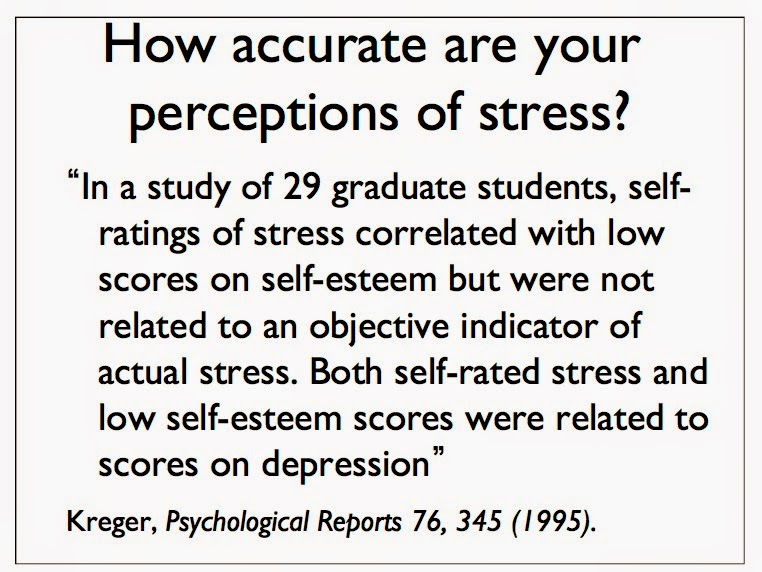
Slides for latest talk on Mental Health for Scientists
Today I am giving a talk "Mental Health for Scientists" to the Early Career Researcher group at the Institute for Molecular Biosciences at UQ. Here are the slides.
Monday, May 5, 2014
Is there a Fermi liquid associated with the pseudogap state of the cuprates?
To me this seems at first to be a strange idea. The phenomenology of the cuprates and doped Hubbard models is roughly that as the doping decreases one goes from a Fermi liquid (large overdoping with no superconductivity) to an anisotropic marginal Fermi liquid (overdoped but superconducting) to strange metal (marginal Fermi liquid) (optimal doping) to pseudogap state (underdoping). Hence, I would have thought that everything was rather non-Fermi liquid like in the pseudogap state.
However, the observation in the pseudogap range of copings of quantum magnetic oscillations (that could be associated with a small Fermi surface) and Fermi arcs, raised the question of a Fermi liquid state.
Over the past few years Martin Greven and collaborators have performed a range of transport measurements on a relatively clean single layer cuprate material Hg1201. They find Fermi liquid type behaviour [e.g. resistivity quadratic in temperature, scattering rates quadratic in frequency] for a range of temperatures below the pseudogap temperature T*.
A recent preprint is
Validity of Kohler's rule in the pseudogap phase of the cuprate superconductors
M. K. Chan, M. J. Veit, C. J. Dorow, Y. Ge, Y. Li, W. Tabis, Y. Tang, X. Zhao, N. Barišić, M. Greven
What is Kohler's rule?
In simple metals the temperature and magnetic field dependence of the magnetoresistance is dominated by the orbital motion of the electrons and described by some function of the product of omega_c and tau.
omega_c is the cyclotron frequency which is proportional to the magnetic field B and independent of temperature.
tau is the scattering time, which is temperature dependent and field independent, and should have the same temperature dependence as 1/rho where rho(B=0) is the resistivity in zero field.
These observations lead to Kohler's rule which is obeyed by simple metals.
A plot of the ratio of the rho(B)/rho(B=0) versus B/rho(B=0) should be independent of temperature.
In 1995 Ong's group observed significant violations of Kohler's rule in the underdoped and overdoped cuprates. Similar results were found by a Japanese group.
In 1998 I pointed out that in one mysterious organic metal there were also significant violations. The paper also has an extensive discussion of reasons why Kohler's rule can fail.
However, the observation in the pseudogap range of copings of quantum magnetic oscillations (that could be associated with a small Fermi surface) and Fermi arcs, raised the question of a Fermi liquid state.
Over the past few years Martin Greven and collaborators have performed a range of transport measurements on a relatively clean single layer cuprate material Hg1201. They find Fermi liquid type behaviour [e.g. resistivity quadratic in temperature, scattering rates quadratic in frequency] for a range of temperatures below the pseudogap temperature T*.
A recent preprint is
Validity of Kohler's rule in the pseudogap phase of the cuprate superconductors
M. K. Chan, M. J. Veit, C. J. Dorow, Y. Ge, Y. Li, W. Tabis, Y. Tang, X. Zhao, N. Barišić, M. Greven
In simple metals the temperature and magnetic field dependence of the magnetoresistance is dominated by the orbital motion of the electrons and described by some function of the product of omega_c and tau.
omega_c is the cyclotron frequency which is proportional to the magnetic field B and independent of temperature.
tau is the scattering time, which is temperature dependent and field independent, and should have the same temperature dependence as 1/rho where rho(B=0) is the resistivity in zero field.
These observations lead to Kohler's rule which is obeyed by simple metals.
A plot of the ratio of the rho(B)/rho(B=0) versus B/rho(B=0) should be independent of temperature.
In 1995 Ong's group observed significant violations of Kohler's rule in the underdoped and overdoped cuprates. Similar results were found by a Japanese group.
In 1998 I pointed out that in one mysterious organic metal there were also significant violations. The paper also has an extensive discussion of reasons why Kohler's rule can fail.
It seems that in the overdoped cuprates a generalised version of Kohler's rule holds.
In the preprint, the authors find results consistent with Kohler's rule for Hg2201 samples with Tc=70 K and 81K, and temperatures between about 100 K and 200 K, and fields up to 30 Tesla.
The left plot is the bare data and the right plot is the data rescaled according to Kohler's rule.

Is the idea of Fermi liquid in the pseudogap region reasonable?
The scenario may be something like this.
There are Fermi liquid like quasi-particles near the nodes of the pseudogap. The non-Fermi liquid excitations occur towards the anti-nodal regions. This is the basic idea of the anisotropic marginal Fermi liquid developed for overdoped cuprates. Suppose one assumes something like that model actually applies for all doping. Then in the pseudogap region the non-Fermi liquid part will start to get gapped out and one will just be left with the Fermi liquid part. This can then undergo charge ordering instabilities to form Fermi surface pockets due to Fermi surface reconstruction.
Friday, May 2, 2014
More mental health issues and resources
Next week I am giving another talk on mental health issues for scientists. Since I am doing this more I have been doing a bit more reading. Also, people are starting to send me various relevant articles. Here are a few things I have learnt, in no particular order.
Andrew Lange was one of the world's leading observational cosmologists and Chair of the Division of Physics, Maths, and Astronomy at Caltech. He was the lead investigator on BICEP, the forerunner of the experiment that recently found evidence for cosmic inflation. He suffered from depression. Tragically, he committed suicide in 2010.
Lewis Wolpert FRS is a distinguished developmental biologist who has suffered through several severe periods of depression. Years ago he wrote an article about his experience in The Guardian newspaper. He says that he received more feedback than for anything he had written in his whole career. This was followed with a book Malignant Sadness: The Anatomy of Depression and an associated BBC TV program, A Living Hell.
Doris Iarovici, a psychiatrist at the Duke University Counseling and Psychological Services has just published a book, Mental Health Issues and the University Student. Some of it is depressing reading, as it chronicles the pressures students in the USA are under, and some of the poor ways they try to cope with them. There is a whole chapter on the problem of perfectionism. Although the book is mostly concerned with undergraduates it does discuss graduate students. The author also has a New York Times blog post raising concerns about over-prescription of anti-depressants.
There is a research article The impact of funding deadlines on personal workloads, stress and family relationships: a qualitative study of Australian researchers. It concerns how much time researchers spend/waste making grant applications, focussing on the case of the NHMRC [the main funding agency for medical research]. It contains the cryptic comment:
Andrew Lange was one of the world's leading observational cosmologists and Chair of the Division of Physics, Maths, and Astronomy at Caltech. He was the lead investigator on BICEP, the forerunner of the experiment that recently found evidence for cosmic inflation. He suffered from depression. Tragically, he committed suicide in 2010.
Lewis Wolpert FRS is a distinguished developmental biologist who has suffered through several severe periods of depression. Years ago he wrote an article about his experience in The Guardian newspaper. He says that he received more feedback than for anything he had written in his whole career. This was followed with a book Malignant Sadness: The Anatomy of Depression and an associated BBC TV program, A Living Hell.
Doris Iarovici, a psychiatrist at the Duke University Counseling and Psychological Services has just published a book, Mental Health Issues and the University Student. Some of it is depressing reading, as it chronicles the pressures students in the USA are under, and some of the poor ways they try to cope with them. There is a whole chapter on the problem of perfectionism. Although the book is mostly concerned with undergraduates it does discuss graduate students. The author also has a New York Times blog post raising concerns about over-prescription of anti-depressants.
There is a research article The impact of funding deadlines on personal workloads, stress and family relationships: a qualitative study of Australian researchers. It concerns how much time researchers spend/waste making grant applications, focussing on the case of the NHMRC [the main funding agency for medical research]. It contains the cryptic comment:
Additional impacts on mental health and well-being were identified through comments including ‘incredible anxiety’, ‘depressed’, ‘despondent’, ‘insecurity’ and ‘soul- destroying’. The mental health and welfare of researchers warrants further examination beyond this study.
Subscribe to:
Posts (Atom)
-
 This week Nobel Prizes will be announced. I have not done predictions since 2020 . This is a fun exercise. It is also good to reflect on w...
 -
 The Ising model is a paradigm in both statistical mechanics and condensed matter physics. Today for most theorists it is so familiar that so...
 -
 Nitrogen fluoride (NF) seems like a very simple molecule and you would think it would very well understood, particularly as it is small enou...