A common problem in the practical implementation of quantum many-body theory [whether for quantum chemistry, solid state physics, or nuclear physics] goes like this. One starts with a Hamiltonian and observables that are written in terms of second quantised operators. Real calculations of observables requires diagonalising the Hamiltonian matrix. It must then be written as a symmetric real matrix in some basis of many-body states.
To do this means manipulating large numbers of creation and annihilation operators. This can quickly become cumbersome, particularly for fermions. It is easy to loose track of signs when calculating matrix elements. It would be nice to be able to do this in an automated way, e.g., using Mathematica.
Sriram Shastry and John Wright have developed a Mathematica program DiracQ that will do all this. It can be downloaded for free and is described in detail in a preprint. The latter contains some highly non-trivial examples, e.g., finding the conserved quantities of the one-dimensional Hubbard model.
This should be very useful, both for research and teaching.
Thursday, September 12, 2013

Tuesday, September 10, 2013
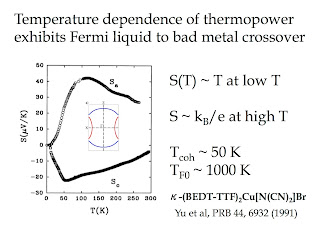
Seminar on bad metals at Rutgers
On Tuesday I am giving a Condensed Matter Seminar at Rutgers.
Here is the current version of the slides for my talk.
The main results in the talk are in a recent PRL, written with Jure Kokalj.
Here is the current version of the slides for my talk.
The main results in the talk are in a recent PRL, written with Jure Kokalj.
The organic charge transfer salts and the relevant Hubbard model are discussed extensively in a review, written with Ben Powell.

Saturday, September 7, 2013
Exotica: a blessing or curse to condensed matter physics?
One of the exciting things about condensed matter physics is that we are continually discovering exotic new phenomena. Many are unanticipated and understanding them presents a rich intellectual challenge. That is the nature of emergence.
Due to chemical complexity and the richness of quantum many-body physics it seems the frontier is endless.
Superfluid 3He, heavy fermions, sliding charge density waves, weak localisation, giant magnetoresistance, organic superconductors, quantum Hall effects, quantum point contacts, cuprate superconductors, non-Fermi liquids, buckyball superconductors, Luttinger liquids, colossal magnetoresistance, spin liquids, pseudogap, composite fermions, strontium ruthenate, topological order, quantum dots, sodium cobaltates, solid state quantum computing, fluctuating gauge fields, spinons, topological insulators, iron pnictide superconductors, ultracold atomic gases, quantum criticality, spin-charge separation, anomalous Hall effect, Majorana fermions, ....
Exotica are a blessing. They keep us excited and busy. The field will never die out or get boring.
However, I believe that exotica can also be a curse to the field.
Why?
1. The field can be too driven by fashions.
Every few years a new system is discovered which grabs attention. Lots of people work on it grabbing the "low-lying fruit" before jumping on the next band-wagon. Painstaking long term studies needed for a deep understanding are neglected.
The current fixation with citation metrics accentuates this problem. People want to publish quickly in a field in which lots of other people are working.
Twenty years ago Pantelides made this criticism.
2. Problems that are old, difficult and important get neglected: water, ice, metallic ferromagnetism, glasses, high-Tc superconductors, polarons, correlated two-dimensional electron gases, bad metals, fracture, enhanced thermoelectricity, multi-scale modelling, magnetite, high quality materials synthesis....
3. One can end up focusing on some exotic system or very specific material that is so finely tuned or rare or fragile or difficult to fabricate that it is not representative of any significant class of materials or phenomena.
4. One ends up with exotic theories in desperate search for a experiment, rather than constructing realistic theories that explain the many existing materials or phenomena waiting to be explained.
5. Students can get too narrow a training and perspective on the field.
6. We end up focusing too much on materials and devices that are so exotic and expensive to make that they will never be of any commercial use. This will ultimately diminish funding for the field.
A real challenge and struggle for me is for each new discovery to try and critically assess whether it is going to be important in the long term. I think the community could benefit from more critical reflection and self control.
What do you think?
Due to chemical complexity and the richness of quantum many-body physics it seems the frontier is endless.
Superfluid 3He, heavy fermions, sliding charge density waves, weak localisation, giant magnetoresistance, organic superconductors, quantum Hall effects, quantum point contacts, cuprate superconductors, non-Fermi liquids, buckyball superconductors, Luttinger liquids, colossal magnetoresistance, spin liquids, pseudogap, composite fermions, strontium ruthenate, topological order, quantum dots, sodium cobaltates, solid state quantum computing, fluctuating gauge fields, spinons, topological insulators, iron pnictide superconductors, ultracold atomic gases, quantum criticality, spin-charge separation, anomalous Hall effect, Majorana fermions, ....
Exotica are a blessing. They keep us excited and busy. The field will never die out or get boring.
However, I believe that exotica can also be a curse to the field.
Why?
1. The field can be too driven by fashions.
Every few years a new system is discovered which grabs attention. Lots of people work on it grabbing the "low-lying fruit" before jumping on the next band-wagon. Painstaking long term studies needed for a deep understanding are neglected.
The current fixation with citation metrics accentuates this problem. People want to publish quickly in a field in which lots of other people are working.
Twenty years ago Pantelides made this criticism.
2. Problems that are old, difficult and important get neglected: water, ice, metallic ferromagnetism, glasses, high-Tc superconductors, polarons, correlated two-dimensional electron gases, bad metals, fracture, enhanced thermoelectricity, multi-scale modelling, magnetite, high quality materials synthesis....
3. One can end up focusing on some exotic system or very specific material that is so finely tuned or rare or fragile or difficult to fabricate that it is not representative of any significant class of materials or phenomena.
4. One ends up with exotic theories in desperate search for a experiment, rather than constructing realistic theories that explain the many existing materials or phenomena waiting to be explained.
5. Students can get too narrow a training and perspective on the field.
6. We end up focusing too much on materials and devices that are so exotic and expensive to make that they will never be of any commercial use. This will ultimately diminish funding for the field.
A real challenge and struggle for me is for each new discovery to try and critically assess whether it is going to be important in the long term. I think the community could benefit from more critical reflection and self control.
What do you think?
Friday, September 6, 2013
Weak coupling can give important insights
Until last week I had several misconceptions about unconventional [i.e., non s-wave] superconductivity due to purely electronic interactions.
I thought weak coupling approaches tend to give a clear "pairing mechanism" and the symmetry of the Cooper pairs is related to the type of fluctuations or collective mode responsible for the pairing
For example, d-wave singlet pairing tends to go with antiferromagnetic spin fluctuations and p-wave triplet tends to go with ferromagnetic spin fluctuations.
There is a very nice paper
Band structure effects on the superconductivity in Hubbard models
by Weejee Cho, Ronny Thomale, Srinivas Raghu, and Steve Kivelson
They consider a weak-coupling renormalisation group (RG) treatment of a Hubbard model with specific band structures that are varied by changing tight-binding parameters.
The relevant Feynman diagrams are below

Calling this "spin fluctuation exchange" is not clear as there is no well defined collective mode that can be thought of as the superconducting "glue." The authors state, instead "the pairing is a result of overscreening by the whole band".
The authors show/claim
1. different order parameter symmetries can emerge from the same underlying mechanism, depending on the band structure.
2. in the weak-coupling limit, it is not possible to attribute the pseudogap entirely to a non-superconducting order. [Since the cuprates are in the intermediate coupling regime, this does not preclude the real pseudogap being due to non-superconducting order].
3. "The structure of the favored superconducting gap along the Fermi surface can be inferred in large part from a catalogue of wave vectors, Q, at which the susceptibility is large....
The most important portions of the Fermi surface are either those in which this approximate nesting condition is satisfied over a substantial region of the Fermi surface, or in which the Fermi velocity is small (density of states is large)."
4. For a spatially anisotropic [nematic] band structure there is a large parameter range where is a remarkable near degeneracy of a singlet (d + s)-wave and a triplet p-wave pairing channel.
 5. a well ordered orbital current-loop state is incompatible with superconductivity, at least for weak-coupling. [This does not preclude superconductivity due to fluctuating orbital currents, as proposed by Varma].
There are three more situations I would like to see this weak-couping approach and formalism applied to.
a. The Hubbard model on the anisotropic triangular lattice at half filling.
Ben Powell and I showed that within an RVB [strong coupling] theory that as the frustration t'/t changed [and the band structure and Fermi surface changed accordingly] that the superconducting pairing symmetry changed from A2 [dx^2-y^2] to A2+iA1 [d+id] to A1 [d_xy].
We interpreted this as "Symmetry of the Superconducting Order Parameter in Frustrated Systems Determined by the Spatial Anisotropy of Spin Correlations"
[The isotropic triangular lattice [t'=t] case was considered earlier with perturbative RG by Raghu, Kivelson, and Scalapino, and with functional RG by Honerkamp. Both found d+id superconductivity.]
b. The "purple bronze" Li0.9Mo6O17
Jaime Merino and I recently considered the simplest possible extended Hubbard model that might describe this quasi-one-dimensional material. It consists of ladders that are weakly coupled to one another and at quarter-filling.
An outstanding question concerns whether this model will produce the observed superconductivity, which is probably triplet.
c. The extended Hubbard model on the square lattice at one-quarter filling.
Using a slave boson approach Jaime Merino and I showed that due to charge fluctuations near the charge-ordering transition there is d_xy superconducting order.
b. and c. require the extension of the weak-coupling approach that including the nearest neighbour repulsion V. This is included in this paper using the same formalism.
I thank Srinivas Raghu for bringing this work to my attention and explaining some key details. He also provided some helpful corrections to the first version of this post.
I thought weak coupling approaches tend to give a clear "pairing mechanism" and the symmetry of the Cooper pairs is related to the type of fluctuations or collective mode responsible for the pairing
For example, d-wave singlet pairing tends to go with antiferromagnetic spin fluctuations and p-wave triplet tends to go with ferromagnetic spin fluctuations.
There is a very nice paper
Band structure effects on the superconductivity in Hubbard models
by Weejee Cho, Ronny Thomale, Srinivas Raghu, and Steve Kivelson
They consider a weak-coupling renormalisation group (RG) treatment of a Hubbard model with specific band structures that are varied by changing tight-binding parameters.
The relevant Feynman diagrams are below

Calling this "spin fluctuation exchange" is not clear as there is no well defined collective mode that can be thought of as the superconducting "glue." The authors state, instead "the pairing is a result of overscreening by the whole band".
The authors show/claim
1. different order parameter symmetries can emerge from the same underlying mechanism, depending on the band structure.
2. in the weak-coupling limit, it is not possible to attribute the pseudogap entirely to a non-superconducting order. [Since the cuprates are in the intermediate coupling regime, this does not preclude the real pseudogap being due to non-superconducting order].
3. "The structure of the favored superconducting gap along the Fermi surface can be inferred in large part from a catalogue of wave vectors, Q, at which the susceptibility is large....
The most important portions of the Fermi surface are either those in which this approximate nesting condition is satisfied over a substantial region of the Fermi surface, or in which the Fermi velocity is small (density of states is large)."
4. For a spatially anisotropic [nematic] band structure there is a large parameter range where is a remarkable near degeneracy of a singlet (d + s)-wave and a triplet p-wave pairing channel.

There are three more situations I would like to see this weak-couping approach and formalism applied to.
a. The Hubbard model on the anisotropic triangular lattice at half filling.
Ben Powell and I showed that within an RVB [strong coupling] theory that as the frustration t'/t changed [and the band structure and Fermi surface changed accordingly] that the superconducting pairing symmetry changed from A2 [dx^2-y^2] to A2+iA1 [d+id] to A1 [d_xy].
We interpreted this as "Symmetry of the Superconducting Order Parameter in Frustrated Systems Determined by the Spatial Anisotropy of Spin Correlations"
[The isotropic triangular lattice [t'=t] case was considered earlier with perturbative RG by Raghu, Kivelson, and Scalapino, and with functional RG by Honerkamp. Both found d+id superconductivity.]
b. The "purple bronze" Li0.9Mo6O17
Jaime Merino and I recently considered the simplest possible extended Hubbard model that might describe this quasi-one-dimensional material. It consists of ladders that are weakly coupled to one another and at quarter-filling.
An outstanding question concerns whether this model will produce the observed superconductivity, which is probably triplet.
c. The extended Hubbard model on the square lattice at one-quarter filling.
Using a slave boson approach Jaime Merino and I showed that due to charge fluctuations near the charge-ordering transition there is d_xy superconducting order.
b. and c. require the extension of the weak-coupling approach that including the nearest neighbour repulsion V. This is included in this paper using the same formalism.
I thank Srinivas Raghu for bringing this work to my attention and explaining some key details. He also provided some helpful corrections to the first version of this post.
Thursday, September 5, 2013
Thirty years ago in Princeton
This month many bright and ambitious young people will begin science Ph.D's in the USA.
What might they anticipate?
Exactly thirty years ago I was one of sixteen young men in the incoming Physics class at Princeton. Here is a photo of fourteen of us outside Jadwin Hall. Thanks to Stephen Naculich and Bill Somsky for providing this copy.

Also, here is a picture of me in the front of Jadwin this week.

Here are a few random observations about my class and where we ended up. I am not sure I have all the history correct so others should feel free to correct me.
There were no women in the class. We came from the USA, Canada, Greece, Italy, Australia, China, and India.
Our future appeared to be bright and exciting.
Prospective advisors included two Nobel laureates [Phil Anderson and Val Fitch] and three future Nobel laureates [Joe Taylor, David Gross, and Dan Tsui]. Other faculty included a young Ed Witten, Bob Austin, Ian Affleck, David Wilkinson, James Peebles, Bob Dicke, Elliot Lieb, and Arthur Wightman. [Wigner still shuffled around the department].
At the time, I did not appreciate the stature of some of these people.
Most of the class wanted to be high energy theorists. But the first year we were assigned to work twenty hours a week for a specific experimental research group as "research assistants" [cheap labour] in the hope we might switch to one of these groups. No one did.
Two big scientific events happened during our time, affecting some of our futures and thesis topics: the first string theory "revolution" [Schwartz-Green, 1984] and high-Tc superconductors and RVB theory, [1986]. Three students did theses on string theory. One did a thesis on RVB [not me]. I still have a preprint copy of Anderson's RVB paper.
The department was dominated by high energy physics, gravitation, and cosmology. There were no tenured faculty doing experimental condensed matter! Ong and Chaikin came at the end of our time. Anderson was the only tenured condensed matter theorist!
Biophysics was a new field. Apparently there were some faculty who did not think it was legitimate. There were two young assistant professors, Sol Gruner and Bob Austin. It was not clear they would both get tenure. [They did].
Generally, most of the assistant professors did not get tenure or left to elsewhere.
When we started there were no laptops, internet or email. The latter only came as we were graduating.
Some faculty had desktop computers. Most of the computing was done on mainframes.
To get journal articles one went to the library and photocopied them.
Reprints of articles written by Princeton faculty from the reprint room in the basement.
As there was no arXiv; preprints were obtained from faculty who were on snail mail lists.
John Nash was stalking Jadwin and Fine Hall, leaving weird encyrptions on the many chalk boards and sitting in the library reading Scientific American.
But, I did not know who this strange man was.
The General exam [taken by most after 2 years] was much harder and more comprehensive than it is today [see this book]. I learnt a lot from studying for the exam. We did not have to take any classes. Just pass the exam. Some of us formed a study group, which we found very helpful.
What happened to people ?
I have written before that I don't think comparisons are healthy and so avoid them here.
Everyone got a Ph.D. Two did transfer to other universities.
Everyone did a postdoc.
Here is the most shocking and discouraging statistic.
I believe that 15 years after commencing the Ph.D only three or four out of sixteen had tenured/permanent positions.
On the other hand I think now only four have left basic science research and teaching. The rest have permanent jobs in science. But, it sure took us a long time to get them.
We entered a very tough faculty job market in the early 90's. It was flooded with prominent scientists from the former Soviet Union and the collapse of industrial labs (Bell, IBM, Kodak, Xerox, ..).
Only one of us failed the General Exam. He passed second time and was the first to get a tenure track job!
One went to Wall street.
Two became assistant professors at Ivy League universities, did not get tenure, and are now doing quite different science.
One published a single author Nature paper that has been cited more than 2,000 times.
Three-quarters have stayed in the US.
What do I think now about the experience?
Would I do it again? Yes.
What do I wish I had known then?
I consider I was very privileged to have had the opportunity. But, I wish I had made more of it.
Particularly, I wish I had taken more initiative at talking to people.
I wish I had known something about mental health issues then.
I wish I had known how hard it would be to make a living in science.
We were naive.
What might they anticipate?
Exactly thirty years ago I was one of sixteen young men in the incoming Physics class at Princeton. Here is a photo of fourteen of us outside Jadwin Hall. Thanks to Stephen Naculich and Bill Somsky for providing this copy.

Also, here is a picture of me in the front of Jadwin this week.

There were no women in the class. We came from the USA, Canada, Greece, Italy, Australia, China, and India.
Our future appeared to be bright and exciting.
Prospective advisors included two Nobel laureates [Phil Anderson and Val Fitch] and three future Nobel laureates [Joe Taylor, David Gross, and Dan Tsui]. Other faculty included a young Ed Witten, Bob Austin, Ian Affleck, David Wilkinson, James Peebles, Bob Dicke, Elliot Lieb, and Arthur Wightman. [Wigner still shuffled around the department].
At the time, I did not appreciate the stature of some of these people.
Most of the class wanted to be high energy theorists. But the first year we were assigned to work twenty hours a week for a specific experimental research group as "research assistants" [cheap labour] in the hope we might switch to one of these groups. No one did.
Two big scientific events happened during our time, affecting some of our futures and thesis topics: the first string theory "revolution" [Schwartz-Green, 1984] and high-Tc superconductors and RVB theory, [1986]. Three students did theses on string theory. One did a thesis on RVB [not me]. I still have a preprint copy of Anderson's RVB paper.
The department was dominated by high energy physics, gravitation, and cosmology. There were no tenured faculty doing experimental condensed matter! Ong and Chaikin came at the end of our time. Anderson was the only tenured condensed matter theorist!
Biophysics was a new field. Apparently there were some faculty who did not think it was legitimate. There were two young assistant professors, Sol Gruner and Bob Austin. It was not clear they would both get tenure. [They did].
Generally, most of the assistant professors did not get tenure or left to elsewhere.
When we started there were no laptops, internet or email. The latter only came as we were graduating.
Some faculty had desktop computers. Most of the computing was done on mainframes.
To get journal articles one went to the library and photocopied them.
Reprints of articles written by Princeton faculty from the reprint room in the basement.
As there was no arXiv; preprints were obtained from faculty who were on snail mail lists.
John Nash was stalking Jadwin and Fine Hall, leaving weird encyrptions on the many chalk boards and sitting in the library reading Scientific American.
But, I did not know who this strange man was.
The General exam [taken by most after 2 years] was much harder and more comprehensive than it is today [see this book]. I learnt a lot from studying for the exam. We did not have to take any classes. Just pass the exam. Some of us formed a study group, which we found very helpful.
What happened to people ?
I have written before that I don't think comparisons are healthy and so avoid them here.
Everyone got a Ph.D. Two did transfer to other universities.
Everyone did a postdoc.
Here is the most shocking and discouraging statistic.
I believe that 15 years after commencing the Ph.D only three or four out of sixteen had tenured/permanent positions.
On the other hand I think now only four have left basic science research and teaching. The rest have permanent jobs in science. But, it sure took us a long time to get them.
We entered a very tough faculty job market in the early 90's. It was flooded with prominent scientists from the former Soviet Union and the collapse of industrial labs (Bell, IBM, Kodak, Xerox, ..).
Only one of us failed the General Exam. He passed second time and was the first to get a tenure track job!
One went to Wall street.
Two became assistant professors at Ivy League universities, did not get tenure, and are now doing quite different science.
One published a single author Nature paper that has been cited more than 2,000 times.
Three-quarters have stayed in the US.
What do I think now about the experience?
Would I do it again? Yes.
What do I wish I had known then?
I consider I was very privileged to have had the opportunity. But, I wish I had made more of it.
Particularly, I wish I had taken more initiative at talking to people.
I wish I had known something about mental health issues then.
I wish I had known how hard it would be to make a living in science.
We were naive.
Wednesday, September 4, 2013
Emergence of dynamical particle-hole asymmetry
Largely due to the work of Sriram Shastry I have recently become aware that particle-hole asymmetry in strongly correlated electron systems is an important issue (and challenge).
This was flagged in an earlier post.
There are a number of experimental anomalies that suggest the asymmetry is much larger than that associated with band structure effects. These include:
-highly asymmetric ARPES line shapes in the cuprates
-the slope of the I-V characteristics for some STM spectra
-a thermoelectric power that is large and changes sign with temperature in some cuprates
Theoretically it has been a puzzle that theoretical calculations for doped Mott insulators often give self energies that have a large particle-hole asymmetry. See for example Figure 3 in this PRL, Figure 13 of this PRB, and the figure below. It is very different from the perfect particle-hole symmetry implicit in Fermi liquid theory and marginal Fermi liquid theory. Also the quadratic frequency dependence only appears over a narrow frequency range, leading to kinks in the quasi-particle dispersions.
There is a new preprint
Extremely Correlated Fermi Liquid study of the U=infinity Anderson Impurity Model
by Sriram Shastry, Edward Perepelitsky, and Alex Hewson
The frequency dependence of the self energy for a range of impurity occupations n is shown below.

The authors show how this asymmetry emerges naturally in terms of Shastry's theory of an Extremely Correlated Fermi liquid that has two Fermi liquid type "self energies", elucidated in this PRB and particularly in this talk. In particular, there is an emergent low-energy scale Delta associated with the asymmetry.
I thank Sriram and Edward for helpful discussions about their work.
This was flagged in an earlier post.
There are a number of experimental anomalies that suggest the asymmetry is much larger than that associated with band structure effects. These include:
-highly asymmetric ARPES line shapes in the cuprates
-the slope of the I-V characteristics for some STM spectra
-a thermoelectric power that is large and changes sign with temperature in some cuprates
Theoretically it has been a puzzle that theoretical calculations for doped Mott insulators often give self energies that have a large particle-hole asymmetry. See for example Figure 3 in this PRL, Figure 13 of this PRB, and the figure below. It is very different from the perfect particle-hole symmetry implicit in Fermi liquid theory and marginal Fermi liquid theory. Also the quadratic frequency dependence only appears over a narrow frequency range, leading to kinks in the quasi-particle dispersions.
There is a new preprint
Extremely Correlated Fermi Liquid study of the U=infinity Anderson Impurity Model
by Sriram Shastry, Edward Perepelitsky, and Alex Hewson
The frequency dependence of the self energy for a range of impurity occupations n is shown below.

The authors show how this asymmetry emerges naturally in terms of Shastry's theory of an Extremely Correlated Fermi liquid that has two Fermi liquid type "self energies", elucidated in this PRB and particularly in this talk. In particular, there is an emergent low-energy scale Delta associated with the asymmetry.
I thank Sriram and Edward for helpful discussions about their work.
Sunday, September 1, 2013

Subscribe to:
Posts (Atom)
The emergence of hadronic matter from interacting quarks and gluons
A characteristic of emergent phenomena is how novel and complex properties can emerge from apparently simple laws. Quantum ChromoDynamics (...

-
 This week Nobel Prizes will be announced. I have not done predictions since 2020 . This is a fun exercise. It is also good to reflect on w...
 -
 The Ising model is a paradigm in both statistical mechanics and condensed matter physics. Today for most theorists it is so familiar that so...
 -
 Nitrogen fluoride (NF) seems like a very simple molecule and you would think it would very well understood, particularly as it is small enou...