Saturday, October 20, 2012
The Higgs boson in social context
A week ago I gave a talk "The Higgs Boson: scientific reality vs. media hype" at the Centre for Science, Religion, and Society at Emmanuel College at UQ. You can see the slides on my other blog.

Friday, October 19, 2012
Why do I keep blogging?
Sometimes I get asked, "Why do you do it?"
"How much time does it take?"
It does require significant time. I estimate I spend an average of 30-60 minutes per post and I try to make one post per weekday.
But, why do it?
1. It is fun.
Why? Probably because I like learning and understanding things. If I have to write something concrete about a paper or an idea then I am forced to understand it better and more carefully think through the basis of my opinions.
2. It saves time.
-On career advice I don't have to keep repeating myself to students and postdocs. I can just refer them to posts on the relevant topics.
-I (or a reader) may detect mistakes in my thinking, that might have gone undetected for a period, wasting time.
-blog=Web log=diary=note book.
It is a good source of notes. Searching old posts I can find information and ideas I have already forgotten about or might be lost otherwise.
-hopefully it is a useful source of information about me (both science and philosophy) for prospective students, postdocs, and collaborators.
This will attract the like-minded and scare off those with different interests and values.
Finally, progress and achievement in science is very slow.
Making a post gives me a tangible sense of achievement for each day.
So even if no one read it I think I would still do it. But, the positive feedback I get is encouragement to keep going. The best encouragement is when a post generates some constructive debate and discussion.
Thursday, October 18, 2012
How good metals turn bad
There is a really nice preprint
How bad metals turn good: spectroscopic signatures of resilient quasiparticles
by Xiaoyu Deng, Jernej Mravlje, Rok Zitko, Michel Ferrero, Gabriel Kotliar, and Antoine Georges
They study a doped Hubbard model using Dynamical Mean-Field Theory (DMFT). Although the ground state is a Fermi liquid this is only a good description at very low temperatures. In particular, the quadratic temperature dependence (characteristic of a Fermi liquid) only occurs below a temperature of about 0.05 delta D [where delta=doping and D=band width]. But, well-defined quasi-particles still exist all the way up to the "bad metal" region at which the mean-free path is comparable to the lattice constant.
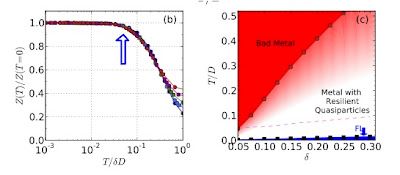 I found this resilience of quasi-particles somewhat surprising [I am not quite sure why] and interesting. Furthermore, in this intermediate temperature regime there is large entropy and significant local magnetic moments, and Kelvin's formula gives a good description of the temperature dependence of the thermoelectric power.
The strong correlations lead to a significant particle-hole asymmetry (in the self energy and single-particle density of states) via the subtle interplay of the lower Hubbard band with the quasi-particle peak in the density of states.
To me this all illustrates how much (but obviously not all) of the rich physics seen in strongly correlated materials can be captured by DMFT.
Note added. I am told that the axis label on the left figure is in error and it should be 1/Z not Z, i.e. Z actually increases with temperature.
How bad metals turn good: spectroscopic signatures of resilient quasiparticles
by Xiaoyu Deng, Jernej Mravlje, Rok Zitko, Michel Ferrero, Gabriel Kotliar, and Antoine Georges
They study a doped Hubbard model using Dynamical Mean-Field Theory (DMFT). Although the ground state is a Fermi liquid this is only a good description at very low temperatures. In particular, the quadratic temperature dependence (characteristic of a Fermi liquid) only occurs below a temperature of about 0.05 delta D [where delta=doping and D=band width]. But, well-defined quasi-particles still exist all the way up to the "bad metal" region at which the mean-free path is comparable to the lattice constant.

The strong correlations lead to a significant particle-hole asymmetry (in the self energy and single-particle density of states) via the subtle interplay of the lower Hubbard band with the quasi-particle peak in the density of states.
To me this all illustrates how much (but obviously not all) of the rich physics seen in strongly correlated materials can be captured by DMFT.
Note added. I am told that the axis label on the left figure is in error and it should be 1/Z not Z, i.e. Z actually increases with temperature.
Wednesday, October 17, 2012
Extracting Berry's phase from experiments on topological insulators
Tony Wright and I just finished a paper
Quantum oscillations and Berry's phase in topological insulator surface states with broken particle-hole symmetry
Quantum oscillations [e.g., Shubnikov de Haas] can be used to determine properties of the Fermi surface of metals by varying the magnitude and orientation of an external magnetic field. Topological insulator surface states are an unusual mix of normal and Dirac fermions. Unlike in graphene and simple metals, Berry's geometric phase in topological insulator surface states is not necessarily quantised. We show that reliably extracting this geometric phase from the phase offset associated with the quantum oscillations is subtle. This is especially so in the presence of a Dirac gap such as that associated with the Zeeman splitting or interlayer tunneling.
We develop a semi-classical theory for general mixed normal-Dirac systems in the presence of a gap, and in doing so clarify the role of topology and broken particle-hole symmetry. We propose a systematic procedure of fitting Landau level index plots at large filling factors to reliably extract the phase offset associated with Berry's phase.

Comments and feedback would be very welcome.
Tuesday, October 16, 2012
Connecting the pseudogap to superconductivity in organics
For the cuprates an outstanding question concerns whether there is a connection between the pseudogap and superconducting states. The same question arises in organic charge transfer salts, although it has received little attention. For the organics evidence for the pseudogap is rather indirect, mostly coming from NMR, which shows a reduction in the Knight shift and the relaxation rate below about 50 K. There is no direct evidence of nodes in the pseudogap.
A recent PRB presents evidence from ultrasound measurements that there is an intimate connection between the two.
Symmetry-imposed signatures at the pseudogap crossover in κ-(BEDT-TTF)2X organic superconductors
by Mario Poirier, Maxime Dion, and David Fournier
The figure below shows the temperature dependence of different elastic moduli near the temperature at which the pseudogap opens.
 A post from last year considered in detail an earlier paper by the same group [plus their theory colleague A.M. Tremblay] that considered the anisotropy in the acoustic anomalies at the superconducting transition.
 Note that the anisotropies are the same for both transitions, suggesting that the coupling of the relevant order parameters to the different components of the elastic tensor is the same.
This earlier paper presented a theory for the elastic anomalies near the superconducting transition. This theory would mean that the pseudogap and the superconducting order parameter have the same symmetry.
My earlier post raised some concerns about the theory, including that it predicts a symmetry distinct from the B2g symmetry predicted by RVB and spin fluctuation calculations (and this recent experimental paper).
Hence, I think there is a need for a slightly different theory of the acoustic anomalies. Nevertheless, I don't think that will change the main conclusion of the current paper: that the pseudogap and the superconducting order parameter have the same symmetry.
Indeed, this was the last sentence of a 2005 PRL that Ben Powell and I wrote about an RVB theory of these materials.
A recent PRB presents evidence from ultrasound measurements that there is an intimate connection between the two.
Symmetry-imposed signatures at the pseudogap crossover in κ-(BEDT-TTF)2X organic superconductors
by Mario Poirier, Maxime Dion, and David Fournier
The figure below shows the temperature dependence of different elastic moduli near the temperature at which the pseudogap opens.


This earlier paper presented a theory for the elastic anomalies near the superconducting transition. This theory would mean that the pseudogap and the superconducting order parameter have the same symmetry.
My earlier post raised some concerns about the theory, including that it predicts a symmetry distinct from the B2g symmetry predicted by RVB and spin fluctuation calculations (and this recent experimental paper).
Hence, I think there is a need for a slightly different theory of the acoustic anomalies. Nevertheless, I don't think that will change the main conclusion of the current paper: that the pseudogap and the superconducting order parameter have the same symmetry.
Indeed, this was the last sentence of a 2005 PRL that Ben Powell and I wrote about an RVB theory of these materials.
Monday, October 15, 2012
Not all iron pnictide superconductors are the same
I am not working on the new iron pnictide superconductors and so am only casually following the field. Here is one recent paper that got my attention.
Nodal versus Nodeless Behaviors of the Order Parameters of LiFeP and LiFeAs Superconductors from Magnetic Penetration-Depth Measurements
K. Hashimoto, S. Kasahara, R. Katsumata, Y. Mizukami, M. Yamashita, H. Ikeda, T. Terashima, A. Carrington, Y. Matsuda, and T. Shibauchi
The temperature dependence of the London penetration depth [which determines the superfluid density] is strikingly different for LiFeP and LiFeAs. This suggests that for the former there are nodes in the superconducting gap.
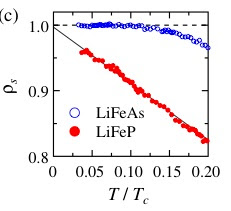 Furthermore, they correlate the presence of nodes in the superconducting energy gap with the height of the pnictogen atoms (Pn=As or P) above the plane of the Fe atoms in the crystal structure.

Nodal versus Nodeless Behaviors of the Order Parameters of LiFeP and LiFeAs Superconductors from Magnetic Penetration-Depth Measurements
K. Hashimoto, S. Kasahara, R. Katsumata, Y. Mizukami, M. Yamashita, H. Ikeda, T. Terashima, A. Carrington, Y. Matsuda, and T. Shibauchi
The temperature dependence of the London penetration depth [which determines the superfluid density] is strikingly different for LiFeP and LiFeAs. This suggests that for the former there are nodes in the superconducting gap.


Thursday, October 11, 2012
Overselling cold atoms
A few previous posts about BECs in dilute atomic gases show that I am at times skeptical about some of the claims made by members of the cold atom community. Those posts also generated some interesting and worthwhile comments.
Yesterday I endured an irritating seminar about realising spin-orbit coupling, topological superconductors, and Majorana fermions in cold atom systems. It was claimed that all of the problems and ambiguities with observing these effects in condensed matter systems could be solved in cold atom systems. I wish this were true. However, it seemed to me that the complexities and challenges associated with the speakers proposed cold atom realisation was just as great. The speaker made the fundamental mistake, never offer undefendable ground.
I mention this because I have heard several cold atom talks (and reviewed grant applications) like this. Basically, there is a lot of hubris and hype. There is also ignorance of the existence of standard condensed matter techniques (e.g. inelastic neutron scattering and scanning tunneling microscopy) and of history (e.g. the Josephson effect).
But, I realise not everyone in the cold atom community is like this.
Quantum many-body systems are extremely difficult to study, both theoretically and experimentally. Every system and every technique has advantages and significant disadvantages.
Dilute atomic gases have a greater tuneability than most solids. However, interpreting experiments is subtle because of spatial non-uniformity, non-equilibrium effects, lack of robust thermometry, .... Furthermore, one can access a limited range of densities and the interactions are short-ranged.
A strong case can be made that dilute atomic gases are of interest in their own right and are complementary to other condensed matter systems. I think it is counter-productive to claim much more...
Subscribe to:
Posts (Atom)