It is amazing to me how much the Higgs boson has featured in the press and entered the public consciousness lately. I fear this is partly because CERN has such a large and effective press office. This was particularly brought home to me when my wife sent me the above cartoon which one of her friends had posted on Facebook.
On the one hand, I think it is good that physics is getting all this publicity. On the other hand I think the scientific significance of this discovery is being blown out of proportion, driven by the large budgets involved....
Monday, August 13, 2012
Friday, August 10, 2012
An annoying bug in Mac Mail
Over the past year I have encountered the following annoying and sometimes embarrassing problem with Mail on my Mac.
It seems that sometimes (apparently randomly to me) it strips attachments from incoming emails. A first I thought the sender had forgotten to attach the file, as sometimes happens. I asked them to resend it. Sometimes the attachment comes through on a second attempt. Other times it does not. The size does not seem to be relevant.
I thought the university system might be stripping the attachment and so I looked on the UQ Webmail and found that it was there in the original email there but not in Mail.
I welcome suggestions. I looked online and found other people with this problem, but no clear solutions.
Thursday, August 9, 2012
Raman scattering from strongly correlated electron materials
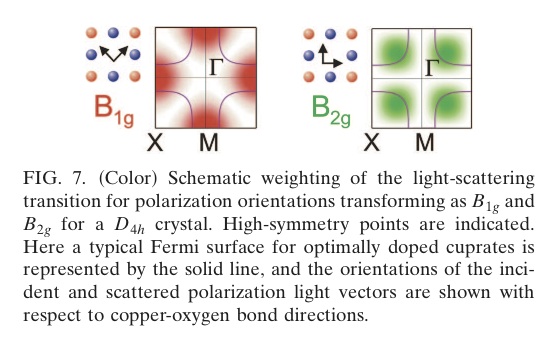
At the cake meeting [weekly condensed matter theory group meeting] we took three weeks to go through the review article Inelastic light scattering from correlated electrons by Devereaux and Hackl.
I found it very helpful. Here are a few things I learnt.
Polarisation dependence
It is sensitive to anisotropy in Fermi surface properties via different light polarisations. This is because the relevant matrix elements depend on the polarisation.
In principle this can be used to detect unconventional superconductivity and even distinguish d-xy and d_x2-y2.
This polarisation dependence also shows signs of anisotropies in the metallic state of cuprates.
Background electronic continuum
In a simple metal the scattering off electron-hole pairs should cutoff at a wavevector of about v_F q where v_F is the Fermi velocity and q is the change in wavevector of the light. This is a relatively small energy. However, in strongly correlated materials such as the cuprates this extends to much higher energies. This is still not really understood.
Electronic Raman scattering played a key role in the cuprates in two regards. First, via two magnon scattering it provided the first experimental estimate of the antiferromagnetic exchange interaction J in the parent Mott insulator. [n.b. most people would agree that the large J is at the heart of the high-Tc]. Second, it showed the large "incoherent" background which is linear in omega, having a large influence on the development of the Marginal Fermi liquid phenomenology.
I was a little disappointed to see that interpreting the experimental results is not completely straightforward and that often there was a fair bit of noise in the data.
Overall it seems this is a promising technique which provides a complementary probe to others such as ARPES, optics, and transport measurements. No doubt in the next few decades there will be technological advances that will increase resolution and increase the signal to noise. It would be nice to see some measurements on organic superconductors.
Tuesday, August 7, 2012
Conserve your political capital
Everyone, and particularly junior people, need to accept the painful reality that within any department and university they only have a finite and limited amount of political capital and goodwill. So, conserve it like a precious commodity. Only cash it in for things you really need: e.g., getting tenure, adequate lab and office space, a strong letter of support for an important grant application, a reasonable teaching load, promotion, ....
Don't squander your capital and goodwill with minor gripes/requests/demands about lab space, small salary increments, not getting exactly the teaching you want, minor irritations about administrative procedures,...
Middle (and senior) management may quickly get tired of these minor concerns and will then be much less sympathetic and willing to address major concerns.
Monday, August 6, 2012
Clarifying the origins of mass and the Higgs boson
There is a nice article by Frank Close, Higgs boson: beginning of the end or end of the beginning.
It gives a succinct discussion of the background to the recent discovery and what it does and does not mean for elementary particle physics.
A couple of points I found helpful.
Reports in the media that "the Higgs boson is responsible for mass" are misleading.
First, almost all the mass in our bodies comes from neutrons and protons, and more than 99% of their mass comes from the binding energy of quarks (due to quantum chromodynamics) and not from the mass of isolated quarks.
The latter are hypothesized to get their mass from the Higgs field.
[Aside: the boson and the field are not the same thing. The boson is one specific excitation of the field].
Secondly, the CERN experiments do not establish that leptons and quarks obtain their mass from the Higgs field. Rather, only that the gauge bosons in electro-weak theory obtain their mass from the Higgs field.
Further experiments at CERN in the next few years may establish this though.
But, the existence of the Higgs field is relevant to chemistry in the following sense. Nuclei are so compact because of the large energy of pions, which is a reflection of the mass of quarks. Furthermore, the size of hydrogen atom is determined by the
mass of the electron.
Friday, August 3, 2012
Criteria for tenure?
Previously, I posted about Stanford's criteria for tenure in chemistry. It is striking that so little consideration is given to the metrics (grant dollars, number of publications, number of graduate students, number of citations, h-index,...) that lesser institutions use to judge staff.
In this light, it was particularly interesting to read the extract below of an interesting interview with Ken Wilson about his career.
PoS [Physics of Scale]
- So by the time you come to Cornell, people don't really know what you're working on. I mean on the surface, there are many things that you're doing, but deep down, there's a commitment to try to explore how far can you go with quantum field theory.
KGW
- The people at Cornell had more of an interest to know what I was doing than people at Harvard, because they were going to have to make a decision... Of course one of the things that happened was, as you may or may not be aware, is that they gave me tenure after only two years and with no publication record. In fact, there was one or two papers on the publications list when I was taken for tenure and Francis Low complained that I should have made sure there was none. Just to prove that it was possible.
History certainly vindicated Cornell's decision!
I wonder whether this really could happen today.
Quality science and the development of quality scientists takes time....
I wonder whether this really could happen today.
Quality science and the development of quality scientists takes time....
Thursday, August 2, 2012
Deconstructing magnetoresistance in cuprates
In simple metals the temperature and magnetic field dependence of the magnetoresistance is encoded in some function of the product omega_c*tau.
omega_c is the cyclotron frequency which is proportional to the magnetic field B and independent of temperature.
tau is the scattering time, which is temperature dependent and field independent, and should have the same temperature dependence as 1/rho where rho(B=0) is the zero field resistivity.
These observations lead to Kohler's rule which is obeyed by simple metals.
A plot of the ratio of the rho(B)/rho(B=0) versus B/rho(B=0) should be independent of temperature. In 1995 Ong's group observed significant violations of Kohler's rule in the underdoped and overdoped cuprates.
In 1998 I pointed out that in one mysterious organic metal there were also significant violations. The paper also has an extensive discussion of reasons why Kohler's rule can fail.
Recently, Jure Kokalj, Nigel Hussey and I wrote a paper which showed that a wide range of transport properties of overdoped cuprates could be quantitatively described by an anisotropic marginal Fermi liquid picture. A referee suggested that we would not be able to describe the temperature dependence of the intra-layer magnetoresistance. It turns out that this also violates Kohler's rule but satisfies a "modified" form where omega_c*tau is related to the Hall angle. We found that with our model we could describe the available experimental data but the magneto-resistance was remarkably sensitive to the details of shape of the Fermi surface. The results are discussed in detail in our paper which just appeared in Physical Review B.
Subscribe to:
Posts (Atom)
Emergence and centralised planning of scientific research
Scientists, individually and collectively, make decisions about research directions and priorities. There are three main interacting influe...
-
An interesting and controversial question for Ph.D's in science and engineering is too what extent students should be expected to have ...
-
Some of my colleagues and I have started an interesting discussion about how to teach quantum theory to undergraduates. We have courses in t...
-
As years go by the PhD thesis in science and engineering is less and less of a ``thesis'' and more just a box to tick. There was a t...


