There is no doubt that the level of hype in science is increasing. You see it in grant applications, university press releases, introductions and conclusion in papers (especially in luxury journals), talks, ... Hype is also a broader problem in society, including in the business world and politics.
Why is hype bad for science?
Some will say something like, ``I agree that it is not good, but we have to do it to survive. Anyway, we all know what is really true and so it does not matter..."
However, I think there are many problems, particularly for the long term flourishing of science.
Waste of time
Figuring out that a ``hyped'' result or research field is actually just hype can take significant time. This is particularly true if one actually tries to reproduce a result and discover all the problems.
Mis-allocation of resources
Researchers, students, and funding agencies flock to hyped fields. However, it can take quite a while and a lot of money for the community to come to the consensus that things are not going to live up to the hype. This is compounded by the fact that people whose careers are enhanced by a hyped result or field are not going to back down too easily and are going to want to keep things going, at least until the next big thing comes along.
Obscuring or hiding problems that need to be solved to make real progress
Making real and significant progress in science is very hard. Every technique has its limitations. Every result involves some uncertainty. Turning science in the lab into a commercially viable technology may arguably be even harder. The obstacles are many. The best way to progress in science and technology is to clearly and honestly state the problems and challenges. This is one of my many concerns about functional electronic materials.
Intellectual integrity
Science is all about intellectual integrity. Losing our credibility with broader society won't be good for science or for society, particularly when it comes to developing well-informed public policy.
Thursday, March 28, 2019

Tuesday, March 26, 2019
Noel Hush (1924- 2019): pioneering theoretical chemist
I was sad to hear last week that Professor Noel Hush died at age 94. Noel [also known as Prof.] was a pioneer in theoretical chemistry and chemical physics. He had a profound influence on both fields, particularly in their development in Australia.
Arguably his greatest scientific contribution was in the theory of electron transfer. Depending on where you are from this is called Hush-Marcus theory, Marcus-Hush theory, or Marcus theory. In particular, in 1958 Hush derived one of the most important equations in chemical physics, which can be used for design principles for functional electronic materials. A key concept here is the notion of diabatic states.
I had the privilege of knowing and working with Prof. Hush on and off over the past decade. As I made an adiabatic transition from condensed matter into chemical physics Prof. Hush provided a lot of encouragement, wisdom, perspective, and ideas. He strongly believed that theoretical chemists and condensed matter theorists could have mutually beneficial interactions. Together with Jeff Reimers and Laura McKemmish, we co-authored seven papers together. The last papers were published when Noel was 90 years old!
Besides his significant legacy of scientific knowledge, there is an incredible legacy of people that he taught, supervised, mentored, encouraged, and collaborated with.
There is an interesting interview of Prof. Hush about his life by Robyn Williams from 2011.
Arguably his greatest scientific contribution was in the theory of electron transfer. Depending on where you are from this is called Hush-Marcus theory, Marcus-Hush theory, or Marcus theory. In particular, in 1958 Hush derived one of the most important equations in chemical physics, which can be used for design principles for functional electronic materials. A key concept here is the notion of diabatic states.
I had the privilege of knowing and working with Prof. Hush on and off over the past decade. As I made an adiabatic transition from condensed matter into chemical physics Prof. Hush provided a lot of encouragement, wisdom, perspective, and ideas. He strongly believed that theoretical chemists and condensed matter theorists could have mutually beneficial interactions. Together with Jeff Reimers and Laura McKemmish, we co-authored seven papers together. The last papers were published when Noel was 90 years old!
Besides his significant legacy of scientific knowledge, there is an incredible legacy of people that he taught, supervised, mentored, encouraged, and collaborated with.
There is an interesting interview of Prof. Hush about his life by Robyn Williams from 2011.
Saturday, March 23, 2019
Emergence and complexity in social systems
Emergent phenomena occur in social systems. For example, self-organisation, power laws, networks, aggregation/segregation, political polarisation, political revolutions...
Can lessons from condensed matter physics help at all in understanding and modeling of social systems? Can analogies from social systems help non-scientists understand some of the basic ideas in condensed matter?
In two months I am giving a seminar in a new UQ multi-disciplinary seminar series, Futures of International Order. In preparation, I am slowly engaging with relevant literature, particularly the work of Scott Page, including his course on Model Thinking at Coursera. The NetLogo software is helpful for exploring a range of simple models.
However, before plunging in here are a few tentative thoughts of ideas that might connect with condensed matter, in the vein of reviews such as
Physics and financial economics (1776–2014): puzzles, Ising and agent-based models
Didier Sornette
Statistical physics of social dynamics
Claudio Castellano, Santo Fortunato, and Vittorio Loreto
Emergence occurs in systems with many interacting components. In social systems, the components are human agents. They can aggregate into emergent entities such as neighbourhoods, institutions, and communities. Associated with these new entities are new scales of size (number of agents), length, time, and connectivity. New effective interactions between entities can also emerge. Even knowing all the details of the system components and the interactions it can be very difficult to predict the properties of the whole system. Surprises are common. Humility is needed.
Qualitative changes can occur due to small quantitative changes in a system parameter.
In condensed matter examples are phase transitions between different states of matter. Furthermore, these changes can be directly seen as discontinuities or singularities in observables. Order parameters can quantify the changes. In social systems, similar phenomena are sometimes called tipping points.
Universality versus particularity
Close to a critical point for a phase transition most of the details of the system components and their interactions do not matter. Properties such as critical exponents are independent of most details. This is wonderful for theory because one can describe large classes of diverse systems with the same model/theory and one does not have to know all the details of the system.
Similar issues of universality are also relevant when one considers phenomena at different length scales. For example, one does not need to know anything about the atoms (even their existence!) in a crystal to develop a theory of elasticity or the propagation of sound waves.
When it comes to social systems there are a wide range of phenomena that can be potentially described by the same model. For example, Miller and Page point out that the essence of the standing ovation problem is how a binary choice (sit or stand) is influenced by the behaviour of one's neighbours. This is similar to choices as to whether to join a riot, take illegal drugs, or whether to vote of political party A or B.
Can lessons from condensed matter physics help at all in understanding and modeling of social systems? Can analogies from social systems help non-scientists understand some of the basic ideas in condensed matter?
In two months I am giving a seminar in a new UQ multi-disciplinary seminar series, Futures of International Order. In preparation, I am slowly engaging with relevant literature, particularly the work of Scott Page, including his course on Model Thinking at Coursera. The NetLogo software is helpful for exploring a range of simple models.
However, before plunging in here are a few tentative thoughts of ideas that might connect with condensed matter, in the vein of reviews such as
Physics and financial economics (1776–2014): puzzles, Ising and agent-based models
Didier Sornette
Statistical physics of social dynamics
Claudio Castellano, Santo Fortunato, and Vittorio Loreto
Emergence occurs in systems with many interacting components. In social systems, the components are human agents. They can aggregate into emergent entities such as neighbourhoods, institutions, and communities. Associated with these new entities are new scales of size (number of agents), length, time, and connectivity. New effective interactions between entities can also emerge. Even knowing all the details of the system components and the interactions it can be very difficult to predict the properties of the whole system. Surprises are common. Humility is needed.
Qualitative changes can occur due to small quantitative changes in a system parameter.
In condensed matter examples are phase transitions between different states of matter. Furthermore, these changes can be directly seen as discontinuities or singularities in observables. Order parameters can quantify the changes. In social systems, similar phenomena are sometimes called tipping points.
Universality versus particularity
Close to a critical point for a phase transition most of the details of the system components and their interactions do not matter. Properties such as critical exponents are independent of most details. This is wonderful for theory because one can describe large classes of diverse systems with the same model/theory and one does not have to know all the details of the system.
Similar issues of universality are also relevant when one considers phenomena at different length scales. For example, one does not need to know anything about the atoms (even their existence!) in a crystal to develop a theory of elasticity or the propagation of sound waves.
When it comes to social systems there are a wide range of phenomena that can be potentially described by the same model. For example, Miller and Page point out that the essence of the standing ovation problem is how a binary choice (sit or stand) is influenced by the behaviour of one's neighbours. This is similar to choices as to whether to join a riot, take illegal drugs, or whether to vote of political party A or B.
Thursday, March 21, 2019
Mental health in academia
Even though I have not posted about it for a while, mental health continues to be on my radar. I monitor my own mental health carefully and generally things are going well. Tragically, I still meet many in academia struggling with the issue. It is also in the news because of the recent death by suicide of Princeton economist, Alan Krueger. A few months ago, Stanford theoretical physicist, Shoucheng Zhang, also died by suicide.
The Chronicle of Higher Education has an article about how Krueger's death is prompting conversations about how the culture of academia can be unconducive to mental health.
Last week there was an excellent New York Times Opinion piece by Lisa Pryor
Mental Illness Isn’t All in Your Head
A “formulation” gathers the biological, psychological and social factors that lead to a mental illness — and offers clues to the way out of suffering.
The Chronicle of Higher Education has an article about how Krueger's death is prompting conversations about how the culture of academia can be unconducive to mental health.
Last week there was an excellent New York Times Opinion piece by Lisa Pryor
Mental Illness Isn’t All in Your Head
A “formulation” gathers the biological, psychological and social factors that lead to a mental illness — and offers clues to the way out of suffering.
Tuesday, March 19, 2019
Orbital-selective bad metals
Alejandro Mezio and I just posted a preprint
Orbital-selective bad metals due to Hund’s rule and orbital anisotropy: a finite-temperature slave-spin treatment of the two-band Hubbard model
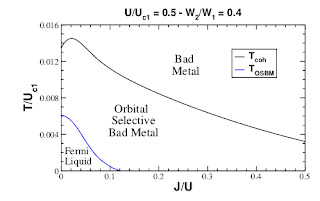
The central result is shown in the Figure below. It shows the phase diagram of the metallic phase as a function of temperature and the Hund's rule interaction J in a system with two bands of differing bandwidth. Uc1 ~ W1 is the critical interaction for a Mott insulator in a one band system with bandwidth W1.
The system is a Hund's metal in that the strong correlations arise from J and not from proximity to a Mott insulating phase (note that U=0.5Uc1).
In the orbital-selective bad metal, one of the bands is a coherent Fermi liquid (with well-defined Fermi surface) and the second (narrower) band is a bad metal.
 Two things that I find particularly interesting are the following.
Stability of the bad metal and the orbital-selective bad metal are enhanced by increasing J and/or by increasing band anisotropy.
The temperatures at which the bad metals occur is orders of magnitude smaller than the Fermi temperature for the corresponding non-interacting system (being of the order of W1~ Uc1).
We welcome comments.
Orbital-selective bad metals due to Hund’s rule and orbital anisotropy: a finite-temperature slave-spin treatment of the two-band Hubbard model
The central result is shown in the Figure below. It shows the phase diagram of the metallic phase as a function of temperature and the Hund's rule interaction J in a system with two bands of differing bandwidth. Uc1 ~ W1 is the critical interaction for a Mott insulator in a one band system with bandwidth W1.
The system is a Hund's metal in that the strong correlations arise from J and not from proximity to a Mott insulating phase (note that U=0.5Uc1).
In the orbital-selective bad metal, one of the bands is a coherent Fermi liquid (with well-defined Fermi surface) and the second (narrower) band is a bad metal.

Stability of the bad metal and the orbital-selective bad metal are enhanced by increasing J and/or by increasing band anisotropy.
The temperatures at which the bad metals occur is orders of magnitude smaller than the Fermi temperature for the corresponding non-interacting system (being of the order of W1~ Uc1).
We welcome comments.
Thursday, March 14, 2019
Imaging orbital-selective quasi-particles in a Hund's metal
Over the past two decades, a powerful new technique has been developed to determine quasi-particle properties in strongly correlated electron systems, based on STM (scanning tunneling microscope) measurements. Quasi-particle interference (QPI) has proved to be particularly useful for studying cuprates (e.g. in revealing the d-wave pairing) and now for iron-based superconductors. The basic physics is as follows. One measures the changes in the local tunneling density of states N(r,E), associated with a single impurity that scatters quasi-particles with a change in momentum q. Then the Fourier transform of this change is
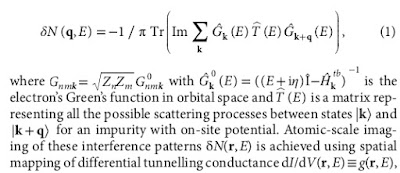
The text above is taken from a nice paper
Imaging orbital-selective quasiparticles in the Hund’s metal state of FeSe
A. Kostin, P.O. Sprau, A. Kreisel, Yi Xue Chong, A.E. Böhmer, P.C. Canfield, P.J. Hirschfeld, B.M. Andersen and J.C. Séamus Davis
They show theoretically that the intensity of the interference pattern is quite sensitive to the quasi-particle weights of the different d-orbital bands. The experiments are consistent with


The large variation between the Z values for different orbitals shows how the effect of the correlations are orbital selective.
The same Z values were used by the same cast of characters in a study of the superconducting state that showed orbital selectivity played a key role in the Cooper pairing, including the significant variation of the energy gaps over the different Fermi surfaces. The quantitative agreement between experiment and the associated theory is quite impressive.
I thank Alejandro Mezio for bringing the papers to my attention.

The text above is taken from a nice paper
Imaging orbital-selective quasiparticles in the Hund’s metal state of FeSe
A. Kostin, P.O. Sprau, A. Kreisel, Yi Xue Chong, A.E. Böhmer, P.C. Canfield, P.J. Hirschfeld, B.M. Andersen and J.C. Séamus Davis
They show theoretically that the intensity of the interference pattern is quite sensitive to the quasi-particle weights of the different d-orbital bands. The experiments are consistent with

The key figure is below. It shows shaded intensity plots of the change in DOS as a function of wavevector. The central column is experimental data with E increasing from -20 meV to +15 meV as one goes down the column. The left and right columns show theoretical values for the same quantities, calculated with all the quasi-particle weights Z=1 (left) and the Z values above (right).

The large variation between the Z values for different orbitals shows how the effect of the correlations are orbital selective.
The same Z values were used by the same cast of characters in a study of the superconducting state that showed orbital selectivity played a key role in the Cooper pairing, including the significant variation of the energy gaps over the different Fermi surfaces. The quantitative agreement between experiment and the associated theory is quite impressive.
I thank Alejandro Mezio for bringing the papers to my attention.
Thursday, March 7, 2019
Why is quantum matter so interesting?
Last year Ben Powell wrote a Perspective for Science, The Expanding Materials Multiverse. It begins with a nice statement about why quantum condensed matter is so interesting, exciting, and challenging.

High-energy physicists are limited to studying a single vacuum and its excitations, the particles of the standard model. For condensed-matter physicists, every new phase of matter brings a new “‘vacuum.” Remarkably, the low-energy excitations of these new vacua can be very different from the individual electrons, protons, and neutrons that constitute the material. The materials multiverse contains universes where the particle-like excitations carry only a fraction of the elementary electronic charge, are magnetic monopoles, or are their own antiparticles. None of these properties have ever been observed in the particles found in free space. Often, emergent gauge fields accompany these “fractionalized” particles, just as electromagnetic gauge fields accompany charged particles. On page 1101 of this issue, Hassan et al. provide a glimpse of the emergent behaviors of a putative new phase of matter, the dipole liquid. What particles live in this universe, and what new physics is found in this and neighboring parts of the multiverse?There is also a nice figure which makes an everyday analogy to illustrate different states of matter.

Subscribe to:
Comments (Atom)
-
 This week Nobel Prizes will be announced. I have not done predictions since 2020 . This is a fun exercise. It is also good to reflect on w...
 -
 Is it something to do with breakdown of the Born-Oppenheimer approximation? In molecular spectroscopy you occasionally hear this term thro...
 -
 Nitrogen fluoride (NF) seems like a very simple molecule and you would think it would very well understood, particularly as it is small enou...