Monday, November 30, 2009

What are deconfined spinons?

They are the spin-1/2 quasi-particle excitations associated with a spin liquid ground state of a quantum antiferromagnet. Perhaps the easiest way to understand them is in contrast to the low-lying excitations in an antiferromagnet with an ordered ground state. Spontaneously broken symmetry is the key concept behind understanding the nature of these excitations. Specifically, for infinite systems the ground state is usually degenerate and is not invariant under the samesymmetries as the system Hamiltonian. This family of ground states is described by an ``order parameter'' which describes the extent of the symmetry breaking. For example, quantum antiferromagnets can be described by a Heisenberg model Hamiltonian which describes a lattice of spins which interact with their nearest (and sometimes next-nearest) neigbours on the lattice. The model Hamiltonian is invariant under rotations of all the spins and under lattice translations. However, both these symmetries can be broken by the ground states.


The figure (a) above shows a cartoon picture of a line of alternating spins in the common antiferromagnetic ground state. This symmetry breaking can be seen by the presence of new Bragg peaks in elastic neutron scattering. In contrast, a spin liquid can be defined as a ground state in which there is no broken spin or translational symmetries.

When there is a continuous symmetry that is broken, the lowest lying excitations are weakly interacting bosons, known as Goldstone modes, and are associated with small
long wave length ``rotations'' of the order parameter. (see Figure (a) above). For an antiferromagnet, these modes have spin-1, and are also referred to as magnons. They can also be viewed as the propagation of a spin flip through the lattice.

The Heisenberg antiferromagnet in one spatial dimension has distinctly different properties from in three dimensions. In one dimension, there is no symmetry breaking or long range magnetic order; the ground state is a spin liquid. The low-lying excitations have spin 1/2, and can be viewed as domains walls or solitons in the background fluctuating magnetic order (see Figure (b) above. Haldane showed these excitations obey fractional statistics (semions which are intermediate between fermions and bosons) in contrast to the spin 1 magnons which are bosons, in three dimensions. Scattering of neutrons creates spin 1 excitations which are composed of pairs of spinons with different momenta. These spinons are deconfined, i.e., they can propagate independently of one another. (See figure above).


It is possible to directly ``see'' the quasi-particles, and measure their energy and lifetimes using inelastic neutron scattering. One scatters a beam of neutrons off a magnetic material and measures the momentum and energy of the scattered neutrons.
If there are well-defined quasi-particles they will have a particular energy for each wavevector q. The neutron scattering cross section is proportional to the dynamical spin structure factor S(E,q) will then show well-defined peaks when E=h ω(q) (see Figure above).

In an actual material the deconfinement of spinons was first seen in the compound KCuF3 which is composed of linear chains of spin-1/2 copper ions. The experimental signature of deconfined spinons was the presence of substantial spectral weight at energies above the magnon dispersion (the lower dashed line in the Figure above) one would see in a semi-classical antiferromagnet.

The Figures above are taken from a review, Mapping atomic motions in materials, by Toby Perring (ISIS) in Materials Today. The spectrometers for inelastic neutron scattering that Toby has built at ISIS have produced much of the beautiful data (such as that shown above) which is keeping theorists such as myself very busy.

Whether or not spinons exist in any real two-dimensional material is controversial. A News and Views piece I wrote for Nature Physics several years ago briefly reviews some of the issues.

Something I am still not clear on is whether a spin liquid ground state is a necessary and/or a sufficient condition for the existence of spinons.

Any ideas?

Sunday, November 29, 2009

THE question

A good (and painful) question to ask when evaluating research, both our own and others, is:
What does the scientific community know now that we did not know when you began the research?
There is a similar probing question to ask yourself before you start a project (or a new sub-project). Suppose everything goes as well as can be hoped (i.e., you are able to complete the calculation, do the measurement, get the new technique to work, or make the compound). Then will you be able to say something new? If not, is it worth even trying?

The before question is a good one for both students and supervisors to contemplate. It is too easy for supervisors (including me) to say do this extra calculation (or make this extra compound and measure all its properties) without considering enough the time cost to the student or postdoc.

Thursday, November 26, 2009

The most important letter in your scientific career?

Hopefully, the title got your attention. This is mostly directed at people applying for postdocs.
The cover letter is key.
I believe most postdoc (and many faculty) applications live or die [i.e., get to the long short list] based on the quality of the cover letter.

You need to specifically answer the following specific questions:
  • Why are you interested in this specific job?
  • Why are you interested in this specific research?
  • Why should they hire specifically you for this specific job?
Most cover letters I receive are generic. People tend to write the same letter for every job they apply for. Furthermore, the research achievements and research interests they list are usually generic.

So to be specific!
Write something like:
"One of the scientific questions I am most interested in is "What is the physical mechanism for XXXX in material YYY? I recently read your nice paper "blah blah" in journal YY and I have been wondering if a similar approach might be relevant to answering my question. I welcome any suggestions from you in this regard....."
Dont write:
"Dear Professor,
I did my Ph.D on topic X and want to continue working on it [even though I have no idea as to whether you have ever worked in this area or have any interest in it]. I published lots of papers [even though most listed on the CV are "in preparation"] and will publish lots more if I come and work with you....]"
The letter is so important you should spend at least a day writing it, even though is should fit on a single page. Should should get a range of faculty to read it and provide feeback.

Wednesday, November 25, 2009

Diverse career options for physicists

Here are the slides of the fascinating talk that Joel Gilmore gave at the Careers session organised by the Australian Institute of Physics (Qld branch) last wednesday.

Deconstructing charge transport in complex materials

Consider a material in which there are two distinct charge carriers (e.g., electrons and protons or electrons and oxygen vacancies). A measurement of the conductivity of a sample will just yield the sum of the conductivities of the two individual charge carriers. Given that the physical conduction mechanism for the two carriers may be distinctly different (e.g., small polaron hopping vs. vacancy diffusion) the temperature, pressure, and composition dependence of the two components may be completely different. Is there a way to extract for each of the carriers the conductivity, density of carriers, and mobility? A few weeks ago I thought this was hopeless, but I was wrong.

So my favourite paper for this week has the weighty title
by Wei Lai and Sossina Haile from Caltech.
The paper is in a journal I have never looked at before, Journal of the American Ceramic Society (n.b. that is Ceramic not Chemical!)

The physics underlying the impedance technique is fascinating. It makes use of the concept of chemical capacitance:
The chemical capacitance has certain similarities to conventional dielectric capacitance. While the latter is a measure of the ability of the system to store electrical energy in the form of polarized electric dipoles, the former is a measure of the ability of the system to store chemical energy in the form of changes in stoichiometry
One measures the frequency dependence of the impedance of a sample of finite thickness. The sample acts like a circuit with a finite RC time constant, but the capacitance is due to the chemical capacitance. One then plots the imaginary part of the impedance vs. the real part (this is known as a Nyquist plot). Qualitatively it should look like one of the plots below.

The left one is what one obtains for a mixed ionic and electronic conductor where the two specifies have distinctly different conductivities. The right one occurs when the two components have comparable conductivities.

Lai and Haile apply the technique to a solid oxide fuel cell material (samaria doped cerium oxide at a range of oxygen partial pressures). They extract a considerable amount of information about the electronic and ionic conduction which is of great interest to Elvis Shoko, Michael Smith and myself. Elvis brought the paper to our attention.

I wonder whether this technique would also be useful for understanding charge transport in hydrated melanin, Gratzel cells, and conjugated polymers with charged functional groups and counterions.

Tuesday, November 24, 2009

Quantum frustration in a nutshell

Understanding lattice models for strongly correlated electron systems is a major challenge. Widely studied (and still poorly understood) models include the Hubbard and Heisenberg models. But some insight can be gained from studying model Hamiltonians on small clusters such as four lattice sites. Although, such a small system is far from the thermodynamic limit, these models can illustrate some of the essential physics associated with the interplay of strong electronic correlations, frustration, and quantum fluctuations. They illustrate the quantum numbers of important low-lying quantum states, the dominant short-range correlations, and how frustration changes the competition between these states.

Furthermore, understanding these small clusters is a pre-requisite for cluster extensions of dynamical mean-field theory and rotationally invariant slave boson mean-field theory which describes band selective and momentum space selective Mott transitions. See for example my earlier post on that.

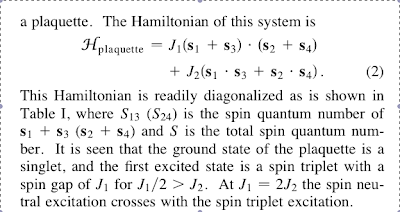
I now give a concrete example which illustrates how frustration can change the quantum numbers of the ground and first excited states. This is taken from a 1996 PRL, Plaquette Resonating valence bond ground state of CaV4O9, by Ueda, Kontani, Sigrist, and Lee. They first consider a single


Sunday, November 22, 2009

Tough times for science in California

My wife brought to my attention an article in the New York Times about the consequences of California's budget woes for the University of California system, and especially Berkeley. People interviewed include Bob Birgeneau (famous for inelastic neutron scattering studies of strongly correlated electron materials, now Chancellor at Berkeley) and Richard Mathies (pioneer in femtosecond spectroscopy, now Dean of the College of Chemistry, Berkeley)

The emergence of hadronic matter from interacting quarks and gluons

 A characteristic of emergent phenomena is how novel and complex properties can emerge from apparently simple laws. Quantum ChromoDynamics (...