Saturday, August 11, 2018

Hype, DNA, drugs, and emergence

Unfortunately, hype in science reflects hype in broader society, including in business. The complete DNA sequencing of the human genome was an amazing scientific achievement. Unfortunately, it was also associated with a lot of hype about what this would mean for medicine and for the pharmaceutical industry. This issue is made painfully and succinctly in a recent column in the business section of  The Guardian by Nils Pratley.
It has been almost two decades since the first bosses of the newly merged GlaxoSmithKline talked up the medical wonders that would flow from the unravelling of the human genome. GSK would become the “Microsoft of the pharmaceutical industry”, they said.  
To put it mildly, the corporate vision hasn’t been realised. GSK’s share price stood at £20 at the time of the turn-of-the-century merger and is £15.42 today. Lack of productivity in the labs has been a constant complaint. The genetics revolution is happening, but not at the pace originally promised, at least not at GSK.
These challenges could have been forseen by filtering the hype through a emergentist perspective, such as that presented beautifully by Denis Noble in a 2006 book, The Music of Life: Biology beyond the Genome.  Knowing a DNA sequence is about as useful, for better or worse, as knowing the many-body Schrodinger equation for a plutonium crystal. A great place to start, but ....

Thursday, August 9, 2018

Emergent temperature scales and spin-orbital separation in the Hund's metal

An important and fascinating issue in many-body physics is the emergence of new energy scales, particularly scales that are orders of magnitude smaller than the energy scales in the underlying Hamiltonian. One example is the coherence temperature associated with the crossover from a Fermi liquid (with coherent quasi-particles) to a bad metal.

Recently, I posted about the crossover from a Hund's metal to a bad metal, seen in the collapse of the Drude peak in the optical conductivity, and the issue of capturing this slave-particle theories. One commenter mentioned the relevance of the paper below and another asked about the claim that the Kondo effect is associated with the collapse.

I agree that Kondo physics is associated with the crossover. Although, far from obvious this is also the case in the single-band Hubbard model. The Kondo effect was first studied with isolated magnetic impurities in metals and can be described by a single-impurity Anderson model (SIAM). Although there are no magnetic impurities in the Hubbard model, it turns out that when studied at the level of Dynamical-Mean-Field Theory (DMFT), the model is described by a self-consistent SIAM and close to the Mott metal-insulator transition Kondo physics does emerge. Specifically, the Kondo temperature for the self-consistent SIAM corresponds to the temperature at which there is a crossover from local unscreened local magnetic moments (associated with the almost-localised electrons near the Mott phase; the bad metal) to a Fermi liquid where the "magnetic moments" are screened.

What happens in a two-band Hubbard-Kanamori model with Hund's rule coupling?
The physics is richer because there is now the possibility screening of spin and/or orbital degrees of freedom, and of a orbital-selective Mott phase (or bad metal). 
This is nicely investigated in the following paper.

Dynamical Mean-Field Theory Plus Numerical Renormalization-Group Study of Spin-Orbital Separation in a Three-Band Hund Metal
K. M. Stadler, Z. P. Yin, J. von Delft, G. Kotliar, and A. Weichselbaum

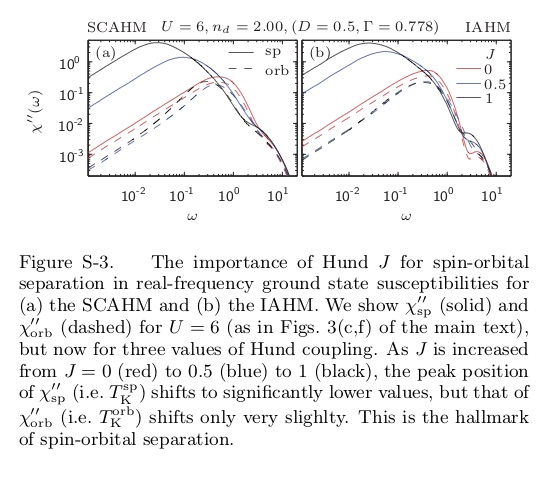
For me, the figure below is the most interesting and illuminating. It shows how due to the Hund's rule coupling, two distinct energy scales (differing by about two orders of magnitude) emerge and associated with screening the spin and orbital degrees of freedom, respectively.

This is Kondo physics, but there are no magnetic impurties.

Tuesday, August 7, 2018

Philosophy and emergence in condensed matter

Condensed matter physics is a source of a multitude of beautiful examples of emergence.  On the other hand, for more than a century philosophers have thought seriously about emergence, partly motivated by profound and difficult questions concerning human consciousness and free will.
Prior to the past decade, there appear to have been no substantial interactions between physicists and philosophers about the subject. A few years ago I posted about some recent work by philosophers of science on quasi-particles.

One of the big issues that philosophers wrestle with is the relative merits of weak emergence and strong emergence, which are sometimes distinguished as epistemological and ontological emergence.

I am very happy that in the past year or so that philosophy journals have published more than half a dozen papers about emergence in condensed matter. One of the papers, by Stephen Blundell, I blogged about earlier. Here I will mention two others and discuss one. All the papers are a result of the Durham Emergence Project.

Strong emergence and downward causation in biological physics
Tom C. B. McLeish

Reduction and emergence in the fractional quantum Hall state 
Tom Lancaster and Mark Pexton

McLeish begins with a helpful and succinct summary of the argument by Jaegwon Kim about "the causal completeness of the physical" [or the argument against non-reductive physicalism] that leads to the conclusion that mental events cannot have physical consequences. This argument has attracted significant attention from philosophers and has been used against strong emergence, and particularly to argue that consciousness is reducible.

McLeish rightly points out that the problem of consciousness is a "can of worms" [my phrase] and instead it might be valuable to consider the issue of "downward causation" by considering three important examples in biological physics.

"Downward causation" means "there are high-level entities, carrying unique information about the system essential for its future evolution, and whose form and evolution are not determined entirely by the low level entities."
He gives a nice introduction to soft matter physics and its applications to biological systems, considering the following examples.
  • Membrane and intra-membrane self-assembly
  • Allosteric Signalling in Gene Expression
  • Entangled DNA and Topoisomerases  
He points out how in these systems there is "top down causation" and that the emergent entities such as protein elasticity are not just a result of "coarse graining" but new "long-range physics" that arises from many microscopic realisations.


McLeish considers these examples reflect what Bishop and Silberstein (2016) defines as ``‘epistemological contextual emergence’ (ECE) as applying to systems whose ...description at a particular descriptive level (including its laws) offers some necessary but no sufficient conditions to derive the description of properties at a higher level.''

I thank Stephen Blundell and Tom McLeish for helpful discussions about their papers.

Thursday, August 2, 2018

Phase diagram of snowflakes

I like "collecting" interesting phase diagrams, partly because they are fun to show students when teaching introductory thermodynamics. I recently discovered the one below that I feel I really should have known about. It shows the morphology of different snow crystals as a function of temperature and water supersaturation (relative to ice).
It should be pointed out that this is a non-equilibrium phase diagram as it involves supercooled liquid water.

The figure below is taken from the beautiful review
The physics of snow crystals 
Kenneth G Libbrecht

This diagram was originally constructed by Ukichiro Nakaya in the 1930's. The physics behind it is still poorly understood.

I came across the diagram while browsing through the Forces of Nature book by Brian Cox and Andrew Cohen.

While on the subject here is a nice video.


Monday, July 30, 2018

Experimental observation of the Hund's metal to bad metal crossover

A definitive experimental signature of the crossover from a Fermi liquid metal to a bad metal is the disappearance of a Drude peak in the optical conductivity. In single band systems this occurs in proximity to a Mott insulator and is particularly clearly seen in organic charge transfer salts and is nicely captured by Dynamical Mean-Field Theory (DMFT).

An important question concerning multi-band systems with Hund's rule coupling, such as iron-based superconductors, is whether there is a similar collapse of the Drude peak. This is clearly seen in one material in a recent paper

Observation of an emergent coherent state in the iron-based superconductor KFe2As2 
Run Yang, Zhiping Yin, Yilin Wang, Yaomin Dai, Hu Miao, Bing Xu, Xianggang Qiu, and Christopher C. Homes


Note how as the temperature increases from 15 K to 200 K that the Drude peak collapses. 
The authors give a detailed analysis of the shifts in spectral weight with varying temperature by fitting the optical conductivity (and reflectivity from which it is derived) at each temperature to a model consisting of three Drude peaks and two Lorentzian peaks. Note this involves twelve parameters and so one should always worry about the elephants trunk wiggling.
On the other hand, they do the fit without the third peak, which is of the greatest interest as it is the sharpest and most temperature dependent, and claim it cannot describe the data.

The authors also perform DFT+DMFT calculations of the one-electron spectral function (but not the optical conductivity) and find it does give a coherent-incoherent crossover consistent with the experiment. However, the variation in quasi-particle weight with temperature is relatively small.

Tuesday, July 24, 2018

Maximise your comparative advantage

A snarky mathematician [Stanislaw Ulam] once challenged the great Paul Samuelson to name an economic proposition that is true but not obvious. Samuelson’s choice was comparative advantage, which shows, among other things, that there are mutual gains from trade even if one nation is better than another at producing everything.  
 Here’s a homespun illustration. Suppose a surgeon is also a whiz at house painting—better than most professional painters. Should she therefore take time off from her medical practice to paint her own house? Certainly not. For while she may have a slight edge over most painters when it comes to painting walls, she has an enormous edge when it comes to performing surgery. Surgery is her comparative advantage, so she should specialize in it and let some others, who don’t know their way around an operating room, specialize in painting—their comparative advantage. That way, the whole economy becomes more efficient.  
 The same principle applies to nations. Even if China could manufacture everything more efficiently than the U.S. can (which it can’t), it would still make sense for the U.S. to specialize in the goods in which it has comparative advantages, and then trade with China for the things it wants but doesn’t produce. Both countries wind up getting more for less.
Alan Blinder
A Brief Introduction to Trade Economics 
Why deficits are normal, especially for a country like the U.S., and what is comparative advantage.

It is worth considering the relevance of the concept of comparative advantage to doing science and its administration.

Individual scientists, should identify their comparative advantage [e.g. a particular technique, a sub-field, approach, instrument, ...] and maximise it. Furthermore, they may be better than their grad students at doing certain things, but that does not mean they should do those things.
Some exceptional scientists may be good at public outreach and chairing committees but they need to be careful such things don't stop them from doing the science for which they have a clear comparative advantage.

Collaborations should also make sure individuals maximise their comparative advantage. A collaboration may also have a particular comparative collective advantage [e.g. combined theory and experiment, chemists and physicists, ...].

Yet, there is significant sociological pressure against maximising comparative advantage for the good of science as a whole. For example, the pressure to publish more papers may lead to a gifted individual focusing on low-lying fruit and publons, rather than maximising their competitive advantage to tackle and solve difficult problems with patience and creativity.
The pressure to work on fashionable topics (e.g. to boost citation indices or get funding) may pressure scientists to leave fields in which they have comparative advantage.

Administrators should think twice before increasing the pressure on scientists to do more of their own administration, lab maintenance, public outreach, IT support, secretarial work, ...
These are not things in which they have a comparative advantage.

Saturday, July 21, 2018

Questions about slave-particle mean-field theories of Hund's metals

One of most interesting new ideas about quantum matter from the last decade is that of a Hund's metal. This is a strongly correlated metal that can occurs in a multi-orbital material (model) as a result of the Hund's rule (exchange interaction) J that favours parallel spins in different orbitals.
Above some relatively low temperature (i.e. compared to the bare energy scales such as non-interacting band-widths, J, and Hubbard U) the metal becomes a bad metal, associated with incoherent excitations.
An important question concerns the extent to which slave mean-field theories can capture the stability of the Hund's metal, and its properties including the emergence of a bad metal above some coherence temperature, T*.

In a single-band Hubbard model, the strongly correlated metallic phase that occurs in proximity to a Mott insulator is associated with a small quasi-particle weight and suppression of double occupancy, reflecting suppressed charge fluctuations. This is captured by slave-boson mean-field theory, including the small coherence temperature.

In contrast, to a "Mott metal", a Hund's metal is associated with suppression of singlet spin fluctuations on different orbitals, without suppression of charge fluctuations and is seen in a Z_2 slave-spin mean-field theory at zero temperature.

Specific questions are whether slave mean-field theories at finite temperature can capture the following?
  • The coherence temperature, T*.
  • A suppression of spin singlet fluctuations at T increases towards T*.
  • An orbital-selective bad metal may occur in proximity to an orbital selective Mott transition. This is where at least one band (orbital) is a Fermi liquid and another is a bad metal. This would mean that there are two different coherence temperatures. 
  • The emergence of a single low-energy scale, common in both bands, as is seen in DMFT.
  • The spin-freezing temperature.
Finally, how does the stability of the Hund's metal change with the number of orbitals?
Figures in this post suggest that the Hund's physics is more pronounced with increasing the number of orbitals. However, that may be because the critical U (and thus proximity to the Mott insulator) changes with the number of orbitals and all the curves are for the same U.

What criteria should be used to evaluate theories of emergence properties?

What criteria do people use to decide if a theory in physics is successful? For special relativity, general relativity, and quantum theory, ...