Cherry picking data is not just done by scientific "denialists" but also some "respected" theorists who are seeking support for their scientific theory.
I recently realised that some experimentalists cherry pick theories to describe their experimental data. I heard a talk by a theorist who reported having several disturbing conversations along the following lines.
Experimentalist: We fitted our data to your theory.
Theorist: But the theory is not valid or relevant in the parameter regime of your experiment.
Experimentalist: We don't care. The theory fits the data.
Monday, August 17, 2015

Friday, August 14, 2015
New proposals to measure the shear viscosity of an electron fluid
Recently, several new approaches have been suggested to experimentally measure the viscosity of the electron fluid in a metallic crystal. Previously, I posted about how ultrasound attenuation can be used to indirectly measure the viscosity. However, that method is arguably not sensitive enough for the small viscosities [of the order n hbar, where n is the electron density] that are of particular relevance to possible quantum limits to the viscosity.
Forcella, Zaanen, Valentinis, and van Der Marel considered electromagnetic properties of viscous charged fluids, finding new possible signatures due to the viscosity such as negative refractive index, a frequency dependent peak in the reflection coefficient, and a strong frequency dependence of the phase. However, they note that these effects may be difficult to observe for viscosities of the order
of the quantum limit, n hbar.
Tomadin, Vignale, and Polini considered a two-dimensional electron fluid in a Corbino disk device
in the presence of an oscillating magnetic flux. They showed that the viscosity could be determined from the dc potential difference that arises between the inner and the outer edge of the disk. In particular, for viscosities of the order of n hbar, the potential difference varied significantly oscillation frequencies in the MHz range.
Levitov and Falkovich recently considered the flow of an electron fluid in a micrometer scale channel in the hydrodynamic regime, where the electron-electron collision rate is much larger than the momentum relaxation rate. They found that when the viscosity to resistance ratio is sufficiently large viscous flow occurs producing vorticity and a negative nonlocal voltage. [See the figure below].
Spatially resolved measurements of the voltage allow determination of the magnitude of the viscosity.

Torre, Tomadin, Geim, and Polini considered the electron liquid in graphene in the hydrodynamic regime and showed that the shear viscosity could be determined from measurements of non-local resistances in multi-terminal Hall bar devices.
Although these last three proposals are promising for the two-dimensional electron fluids in graphene and semiconductor heterostructures fabrication of the relevant micron-scale devices will be particularly challenging for bad metals such as cuprates and organic charge transfer salts.
Forcella, Zaanen, Valentinis, and van Der Marel considered electromagnetic properties of viscous charged fluids, finding new possible signatures due to the viscosity such as negative refractive index, a frequency dependent peak in the reflection coefficient, and a strong frequency dependence of the phase. However, they note that these effects may be difficult to observe for viscosities of the order
of the quantum limit, n hbar.
Tomadin, Vignale, and Polini considered a two-dimensional electron fluid in a Corbino disk device
in the presence of an oscillating magnetic flux. They showed that the viscosity could be determined from the dc potential difference that arises between the inner and the outer edge of the disk. In particular, for viscosities of the order of n hbar, the potential difference varied significantly oscillation frequencies in the MHz range.
Levitov and Falkovich recently considered the flow of an electron fluid in a micrometer scale channel in the hydrodynamic regime, where the electron-electron collision rate is much larger than the momentum relaxation rate. They found that when the viscosity to resistance ratio is sufficiently large viscous flow occurs producing vorticity and a negative nonlocal voltage. [See the figure below].
Spatially resolved measurements of the voltage allow determination of the magnitude of the viscosity.

Torre, Tomadin, Geim, and Polini considered the electron liquid in graphene in the hydrodynamic regime and showed that the shear viscosity could be determined from measurements of non-local resistances in multi-terminal Hall bar devices.
Although these last three proposals are promising for the two-dimensional electron fluids in graphene and semiconductor heterostructures fabrication of the relevant micron-scale devices will be particularly challenging for bad metals such as cuprates and organic charge transfer salts.
Thursday, August 13, 2015
Reflecting on student teaching evaluations
I recently received my student evaluations for teaching last semester. I was pleased to see that the scores were very high and students made many positive comments about my teaching and the course.
I would like to think this is due to my brilliant performance. But it is not.
This years positive results are in contrast to several years ago when students in the same course were so unhappy that they met with the head of department to complain about me and the course. That year many students failed. This year more than half the class got the highest grade possible.
What brought about this dramatic change?
What did I do?
Actually, virtually nothing! The course content and difficulty is the same. The assignments and exams are basically identical, as they have been for the past decade. I did minor fine tuning to my lectures, as I always do, and to the assessment mix. Students also do a pre-test to check prior knowledge and the tutorials are more student led.
The real significant change is the students. From year to year a small class of 5-15 is prone to significant statistical fluctuations in student quality and attitude.
Furthermore, I believe that the ethos and atmosphere in such a small class can be significantly shaped by a few individuals with strong personalities.
Positive attitudes such as hard work, interest, politeness, curiosity, enthusiasm, humility, punctuality, diligence, ..... affect others.
Similarly, negative attitudes such as laziness, boredom, rudeness, arrogance, lateness, whining, a sense of entitlement, ... can sour a class.
I think the main difference in the student evaluations and their results reflect not my performance or the quality or difficulty of the class but the composition of the class.
I post this because this dependence on student quality seems to be rarely considered when the teaching of faculty is evaluated, particularly by administrators.
Teaching and learning is a two way street.
I would like to think this is due to my brilliant performance. But it is not.
This years positive results are in contrast to several years ago when students in the same course were so unhappy that they met with the head of department to complain about me and the course. That year many students failed. This year more than half the class got the highest grade possible.
What brought about this dramatic change?
What did I do?
Actually, virtually nothing! The course content and difficulty is the same. The assignments and exams are basically identical, as they have been for the past decade. I did minor fine tuning to my lectures, as I always do, and to the assessment mix. Students also do a pre-test to check prior knowledge and the tutorials are more student led.
The real significant change is the students. From year to year a small class of 5-15 is prone to significant statistical fluctuations in student quality and attitude.
Furthermore, I believe that the ethos and atmosphere in such a small class can be significantly shaped by a few individuals with strong personalities.
Positive attitudes such as hard work, interest, politeness, curiosity, enthusiasm, humility, punctuality, diligence, ..... affect others.
Similarly, negative attitudes such as laziness, boredom, rudeness, arrogance, lateness, whining, a sense of entitlement, ... can sour a class.
I think the main difference in the student evaluations and their results reflect not my performance or the quality or difficulty of the class but the composition of the class.
I post this because this dependence on student quality seems to be rarely considered when the teaching of faculty is evaluated, particularly by administrators.
Teaching and learning is a two way street.
Wednesday, August 12, 2015
Shear viscosity: from dilute gases to dense liquids
I have received a lot of helpful feedback on a recent paper about shear viscosity in strongly interacting quantum fermion fluids. As a result I have learnt some interesting things that I will post about. Here is the first one.
The shear viscosity can be written in terms of a Kubo formula which is an unequal time correlation function of the stress energy tensor.
In a general fluid there are two terms in the stress energy tensor: one associated with the kinetic energy and the second with the interparticle interaction. In dense classical liquids the term in the Kubo formula due to the interaction term dominates and are associated with the Einstein-Stokes relation where the viscosity is inversely proportional to the particle self-diffusion constant.
In contrast, in dilute gases and fluids the kinetic term dominates and the shear viscosity scales with the diffusion constant and scattering time. The crossover from the dilute to the dense case in a classical fluid is discussed here.
The case of the dilute classical gas is of particular historical interest. The viscosity scales with the density and the mean-free path. In a dilute gas the mean free path is inversely proportional to the density and the molecular cross section. This means that the viscosity is independent of the density (and pressure at fixed temperature). When Maxwell obtained this theoretical result from kinetic theory he found it so surprising that he tested it experimentally. According to this site,
For a zero-range interaction, as in the unitary Fermi gas (and presumably the Hubbard model), it can be shown that the potential term does not contribute to the shear viscosity. For a succinct discussion of these issues and relevant references see the section of this paper that I reproduce below. I thank Thomas Schafer for pointing this out to me.
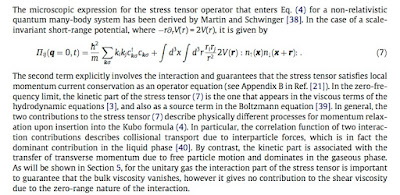
The shear viscosity can be written in terms of a Kubo formula which is an unequal time correlation function of the stress energy tensor.
In a general fluid there are two terms in the stress energy tensor: one associated with the kinetic energy and the second with the interparticle interaction. In dense classical liquids the term in the Kubo formula due to the interaction term dominates and are associated with the Einstein-Stokes relation where the viscosity is inversely proportional to the particle self-diffusion constant.
In contrast, in dilute gases and fluids the kinetic term dominates and the shear viscosity scales with the diffusion constant and scattering time. The crossover from the dilute to the dense case in a classical fluid is discussed here.
The case of the dilute classical gas is of particular historical interest. The viscosity scales with the density and the mean-free path. In a dilute gas the mean free path is inversely proportional to the density and the molecular cross section. This means that the viscosity is independent of the density (and pressure at fixed temperature). When Maxwell obtained this theoretical result from kinetic theory he found it so surprising that he tested it experimentally. According to this site,
In the attic of his house in Kensington, with the help of his wife, he carried out experimental measurements of gas viscosities in order to confirm the conclusions he had drawn about the effects of pressure and temperature. Many of these experiments were made between 51 °F (10.6 °C) and 74 °F (23.3 °C), and it appears that these temperatures were obtained simply by changing the temperature of the attic! This was arranged by Mrs. Maxwell, who organized the appropriate stoking of the fire. Some work was also done at 185 °F (85 °C), and this temperature was achieved by a suitably directed current of steam.The results are described in this 1866 paper.
For a zero-range interaction, as in the unitary Fermi gas (and presumably the Hubbard model), it can be shown that the potential term does not contribute to the shear viscosity. For a succinct discussion of these issues and relevant references see the section of this paper that I reproduce below. I thank Thomas Schafer for pointing this out to me.

Monday, August 10, 2015
Climate change action at the grass roots
When I was recently visiting my mother-in-law in Anacortes, Washington she took my wife and I to a meeting of the local chapter of Transition, an international grass roots movement responding to climate change.
First, an employee of a local not-for-profit Sustainable Connections spoke briefly about home energy efficiency audits that they organise.
Then there was an interesting talk from a local climate change researcher, Roger Fuller, that focussed on the potential impact of climate change on surrounding Skagit County. It is somewhat unique because much the water flowing through the county comes from glacial snow melt in the nearby Cascade mountains. Increased temperatures will mean a greater rain/snow ratio, and greater river flow in the winter and less in the spring. This could have significant effects on the frequency of extreme flooding events.
I think these local initiatives are particularly important beyond the immediate concrete [but modest] energy savings and reduced CO2 emissions that they produce. Such initiatives provide models for wider more ambitious programs and show politicians and policy makers that some people are concerned about climate change and willing to make life style changes.
Besides the significant benefit of addressing climate change this initiative has the other benefit of building community in the face of rapidly declining social capital.
I also picked up a copy of the excellent free booklet Climate Change: Evidence, Impacts, and Choices, produced by the National Research Council for the general public.
Anacortes is one of 50 communities [with a population between 5,000 and 250,000] in the USA that are competing for the $5 million Georgetown University Energy Prize. Each community tries to cut its energy consumption by as much as possible in 2015.
First, an employee of a local not-for-profit Sustainable Connections spoke briefly about home energy efficiency audits that they organise.
Then there was an interesting talk from a local climate change researcher, Roger Fuller, that focussed on the potential impact of climate change on surrounding Skagit County. It is somewhat unique because much the water flowing through the county comes from glacial snow melt in the nearby Cascade mountains. Increased temperatures will mean a greater rain/snow ratio, and greater river flow in the winter and less in the spring. This could have significant effects on the frequency of extreme flooding events.
I think these local initiatives are particularly important beyond the immediate concrete [but modest] energy savings and reduced CO2 emissions that they produce. Such initiatives provide models for wider more ambitious programs and show politicians and policy makers that some people are concerned about climate change and willing to make life style changes.
Besides the significant benefit of addressing climate change this initiative has the other benefit of building community in the face of rapidly declining social capital.
I also picked up a copy of the excellent free booklet Climate Change: Evidence, Impacts, and Choices, produced by the National Research Council for the general public.
Anacortes is one of 50 communities [with a population between 5,000 and 250,000] in the USA that are competing for the $5 million Georgetown University Energy Prize. Each community tries to cut its energy consumption by as much as possible in 2015.
Thursday, August 6, 2015
Research environment is over-rated
For assessing grant applications in Australia, and some other countries, one criteria is "research environment". This means different things to different people. Unfortunately, I too often see both applicants and assessors/referees using this criteria in an unhelpful and/or meaningless way.
When does the environment of the proposed research project matter?
Here are a few ways, listed in order of decreasing importance.
Access to crucial equipment, materials, and infrastructure.
For example, if the project involves femtosecond laser spectroscopy, then there is little point if the researchers do not have access to the relevant lasers, probably at their own institution.
Similarly, neutron scattering requires relevant beam time on a user facility. Experimental studies of strongly correlated electron materials require access to high quality single crystals of the relevant materials. Large scale computational chemistry requires access to the relevant supercomputing facilities.
Access to intellectual resources.
Colleagues with relevant technical expertise may enhance the project. Also, a theory (experimental) project can be enhanced by the local presence of an experimental (theory) group that is actively interested in similar problems and systems.
A lively and interactive department with a history of fostering new collaborations.
What are debatable measures of research environment?
The overall "ranking" of the institution that will host the grant. Previously, I posted about a study that investigated whether moving to a more highly ranked institution improved research quality [as measured by citations].
The "ranking" of the host department in some silly national "research quality assessment" exercise.
The geographic proximity of "high profile" research groups or "big fancy shiny buildings" with $M budgets in vaguely related research areas.
What do you think?
How does research environment help research quality?
When does the environment of the proposed research project matter?
Here are a few ways, listed in order of decreasing importance.
Access to crucial equipment, materials, and infrastructure.
For example, if the project involves femtosecond laser spectroscopy, then there is little point if the researchers do not have access to the relevant lasers, probably at their own institution.
Similarly, neutron scattering requires relevant beam time on a user facility. Experimental studies of strongly correlated electron materials require access to high quality single crystals of the relevant materials. Large scale computational chemistry requires access to the relevant supercomputing facilities.
Access to intellectual resources.
Colleagues with relevant technical expertise may enhance the project. Also, a theory (experimental) project can be enhanced by the local presence of an experimental (theory) group that is actively interested in similar problems and systems.
A lively and interactive department with a history of fostering new collaborations.
What are debatable measures of research environment?
The overall "ranking" of the institution that will host the grant. Previously, I posted about a study that investigated whether moving to a more highly ranked institution improved research quality [as measured by citations].
The "ranking" of the host department in some silly national "research quality assessment" exercise.
The geographic proximity of "high profile" research groups or "big fancy shiny buildings" with $M budgets in vaguely related research areas.
What do you think?
How does research environment help research quality?
Tuesday, August 4, 2015
Searching for conical intersections for singlet fission
Previously I have posted about the fascinating challenge of understanding singlet fission [and the inverse process of triplet-triplet annihilation] in large organic molecules. A key feature to understand is how fission can occur in less than 100 femtoseconds, suggestive of a conical intersection between excited state potential energy surfaces.
In Telluride Nandini Ananth gave a nice talk about work described in the paper
The Low-Lying Electronic States of Pentacene and Their Roles in Singlet Fission
Tao Zeng, Roald Hoffmann , and Nandini Ananth
Diabatic states provide a natural and powerful approach to understanding what is going on.
The authors perform high level quantum chemistry calculations to describe the relevant electronic excited states. They claim that for a pair of pentacene molecules one needs to include at least six diabatic states. Their dominant electronic configuration is shown in the schematic below.

In more recent work, the authors have tried to pin down what is the relevant nuclear co-ordinate [vibrational mode] associated with a conical intersection. It is not the intermolecular separation but may be instead the relative orientation [twisting] of the two penatacene molecules. This has included some constructive interaction with the experimental group of Luis Campos.
In Telluride Nandini Ananth gave a nice talk about work described in the paper
The Low-Lying Electronic States of Pentacene and Their Roles in Singlet Fission
Tao Zeng, Roald Hoffmann , and Nandini Ananth
Diabatic states provide a natural and powerful approach to understanding what is going on.
The authors perform high level quantum chemistry calculations to describe the relevant electronic excited states. They claim that for a pair of pentacene molecules one needs to include at least six diabatic states. Their dominant electronic configuration is shown in the schematic below.

We find that only one of the two charge-transfer states, ac, is engaged in the SF [singlet fission] in pentacene; it is the low-lying charge-transfer state that gets closer to the multi- and single-exciton states. Moreover, the ac diabat can move into degeneracy with the single-exciton states, more effectively mediating the mixing of the bright single- to and dark multiexciton diabats. This finding is different from the basic assumption of high-lying charge-transfer states in the superexchange model, emphasizing the need to adapt the general SF model to specific cases.Aside: I wonder if this is one the few papers that Hoffmann has co-authored where strong electron correlations are central.
In more recent work, the authors have tried to pin down what is the relevant nuclear co-ordinate [vibrational mode] associated with a conical intersection. It is not the intermolecular separation but may be instead the relative orientation [twisting] of the two penatacene molecules. This has included some constructive interaction with the experimental group of Luis Campos.
Subscribe to:
Posts (Atom)
Nobel Prize Predictions for 2026
This week Nobel Prizes will be announced. Predicting the awardees is a fun annual exercise. It is also good to reflect on what has been achi...

-
 This week Nobel Prizes will be announced. I have not done predictions since 2020 . This is a fun exercise. It is also good to reflect on w...
 -
Two years ago, I wrote a post about a paper by Wei et al, Emergent Abilities of Large Language Models Then last year, I posted about a pap...
-
Some of my colleagues and I have started an interesting discussion about how to teach quantum theory to undergraduates. We have courses in t...