Yesterday the Australian Research Council announced which grant applications were successful for funding for next year. So roughly 20 per cent of people were happy and 80 per cent were sad. After the exhilaration or devastation inevitably come the post-mortems, particularly from those who are unsuccessful. We offer each other a multitude of possible reasons for failure or for success....
Professor Z was on the committee and he doesn't like my field.... All they care about is number of publications.... I need to increase my h-index... They must have liked the bit I wrote about... Clearly they don't like people who work at the interface of chemistry and physics... I need more Nature papers.... I should have promised less... It is because I did not have a big name person on the grant... it is because I am working on such a hot topic.... Obviously they aren't going to fund 2 groups working in my area.... I think Dr. X must have been that negative referee...People think my group has too much money....
The problem with this type of analysis is that it is all speculation. There is usually NO evidence for any of these ideas. Most funding decisions involve a black box. Input is your application which contains tens to fifty pages of information. The output is binary information: yes/no. The input/output correlation has a large random and subjective element to it.
As scientists we should only draw conclusions based on the evidence at hand.
If you did not succeed, don't take it personally and give up. Keep applying. Don't write a totally different application next time just because of some speculative reason for past failures.
If you did succeed, don't let it go to your head. Acknowledge the random element in success.
p.s. This is basically the same post I wrote two years ago at the same time. I just thought it was good for me and my colleagues to be reminded of these issues.
Tuesday, November 6, 2012

Monday, November 5, 2012
Hewson's Kondo narrative
In the reading group this past week we finished the first chapter of Hewson's The Kondo problem to heavy fermions. There is a bit of a narrative which I will try to highlight.
A key aspect is getting to the Kondo Hamiltonian which describes a single magnetic impurity spin interacting with a band of conduction electrons.
 Where does this come from?
What is the physical origin of the local magnetic moment?
To understand this one needs to look at the Anderson model Hamiltonian.
 Key physics is associated with the Coulomb repulsion U [aka Hubbard] associated with two electrons on the localised orbital associated with the impurity.
First, if one solves the model in the mean-field [Hartree-Fock] approximation one finds that a net magnetic moment can occur, i.e. spin rotational symmetry is broken, for certain parameter regimes. This result was half of Anderson's 1978 Nobel Prize.
Second, one can derive the Kondo Hamiltonian as an effective Hamiltonian for the Anderson model in the limit of large U and small hybridisation [the local moment regime]. This is done via a "canonical" transformation due to Schrieffer and Wolff or via van Vleck's quasi-degenerate perturbation theory. On some level one is "integrating out" the charge fluctuations on the impurity. This is analogous to the way one starts with a Hubbard model and derives a Heisenberg model as the effective Hamiltonian for the spin degrees of freedom in a Mott insulator.
This is done in Section 1.7.
The Anderson model with U=0 [Section 1.4] illustrates some key physics.
a. The existence of virtual bound states within the conduction band. These lead to a resonance and a large peak in the density of states (DOS).
 b. The energy scale associated with hybridisation.
 c. The Friedel sum rule which connects the phase shift associated with scattering from the impurity with the change in the DOS and the total additional number of states that appear in the conduction band.
 The above three concepts will all be useful for later understanding the Kondo resonance.
It is also pointed out that the non-interaction Anderson model cannot explain the temperature dependence of the spin susceptibility associated with the impurities.
Finally. one introduces the Coqblin-Schrieffer model which is the generalisation of the SU(2) spin symmetry of the spin-1/2 Kondo Hamiltonian to SU(N) symmetry. There are two important reasons for this generalisation.
First, many magnetic impurities involve d and f electrons which have significant orbital degeneracy. For example, Ce3+ has a single electron in the 4f1 configuration which involves (with spin-orbital coupling) total angular momentum j=5/2 and so N=6.
Second, one can consider the large N limit, which turns out to analytically tractable. The corresponding mean-field (slave boson) theory captures a lot of the essential physics [chapters 7 and 8].
A key aspect is getting to the Kondo Hamiltonian which describes a single magnetic impurity spin interacting with a band of conduction electrons.

What is the physical origin of the local magnetic moment?
To understand this one needs to look at the Anderson model Hamiltonian.

First, if one solves the model in the mean-field [Hartree-Fock] approximation one finds that a net magnetic moment can occur, i.e. spin rotational symmetry is broken, for certain parameter regimes. This result was half of Anderson's 1978 Nobel Prize.
Second, one can derive the Kondo Hamiltonian as an effective Hamiltonian for the Anderson model in the limit of large U and small hybridisation [the local moment regime]. This is done via a "canonical" transformation due to Schrieffer and Wolff or via van Vleck's quasi-degenerate perturbation theory. On some level one is "integrating out" the charge fluctuations on the impurity. This is analogous to the way one starts with a Hubbard model and derives a Heisenberg model as the effective Hamiltonian for the spin degrees of freedom in a Mott insulator.
This is done in Section 1.7.
The Anderson model with U=0 [Section 1.4] illustrates some key physics.
a. The existence of virtual bound states within the conduction band. These lead to a resonance and a large peak in the density of states (DOS).


It is also pointed out that the non-interaction Anderson model cannot explain the temperature dependence of the spin susceptibility associated with the impurities.
Finally. one introduces the Coqblin-Schrieffer model which is the generalisation of the SU(2) spin symmetry of the spin-1/2 Kondo Hamiltonian to SU(N) symmetry. There are two important reasons for this generalisation.
First, many magnetic impurities involve d and f electrons which have significant orbital degeneracy. For example, Ce3+ has a single electron in the 4f1 configuration which involves (with spin-orbital coupling) total angular momentum j=5/2 and so N=6.
Second, one can consider the large N limit, which turns out to analytically tractable. The corresponding mean-field (slave boson) theory captures a lot of the essential physics [chapters 7 and 8].
Should postdocs teach?
Sometimes postdocs are given the opportunity to teach part [or all] of an undergraduate or graduate course, even though this is not part of their job description.
At UQ there is a formal university wide program ResTeach which aims to get research staff [including senior faculty such as myself] involved in teaching.
If you are a postdoc, should you do it?
Should faculty who pay the salaries of postdocs from their grants encourage or discourage this?
Here are some of the significant advantages to a postdoc of doing some teaching:
- Having the experience listed on your CV may help you get a faculty position at some institutions. For example, in Australia this seems to be almost a pre-requisite these days. Furthermore, if you can be innovative, get high student evaluations, and/or boost enrolments that may be viewed very favourably.
- You usually learn a lot of science from teaching, even lower level courses.
- It can be enjoyable and satisfying.
- If you are fortunate enough to eventually get a faculty position this experience will make it easier handling the formidable challenges of starting out teaching.
- If you are a senior post-doc/research fellow who can supervise undergrads and/or Ph.D students this may help to recruit research students.
- It may create some goodwill towards you in your department. You may be seen as a team player and good departmental citizen.
However, there can be significant disadvantages:
- Foremost, it can consume a large amount of time and energy that reduces your research productivity. Teaching a course for the first time is usually a full-time occupation. You may lose research momentum and that competitive edge you need to land a faculty position or the next research fellowship.
- It may not add a lot to your CV, particularly if your student evaluations are average. They will probably be average or even below average since you are starting out.
- If you don't do a stellar job and/or there are a few disgruntled students your reputation in the department may suffer, perhaps unjustly.
On balance, I think it really depends on the individual: their career goals and career stage. In some cases, I encourage people to do this. In other cases, I discourage it. The main thing is to make a well informed decision which takes into account both the pro's and con's. Postdocs and Research Fellows also need to be wary of the vested interests who will push them in either direction, possibly against the best long-term interests of the postdoc.
I welcome comment, particularly on the situation in other countries.
I get the impression that for major US research universities teaching experience counts for little in landing a faculty position.
I suspect that for 4-year colleges they expect not just experience but evidence of innovation and positive student evaluations.
Friday, November 2, 2012
Does the doped Hubbard model superconduct?
Answer this question is difficult and controversial.
There is a nice review Numerical studies of the 2D Hubbard model by Doug Scalapino which considers the question.
He claims that in the end the answer is yes.
However, there are several subtleties along the way. I just mention two that I learnt.
To attempt to answer the question one calculates the d-wave pairing susceptibility on a finite lattice.
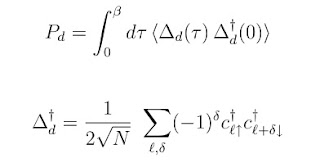 In determinantal Monte Carlo [which acts in imaginary time and does have an increasing sign problem with decreasing temperature] one observes that as the temperature (=1/beta) decreases the pairing susceptibility increases. This is encouraging. Except, ...
Puzzle/caution/subtlety I
the pairing susceptibility is less than for U=0!
Clearly there is no superconductivity for U=0 and a key claim of the Anderson paradigm is that large U and correlations are the key for high-Tc. So what is going on?
Scalapino and his collaborators argue that this decrease with increasing U is because U reduces the single particle spectral weight [i.e. the effective mass of quasi-particles increases with increasing U] and so P_d should be compared to the function below which is the value of P_d in the absence of interactions between the holes.
 Indeed, one finds that this quantity is less than the calculated P_d, confirming the existence of an attractive d-wave pairing interaction.
Puzzle/caution/subtlety II
finite size effects and dependence on cluster geometry
It turns out that the results don't just depend on the size of the cluster but also its geometry. "One needs to take into account the 4-site local plaquette structure of the order parameter." Z_d is the number of independent near-neighbour plaquettes on a cluster. For the square 16 site cluster (16B) in the figure below Z_d=2. In contrast, for the diamond 16 site cluster (16A) on has Z_d=3. As a result the pairing correlations are suppressed in 16A relative to 16B.

There is a nice review Numerical studies of the 2D Hubbard model by Doug Scalapino which considers the question.
He claims that in the end the answer is yes.
However, there are several subtleties along the way. I just mention two that I learnt.
To attempt to answer the question one calculates the d-wave pairing susceptibility on a finite lattice.

Puzzle/caution/subtlety I
the pairing susceptibility is less than for U=0!
Clearly there is no superconductivity for U=0 and a key claim of the Anderson paradigm is that large U and correlations are the key for high-Tc. So what is going on?
Scalapino and his collaborators argue that this decrease with increasing U is because U reduces the single particle spectral weight [i.e. the effective mass of quasi-particles increases with increasing U] and so P_d should be compared to the function below which is the value of P_d in the absence of interactions between the holes.

Puzzle/caution/subtlety II
finite size effects and dependence on cluster geometry
It turns out that the results don't just depend on the size of the cluster but also its geometry. "One needs to take into account the 4-site local plaquette structure of the order parameter." Z_d is the number of independent near-neighbour plaquettes on a cluster. For the square 16 site cluster (16B) in the figure below Z_d=2. In contrast, for the diamond 16 site cluster (16A) on has Z_d=3. As a result the pairing correlations are suppressed in 16A relative to 16B.

Getting or not getting superconductivity in quantum Monte simulations is certainly subtle. A different technique [constrained path Monte Carlo and which is at zero temperature] used by a different group did not produce long range correlations. [See this PRB from 1999]. I am not sure if this discrepancy has ever been explained to the satisfaction of all parties...
Thursday, November 1, 2012
The Nozieres exhaustion problem
The trivial problem is that I find reading the papers of Nozieres difficult and exhausting. They are big on hand waving and physical insight. An earlier post considered his classic paper on a Fermi liquid treatment of the Kondo problem.
Now the real problem.
Today I giving a cake meeting talk about a short 2005 paper Kondo lattices and the Mott Metal-Insulator which Nozieres published in a JPSJ volume "Kondo effect- 40 years after the discovery". It also has several other nice (short) review articles. This paper reviews the resolution of the "exhaustion problem" for Kondo lattices, first raised by Nozieres in a 1998 paper.
In the Kondo effect a single magnetic impurity forms a spin singlet with a collection of metallic electrons within an energy range T_K (the Kondo temperature) of the Fermi energy, E_F. Typically, T_K is much smaller than E_F.
Now consider the Kondo lattice where there are magnetic "impurities" (i.e. localised spins) placed on a lattice of N_L sites. The metal contains of order N_L electrons. How many electrons can form Kondo spin singlets with (i.e. screen) the localised electrons?
N_eff ~ DOS(E_F)*T_K ~ N_L/E_F * T_K is much less than N_L
Hence, just a few itinerant electrons must screen (form singlets with) many localised spins.
Why is this a problem?
Because in heavy fermion materials (which are described by a Kondo lattice model) one does observe a Fermi liquid ground state, which is a spin singlet with all the localised spins "screened", below some coherence temperature T_coh
Nozieres has a simple argument [which I don't follow and it turns out to be wrong] that
T_coh ~ N_eff/N_L * T_K ~ T_K^2/E_F is much less than T_K
This prediction that T_coh can be much less than T_K and that their ratio has a non-perturbative dependence on the Kondo coupling turns out to be incorrect. This was shown in 2000 with a slave boson theory by Burdin, Georges, and Grempel and confirmed with DMFT by Costi and Manini. There is a nice review of the problem by Burdin.
Nozieres says there is an "obscure puzzle" here: "a phase transition that generates an energy scale much bigger than its transition temperature". He refers to the fact that in the Kondo lattice problem the hybridisation energy Delta [which mixes the localised spin states with the conduction band] is much larger than T_K [its value in the single impurity problem].
Another puzzle for me is how all this relates to a 2008 Nature paper
Scaling the Kondo lattice
by Yang, Fisk, Lee, Thompson, and Pines
which gives an exhaustive (!) analysis of a wide range of experimental data on heavy fermions and only invokes a single temperature scale T* which is much larger than T_K.
What does all this have to do with the Mott transition and the DMFT treatment of it?
The latter can be viewed as a "Kondo lattice problem". At half filling each site contains a "localised" electron which hybridizes and (in the metallic state) forms Kondo singlets with all the remaining electrons.
Nozieres then makes an obscure argument that leads him to the "physical insight" that "the narrow resonance behaviour [present in the metallic phase] is a direct consequence of the residual entropy [of the Mott insulator]"
Wednesday, October 31, 2012
Scaling plots near the Mott transition
Earlier this year Jure Kokalj brought to my attention an interesting PRL
Quantum Critical Transport near the Mott Transition
by H. Terletska, J. Vučičević, Darko Tanasković, and Vlad Dobrosavljević.
My interest in this paper increased this week when Vlad emailed me to tell me about a recent talk at KITP by Kazushi Kanoda. The right side of the slide below [click on it to see it larger] shows a scaling analysis of the temperature and pressure dependence of the resistivity of the organic charge transfer salt kappa-(ET)2(CN)3 near the pressure driven Mott transition. This scaling analysis is based on the theory in the PRL.
The left side shows the Dynamical Mean-Field Theory (DMFT) results [for a Hubbard model at half filling] in the PRL. The top shows the scaling of the resistivity curves and the bottom the T vs. U phase diagram where the yellow region is the "quantum critical" region above the Mott transition.

Aside: This same organic material is also of considerable interest because the Mott insulating phase seems to exhibit a spin liquid ground state and metallic state becomes superconducting at low temperatures. (See this review).
Quantum Critical Transport near the Mott Transition
by H. Terletska, J. Vučičević, Darko Tanasković, and Vlad Dobrosavljević.
My interest in this paper increased this week when Vlad emailed me to tell me about a recent talk at KITP by Kazushi Kanoda. The right side of the slide below [click on it to see it larger] shows a scaling analysis of the temperature and pressure dependence of the resistivity of the organic charge transfer salt kappa-(ET)2(CN)3 near the pressure driven Mott transition. This scaling analysis is based on the theory in the PRL.
The left side shows the Dynamical Mean-Field Theory (DMFT) results [for a Hubbard model at half filling] in the PRL. The top shows the scaling of the resistivity curves and the bottom the T vs. U phase diagram where the yellow region is the "quantum critical" region above the Mott transition.

It is striking that the experimental curves involve scaling over about 6 orders of magnitude of the resistivity.
There are several things that are rather strange/exotic/interesting about the theory.
First, there is a "duality" between the resistivity in the metallic and insulating sides of the transition.
Second, the critical resistivity is an order of magnitude larger than the Mott-Ioffe-Regel limit.
Third, connections are suggested with the "holographic duality" picture of in papers such as this one by Subir Sachdev.
Tuesday, October 30, 2012
Public accountability gone amok?
Physics Today has a fascinating review by Naomi Oreskes of the book The Hockey Stick and the Climate Wars by Michael Mann.
In the Print edition the review is entitled, "A call to throw caution to the wind".
I suggest reading the one page review in full with two questions in mind:
1.
How would you personally cope with the level of public scrutiny (and attack) that Mann was subjected to following publication of his 1998 Nature paper?
e.g., having emails and grant applications subject to subpoenas from politicians. The Wikipedia page on Mann describes the many investigations he has been subjected to.
2.
Is it really possible for non-scientists to understand and realistically evaluate the evidence for and against scientific hypotheses concerning complex systems?
Oreskes seems to claim not in this political context and suggests Mann should not have been so cautious with his public pronouncements about ambiguities and subtleties in the data.
If people post their answers to one or both of these questions I will then will try and give mine.
Subscribe to:
Posts (Atom)