“purely a matter of taste, roughly equivalent to whether or not one believes mathematical language or human language to be more fundamental.”But it is interesting that he is now writing articles about multiverses...
Tuesday, November 10, 2009
Many worlds or many words?
In 1998 Max Tegmark wrote a paper with the great title, The Interpretation of Quantum Mechanics: Many worlds or many words. He suggested that the validity of different interpretations of quantum theory cannot be decided empirically, but are:

Monday, November 9, 2009
Schrodinger was right on the money!
In 1983 Austria introduced this bank note featuring Erwin Schroedinger. Note the Psi! But where is the cat?

It is interesting they also introduced a 50 Schilling note with Sigmund Freud and a 5000 Schilling note for Mozart. Is this a relative measure of their contributions to culture and society?

It is interesting they also introduced a 50 Schilling note with Sigmund Freud and a 5000 Schilling note for Mozart. Is this a relative measure of their contributions to culture and society?
The decay path taken
I am very happy that a paper, Conical Intersections, Charge Localization and Photoisomerization Pathway Selection in a Minimal Model of a Degenerate Monomethine Dye by Seth Olsen and I, has been accepted for publication in Journal of Chemical Physics.
A key question concerning optically active molecules is what is dynamics of the excited states?
Specifically, what are the predominant non-radiative decay mechanisms. The schematic below shows several options for the energy of the potential energy surfaces versus some configurational co-ordinate. On the left both S1 and S2 excited states decay to a conical intersection with the ground state. In contrast, on the right they have distinctly different decay paths.

But how does one go beyond such schematics. It turns out that for a broad class of dyes one can justify from high level quantum chemistry calculations a description in terms of just three valence bond states (see below).
 The description in terms of the three diabatic states allow us to consider a somewhat "generic" or minimal model which exhibits a number of significant features, including:
BTW, if you look at the paper look at the great job Seth did at writing Informative section headings!
A key question concerning optically active molecules is what is dynamics of the excited states?
Specifically, what are the predominant non-radiative decay mechanisms. The schematic below shows several options for the energy of the potential energy surfaces versus some configurational co-ordinate. On the left both S1 and S2 excited states decay to a conical intersection with the ground state. In contrast, on the right they have distinctly different decay paths.

But how does one go beyond such schematics. It turns out that for a broad class of dyes one can justify from high level quantum chemistry calculations a description in terms of just three valence bond states (see below).
 The description in terms of the three diabatic states allow us to consider a somewhat "generic" or minimal model which exhibits a number of significant features, including:
- Conical intersections between the S1 and S0 surfaces only occur for large twist angles.
- In contrast, S2/S1 intersections can occur near the Franck-Condon region.
- When the molecule has left-right symmetry, all intersections are associated with con- or dis-rotations and never with single bond twists.
- For asymmetric molecules (i.e. where the bridge couples more strongly to one end) then the S2 and S1 surfaces bias torsion about different bonds.
- Charge localization and torsion pathway biasing are correlated.
BTW, if you look at the paper look at the great job Seth did at writing Informative section headings!
Sunday, November 8, 2009
MO vs. VB for ketone dyes
I am thinking more about photophysical properties of ketocyanine dyes. I have puzzled through the basics of the molecular orbitals. Some material on this site is useful, including a visualisation of the molecular orbitals of formaldehyde. A key point is that the HOMO is a non-bonding orbital centred on the O atom and lying perpendicual to the C=O bond.
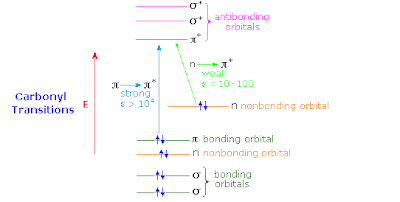

Thinking in the alternative resonating valence bond picture there will be three alternative Lewis structures
O
||
C -R
|
L
O-
|
C -R
|
L+
O-
|
C -R+
|
L
The extent to which the lower two structures contribute will increase the C-O bond length and reduce the C-O stretch frequency.
It should be possible to describe the low lying excited states in terms of a complete active space with 4 electrons in 3 orbitals (a pi* orbital on the C=O bridge, and a pi orbital on the left and right fragments).
Saturday, November 7, 2009
Inventing your mother-in-law or More is Different II
P. W. Anderson, “Emergence, Reductionism and the Seamless Web: When and Why Is Science Right,” Current Science 78:6 (2000), 1. [Based on the Pagels lecture, Aspen, 1999].
Anderson suggests that emergence is the mechanism for consilience (the unifying of disparate pieces of knowledge) and reduction is the evidence for it. Theories may be under-determined, i.e., there may be many possible theories that can explain what is actually known. Hence, a successful theory may not actually correspond to what is happening. If there are only a few constraints (hypotheses, observations) that a theory must satisfy it has sometimes been the case that more than one theory can satisfy the constraints. However, as the number of constraints increases, acceptance of a theory is more likely and it becomes hard to conceive of alternative theories that could satisfy these constraints. Reduction can greatly increase the number of conditions that a theory must satisfy. For example, any alternative to quantum theory must be able to explain all known principles of atomic physics and of chemistry. Anderson concludes ``it is as impossible to `socially construct’ science as it is to invent A. Abrikosov or your mother-in-law.’’
Anderson mentions work of Kirkpatrick concerning the problem of satisfying many constraints. An example is this Science paper.
Friday, November 6, 2009
Pauling and Bardeen on postage stamps

It is wonderful that last year the US Postal Service issued new stamps featuring four prominent scientists. Pauling and Bardeen were indeed masters in unravelling emergent phenomenon using quantum many-body theory.
Update (2016). I just discovered that in 2005 there was one for Josiah Willard Gibbs and Feynman.

Thursday, November 5, 2009
Modelling a class of organic dyes

Ketocyanine dyes are of considerable interest. An example is shown above. What are the essential ingredients that determine their photophysical properties? The figure below is from a nice paper which compares essential differences between cyanines (CY), ketocyanines (KCY), and squarenes (SQ).

The difference between the upper and lower panels (A and B) relates [I think] to whether one has an even (A) or odd (B) number of p-electron centres on each of the molecular units on the left and right side of the central C=O bridge. Apparently, this is following a "composite molecule" approach in a book by Fabian and Hartmann.
A complementary approach to describing optical properties of these materials is within a resonating valence bond approach. There will be three dominant resonant structures, similar to those advocated by Pauling for urea. [I will try and get a picture]. Such an approach will naturally lead to two low-lying singlet excited states.
This type of resonance is of great biochemical significance since it leads to the planarity of amide groups in polypeptides, something figured out by Pauling and Corey in 1952, an emphasized because it is required for the alpha helix of proteins.

Subscribe to:
Posts (Atom)
Lecture on Debye model for solids
I just finished preparing my undergraduate lecture on the Debye model for solids. Here are my slides . The course is a third-year course on...

-
An interesting and controversial question for Ph.D's in science and engineering is too what extent students should be expected to have ...
-
 This week Nobel Prizes will be announced. I have not done predictions since 2020 . This is a fun exercise. It is also good to reflect on w...
-
 Is it something to do with breakdown of the Born-Oppenheimer approximation? In molecular spectroscopy you occasionally hear this term thro...