Previously I posted about The Two Cultures of C.P. Snow who noted how the academic cultures of science and the humanities diverged in the twentieth century. I agree that both are the poorer for it.
Yesterday I went to a history seminar. The purpose of this post is not to discuss the content, which was fascinating. But rather, to note the striking difference between the mode of presentation and discussion from a typical science seminar.
First, the paper was read. Literally! The speaker had a manuscript which they read without interuption. There were no PowerPoint slides. Yet, the talk/paper was very engaging, interesting, and easy to follow, even for me a non-historian.
Second, the seminar went for 90 minutes, with about 40 minutes devoted to questions and discussions! Probably ten different people asked questions. This was also engaging and interesting. Furthermore, I felt everyone [speaker, questioner, and audience] benefited from this.
One might easily dismiss these differences as being solely due to the different content of disciplines or just how this particular seminar was run. However, I think science seminars and conference presentations could be more interesting and productive if
-they were more accessible
-they had fewer PowerPoint slides (or none!)
-there was more extended time for questions and discussion
-more people asked questions
Friday, September 14, 2012

Thursday, September 13, 2012
Strong electronic correlations in diamond qubits
Yesterday I read a nice paper
Mechanism for optical initialization of spin in NV− center in diamond
by SangKook Choi, Mahish Jain, and Steven Louie
The NV- center in diamond has attracted renewed interest in the past few years because it can be used as a qubit and experimentalists have created entangled states associated with it.
Outstanding questions concern the nature, ordering, and quantum numbers of the low-lying states of a single NV- center. This is key to understanding the process whereby one creates a qubit with a coherence time of order of milliseconds following optical excitation. A previous post discussed this and a recent article by Doherty, Manson, Delaney and Hollenberg provides a helpful review.
The authors obtain definitive results by considering a 4 site Hubbard model with 6 electrons. The model parameters are evaluated from ab initio electronic structure calculations. The 4 sites correspond to orbitals localised on the 3 carbon atoms and one nitrogen atom next to the carbon vacancy.
They find that the Hubbard U is of order 3-4 times the hopping integral and that electronic correlations play a significant role, having a significant effect on the relative energies of the excited states. Previous studies have not treated these correlation effects adequately and so have obtained spurious results. Specifically, the singlet excited states cannot be described in terms of a single Slater determinant.
The effect of correlations is illustrated in the Figure below which shows the energy of the states as a function a structural relaxation [the N atom moves towards the vacancy while the neighbouring C atoms move away]. GEG denotes Ground state Equilibrium Geometry, and EEG denotes Excited state Equilibrium Geometry.
 The left panel gives results for exact diagonalisation of the Hubbard model and the right panel for a perturbative treatment based in Density Functional Theory [GW-BSE].
A few minor comments.
1. The authors point out an outstanding question concerns the mechanism whereby the 1A1 excited singlet state decays non-radiatively in 1 nsec to the 1E ground singlet state.
2. Calculating the energy levels for defects in diamond has a long history which seems to have been forgotten. A seminal paper from 1957 was by [my hero] Charles Coulson and Mary Kearsley. They pointed out the utility of a molecular orbital description.
3. Because the nitrogen atomic orbitals are much lower in energy (about 2.6 eV) than the carbon orbitals it should be possible to "integrate them out" and reduce the 4 site 6 electron model to a 3 site 4 electron model where the "carbon" sites have some admixture of the nitrogen orbitals.
4. Using the C3 symmetry of the system it is possible to block diagonalise the Hubbard model into blocks with dimension no larger than 2. The notes below show the energy eigenvalues and quantum numbers for 2 holes on 3 sites with the sign of the hopping integral the same as for the NV- center. The triplet states involve a single Slater determinant. The singlet states all involve two Slater determinants. In the parameter regime relevant to the NV- center, the two determinants have comparable coefficients in all the wavefunctions.

Mechanism for optical initialization of spin in NV− center in diamond
by SangKook Choi, Mahish Jain, and Steven Louie
The NV- center in diamond has attracted renewed interest in the past few years because it can be used as a qubit and experimentalists have created entangled states associated with it.
Outstanding questions concern the nature, ordering, and quantum numbers of the low-lying states of a single NV- center. This is key to understanding the process whereby one creates a qubit with a coherence time of order of milliseconds following optical excitation. A previous post discussed this and a recent article by Doherty, Manson, Delaney and Hollenberg provides a helpful review.
The authors obtain definitive results by considering a 4 site Hubbard model with 6 electrons. The model parameters are evaluated from ab initio electronic structure calculations. The 4 sites correspond to orbitals localised on the 3 carbon atoms and one nitrogen atom next to the carbon vacancy.
They find that the Hubbard U is of order 3-4 times the hopping integral and that electronic correlations play a significant role, having a significant effect on the relative energies of the excited states. Previous studies have not treated these correlation effects adequately and so have obtained spurious results. Specifically, the singlet excited states cannot be described in terms of a single Slater determinant.
The effect of correlations is illustrated in the Figure below which shows the energy of the states as a function a structural relaxation [the N atom moves towards the vacancy while the neighbouring C atoms move away]. GEG denotes Ground state Equilibrium Geometry, and EEG denotes Excited state Equilibrium Geometry.
A few minor comments.
1. The authors point out an outstanding question concerns the mechanism whereby the 1A1 excited singlet state decays non-radiatively in 1 nsec to the 1E ground singlet state.
2. Calculating the energy levels for defects in diamond has a long history which seems to have been forgotten. A seminal paper from 1957 was by [my hero] Charles Coulson and Mary Kearsley. They pointed out the utility of a molecular orbital description.
3. Because the nitrogen atomic orbitals are much lower in energy (about 2.6 eV) than the carbon orbitals it should be possible to "integrate them out" and reduce the 4 site 6 electron model to a 3 site 4 electron model where the "carbon" sites have some admixture of the nitrogen orbitals.
4. Using the C3 symmetry of the system it is possible to block diagonalise the Hubbard model into blocks with dimension no larger than 2. The notes below show the energy eigenvalues and quantum numbers for 2 holes on 3 sites with the sign of the hopping integral the same as for the NV- center. The triplet states involve a single Slater determinant. The singlet states all involve two Slater determinants. In the parameter regime relevant to the NV- center, the two determinants have comparable coefficients in all the wavefunctions.

I thank Taras Plakhotnik for bringing the paper to my attention and reviving my interest in this problem.
Wednesday, September 12, 2012
2012 Nobel Prize predictions
People are starting to make predictions. A post from last year links to prediction from other bloggers, mostly in Chemistry.
1. Experiments for testing Bell inequalities and elucidating the role of entanglement in quantum physics
Alan Aspect, John Clauser, and Anton Zeilinger
They received the Wolf Prize in 2010, a common precursor to the Nobel.
2. Duncan Haldane and David Thouless
Showing the important role of topology in low-dimensional condensed matter
This should be a precursor to any prize for topological insulators. I remain to be convinced that there should be a prize for that. Also note Haldane and Thouless both wrote papers that were foundational for topological insulator theory.
I was convinced of the importance of Haldane and Thouless by Rajiv Singh several years ago.
I think their contributions are more original, significant and profound than Berry and Aharonov. But, I think the latter are probably more popular and likely.
Also, Haldane has not received the Wolf Prize yet.
3. Higgs, Kibble, and Englert?
They must be hot candidates and CERN will be lobbying hard. But, I hope it won't happen this year. I would like to see more statistics and checks on the experimental data. Also it has not yet been established that the Higgs field is the origin of the mass of fermions.
I welcome alternative views and suggestions.
Tuesday, September 11, 2012
Don't believe textbooks
There is a really nice article
What is a hydrogen bond? Mutually consistent theoretical and experimental criteria for characterizing H-bonding interactions
by Frank Weinhold and Roger Klein
It contains the following wonderful paragraph
[Aside: this is essentially the same quantum physics as in my recent paper on H-bonding].
They also give a nice explanation of why simple classical electrostatic calculations sometimes give approximately the right binding energies for the wrong reasons. At the equilibrium geometry the classical electrostatic interaction energy is of the order of a few kcal/mol. These calculations neglect the significant steric repulsion energy (a quantum effect) which in reality is overcome by the strong (quantum) attractive interaction associated with "ionic-covalent resonance".

What is a hydrogen bond? Mutually consistent theoretical and experimental criteria for characterizing H-bonding interactions
by Frank Weinhold and Roger Klein
It contains the following wonderful paragraph
The definitions of H-bonding to be found in current textbooks (or indeed those of the past half-century) employ near-identical verbiage to express concurrence with the classical electrostatic viewpoint, viz. “a special type of dipole–dipole force” 10, “particularly strong dipole–dipole forces” 11, “an extreme form of dipole–dipole interaction” 12, “unique dipole–dipole attractions” 13, “a sort of super dipole–dipole force”14, and the like. Popular molecular mechanics (MM) and molecular dynamics (MD) potentials 15 exhibit similarly unanimous adherence to classical electrostatic functional forms to ‘simulate’ H-bonding, thereby defining how this phenomenon has been represented to MM/MD users since the 1960s. In the face of such unanimity, the title question may seem to have been long since settled!The authors calculate the dipole-dipole interaction for twenty different hydrogen bonded complexes and find there is no correlation (chi less than 0.1!) with the actual binding energies. In contrast there are strong correlations with quantum signatures such as the intermolecular bond order and the "ionic-covalent resonance" character of the ground state wavefunction.
[Aside: this is essentially the same quantum physics as in my recent paper on H-bonding].
They also give a nice explanation of why simple classical electrostatic calculations sometimes give approximately the right binding energies for the wrong reasons. At the equilibrium geometry the classical electrostatic interaction energy is of the order of a few kcal/mol. These calculations neglect the significant steric repulsion energy (a quantum effect) which in reality is overcome by the strong (quantum) attractive interaction associated with "ionic-covalent resonance".

Monday, September 10, 2012
Face it: some students do cheat!
The New York Times has a good article Studies show more students cheating, with high achievers no exception which is worth reading.
Here are a few practical suggestions to those of us involved in teaching.
1. Don't live in denial. It does happen.
2. Make sure at several stages in a course (e.g., the introduction, before specific assessment is due) tell/remind/exhort students about cheating. Try and be specific about what it is and isn't.
3. Don't assume that just because you said it once in class or wrote it in the course profile that students heard, understood, or internalised it.
4. When it does happens, make sure you do discipline students, in accordance with course and institutional policies. Private words and "slaps on the wrist" are ineffective. It is very important that student records reflect repeat offences.
Unfortunately, all of the above is a hassle and just increases our workload. But, if we don't act nothing is going to change.
I welcome other suggestions.
Saturday, September 8, 2012
Is this test of the Standard Model impressive?
A week ago we had an interesting physics colloquium The Higgs Boson at the Large Hadron Collider by Elizabetta Barberio, who works in the ATLAS detector collaboration.
It was nice to hear a talk about the Higgs boson which simply discussed the physics and the actual experimental results, without any hype.
To me one of the most interesting and impressive figures shown in the talk actually had nothing to do with the Higgs! I found it here on the CERN website.
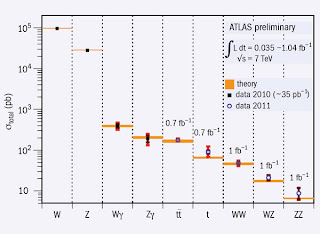 It shows the measured cross sections for the production of different particle products (horizontal scale).
Note the vertical scale varies by four orders of magnitude.
Basically, it shows that the results from the ATLAS detector are consistent with the Standard Model.
One thing I would like to know is how many independent parameters (coupling constants) are involved in determining these cross sections from the Standard Model?
Is the agreement between experiment and theory impressive? Or are there so many parameters in the Standard Model that this plot is really just saying what those parameters are? But, all the cross sections can't be independent of one another.
It was nice to hear a talk about the Higgs boson which simply discussed the physics and the actual experimental results, without any hype.
To me one of the most interesting and impressive figures shown in the talk actually had nothing to do with the Higgs! I found it here on the CERN website.

Note the vertical scale varies by four orders of magnitude.
Basically, it shows that the results from the ATLAS detector are consistent with the Standard Model.
One thing I would like to know is how many independent parameters (coupling constants) are involved in determining these cross sections from the Standard Model?
Is the agreement between experiment and theory impressive? Or are there so many parameters in the Standard Model that this plot is really just saying what those parameters are? But, all the cross sections can't be independent of one another.
Friday, September 7, 2012
Cake meeting talk on thermopower
This week I talk about Kelvin formula for the thermopower. Here are the slides. Not sure that they will be much use for people not at the meeting. At least, they give a flavour of some of the experimental results of particular interest to me. Most have been featured in earlier blog posts on the subject.
I made one small discovery in my preparation: a specific example where the Kelvin formula is exact. If one takes the temperature dependence of the chemical potential for non-interacting fermions with a general density of states [equation 2.77 in Ashcroft and Mermin] then the thermopower from the Kelvin formula is exactly that given by the Mott-Heikes formula obtained from solving the Boltzmann equation [equation 13.62 in Ashcroft and Mermin] for the case where the scattering time and velocity have no energy dependence.
I made one small discovery in my preparation: a specific example where the Kelvin formula is exact. If one takes the temperature dependence of the chemical potential for non-interacting fermions with a general density of states [equation 2.77 in Ashcroft and Mermin] then the thermopower from the Kelvin formula is exactly that given by the Mott-Heikes formula obtained from solving the Boltzmann equation [equation 13.62 in Ashcroft and Mermin] for the case where the scattering time and velocity have no energy dependence.
Subscribe to:
Posts (Atom)