Showing posts with label strong correlations. Show all posts

Wednesday, April 15, 2026

The disappointing story of superconductivity in Strontium Ruthenate

In 1994 superconductivity was discovered in strontium ruthenate (Sr2RuO4). This attracted considerable interest because it had a perovskite crystal structure, just like the cuprates. Furthermore, it was a stoichiometric compound and so not plagued by impurities like the cuprates.

In 1998, things got more interesting when NMR Knight shift measurements were interpreted as evidence for triplet superconductivity.

Analogues were made with triplet Cooper pairing in superfluid 3He mediated by ferromagnetic spin fluctuations.

Triplet pairing is associated with odd-parity (spatial) and time-reversal symmetry breaking. Evidence for the latter was claimed from muon spin relaxation (muSR) and the polar Kerr effect.

There are subtle questions about whether a bulk sample of a triplet superconductor exhibits spontaneous magnetisation. Leggett discussed this in an Appendix of his textbook. It turns out the magnetisation probably only exists on the edges.

Aside. The metallic phase is of interest because (unlike the cuprates) it is a Fermi liquid. More recently, it has been argued to be a Hund's metal.

Fueled by hype about topological quantum computing, the past two decades have seen even greater interest in the material due to proposals that it may be a topological superconductor. See for example, this paper.

Now we come to the disappointment. It turns out that the original Knight shift measurements were flawed, probably due to a problem with thermometry.

Recent, careful Knight shift measurements suggest spin-singlet pairing. They were described in a Physics Today article by Alex Lopatka in 2021, An unconventional superconductor isn’t so odd after all. The article describes all the intricacies and challenges of these measurements. Stuart Brown is to be commended for persisting with this problem.

What about the Kerr effect and muSR measurements suggesting time-reversal symmetry breaking?

The polar Kerr effect involves rotation of the plane of polarisation of the electromagnetic radiation by an angle of 65 nanoradians! There is only one group in the world (at Stanford) that can detect these ultra-minute rotations.

muSR may also be problematic. It is not really known where the implanted muon sits in the crystal or what effect it has on the surrounding crystal structure. In particular, these perturbations may produce a small local magnetic field which is nothing to do with the claimed global field due to the magnetism associated with the triplet superconductivity. A recent preprint by Warren Pickett considers some of the challenges associated with interpreting these experiments as evidence for time-reversal symmetry breaking.

What is disappointing about this?
Obviously, it would be nice to have a triplet superconductor and even more a topological one.
However, for me, the big disappointment is that it took almost thirty years for the original NMR measurements to be checked and shown to be wrong. This may reflect several sociological problems.

Kauzmann's maxim: people will tend to believe what they want to believe rather than what the evidence before them might suggest.

The condensed matter community tends to be infatuated with exotica.

There is not enough application of Occam's razor. Luxury journals don't want simple explanations or authors to raise doubts or ambiguities.

As far as I am aware, the 1998 Nature paper on the NMR Knight shift has still not been retracted.

This post was stimulated by a helpful colloquium at UQ given recently by James Annett. He has worked on strontium ruthenate for many years and is a co-author of a relevant review article.

Update. 23 April. James Annett pointed out to me that the authors for the 1998 NMR published a paper in 2020 which acknowledges that their original paper was incorrect.

Reduction of the 17O Knight Shift in the Superconducting State and the Heat-up Effect by NMR Pulses on Sr2RuO4

Thursday, February 5, 2026

The legacy of 40 years of cuprate superconductivity

In February 1986, Bednorz and Müller made a stunning discovery: superconductivity at a temperature of 35 K in a doped copper oxide (cuprate). Arguably, this discovery changed condensed matter physics. In April 1986, they submitted their results to Z. Phys. B. Only nineteen months later, they were awarded the Nobel Prize in Physics, the shortest time ever between a discovery and the award. A nice and short review of the history is here.

One measure of my estimate of the influence of this discovery is that it received about 5 pages of coverage in my Condensed Matter Physics: A Very Short Introduction. (See Chapter 5, Adventures in Flatland).

How things have developed over the past forty years, for better and worse, may be representative of how science advances: discovery by serendipity, hype about applications, unexpected secondary benefits, foundational questions, new concepts, unification, and incremental advances.

Hype about technological applications

On March 20, 1987, The New York Times had a front-page article, DISCOVERIES BRING A 'WOODSTOCK' FOR PHYSICS, by James Gleick. This followed the 1987 APS March meeting. It began 

"Physicists from three continents converged on the New York Hilton for a hastily scheduled special conference on a string of discoveries that seem certain to produce a rapid cascade of commercial applications in electricity, magnetism and electronics.There are many things we know and understand that we did not when they were first discovered."

This has largely been unfulfilled. There are a few niche applications, but cuprates are not used in electricity distribution or even in the superconducting magnets in hospital MRI machines, which are probably the main commercial application of superconductors. One of the significant obstacles is that it is hard to make wires from these materials, as they are ceramics. This is an example of the common gap between research laboratory science and commercially viable technology.

After 40 years, do we have a successful theory?

It depends on who you ask. But I would say there is a lot we do understand.

We have a phenomenological theory for all the macroscopic phenomena associated with the superconducting state: Ginzburg-Landau theory!

Properties of the superconducting state are well-described by a BCS wavefunction with a d-wave order parameter and the associated Bogoliubov quasiparticles. [This is somewhat puzzling, as in the metallic state quasi-particles are not well defined].

Although not everyone agrees, I think it is fair to say that the essential physics is in a one-band Hubbard model, and the key physics is:

strong electronic correlations,

a doped antiferromagnetic Mott insulator,

d-wave pairing that is "mediated"/caused from some mixture/variant of antiferromagnetic spin fluctuations or RVB spin singlets,.....

We certainly don't understand the cuprates at the same level as elemental superconductors. But we do understand the essential physics.

What is harder to describe and understand are the states adjacent to the superconducting state in the phase diagram: the pseudogap state and the strange metal.


Strongly correlated electron materials became a large, vibrant and unified field

Before 1986, there were small, disconnected communities intermittently interested in transition metal oxides, rare earths, Kondo impurities, Mott metal-insulator transitions, organic superconductors, heavy fermions, and quantum antiferromagnets.

The discovery of the cuprates brought together these communities as they found common interests, challenges, questions, concepts, and techniques.

The discovery of superconductivity in strontium ruthenate, alkali fullerides, iron pnictides and chalcogenides, twisted bilayer graphene and more cuprates, organic charge-transfer salts, and heavy fermions has shown how rich these systems are. The challenge is to understand the similarities and differences between these chemically and structurally diverse systems. In many of them, superconductivity is proximate to a Mott insulating state.

The unity and excitement were probably stimulated and enhanced by the activities and ideas of high-profile theorists such as Anderson, Schrieffer, Scalapino, Pines, Rice, and Varma. On the other hand, their acrimonious disagreements probably did not help.

Secondary theoretical benefits

The things I list below were not new ideas when the cuprate discovery happened. However, interest in the cuprates led them to become major research themes and ideas.

Importance of phase diagrams, including as a function of interaction parameters in toy models

Highlighting the limitations of electronic structure methods based on Density Functional Theory with approximate Exchange-Correlation functionals (i.e., anything computational). In the presence of strong correlations, DFT methods have spectacular failures. For example, predicting a metallic state instead of the Mott insulator.

Low dimensionality leads to qualitatively different behaviour, including the possibility of new types of order and quasiparticles. This is most dramatic in one dimension, where one has Luttinger liquids and spin-charge separation.

Spin liquids. Landau was wrong. Spontaneous symmetry breaking does not always occur in antiferromagnets.

Non-Fermi liquids. Landau was wrong. Not all metals are Fermi liquids.

Quantum criticality. Although this is a robust concept for certain toy models, whether it is relevant to the cuprates remains contentious.

Systematic improvements in approximation schemes and numerical techniques - exact diagonalisation, DMRG, DMFT, quantum Monte Carlo,...

Emergence. Chemical complexity and strong interactions can lead to new states of matter.

Secondary experimental benefits

Better probes. The desire to characterise the cuprates helped drive significant improvements in the resolution of ARPES (Angle-Resolved PhotoEmission Spectroscopy), STM (Scanning Tunnelling Microscopy), and inelastic neutron scattering. These advances have born fruit in the study of a wide range of other materials, beyond the cuprates.

Growth of single crystals. The early days of the cuprates produced a lot of junk experimental results because of the poor quality of the samples produced by "shake and bake". However, the involvement of solid-state chemists has improved things. The techniques have also led to the production of single crystals for a wide range of strongly correlated materials.

Why is there so little research on cuprates today?

Today, there is little research directly on cuprates, both theoretically and experimentally. It is hard to get funding to work on them, even though there is a lot we don't understand really well.

This is because of the problem of fashion in science. The low-lying fruit has been picked. There is a continuous new stream of materials being discovered with exotic properties, the latest being twisted bilayer van der Waals compounds.

Wednesday, August 13, 2025

My review article on emergence

I just posted on the arXiv a long review article on emergence

Emergence: from physics to biology, sociology, and computer science

The abstract is below.

I welcome feedback. 

------

Many systems of interest to scientists involve a large number of interacting parts and the whole system can have properties that the individual parts do not. The system is qualitatively different to its parts. More is different. I take this novelty as the defining characteristic of an emergent property. Many other characteristics have been associated with emergence are reviewed, including universality, order, complexity, unpredictability, irreducibility, diversity, self-organisation, discontinuities, and singularities. However, it has not been established whether these characteristics are necessary or sufficient for novelty. A wide range of examples are given to show how emergent phenomena are ubiquitous across most sub-fields of physics and many areas of biology and social sciences. Emergence is central to many of the biggest scientific and societal challenges today. Emergence can be understood in terms of scales (energy, time, length, complexity) and the associated stratification of reality. At each stratum (level) there is a distinct ontology (properties, phenomena, processes, entities, and effective interactions) and epistemology (theories, concepts, models, and methods). This stratification of reality leads to semi-autonomous scientific disciplines and sub-disciplines. A common challenge is understanding the relationship between emergent properties observed at the macroscopic scale (the whole system) and what is known about the microscopic scale: the components and their interactions. A key and profound insight is to identify a relevant emergent mesoscopic scale (i.e., a scale intermediate between the macro- and micro- scales) at which new entities emerge and interact with one another weakly. In different words, modular structures may emerge at the mesoscale. Key theoretical methods are the development and study of effective theories and toy models. Effective theories describe phenomena at a particular scale and sometimes can be derived from more microscopic descriptions. Toy models involve minimal degrees of freedom, interactions, and parameters. Toy models are amenable to analytical and computational analysis and may reveal the minimal requirements for an emergent property to occur. The Ising model is an emblematic toy model that elucidates not just critical phenomena but also key characteristics of emergence. Many examples are given from condensed matter physics to illustrate the characteristics of emergence. A wide range of areas of physics are discussed, including chaotic dynamical systems, fluid dynamics, nuclear physics, and quantum gravity. The ubiquity of emergence in other fields is illustrated by neural networks, protein folding, and social segregation. An emergent perspective matters for scientific strategy, as it shapes questions, choice of research methodologies, priorities, and allocation of resources. Finally, the elusive goal of the design and control of emergent properties is considered.

Saturday, August 2, 2025

Science job openings in sunny Brisbane, Australia

Bribie Island, just north of Brisbane.

The University of Queensland has just advertised several jobs that may be of interest to readers of this blog, particularly those seeking to flee the USA.

There is a junior faculty position for a theorist working at the interface of condensed matter, quantum chemistry, and quantum computing.

There is also a postdoc to work on the theory of strongly correlated electron systems with my colleagues Ben Powell and Carla Verdi.

There is a postdoc in experimental condensed matter, to work on scanning probe methods, such as STM, with my colleague Peter Jacobson.

Glasshouse Mountains. Just north of Brisbane.

Tuesday, September 3, 2024

Autobiography of John Goodenough (1922-2023)

 John Goodenough was an amazing scientist. He made important contributions to our understanding of strongly correlated electron materials, magnetism, solid state chemistry, and materials science and engineering. He developed materials that are widely used in computer RAMs and rechargeable lithium batteries. He kept working in the laboratory and writing papers into his early 90s. Goodenough was awarded the Nobel Prize in Chemistry in 2019. Here is his Nobel Lecture, including text, slides, and video.

In 2008 he published Witness to Grace, a brief autobiography that chronicles his personal, scientific, and spiritual journeys. It is a fascinating story. The book is now out of print and the publisher is out of business. I have scanned a copy. You can download it here. I thank David Purdy for bringing to my attention the need to preserve the book.


Friday, October 7, 2022

Probing the relationship between superexchange and superconductivity in cuprates

One of the most basic ideas in science is the controlled experiment. A single "independent" variable is changed while all others are held fixed. One then observes how the properties of the system change. Unfortunately, reality is more complicated and there are rarely any truly independent variables, particularly in materials science.

Since the discovery of cuprate superconductors one-quarter of a century ago there has been a constant struggle to tease out systematic trends that can provide insight into the underlying physics causing the superconductivity. This is a challenge because it is difficult to change only one variable. For example, a key property is how the superconductivity changes with the chemical composition of the material, particularly with regard to the doping level, i.e., the density of charge carriers. The problem is that with changes in doping, many other things change as well: the amount of disorder, the periodicity and strength of magnetic interactions, crystal structure, ... 

There is a beautiful experimental paper that recently overcomes these problems. 

On the electron pairing mechanism of copper-oxide high temperature superconductivity

Shane M. O’Mahony, Wangping Ren, Weijiong Chen,  Yi Xue Chong, Xiaolong Liu, H. Eisaki, S. Uchida, M. H. Hamidian, and J. C. Séamus Davis 

In a very clever way they can do all their measurements on a single material of fixed chemical composition, and yet vary a key parameter, the size of the energy difference between the relevant oxygen and copper electronic states, Epsilon.

In the material under study,  Bi2Sr2CaCu2O8+xthere are CuO5 units, as pictured below. In the crystal there is a modulation of delta, the distance at which the fifth oxygen sits above the CuO4 squares that form the square lattices that comprise the layers responsible for the superconductivity.

Due to electrostatics, the distance delta has an effect on the energy Epsilon. This in turn changes the size of the magnetic superexchange between neighbouring copper spins, as pictured below.

In the experiment, a STM is used to measure how Epsilon varies as delta varies (see the red dots in the Figure below). We then expect this to vary the superexchange.

An electron-pair (Josephson) STM is used to measure the magnitude of the superfluid density (electron-pair density) and how it changes with delta (see the blue dots in the figure below).

These two sets of measurement are combined in the second figure below. 

The yellow band in the figure above is the range of values expected from theory, including the recent paper.

Oxygen hole content, charge-transfer gap, covalency, and cuprate superconductivity

Nicolas Kowalski, Sidhartha Shankar Dash, Patrick Sémon, David Sénéchal, and André-Marie Tremblay

The theory is based on DMFT calculations for a three-band Hubbard model, following earlier work including by Weber, Haule, Kotliar, and independently by Maier.

Quanta magazine has a popular report on the experiment. The headline, "High-Temperature Superconductivity Understood at Last", overstates the significance of the experiment.

There are still issues of correlation versus causality. I would also like to see what other theories predict for the relationship between Epsilon and the pairing density. Nevertheless, it is a beautiful experiment and marks a significant advance.

Thursday, July 7, 2022

A guide through hype about computational chemistry on quantum computer

One of the many problems with hype in science is that it glosses over problems that means they do not get addressed which ultimately hinders real scientific progress. 

There is a lot of hype about how quantum computers will be able to solve problems in materials science that are of industrial significance and thus "herald a new era of chemical research". Such claims are carefully examined and deconstructed in the following preprint. Most of the authors are at Schrodinger, Inc.

How will quantum computers provide an industrially relevant computational advantage in quantum chemistry?

V.E. Elfving, B.W. Broer, M. Webber, J. Gavartin, M.D. Halls, K. P. Lorton, A. Bochevarov

The article is also a useful guide to current state-of-the-art computational chemistry on classical computers.

I reproduce most of the paper abstract below as it is helpful summary.

Numerous reports claim that quantum advantage, which should emerge as a direct consequence of the advent of quantum computers, will herald a new era of chemical research because it will enable scientists to perform the kinds of quantum chemical simulations that have not been possible before. Such simulations on quantum computers, promising a significantly greater accuracy and speed, are projected to exert a great impact on the way we can probe reality, predict the outcomes of chemical experiments, and even drive design of drugs, catalysts, and materials. 
In this work we review the current status of quantum hardware and algorithm theory and examine whether such popular claims about quantum advantage are really going to be transformative. We go over subtle complications of quantum chemical research that tend to be overlooked in discussions involving quantum computers. 
We estimate quantum computer resources that will be required for performing calculations on quantum computers with chemical accuracy for several types of molecules. In particular, we directly compare the resources and timings associated with classical and quantum computers for the molecules H2 for increasing basis set sizes, and Cr2 for a variety of complete active spaces (CAS) within the scope of the CASCI and CASSCF methods. The results obtained for the chromium dimer enable us to estimate the size of the active space at which computations of non-dynamic correlation on a quantum computer should take less time than analogous computations on a classical computer. Using this result, we speculate on the types of chemical applications for which the use of quantum computers would be both beneficial and relevant to industrial applications in the short term.

The authors present a useful typology of claims of quantum advantage that are irrelevant.

1. Irrelevance due to availability of accurate experimental results. 

2. Irrelevance due to availability of conventional computational results. 

3. Irrelevance due to real world complexity:

When simulated chemical processes are very complicated and involve potentially hundreds of intermediates, conformations, or reaction paths, as in catalytic and metabolic pathways, the real research bottleneck lies in a combinatorial explosion of possibilities to probe with simulation.

4. Irrelevance to industrial applications

Many of the issues discussed in the preprint are not unrelated to those associated with hype about using machine learning in computational materials science, and are beautifully critiqued by Roald Hoffmann and Jean-Paul Malrieu.


Friday, March 25, 2022

Anthony Jacko (1985-2022): condensed matter theorist

I was very sad when last week I learned of the death of Anthony Jacko, a former member of the Condensed Matter Theory group at UQ. He was only 36 years old, having been diagnosed with stage 4 cancer at the end of last year.

Jacko's funeral was this week. Family and friends spoke warmly of his intelligence, humour, faithfulness, passion for life, and endearing quirkiness. There were both tears and laughs.

I will say something here about his scientific contributions, though at times like this what we achieve professionally does not really seem that important.

I first met Jacko as an undergraduate at UQ when he took an advanced undergraduate condensed physics course with me in 2006. That year he did an undergraduate honours (fourth year) project with Ben Powell and John Fjaerestad, on the Kadowaki-Woods ratio. This work eventually led to a Nature Physics paper, that I discussed in this blog post.

In 2007 I was quite happy when Jacko decided to do a Ph.D. with me and Ben Powell. We tried to come up with simple effective Hamiltonians for organometallic complexes that are used in organic LEDs and solar cells. Although we made some progress, I think the questions we tried to address have still not been answered definitively. The most progress has subsequently been made by Ben Powell.

For a postdoc, Jacko moved to Frankfurt to work with Roser Valenti and Harald Jeschke (now at Okayama University). I was really impressed how Jacko learned how to do reliable DFT-based electronic structure calculations and to use Wannier orbitals to extract tight-binding model parameters. Jacko brought this expertise back to Ben Powell's group at UQ, where he worked from 2013 to 2018.

During that time Jacko co-authored a string of really nice papers that inspired me to write multiple blog posts, such as those below. Looking back over that work I see how careful, solid, and systematic it is. Basically, good science, that we do not see enough of these days.

The broad issue is as follows. Understanding strong electron correlations in complex molecular materials requires effective Hamiltonians that are a realistic representation of the essential physics and chemistry. Sometimes next-nearest-neighbour interactions and subtleties in crystal structure really do matter. Other times they do not. The methods used by Jacko provided a robust way of doing this.


Faculty hope that former students will come to their funeral. We also hope that we won't have to attend the funeral of any of our students. It is very sad.

An endowment is being created at The University of Queensland, to fund an undergraduate physics prize that will be awarded each year in honour of Jacko.

My condolences to Jacko's partner, Alana, and to family and friends.

Thursday, March 17, 2022

Predicting new states of quantum matter is highly unlikely

Last year New Scientist published a nice article by Jon Cartwright

States of matter: The unthinkable forms beyond solid, liquid and gas

From time crystals to supersolids, we keep discovering extraordinary new kinds of matter – now the true challenge is being able to predict what we'll find next

Unlike the typical New Scientist article, this one is a measured and reasonable discussion about reality, rather than the latest wild and breathless speculations that the magazine is rife with. Unfortunately, it is behind a paywall.

I was interviewed for the article, which ends (see below) by contrasting my pessimism with the optimism of Andrei Bernevig. His optimism is based on this recent paper that reports a systematic identification of stoichiometric compounds that have topological bands and so can support topological states of matter. That is important and wonderful work. But, it is looking at what can be considered a "one-electron" problem, and so does not shake my pessimism. I do hope I am wrong.


Wednesday, March 2, 2022

Unusual metal-insulator transitions arising from interplay of frustration, flat bands, and strong correlations

My colleagues and I recently posted a preprint

C3 symmetry breaking metal-insulator transitions near a flat band in the half-filled Hubbard model on the decorated honeycomb lattice

H. L. Nourse, Ross H. McKenzie, B. J. Powell

We study the single-orbital Hubbard model on the half-filled decorated honeycomb lattice. In the non-interacting theory at half-filling, the Fermi energy lies within a flat band where strong correlations are enhanced and the lattice exhibits frustration. We find a correlation driven first-order metal-insulator transition to two different insulating ground states - a dimer valence bond solid Mott insulator when inter-triangle correlations dominate, and a broken C3 symmetry antiferromagnet that arises from frustration when intra-triangle correlations dominate.

The metal-insulator transitions into these two phases have very different characters. 

The metal-broken C3 antiferromagnetic transition is driven by spontaneous C3 symmetry breaking that lifts the topologically required degeneracy at the Fermi energy and opens an energy gap in the quasiparticle spectrum. 

The metal-dimer valence bond solid transition breaks no symmetries of the Hamiltonian. It is caused by strong correlations renormalizing the electronic structure into a phase that is adiabatically connected to both the trivial band insulator and the ground state of the spin-1/2 Heisenberg model in the relevant parameter regime. 

Therefore, neither of these metal-insulator transitions can be understood in either the Brinkmann-Rice or Slater paradigms.

We welcome comments.

Monday, January 24, 2022

Angle-Dependent Magnetoresistance as a probe of Fermi surface properties in cuprates

About twenty-five years ago I became interested in how the Fermi surface of the metallic state of organic charge-transfer salts could be mapped out by measuring the interlayer resistance as a function of the direction of a large applied magnetic field. [A nice review from 2004 is by Mark Kartsovnik]. Later this technique was used for a range of other metals including strontium ruthenate, iron pnictides, semiconductor heterostructures, and finally cuprates, mostly in the overdoped region.

For the cuprates, it was discovered that one could not only map out the shape of the intralayer Fermi surface, but also anisotropies in the scattering rate and the interlayer hopping integral. Of particular interest was the finding that the overdoped cuprates were not simple Fermi liquids, as usually claimed, but more like anisotropic marginal Fermi liquids.

It should be stressed that the Fermi surface information is extracted indirectly by comparing experimental curves of angle-dependence to calculations based on different models for the shape of the Fermi surface, anisotropies in the scattering rate, and interlayer hopping. Thus, there is a fair bit of curve fitting to determine the parameters of the model. However, when one has observations at several magnetic fields, temperatures, and curves for the angle dependence in all directions, there are a lot of constraints, and specific anisotropies tend to produce some specific qualitative features in the shapes of the curves. Examples are shown below, taken from the Nature paper referenced below.

Recently, measurements have been reported on samples of the cuprate Nd-LSCO 

[La1.6xNd0.4SrxCuO4] at dopings of p=0.21 and p=0.24, lying on both sides of the putative quantum critical point at p=0.23. 

The differences between the ADMR at these two dopings are analysed quantitatively in a preprint, which claims to show that at p=0.21 the Fermi surface is reconstructed due to (pi,pi) ordering. This is important as it relates to the fundamental question as to the origin of the pseudogap state.

Fermi surface transformation at the pseudogap critical point of a cuprate superconductor

Yawen Fang, Gael Grissonnanche, Anaelle Legros, Simon Verret, Francis Laliberte, Clement Collignon, Amirreza Ataei, Maxime Dion, Jianshi Zhou, David Graf, M. J. Lawler, Paul Goddard, Louis Taillefer, B. J. Ramshaw

Submitted on 3 Apr 2020 (v1), last revised 26 Nov 2020 (v2)

Aside: There is also a Nature paper, Linear-in temperature resistivity from an isotropic Planckian scattering rate, by the same group that compares the p=0.24 observations to those on the overdoped cuprate Tl2201 [p=0..29]. The arxiv notes "substantial text overlap" between the preprint above and the preprint for the Nature paper. [Figure 2 in v1 of the preprint above is in the Nature paper].

Here I focus on the first preprint as it stimulated a nice theory preprint

Interpreting Angle Dependent Magnetoresistance in Layered Materials: Application to Cuprates

Seth Musser, Debanjan Chowdhury, Patrick A. Lee, T. Senthil

They present a strong case against the main claim of Fang et al. that their ADMR data supports a reconstructed Fermi surface for the p=0.21 system.

There are several nice things about this preprint.

1. It shows how one should be careful about interpreting ADMR

2. It highlights the possible role of an anisotropic quasi-particle weight, Z(phi), where phi denotes the position on the intralayer Fermi surface, not the direction of the field. Anisotropy can arise from correlation effects and or "coherence factors" associated with Fermi surface reconstruction due to an ordered state. 

2. In their modeling, Fang et al. did not include the effects of Z(phi) and Musser et al. show that when it is included the qualitative differences in the ADMR that they claim arise due to the ordered state do not appear.

3. The authors consider a "toy" model for which some analytical results can be obtained. 

4. This provides some physical insight into the origins of the different features in the data, such as the peak around theta=40 degrees [It is just the magic angle associated with the average radius of the Fermi surface] and how the behaviour near theta=90 degrees depends on the relative size of different parameters [see especially equation (16)].

5. What is happening in this material may not be generic to the cuprates. "The van Hove filling in Nd-LSCO is located between the two dopings, p = 0.21 and p = 0.24, respectively. Thus what was a large Fermi surface centered at the Γ-point on the overdoped side will become a Fermi surface centered at (π, π) on the underdoped side, assuming no reconstruction occurs"

6. The most important insight is at the beginning of Section V. When the value of of the interlayer hopping integral t_perp(phi) averaged over the Fermi surface, changes from non-zero to zero an upturn in the ADMR at low angles (i.e. fields almost parallel to the layers) to a downturn. This suggests an alternative explanation for the transition seen in the preprint.

7. It highlights the often overlooked fact that observation of ADMR is not conclusive evidence of a three-dimensional Fermi surface. Using the parameters from the experimental preprint gives typical values of t_perp * tau ~ 0.1, and so the materials are far from the regime of a coherent three-dimensional Fermi surface.

I have a few minor comments

a. Like many others, the authors incorrectly credit with Yamaji explaining the magic angles associated with ADMR. However, Yamaji's explanation is not the correct one because it involves quantised orbits, whereas the effect is semi-classical, as explained by Kartsovnik, Laukhin, Pesotskii, Schegolev, and Yakovenko. 

b. Investigation of the role of small closed orbits when the magnetic field is almost parallel to the layers is credited to Schofield and Cooper. However, there was earlier and more detailed work by Hanasaki et al. Albeit, both of these papers consider the clean high field limit and so are of debatable relevance.

c. It would be nice to know the status of Fang et al., preprint on which this paper is based, particularly as the first authors of both are in the same department.

Monday, October 4, 2021

What do we really understand about cuprate superconductors?

 At a recent meeting of the condensed matter theory group at UQ we watched the first half of a Harvard (online) seminar that Steve Kivelson gave (at the end of 2020), What do we know about the essential physics of high temperature superconductivity after one third of a century?


As a springboard he takes Phil Anderson's final posting of the arXiv, Last Word's on the Cuprates, from the end of 2016. He was 93 years old then!

Kivelson considers that there are two things we really understand about the cuprates. The first, is that the d-wave superconductivity is intimately connected with the antiferromagnetism of the undoped materials.

The second, is that Tc, the superconducting transition temperature, is determined by thermal disordering of the phase of the order parameter for the superconducting state. This is in contrast to conventional superconductors, where Tc is determined by the amplitude of the order parameter vanishing. 

Kivelson's argument for the first point is based on nice work done a decade ago with Sri Raghu and Doug Scalapino, and that led to other work I have blogged about. It should be stressed that this work is a weak-coupling renormalisation group treatment and so the question remains as to whether the phase diagram for weak-coupling is adiabatically connected to that for strong coupling, which is the regime of the actual cuprate materials. In different works, as U/t increases from very small values to large values there are no phase transitions. Cluster Dynamical Mean-Field Theory (DMFT) studies give some confidence that this is the case. However, not everyone will be convinced by that.

The talk is worth watching, even if at times it gets a bit too technical. It is very important that we have such honest and open reflections about how much progress is (not) being made in a field. I largely agree with Kivelson, but do find the lack of progress rather discouraging and cannot see that this will be inspiring bright young graduate students to enter the field or for funding agencies to put more money into it.

Monday, September 13, 2021

Vertex corrections do matter

For an experimentalist one of the "easiest" quantities to measure for a metal is the electrical resistivity. Yet, for a many-body theorist working on models for strongly correlated electron systems this is one of the most difficult quantities to calculate, without making strong and debatable assumptions. One of the key questions is whether vertex corrections do matter. Ten years ago I summarised some of the issues.

This issue is nicely addressed in this nice paper from 2019.

Conductivity in the Square Lattice Hubbard Model at High Temperatures: Importance of Vertex Corrections

J. Vučičević, J. Kokalj, R. Žitko, N. Wentzell, D. Tanasković, and J. Mravlje

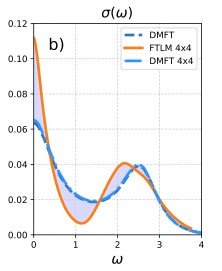
Besides the general issue of understanding the importance of vertex corrections, the paper is partly motivated by recent experiments on ultracold atoms that were compared to the results of calculations for a Hubbard model, using the finite-temperature Lanczos method (which essentially gives exact results on small finite lattices (e.g. 4 x 4)) and cluster Dynamical Mean-Field Theory (DMFT) (which does not include vertex corrections and has some momentum dependence in the self energy).

Before looking at the results I should point out the parameter values for the calculations. They are done for a Hubbard model on a square lattice. The half-bandwidth D=4t where t is the hopping parameter and U=10t. For the graphs below the doping p=0.1 (comparable to optimal doping in the cuprates).

Most importantly, the lowest temperature for which reliable calculations can be performed is T=0.2D=0.8t. In the cuprates, t is about 0.3 eV and so this lowest temperature corresponds to about 3000 K!, i.e. well above the superconducting Tc and the range of resistivity measurements on real materials. Most solids melt at these high temperatures.

Nevertheless, the results are important for two reasons. 

First, the experiments on ultracold atoms are in this temperature regime. [Aside: again this shows how fermion cold atom experiments are a long long way from simulating cuprates, contrary to some hype a decade ago]. 

Second, we are desperate for reliable results, and so it is worth knowing something about the possible importance of vertex corrections, even at very high temperatures. [Aside: my first guess would have been that they are not very important since I would have thought that correlations would be short-range and hand waving from Ward's identity would suggest that it follows the vertex corrections are small. This is wrong.]

In the figure above the top panel is the charge compressibility versus temperature. This is a thermodynamic quantity and the results show that most of the methods give similar results suggesting that the corresponding vertex corrections are small, at least above 0.1D.

The lower panel shows the temperature dependence of the resistivity and suggests that vertex corrections do lead to quantitative, but not qualitative differences. I guess the resistivity is in units of the quantum of resistance. Each rectangle has a vertical dimension of 5 units and so the resistivity is in excess of the Mott-Ioffe-Regel limit, i.e. the system is a bad metal. 

The figure above shows the frequency dependence of the optical conductivity for T=0.5D. There is a Drude peak at zero frequency and the broad peak near omega=2.5D=U corresponds to transitions between the lower and upper Hubbard band. DMFT is qualitatively correct but does differ from FTLM, showing the importance of vertex corrections.

Monday, July 26, 2021

Sage wisdom on computational materials science

Roald Hoffmann and Jean-Paul Malrieu are two of my favourite living theoretical chemists. Both greatly value the role of concepts and intellectual clarity in theory. Hoffmann has featured in 22 posts on this blog.

They recently published a wonderful trilogy in  Angewandte Chemie.

Simulation vs. Understanding: A Tension, in Quantum Chemistry and Beyond. 

Part A. Stage Setting

Part B. The March of Simulation, for Better or Worse

Part C. Toward Consilience

I add this trilogy to my list of 5 papers every computational chemistry student should read, suggested by me a decade ago. [Malrieu is author of one of those and Hoffmann co-author of another.]

Although the trilogy addresses and uses specific examples from computational quantum chemistry it is just as relevant to anyone interested in computational materials science. Actually, I hope that anyone interested in materials science would read and digest it as it gives a sober and balanced perspective about the relationship between theory, simulation, and understanding.

Articles are timely as they address hype about how AI techniques will "revolutionise" materials theory. 

The articles are beautifully written and engage with broader themes such as philosophy of science, culture, art, and politics.

Finally, I just love this photo of the two authors, both in their eighties. the photo reflects some of the joy they find in science, so beautifully expressed in these articles.

I thank Ben Powell for bringing the papers to my attention.

Tuesday, May 25, 2021

Superconductivity in kagome metals

Condensed matter physics is driven by fashion (too much). Is it fair to say that the latest fashion is the vanadium-based kagome metals  AV3Sb3 (A=K,Rb,Cs)?

[The PRL reporting superconductivity was published less than six months ago and has already been cited 44 times.]

These are certainly fascinating materials and have probably attracted attention for the following reasons.

-Kagome lattices support rich physics such as flat bands, Dirac metals, massively degenerate ground states, and (possibly) spin liquids.

-unlike other Kagome metals these compounds have both inversion and time-reversal symmetries, there is a Z2 topological invariant associated with bands near the Fermi surface, and topologically non-trivial surface states

-they are superconducting; furthermore, there are two superconducting domes as a function of pressure

-an anomalous Hall effect has been observed, which may result from topological physics

-there may be several types of charge order, including chiral charge density wave order

-the materials may be a topological superconductor [which MAY mean that it can be used to construct qubits that are "topologically protected].

Here are a few papers that I have looked at to get a better feel for this topic. I add a few things I gleaned from the papers and some basic questions I have. I welcome suggestions of other papers, that may be more helpful introductions. 

CsV3Sb5: A Z2 Topological Kagome Metal with a Superconducting Ground State 

Brenden R. Ortiz, Samuel M. L. Teicher, Yong Hu, Julia L. Zuo, Paul M. Sarte, Emily C. Schueller, A. M. Milinda Abeykoon, Matthew J. Krogstad, Stephan Rosenkranz, Raymond Osborn, Ram Seshadri, Leon Balents, Junfeng He, and Stephen D. Wilson

The figure below shows a top-down view of a single layer. The V atoms (red) form a Kagome lattice. There are three V atoms per unit cell.


The authors present DFT-based band structure calculations, which are compared to ARPES data. The good agreement suggests to me that strong correlations are not important. 

The authors use their band structures to construct Wannier orbitals and a tight-binding model for the band structure. However, even in the Supplementary information, they provide no details of this. I would like to know answers to the following.

For bands near the Fermi energy what is the composition of the underlying atomic orbitals (especially, how much d on V and p on Sb)?
How much of the band structure is described by a simple tight-binding model on a Kagome lattice with only next-nearest neighbour hopping?
Is the hopping between V sites via the p orbitals on the intermediate Sb atoms (superexchange in chemistry language)?

What is the band filling? 
Simple charge counting suggests there is one electron per triangle (1/6 band filling).

At a temperature of 100 K the intralayer resistivity is about 10 microohm-cm, well below the Mott-Ioffe-Regel limit (where the mean-free path is comparable to the lattice spacing), also suggesting that strong correlations are not significant.

Section V. A. discusses a tight-binding model. I think it is for the Kagome lattice with only nearest-neighbour hopping.

Double-dome superconductivity under pressure in the V-based Kagome metals AV3Sb5 (A = Rb and K)

C. C. Zhu, X. F. Yang, W. Xia, Q. W. Yin, L. S. Wang, C. C. Zhao, D. Z. Dai, C. P. Tu, B. Q. Song, Z. C. Tao, Z. J. Tu, C. S. Gong, H. C. Lei, Y. F. Guo, S. Y. Li

Answers to the following questions may determine whether interest in these materials is sustained.

Is the superconductivity topological?

Is the superconductivity unconventional? There are two independent parts to this question: does the superconductivity result from electron-phonon coupling or purely electronic interactions? Is the order parameter s-wave?

[On the related question of whether there are nodes in the superconducting energy gap there are already preprints with contradictory conclusions].

Is there any significant connection between any of the following: the topological character of the metal, the superconductivity, charge density orderings, and electron correlations?


Tuesday, May 4, 2021

A rich phase diagram for a Hubbard model on the decorated honeycomb lattice

 An important scientific idea is that simple rules can produce complex behaviour. In condensed matter theory, model Hamiltonians with just a few parameters can have rich phase diagrams with many competing ground states. My colleagues and I just completed a paper that is one more example of this.

Spin-0 Mott insulator to metal to spin-1 Mott insulator transition in the single-orbital Hubbard model on the decorated honeycomb lattice  H. L. Nourse, Ross H. McKenzie, B. J. Powell 

We study the interplay of strong electron correlations and intra-triangle spin exchange at two-thirds filling of the single-orbital Hubbard model on the decorated honeycomb lattice using rotationally invariant slave bosons (RISB). We find that the spin exchange tunes between a spin-1 Mott insulator, a metal, and a spin-0 Mott insulator when the exchange is antiferromagnetic. The Mott insulators occur from effective intra-triangle multi-orbital interactions and are adiabatically connected to the ground state of an isolated triangle. An antiferromagnetic spin exchange, as determined by the Goodenough-Kanamori rules, may occur in coordination polymers from kinetic exchange via the ligands. We characterize the magnetism in the regime where spin-triplets dominate. For small U a spin-1 Slater insulator occurs with antiferromagnetic order between triangles. Magnetism in the spin-1 Mott insulator is described by a spin-1 Heisenberg model on a honeycomb lattice, whose ground state is Néel ordered.

Comments are welcome.

Wednesday, September 16, 2020

Kondo effect in the New York Times!

The Kondo effect is a paradigm for quantum many-body physics. It has so much: non-perturbative effects, scaling, emergent energy scales, Bethe ansatz solution, asymptotic freedom, Fermi liquid, ...

The Kondo model is a benchmark for testing many approximations and numerical methods.

Furthermore, it connects to so many other things: Anderson single impurity model, Dynamical Mean-Field Theory, Kosterlitz-Thouless transition, heavy fermions, ...

Nevertheless, outside the strongly correlated electron community, it is not widely known, and particularly not in popular discussions of science.

I never thought it would feature at the beginning of the New York Times article, unless Jun Kondo (now 90 years old) was awarded a belated Nobel Prize.

I was pleasantly surprised to see a long profile of Myriam Sarachik that began with her experimental work on the Kondo effect back in 1963.

The article also chronicles some of the sexism she faced in her career and the very limited employment options there were for women in physics. The article also describes how she was not very "productive" for a decade due to recovering from the personal tragedy of the murder of her daughter. Yet, as her mental health recovered she made significant contributions: quantum tunneling in single molecule magnets and the metal-insulator transition in semiconductor heterostructures.

There is a longer autobiographical piece in Annual Reviews.

Tuesday, September 8, 2020

What's the big deal about twisted bilayer graphene?

 Twisted bilayer graphene seems to be the hottest topic in condensed matter physics right now. I tend to not follow fashion, both in clothing and science, for a multitude of reasons. However, I recently tried to catch up and read several of the nice perspectives on the topic at the Journal Club for Condensed Matter Physics.

Electronic bands of twisted graphene layers by Francisco Guinea

New correlated phenomena in magic-angle twisted bilayer graphene/s by Michael Zaletel.

What drives superconductivity in twisted bilayer graphene? by T. Senthil

Here are just a few big picture comments. I welcome feedback. I am just dipping into the subject.

Why is this attracting so much interest?

It is a playground for both experimentalists and theorists. There is some beautiful mathematics, even at the level of Moire patterns, large unit cells for the crystal structure (7204 carbon atoms!), and electronic band structure. For experimentalists, it presents a tuneable system with a rich phase diagram.

The band structure is unique in having topological features (Chern numbers), Wannier orbitals with subtle features, and non-abelian gauge fields.

The discovery of superconductivity and ferromagnetism was unexpected (I think).

There is a subtle competition between many different strongly correlated phases: Mott insulators, ferromagnetism, superconductivity, Dirac metals, ...

The possibility that superconductivity is associated with (i.e. in close proximity in the phase diagram) a Mott insulator suggests some possible similarities to cuprate superconductors.

What are some outstanding issues?

All the theory has a precise and uniform twist angle between the two sheets of graphene. However, there will inevitably be some spatial inhomogeneity in the twist angle across any real laboratory sample. How much does this inhomogeneity matter in the experiments that have been reported so far?

What is the role of the substrate that the twisted bilayer sits on?

Is the superconductivity always "derived" from a Mott insulator?

Is the superconductivity unconventional in being non-phononic and/or having non-s-wave pairing?

Can we achieve consensus on a model effective Hamiltonian and what its phase diagram is?

Will this interest last?

Interest may fade if further and more careful experiments on better samples can never definitely answer the questions above OR if the experiments do find some of the following to be true.

The sample inhomogeneity matters and some of the exciting results reported do not survive in better samples.

The superconductivity is not intimately connected to the Mott insulator.

The superconductivity is conventional.

Some caution and skepticism are in order. Many results published in luxury journals do not stand the test of time. Furthermore, condensed matter physics is a field that rapidly goes through fashions that attract a crowd that quickly moves onto to the next ``big thing,'' i.e. exotic phenomena.

I welcome comments and corrections. I do want to learn more about this fascinating subject.

Friday, September 4, 2020

The intellectual legacy of Phil Anderson

I am looking forward to reading Andrew Zangwill's book, A Mind Over Matter: Philip Anderson and the Physics of the Very Many, that should be available in January 2021.

Andy recently gave a beautiful talk at an ICAM meeting on the life and science of Phil Anderson. I highly recommend it. Yesterday, at the UQ condensed matter theory group meeting we watched it and discussed it.


A few things that stood out to me, partly because some were new to me.
``PWA was a brilliant intuitionist who did more than any other person to transform the patchwork of ideas and techniques of what was formerly called solid state physics into the deep, subtle, and intellectually coherent discipline know as condensed matter physics.''

Phil's wife, Joyce, had an MA in English literature and edited all his prose pieces. This may explain how well written his writing for general audiences, such as Physics Today columns and book reviews in The Times Higher Education Supplement were so well written. In contrast, Phils talks and some papers were rather obscure.

PWA was a contrarian. He did not follow the pack. This is embodied in the fact that he chose to work on his PhD at Harvard with van Vleck, rather than Schwinger, who was chosen by eleven of his peers! van Vleck said "follow the data". During this time he was a friend of Tom Lehrer, a mathematics graduate student who became famous for writing and performing satirical songs with a strong social justice theme.

Phil did a BS in Electronic Physics (essentially Radio Engineering) and did not learn any modern physics. He did a PhD in chemical physics. It was only at Bell Labs that he started working on condensed matter problems. There he had three significant mentors: Conyers Herring, Gregory Wannier, and Charles Kittel.

Phil's 1952 paper on antiferromagnetism contained the idea of spontaneous symmetry breaking. But, this was not appreciated for a decade.

Phil's 1957 localisation paper and his 1961 magnetic impurities paper [the two works cited for his Nobel Prize] were both stimulated by talking to experimentalists at Bell Labs [George Feher and Berndt Matthias, respectively].

Concepts in Solids, based on his graduate lectures at Cambridge in 1961-2, was revolutionary for the time because the focus was on the properties of model Hamiltonians, rather than detailed phenomenology.

Phil's criticisms of high energy physics, its reductionism and drawing resources away from "tabletop" science, began as early as 1971, when he wrote a New Scientist article on the subject. 

But there is a lot more. Watch the video!

Wednesday, April 22, 2020

Mean-field theories: helpful or misleading? From Hubbard to COVID-19 models

Mean-field theory (self-consistent field theory) is incredibly valuable. It gives significant insights into what is possible with a particular model.
What kind of phases and broken symmetries may be possible?
How does the phase diagram depend on different parameters in a model?
Indeed, mean-field theory is the basis of the whole Landau paradigm for spontaneous symmetry breaking and phase transitions.
Implementations of Density Functional Theory (DFT) in computational materials science are basically mean-field theories. Most of computational quantum chemistry involves some sort of mean-field theory.

Mean-field theories do not take into account fluctuations, dynamic or spatial.
Basically, a many-body problem is reduced to a one-body problem.

A good mean-field theory can win you a Nobel Prize. That's what Anderson, BCS, Ginsberg, Abrikosov, and Leggett all did!
Can you think of others?

However, mean-field theory does have its limitations.
It is usually quantitatively wrong. It often gives unreliable values for transition temperatures. In spatial dimensions less than four, mean-field theory gives the wrong values for the critical exponents near a phase transition.

An even bigger problem is that mean-field can be qualitatively wrong.
For many models (e.g. the Ising model or Heisenberg model) mean-field theory always gives a transition from a disordered to an ordered phase at a non-zero temperature.
However, in one dimension the Ising model has no phase transition in one dimension. For a Heisenberg ferromagnet or antiferromagnet, there is no transition at finite temperature in two dimensions.
The Mermin-Wagner theorem states that in two dimensions a superconductor or superfluid never has long-range order at finite temperature. Instead, there is a Kosterlitz-Thouless transition, to a distinct state of matter, with power-law correlations.

Mean-field theory can also fail to predict the existence of states of matter. For example, for Hubbard models, mean-field theory can produce several states: a Fermi liquid metal, a ferromagnetic metal, an antiferromagnetic metal, and a spin-density-wave insulator. But it is quite possible the model also can have non-magnetic Mott insulating phases, superconductivity, non-Fermi liquid metals, and pseudogap states.

In the next post, I will discuss some issues that arise in mean-field theories used in modeling the COVID-19 epidemic.

What does this movie tell us about the modern university?

Last night, my wife and I watched the movie, Wit. You can watch the full movie here  (free with ads). I should warn that some of the conten...