Showing posts with label Kondo. Show all posts

Wednesday, October 29, 2025

Rodney Baxter (1940-2025): Mathematical Physicist

I recently learnt that Rodney Baxter died earlier this year. He was adept at finding exact solutions to two-dimensional lattice models in statistical mechanics. He had a remarkably low public profile. But, during my lifetime, he was one of the Australian-based researchers who made the most significant and unique contributions to physics, broadly defined. Evidence of this is the list of international awards he received.

On Baxter's scientific achievements, see the obituary from the ANU, and earlier testimonials from Barry McCoy in 2000, and by Vladimir Bahzanov, on the award of the Henri Poincaré Prize to Baxter in 2021.

Exact solutions of "toy models" are important in understanding emergent phenomena. Before Onsager found an exact solution to the two-dimensional Ising model in 1944, there was debate about whether statistical mechanics could describe phase transitions and the associated discontinuities and singularities in thermodynamic quantities. 

Exact solutions provide benchmarks for approximation schemes and computational methods. They have also guided and elucidated key developments such as scaling, universality, the renormalisation group and conformal field theory.

Exact solutions guided Haldane's development of the Luttinger liquid and our understanding of the Kondo problem.

I mention the specific significance of a few of Baxter's solutions. His Exact solution of the eight-vertex model in 1972 gave continuously varying critical exponents that depended on the interaction strength in the model. This surprised many because it seemed to be against the hypothesis of the universality of critical exponents. This was later reconciled in terms of connections to the Berezinskii-Kosterlitz-Thouless transition (BKT) phase transition, which was discovered at the same time. I am not sure who explicitly resolved this.

It might be argued that Baxter independently discovered the BKT transition. For example, consider the abstract of a 1973 paper, Spontaneous staggered polarization of the F-model

"The “order parameter” of the two-dimensional F-model, namely the spontaneous staggered polarization P0, is derived exactly. At the critical temperature P0 has an essential singularity, both P0 and all its derivatives with respect to temperature vanishing."

Following earlier work by Lieb, Baxter explored the connection of two-dimensional classical models with one-dimensional quantum lattice models. For example, the solution of the XYZ quantum spin chain is related to the Eight-vertex model. Central to this is the Yang-Baxter equation. Alexander B. Zamolodchikov connected this to integrable quantum field theories in 1+1 dimensions. [Aside: the Yang is C.N. Yang, of Yang-Mills and Yang-Lee fame, who died last week.]

Baxter's work had completely unanticipated consequences beyond physics. Mathematicians discovered profound connections between his exact solutions and the theory of knots, number theory, and elliptic functions. It also stimulated the development of quantum groups.

I give two personal anecdotes on my own interactions with Baxter. I was an undergraduate at the ANU from 1979 to 1982. This meant I was completely separated from the half of the university known as the Institute for Advanced Studies (IAS), where Baxter worked. Faculty in the IAS there did no teaching, did not have to apply for external grants, and had considerable academic freedom. Most Ph.D. students were in the IAS. By today's standards, the IAS was a cushy deal, particularly if faculty did not get involved in internal politics. As an undergraduate, I really enjoyed my courses on thermodynamics, statistical mechanics, and pure mathematics. My honours supervisor, Hans Buchdahl, suggested that I talk to Baxter about possibly doing a Ph.D. with him. I found him quiet, unassuming, and unambitious. He had only supervised a few students. He wisely cautioned me that Ph.D. students might not be involved in finding exact solutions but might just be comparing exact results to series expansions.

In 1987, when I was a graduate student at Princeton, Baxter visited, hosted by Elliot Lieb, and gave a Mathematical Physics Seminar. This visit was just after he received the Dannie Heinemann Prize for Mathematical Physics from the American Physical Society. These seminars generally had a small audience, mostly people in the Mathematical Physics group. However, for Baxter, many string theorists (Witten, Callen, Gross, Harvey, ...) attended. They had a lot of questions for Baxter. But, from my vague recollection, he struggled to answer them, partly because he wasn't familiar with the language of quantum field theory. 

I was told that he got nice job offers from the USA. He could have earned more money and achieved a higher status. For personal reasons, he turned down the offer of a Royal Society Research Professorship at Cambridge.  But he seemed content puttering away in Australia. He just loved solving models and enjoyed family life down under.

Baxter wrote a short autobiography, An Accidental Academic. He began his career and made his big discoveries in a different era in Australian universities. The ANU had generous and guaranteed funding. Staff had the freedom to pursue curiosity-driven research on difficult problems that might take years to solve. There was little concern with the obsessions of today: money, metrics, management, and marketing. It is wonderful that Baxter was able to do what he did. It is striking that he says he retired early so he would not have to start making grant applications!

Monday, October 6, 2025

Nobel Prize predictions for 2025

 This week Nobel Prizes will be announced. I have not done predictions since 2020. This is a fun exercise. It is also good to reflect on what has been achieved, including outside our own areas, and big advances from the past we may now take for granted.

Before writing this I looked at suggestions from readers of Doug Natelson's blog, nanoscale views, an article in Physics World, predictions from Clarivate based on citations, and recent recipients of the Wolf Prize.

Please enter you own predictions below.

Although we know little about how the process actually works or the explicit criteria used, I have a few speculative suggestions and observations.

1. The Wolf Prize is often a precursor.

2. Every now and then, they seem to surprise us.

3. Every few years, the physics committee seems to go for something technological, sometimes arguably outside physics, perhaps to remind people how important physics is to modern technology and other areas of science.

4. They seem to spread the awards around between different areas of physics.

5. Theory only gets awards when it has led to well-established experimental observations. Brilliant theoretical discoveries that motivate large research enterprises (more theory and experimental searches) are good enough. This is why predictions based on citation numbers may be misleading.

6. Once an award has been made on one topic, it is unlikely that there will be another award for a long time, if ever, on that same topic. In other words, there is a high bar for a second award.

7. I don't think the logic is to pick an important topic and then choose who should get the prize for the topic. This approach works against topics where many researchers independently made contributions that were all important. The awardee needs to be a standout who won't be a debatable choice.

What do you think of these principles?

For some of the above reasons, I discuss below why I am sceptical about some specific predictions.

My top prediction for physics is Metamaterials with negative refractive index, going to John Pendry (theory) and David Smith (experiment). This is a topic I know little about.

Is it just a matter of time before twisted bilayer graphene wins a prize? This might go to Allan MacDonald (theory) and Pablo Jarillo-Herrero (experiment). They recently received a Wolf Prize. One thing that convinced me of the importance of this discovery was a preprint on moirĂ© WSe2 with beautiful phase diagrams such as this one.


The level of control is truly amazing. Helpful background is the recent Physics Today article by Bernevig and Efetov.

This is big enough to overcome 6. and the earlier prize for graphene.

Unfortunately, my past prediction/wish of Kondo and heavy fermions won't happen as Jun Kondo died in 2022. This suggestion also always went against Principle 6, with the award to Ken Wilson citing his solution of the Kondo problem.

The prediction of Berry and Aharonov for topological phases in quantum mechanics is reasonable, except for questions about historical precursors.

The prediction of topological insulators is going against 6. and the award to Haldane in 2016.

Clarivate's predictions of DiVincenzo and Loss (for qubits based on electron spin in quantum dots) goes against 5. and 7. It is just one of many competing proposals for a scaleable quantum computer and a large-scale device is still elusive.

Predictions of a prize for quantum algorithms (Shor, Deutsch, Brassard, Bennett) go against 5. 

Chemistry 

I don't know enough chemistry to make meaningful predictions. On the other hand, in 2019 I did correctly predicted John Goodenough for lithium batteries.  I do like the prediction from Clarivate for Biomolecular condensates (Brangwynne, Hyman, and Rosen). I discussed them briefly in my review article on emergence.

What do you think about my 7 "principles"?

What are your predictions?

Tuesday, October 6, 2020

Nobel Prize predictions for 2020

It is that time of year again. My physics predictions are the same as last year.

For physics this year I predict
Experiments for testing Bell inequalities and elucidating the role of entanglement in quantum physics
Alain Aspect, John Clauser, and Anton Zeilinger
They received the Wolf Prize in 2010, a common precursor to the Nobel. 

My personal preference for the next Nobel for CMP would be centred around Kondo physics since that is such a paradigm for many-body physics, maybe even comparable to BCS.

Kondo effect and heavy fermions
Jun KondoFrank Steglich, David Goldhaber-Gordon

Arguably the latter two might be replaced with others who worked on heavy fermions and/or Kondo in quantum dots.
Steglich discovered heavy fermion superconductivity.
Goldhaber-Gordon realised tuneable Kondo and Anderson models in quantum dots (single-electron transistors).

Unlike many, I still remain to be convinced that topological insulators are worthy of a Nobel.

How about other prizes?

The nomination deadline was January 31, before most people appreciated the significance of covid-19. I predict next year that their will be at least one prize (Chemistry, Medicine, Economics, or Peace) relating to public health and/or viruses. One possibility would be Bill and Melinda Gates for Peace.

Here are a few unusual suggestions.

Literature: Lin-Manuel Miranda for Hamilton

Peace (more likely next year): Colin Kaepernick and/or Black Lives Matter, Joshua Wong and/or other Hong Kong protestors, Jacinda Ardern.

On peace, here are some other ideas.

What do you think?

Wednesday, September 16, 2020

Kondo effect in the New York Times!

The Kondo effect is a paradigm for quantum many-body physics. It has so much: non-perturbative effects, scaling, emergent energy scales, Bethe ansatz solution, asymptotic freedom, Fermi liquid, ...

The Kondo model is a benchmark for testing many approximations and numerical methods.

Furthermore, it connects to so many other things: Anderson single impurity model, Dynamical Mean-Field Theory, Kosterlitz-Thouless transition, heavy fermions, ...

Nevertheless, outside the strongly correlated electron community, it is not widely known, and particularly not in popular discussions of science.

I never thought it would feature at the beginning of the New York Times article, unless Jun Kondo (now 90 years old) was awarded a belated Nobel Prize.

I was pleasantly surprised to see a long profile of Myriam Sarachik that began with her experimental work on the Kondo effect back in 1963.

The article also chronicles some of the sexism she faced in her career and the very limited employment options there were for women in physics. The article also describes how she was not very "productive" for a decade due to recovering from the personal tragedy of the murder of her daughter. Yet, as her mental health recovered she made significant contributions: quantum tunneling in single molecule magnets and the metal-insulator transition in semiconductor heterostructures.

There is a longer autobiographical piece in Annual Reviews.

Friday, September 4, 2020

The intellectual legacy of Phil Anderson

I am looking forward to reading Andrew Zangwill's book, A Mind Over Matter: Philip Anderson and the Physics of the Very Many, that should be available in January 2021.

Andy recently gave a beautiful talk at an ICAM meeting on the life and science of Phil Anderson. I highly recommend it. Yesterday, at the UQ condensed matter theory group meeting we watched it and discussed it.


A few things that stood out to me, partly because some were new to me.
``PWA was a brilliant intuitionist who did more than any other person to transform the patchwork of ideas and techniques of what was formerly called solid state physics into the deep, subtle, and intellectually coherent discipline know as condensed matter physics.''

Phil's wife, Joyce, had an MA in English literature and edited all his prose pieces. This may explain how well written his writing for general audiences, such as Physics Today columns and book reviews in The Times Higher Education Supplement were so well written. In contrast, Phils talks and some papers were rather obscure.

PWA was a contrarian. He did not follow the pack. This is embodied in the fact that he chose to work on his PhD at Harvard with van Vleck, rather than Schwinger, who was chosen by eleven of his peers! van Vleck said "follow the data". During this time he was a friend of Tom Lehrer, a mathematics graduate student who became famous for writing and performing satirical songs with a strong social justice theme.

Phil did a BS in Electronic Physics (essentially Radio Engineering) and did not learn any modern physics. He did a PhD in chemical physics. It was only at Bell Labs that he started working on condensed matter problems. There he had three significant mentors: Conyers Herring, Gregory Wannier, and Charles Kittel.

Phil's 1952 paper on antiferromagnetism contained the idea of spontaneous symmetry breaking. But, this was not appreciated for a decade.

Phil's 1957 localisation paper and his 1961 magnetic impurities paper [the two works cited for his Nobel Prize] were both stimulated by talking to experimentalists at Bell Labs [George Feher and Berndt Matthias, respectively].

Concepts in Solids, based on his graduate lectures at Cambridge in 1961-2, was revolutionary for the time because the focus was on the properties of model Hamiltonians, rather than detailed phenomenology.

Phil's criticisms of high energy physics, its reductionism and drawing resources away from "tabletop" science, began as early as 1971, when he wrote a New Scientist article on the subject. 

But there is a lot more. Watch the video!

Tuesday, April 14, 2020

Phil Anderson (1923-2020): theoretical physicist extraordinaire

Phil Anderson died two weeks ago. There have been many obituaries, including at The New York Times, Not Even Wrong (Peter Woit), and Nanoscale Views (Doug Natelson). Few would argue that he was the greatest condensed matter theorist of the second half of the twentieth century. I would go further and suggest that he and Ken Wilson were the greatest theoretical physicists of the second half of the twentieth century. Anderson's scientific legacy extends far beyond condensed matter physics.

More than sixty posts on this blog include ``P.W. Anderson'' in the label. There is no doubt that Anderson is the largest intellectual influence on this blog.

Phil Anderson made incredibly diverse and valuable contributions to condensed matter physics (anti-ferromagnetism, localisation, weak localisation, magnetic impurities in metals, Kondo problem, poor mans scaling, superfluid 3He, spin liquids, RVB theory of superconductivity... ).

It is noteworthy that Anderson applied scaling to condensed matter before Wilson. In the late 1960s he wrote a series of papers on ``poor man's scaling" for the Kondo problem.

I can think of several significant and profound influences of Phil beyond condensed matter physics.

1. Codifying and elucidating the concept of emergence (and the limitations of reductionism) in all of science, in More is Different in 1972.
[Although it should be acknowledged that the word ``emergence'' does not appear in the article and that Michael Polanyi developed similar ideas about emergence earlier.]

2. Nambu referenced several papers by Anderson about superconductivity in his seminal papers on the mass of elementary particles and symmetry breaking.

3. Laying the groundwork for the Higgs boson in 1963 by connecting spontaneous gauge symmetry breaking and mass. 

4. Elucidating spin glasses in a way that was key to John Hopfield's development of a particular neural network and to the notion of a "rugged landscape", relevant in protein folding and evolution. Anderson described these connections nicely in two pages in Physics Today in 1990.

Phil had a significant influence on my own job/career trajectory. For my Princeton Ph.D. I worked with Jim Sauls on superfluid 3He, which Phil supported financially. He was on the committee for my Ph.D. thesis defense in 1988. In 1993, towards the end of a postdoc, my job prospects were extremely slim. Phil told me that he had been asked to review an application I made for a five-year research fellowship back in Australia. My success was probably based on a positive review from Phil. I regret that during my time as a graduate student I did not have the confidence to interact much with him. However, from about 1995 to 2002, I made a visit to Princeton practically every year and had some nice discussions with him. It was also fascinating to see the close personal and scientific relationship that Phil and N.P. Ong had; it was clearly mutually very beneficial.
One cryptic comment: ``look at the metal-insulator-metal tunneling theory from the 1960s" [I found Mahan has a nice discussion] set me on the right path to do the calculations in this paper, about angle-dependent-magnetoresistance oscillations in layered metals.


I highly recommend the Anderson anthologies (reprint collections), listed below in order of increasing technical difficulty.

More and Different: notes from a thoughtful curmudgeon.
It is a collection of essays on wide-ranging subjects: personal reminiscences, history, philosophy, sociology, science wars, ...
Some of these have been published before but many have not.

A Career in Theoretical Physics
Something amazing about this collection of papers is what is not in it; e.g. his papers on superfluid 3He with Brinkman, or on charge ordering and antiferromagnetism in ferrites.

Basic Notions of Condensed Matter Physics

Andrew Zangwill is working on a scientific biography of Phil Anderson. I am looking forward to reading.

Thursday, December 12, 2019

John Wilkins (1936-2019): condensed matter leader

I was sad to hear last week of the death of John Wilkins. He was a mentor to a whole generation of condensed matter physicists and a generous servant, both individuals and institutions. This obituary and memories from some colleagues gives a nice description of his many contributions.

I was privileged to do a postdoc with Wilkins at Ohio State University in the early 1990s. He had a significant influence on me, both scientifically and professionally. Much of the practical advice I write on this blog relating to jobs, writing, and giving talks, I learned from Wilkins. Even ten years after I worked with him I would still occasionally phone him for advice, particularly with negotiating and deciding on job offers.

Real leadership does not involve having a position, but rather having influence. Servant leaders are not concerned with advancing their own interests, but rather those of others in their community. They do this by investing in people and institutions. Wilkins did this in many ways. He invested heavily in his own graduate students and postdocs. He advised and mentored countless other students, postdocs, and young faculty, for whom he had no formal responsibility or anything to gain from their success. He was proud of the fact that he never held an administrative position in a university. Nevertheless, his influence was far greater than most department chairs and deans. He served the American Physical Society in countless ways, particularly their publishing activities and the Division of Condensed Matter Physics. He wrote innumerable reference letters, referee reports, and grant reviews.

Reflecting on Wilkins, I was reminded of these recent words of David Brooks, written in a different context.
I had a feeling of going back in time. Why did it feel so strange? It was because I was looking at people who are not self-centered. They’ve dedicated themselves to the organization that formed them, and which they serve.
A few other basic but important things I learned from Wilkins:
Write clearly. Rewrite. Talk to people. Theory should relate to real materials and real experiments. Defining the problem clearly can be an important contribution. A concrete calculation on a concrete model is valuable.

Wilkins did have significant scientific achievements, but they tend to get dwarfed in comparison to his influence over people. Perhaps, the most significant relate to the Kondo problem. This began with his student Krishnamurthy, who used Wilson's numerical renormalisation group to understand all the different regimes of the Anderson single impurity model. Later with his students Dan Cox and Gene Bickers, Wilkins applied slave boson techniques to describe a wide range of experimental properties of valence fluctuation associated with magnetic impurities in metals.

In classic Wilkins style, he convened a group of distinguished theorists to meet in Los Alamos one summer to write a definitive early review article on heavy fermions.

Wilkins was larger than life. He laughed a lot and was a tease. He could also be intimidating. Before his groups' annual pilgrimage to the APS March meeting, everyone had to give a practice talk to the group and Wilkins. A fellow postdoc confided to me that each year he was more nervous about giving the practice talk than the real talk! One time, Wilkins got frustrated that too many of us had small fonts on our overhead transparencies. He made us all chant together: ``22 point type is the smallest! 22 point type is the smallest! ...."  again and again until we got the point.

It was well known that Wilkins did not like his picture taken. On his department web page he put a picture of another John Wilkins, one of the founders of the Royal Society. However, my wife did not know his aversion. In 1992? Kevin Ingersent hosted a group Thanksgiving dinner at his house. Later to my shock, I discovered my wife took the photo below. ``What?! You took a photo of Wilkins?!"


Wilkins was a great role model as a scientist, a faculty member, and a servant of a professional community.

Tuesday, October 8, 2019

2019 Nobel Predictions

It is that time of year again. I have not made predictions for a few years.

For physics this year I predict
Experiments for testing Bell inequalities and elucidating the role of entanglement in quantum physics
Alan Aspect, John Clauser, and Anton Zeilinger
They received the Wolf Prize in 2010, a common precursor to the Nobel.

My personal preference for the next Nobel for CMP would be centred around Kondo physics, since that is such a paradigm for many-body physics, maybe even comparable to BCS.

Kondo effect and heavy fermions
Jun Kondo, Frank Steglich, David Goldhaber-Gordon

Arguably the latter two might be replaced with others who worked on heavy fermions and/or Kondo in quantum dots.
Steglich discovered heavy fermion superconductivity.
Goldhaber-Gordon realised tuneable Kondo and Anderson models in quantum dots (single-electron transistors).

Unlike many, I still remain to be convinced that topological insulators is worthy of a Nobel.

For chemistry, my knowledge is more limited. However, I would go for yet another condensed matter physicist to win the chemistry prize: John Goodenough, inventor of the lithium battery.
He also made seminal contributions to magnetism, random access memories, and strongly correlated electron materials.

What do you think?

Postscripts (October 10).

I got confused about the day of the physics prize and I think when I posted my ``prediction'' the prize may have already been announced.

A few years ago I read Goodenough's fascinating autobiography. It was actually in that book that I learned about U. Chicago requiring PhD students to publish a single author paper. This observation featured in my much commented on recent post about PhD theses.

I also have a prediction for the Peace Prize. First, I hope it is not Greta Thunberg, as much as I admire her and agree with the importance of her cause. I worry whether it may ruin her life.
My wife suggested the Prime Minister of Ethiopia, Abiy Ahmed and the President of Eritrea, Isaias Afwerki. I find it truly amazing what Ahmed has achieved.
Another great choice would be some of the leaders of Armenia, which has seen significant increases in human rights, political freedoms, and freedom the press. It was selected as The Economist's country of the year in 2018.

Postscript (October 30).
I was really happy about the economics prize. Six years ago, I read Poor Economics, by Banerjee and Duflo, with my son (an economics student), and blogged about it. Below a respond to a commenter who was critical of this prize.

Tuesday, August 13, 2019

J.R. Schrieffer (1931-2019): quantum many-body theorist

Bob Schrieffer died last month, as reported in a New York Times obituary.

Obviously, Schrieffer's biggest scientific contribution was coming up with the variational wave-function for the BCS theory of superconductivity. BCS theory was an incredible intellectual achievement on many levels. Many great theoretical physicists had failed to crack the problem. The elegance of the theory was manifest in the fact that it was analytically tractable, yet could give a quantitative description of diverse physical properties in a wide range of materials. BCS also showed the power of using quantum-field-theory techniques in solid state theory. This was a very new thing in the late 50s. Then there was the following cross-fertilisation with nuclear physics and particle physics (e.g. Nambu).

Another significant contribution was the two-page paper from 1966 that used a unitary transformation to connect the Kondo model Hamiltonian to that of the Anderson single impurity model. In particular, it gave a physical foundation for the Kondo model, which at the time was considered somewhat ad hoc.
John Wilkins wrote a nice commentary on the background history and significance of the Schrieffer-Wolff transformation.

The SW transformation is an example of a general strategy of finding an effective Hamiltonian for a reduced Hilbert space. This can also be done via quasi-degenerate perturbation theory. In different words, when one ``integrates out'' the charge degrees of freedom in the Anderson model one ends up with the Kondo model.

There is also the Su-Schrieffer-Heeger model, that is related to Heeger's Nobel Prize in Chemistry. However, although this spawned a whole industry (that I worked in as a postdoc with Wilkins) its originality and significance is arguably not comparable to BCS and SW.

Because of when he was born, like many of the pioneers of quantum many-body theory, Schrieffer may have been born for success?

I am somewhat (scientifically) descended from Schrieffer because I did a postdoc with John Wilkins, who was one of Schrieffer's first PhD students. My main interaction with Schrieffer was during 1995-2000. Each year I would visit my collaborator, Jim Brooks, at the National High Magnetic Field Laboratory, and would have some helpful discussions with Schrieffer. During one of those visits, I stumbled across a compendium of reprints from a Japanese lab. [This was back in the days when some people snail-mailed out such things to colleagues]. It had been sent to Schrieffer and contained a copy of a paper by Kino and Fukuyama on a Hubbard model for organic charge transfer salts. That was the starting point for my work on that topic.

Thursday, August 9, 2018

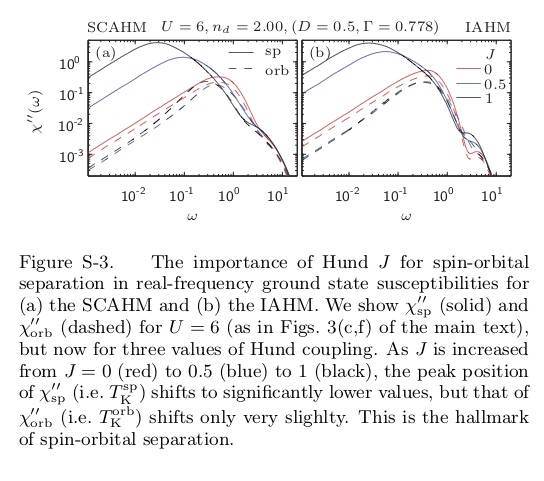
Emergent temperature scales and spin-orbital separation in the Hund's metal

An important and fascinating issue in many-body physics is the emergence of new energy scales, particularly scales that are orders of magnitude smaller than the energy scales in the underlying Hamiltonian. One example is the coherence temperature associated with the crossover from a Fermi liquid (with coherent quasi-particles) to a bad metal.

Recently, I posted about the crossover from a Hund's metal to a bad metal, seen in the collapse of the Drude peak in the optical conductivity, and the issue of capturing this slave-particle theories. One commenter mentioned the relevance of the paper below and another asked about the claim that the Kondo effect is associated with the collapse.

I agree that Kondo physics is associated with the crossover. Although, far from obvious this is also the case in the single-band Hubbard model. The Kondo effect was first studied with isolated magnetic impurities in metals and can be described by a single-impurity Anderson model (SIAM). Although there are no magnetic impurities in the Hubbard model, it turns out that when studied at the level of Dynamical-Mean-Field Theory (DMFT), the model is described by a self-consistent SIAM and close to the Mott metal-insulator transition Kondo physics does emerge. Specifically, the Kondo temperature for the self-consistent SIAM corresponds to the temperature at which there is a crossover from local unscreened local magnetic moments (associated with the almost-localised electrons near the Mott phase; the bad metal) to a Fermi liquid where the "magnetic moments" are screened.

What happens in a two-band Hubbard-Kanamori model with Hund's rule coupling?
The physics is richer because there is now the possibility screening of spin and/or orbital degrees of freedom, and of a orbital-selective Mott phase (or bad metal). 
This is nicely investigated in the following paper.

Dynamical Mean-Field Theory Plus Numerical Renormalization-Group Study of Spin-Orbital Separation in a Three-Band Hund Metal
K. M. Stadler, Z. P. Yin, J. von Delft, G. Kotliar, and A. Weichselbaum

For me, the figure below is the most interesting and illuminating. It shows how due to the Hund's rule coupling, two distinct energy scales (differing by about two orders of magnitude) emerge and associated with screening the spin and orbital degrees of freedom, respectively.

This is Kondo physics, but there are no magnetic impurties.

Wednesday, March 28, 2018

Low energy scales near the orbital-selective Mott transition

One of the most fundamental and profound concepts in quantum many-body theory is the emergence of low energy scales that are much smaller than the energy scales in the "bare" Hamiltonian.
For example, in a metallic phase near the Mott transition in a single band system, there is the energy scale associated with a Fermi liquid. Studies using Dynamical Mean-Field Theory (DMFT) have shown how this scale is associated with ``kinks'' in the quasi-particle dispersion relation and is related to the energy scale for spin fluctuations.

The problem of the Mott transition in multi-band systems (degenerate orbitals) is fascinating and of renewed interest since the discovery of iron-based superconductors. A basic question concerns how the Mott transition is qualitatively different from in single band systems. More specifically, how does a Hund's rule coupling change things?

One new concept is that of an orbital-selective Mott transition. This is where one or more of the bands remains metallic but others become Mott insulators. This concept was originally introduced to explain the intriguing properties of Ca_xSr_2-xRuO4 with x ~ 0.5: it is metallic but has localised spin-1/2 magnetic moments.
[For a critical discussion see the  nice review Strong correlations from Hund's coupling by Antoine Georges, Luca de' Medici, and Jernej Mravlje.]

One might expect that near this transition there are separate low energy scales associated with each of the bands and that these scales are quite different for the bands that become insulator.
However, this is not the case.

There is a nice paper
Emergence of a Common Energy Scale Close to the Orbital-Selective Mott Transition 
Markus Greger, Marcus Kollar, and Dieter Vollhardt

They use DMFT to study a two-band Hubbard model with different bandwidths. They calculate the one-electron spectral functions, the electronic self energy, and the dynamical spin susceptibilities.

The left panel below shows the spectral functions for the two bands. Note how for one the quasi-particle peak width is much smaller than the other.
The right panel (top) shows the energy dependence of the real part of the self-energy for the two bands. Surprisingly, the kink occurs at the same energy.
Furthermore, the bottom of the right panel shows that this peak corresponds to the peak in the dynamical spin susceptibility for both bands.


The figure below shows that "If the Hund’s rule coupling is sufficiently strong, one common energy scale emerges which characterizes both the location of kinks in the self-energy and extrema of the diagonal spin susceptibilities."


The authors then give a physical explanation of this energy scale from a two-impurity Kondo model.

Thursday, July 21, 2016

Bad metals and the unitary limit


In clean elemental metals the mean free path is much larger than the lattice constant and the Fermi wavelength. This means that an electron (or quasi-particle) has a well defined wavelength and momentum (wave vector) between collisions which change its momentum.
Thus, quasi-particles are a well defined entity.
However, consider that limit where the scattering becomes so strong that the mean-free path becomes comparable to the Fermi wavelength (or lattice constant).
Then clearly the idea of a quasi-particle with a well define wave vector and a mean free path does not make sense.

The resistivity (in a Boltzmann-Bloch) picture is inversely proportional to kF l.
Waving ones hands one can argue that in a metal there is a maximum value for the resistivity.
This is known as the Mott-Ioffe-Regel (MIR) limit.
Waving one hands  some more, one might argue that as the temperature increases (and inelastic scattering increases) towards the MIR limit the resistivity might saturate or even decrease because the material becomes an insulator.
Some people also debate whether the minimum value of kF l is 1, pi or 2 pi.

In reality, it is not clear whether the MIR limit exists in any known material.
Bad metals, by definition, violate it.

So what about the above argument? Obviously, there is significant hand waving.
The argument basically extrapolates results for weak scattering to the strong scattering limit.
Is there any way one can make some of the argument more rigorous?

One case where one can do better is for the specific case of elastic scattering due to impurities. Large scattering corresponds to what is known as the unitary limit.
[I often find the terminology obscure. I think it may relate to the optical theorem and the scattering S- matrix having the maximum possible value (unit = -1). I welcome clarification].

This post was stimulated by discussions with my colleagues who wrote the following paper, which has a brief discussion of some of the issues in Section II.

Breakdown of the universality of the Kadowaki-Woods Ratio in multi-band metals
D C Cavanagh, A C Jacko, and B J Powell

Here is my version of the argument, drawing on results found in Hewson’s wonderful book on The Kondo Problem.

Consider an electron scattering off a single impurity potential.
In the weak scattering limit the scattering cross section and mean-free path can be calculated in the Born approximation. However, the strong scattering limit can also be solved using a T-matrix which
sums all of the relevant Feynman diagrams.
Results can be expressed in terms of the scattering phase shifts.
In the limit of an infinite s-wave potential, the relevant phase shift becomes pi/2.
The scattering cross section is proportional to 1/k^2 which is must on dimensional grounds since there is no other well-defined length scale when the scattering length associated with the potential becomes infinite.

The scattering rate for the electrons is written in terms of phase shifts eta_l


If the only non-zero phase shift is the s-wave one and it equals pi/2, one sees that the scattering rate scales as 1/kF.
Note: this is what determines the resistivity in the Kondo problem at very low temperatures.
This (unitary limit) is similar to what one would get from a hand waving argument that takes the weak coupling result and sets kF l = 1.

So how does this relate to bad metals?
Well it should be stressed that the above argument is for elastic scattering and so does not necessarily carry over to inelastic scattering, which is actually what is relevant to bad metals.

I welcome clarifications on any of this.

Tuesday, April 26, 2016

Low temperature physics without nuclear weapons

Liquid 3He is amazing stuff. Below temperatures of a few hundred milliKelvin it forms a model (and the original inspiration for) Landau Fermi liquid. Furthermore, below about 1 mK it forms two different superfluid states, involving Cooper pairs in a spin triplet state. This is the model case for unconventional superconductivity.

Liquid 3He is actually of great practical use since it the crucial ingredient of dilution refrigerations that allow cooling from a few Kelvin to temperatures as low milliKelvin.
But where do labs get 3He from?
Well, it is a very useful by-product of nuclear weapons production.
Currently, the scientific community (which consumes only about 1% of the supply) is experience supply problems and dramatic price increases (a 15-fold increase between 2004 and 2010).
Why is this happening?
Thankfully, we are cutting back on nuclear weapons production!

One practical way to solve this problem is to develop alternative materials for ultra-low temperature refrigeration; one possibility is by adiabatic demagnetisation. Indeed, this is the method that was first developed in the 1930s using paramagnetic salts to achieve temperatures below about 0.3 K (and was the basis of the 1949 Nobel Prize in Chemistry) and is the basis for nice undergraduate problems in thermodynamics and statistical mechanics. Simply the entropy is a function of B/T (where B is the magnetic field and T the temperature). One cools the system down in a fixed magnetic field, then adiabatic isolates it and reduces the magnetic field slowly. In the last step the entropy must not change and so the temperature must decrease. (This is shown as the red horizontal arrow in the figure below). This is also known as the magnetocaloric effect. The problem is that most paramagnetic materials are insulators and one would prefer to have a metallic material that is a good thermal conductor and can be "machined".

I learnt some of this from an interesting paper (that I actually looked at in preparing an undergraduate thermodynamics lecture about Maxwell relations).

Large magnetocaloric effect and adiabatic demagnetization refrigeration with YbPt2Sn 
Dongjin Jang, Thomas Gruner, Alexander Steppke, Keisuke Mitsumoto, Christoph Geibel and Manuel Brando

The authors mention some basic unanswered science questions about why this material is a good candidate. Specifically, why is the Kondo temperature (associated with interaction of the magnetic moments of the Yb3+ ions with the conduction electrons) and the inter-ion magnetic interactions so low? This ensures that the spins act essentially like non-interacting spins (with a large entropy) down to less than 1 K.

A key figure is below, showing the entropy versus temperature at several different magnetic fields.


Wednesday, December 2, 2015

What is omega/T scaling?

And why is it so elusive?

Quantum many-body systems are characterised by many different energy scales (e.g. Fermi energy, Debye frequency, superconducting energy gap, Kondo temperature, ....). However, in many systems properties are "universal" in that they are determined by a single energy scale. This means that the frequency (omega) and temperature (T) dependence of a spectral function can be written in a form such as
where here  T_ K is the relevant energy scale and I set hbar =1 and k_B = 1.

However, what happens in the limit where the relevant energy scale T_K goes to zero, for example near a quantum critical point? Then the only energy scale present is that defined by the temperature T and we now expect a functional dependence of the form
This is omega/T scaling.

In one dimension the form of the scaling function is specified by conformal field theory and for quantum impurity problems (e.g. Kondo) by boundary conformal field theory.

In 1989 Varma et al. showed that many of the anomalous properties of the metallic phase of the cuprate superconductors at optimal doping could be described in terms of a “marginal Fermi liquid” self energy. They associate this with a spin (and charge) fluctuation spectrum that exhibited omega/T scaling (for all wave vectors). Specifically, the spectral function was linear in frequency at low frequencies, up to a frequency of order T.

Some claims about quantum criticality in cuprates are debatable, as discussed here.

Finding concrete realistic theoretical microscopic fermion models that exhibit such scaling has proven challenging.

In his Quantum phase transitions book Sachdev reviews several spin models (e.g. transverse field Ising model in one dimension) that exhibit omega/T scaling in the quantum critical region, associated with a quantum critical point.

 In 1999 Parcollet and Georges  considered a particular limit of a random Heisenberg model which had a spin liquid ground state and a local spin susceptibility chi’’(omega) that exhibited a form consistent with that conjectured in the marginal Fermi liquid scenario.

Local quantum criticality has been observed in a few heavy fermion compounds.  Specifically, in 2000 Schroder et al. observed inelastic neutron scattering gives the following \omega/T scaling,


In 2008 Kirchner and Si showed that near the quantum critical point in the Ising-anisotropic Bose-Fermi Kondo model (BFKM) with a sub-ohmic bath (i.e. a very specific model!) they obtained omega/T scaling similar to that associated with boundary conformal field theory, even though the model has no obvious conformal invariance.

This is my potted history and understanding. I welcome corrections and clarifications.

Monday, November 23, 2015

Quantum critical spin dynamics of a magnetic impurity in a semiconductor

There is an interesting paper
Quantum critical dynamics of a magnetic impurity in a semiconducting host
Nagamalleswararao Dasari, Swagata Acharya, A. Taraphder, Juana Moreno, Mark Jarrell, N. S. Vidhyadhiraja

The key physics of the Kondo model is the formation of a spin singlet state between the impurity spin and the spins of the electrons in the conduction band. We say, the impurity spin is “screened” by the spins in the conduction band.
The "screening" electrons involved span from the Fermi energy up to some higher energy.
The relevant energy scale is the Kondo temperature which depends in a non-analytic way on the density of states (DOS) at the Fermi energy, and is roughly the binding energy of the spin singlet.
As the DOS goes to zero the Kondo temperature goes to zero.

But, what if there is an energy gap at the Fermi energy, as in a semiconductor?
One might expect that the Kondo effect disappears and the local moment is no longer screened.
Specifically, is there a critical non-zero value of the energy gap below which the Kondo effect survives and one observes at Fermi liquid?
How about if the temperature is larger than the energy gap but less than the Kondo temperature?
Then perhaps the electrons that are thermally excited into the conduction band can screen the impurity spin.

The above fundamental questions are relevant to understanding magnetic semiconductors. They can be addressed by studying the gapped single impurity Anderson model. A number of numerical and analytical studies over the years have produced different answers to the above questions. The current paper gives definitive answers based on state-of-the art Quantum Monte Carlo calculations.

The phase diagram is shown below, with temperature versus the energy gap, delta.
Both are scaled by the Kondo temperature in the absence of the gap. LM denotes an unscreened local moment and GFL a Generalised Fermi Liquid.
The phase diagram is universal in the sense that it is independent of U in the Kondo regime (for large U) and the only relevant energy scale is the Kondo temperature (not the band width or the hybridisation energy).
It is not at all obvious (at least to me) that the universality of the delta=0 case has to extend to the non-zero delta case. But it does.

One sees that the critical value of the energy gap is zero.
Furthermore, above some non-zero temperature, of the order of a fraction of Kondo temperature and about one half of delta, a Generalised Fermi liquid forms where the local moment is completely screened.
The authors also show that the dynamic spin susceptibility associated the spin of impurity exhibits “quantum critical scaling” in the sense that it depends only on omega/T where T is the temperature and omega is the frequency.

Hopefully the paper will stimulate some experiments, either in quantum dots or in semiconductors, to observe this fascinating physics.

Monday, September 21, 2015

Emergence and singular asymptotic expansions, II

When is a phenomena truly emergent?
Is there some objective quantitative criteria that one might use to decide?
This is an issue because sometimes discussions of emergence are pretty fuzzy and even flaky.

by Michael Berry that I mentioned in passing in a previous post.

I highly recommend the article as I think it has a very important insight: singular asymptotic expansions provide a concrete criteria for emergence.

Berry considers the specific problem:


He then discusses these examples in detail, including discussions of the asymptotic expansions.

I recommend reading this article before the one by Hans Primas (reviewed in the previous post) as the latter is more technical and philosophical than Berry's.

One thing I think this highlights is that the problem of emergence in quantum systems is neither more or less challenging or interesting than in classical systems, something I argued before.

I have one minor addition to Berry. In quantum many-body systems the singular parameter delta may not just be 1/N, where N = number of particles. It can also be the coupling constant, lambda.  Emergent phenomena are associated with non-perturbative effects. Concrete examples are in the BCS theory of superconductivity and the Kondo effect. In both there is an emergent energy scale  exp(-1/lambda). There is no convergent expansion in powers of lambda. Taylor series around lambda =0 is singular.

Tuesday, February 10, 2015

Rich Kondo physics in iron-based superconductors.

One of the most fascinating, challenging, and frustrating aspects of the iron-based superconductors is the presence of many competing energy scales, particularly associated with Hund's rule coupling.
There are debates about just how strong the correlations are, how large the spin moments are, and how relevant Mott physics is.

Furthermore, Hund's rule seems to lead to an unusual metallic state that is both difficult to characterise and describe theoretically. It has some signatures of a bad metal, as emphasised by (amongst others) Haule, Kotliar, Si, and Abrahams, but this characterisation is disputed by Johnston in his review [see Section 3.8.2].

Given the chemical and structural diversity of this large class of materials, we should be cautious about claiming the same physics is dominant in all the materials.

There is a nice paper that illustrates the richness of this system.
Local Quantum Criticality of an Iron-Pnictide Tetrahedron 
T. Tzen Ong and Piers Coleman

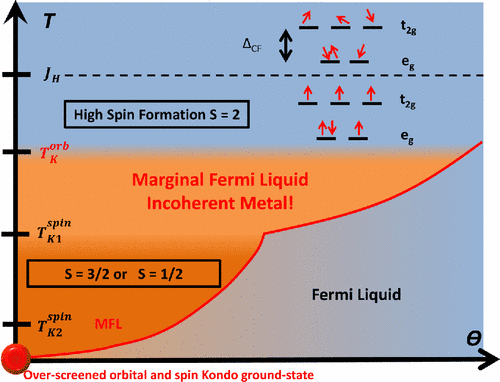
It shows how the Hund's rule coupling and interplay of orbital and spin degrees of freedom can suppress formation of the Fermi liquid state that would occur in a one band system.


One of our key observations, is that in addition to their spin physics, the iron-based tetrahedra develop an orbital degree of freedom associated with the degenerate eg orbitals. For conventional transition metal ions, the Hund’s coupling JH locks the unpaired electrons together into a high-spin configuration, exponentially suppressing the spin-Kondo temperature to low temperatures according to an effect discovered by Schrieffer [15] and recently noted by others [16]. Here we show that unlike their spin counterparts, orbital fluctuations are not subject to the “Schrieffer effect”, giving rise to a unique situation in which the orbital degrees of freedom behave as fluctuating quantum mechanical variables that result in an incoherent “non-Fermi liquid” ground state. While departures from perfect tetragonality will reestablish the Fermi liquid, a large temperature range of incoherent metal behavior is expected to remain.

One of the effects of the projection into the high-spin manifold is an S-fold reduction of the spin-Kondo coupling, JS=J/4S but strikingly, the strength of the orbital Kondo interaction is unaffected. This means that the Hund’s interaction will exponentially suppress the spin-Kondo effect down to a lower scale TspinK/D(TorbK/D)2S, as in conventional transition metal ions, while leaving the orbital Kondo effect unaffected. This schism between the orbital and spin-Kondo effect drastically affects the physics,

What does this movie tell us about the modern university?

Last night, my wife and I watched the movie, Wit. You can watch the full movie here  (free with ads). I should warn that some of the conten...