Showing posts with label glasses. Show all posts

Sunday, March 15, 2026

Tony Leggett (1938-2026): condensed matter theorist

Tony Leggett died last week. The New York Times has a nice obituary. One measure of his influence on me is that more than 20 posts on this blog feature his work. He received the Nobel Prize in 2003 for developing the theory of superfluid 3He.

In 1972, a graduate student at Cornell, Doug Osheroff, discovered a phase transition around a temperature of 2 mK in liquid 3He. In the 1960s liquid 3He was established to be a Fermi liquid that was beautifully described by Landau's theory. Osheroff and his advisors, David Lee and Robert Richardson, incorrectly identified the phase transition as arising from antiferromagnetic order in the solid phase of 3He.

However, Leggett argued that it was actually due to superfluidity that there were two distinct superfluid phases, A and B, with different order parameters. 

Lee, Osheroff, and Richardson shared the Nobel Prize in 1996 for their discovery.

Leggett was primed to make rapid progress, as in 1965 and 1966 he had written three papers about superfluidity in liquid 3He, albeit assuming s-wave pairing. Indeed, by 1975 he wrote a comprehensive review article on the two superfluid phases.

For many reasons superfluid 3He was significant for the broader field of condensed matter. BCS showed that in elemental metals, superconductivity resulted from Cooper pairing of electrons due to an attractive electron-phonon interaction.  The order parameter (Cooper pair wave function) had s-wave spin singlet symmetry.

In contrast, superfluid 3He showed that Cooper pairing could also occur in a neutral Fermi liquid, and have non-trivial symmetry, i.e., p-wave symmetry and spin triplet. The order parameter has 18 components, compared to only 2 for elemental superconductors. There is spontaneous symmetry breaking of the local gauge symmetry, and spin or orbital rotational symmetries. 

The Cooper pairing in superfluid 3He is not due to a fermion-phonon interaction but due to spin fluctuations.

The fact that Cooper pairing was possible for different symmetries and mechanisms than for elemental superconductors was significant in that it meant it was reasonable to consider this possibility for superfluidity in neutron stars, and superconductivity in cuprates, strontium ruthenate, heavy fermions, and organic charge transfer salts.

There is rich physics associated with the symmetry breaking: 18 collective modes of the order parameter, textures such as boojums, and exotic vortex cores. For vortices, there is also some (controversial) connection to cosmic strings, including experiments that test the Kibble-Zurek mechanism and the electro-weak phase transition in the early universe.

Aside: My Ph.D. thesis was on the theory of the non-linear interaction of zero sound with the order parameter collective modes in the B-phase.

Leggett's development of the theory of superfluid 3He was amazing and certainly worthy of a Nobel. However, I think he made an even greater contribution to physics through his work on the theory of macroscopic quantum effects in Josephson junctions. This work was the basis for the experimental work that was honoured with the Nobel Prize last year.

With his student Amir Caldeira, Leggett performed concrete calculations of the effects of decoherence on quantum tunnelling in Josephson junctions.

[The NY Times obituary mistakenly says this work began after Leggett moved to Urbana. It was done while he was still at Sussex].

The formalism they developed involving the spectral density is the basis for most theoretical treatments of decoherence in superconducting qubits. A relevant toy model is the spin-boson model, and in 1987 Leggett published a seminal (but rather dense) review on the subject.

Leggett aided our understanding of cuprate superconductors. He contributed to the theoretical ideas that were the basis of the phase-sensitive measurements that established the d-wave nature of the order parameter. He also showed that experiments with inconsistent with  Anderson's interlayer tunneling theory.

I recommend reading Leggett's own scientific autobiography, Matchmaking Between Condensed Matter and Quantum Foundations, and Other Stories: My Six Decades in Physics and his book, The Problems of Physics

Friday, July 25, 2025

Reviewing emergent computational abilities in Large Language Models

Two years ago, I wrote a post about a paper by Wei et al, Emergent Abilities of Large Language Models

Then last year, I posted about a paper Are Emergent Abilities of Large Language Models a Mirage? that criticised the first paper.

There is more to the story. The first paper has now been cited over 3,600 times. There is a helpful review of the state of the field.

Emergent Abilities in Large Language Models: A Survey

Leonardo Berti, Flavio Giorgi, Gjergji Kasneci

It begins with a discussion of what emergence is, quoting from Phil Anderson's More is Different article [which emphasised how new properties may appear when a system becomes large] and John Hopfield's Neural networks and physical systems with emergent collective computational abilities, which was the basis of his recent Nobel Prize. Hopfield stated

"Computational properties of use to biological organisms or the construction of computers can emerge as collective properties of systems having a large number of simple equivalent components (or neurons)."

Berti et al. observe, "Fast forward to the LLM era, notice how Hopfield's observations encompass all the computational tasks that LLMs can perform."

They discuss emergent abilities as in-context learning, defined as the "capability to generalise from a few examples to new tasks and concepts on which they have not been directly trained."

Here, I put this review in the broader context of the role of emergence in other areas of science.

Scales. 

Simple scales that describe how large an LLM is include the amount of computation, the number of model parameters, and the size of the training dataset. More complicated measures of scale include the number of layers in a deep neural network and the complexity of the training tasks.

Berti et al. note that the emergence of new computational abilities does not just follow from increases in the simple scales but can be tied to the training process. I note that this subtlety is consistent with experience in biology. Simple scales would be the length of an amino acid chain in a protein or base pairs in a DNA molecule, the number of proteins in a cell or the number of cells in an organism. More subtle scales include the number of protein interactions in a proteome or gene networks in a cell. Deducing what the relevant scales are is non-trivial. Furthermore, as emphasised by Denis Noble and Robert Bishop, context matters, e.g., a protein may only have a specific function if it is located in a specific cell.

Novelty. 

When they become sufficiently "large", LLMs have computational abilities that they were not explicitly designed for and that "small" versions do not have. 

The emergent abilities range "from advanced reasoning and in-context learning to coding and problem-solving."

The original paper by Wei et al. listed 137 emergent abilities in an Appendix!

Berti et al. give another example.

"Chen et al. [15] introduced a novel framework called AgentVerse, designed to enable and study collaboration among multiple AI agents. Through these interactions, the framework reveals emergent behaviors such as spontaneous cooperation, competition, negotiation, and the development of innovative strategies that were not explicitly programmed."

An alternative to defining novelty in terms of a comparison of the whole to the parts is to compare properties of the whole to those of a random configuration of the system. The performance of some LLMs is near-random (e.g., random guessing) until a critical threshold is reached (e.g., in size) when the emergent ability appears.

Discontinuities.

Are there quantitative objective measures that can be used to identify the emergence of a new computational ability? Researchers are struggling to find agreed-upon metrics that show clear discontinuities. That was the essential point of Are Emergent Abilities of Large Language Models a Mirage? 

In condensed matter physics, the emergence of a new state of matter is (usually) associated with symmetry breaking and an order parameter. Figuring out what the relevant broken symmetry and the order parameter often requires brilliant insight and may even lead to a Nobel Prize (Neel, Josephson, Ginzburg, Leggett,...) A similar argument can be made with respect to the development of the Standard Model of elementary particles and gauge fields. Furthermore, the discontinuities only exist in the thermodynamic limit (i.e., in the limit of an infinite system), and there are many subtleties associated with how the data from finite-size computer simulations should be plotted to show that the system really does exhibit a phase transition.

Unpredictability.

The observation of new computational abilities in LLMs was unanticipated and surprised many people, including the designers of the specific LLMs involved. This is similar to what happens in condensed matter physics, where new states of matter have mostly been discovered by serendipity.

Some authors seem surprised that it is difficult to predict emergent abilities. "While early scaling laws provided some insight, they often fail to anticipate discontinuous leaps in performance."

Given the largely "black box" nature of LLMs, I don't find it the unpredictability surprising. It is hard for condensed matter systems, and they are much better characterised and understood.

Modular structures at the mesoscale.

Modularity is a common characteristic of emergence. In a wide range of systems, from physics to biology to economics, a key step in the development of the theory of a specific emergent phenomenon has been the identification of a mesoscale (intermediate between the micro- and macro-scales) at which modular structures emerge. These modules interact weakly with one another, and the whole system can be understood in these terms. Identification of these structures and the effective theories describing them has usually required brilliant insight. An example is the concepts of quasiparticles in quantum many-body physics, pioneered by Landau.

Berti et al. do not mention the importance of this issue. However, they do mention that "functional modules emerge naturally during training" [Ref. 7,43,81,84] and that "specialised circuits activate at certain scaling thresholds [24]".

Modularity may be related to an earlier post, Why do deep learning algorithms work so well? In the training process, a neural network rids noisy input data of extraneous details...There is a connection between the deep learning algorithm, known as the "deep belief net" of Geoffrey Hinton, and renormalisation group methods (which can be key to identifying modularity and effective interactions).

Is emergence good or bad?

Undesirable and dangerous capabilities can emerge. Those observed include deception, manipulation, exploitation, and sycophancy.

These concerns parallel discussions in economics. Libertarians, the Austrian school, and Federich Hayek tend to see the emergence as only producing socially desirable outcomes, such as the efficiency of free markets [the invisible hand of Adam Smith]. However, emergence also produces bubbles and crashes and recessions.

Resistance to control

A holy grail is the design, manipulation, and control of emergent properties. This ambitious goal is promoted in materials science, medicine, engineering, economics, public policy, business management, and social activism. However, it largely remains elusive, arguably due to the complexity and unpredictability of the systems of interest. Emergent properties of LLMs may turn out to offer similar hopes, frustrations, and disappointments. We should try, but have realistic expectations.

Toy models.

This is not discussed in the review. As I have argued before, a key to understanding a specific emergent phenomenon is the development of toy models that illustrate the phenomenon and the possible essential ingredients for it to occur. The following paper may be a step in that direction.

An exactly solvable model for emergence and scaling laws in the multitask sparse parity problem

Yoonsoo Nam, Nayara Fonseca, Seok Hyeong Lee, Chris Mingard, Ard A. Louis

In a similar vein, another possibly relevant paper is the review

Statistical Mechanics of Deep Learning

Yasaman Bahri, Jonathan Kadmon, Jeffrey Pennington1, Sam S. Schoenholz, Jascha Sohl-Dickstein and Surya Ganguli

They considered a toy model for the error landscape for a neural network, and show that the error function for a deep neural net of depth D corresponds to the energy function for a D-spin spherical spin glass. [Section 3.2 in their paper].

Friday, November 15, 2024

Emergence and protein folding

Proteins are a distinct state of matter. Globular proteins are tightly packed with a density comparable to a crystal but without the spatial regularity found in crystals. The native state is thermodynamically stable, in contrast to the globule state of synthetic polymers which is often glassy and metastable, with a structure that depends on the preparation history.

For a given amino acid sequence the native folded state of the protein is emergent. It has a structure, properties, and function that the individual amino acids do not, nor does the unfolded polymer chain. For example, the enzyme catalase has an active site whose function is as a catalyst to make hydrogen peroxide (which is toxic) decay rapidly.


Protein folding is an example of self-organisation. A key question is how the order of the folded state arises from the disorder (random configuration) of the unfolded state.

There are hierarchies of structures, length scales, and time scales associated with the folding.

The hierarchy of structures are primary, secondary, tertiary, and ternary structures. The primary structure is the amino acid sequence in the heteropolymer. Secondary structures include alpha-helices and beta-sheets, shown in the figure above in orange and blue, respectively. The tertiary structure is the native folded state. An example of a ternary structure is in hemoglobin which consists of four myoglobin units in a particular geometric arrangement.

The hierarchy of time scales varies over more than fourteen orders of magnitude, including folding (msec to sec), helix-coil transitions (microsec), hinge motion (nanosec), and bond vibrations (10 fsecs).

Folding exhibits a hierarchy of processes, summarised in the figure below which is taken from
Masaki Sasai, George Chikenji, Tomoki P. Terada
Modularity 
"Protein foldons are segments of a protein that can fold into stable structures independently. They are a key part of the protein folding process, which is the stepwise assembly of a protein's native structure." (from Google AI)
See for example.

Discontinuities
The folding-unfolding transition [denaturation] is a sharp transition, similar to a first-order phase transition. This sharpness reflects the cooperative nature of the transition. There is a well-defined enthalpy and entropy change associated with this transition.


Universality
Proteins exhibit "mutational plasticity", i.e., native structures tolerant to many mutations (changes in individual amino acids). Aspects of the folding process such as its speed, reliability, reversibility, and modularity appear to be universal, i.e., hold for all proteins.

Diversity with limitations
On the one hand, there are a multitude of distinct native structures and associated biological functions. On the other hand, this diversity is much smaller than the configuration space, presumably because thermodynamic stability vasts reduces the options.

Effective interactions
These are subtle. Some of the weak ones matter as the stabilisation energy of the native state is of order 40 kJ per mole, which is quite small as there are about 1000 amino acids in the polymer chain. Important interactions include hydrogen bonding, hydrophobic, and volume exclusion. In the folded state monomers interact with other monomers that are far apart on the chain. The subtle interplay of these competing interactions produces complex structures with small energy differences, as is often the case with emergent phenomena.

Toy models
1. Wako-Saito-Munoz-Eaton model
This is an Ising-like model on a chain. A short and helpful review is

Note that the interactions are not pairwise but involves strings of "spins" between native contacts.

2. Dill's HP polymer on a lattice
This consists of a polymer which has only two types of monomer units and undergoes a self-avoiding walk on a lattice. H and P denote hydrophobic and polar amino acid units, denoted by red and blue circles, respectively, in the figure below. The relative simplicity of the model allows complete enumeration of all possible confirmations for short chains. The model is simpler in two dimensions, yet still captures essential features of the folding problem.  

As the H-H attraction increases the chain undergoes a relatively sharp transition to just a few conformations that are compact and have hydrophobic cores. The model exhibits much of the universality of protein folding. Although there are 20 different amino acids in real proteins, the model divides them into two classes and still captures much of the phenomena of folding, including mutational plasticity.


co-operativity - helical order-disorder transition is sharp

Organising principles
Certain novel concepts such as the rugged energy landscape and the folding funnel apply at a particular scale.


This post drew on several nice papers written by Ken Dill and collaborators including

The Protein Folding Problem, H.S. Chan and K.A. Dill, Physics Today, 1993

Roy Nassar, Gregory L. Dignon, Rostam M. Razban, Ken A. Dill, Journal of Molecular Biology, 2021

Interestingly, in the 2021 article, Dill claims that the protein folding problem [which is not the prediction problem] has now essentially been solved.

Tuesday, August 27, 2024

What symmetries distinguish liquids, crystals, glasses, and isotropic solids?

 One of the most important ideas in condensed matter physics is that different states of matter are associated with different symmetries. These different symmetries result in different types of elementary excitations such as the Goldstone bosons associated with continuous symmetry breaking. The symmetries of the low-lying excited states reflect the symmetries of the ground state.

For example, consider the transition from a liquid to a cubic crystal. The continuous rotational and translational symmetry of the liquid is broken to the discrete rotational and translational symmetry of the crystal. Long-wavelength sound waves reflect these changes in symmetry. In the crystal, there are three distinct sound waves: one longitudinal and two shear modes. In contrast, in the liquid, there are only longitudinal modes. 

An isotropic solid, such as studied in elasticity theory, supports two types of distortions: compression and shear. Consequently, there are three types of sound waves (longitudinal and transverse phonons. The latter can have two different polarisations). The isotropic solid has continuous, not discrete, rotational and translational symmetries. A glass is an example.

This leads to a fundamental question:

What is the difference between liquids and solids at the level of fundamental symmetries?

In different words, what is the order parameter for the liquid-solid transition? A possible answer is the shear modulus G, which vanishes in the liquid state.

A related question is: What is the fate of the transverse phonons upon transitioning from the solid state to the liquid state?

I would have thought that these questions would have been settled decades ago. However, they have not. Just two years ago, Physical Review E published a 22 page article that aims to address the questions above.

Deformations, relaxation, and broken symmetries in liquids, solids, and glasses: A unified topological field theory

Matteo Baggioli, Michael Landry, and Alessio Zaccone


The paper immediately drew a Comment claiming the paper
"contradicts the known hydrodynamic theory of classical liquids." The authors have a Reply.

I do not have the expertise to give insight on the subtle technical issues in this debate. My only comment is that it is amazing how we are struggling to answer such basic questions.

I thank Jean-Noel Fuchs for getting me interested in these subtle questions. This happened when he kindly pointed out an error in Condensed Matter Physics: A Very Short Introduction. On page 40, I erroneously stated that shear sound waves exist in a liquid. This was part of a confused discussion about how sound waves can be used to distinguish different states of matter.  I have drafted a corrected paragraph and inserted it in my post listing the errors in my book.

I welcome any comments about the issues discussed above.

Thursday, April 1, 2021

Where might condensed matter physics be heading?

Will there be big new discoveries? Will old problems be solved?  

I have finished my draft of, "An endless frontier" the last chapter of Condensed Matter Physics: A Very Short Introduction.

I aim to give a balanced perspective that is optimistic but realistic. Have I? Obviously, this is highly subjective.

I am interested in general feedback, particularly on whether your aunt or uncle or an eager undergraduate would find this interesting and engaging.

Besides your own research area :), are there particular topics that you think are ripe for exploration?

Perhaps, a cartoon about predicting the future. Maybe one of these two?


Wednesday, January 20, 2021

Where is materials research heading?

One way to answer this question is to look at the reports prepared every decade by the National Academies in the USA. I have recently been looking through the 2019 report, Frontiers of Materials Research: A Decadal Survey.

There are several reasons why I like to look at these reports. A previous post mentioned a similar 2007 report prepared for the USA Department of Energy.

I can learn a lot about materials science and engineering. See, for example, the figure below.

The reports help put condensed matter physics in the broader context of research in materials science and engineering. 

[Previously, I have argued that CMP is a particular approach to materials research and is distinct from materials physics. Although there is a significant overlap in the materials studied and some of the methods used, the driving questions are distinctly different].

The reports provide choice quotes for grant applications. Here is one from pages 24-25.

Key Finding: Basic research in fundamental science directions, meaning work that neither anticipates nor seeks a specific outcome, is the deep well that both satisfies our need to understand our universe and feeds the technological advances that drive the modern world. It lays the groundwork for future advances in materials science as in other fields of science and technology. Discoveries without immediate obvious application often represent great technical challenges for further development (e.g., high-Tc superconductivity, carbon nanotubes) but can also lead to very important advances, often years in the future. 

Key Recommendation: It is critically important that fundamental research remains a central component of the funding portfolio of government agencies that support materials research. Paradigm-changing advances often come from unexpected lines of work.

Here is one from page 6.

Key Finding: Quantum materials science and engineering, which can include superconductors, semiconductors, magnets, and two-dimensional and topological materials, represents a vibrant area of fundamental research. New understanding and advances in materials science hold the promise of enabling transformational future applications, in computing, data storage, communications, sensing, and other emerging areas of technology. This includes new computing directions outside Moore’s law, such as quantum computing and neuromorphic computing, critical for low-energy alternatives to traditional processors. Two of NSF’s “10 big ideas” specifically identify support of quantum materials (see The Quantum Leap: Leading the Next Quantum Revolution and Midscale Research Infrastructure).

The reports are based on the consensus of a range of experts. Hence, they arguably more objective than survey articles written in luxury journals by individuals hyping their field.

But, right now the reason I am reading this report is that I am writing the last chapter of Condensed Matter Physics: A Very Short Introduction, and need to address the question of where CMP is heading. Some earlier preliminary thoughts are here.

Here are a few of my thoughts about this report. I would love to hear the perspectives of others. 

First, I should give some important caveats. I have only skimmed the report. It was written by people who know much more than I. Writing a report that is based on a diverse community of interests and perspectives is extremely difficult. The main audience for such reports is not scientists themselves but rather funding agencies and policymakers.

The Summary begins with "The past decade has seen extraordinary advances in materials research" (page 3). Chapter 2 describes "significant advances" from the past decade. There is no doubt there have been many advances. It is great to read about them. Section 2.4 concerns Quantum Materials and Strongly Correlated Systems. Most of the advances described there are incremental advances from discoveries made before 2010, such as topological insulators. This haunts me with a nagging concern that CMP has not seen a big discovery in the past decade. For quantum materials is superconductivity in twisted bilayer graphene the leading candidate? Other suggestions?

A lot of attention is given to the potential of computational materials science, including when combined with data science methods (e.g. machine learning), topological matter, and quantum information processing in solid-state devices. However, I remain skeptical about the hype associated with these subjects, particularly with regard to technological applications. Big data need big theory too.

Significant attention is given to the relevance of materials research to USA defense, national security, and economic competitiveness. I wonder if this is because the report is being pitched to a MAGA government. Although I agree on the relevance, for many of us that is not the motivation for our interest in materials.

Update. In a comment below, David Sholl pointed out that NSF is not happy with the report. The background given there is also worth reading.

Wednesday, September 28, 2016

Deconstructing noise in organic charge transfer salts

There are several things that I used to find very puzzling about electrical noise measurements on the metallic phase of organic charge transfer salts.

The  measured noise spectrum is close to (but not exactly) 1/f.


The disparity of time/energy scales.
What is the relationship (if any) between the noise (which is sometimes measured on time scales as long as one thousand seconds (mHz)) and microscopics (which one might calculate with quantum chemistry and/or Hubbard models, but typically involves energies larger than meV or frequencies that can be ten orders of magnitude larger)?

Obscure trends.
If one looks at the actual exponent alpha of the noise, 1/f^alpha. It varies in a non-monotonic way as the temperature T varies. This looks rather "random" to me (i.e. I found it hard to believe there was any systematics involved).


However, Jens Muller and collaborators have used a model due to Dutta, Dimon, and Horn (DDH) to nicely elucidate what is going on in a series of papers such as this one.

Origin of the glass-like dynamics in molecular metals Îş-(BEDT-TTF)2X: implications from fluctuation spectroscopy and ab initio calculations 
Jens MĂĽller, Benedikt Hartmann, Robert Rommel, Jens Brandenburg, Stephen M Winter, and John A Schlueter

Here are the basic ideas of the DDH model.
There is a distribution of relaxation times tau, which arise because there are a distribution of activation energies E for relaxation.


tau0 is a typical "attempt frequency"/molecular vibration frequency for something like a conformational change of a molecule.
One assumes that for a specific tau that the noise is simply Lorentzian. But one then averages over D(E), the distribution of activation energies.


One can then show that at a given temperature the noise has a 1/f^alpha form with an exponent given by,
A specific consistency test of the model is to then compare the measured alpha to that calculated from the above expression using the observed temperature dependence of the noise spectrum. This comparison is shown in the figure above. 

One can also invert the equation above to extract D(E), giving the result in the figure below.

These two points give a better understanding of where the temperature dependence of alpha comes from; it has a reasonable explanation in terms of the distribution of activation energies.

Furthermore, the origin of the low frequency noise is the relatively large value of the activation energies. This leads to conformational transitions being extremely rare. In particular, I find it amazing that the noise at the Hz scale is detecting the fact that in the macroscopic crystal about every one second a single molecule (yes, just one undergoes a conformational change)!

Note that the activation energy distribution D(E) is peaked around 230 meV. This is the same energy that is deduced from studies of the activation energy for the glassy behaviour seen in NMR, specific heat, and thermal expansion. Moreover it is also the energy barrier calculated from quantum chemistry for the transition between the two conformations of the ethylene end groups (staggered vs. eclipsed) that I discussed in a recent post.


The reference given above also gives an explanation using ab initio calculations as to why the presence of the glass transition depends on the chemical identity of the anion X in kappa-(BEDT-TTF)2X. It relates to the relative strength of the bonding between X and the ethylene end groups of the BEDT-TTF molecules.

One thing that is not clear is what determines the width of the distribution D(E).

There are subtleties that I have glossed over here and other interesting things but the aim of this post is to focus on the big picture and some of my basic puzzles.

I thank Jens Muller for a very helpful discussion about his work.

Wednesday, September 21, 2016

A minor detail that matters in organic charge transfer salts

One helpful way to think about condensed matter is in terms of relative energy scales. This can help one decide what is important and what is not.
However, this does not always work, particularly in complex systems where new low energy scales can emerge.

For a long time there has been a "minor detail" about organic charge transfer salts based on the BEDT-TTF molecule that I have found rather annoying and puzzling.
It concerns the role of ethylene end groups on the molecule and their possible different conformations (eclipsed vs. staggered).


Why should the conformations matter?

I would think not. The overlap of the relevant electronic molecular orbitals which are largely centred on sulphur atoms are negligible as seen below in the HOMO (Highest Occupied Molecular Orbital) for a BEDT-TTF dimer.


The figures are taken from this paper by Edan Scriven and Ben Powell.

However, things are more subtle than I would have thought.

Here are some of the significant effects that result from these two different conformations. They have different energies and by thermal annealing in a crystal you can convert between them.
As a result disorder in a crystal can be controlled by varying the cooling rate.
In some materials there is even a glass transition around 80 Kelvin.

Examples of the dramatic effects of the disorder can be seen.

Resistance vs. temperature curve (see for example the figure below taken from here).

Suppression of the superconducting transition temperature.
This can be seen in the curves above.

Electrical noise experiments

Another dramatic effect of the ethylene groups that is much larger than most people expect is
Isotopic substitution of the hydrogen with deuterium in the ethylene groups can drive the Mott metal-insulator transition. 
This somehow arises from a geometrical isotope effect associated with hydrogen bonds between the ethylene groups and the anion.

It turns out that changing the conformation of the end group can have a significant effect on the parameters in the Hubbard model, that is the simplest possible effective Hamiltonian for these materials.
This is shown in this recent paper which estimates these parameters using DFT-based electronic structure calculations and Wannier orbitals to map onto a tight-binding model.

Influence of molecular conformations on the electronic structure of organic charge transfer salts Daniel Guterding, Roser ValentĂ­, and Harald O. Jeschke .


In particular in going from Eclipsed (E) to Staggered (S) or visa versa is enough to cross the Mott insulator-metal phase boundary.
This provides a framework to understand the experimental puzzles discussed above.

One minor quibble. 
The authors estimate the Hubbard paper U (Coulomb interaction) for two holes on a BEDT-TTF dimer with a formula which is only valid in a particular limit.
The general formula for the energy of  two electrons on a two site Hubbard model is
where Um is the Hubbard interaction on a single dimer, V is the inter site Coulomb repulsion and t is the intersite hopping. The authors are assuming that Um - Vm is much larger than 4t which Scriven and Powell argue is not the case.
This will lead to quantitative changes but not change the main point that the conformational changes can produce a significant change in the Hubbard model parameters; particularly a large enough change to cross the Mott insulator-metal phase boundary.

Later I will write about the noise measurements (which I puzzled about before) which turn out to be a very sensitive probe of these two molecular conformations and their interconversion.

I thank Jens Muller for very helpful discussions about this work.

Tuesday, October 28, 2014

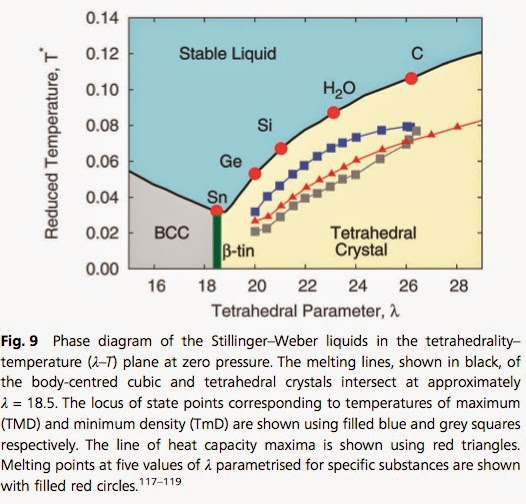
A unified phase diagram for tetrahedral liquids

At the NORDITA water meeting Charusita Chakravarty gave a nice talk that featured the phase diagram below.


The figure is taken from a nice Perspective paper in PhysChemChemPhys.
Water and water-like liquids: relationships between structure, entropy and mobility 
Divya Nayara and Charusita Chakravarty

The article gives a nice overview, putting the anomalous properties of water in a broad context, comparing and contrasting to the properties of other liquids for which tetrahedral interactions are dominant. Possible relations between thermodynamics, transport, and structure are also discussed.

Key anomalous properties of water [compared to simple isotropic liquids] include
-the negative slope of the melting line in the temperature-pressure phase diagram
-the temperature of maximum density [277.15 K at 1 atm]
-increase in diffusion with increasing density
-increase in specific heat, thermal expansion, compressibility upon isobaric supercooling.

Water is actually not as unique as I thought. Other tetrahedral liquids exhibit similar anomalies. Furthermore, it is not the hydrogen bonding (per se) that makes water anomalous, but rather the tetrahedral interactions associated with the hydrogen bonding.

The figure above is based on the Stillinger-Weber model, a coarse-grained model that captures the competition between two-body interactions and three-body (tetrahedral) interactions. The version of the model for water is termed monatomic Water (mW) and is described in this previous post. At the meeting Jibao Lu described recent work which gave an objective scoring of the successes and failures of different mW models and atomistic models.

Thursday, October 2, 2014

We dunno nothin' ...

We don't know anything about .... water, high-Tc superconductors, glasses, photosynthesis, enzymes, protein folding ....
We don't understand them. No one has any idea how they work. We have no theory. They are unsolved problems. No one can agree on anything....

Sometimes I hear strong claims such as this.
I think they are exaggerations. They diminish/ignore/dis-respect significant progress and understanding that has been made. 

Unfortunately, these claims of ignorance are often made by people who claim they are going to solve one of these problems, .... once you give them lots of money.....

Let me take one specific case: cuprate superconductors.
There are many things we know and understand that we did not when they were first discovered.

We have a phenomenological theory for all the "macroscopic" phenomena: Ginzburg-Landau!

Although not everyone agrees I think it is fair to say that the essential physics is in a one-band Hubbard model and the key physics is:
strong electronic correlations,
a doped antiferromagnetic Mott insulator,
d-wave pairing that is "mediated"/caused from some mixture/variant of "antiferromagnetic" spin fluctuations or RVB spin singlets,.....

We certainly don't understand the cuprates at the same level as elemental superconductors. But we do understand some things.

We certainly don't understand water at the same level as liquid argon. But we do understand some things.

This post was partly stimulating by reading Biman Bagchi's response to such a claim about water in his recent book.

There are still outstanding challenges and these topics should attract ongoing attention.

I don't think the topics I listed above are anything like problems such as dark energy, dark matter, quantum gravity, ... or superconductivity before BCS
and then there is consciousness....

Am I over-reacting?

Aside: the title of this post is from this music video. Some think it is hilarious. I find it a bit too close to the truth.

Thursday, August 28, 2014

Hard questions about glasses

A recent book Dynamical heterogeneities in glasses, colloids, and granular media contains a fascinating chapter where four experts [Jorge Kurchan, James Langer, Thomas Witten, and Peter Wolynes] give their answers to the questions below.

I think we need more of these kind of frank discussions about scientific topics. I am slowly working through the answers. The most fascinating bit so far is Peter Wolynes inspiring response to Q9, including "I believe a young physicist who wants to work on any challenging problem in physics will eventually have to learn about glasses."
Q1) In your view, what are the most important aspects of the experimental data on the glass transition that any consistent theory explain? Is dynamical heterogeneity one of these core aspects?  
Q2) Why should we expect anything universal in the behavior of glass-forming liquids? Is the glass-transition problem well defined?  
Q3) In spin-glasses, the existence of a true spin-glass phase transition has been well established by simulations and experiments. Do you believe that a similar result will ever be demonstrated for molecular glasses? 
Q4) Why are there so many different theories of glasses? What kind of decisive experiments do you suggest to perform to rule out at least some of them? 
Q5) Can you briefly explain, and justify, why you believe your pet theory fares better than others? What, deep inside, are you worried about, that could jeopardize your theoretical construction?  
Q6) In the hypothesis that Random First-Order Theory [RFOT] forms a correct skeleton of the theory of glasses, what is missing in the theoretical construction that would convince the community?  
 Q7) Exactly solvable mean-field glass models exhibit an extraordinary complexity requiring impressive mathematical tools to solve them. 
 Q8) In your view, do the recent ideas and experimental developments concerning jamming in granular media and colloids contribute to our understanding of molecular glasses, or are they essentially complementary?  
Q9) If a young physicist asked you whether he or she should work on the glass problem in the next few years, would you encourage him or her and if so, which aspect of the glass problem would you recommend him or her to tackle 
 Q10) In twenty years from now, what concepts, ideas or results obtained on the glass transition in the last twenty years will be remembered?  
Q11) If you met an omniscient God and were allowed one single question on glasses, what would it be?
I thank Peter Wolynes for bringing this to my attention.

Tuesday, August 5, 2014

Stokes-Einstein relation between viscosity and diffusion in liquids

The Stokes-Einstein equation
relates the diffusion constant D of a macroscopic particle of radius r undergoing a Brownian motion to the viscosity eta of the fluid in which it is immersed.
It is a beautiful and simple example of a fluctuation-dissipation relation.

But suppose now we think about one of the individual atoms or molecules in the fluid. It also undergoes Brownian motion and one can define a self-diffusion constant.
It is amazing to me that the Stokes-Einstein relation still holds for a wide range of liquids, temperatures, and pressures with r being of the order of the molecular radius.

The figure and table below are taken from this paper.


Can this relation be derived from microscopic theory?
Zwanzig gave a heuristic justification here.
Rah and Eu gave a derivation from stat. mech. here.

The Stokes-Einstein relation does break down as one approaches the glass temperature in a supercooled liquid, as for example shown here. The origin of that breakdown is controversial, as is many phenomena involving glasses.

Tuesday, July 22, 2014

A key concept in glasses: the entropy crisis

The figure below introduces the idea of an "entropy crisis" and the Kauzmann temperature in glasses. It also leads to profound and controversial questions about the intimate connection between thermodynamics and kinetics in glasses.

Each solid curve shows the temperature dependence of the entropy of a supercooled liquid, relative to that of the crystal, above T_g, the glass transition temperature. T_m is the melting temperature of the crystal. The dashed curves are entropy in the glassy state.
The figure is taken from a very helpful review and adapted from Walter Kauzmann's classic 1948 paper.

What is going on?
The entropy of a liquid is greater than a solid [think latent heat of melting] so Delta S is positive. But, the specific heat capacity of a liquid is also greater than that of a solid [the vibrational, translational, and rotational degrees of freedom are all "softer" and less constrained]. Hence, the slope of Delta S vs. T must be positive.
Now, suppose that the liquid is supercooled so incredibly slowly that the glass does not form and you keep lowering the temperature, then at some temperature Delta S becomes negative. This extrapolated temperature [see the light blue straight line] is known as the Kauzmann temperature.

Why does this matter?
By the third law of thermodynamics, the entropy of the crystal goes to zero as the temperature goes to zero. Thus the supercooled liquid, could have negative entropy, which is physically nonsense.
Formation of the glass prevents this possibility. But, formation of the glass involves kinetics. So is there some deep connection between thermodynamics and kinetics? The review  discusses some possible connections. The extent of that connection is one of the controversial questions in glasses.

Wednesday, July 2, 2014

Key concepts in glasses, I.

In 1995 a group of distinguished scientists were asked by Science magazine about outstanding problems that should receive attention in the following decade. The answers are compiled here, and ironically entitled, "Through a glass lightly". Phil Anderson said:
The deepest and most interesting unsolved problem in solid state theory is probably the theory of the nature of glass and the glass transition. This could be the next breakthrough in the next decade.
Although I know this remains an important problem it has been a bit of a mystery to me. However, my understanding has increased by hearing a couple of nice talks in Telluride by David Reichman. This has been solidified [pun intended!] by reading a very accessible (and short) review Supercooled liquids and the glass transition by Pablo Debenedetti and Frank Stillinger. I think I now have a crude/basic understanding of a few of the key ideas including
  • defining the glass transition temperature
  • strong versus fragile glasses
  • dynamical heterogeneity
  • violations of the Stokes-Einstein relation between viscosity and diffusion constant
  • mode coupling theory
Hopefully, I will post about some of these. First, here is the "Angell plot" that distinguishes strong and fragile glasses. It shows the viscosity [on a logarithmic scale] of a supercooled liquid [i.e. a liquid that has been rapidly cooled to below its melting temperature] vs. Tg/T where T is temperature and Tg is the glass temperature. The latter can actually be defined as the temperature at which the viscosity becomes 10^13 poise. [For comparison the viscosity of water at room temperature and pressure is about  0.01 poise!].
In a normal liquid the temperature dependence of the viscosity is activated [eta ~ exp (A/T) and so this plot should give a straight line. (Arrhenius behaviour).

Angell made this plot in 1995 for a wide range of glasses and found they fell into two distinct categories, that he defined as strong and fragile.

The horizontal scale is from 0 to 1.
Note that the data on the vertical scale covers 15 orders of magnitude!

 The strong glasses have a simple activated form for the temperature dependence of the viscosity. The fragile glasses have an activation energy that increases with decreasing temperature.
It is amazing that such chemically and structurally diverse systems exhibit such universal behaviour.

Saturday, September 7, 2013

Exotica: a blessing or curse to condensed matter physics?

One of the exciting things about condensed matter physics is that we are continually discovering exotic new phenomena. Many are unanticipated and understanding them presents a rich intellectual challenge. That is the nature of emergence.

Due to chemical complexity and the richness of quantum many-body physics it seems the frontier is endless.

Superfluid 3He, heavy fermions, sliding charge density waves, weak localisation, giant magnetoresistance, organic superconductors, quantum Hall effects, quantum point contacts, cuprate superconductors, non-Fermi liquids, buckyball superconductors, Luttinger liquids, colossal magnetoresistance, spin liquids, pseudogap, composite fermions, strontium ruthenate, topological order, quantum dots, sodium cobaltates, solid state quantum computing, fluctuating gauge fields, spinons, topological insulators, iron pnictide superconductors, ultracold atomic gases, quantum criticality, spin-charge separation, anomalous Hall effect, Majorana fermions, ....

Exotica are a blessing. They keep us excited and busy. The field will never die out or get boring.

However, I believe that exotica can also be a curse to the field.
Why?

1. The field can be too driven by fashions.
Every few years a new system is discovered which grabs attention. Lots of people work on it grabbing the "low-lying fruit" before jumping on the next band-wagon. Painstaking long term studies needed for a deep understanding are neglected.
The current fixation with citation metrics accentuates this problem. People want to publish quickly in a field in which lots of other people are working.
Twenty years ago Pantelides made this criticism.

2. Problems that are old, difficult and important get neglected: water, ice, metallic ferromagnetism, glasses, high-Tc superconductors, polarons, correlated two-dimensional electron gases, bad metals, fracture, enhanced thermoelectricity, multi-scale modelling, magnetite, high quality materials synthesis....

3. One can end up focusing on some exotic system or very specific material that is so finely tuned or rare or fragile or difficult to fabricate that it is not representative of any significant class of materials or phenomena.

4. One ends up with exotic theories in desperate search for a experiment, rather than constructing realistic theories that explain the many existing materials or phenomena waiting to be explained.

5. Students can get too narrow a training and perspective on the field.

6. We end up focusing too much on materials and devices that are so exotic and expensive to make that they will never be of any commercial use. This will ultimately diminish funding for the field.

A real challenge and struggle for me is for each new discovery to try and critically assess whether it is going to be important in the long term. I think the community could benefit from more critical reflection and self control.

What do you think?

Thursday, March 26, 2009

Walter Kauzmann (1916 -2009): the master of thermodynamics

Walter Kauzmann was a pioneer in understanding condensed phases of matter. Two of his most important contributions to science (the hydrophobic interaction and a paradox concerning glasses) were made using his profound understanding of thermodynamics. He first introduced the notion of a hydrophobic interaction. Before any structures of proteins were known he deduced solely from thermodynamic data on the solvation of small organic molecules that a protein must fold so that the non-polar amino acids are predominantly in the centre of the protein. I discuss this in a lecture I often give to undergraduates at the University of Queensland in the course PHYS2020: Thermodynamics and Condensed Matter Physics.

Kauzmann wrote a beautiful article, Reminiscences of a life in protein physical chemistry, that I warmly recommend. One point he makes repeatedly in the article is that in science (and life) people will often believe what they want to believe rather than what the evidence before them suggests they should believe. The article recounts some of the "silly" things (from the perspective of our knowledge today) people believed about proteins in the 1950's, and how reluctant the advocates of these theories were to give up on them. Those of us trying to understand complex materials today, and especially biomolecular function, should be sobered and chastened by this lesson from history.

Kauzmann co-authored with David Eisenberg the definitive monograph on water and a beautiful "ancient" text, Quantum Chemistry (1957) which I found extremely helpful as an undergraduate and today.

Bruce Alberts testifies to Kauzmann's personal legacy in this fascinating article where he describes how Kauzmann mentored him. Alberts is currently the Editor in chief of the journal Science, a former past president of the National Academy of Sciences in the USA, and a co-author of the definitive text, The Molecular Biology of the Cell.

More about Kauzmann's life is available here. I was privileged to have some personal interaction with him, while a graduate student (in physics not chemistry) at Princeton, because he was a long-time friend of my late father. However, I did not realize what a great scientist he was and how much I could have learnt from him. Back then I was a some-what narrow-minded physicist who had not developed a fascination with problems at the interface of chemistry and physics. Youth is wasted on the young!

What does this movie tell us about the modern university?

Last night, my wife and I watched the movie, Wit. You can watch the full movie here  (free with ads). I should warn that some of the conten...