Showing posts with label energy research. Show all posts

Monday, June 5, 2017

The challenge of applied research

Last friday we were fortunate to have David Sholl give a physics colloquium at UQ,
``What Does Quantum Mechanics Have To Do With The Chemical Industry? Reflections On A Journey From Pure To Applied Research.''
Here are the slides.

David has a background in theoretical physics and has been particularly successful at using atomistic simulations to study problems that chemical engineers care about. He is co-author of a book, Density Functional Theory: A Practical Introduction
His three main points in the talk were
  • Applied research is worth doing and is intellectually satisfying
  • Applied research relies on fundamental insights 
  • How to waste time and money doing applied research
The piece of science I found most interesting was the figure below which shows how the calculated self-diffusion constant D of small hydrocarbons in a zeolitic imidazolate framework varies with the size of the hydrocarbon molecule.
Note how D varies over 14 orders of magnitude.

Some of the key physics is that this large variation arises because the diffusion constant is essentially determined by the activation energy associated with the transfer of a molecule through the molecular hole between adjacent pores. When the molecular size is comparable to the hole size, D rapidly diminishes because of steric effects.
It would be nice to have "simple" theory of the correlation.

The figure is taken from the paper
Temperature and Loading-Dependent Diffusion of Light Hydrocarbons in ZIF-8 as Predicted Through Fully Flexible Molecular Simulations 
Ross J. Verploegh, Sankar Nair, and David S. Sholl

Friday, June 3, 2016

Functional electronic materials: I usually just don't get it

A hot area of research is that of functional electronic materials. The goal is to find new materials that can be used in new devices, ranging from solar cells to biosensors to catalysts to transistors.

Let me first concede some positive points.

Overall this is an important and exciting area of research which involves some interesting science and significant potential technological benefits.

There are some excellent people working in this challenging field and doing careful and valuable work.

History shows that going from a university lab to mass produced technology can take a long time. Who would have ever thought you could go from the first transistor to computer chips? Or from the first giant magnetoresistance materials to current computer memories?

Good science is hard.

However, I wonder if I am the only one who is underwhelmed by the average work in this field.

In a "typical" experiment someone might do something like the following. They get some large complicated organic molecules and they somehow get it to stick on the surface of some highly exotic material. The experiment is often done under extreme conditions such as low temperatures or ultrahigh vacuum. They then probe the system with some highly specialised probe such as STM (scanning tunnelling microscope) or a femtosecond laser. Maybe they make an actual device such as a photovoltaic cell. It may have terrible performance characteristics. They then produce some pretty coloured graphs. They might do some DFT (density functional theory) based calculations to produce some more pretty coloured graphs. The results are published in a baby Nature and claims are made about the technological promise. The authors then move on to a new system for their next paper...

First, the exotic factor worries me.

Is there any realistic hope of an economically competitive technology coming out of this, even on the time scale of 20-30 years?

The lack of reproducibility and control, the extreme conditions, the highly specialised and expensive materials raise concerns.
For solid state devices and solar cells it is going to be so hard to beat the well developed technologies, fabrication and cheap materials associated with silicon based devices.
We should certainly be trying but there is big difference between realistic optimism and scientific fantasy. This is my view on quantum computing with Majorana fermions.
For photovoltaics there has been a rigorous cost analysis of different competing materials, highlighting challenges of competing with plain old silicon. Note, those materials are nothing like the exotic ones I see in many studies.

Second, the lack of control and reproducibility worries me.
This relates more to the science than the technology.
There is great value in studying in detail some exotic material under extreme conditions if one can control the different variables in order to gain a good understanding of the fundamental science involved, e.g. of photo induced charge transfer between an organic molecule and a substrate. However, very rarely do I see this happening in these studies. There is just a bunch of data and some hand waving about what is going on....

I think all of this is compounded by the luxury journals and the pressures on people to justify funding and to claim dramatic economic benefits for their research.

But, to me much of what is going on isn't science and it isn't technology.

So, am I too harsh? too pessimistic? what do you think?

Wednesday, February 24, 2016

What are the best interdisciplinary courses for undergraduate science majors?

Previously I posted about how science has changed [it is much more interdisciplinary and computational] and undergraduate science education really needs to catch up. I endorsed a great course on Physical models of living systems that Phil Nelson teaches and has just published a text for. [He kindly sent me a complimentary copy recently.].

In the recent UQ review of the B.Sc. there was some discussion of whether there should be more interdisciplinary courses offered and even whether one or two might be compulsory.
That got me thinking about what the best courses would be.

Energy and the Environment
David  MacKay at Cambridge has a book Sustainable energy: without the hot air

Advanced instrumentation and precision measurement
NMR, x-ray crystallography, laser spectroscopy, mass spectrometry, microscopy, ...
This should not just introduce these methods as "black boxes" but also describe the underlying science and let students have hands on experience.

Chemical biophysics or Biophysical chemistry
Either of Phil Nelson's two texts are idea models. On the other hand, they involve purely classical physics. One needs to also look at some quantum mechanics that relates to spectroscopy.

Computational biomolecular simulation and materials science
Again hands on experience is essential. But, a "black box" mentality must be avoided.

Materials science and engineering
There is a classic text by Callister, but a colleague tells me it is to much from the perspective of a metallurgist.

Here I think it needs to be continually emphasised that there is no point offering such courses if they are not rigorous and coherent. They need to be "owned" by just a few faculty. Courses will multiple guest lecturers from multiple departments quickly degenerate into a "dogs breakfast" and political nightmares. A single text is highly desirable.

What do you think?
What courses would you suggest?
What are suitable texts?

Monday, February 15, 2016

A career transition from theoretical physics to public policy

Robert Socolow has an interesting career history. He started out in elementary particle theory, with a Ph.D at Harvard, a postdoc at Berkeley and was an Assistant Professor at Yale. He then made a transition to environmental and energy policy, joining the faculty in Mechanical and Aerospace Engineering at Princeton in 1971. There is an interesting letter he wrote to Steve Fels in 1969 that describes his transition in research interests.

Two years ago Socolow gave a Homage to Frank von Hippel, a physicist who made a similar transition, focusing on nuclear policy and arms control. It is worth reading. Here are some comments Socolow made about physics.
Physics is a special way of knowing, within science. Physics stresses simplification – incredibly useful when other fields place a much lower value on simplification. The physics approach shines a light on other sciences, provides accessibility for outsiders (the intelligent layman).  
Although our cohort stopped working at the frontier of physics, arguably we didn’t leave physics but rather we enlarged the scope of physics. APS has remained our institutional home. A whole cohort of us moved from frontier physics into fields that did not exist beforehand -- fields that did not construct entry points until a long time afterwards. In the 1970s our cohort had a role in creating APS institutions like the Panel on Public Affairs (POPA), the Forum on Physics and Society, and the APS Fellows Program. Frank and I were two of the first six APS Fellows whose route to Fellow was via the Forum on Physics and Society. 
Less than a week ago I was at Harvard for a reunion of all those who received Ph.D.’s in Physics from Harvard, as well as faculty from all periods and current graduate students. There were two morning panels on alternative careers for physicists, featuring alumni now doing different things. Sadly, in my view, nearly all of the panelists had moved from physics to finance. I invited myself onto one panel, and Dan Kammen was on the other one. We reminded the audience that critically important problems were out there which physicists could contribute to. Our message seemed not especially welcome.
I do think physicists have a lot to contribute. Socolow and von Hippel are great role models. However, I also think we have to be careful about "physics hubris", most commonly manifested in two related directions. The first is being naive about how complex problems are. Second, being arrogant and thinking that we are smarter than others who have already spent a lot of time working on these problems. Previously, I wrote about How (not) to break into a new field.

Wednesday, February 10, 2016

Is this the ultimate compliment for your paper?

For someone to put the main points to a popular song!

Yesterday I heard an interesting talk "Truths we must tell ourselves if we are to manage climate change" at UQ by Robert Socolow [aged 80!].

He is well known for a paper, Stabilization Wedges: Solving the Climate Problem for the Next 50 Years with Current Technologies

The paper considers Seven ways to reduce carbon emissions. Glenn Wolkenfeld has written corresponding lyrics to the tune of the classic Paul Simon song, 50 ways to leave your lover!


Socolow has an interesting career history, having started out in theoretical physics, working on elementary particles. I will write more about that career transition later.

Tuesday, December 22, 2015

Will burning lots of coal lift people out of poverty?

A few months ago I attended a symposium at UQ on Energy in India. The talks can be viewed on Youtube. The one by Alexie Seller is particularly inspiring.

In the presentation of Chris Greig he showed a slide similar to that below with the title "Electricity affects Human well being".

He did not say it, but sometimes graphs like this are used to make claims such as "the more electricity people consume the better off they will be..."  or "the only way to lift people out of poverty is to burn more coal..."


Sometimes people show graphs that correlate GDP with energy consumption. But this one is better because it uses the Human Development Index, a multi-dimensional measure of human well being (as it includes life expectancy and education).

Two things are very striking about the graph.
First, the initial slope is very large. Second, the graph levels off quickly.
A little bit of electricity makes a huge difference. If you don't have electric lighting or minimal electricity to run hospitals, schools, basic communications, water pumps and treatment plants, ... then life is going to be difficult.
However, once you get to about 2000 kW hours per person per year, all the extra electricity beyond that makes little difference to basic human well being. This is frivolous use of air conditioners, aluminium smelters, conspicuous consumption, ...

Finally, we always need to distinguish correlation and causality. As people become more prosperous they do tend to consume more electricity. However, it is not necessarily the electricity consumption that is making them more prosperous. This is clearly seen by how flat the top of the curve is. Electricity consumption in Canada is almost four times that of Spain!

A more detailed discussion of the graph is in this book chapter by Vaclav Smil.

Monday, November 30, 2015

A student's questions about scientists responding to climate change

A first year undergraduate student who is deeply concerned about climate change asked me a number of questions by email and then came to my office to discuss them. Since I think they are excellent questions I thought I would post them here (with his permission) and give a brief version of my answers. I welcome readers to give their own answers.
I am interested in and passionate about climate change. At the moment, I'm considering my uni options - wondering what I can study to best equip me to help in the great, global effort to mitigate (I'm a bit less interested in adaptation) climate change. I have a couple of questions to ask of you.
1. How would you respond to each of the following, somewhat contradictory statements: 
- 'Climate change can be mitigated by developing and deploying renewable energy and energy efficiency technologies, without significantly impacting on our standard of living.' 
- 'Environmental crises, including climate change, require us to move away from a social and economic system based on consumerism and growth' .
First, I am no expert on this complex issue. An economist at UQ who is an expert is John Quiggin. But, my view is that with energy efficiency measures, renewable energy, and some modest lifestyle changes significant progress can be made towards mitigating climate change. On the other hand, I think there are compelling social  and political reasons why the world, particularly the Western world, would be better off if we moved away from this mindless and insatiable pursuit of consumerism and economic growth.

But, I really think the biggest obstacle to concerted and significant global action is a lack of political will and leadership. This is particularly driven by "fear mongering" from vested business and political interests who claim the first option is true. "If we don't burn more coal we will all end up back in the caves or at least riding bicycles..."
I don't think the biggest obstacle is missing technical and economic solutions. Of course, if someone can make a durable and reliable photovoltaic cell with 20 per cent efficiency, that costs 20 cents per square metre to manufacture, and with a lifetime of 20 years, it would "solve" the problem. But, I only foresee incremental advances in the next decade. The case of Gratzel cells is quite discouraging.
2. If the institutional ethos of the UQ science faculty were a person, how would he/she respond to the above statements? 
I think you would really encounter a range of views, probably reflecting a rang of political convictions. I would hope most staff would believe that climate change is real, a result of human activity, and a major issue to address. On the other hand, I am occasionally surprised and disappointed to meet scientists, who are skeptics, even though 97 per cent of climate scientists are not.

I think you would find that some would also claim we need lots more research money (especially for new technologies) to address these issues, but they are clouded by self interest.
3. What facets of science would you recommend that I study:  
- Earth science (better understanding of the climate system)
- Physics/Engineering (renewable energy technology) 
- Psychology (Why do people behave the way they do) 
- Ecology (how ecosystems respond to climate change and other pressures)
Given that I think the major obstacles are political I think that becoming a political activist you may have the biggest impact. Studying sociology and psychology may help design the most effective campaigns. But you do need to understand the technical issues.
On the other hand, you should consider what you are good at and enjoy. There is no point trying to put square pegs in round holes.
Hence, I think you should let your own interests and abilities be a consideration. But studying a mix of the above could be very helpful.
I am wondering if UQ has plans to develop a specific course, or even a program, devoted to climate change?
Not that I am aware of. There are significant postgraduate activities at The Global Change Institute and the Energy Initiative. There was recently a review of the Bachelor of Science. The possibility of some elective courses that are multi-disciplinary has been floated and climate change is one. However, my experience is that such courses become a can of worms once you get multiple departments involved. Everyone wants a piece of the pie, to do it their way, but are not willing to take responsibility, or to "force" their own students to take the course so it is viable. Hence, I doubt you will see the kind of course you are hoping for during your time here. Sorry.

We ended our discussion with me lending the student a copy of The Eye of the Storm: the autobiography of Sir John Houghton. He is nice example of someone who moved from basic research in climate science to public policy and advocacy.

I wish I had more discussions like this with students.

I welcome people to give their own answers.

Monday, August 10, 2015

Climate change action at the grass roots

When I was recently visiting my mother-in-law in Anacortes, Washington she took my wife and I to a meeting of the local chapter of Transition, an international grass roots movement responding to climate change.
First, an employee of a local not-for-profit Sustainable Connections spoke briefly about home energy efficiency audits that they organise.
Then there was an interesting talk from a local climate change researcher, Roger Fuller, that focussed on the potential impact of climate change on surrounding Skagit County. It is somewhat unique because much the water flowing through the county comes from glacial snow melt in the nearby Cascade mountains. Increased temperatures will mean a greater rain/snow ratio, and greater river flow in the winter and less in the spring. This could have significant effects on the frequency of extreme flooding events.

I think these local initiatives are particularly important beyond the immediate concrete [but modest] energy savings and reduced CO2 emissions that they produce. Such initiatives provide models for wider more ambitious programs and show politicians and policy makers that some people are concerned about climate change and willing to make life style changes.

Besides the significant benefit of addressing climate change this initiative has the other benefit of building community in the face of rapidly declining social capital.

I also picked up a copy of the excellent free booklet Climate Change: Evidence, Impacts, and Choices, produced by the National Research Council for the general public.

Anacortes is one of 50 communities [with a population between 5,000 and 250,000] in the USA that are competing for the $5 million Georgetown University Energy Prize. Each community tries to cut its energy consumption by as much as possible in 2015.

Tuesday, August 4, 2015

Searching for conical intersections for singlet fission

Previously I have posted about the fascinating challenge of understanding singlet fission [and the inverse process of triplet-triplet annihilation] in large organic molecules.  A key feature to understand is how fission can occur in less than 100 femtoseconds, suggestive of a conical intersection between excited state potential energy surfaces.

In Telluride Nandini Ananth gave a nice talk about work described in the paper

The Low-Lying Electronic States of Pentacene and Their Roles in Singlet Fission 
Tao Zeng,  Roald Hoffmann , and Nandini Ananth

Diabatic states provide a natural and powerful approach to understanding what is going on.
The authors perform high level quantum chemistry calculations to describe the relevant electronic excited states. They claim that for a pair of pentacene molecules one needs to include at least six diabatic states. Their dominant electronic configuration is shown in the schematic below.
We find that only one of the two charge-transfer states, ac, is engaged in the SF [singlet fission] in pentacene; it is the low-lying charge-transfer state that gets closer to the multi- and single-exciton states. Moreover, the ac diabat can move into degeneracy with the single-exciton states, more effectively mediating the mixing of the bright single- to and dark multiexciton diabats. This finding is different from the basic assumption of high-lying charge-transfer states in the superexchange model, emphasizing the need to adapt the general SF model to specific cases.
Aside: I wonder if this is one the few papers that Hoffmann has co-authored where strong electron correlations are central.

In more recent work, the authors have tried to pin down what is the relevant nuclear co-ordinate [vibrational mode] associated with a conical intersection. It is not the intermolecular separation but may be instead the relative orientation [twisting] of the two penatacene molecules. This has included some constructive interaction with the experimental group of Luis Campos.

Wednesday, July 29, 2015

Coupled electron-proton transfer: adiabatic or non-adiabatic?

Sharon Hammes-Schiffer gave an interesting talk in Telluride last week about coupled electron-proton transfer.
[A couple of my earlier posts on this fascinating subject are here and here].

Here are a few things that stood out.

There are a lot more people working on this problem now than twenty years ago. This is because of possible solar energy applications.

Diabatic states are the key to understanding. There are four relevant states. Simply the proton can be on the donor or acceptor. The electron can be on the donor or the acceptor. Whether the process is concerted or sequential depends on the relative energy of these four states.

A key question is whether the process is adiabatic or non-adiabatic.
What are the key experimental signatures of each?
One contrast is coupled electron-proton transfer (EPT) and hydrogen atom transfer (HAT).

The two cases are nicely embodied respectively in the model systems
HAT - benzyl/toluene
EPT - phenoxly/phenol
The theoretical details are worked out here.

In some enzymes such as soybean lipoxygenase (SLO) there are very large kinetic isotope effects (~80) for proton transfer, orders of magnitude larger than expected. Many people, including me, have struggled to understand this in terms of proton tunnelling in an adiabatic picture with coupling to an environment. 
However, the relevant reactions are actually coupled electron-proton transfer, in the non-adiabatic regime. The key equation to understand both the magnitude and temperature dependence of the isotope effect is

taken from this paper.

A recent paper compares the theory to a mutant of SLO in which the isotope effect becomes ~500 as a result of the increase in the proton donor-acceptor distance R.

One minor point on how this relates to my talk. I said that quantum nuclear effects [and H/D isotope] effects were largest [and very subtle] in hydrogen bonding for donor-acceptor distances of R= 2.4-2.5 Angstroms. In contrast, here the isotope effects actually get larger with increasing R, with R=2.7 A for the wild-type SLO and increasing to 2.8-2.9 A with the selected mutations. I thank Sharon for pointing out this difference to me.

Saturday, March 14, 2015

The peaceful atom is a bomb

Previously, I wrote about my concern that little attention and publicity is given these days to issues of nuclear security and proliferation. Hence, it was good to see the cover (and a lead editorial) of The Economist this past week.

On related matters there is an interesting article [and cover story] in the February Physics Today, Pakistan’s nuclear Taj Mahal  by Stuart W. Leslie
Inspired by the promise of Atoms for Peace, the Pakistan Institute of Nuclear Science and Technology eventually succumbed to the demands of the country’s nuclear weapons program. 
One thing I learnt was the central role that Abdus Salam played. I found the following rather disturbing.
Salam, though still the director of the ICTP, organized the theoretical-physics group that performed the sophisticated calculations for the bomb, and he personally asked his former student and protégé Riazuddin to head it. Riazuddin, then teaching at the University of Islamabad (now Quaid-i-Azam University), took several trips to the US, where he collected unclassified documents on nuclear weapons design. ....  Salam left the details to others, though he did open the ICTP library to Riazuddin’s group and kept in close touch with its members. Riazuddin, describing his research team, later acknowledged, “We were the designers of the bomb.... ” 
A thoughtful and careful analysis of the implications of India and Pakistan obtaining nuclear weapons was given in 2000 by Amartya Sen.

Thursday, January 29, 2015

The cheapest and cleanest energy source is efficiency

The Economist has a good editorial
Seize the day
The fall in the price of oil and gas provides a once-in-a-generation opportunity to fix bad energy policies

Governments need to do two main things.
First, cut fuel subsidies. This is particularly important in the Majority world, as this favours the wealthy, who can afford to drive cars. Indonesia has just done this and used the saves to fund education and welfare.
Second, cut subsidies that encourage oil and gas exploration and production, rather than renewables.

There is also a 10 page special report
Let there be light 
Thanks to better technology and improved efficiency, energy is becoming cleaner and more plentiful

The two most striking graphs are those below.


Tuesday, December 30, 2014

Nuclear power is irrelevant to Australia

My UQ economics colleague John Quiggin has an excellent article, Tell 'em there dreaming. He argues convincingly that nuclear power is irrelevant to reducing carbon emissions in Australia. The argument is purely pragmatic. We currently have no commercial nuclear power plants, no nuclear industry, and no legislative or regulative framework. Even in the most optimistic scenario [including the highly unlikely prospect of a groundswell of popular and political support for an ambitious nuclear program] it would be around 2040 before any actual electricity would come onto the grid. That is too late.

Aside: the title of the article is an allusion to a famous line in a cult classic Australian movie, The Castle. If Americans want to really appreciate that Australia is a very different culture they should watch this movie with a group of Australians. The Aussies will be dying with laughter and the Americans will be wondering what is so funny.

Friday, April 4, 2014

The grand challenge of wood stoves and the rural poor

Today I went to a very interesting talk, presented by the UQ Energy Initiative, by Gautam Yadama.
He described the "Wicked problem" of the use of wood stoves by the rural poor in the Majority world.

This causes a multitude of problems including deforestation, climate change, household pollution, disability due to respiratory problems,…. Yet solutions are elusive, particularly because of poverty, cultural obstacles, gender inequality, technical problems, …. In particular, previous "top down" "solutions" such as the wide scale free distribution of 35 million gas stoves by the Indian government in the 70s and 80s [largely funded by the World Bank] have been complete failures. He described his multi-disciplinary research involving social scientists, engineers, and medical experts. Yadama emphasized the importance of community involvement and programs that are "evidence based" using randomised trials [similar to those featured in Poor Economics].

Yadama has just published a "coffee table" book Fires, Fuel, and the Fate of 3 Billion that describes the  problem and features striking photos that capture some of the human dimension to the problem.

Tuesday, April 1, 2014

The challenge of colossal thermoelectric power in FeSb2

There is an interesting paper
Highly dispersive electron relaxation and colossal thermoelectricity in the correlated semiconductor FeSb2
Peijie Sun, Wenhu Xu, Jan M. Tomczak, Gabriel Kotliar, Martin Søndergaard, Bo B. Iversen, and Frank Steglich.

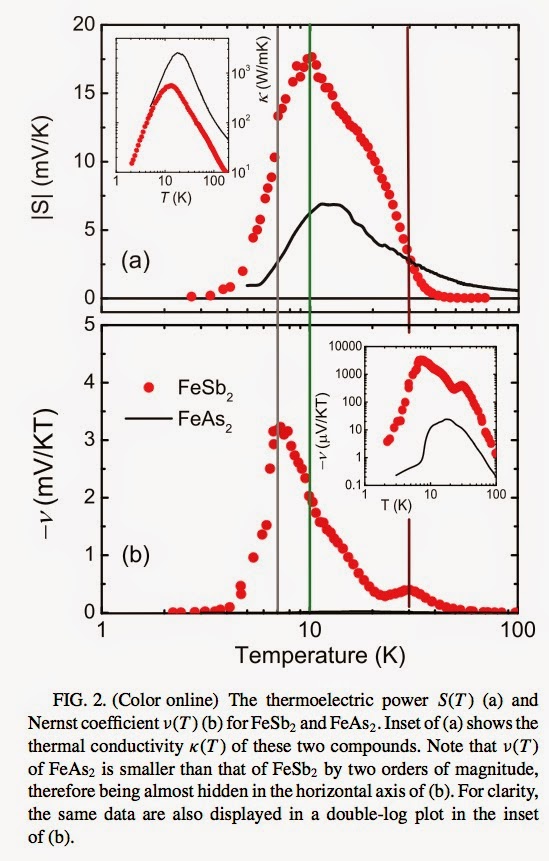
The main results that are a struggle to explain are in the figure below.
The top panel shows the temperature dependence of the thermopower [Seebeck coefficient] of FeSb2 [red] and the isoelectronic FeAs2.
First, notice the vertical scale is tens of mV/K. In an elemental metal the thermopower is less than a microV/K. In a strongly correlated metal it can be tens of microV/K. [see for example this earlier post].
Why is it so large? Why is the Sb compound so much larger than the As compound?
In a simple model of a band semiconductor S ~ k_B/e * gap/k_B T. But here the Sb compound has the smaller gap.
Also, why is there a maximum in the temperature dependence, S(T) going to zero with decreasing temperature.


In an attempt to elucidate these subtle issues the authors have also measured the Nernst effect and the magnetoresistance. The Nernst signal is also colossal, being of the other of mV/KT for FeSb2, which is two orders of magnitude large than that for FeAs2.

The authors also consider a simple analytical model of a semiconductor with an energy dependent scattering rate to see what properties that can explain: some but not all. A strongly energy dependent scattering rate is also needed; this can occur in the case of Kondo physics, for example.
They also find some interesting relations between Seebeck, Nernst, Hall mobility, magnetoresistance, and the thermal mobility.

It is helpful to read the paper in conduction with an experimental review and this earlier theory paper,
Thermopower of correlated semiconductors: Application to FeAs2 and FeSb2
Jan M. Tomczak, K. Haule, T. Miyake, A. Georges, and G. Kotliar

To further complicate all of the above it seems that the results can be quite sample dependent, and the results varying significantly, even by orders of magnitude between different groups. One clue is that it seems that FeSb2 is very close to a metal-insulator transition, seen in some samples but not others…

Much remains to be done...

Wednesday, March 12, 2014

Can strongly correlated electrons save the planet? III

Last week lithium batteries kept coming up.

Chandra Varma wrote a cursory piece Mott Physics, Mixed Valence, Oxygen Valence, in Lithium ion batteries at the Journal Club for the Condensed Matter Physics. He pointed out that these batteries use some materials involving cobaltate [CoO2] layers similar to those in superconducting sodium cobaltate. Furthermore, insights are being gained from ARPES.

But, I struggled to see the way forward for any significant involvement of quantum many-body theorists. The most useful connection was the figure below in the article that Chandra reviews.


I would think that LDA+DMFT calculations would be ideal for addressing whether these cartoon pictures are correct. One question will be the role of Hund's rule coupling.

The Economist had an article about Tesla motors which makes electric cars and is really trying to develop the lithium battery technology further. The company stock capitalisation is now half that of General Motors! But GM sells as many cars in one day as Tesla sells in six months!
Tesla CEO, Elon Musk has a physics background [he dropped out of an applied physics Ph.D at Stanford] and there is an interesting interview with him in APS News.

Friday, February 7, 2014

Quantifying many-body effects in organic photovoltaics

Most papers about organic photovoltaics are full of discussion about HOMO's and LUMO's, their relative energies and spatial extents.  
In the early days of this blog, I asked Am I HOMO- and LUMO-phobic?

Molecular orbitals are beautiful intuitive concepts that are extremely valuable for qualitative understanding. However, they do not exist, i.e., there is no way to measure one, even in principle.
Furthermore, for typical organic molecules used in organic photonics and electronics the one-electron energies associated with these orbitals usually do not give reliable estimates of physically observable energies [associated with true many-body states] such as the ionisation energy, electron affinity, optical energy gap....

I was pleased to see that the above issues are nicely explained and quantified in a recent paper

Reassessing the use of one-electron energetics in the design and characterization of organic photovoltaics
Brett M. Savoie, Nicholas E. Jackson, Tobin J. Marks, and Mark A. Ratner
We present results showing that common approximations employed in the design and characterization of organic photovoltaic (OPV) materials can lead to significant errors in widely adopted design rules. First, we assess the validity of the common practice of using HOMO and LUMO energies in place of formal redox potentials to characterize organic semiconductors. We trace the formal justification for this practice and survey its limits in a way that should be useful for those entering the field. We find that while the HOMO and LUMO energies represent useful descriptive approximations, they are too quantitatively inaccurate for predictive material design. Second, we show that the excitonic nature of common organic semiconductors makes it paramount to distinguish between the optical and electronic bandgaps for materials design. Our analysis shows that the usefulness of the “LUMO–LUMO Offset” as a design parameter for exciton dissociation is directly tied to the accuracy of the one-electron approximation. In particular, our results suggest that the use of the “LUMO–LUMO Offset” as a measure of the driving force for exciton dissociation leads to a systematic overestimation that should be cautiously avoided.
Some of these issues were also highlighted in earlier work, led by my UQ colleague Ben Powell, but not referenced.

Monday, October 7, 2013

Tutorial on effective Hamiltonians for quantum dynamics in functional molecular materials

Today I am giving a seminar in the Theoretical Physics Department of the Stefan Institute. The abstract is below. The slides are here. The most important equation [the general form of the Hamiltonian] is missing (!) because I will write it on the white board and discuss at length. It is included below.

This informal tutorial will introduce some of the key concepts and approaches associated with modelling and understanding quantum dynamical processes in complex molecular materials.
This will provide background and motivation for understanding some of my work [1-4].

1. Examples of functional materials: optically active biomolecules, organic light emitting diodes and solar cells, enzymes, …
2. Examples of dynamical processes: charge separation, proton transfer, exciton transport, …
3. Partition: discrete quantum system + environment (solvent or protein)
4. Form of Model Hamiltonians
5. Diabatic states and potential energy surfaces
6. Example: spin boson model
7. Outstanding questions: quantum coherence, sequential vs. concerted, breakdown of Born-Oppenheimer, ...

[1] J. Gilmore and R.H. McKenzie, J. Phys. Chem. A 112, 2162 (2008).
[2] J. Bothma, J. Gilmore, and R.H. McKenzie, New. J. Phys. 12, 055002 (2010).
[3] S.C. Olsen and R.H. McKenzie, J. Chem. Phys. 130, 184302 (2009).
[4] R.H. McKenzie, Chem. Phys. Lett. 535, 196 (2012).

Tuesday, July 9, 2013

Elucidating singlet fission

Singlet fission is the process where a excited spin singlet state of an organic molecular complex can decay into two spin triplet states on spatially separated molecules. This process has received considerable attention recently because of the possibility of using it to increase the efficiency of organic photovoltaic cells. Several previous posts considered some of the fascinating science involved, including the reverse process of triplet-triplet annihilation.

There are a beautiful series of papers by Timothy Berkelbach, Mark Hybertsen, and David Reichman

Microscopic theory of singlet exciton fission. I. General formulation

Microscopic theory of singlet exciton fission. II. Application to pentacene dimers and the role of super exchange


To me these papers provide a quality benchmark for theoretical work in the field and highlight the limitations and confusion of some of the previous work on the subject.
Why do I like the papers? The authors
  • use diabatic states as a starting point. This connects to chemical intuition about the mixed character of the excited states  (see the Figure above). 
  • combine quantum chemistry calculations with effective Hamiltonians.
  • highlight the importance of the environment in determining the excited state dynamics.
  • acknowledge the limitations of quantum chemical calculations for providing accurate parameters for effective Hamiltonians and the excited states. This leads them to consider how the efficiency of singlet fission can vary significantly with the excited state energies and the extent of their charge transfer character (see the Figure below).
  • show how the effect of the environment can be treated reasonably reliably in an [relatively low cost] approximation schemes [e.g., Redfield and Polaronic Quantum Master Equation=PQME].
  • answer an important question. The singlet fission does occur via an "intermediate" charge transfer state, even when that state is at high energy.
Hopefully this approach will be applied to other important processes of relevance to organic photovoltaic cells, including charge separation in bulk heterojunction cells and in the Gratzel cell.

Seogjoo Jang, Timothy Berkelbach, and David Reichman have a preprint where they have applied the PQME formalism to a donor--bridge-acceptor system.

An outstanding challenge remains to understand how the coherent triplet pair decoheres into uncorrelated triplet states on the two molecules.

Monday, June 17, 2013

Quantum diesel engines?

Seth Olsen brought to my attention an interesting paper Quantum tunneling affects engine performance.

The authors consider a specific chemical reaction that occurs in diesel engines. The rate of this hydrogen abstraction reaction, shown below, is modified by quantum tunneling below the energy barrier associated with the transition state.


This reaction is one of hundreds happening in an engine but it turns out the ignition time of the diesel engine is quite sensitive to the rate at which this specific reaction occurs. The authors estimate the ignition time could vary by up to ten per cent due to tunneling.

I don't know anything about diesel engines.
But I do see a little bit of a falsification problem with the papers claim. The reaction rate also varies with small changes in the barrier height [see Table 1]. The latter is difficult to calculate accurately. One way to separate out the effect of tunneling is to do an isotope substitution. Deuterium will have less tunneling than hydrogen. But, it also has a different barrier due to the zero point correction. Similar issues come up in trying to establish the contribution of tunneling to proton transfer reactions in enzymes.

Lecture on Debye model for solids

 I just finished preparing my undergraduate lecture on the Debye model for solids. Here are my slides . The course is a third-year course on...