Showing posts with label proteins. Show all posts

Tuesday, June 30, 2026

Biological evolution and emergence

 The theory of evolution explains the origin of biological diversity and levels of similarity between species. A characteristic of emergence is that many iterations of a simple law (natural selection of the fittest to reproduce) can produce novel, diverse and rich structures. In biological evolution many generations in a population can produce new traits and species. 

Many of the most debated issues about evolution relate to the different characteristics of emergence and are briefly discussed below.

Scales

Central to emergence are the ideas of “many” and of scales. The former can take two forms: a system composed of many interacting components, or a system that undergoes many iterations according to a rule that is repeated many times. For evolution, both forms of “many” are relevant and have several dimensions. Evolution occurs in a population, i.e., a community of many members of a species living in a specific environment. Each member of the population has a specific genotype (many genes), which largely determines biological characteristics, from proteins to organs, defined as the phenotype. The environment also consists of many interacting species. Natural selection can act at multiple levels: on genes, cells, organisms, species, and groups of species.

Microscopic and macroscopic scales can also manifest in different ways. In terms of length, the micro- and macro- scales can be defined in terms of genotypes and phenotypes, respectively. In terms of time, microevolution and macroevolution roughly correspond to directly observable timescales and geological timescales, respectively. They are associated with the emergence of new traits within a species and new species, respectively.

Novelty

Development of new traits and species occurs over many generations, due to the repetition of the rule of natural selection.

Evolution theory uses concepts such as natural selection, survival of the fittest, niches, and hierarchical trees, that are not present in chemistry and physics. 

Connecting micro- and macro- properties

As for other systems, this is one of the great challenges of emergence. Genotypes and phenotypes are extremely well characterised. Genotype-phenotype maps seek to connect these micro- and macro- levels. A detailed understanding of how microevolution leads to macroevolution is a challenge.

Discontinuities

In microevolution, new traits occur within a species due to (continuous) adaptation to the environment. In contrast, in macroevolution, new organs and species can occur suddenly (at least on geological timescales). An example is the Cambrian explosion of new life forms. Extinctions can also represent discontinuities.

Evolution of a population occurs in response to changes in an environment. New traits, new species, and extinctions can be viewed as qualitative changes due to quantitative changes. For example, small changes in the oxygen concentration in the atmosphere is one (among many) hypotheses for the cause of the Cambrian explosion.

Using techniques from statistical physics, the transition of a species from survival to extinction can be viewed as a non-equilibrium phase transition to an absorbing state. The order parameter is the population and a toy model is directed population.1

Diversity with limitations

All species are based on the same biochemistry of DNA and proteins. Yet from these same building blocks there is an incredible diversity: more than 8 million distinct species, including more than 10,000 species of birds and more than 15,000 species of ants. Darwin said nature produces “endless forms most beautiful.”

But there are limitations. For example, the number of species with more than one head, brain, heart, or liver is limited. There are many more genotypes than phenotypes. 

The dominant view is that evolution is driven by random genetic mutations. Debates have arisen about how much evolution is limited (constrained) by morphology and environment.

Ball stated: (p. 332)

“convergent evolution is often regarded as a sign that certain shapes or structures are ideal adaptations to particular environments for physical reasons: wings consisting of flat, thin membranes are best for flying, torpedo-shaped bodies a streamlined for efficient swimming, and so on… There is a tendency in evolutionary biology to regard natural selection as a process with an infinite palette: anything is possible so long as it doesn't break the laws of physics. But the laws of physics might impose more constraint than that, precisely because biology uses rather than merely suffers them.”

Universality

Not all mutations produce a change in phenotype. There are neutral mutations. There are many more genotypes than phenotypes. In other words, genotype-phenotype maps are many-to-one.

Species that are unrelated or distantly related (in the tree of life) sometimes have traits or behaviours that are similar. Convergent evolution is the hypothesis that natural selection produced the same outcome in a different context. 

Modularity at the mesoscale

The economist Simon pointed out that evolution can occur on much faster time scales than might be expected because of modularity. According to Clune et al.

“A long-standing, open question in biology is how populations are capable of rapidly adapting to novel environments, a trait called evolvability [1]. A major contributor to evolvability is the fact that many biological entities are modular, especially the many biological processes and structures that can be modelled as networks, such as metabolic pathways, gene regulation, protein interactions and animal brains [1–7].”

Ball highlighted how domains in proteins provide functional modules that evolution uses: (pp. 174-5)

“the evolution of metazoan proteins is not so much a slow affair of letting random genetic mutations change one amino acid for another and seeing what effect it produces. Rather, it constitutes a reshuffling of already functional modules to produce multidomain molecules with new potential - a strategy much more likely to yield successful results…  the “unit” of molecular evolution here is not really the base pair of DNA or the amino acid or protein, or the gene itself, by the peers at a scale intermediate between the two: the module of a domain. It seems that this shuffling, rather than the slow mutation of primary base sequences, is what has driven the evolution of animals.”

Johnston et al. considered an algorithmic picture of evolution that 

“suggests that symmetric structures preferentially arise not just due to natural selection but also because they require less specific information to encode and are therefore much more likely to appear as phenotypic variation through random mutations… many genotype–phenotype maps are exponentially biased toward phenotypes with low descriptional complexity. A preference for symmetry is a special case of this bias… Lower descriptional complexity also correlates with higher mutational robustness, which may aid the evolution of complex modular assemblies of multiple components.”

Self-organisation

Complex biological structures, from proteins to organisms, have formed spontaneously due to evolution over millions of years. Their intricacy and functionality have led to claims of purpose and design. However, this is argued to be an “apparent” design, just like an economy whose self-organisation appears “as if” it is guided by an “invisible hand.”

Kauffman claimed that self-organisation is as important as natural selection in driving evolution.

Unpredictability

A contested question about evolution is the role of contingency (historical accidents) and whether the evolution of complex life forms, particularly humans, was an accident of history or inevitable.

Irreducibility

Until recently, evolutionary biology has been dominated by a reductionist gene-centric view, popularised by Dawkins. However, recent discussions about systems biology, evo-devo, and epigenetics have questioned this view. Some characterise these alternative views as a form of structuralism.

Complexity

An algorithmic picture of evolution suggests that simplicity spontaneously emerges as many genotype-phenotype maps may be biased towards phenotypes with low descriptional complexity. 

Toy models

An earlier post discussed the key role that toy models, such as “bean bag” genetics, have played in evolutionary theory.

Cross-fertilisation of fields

Ideas from evolution have stimulated the development of genetic algorithms in computer science.

Drossel has reviewed connections between evolution and statistical physics, including a wide range of toy models. Examples include spin glass models that give rise to rugged landscapes for fitness and can describe hierarchical structures, comparable to Darwin’s tree of life. Goldenfeld and Woese argued that evolution can be viewed as a collective phenomenon far from equilibrium. The toy model central to their discussion is directed percolation.

I welcome comments. My knowledge of biology is limited, and scientifically some the ideas above can be contentious. (Never mind philosophy, politics, or theology!)

Tuesday, February 24, 2026

Information theoretic measures for emergence and causality

The relationship between emergence and causation is contentious, with a long history. Most discussions are qualitative. Presented with a new system, how does one identify the microscopic and macroscopic scales that may be most useful for understanding and describing the system? Can Judea Pearl’s seminal ideas about causality be implemented practically for understanding emergence?

Broadly speaking, a weakness of discussions of emergence and causality is that it is hard to define these concepts in a rigorous and quantitative manner that makes them amenable to empirical testing, with respect to theoretical models and to experimental data. 

Fortunately, in the past decade, there have been some specific proposals to address this issue, mostly using information theory. A helpful recent review is by Yuan et al. 

“Two primary challenges take precedence in understanding emergence from a causal perspective. The first is establishing a quantitative definition of emergence, whereas the second involves identifying emergent behaviors or phenomena through data analysis.

To address the first challenge, two prominent quantitative theories of emergence have emerged in the past decade. The first is Erik Hoel et al.’s theory of causal emergence [19] whereas the second is Fernando E. Rosas et al.’s theory of emergence based on partial information decomposition [24].

Hoel et al.’s theory of causal emergence specifically addresses complex systems that are modeled using Markov chains. It employs the concept of effective information (EI) to quantify the extent of causal influence within Markov chains and enables comparisons of EI values across different scales [19,25]. Causal emergence is defined by the difference in the EI values between the macro-level and micro-level."

One perspective on causal emergence is that it occurs when the dynamics of a system at the macro-level is described more efficiently by macro-variables than by the dynamics of variables from the micro-level.

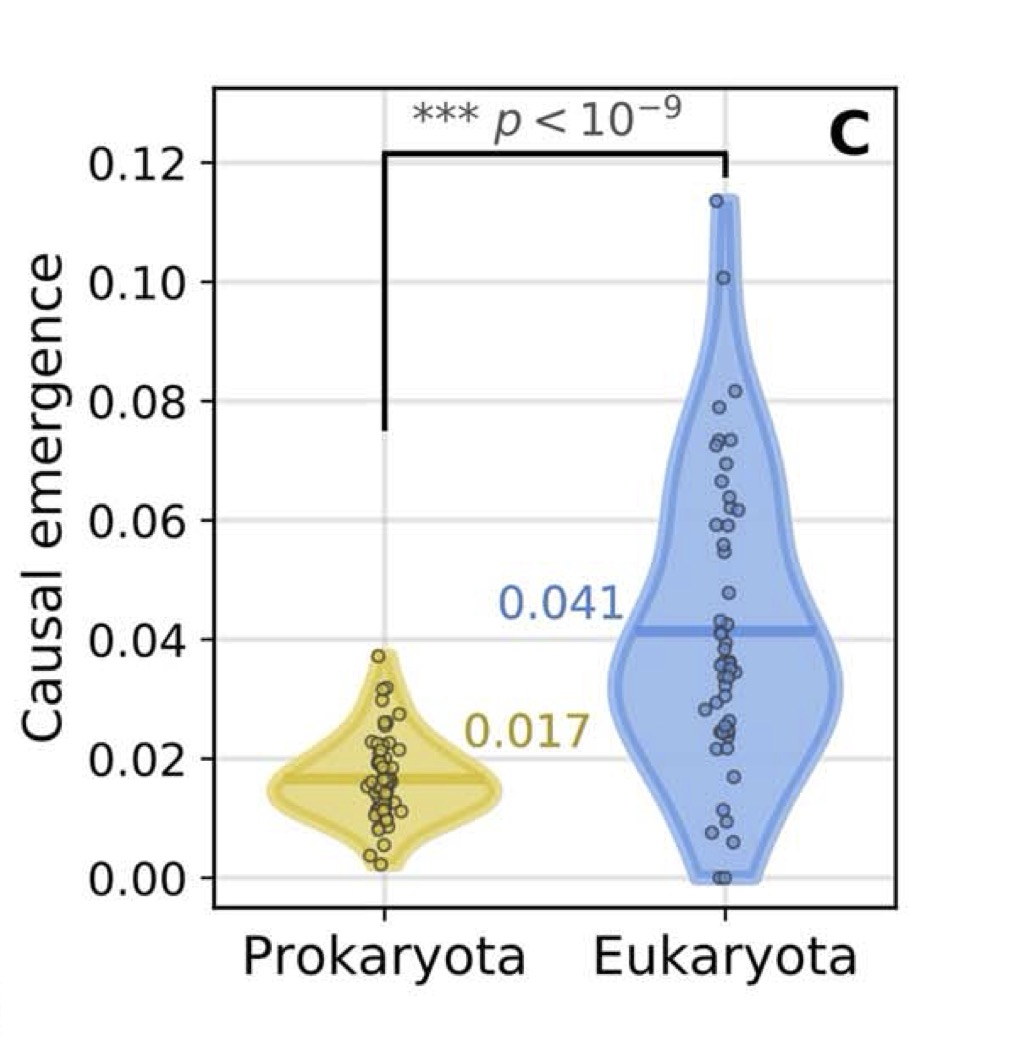
Klein et al. used Hoel’s information-theoretic measures of causal emergence to analyse protein interaction networks (interactomes) in over 1800 species, containing more than eight million protein–protein interactions, across different scales. They showed the emergence of ‘macroscales’ that are associated with lower noise and uncertainty. The nodes in the macroscale description of the network are more resilient than those in less coarse-grained descriptions. Greater causal emergence (i.e., a stronger macroscale description) was generally seen in multicellular organisms compared to single-cell organisms. The authors quantified causal emergence in terms of mutual information (between large and small scales) and effective information (a measure of the certainty in the connectivity of a network). Philip Ball (2023) (pages 218-220) gives an account of this work in terms of the emergence of multicellularity in biological evolution. He introduced the term causal spreading (pages 225-7), arguing that over the history of evolution the locus of causation has changed.

Yuan et al. continue

"However, in Hoel’s theory of causal emergence, it is essential to establish a coarse-graining strategy beforehand. Alternatively, the strategy can be derived by maximizing the effective information (EI) [19]. However, this task becomes challenging for large-scale systems due to the computational complexity involved. To address these problems, Rosas et al. introduced a new quantitative definition of causal emergence [24] that does not depend on coarse-graining methods, drawing from partial information decomposition (PID)-related theory. PID is an approach developed by Williams et al., which seeks to decompose the mutual information between a target and source variables into non-overlapping information atoms: unique, redundant, and synergistic information [29]…"

The Figure below is taken from Rosas et al. Xt^j (j=1,…,n) are microscopic variables that define a Markov chain. Vt is a macroscopic variable that is completely determined by the microscopic variables.

“Diagram of causally emergent relationships. Causally emergent features have predictive power beyond individual components. Downward causation takes place when that predictive power refers to individual elements; causal decoupling when it refers to itself or other high-order features.”

Rosas et al. applied the method to specific systems, including Conway’s Game of Life, Reynolds’ flocking model, and neural activity as measured by electrocorticography. More recently, it was used to describe emergence in computer science, including the identification of modular structures. Calculations were performed for specific examples, including Ehrenfest’s urn model for diffusion, the Ising model with Glauber dynamics, a Hopfield neural network model for associative memory.

Yuan et al. also state the following:

"The second challenge pertains to the identification of emergence from data. In an effort to address this issue, Rosas et al. derived a numerical method [24]. However, it is important to acknowledge that this method offers only a sufficient condition for emergence and is an approximate approach. Another limitation is that a coarse-grained macro-state variable should be given beforehand to apply this method."

Sas et al. recently stated

“Empirical applications of this framework to study emergence … including the study of gene regulatory networks [22], the dynamics of the human brain [23], the internal dynamics of reservoir computing [24], and the formation of useful internal representations in machine learning [25].”

Yuan et al. also discuss two significant connections between causal emergence and machine learning. First, machine learning can be used to improve calculations of causal emergence. Second, causal emergence measures can be used to better understand how machine learning works and improve it.

The work described above built on earlier work by Crutchfield, who claimed that the identification of emergence and hierarchies could be made operational, stating that “different scales are delineated by a succession of divergences in statistical complexity at lower levels.” More recently, Rupe and Crutchfield have reported progress towards identifying emergent self-organisation in a system.

Although this work on quantitative measures of emergence based on information theory represents significant progress, there are many open problems. Examples include the extension to non-Markovian systems and the development of computationally feasible methods for large systems. The latter is particularly important in physical systems where spontaneous symmetry breaking occurs, as this only happens in the thermodynamic limit of an infinite system.

There is an unrecognised similarity between the work described above and techniques recently developed to characterise phase transitions in statistical mechanics models such as the Ising model and classical dimer models. Coarse-graining (CG) is optimised by maximising the Real-Space Mutual Information (RSMI) between a spatial block and its distant environment. 

In general, maximising mutual information is notoriously hard but can be done using state-of-the-art machine learning algorithms. Gokmen et al. have developed an algorithm that they claim “can, unsupervised, construct order parameters, locate phase transitions, and identify spatial correlations and symmetries for complex and large-dimensional real-space data.” Furthermore, the optimal CG explicitly identifies the scaling operators associated with the critical point. 

The classical dimer model provides a stringent test as “the relevant low-energy degrees of freedom are profoundly different from the microscopic building blocks of the theory and change qualitatively throughout the phase diagram.” In other words, the emergent entities (quasiparticles such as vortices associated with the height field, which is described by a sine-Gordon field theory) are different from the dimers.

It is encouraging to see that two different scientific communities have developed similar ideas to address this challenging problem of making discussions about emergence and causality more concrete and quantitative.

Friday, November 15, 2024

Emergence and protein folding

Proteins are a distinct state of matter. Globular proteins are tightly packed with a density comparable to a crystal but without the spatial regularity found in crystals. The native state is thermodynamically stable, in contrast to the globule state of synthetic polymers which is often glassy and metastable, with a structure that depends on the preparation history.

For a given amino acid sequence the native folded state of the protein is emergent. It has a structure, properties, and function that the individual amino acids do not, nor does the unfolded polymer chain. For example, the enzyme catalase has an active site whose function is as a catalyst to make hydrogen peroxide (which is toxic) decay rapidly.


Protein folding is an example of self-organisation. A key question is how the order of the folded state arises from the disorder (random configuration) of the unfolded state.

There are hierarchies of structures, length scales, and time scales associated with the folding.

The hierarchy of structures are primary, secondary, tertiary, and ternary structures. The primary structure is the amino acid sequence in the heteropolymer. Secondary structures include alpha-helices and beta-sheets, shown in the figure above in orange and blue, respectively. The tertiary structure is the native folded state. An example of a ternary structure is in hemoglobin which consists of four myoglobin units in a particular geometric arrangement.

The hierarchy of time scales varies over more than fourteen orders of magnitude, including folding (msec to sec), helix-coil transitions (microsec), hinge motion (nanosec), and bond vibrations (10 fsecs).

Folding exhibits a hierarchy of processes, summarised in the figure below which is taken from
Masaki Sasai, George Chikenji, Tomoki P. Terada
Modularity 
"Protein foldons are segments of a protein that can fold into stable structures independently. They are a key part of the protein folding process, which is the stepwise assembly of a protein's native structure." (from Google AI)
See for example.

Discontinuities
The folding-unfolding transition [denaturation] is a sharp transition, similar to a first-order phase transition. This sharpness reflects the cooperative nature of the transition. There is a well-defined enthalpy and entropy change associated with this transition.


Universality
Proteins exhibit "mutational plasticity", i.e., native structures tolerant to many mutations (changes in individual amino acids). Aspects of the folding process such as its speed, reliability, reversibility, and modularity appear to be universal, i.e., hold for all proteins.

Diversity with limitations
On the one hand, there are a multitude of distinct native structures and associated biological functions. On the other hand, this diversity is much smaller than the configuration space, presumably because thermodynamic stability vasts reduces the options.

Effective interactions
These are subtle. Some of the weak ones matter as the stabilisation energy of the native state is of order 40 kJ per mole, which is quite small as there are about 1000 amino acids in the polymer chain. Important interactions include hydrogen bonding, hydrophobic, and volume exclusion. In the folded state monomers interact with other monomers that are far apart on the chain. The subtle interplay of these competing interactions produces complex structures with small energy differences, as is often the case with emergent phenomena.

Toy models
1. Wako-Saito-Munoz-Eaton model
This is an Ising-like model on a chain. A short and helpful review is

Note that the interactions are not pairwise but involves strings of "spins" between native contacts.

2. Dill's HP polymer on a lattice
This consists of a polymer which has only two types of monomer units and undergoes a self-avoiding walk on a lattice. H and P denote hydrophobic and polar amino acid units, denoted by red and blue circles, respectively, in the figure below. The relative simplicity of the model allows complete enumeration of all possible confirmations for short chains. The model is simpler in two dimensions, yet still captures essential features of the folding problem.  

As the H-H attraction increases the chain undergoes a relatively sharp transition to just a few conformations that are compact and have hydrophobic cores. The model exhibits much of the universality of protein folding. Although there are 20 different amino acids in real proteins, the model divides them into two classes and still captures much of the phenomena of folding, including mutational plasticity.


co-operativity - helical order-disorder transition is sharp

Organising principles
Certain novel concepts such as the rugged energy landscape and the folding funnel apply at a particular scale.


This post drew on several nice papers written by Ken Dill and collaborators including

The Protein Folding Problem, H.S. Chan and K.A. Dill, Physics Today, 1993

Roy Nassar, Gregory L. Dignon, Rostam M. Razban, Ken A. Dill, Journal of Molecular Biology, 2021

Interestingly, in the 2021 article, Dill claims that the protein folding problem [which is not the prediction problem] has now essentially been solved.

Tuesday, October 22, 2024

Colloquium on 2024 Nobel Prizes


This friday I am giving a colloquium for the UQ Physics department.

2024 Nobel Prizes in Physics and Chemistry: from biological physics to artificial intelligence and back

The 2024 Nobel Prize in Physics was awarded to John Hopfield and Geoffrey Hinton “for foundational discoveries and inventions that enable machine learning with artificial neural networks.” Half of the 2024 Chemistry prize was awarded to Dennis Hassabis and John Jumper for “protein structure prediction” using artificial intelligence. I will describe the physics background needed to appreciate the significance of the awardees work. 

Hopfield proposed a simple theoretical model for how networks of neurons in a brain can store and recall memories. Hopfield drew on his background in and ideas from condensed matter physics, including the theory of spin glasses, the subject of the 2021 Physics Nobel Prize.

Hinton, a computer scientist, generalised Hopfield’s model, using ideas from statistical physics to propose a “Boltzmann machine” that used an artificial neural network to learn to identify patterns in data, by being trained on a finite set of examples. 

For fifty years scientists have struggled with the following challenge in biochemistry: given the unique sequence of amino acids that make up a particular protein can the native structure of the protein be predicted? Hassabis, a computer scientist, and Jumper, a theoretical chemist, used AI methods to solve this problem, highlighting the power of AI in scientific research. 

I will briefly consider some issues these awards raise, including the blurring of boundaries between scientific disciplines, tensions between public and corporate interests, research driven by curiosity versus technological advance, and the limits of AI in scientific research.

Here is my current draft of the slides.

Sunday, September 15, 2024

Biology is about emergence in subtle ways

Biology is a field that is all about emergence. It exhibits a hierarchy of structures from DNA to proteins to cells to organs to organisms. Phenotypes emerge from genotypes. At each level of the hierarchy (stratum) there are unique entities, phenomena, principles, methods, theories, and sub-fields. But there is more to the story. 

Philip Ball is probably my favourite science writer. Earlier this year, he gave a beautiful lecture at The Royal Institution, What is Life and How does it Work?


The lecture presents the main ideas in his recent book,  How Life Works: A User's Guide to the New Biology

Here are a few things that stood out for me from the lecture.

1. The question, "What is life?" has been and continues to be notoriously difficult to answer.

It was originally stated by Francis Crick, and some commonly assumed corollaries of it are wrong. In simple terms, the Dogma states that DNA makes RNA and RNA makes proteins. This is a unique and unidirectional process. For example, a specific code (string of the letters A,G,T, and C) will produce a specific protein (sequence of amino acids) which will naturally fold into a unique structure with a specific biochemical function. 


The central dogma has undergirded the notion that genes determine everything in biology. Everything is bottom-up.
However, Ball gives several counterexamples.
A large fraction of our DNA does not code for proteins.
Many proteins are disordered, i.e., they do not have a unique folded structure.

Aside: An earlier failure of (some versions of) the central dogma was the discovery of reverse transcriptase by the obscure virus club, essential for the development of HIV drugs and covid-19 vaccines.

3. The role of emergence can be quantified in terms of information theory, helping to understand the notion of causal emergence: the cause of large-scale behaviour is not just a sum of micro-causes, i.e., the properties of and interactions between the constituents at smaller scales. Entities at the level of the phenomena are just as important as what occurs at lower levels.
(page 214 in the book). Causal emergence is concerned with fitting the scale of the causes to the scale of the effects.
The figure above is taken from this paper from 2021.


The authors quantify casual emergence in protein networks in terms of mutual information (between large and small scales) and effective information (a measure of the certainty in the connectivity of a network).

Aside: These quantitative notions of emergence have been developed more in recent work by Fernando Rosas and collaborators and discussed in a Quanta article by Philip Ball.

4. Context matters.  A particular amino acid sequence does not define a unique protein structure and function. They may depend on the specific cell in which the protein is contained.

5. Causal spreading.  Causality happens at different levels. It does not always happen at the bottom (genetic level). Sometimes it happens at higher levels. And, it can flow up or down.

6. Levels of description matter. This is well illustrated by morphology and the reasons that we have five fingers. This is not determined by genes.

7. Relevance to medicine. There has been a focus on the genetic origin of diseases. However, many diseases, such as cancer, do not predominantly happen at the genetic level. There has been a prejudice to focus on the genetic level, partly because that is where most tools are available. For cancer, focussing on other levels, such as the immune system, may be more fruitful.

8. Metaphors matter. Biology has been dominated by  metaphors such as living things are "machines made from genes" and "computers running a code". However, metaphors are metaphors. They have limitations, particularly as we learn more. All models are wrong, but some are useful. Ball proposes that metaphors from life, including the notion of agency, may be more fruitful.

9. The wisdom of Michael Berry. Ball ends with Berry's saying that the biggest unsolved problem in physics is not about dark matter (or some similar problem), but rather, "If all matter can be described by quantum theory, where does the aliveness of living things come from?" In other words, "Why is living matter so different from other matter?"

There is also an interesting episode of the How To Academy podcast, where Ball is interviewed about the book.

Wednesday, April 3, 2024

Is biology better at computing than supercomputers?

Stimulated by discussions about the physics of learning machines with Gerard Milburn, I have been wondering about biomolecular machines such as proteins that do the transcription and translation of DNA in protein synthesis. These are rather amazing machines.

I found an article which considers a problem that is simpler than learning, computation.

The thermodynamic efficiency of computations made in cells across the range of life

Christopher P. Kempes, David Wolpert, Zachary Cohen and Juan Pérez-Mercader


It considers the computation of translating a random set of 20 amino acids into a specific string for a specific protein. Actual thermodynamic values are compared to a generalised Landauer bound for computationBelow is the punchline. (page 9)

Given that the average protein length is about 325 amino acids for 20 unique amino acids, we have that pi=p=1/20325=1.46×10−423, where there are 20325 states, such that the initial entropy is Inline Formula , which gives the free energy change of kT(SI−0)=4.03×10⁻¹⁸ (J) or 1.24×10⁻²⁰ (J per amino acid). This value provides a minimum for synthesizing a typical protein. 

We can also calculate the biological value from the fact that if four ATP equivalents are required to add one amino acid to the polymer chain with a standard free energy of 47.7 (kJ mol−1) for ATP to ADP, then the efficiency is 1.03×10⁻¹⁶ (J) or 3.17×10⁻¹⁹ (J per amino acid).  

This value is about 26 times larger than the generalized Landauer bound.

These results illustrate that translation operates at an astonishingly high efficiency, even though it is still fairly far away from the Landauer bound. To put these results in context, it is interesting to note that the best supercomputers perform a bit operation at approximately 5.27×10⁻¹³ (J per bit). In other words, the cost of computation in supercomputers is about eight orders of magnitude worse than the Landauer bound of Inline Formula (J) for a bit operation, which is about six orders of magnitude less efficient than biological translation when both are compared to the appropriate Landauer bound. Biology is beating our current engineered computational thermodynamic efficiencies by an astonishing degree.

Thursday, November 2, 2023

Diversity is a common characteristic of emergent properties

Consider a system composed of many interacting parts. I take the defining characteristic of an emergent property is novelty. That is, the whole has a property not possessed by the parts alone. I argue that there are five other characteristics of emergent properties. These characteristics are common but they are neither necessary nor sufficient for novelty.

1. Discontinuities

2. Unpredictability

3. Universality

4. Irreducibility

5. Modification of parts and their relations

I now add another characteristic.

6. Diversity

Although a system may be composed of only a small number of different components and interactions, the large number of possible emergent states that the system can take is amazing. Every snowflake is different. Water is found in 18 distinct solid states. All proteins are composed of linear chains of 20 different amino acids. Yet in the human body there are more than 100,000 different proteins and all perform specific biochemical functions. We encounter an incredible diversity of human personalities, cultures, and languages. 

A related idea is that "simple models can describe complex behaviour". Here "complex" is often taken to mean diverse. Examples, how simple Ising models with a few competing interactions can describe a devil's staircase of states or the multitude of atomic orderings found in binary alloys.

Perhaps the most stunning case of diversity is life on earth. Billions of different plant and animal species are all an expression of different linear combinations of the four base pairs of DNA: A, G, T, and C.

One might argue that this diversity is just a result of combinatorics. For example, if one considers a chain of just ten amino acids there are 10^13 different possible linear sequences. But this does not mean that all these sequences will produce a functional protein, i.e., one that will fold rapidly (one the timescale of milliseconds) into a stable tertiary structure, and one that can perform a useful biochemical function. 

Friday, October 20, 2023

Opening the door for women in science

 I really liked reading Transcendent Kingdom by Yaa Gyasi. She is an amazing writer. I recently reread some of it for an extended family book club. Just check out some of these quotes. 

A colleague suggested I might like Lessons in Chemistry, a novel by Bonnie Garmus. I have not read the book yet, but I have watched the first two episodes of the TV version on AppleTV. I watched the first episode for free.

The show contains a good mix of humour, love of science, and feminism. The chemistry dialogue seems to be correct. The show chronicles just how in the 1950s how awful life was for a young woman who aspired to be a scientist. Things have improved. But there is still a long way to go... 

Friday, January 27, 2023

Science and the universe are awesome

Since we are surrounded by scientific knowledge. We are so used to it that we can take science for granted and not reflect on how amazing science truly is. And how amazing the universe is that science reveals. Things that we know, learn, and do today in science would have been inconceivable decades ago, let alone centuries ago.

What specific things do you think are particularly awesome? This question was stimulated by Frank Wilczek's recent book, Fundamentals: Ten Keys to Reality. In writing the book, he says "what began as an exposition grew into a contemplation."

 My answer to the question has some significant overlap with Wilczek's ten. 

Below I list some of the things that I find awesome. I consider two classes: what science can do and what we learn about the universe from science.

Science works! It is amazing what science can do.

We can understand the material world.

Einstein said, "The most incomprehensible thing about the world is that it is comprehensible." In a previous post, I explored some different dimensions of the fact that the universe is comprehensible. The mystery includes human capabilities, both intellectual and physical, and the malleability of the material world.

We can make precise measurements.

Scientists have created incredibly powerful and specialised instruments for making very precise measurements such as spectrometers, telescopes and microscopes. Scientists can measure the tension in a single strand of DNA, the magnetic moment of an electron to a precision of one part in one billion billion, the spectrum of light emitted by a galaxy that is ten billion light years away, ...

We can predict the outcome of new experiments.

Scientists construct theories in their minds, on pieces of paper, in mathematical equations, and in computers. One way to evaluate the possible validity of a theory is to propose new experiments and predict the outcome. Famous examples include the existence of the chemical element aluminium, the existence of the planet Neptune, radio waves, a specific excited quantum state of the atomic nucleus of carbon atoms, the pollinator moth for Darwin's orchid, the deflection of the path of light from a distant star by our sun, gravitational waves, the Cosmic Microwave Background, quarks, the Higgs boson, the Berezinskii-Kosterlitz-Thouless phase transition, the hexatic phase, edge states in integer spin antiferromagnetic chains, topological insulators, ... Predictions are particularly impressive when they are unexpected and controversial.

We can use mathematics. 

Eugene Wigner received the Nobel Prize in Physics in 1963. In 1960 he published an essay "The Unreasonable Effectiveness of Mathematics in the Natural Sciences that concludes

The miracle of the appropriateness of the language of mathematics for the formulation of the laws of physics is a wonderful gift which we neither understand nor deserve. 

We can manipulate and control nature.

Scientists and engineers can move single atoms, design drugs, make computers, build atom bombs, heart pacemakers, and mobile phones, manipulate genes, ......

We know so much but we know so little. 

On the one hand, the achievements of science are amazing. Yet, in spite of this, there are still significant mysteries and challenges. Examples include the nature of dark matter or human consciousness, a quantum theory of gravity, fine-tuning of fundamental constants, the quantum-classical boundary, protein folding, the nature of glasses, and how to calculate the properties of complex systems.

It is awesome what science reveals to us about the universe.

The immense scales of the observable universe

Our sun is just one star among the more than two hundred billion that make up our galaxy, the Milky Way. And that is just one of one trillion galaxies in the whole universe. It takes light from the most distant galaxies tens of billions of years to travel to us.

Length, time, and energy scales over many many orders of magnitude

These go far beyond our everyday experience and what we can see with the naked eye (from a millimetre to a kilometre). On the large scale, the visible universe involves distances of billions of light years (10^25 metres). On the small scale, there is the sub-structure of nucleons, which is smaller than femtometres (10^-15 m).  This wide range of length scales is nicely illustrated in the wonderful movie Powers of Ten and its update, The Cosmic Eye. There are corresponding time, energy, and temperature scales varying over many many orders of magnitude. For example, as one goes from ultracold atomic gases to quark-gluon plasmas, the  relevant energy and temperature scales vary over more than 20 orders of magnitude! At every scale, there are distinct phenomena and structures. 

Universal laws that are simple to state

The universe exhibits a diversity of rich and complex behaviour. Yet it can understand much of it in terms of simple universal laws that are easy to state, e.g., Newton's laws of motion, the laws of thermodynamics, Maxwell's equations of electromagnetism, Schrodinger's equation of quantum mechanics, the genetic code, ....  And, these are just a few of these laws. One does not need a multitude of laws to describe a multitude of instances of a multitude of phenomena.

Just a few building blocks

There are just a few fundamental particles in the standard model (leptons, neutrinos, and gauge bosons). Everything is made of them. They are the building blocks of atoms. They each have just a few physical properties: charge, spin, mass, and colour. Every single particle of a particular type in the universe has exactly the same properties. Exactly. As far as we know, they have been exactly the same throughout time, going back to the beginning of the universe, and whether they are in your body, or in a star in a distant galaxy.

Atoms are the building blocks of chemical compounds. Every single atom of a particular chemical element (and nuclear isotope) is absolutely identical. This allows astronomers to determine the chemical composition of distant stars, galaxies, and dust clouds.

Humans, plants, and animals all have the same molecular building blocks and there are just a few of them. Any DNA molecule is composed of just four different base pairs (denoted A, G, T, C) and proteins are composed of just twenty different amino acids.

There are two amazing things here. First, there are just so few building blocks. Second, every one of these building blocks is absolutely identical.

Emergence: simple rules produce complex behaviour

Humans, cells, and crystals can be viewed as systems composed of many interacting components. The components and their interactions can often be understood and described in simple terms. Nevertheless, from these interactions complex structures and properties can emerge.

Nature appears to be fine-tuned for life

This covers not just the values of fundamental physical constants that lead to the notion of fine-tuning and the anthropic principle. Water has unique physical and chemical properties that allow it to play a crucial role in life, such as the surface of lakes freezing before the bottom and aiding protein folding.

The intricate and subtle "machinery" of biomolecules

Proteins have very unique structures that are intimately connected to their specific functions, whether as catalysts or light sensors.


What do you think are the most amazing things about science and what we learn from it?


Friday, December 9, 2022

The wonders and mysteries of bioluminescence

 Members of my family have been reading Phosphorescence: On awe, wonder, and things that sustain you when the world goes dark, a personal memoir by Julia Baird.

This reminded me of how amazing and fascinating bioluminescence is, stimulating me to read more on the science side. One of the first things is to distinguish between bioluminescence, fluorescence, and phosphorescence.

Bioluminescence is chemical luminescence whereby a biomolecule emits a photon through the radiative decay of a singlet excited state that is produced by a chemical reaction. 

In contrast, fluorescence occurs when the singlet excited state is produced by the molecule absorbing a photon.

Phosphorescence occurs when a molecule emits a photon through the radiative decay of an excited triplet state, that was produced by the absorption of a photon.

Bioluminescence can occur in the dark. Fluorescence cannot as there are no photons to absorb. Phosphorescence is sometimes seen in the dark but this is because the molecule absorbs invisible UV light which produces the triplet state which has a very long radiative lifetime.

Baird gives beautiful and enchanted descriptions of seeing "phosphorescence" on her daily early morning ocean swim. She acknowledges that this is actually bioluminescence not phosphorescence. I should stress that in pointing this out I am not "unweaving the rainbow", as for literary purposes using "bioluminescent" would be clunky.


There is a useful webpage from a research group at UC Santa Barbara. They also have a detailed review article from which I took the image above.

Steven H.D. HaddockMark A. MolineJames F. Case

A much shorter review that I read this morning is

Bioluminescence in the Ocean: Origins of Biological, Chemical, and Ecological Diversity, by E.A. Widder

An article in Quanta magazine, In the Deep, Clues to How Life Makes Light by Stephanie Yin

So what is the underlying photophysics and quantum chemistry? The following review is helpful.

The Chemistry of Bioluminescence: An Analysis of Chemical Functionalities 

Isabelle Navizet, Ya-Jun Liu, Nicolas Ferré, Daniel Roca-Sanjuán, Roland Lindh

Almost all currently known chemiluminescent substrates have the peroxide bond, -O-O-, in common as a chemiluminophore. This chemical system facilitates the essential mechanism of chemiluminescence—providing a route for a thermally activated chemical ground-state reaction to produce a product in an electronically excited state. The basics of this process can be understood from studies of ... dioxetanone. [it] contains a peroxide bond, [and] fragments like the firefly luciferin system to carbon dioxide.

The squiggly line denotes the bond that is broken to produce the excited singlet state.
The figure below shows the potential energy surface that describes the dynamics leading to the emissive state. Note the presence of two conical intersections.


Much of this photophysics can be understood in terms of a "two-site Hubbard model" discussed in this classic paper that I love.

Neutral and Charged Biradicals, Zwitterions, Funnels in S1, and Proton Translocation: Their Role in Photochemistry, Photophysics, and Vision

Vlasta Bonačić-Koutecký, Jaroslav Koutecký, Josef Michl

In simple terms, all that is different in the biomolecular system is that the enzyme and the larger chromophore tune energy levels so that the energy barriers are much smaller so that the steps needed for bioluminescence become accessible at room temperature.

This highlights two fundamental things. 

Chemistry is local. This is relevant to understanding Wannier orbitals in solid state physics, to hydrogen bonding, and how protein structure aids function.

"Biochemistry is the search for the chemistry that works" [in water at room temperature].

Thursday, November 25, 2021

Role of quantum nuclear motion in biomolecular systems

 Total I am giving a talk, "Effect of quantum nuclear motion on hydrogen bonds in complex molecular materials" at Light-matter Interactions from scratch: Theory and Experiments at the Border with Biology 

Here are the slides

The talk provides a concrete example of the tutorial on constructing simple model Hamiltonians for complex materials that I give before the talk. It relates to the bio theme of the meeting through work on isotopic fractionation in proteins and the recent paper below. It makes use of the simple model that I talk about.

Unusual Spectroscopic and Electric Field Sensitivity of Chromophores with Short Hydrogen Bonds: GFP and PYP as Model Systems

Chi-Yun Lin and Steven G. Boxer

Tuesday, November 23, 2021

Tutorial on modelling quantum dynamics in biomolecules

This week I am giving two (virtual) talks at a meeting

Light-matter Interactions from scratch: Theory and Experiments at the Border with Biology 

supported by the ICTP (International Center for Theoretical Physics) in Trieste.

In the ICTP tradition, one talk is a tutorial and the second talk is about my research.

Here are the slides for the tutorial on Effective Model Hamiltonians for Quantum Dynamics in Complex Molecular Materials. Feedback is welcome.

The research talk is about hydrogen bonding. I will post slides for that later.


Wednesday, October 13, 2021

The biochemical basis of mental health basics

 Yesterday the UQ Brain Institute had an excellent webinar Brain Health for Mental Health. Four researchers discussed the scientific basis for some simple strategies to reduce the likelihood of mental illness and/or to aid its treatment. These include

eat well

exercise regularly

sleep well

reduce screen time

drink less caffeine

minimise international travel (because of the associated jet lag).

I was fascinated to see the biological and biochemical basis for these strategies. I try to implement them myself and often emphasise the importance of these basic disciplines to others.

Some of the science is fascinating in itself. Did you know you can study sleep in fruit flies?

The webinar also provides a nice example of a public engagement activity. Rather than having one person give a long talk, four different researchers speak, and each for only five minutes with about five slides each. Each talk is followed by a question from the chair. Then at the end there are questions from the live online audience.

Tuesday, September 21, 2021

Nanoscale machines in nature

Part two of the Biology brief in The Economist is Cells and how to run them: All life is made of cells, and cells depend on membranes

A few of the main ideas are the following. Cells are either prokaryotic (bacterium) or eukaryotic (animals). Cell membranes are made of lipids that spontaneously form structures due to an interplay between hydrophobic and hydrophilic interactions. The boundary of prokaryotic cells is the membrane. Eukaryotic cells are more complex, containing many organelles (mitochondria), whose boundary are membranes.


Cells are little factories that can multiply themselves and perform distinct biological functions. It requires energy to maintain the cell shape and for it to manufacture new things. Inside and out is maintained by a difference in the concentration of protons (hydrogen ions) across the membrane. There are two aspects to this. First, the electron transport chain produces the protons. Second, a specific protein in the membrane, ATP synthase, pumps protons across the membrane.

The electron transfer chains are driven either by respiration or photosynthesis. 

Energy for processes in the cell is provided by breaking ATP down to ADP. The reverse process is driven by the kinetic energy of rotation (at about 6000 rpm) of the part of the ATP synthase protein.  ATP is Adenosine triphosphate.

To me the amazing/awesome/cool/miraculous thing is what the hardware can do. These are nanoscale chemical machines and factories. The video below shows a simulation of the ATP synthase protein that is located within cell membranes. It acts as a proton pump to maintain the concentration imbalance between the outside and inside of the cell and to convert ADP to ATP.


I learnt from this how the ATP synthase spins in only one direction and the rotation corresponds to sequential conformational changes in the protein subunits.

There is a beautiful discussion of the underlying physics in a chapter in Biological Physics by Phil Nelson. I have written a brief summary here.

The underlying quantum chemistry is explored in

Tuesday, September 7, 2021

Biology in a nutshell: emergence at many levels

 One of the many great things about The Economist magazine is that they run "Briefing" articles that give brief readable introductions and analyses to important topics, ranging from racism to taxation to climate change. Last year they ran a series about new ideas in economics.

They are currently running a series, Biology Briefs. Each week, for six weeks, there is a two-page article on one key topic in modern biology. They are naturally divided by different scales: molecules, cells, organs, individual lives, species, and living planets. 

The most important idea in molecular biology: DNA encodes information that is used to make specific proteins.

Replication: the protein DNA polymerase makes new DNA molecules with the same sequence of base pairs

Transcription: the protein RNA polymerase makes single strands of RNA that have the same genetic information.

Translation: the protein ribosome reads the information in the mRNA and uses it to make chains of amino acids (with specific sequences determined by the RNA sequence). These polymers then fold spontaneously into proteins with specific functions.

There is much that is amazing and awesome about this, including that people have been able to figure all this out. What I find most amazing/miraculous/awesome/cool is not the software but rather the hardware, i.e. the proteins that act as nanoscale biochemical factories, particularly the ribosome.

Tuesday, May 5, 2020

The beautiful mathematics and physics of virions

Next Monday I am giving a seminar, ``The mathematics and physics of virions", for the virtual Pandemic Seminar of the UQ School of Mathematics and Physics. Most of the talks so far have been about modeling the spread of the virus and the effect of social distancing measures. In contrast, I will look at phenomena at a much smaller scale.

The past month I have taken a crash course in what is known about the structure and properties of virions (single virus nanoparticles). There is some fascinating and beautiful mathematics and condensed matter physics involved. A nice place to start is this short animation video that shows how the Dengue fever virus replicates itself.


Three important questions for any virus are the following.

1. What is the structure of the virion?
In particular, what is the structure of the viral capsid, i.e. the protein shells that encapsulate the genome of the virus?

2. How does the capsid self assemble?

3. How is the genetic material packaged inside the capsid?

Handwashing with sanitiser works because hydrophobic interactions cause the breakup of the membrane that encases the virion. This is the same soft matter physics as when soap removes dirt.

The role of anti-viral drugs is to interrupt/sabotage any of the steps in the multi-step process of the action or duplication of the virion. Thus, finding answers to any of the three questions above may facilitate the development of anti-viral drugs or vaccines.

Here are a few of the articles I have found fascinating and helpful.

Geometry as a Weapon in the Fight Against Viruses
Reidun Twarock

On Virus Growth and Form 
Roya Zandi, Bogdan Dragnea, Alex Travesset, Rudolf Podgornik

TRIM5α self-assembly and compartmentalization of the HIV-1 viral capsid 
Alvin Yu, Katarzyna A. Skorupka, Alexander J. Pak, Barbie K. Ganser-Pornillos, Owen Pornillos, Gregory A. Voth

The figure below (taken from the second article above) shows the structure of the capsid of five different virions. The number of proteins in all of them is an integer multiple of 60.


Left to right: Satellite Tobacco Mosaic virus (composed of 60 proteins); L-A virus (120 proteins); Dengue virus (180 proteins); Chlorosome Vigna virus (180 proteins); Sindbis virus (240 proteins).

In the next post, I will explain the geometric origin of this quantisation.

What does this movie tell us about the modern university?

Last night, my wife and I watched the movie, Wit. You can watch the full movie here  (free with ads). I should warn that some of the conten...