Showing posts with label BECs. Show all posts

Tuesday, May 5, 2015

Not seeing the pseudogap in ultra cold 2D atoms

Two weeks ago it was nice to have Meera Parish visit UQ and give a colloquium Fermions in Flatland. She recently moved to Monash University from University College London.

One important point she made was the comparison of the two figures below, showing a colour intensity plot of the one fermion spectral function A(E,k) for a two-dimensional Fermi gas near the unitary limit (BCS-BEC crossover).

The bottom figure is experimental data from a Nature paper, 
It makes much of the possible connection to the pseudogap seen in cuprate superconductors.

The top figure is from a theory paper
Vudtiwat Ngampruetikorn, Jesper Levinsen, and Meera M. Parish
Therefore, our results suggest that the observed pairing gap [Nature paper] effectively arises from two-body physics and does not correspond to a pseudogap regime. This view is further supported by the fact that the pairing gap in the spectrum persists to very high temperatures well above Tc, as shown in Fig. [above]. Moreover, we see that the “closure” of the gap with increasing temperature appears to be due to the thermal broadening of the two branches.
An earlier post discussed more recent measurements of the spectral function in three-dimensional ultra cold fermionic atoms near the unitary limit.

Thursday, February 19, 2015

Mapping quasi-particles in strongly interacting ultra cold fermionic gases

There is an interesting preprint
Breakdown of Fermi liquid description for strongly interacting fermions 
Yoav Sagi, Tara E. Drake, Rabin Paudel, Roman Chapurin, Deborah S. Jin

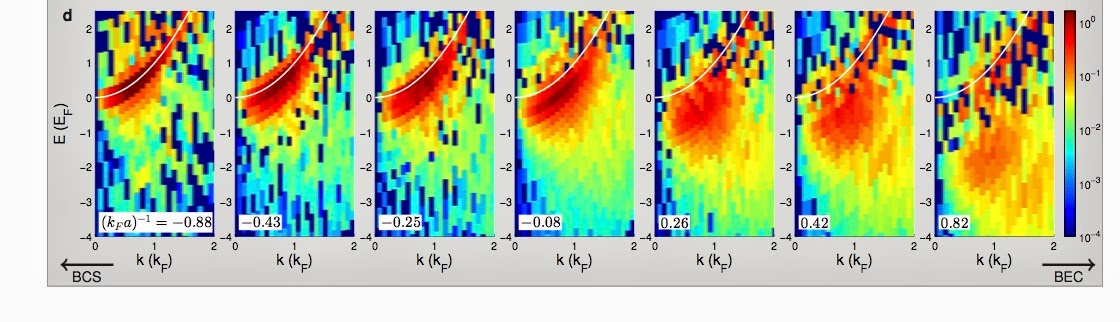
It describes some nice ultra cold atom experiments that tune through the BEC-BCS crossover with a Feshbach resonance, focusing on the properties of the normal (i.e. non-superfluid) phase. All the measurements are at a temperature of T=0.2T_F, just above the superfluid transition.
It is like an ARPES [Angle Resolved PhotoEmission Spectroscopy] experiment in the solid state.
Specifically, the one-fermion spectral function A(k,E) is measured, shown in the colour intensity plots below.

The left and right side correspond to the BCS and BEC limits respectively. The unitary limit [i.e. infinite interaction occurs close to the middle].

On the left one can clearly see dispersing quasi-particle excitations, as one would expect in a Fermi liquid. As the interaction strength increases this feature is broader and there is more incoherent spectral weight at lower energies.

Some caution is in order as there is quite a bit of curve fitting involved in the analysis of the above data. [Solid state ARPES also suffers from this problem to.]

Specifically, the form below is used for the spectral function, where Z is the quasi-particle weight


In an earlier post I considered the history of this type of expression.

For the incoherent part the authors make the somewhat ad hoc assumption that it is given by a
 "function that describes the normal state in the BEC limit, namely, a thermal gas of pairs."

They then find the following results for the dependence of Z and the effective mass m* [defined by the quadratic dispersion] on the interaction strength [a is the scattering length, which becomes infinite at the Feshbach resonance, i.e. for the unitary limit].
There is already a theory paper that discusses the experiments. It captures the results above at the semi-quantitative level using a Brueckner-Goldstone theory. The self energy is assumed to be frequency independent in this approximation. I found this interesting as it is the opposite to Dynamical Mean-Field Theory (DMFT) for which the self energy is assumed to be momentum independent.

I feel the paper title may be a misnomer. The quasi-particle weight is always finite, except in the BEC regime [attractive interactions] where one does not really have fermions anymore.

In future experiments, it would be nice to see the temperature dependence of the spectral function. Specifically, do the quasi-particles get destroyed with increasing temperature as in bad metals.

I thank Matt Davis for bringing the preprint to my attention.

Wednesday, February 12, 2014

Are ultracold atomic gases strongly correlated systems?

I recently heard a talk by someone working on cold atoms who kept saying again and again that these were strongly correlated systems. I may have missed it but the justification was never clear. This got me wondering, what criteria would I use as a signature of strong correlations?

Here is my tentative answer motivated by strongly correlated electron materials.

A key signature of strong correlations is a significant redistribution of spectral weight [i.e., the many-body eigenvalue spectrum] compared to the corresponding non-interacting electron problem.

Common phenomena associated with this redistribution are
  • the emergence of new low-energy scales [e.g. Kondo temperature]
  • large renormalisation of quasi-particle energies [heavy fermions]
  • separation of the energy scales for spin and charge excitations
  • incoherent spectral features [Hubbard "bands"] 
  • breakdown of quasi-particle approximations [bad metals]
This redistribution is usually poorly [never?] described by weak coupling theories, static mean-field theories or the RPA [Random Phase Approximation].

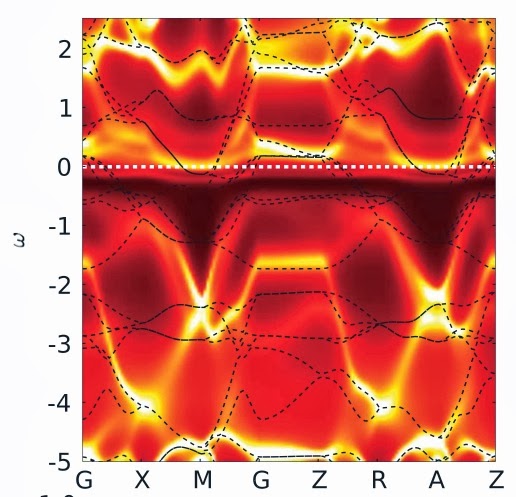
I attempt to illustrate this idea with two figures below. The first color shaded plot shows the one-particle spectral density calculated from LDA+DMFT [Local Density Approximation for DFT (Density Functional Theory) + Dynamical Mean-Field Theory] for the parent compound of the iron pnictide superconductors.
The dashed lines are the band structure calculated from pure LDA [i.e. not including the strong correlation effects captured by DMFT].
The Figure is taken from a PRL by Haule, Shim, and Kotliar.


The figure below shows the spectral density measured by ARPES [Angle Resolved PhotoEmission Spectroscopy] for the iron pnictide LaOFeP. The solid red lines are the band structure calculated from LDA.
This is Figure 6 in a recent review from Z.X. Shen's group.


In the absence of strong correlations all of the spectral weight would lie on top of the band structure.
The important point is that it does not.

In the cuprates these effects are even more dramatic.

So what about cold atomic gases?

For fermionic systems I have not seen much discussion of redistribution of spectral weight.
Often a quasi-particle picture and mean-field techniques are used in theoretical calculations.

Chris Vale's group has done a beautiful series of experiments measuring dynamical spin and density correlation functions for a strongly interacting system with a BEC-BCS crossover. The figure below is taken from this PRL. One does see differences between the density [D] and spin [S] correlation functions and there is a redistribution of spectral weight. But, to me at least, it does not appear as dramatic as in strongly correlated electron materials.


For bosons near the Mott transition there has been some discussion of the spectral weight redistribution [see this PRA and references therein].

I think the condensate fraction in the first cold atom BEC's is close to unity. In contrast, in superfluid helium 4 the fraction is about 10 per cent. The vanishing of the condensate fraction as one approaches the Mott insulator has been observed, but seems to be captured by a mean-field theory.
For reference, in cuprate superconductors the superfluid density can be much less than the charge density.

So, my questions are:

Is large redistribution of spectral weight the best signature of strong correlations?

In what cold atom systems does one see the largest redistribution?

Saturday, October 26, 2013

Quantum emergence is not strong emergence

Is there any difference in the nature of emergence in quantum and classical systems?
What is the difference between strong and weak emergence?

An emergent property of a system is one that is:
a. not present in the individual components of the system
b. difficult to predict a priori from a knowledge of the components and their interactions
c. independent of the finer details of the components

Equivalently emergent properties are
a. qualitatively different
b. usually discovered empirically and sometimes are given a reductionist explanation a posteriori
c. universal and stable to perturbations

This can be illustrated with the rigidity of a solid
a. the individual atoms that make up a solid are not rigid.
b. elasticity theory preceded crystallography
c. all solids are rigid, regardless of their chemical composition.

Emergence occurs in both quantum and classical systems.  The properties that emerge can be distinctly different.  Superconductivity  and superfluidity are intrinsically quantum.
However, the associated issues and challenges: scientific, methodological, and philosophical are essentially the same. Emergence in classical systems is just as fascinating and challenging as for quantum systems.

Hence, last year I was surprised and disappointed to read the details of The Physics of Emergence program at the Templeton Foundation.
It appears to be based on two significant misunderstandings:
Emergence in quantum and classical systems is profoundly different.
In particular, quantum and classical emergence should be identified with strong and weak emergence, respectively.
I disagree with both the preceding two statements.

What is the difference between strong and weak emergence?
Some philosophers equate these with ontological and epistemological emergence.
For practical scientists the issue boils down to the following possible
answers to the question, "Is it possible to predict emergent properties?":
i. No. It is impossible.
ii. No. But, one can make postdictions, i.e., once the phenomena has been observed very smart people can construct reductionist models that explain the phenomena.  [BCS theory is an example].
iii. Yes. But, it is difficult. BECs and topological insulators give us hope.
iv. Yes. We just need a little more computer power and creativity.

The believer in strong emergence says i. All the other answers amount to weak emergence.
Different scientists will answer ii, iii, or iv.
I would probably go with ii.
The only scientist who I think might answer i. is Bob Laughlin on his more cantankerous days.
Yet i. appears to be serious option for many philosophers. This seems to be largely because of the thorny issue of consciousness.

Wednesday, May 29, 2013

From cold atoms to quark-gluon plasmas

In 2007 Gordon Baym gave a fascinating talk New States of Quantum Matter which is nicely summarised in a short conference paper. You can watch a 2010 version of the talk here.

Baym discusses similarities of the physics associated with cold atomic gases and quark-gluon plasmas. These similarities occur in spite of the fact that the relevant energy scales in the two systems differ by more than 20 orders of magnitude!

For example, the phase diagram below shows the different phases of a many-body quark system as a function of temperature and chemical potential.
Increasing the chemical potential corresponds to increasing the density. [Remember that for a non-interacting Fermi gas the Fermi energy increases with density].
Note that at "low" temperatures there is a continuous cross-over from a hadronic superconductor [roughly a BEC of paired quarks] to a quark superconductor. Baym points out that some level this is analogous to the BEC-BCS crossover that occurs in ultracold Fermi gases as one tunes the interaction from repulsion to attraction (e.g. via a Feshbach resonance). However, like all analogies this is not perfect. The quark system involves three different "colours" of fermion with different masses, whereas the cold gas one involves two with identical mass. An interesting challenge for the cold atom community is to design the corresponding three fermion system. This has been discussed by Rapp, Zarand, Honerkamp, and Hofstetter  (see the associated Nature Physics News and Views by Frank Wilczek). 

Friday, May 24, 2013

What is quantum matter?

It may depend on who you ask.
It is interesting that even twenty years ago the phrase "quantum matter" was rarely used.
Now we have

Department of Quantum Matter, Hiroshima University 

Quantum Matter Institute, University of British Columbia 

 Shoenberg Laboratory for Quantum Matter, University of Cambridge 

 So, what is quantum matter?
To some it is any material system (solid, liquid, or gas) where the quantum statistics of the constituent particles significantly affect the properties of the system. One could argue on some level this is any state of matter! After all, the Pauli exclusion principle is key to chemistry!

The above departments are largely concerned with studying what used to be called "strongly correlated electron systems". Hence, one also often sees the phrase "correlated quantum matter". I think David Pines and Piers Coleman may be two of the people who have most promoted the phrase. Coleman and Andy Schofield use the phrase "quantum matter" repeatedly in their 2005 Nature review Quantum criticality. Pines has a nice tutorial article Emergent behavior in quantum matter.
Does anyone have a better etymology?

To me the key idea is that there are states of matter [quantum many-body systems] with emergent macroscopic properties that are intrinsically quantum mechanical. Superconductivity is the classic example, being described by a macroscopic quantum mechanical wave function. Furthermore, there may not be broken symmetries. Instead, the many-body states of quantum matter may require concepts such as topological order, the most common examples being found in fractional quantum Hall effect and topological insulators. In some sense different metallic states: bad metals, "quantum critical metals", and the "strange metal" in the cuprates are all quantum matter.

The notion of quantum matter is useful as a unifying concept for describing many of the common themes of interest in two culturally distinct research communities: those studying ultracold atomic gases and correlated electron materials.

There is also a puzzling somewhat philosophical question:
Is quantum matter itself emergent or does quantum matter have emergent properties?

Friday, May 3, 2013

Some ultra-cold atom experiments I would like to see

I have been having some stimulating interactions with my Australian cold atom colleagues, including Matt Davis, Chris Vale, Andy Martin, and Kris Helmerson.

As I see it ultracold atomic gases and solid-state materials have complementary strengths and weaknesses for investigating emergent quantum many-body phenomena. Solid state materials are much easier to bring to spatially uniform thermal equilibrium, achieve temperatures much less than characteristic temperatures (such as the Fermi temperature), and perform high precision thermometry. On the other hand it is hard to drive solid state systems far from equilibrium, to investigate non-equilibrium phenomena such as turbulent charge flows, and the time scales for relaxation to equilibrium are often too fast to be observed.

In contrast, ultra-cold atomic gases make it is much easier to access non-equilibrium states, and image them and their time evolution. The two platforms are also complementary in the access they provide to tune-ability, control and design. Solid state systems can be tuned considerably by temperature, pressure, magnetic field, electric field, and chemical substitution. However, sometimes it is hard to know how these variations produce changes in the underlying microscopic interactions between the constituent particles. In contrast, some of the underlying interatomic interactions in ultracold atom systems can be readily tuned from weak to strong in a precise and the known manner. However, a major challenge remains to expand the repertoire of possible tune able interactions, particularly to include some of the more common interactions found in solid state systems (e.g., the coupling of orbital motion of fermions to a magnetic field and the Heisenberg antiferromagnetic spin interaction in Mott insulators).

Here a few experiments that I would particularly like to see done and may be "relatively straight-forward", i.e, feasible in the next few years. Of particular interest would be observing these phenomena in fermionic atom systems in which one can tune the strength of the interactions, observe the BEC-BCS crossover, and universal behaviour associated with scattering close to unitarity.

Probing Thermoelectric transport with cold atoms
and
Quantum oscillations in ultracold Fermi gases: Realizations with rotating gases or artificial gauge fields
Charles Grenier, Corinna Kollath, Antoine Georges

The "Higgs boson"!
Visibility of the amplitude (Higgs) mode in condensed matter
Daniel Podolsky, Assa Auerbach, and Daniel P. Arovas

For bosonic systems there is a recent experimental paper from Immanuel Bloch's group
The ‘Higgs’ amplitude mode at the two-dimensional superfluid/Mott insulator transition

This then connects to
Conductivity of hard core bosons: A paradigm of a bad metal
by Lindner and Auerbach
An earlier post discussed this paper, suggesting calculation of the thermopower.

Observation of an d-wave pseudogaps. For the s-wave case see
Observation of a pairing pseudogap in a two dimensional Fermi gas.

Wednesday, April 17, 2013

Shear viscosity of bad metals

Until a few years ago the shear viscosity of a metal was not a topic of interest. However, that has changed, largely stimulated by some calculations based on string theory techniques! The history is described here.

In particular, these calculations suggest that for a quantum critical metal the ratio of the shear viscosity to the entropy density has a universal lower bound, hbar/(4 pi k_B).
Calculations for graphene suggest the ratio is close to the lower bound leading it to be dubbed "a nearly perfect fluid".
Recent experiments on fermionic cold atoms find the ratio is several times the universal minimum.
The quark-gluon plasma is close to the minimum.

Somehow this "minimum viscosity" (which in simple kinetic theory scales with the relaxation time) is related to a minimum conductivity, and thus the somewhat elusive and poorly defined Mott-Ioffe-Regel limit, which bad metals comfortably violate.

The exact relationship between viscosity [a hydrodynamic concept] and conductivity is a rather subtle one I don't understand. Some of the issues for strongly correlated systems are discussed by Andreev, Kivelson, and Spivak.
I welcome clarifications.

I am only aware of a few model calculations of the shear viscosity of metals, starting from model Hamiltonians.
In 1958 Steinberg did it for the Sommerfeld model, including electron-phonon scattering.
Calculations for ferromagnetic spin fluctuations (paramagnon model) are reviewed by Beal-Monod.

It would be nice to see some calculations of the shear viscosity for the bad metal state of a Hubbard model using a technique such as Dynamical Mean-Field Theory.

In July I am going to a workshop in Korea on "Bad metals and Mott criticality" and am sure these issues will be discussed extensively there.

But, in the mean time I would love to generate some discussion on this issue.

Thursday, October 11, 2012

Overselling cold atoms

A few previous posts about BECs in dilute atomic gases show that I am at times skeptical about some of the claims made by members of the cold atom community. Those posts also generated some interesting and worthwhile comments.

Yesterday I endured an irritating seminar about realising spin-orbit coupling, topological superconductors, and Majorana fermions in cold atom systems. It was claimed that all of the problems and ambiguities with observing these effects in condensed matter systems could be solved in cold atom systems. I wish this were true. However, it seemed to me that the complexities and challenges associated with the speakers proposed cold atom realisation was just as great. The speaker made the fundamental mistake, never offer undefendable ground.

I mention this because I have heard several cold atom talks (and reviewed grant applications) like this. Basically, there is a lot of hubris and hype. There is also ignorance of the existence of standard condensed matter techniques (e.g. inelastic neutron scattering and scanning tunneling microscopy) and of history (e.g. the Josephson effect).
But, I realise not everyone in the cold atom community is like this.

Quantum many-body systems are extremely difficult to study, both theoretically and experimentally. Every system and every technique has advantages and significant disadvantages. 

Dilute atomic gases have a greater tuneability than most solids. However, interpreting experiments is subtle because of spatial non-uniformity, non-equilibrium effects, lack of robust thermometry, .... Furthermore, one can access a limited range of densities and the interactions are short-ranged.

A strong case can be made that dilute atomic gases are of interest in their own right and are complementary to other condensed matter systems. I think it is counter-productive to claim much more...

Tuesday, April 10, 2012

Are you impressed or depressed?

Previously I posted about just how hard it is to predict new phases of matter, particularly in a specific material. I more or less claimed this has never be done. I was incorrect. Ben Powell pointed out to me two significant counter examples: Bose Einstein Condensates (BECs) and Topological Insulators. Both represent monumental and profound achievements. But, how impressed (or smug) should we be?

After all, both these examples involve non-interacting particles, or at least particles just interacting at the mean-field level. Hence, this just further underscores to me just how hard it is to actually predict truly emergent phenomena, involving "non-trivial" quantum many-body physics.

Friday, March 9, 2012

Testing universality in ultracold fermion atomic gases

Today we had a nice colloquium by Chris Vale about recent experiments from his group testing Tan's universal relations for ultracold high density (k_F a much greater than 1) atomic Fermi gases with large scattering lengths a.
This regime corresponds to the centre of the figure below, taken from a Physics Today article by Carlos Sa de Melo

There is an interesting short Physics article by Eric Braaten which puts Tan's theory in a broader historical context.

Wednesday, January 25, 2012

I cannot get excited about atomic BEC's

There is an interesting article Ultracold Bose gases deviate from the textbook picture in the Search and Discovery section of the July 2011 Physics Today. [My issue just arrived by snail mail today!].
It discusses how recent experiments have quantified deviations from the non-interacting boson theory of Einstein, which is taught to undergraduates.
It seems that these deviations can be described by Hartree-Fock theory. One might argue Hartree-Fock is also rather "text book".

For all the hype, somehow I cannot get excited about atomic BECs. To me, there seems a distinct contrast to solid state systems such as strongly correlated electron materials which exhibit properties (high-Tc superconductivity, spin liquids, heavy fermions, pseudogap, non-Fermi liquid metals,...) which are such a long way from anything remotely "text book"-ish and whose explanation requires the development of new physical concepts, approximation schemes, and numerical methods.

But, perhaps I am missing something.

Sunday, August 15, 2010

A turbulent claim?


On Friday we had a nice clear and stimulating physics colloquium, Turbulent times in quantum physics from Brian Anderson.

What are unique characteristics of turbulence?
A beautiful video of a dragon fly in fluid flow was shown to illustrate this.
1. continuous flow
2. unpredictable flow details
3. eddy formation, interaction
4. rapid mixing
5. energy input at one length scale and energy dissipation at another length scale.

The latter is described in a landmark paper from 1941 by Kolmorgorov. He used dimensional analysis to show that the kinetic energy spectrum
E(k) ~ k^-5/3 where k is the wave vector.

A superfluid has no viscosity. But turbulence is still possible. Feynman suggested in 1955 that this could arise as a disordered tangle of vortices.

Three features of quantum turbulence
1. dynamics is described by a quantum dynamical equation (e.g., a non-linear Schrodinger equation) rather than the Navier-Stokes equation.
2. Kolmogorov scaling (this was observed in 1998)
3. disordered tangled arrangement of vortices

BECs have "high potential" for step-by-step construction of a quantum turbulent state.

There are only a million atoms in the BECs studied here.
[But isnt this just 100^3? What is the max. no of vortices one could put in such a small system, 100?]

Spontaneous vortices can be produced with a temperature quench.
It was claimed that dissociation of vortex-antivortex pairs is related to quantum turbulence. However, in two dimensions this dissociation is just the Kosterlitz-Thouless transition which I doubt this has anything to do with quantum turbulence.

Quantum vs. classical turbulence in two dimensions was discussed.
Jupiter's great red spot is considered to be an example of the latter.
Two dimensions leads to different kinetic energy scaling for quantum turbulence, E(k) ~ k^ -3 for large k
Numerical simulations claim to see a crossover to this scaling [However, the graph shown did not appear to have a horizontal scale and so one could not see how may decades of k this covered].

The take home point of the talk was meant to be:
Atomic quantum fluids are enabling advances in difficult physics problems that are relevant beyond quantum physics labs.
However, I failed to see these advances from the talk. The experiments are beautiful and fascinating. But, I could not see how the experiments or simulations have led to any new insights or advances beyond those from Kolmogorov in 1941 and Feynman in 1955. To me this is another example of how people in the BEC community oversell the significance of their work. Potential advances and hoped for insights are not the same as real advances and insights.

For an example of a real advance in a difficult problem which spread across disciplines consider the case of the Hopfield net, which was influenced by ideas from spin glasses in condensed matter physics. This had a large influence on neural networks in computer science and biology. The fact that Hopfield is now a Professor of Molecular Biology at Princeton is a testimony to the advances he made.

Chemical Engineering departments now regularly hire faculty who do research using density functional theory (DFT). This is testimony to the advances that have been made in modelling real materials and chemical processes using quantum chemical methods.

When departments of Aeronautical and Mechanical Engineering hire people to work on quantum turbulence will be a real sign of a significant contribution.

Wednesday, November 18, 2009

When was the first BEC observed?

I am getting tired of hearing talks and reading reports which state, "The first Bose-Einstein condensate was observed in 1995." I think a more accurate statement would be "The first BEC in a dilute atomic gas was observed in 1995." Many would argue that superfluid 4He is a BEC. This new phase of matter was first observed around 1930. In 1932 Fritz London proposed that this was a BEC. (BTW, this is the same London as in the Heitler-London wave function, the London penetration depth, and London dispersion forces...).
But it should be noted that the case of a BEC in superfluid He is not as clear cut as in dilute atomic gases. Nevertheless, I dont think these subtleties validate ignoring 80 years of research on superfluid helium. A very useful summary of the history and the associated physical issues is contained in this nice article by Sebastian Balibar.

I think that people who are supervising Ph.D students on BEC's should be familiar with these issues, make sure their students are aware of this history, and present their work in the appropriate context. But then I am just a grumpy old condensed matter physicist....

Saturday, June 27, 2009

Emergence matters

Reality is stratified and science is hierarchial: from physics to chemistry to biochemistry to biology to psychology. Generally, as one goes up the strata the complexity of the system under study increases and the relevant length and time scales become greater. At each strata or level of hierarchy, science seeks to illuminate what are the principles that describe the phenomena under study. Sometimes principles can be reduced to and understood in terms of principles from the strata below. For example, genetics can be understood in terms of molecular biology. Rules of chemical bonding can be understood in terms of quantum physics. However, it should be stressed that there are very few specific cases where phenomena at one strata have been predicted solely from a knowledge of the laws underlying strata below. In almost all cases, one observes (n.b., not deduces) phenomena at one level, develops concepts to understand them at that level, and then a posteriori tries to understand them in terms of the laws from the level below.

Perhaps is not appreciated enough just how hard it is to predict properties of quantum many-body systems. New phases of matter continue to be discovered: liquid crystals, quasicrystals, antiferromagnets, superfluids, …. Yet I am only aware of one case where a new state of matter was predicted and then discovered; that is Bose-Einstein condensates in dilute atomic gases were predicted.

Quantum chemistry involves using Schrodinger’s equation to calculate properties of molecules. It has many successes at calculating observed properties of small molecules. However, a measure of its limitations is the citation that one of the world leaders in the field, Fritz Schaefer, received for award of the Centenary Medal of the Royal Society of Chemistry in 1992: ``the first theoretical chemist successfully to challenge the accepted conclusions of a distinguished experimental group for a polyatomic molecule, namely methylene.”


In his classic More is Different paper, Phil Anderson emphasised that the success of methodological micro-reductionism does not imply a constructivist hypothesis: if we know the laws of one strata we can deduce the laws of the next strata above. Since making predictions from one strata to the next is so difficult, if not impossible, an a posteriori approach rather than an a priori approach is often necessary.

What does this movie tell us about the modern university?

Last night, my wife and I watched the movie, Wit. You can watch the full movie here  (free with ads). I should warn that some of the conten...