Showing posts with label catalysis. Show all posts

Monday, June 5, 2017

The challenge of applied research

Last friday we were fortunate to have David Sholl give a physics colloquium at UQ,
``What Does Quantum Mechanics Have To Do With The Chemical Industry? Reflections On A Journey From Pure To Applied Research.''
Here are the slides.

David has a background in theoretical physics and has been particularly successful at using atomistic simulations to study problems that chemical engineers care about. He is co-author of a book, Density Functional Theory: A Practical Introduction
His three main points in the talk were
  • Applied research is worth doing and is intellectually satisfying
  • Applied research relies on fundamental insights 
  • How to waste time and money doing applied research
The piece of science I found most interesting was the figure below which shows how the calculated self-diffusion constant D of small hydrocarbons in a zeolitic imidazolate framework varies with the size of the hydrocarbon molecule.
Note how D varies over 14 orders of magnitude.

Some of the key physics is that this large variation arises because the diffusion constant is essentially determined by the activation energy associated with the transfer of a molecule through the molecular hole between adjacent pores. When the molecular size is comparable to the hole size, D rapidly diminishes because of steric effects.
It would be nice to have "simple" theory of the correlation.

The figure is taken from the paper
Temperature and Loading-Dependent Diffusion of Light Hydrocarbons in ZIF-8 as Predicted Through Fully Flexible Molecular Simulations 
Ross J. Verploegh, Sankar Nair, and David S. Sholl

Saturday, August 29, 2015

Basic, bold, and boring: a claim about enzyme mechanism

This post concerns a basic but bold claim about the effects of a protein or solvent environment on chemical structure and reactivity. I am not clear on how original or how radical or controversial the claim is. In some sense, I think it is largely consistent with what Ariel Warshel has being saying for a long time. [See here for example].

I would be interested to hear feedback on the claim.

Consider some chemical reaction

A + B to C + D

One can consider the reaction is the gas phase [i.e. without an environment] or in a solvent [polar or non-polar] or in a protein environment. The relative stability of the reactants and the products, the rate of the reaction, and the reaction mechanism [i.e. the reaction co-ordinate and transition state geometry] can vary significantly and dramatically.
This is what is amazing about enzymes: you can increase the rate of a reaction by a factor of a billion.

So what is the most basic hypothesis about the effect of the environment? It can do two significant things.

1. The bond lengths of A and/or B and/or their relative geometry is changed by the environment. For example, A and B are forced closer together.

2. A polar environment [e.g. water or a protein] can change the relative energies of the transition state, and/or the reactants and products. This is highly likely because most molecules have non-uniform charge distributions and significant dipole moments.

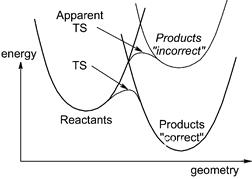
This claim has a natural understanding in terms of a simple diabatic state picture for the reaction. The environment can change the shapes of the diabatic potential energy surfaces and/or change the strength of the coupling of the two surfaces. [For example, in the figure below replace "incorrect" with "no environment" and "correct" with "environment"].


Why is this claim boring?
Well it means that there is nothing that "special" or unique about proteins. There is no new physics or chemistry.
It rules out exotic mechanisms such as dynamic effects and particularly collective quantum effects.

Finding out how an environment does change specific parameters is highly non-trivial.

Furthermore, outstanding, fascinating, and difficult problems remain understanding and describing:

  • how the protein "engineers" the changes in the reaction potential energy surface,
  • how mutations distant from the "reaction centre" can sometimes have such a significant effect,  
  • the role of the hundreds of amino acids not close to the "reaction centre", i.e. why do proteins need be so big? is there a lot of redundancy? or does one really need all those amino acids to produce a highly "tuned" and exquisite tertiary structure?
So is this claim "controversial" or "dogma" or "obvious"? 

Thursday, November 6, 2014

Strong hydrogen bonds can be insensitive to pKa detuning

Previously I posted about the role of short strong H-bonds [sometimes called low-barrier H-bonds] in the enzyme KSI.

There is a very interesting paper
Using Unnatural Amino Acids to Probe the Energetics of Oxyanion Hole Hydrogen Bonds in the Ketosteroid Isomerase Active Site
Aditya Natarajan, Jason P. Schwans, and Daniel Herschlag

The authors report a beautifully designed and implemented experiment. The idea and results are elegantly summarised in the graphical abstract below.


 The key Tyrosine amino acid (Tyr16) is substituted with different fluorinated versions. These have different proton affinities (acidity or pKa) to the native amino acid. It is well established that the strength of a hydrogen bond is maximal when the hydrogen donor and acceptor have the same proton affinity [pKa matching].  This can be naturally understood in terms of a diabatic state model for H-bonding.

The aim of the experiment is to vary the strength of one of the key hydrogen bonds in the enzyme and see what effect it has on the activity of the enzyme. They vary the pKa from 8.35 to 9.95 and find negligible change in the activity of the enzyme. They conclude
The observed shallow dependence of activity on the pKa of the substituted Tyr residues suggests that the KSI oxyanion hole does not provide catalysis by forming an energetically exceptional pKa-matched hydrogen bond. 
I am puzzled because I have the opposite conclusion, i.e. the shallow dependence is what one expects for a strong short H-bond. For strong bonds you need to vary the pKa difference between the donor and acceptor by much more than 2. A pKa difference of 2 corresponds to “detuning” the two diabatic states by about 2.7 kcal/mol [11 kJ/mol]. Experimentally, you can also see this in the two figures below.  The first [Figure 3(d) in this paper] shows the binding energy of a series of strong H-bonds as a function of the difference in proton affinity.

 The second [Figure 2 in this paper] shows the softening of the O-H stretch as a function of the proton affinity difference [in kJ/mol].


Note that in both cases a pKa difference of 2 corresponds to a very small change in the strength of the H-bond.

This is also what one expects from the diabatic state model. For short bonds (donor acceptor distance R about 2.5 A) the diabatic coupling Delta(R) is of order 40 kcal/mol. Hence, detuning the two diabatic states by 3 kcal/mol will have negligible effect on the bond. Thus, I would not expect the pKa changes to have much effect on the enzyme activity.

Saturday, August 23, 2014

Seeing enzyme catalysis with the naked eye

For my latest celebrity scientist speaking gig [at a small church youth group] my glamorous assistant [my wife] found a new demonstration to add to my repertoire, Elephants toothpaste. It is described in this Journal of Chemical Education paper.

Hydrogen peroxide is thermodynamically unstable. However, you can buy bottles of it and they will remain useful for months. It will slowly decompose into water and oxygen.
H
2
O
2
 → 2 H
2
O
 + O
2


However, if you add some iron chloride it acts as a catalyst and increases the decomposition rate by a factor of a thousand. You will see some amount of "bubbling" due to the oxygen gas produced. If blood [which contains haemoglobin] is added the rate increases by a factor of a million. Even better, if you add the enzyme catalase, the rate increases by a factor of a billion. In the demonstration the catalase is present in the yeast that is added. Catalase is one of the fastest catalysts known. It performs an incredibly important biochemical function, that is essential to life existing. Hydrogen peroxide is a strong oxidant  that could destroy many biomolecules. It is also an unwanted byproduct of many biochemical reactions. Biological systems use catalase to rapidly destroy the hydrogen peroxide before it can do harm.

The demonstration I did (and described in the JCE article) makes use of a dilute aqueous solution [a few per cent] of hydrogen peroxide. The spectacular video below makes use of a highly concentrated solution that is quite dangerous because it can cause chemical burns of the skin.


The above discussion follows the beautiful introduction to enzymes in chapter 11 of my favourite biochemistry text by Matthews, van Holde, Appling, and Anthony-Cahill 
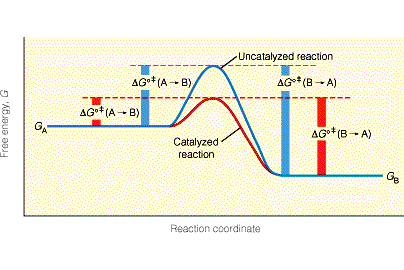
It contains the figure below, illustrating the key idea of how catalysts work: by lowering the energy barrier [the transition state] for a chemical reaction.

Thursday, June 12, 2014

Deconstructing enzyme mechanism

Enzymes are amazing molecules. They increase rates of specific chemical reactions by factors as large as a trillion. Without them there would be no biochemistry and no life. Exactly, how they work remains controversial. Broadly they significantly lower the energy of the transition state for a chemical reaction and thus lower the activation energy, Ea. Since the reaction rate scales with
exp(-Ea/k_B T), lowering the barrier by one electron volt (23 kcal/mol) has a dramatic effect.

But, how is this lowering of the transition state achieved? There is no doubt that simple electrostatic effects can make a major contribution, as emphasised by Ariel Warshel. From the point of view of quantum physics, this is rather "boring". But, thats good science: going with the best and simplest explanation.
However, that is not the whole story, and particularly not for all enzymes.

One enzyme that is attracting significant interest is (KSI) keto-steroid isomerase, highlighted by nice work from the groups of Steve Boxer and Daniel Herschlag at Stanford. This enzyme catalyses the conversion of cholesterol into steroids such as oestrogen and testosterone.

Understanding has advanced by clever studies performing mutations [replacing specific amino acids in the protein by others] and replacing the reactant with a simpler phenol group with tuneable acidity, and seeing how the enzyme structure and catalytic power change.
Here are two short commentaries that put that work in context.

What Governs Enzyme Activity? For One Enzyme, Charge Contributes Only Weakly 
Richard Robinson

 Biochemistry: Enzymes under the nanoscope 
Anthony J. Kirby and Florian Hollfelder

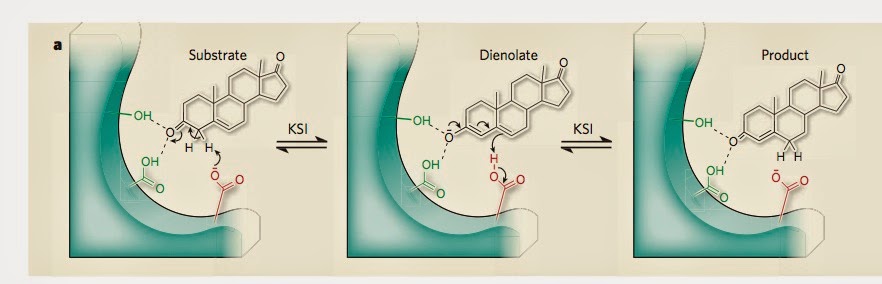
The figure below [taken from the second commentary] how the substrate [reactant] is hydrogen bonded to two tyrosine [amino acids] molecules. The hydrogen network is crucial to the stabilisation of the transition state (middle panel).


That commentary emphasises how small changes in the hydrogen bond lengths [as little as 0.1 Angstroms] produce significant changes in the enzyme catalytic power. But, even engineering such a
small decrease is difficult.
This result has wide-reaching implications: it defines experimentally the distance scale on which enzymes can distinguish geometric rearrangements of atoms, and determines the energetic consequences of this constraint. The picometre-precision of KSI also explains why protein engineering to produce enzymes that have new or altered functions has proved so difficult.
The last statement refers to the grand challenge of trying to do "bio-mimetics" and produce artificial catalysts that could have the incredible power of enzymes.

This structural sensitivity also prevents a significant challenge to structural biology [a.ka. protein crystallography] and computational molecular modelling.  Distance resolutions of 0.1 A are at the boundary of the best protein X-ray crystallography. For  hydrogen bonds density functional theory based calculations are not that reliable on this length scale. Classical molecular dynamics cannot even describe moderate to short bonds.

I am particularly interested in KSI because of the presence of short to medium strength hydrogen bonds in which quantum nuclear effects play a role. The figure below is taken from this paper.


For such bonds changes in H-bond lengths of 0.1A can produce significant changes in the proton transfer potential. 
Furthermore, the interpretation of hydrogen-deuterium isotope substitution experiments will be complicated by the secondary geometric isotope effect.

Tuesday, February 12, 2013

Enzymes are not different just better

Before I gave my talk in Bangalore about proton transfer in enzymes I reviewed some of the recent literature since I have not worked on the problem for a few years.

I found a very nice paper in Nature Chemistry
Taking Ockham's razor to enzyme dynamics and catalysis
by David R. Glowacki, Jeremy N. Harvey, and Adrian J. Mulholland

They consider a simple transition state model for the anomalous kinetic isotope effects that have been observed in several enzymes. These anomalies have previously been claimed to be evidence for quantum tunneling, breakdown of transition state theory, and require a new paradigm for enzyme catalysis.
The key feature of their model is the assumption that there are two transition states, not one, being associated with two possible conformations of the enzyme-substrate complex.

They end the paper quoting a 1991 Nature paper by Jeremy Knowles
Enzyme catalysis: Not different, just better.

Another nice reference removing the almost mystical interpretation of proteins [and containing some nice thermodynamics] is
Protein heat capacity: An anomaly that maybe never was by Alan Cooper.
I need to read it.

There is an important lesson here, particularly for proponents of "quantum biology". Extra-ordinary explanations require first ruling out simpler less glamorous explanations.

Tuesday, July 3, 2012

Developing science demonstrations that actually teach science

Demonstrations to school students can easily degenerate into the following format. First, one does something spectacular such as the Coke-Mentos fountain or the barrel crush. Second, one tells the student how it works. I confess I have often done this. However, this is actually terrible because it reinforces the misconception that science is a noun not a verb. It teaches nothing about the scientific method.

This week my wife and I demonstrated the Coke-Mentos fountain to a group of kids at a holiday club that my church was running. In order to promote critical thinking we did some comparative measurements. The fountain was done for diet Coke, Solo (a lemon drink), and generic brand (Coles) Cola. We also compared Mentos bought in the USA (on my recent trip) and in Australia. It turned out that the former is much more effective. I later learnt that we had been scooped in this important scientific discovery. It had already been published on YouTube!


I also discovered there is some nice literature on the subject.

Mentos and the Scientific Method: A Sweet Combination in the Journal of Chemical Education.

Diet Coke and Mentos: What is really behind this physical reaction? in the American Journal of Physics. They have some impressive apparatus for making quantitative measurements. They also found that playground sand was almost as good as Mentos.
They report surface analysis studies of the Mentos, highlighting the importance of the surface roughness for nucleation sites for CO2 bubbles.

The Ultrasonic Soda Fountain: A Dramatic Demonstration of Gas Solubility in Aqueous Solutions in the Journal of Chemical Education

“Can we do That Again?” Engaging Learners and Developing Beyond the “Wow” Factor in the Science Education Review.

Finally, having good apparatus helps. From Steve Spangler science we purchased a Geyser Tube which feeds the Mentos into the Coke. With the recommended 7 US Mentos we observed fountains of 2-3 metres!

Thursday, June 28, 2012

Refuting the dynamic hypothesis for enzymes

How do enzymes work? Are they any different from other catalysts?
The traditional view is no. They simply lower the energy barrier of the transition state between the reactants and products. The only difference from man-made catalysts is that due to their complexity (and evolution) enzymes can lower this barrier by more than
an eV leading to an increase in reaction rate by tens of orders of magnitude.

In the traditional view the only role of the dynamics of the nuclei in the enzyme is that statistical thermal fluctuations provide access to the transition state. Furthermore, quantum dynamics of the nuclei does not play any significant role. Tunneling below the barrier may provide small corrections to the reaction rate for light nuclei such in proton, hydrogen, or hydride (hydrogen anion) transfer reactions.

Over the past decade some people have been advocating a radical non-traditional view of how (some) enzymes work. They claim that non-trivial (and non-local) dynamics plays
a key role. I think it should be emphasized that this is a radical point of view.
Proponents of this view include Steven Schwartz and Judith Klinman.
They also emphasize the role of quantum tunneling and suggest that enzymes have evolved to enhance it.
I have a paper which is skeptical of quantum tunneling playing a significant role.
A disparaging opponent of dynamical effects is Arieh Warshel.

At the worshop yesterday Tom Miller gave a stimulating talk based on a recent PNAS paper Dynamics and dissipation in enzyme catalysis. He addresses this controversy considering the specific case of hydride transfer in dihydrofolate reductase. This has attracted interest because double mutants (very distant from the active site) lead to non-additive effects on the rate activation energy.

Boekelheide, Salomón-Ferrer, and Miller calculated the reaction rate using a path integral approach (ring polymer molecular dynamics = RPMD)  for which it is claimed
In contrast to mixed quantum-classical and transition state theory methods, RPMD yields reaction rates and mechanisms that are formally independent of the choice of dividing surface or any other reaction coordinate assumption 
They compared both statistical and dynamical correlations in the enzyme nuclei in the reactant state, transition state, and product state. The former were sizeable over different parts of the enzyme as one might expect from its rigidity. However, the dynamical correlations were only significant close to the hydride donor and acceptor.

This talk led to the most animated discussion in the workshop so far. I got the impression (perhaps wrongly) that some people were concerned
  • whether one could make a clear division between statistical and dynamical correlations
  • whether the RPMD is really as assumption free as claimed
  • one should not be surprised the claimed dynamical correlations do not exist
  • transition state theory is very robust.
A recent PNAS paper from Steve Boxer's group addressed the issue (on a different enzyme) from an experimental view. It concluded that simple electrostatics (as advocated by Warshel) rather than dynamics were determinant.

A recent Nature Chemistry Perspective argues that transition state theory is adequate to describe enzymes.

Similar issues about protein dynamics are also relevant for claims of quantum coherent effects in photosynthetic proteins (an earlier post discussed work showing that the claimed dynamical correlations did not exist.)

Monday, March 26, 2012

Getting nervous at the biomolecular dance

Enzymes are amazing.
Today I went to an interesting chemistry seminar today by Ian Dance,
Nitrogenase reduces N2 to NH3 and CO to hydrocarbons. What chemistry is used?
It was also a David Craig lecture and was a model seminar for a general audience.

A major industrial process is the fixation of nitrogen to from ammonia.
N2 + 3H2 -> 2 NH3.
This is done via the Haber-Bosch process and requires pressures of 1000 atm and high temperatures of 450 degrees C with iron or ruthenium as catalysts.

However, nature does this at room temperature and pressure via nitrogenase enzymes. A surprising recent discovery was that vanadium nitrogenase can also reduce carbon monoxide to small hydrocarbons.

Dance used an interesting dance (!) metaphor during the talk. You need a stage [key part of the enzyme], centre stage [the active sites], dancers [the intermediate states], and a choreography [reaction mechanisms].

The stage for nitrogenase is shown below. the FeMo-co, which can be viewed as two  cubes [one is Fe4S3 and one Fe3MoS3] that have been fused together at a N vertex. Only very recently was the N atom seen in the enzyme structure.

Previously it was thought that the Mo atom on the bottom was the active site but now it is believed to be a pair of the Fe ions in the upper cube.

Something I thought were particularly interesting:
To obtain a good supply of protons to the active site one possible mean is a chain of hydrogen bonded water molecules [see the orange circles below].

A few things in the talk made me nervous.
All the calculations are based on some version of DFT. There was no mention of what functional was used, basis sets, convergence tests, or benchmarking.
Dance is using his own personal method for finding transition states.
It is not clear that he has a ground state with the correct spin, S=3/2.
There are tens of "molecular orbitals" [presumably actually Kohn-Sham orbitals] within about 1 eV of the so-called "HOMO" and "LUMO".
All the calculations are done in gas phase without implicit or explicit solvent (water + protein).
Many of the calculated activation energies are in the range 2-20 kcal/mol [0.1-1 eV for the physicists]. Is DFT really very reliable on this scale for such large molecules, particularly including 8 transition metal atoms?
Because the calculation gives too large an activation energy compared to experiment it was suggested that proton tunneling may occur below the barrier. [Apparently, it is not possible to test this hypothesis experimentally with isotope substitution.] [My experience with proton tunneling in enzymes is that this is subtle and murky issue].

Much of the material in the talk is in a summary paper

Saturday, December 4, 2010

Deconstructing H atom transfer in enzymes

Yesterday I had a really helpful discussion with Judith Klinman about the question of quantum tunneling of hydrogen in enzymes. [An accessible summary of her point of view is a recent Perspective with Zachary Nagel in Nature Chemical Biology].
Here are a few points I came to a better appreciation of:

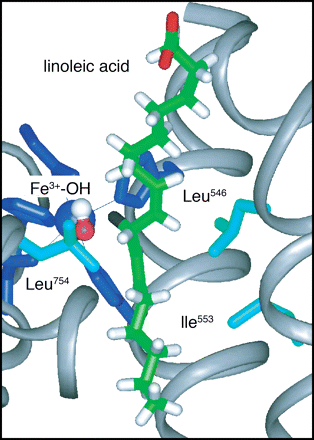
There are a number of enzymes (e.g. soybean lipoxygenase) which have very small activation energies (Ea~0-2 kcal/mol ~ 100 meV) for hydrogen atom transfers. (n.b. this is a coupled electron and proton transfer). They exhibit kinetic isotope effects which are
  • very large in magnitude (~100)
  • weakly temperature dependent (difference in Ea for H and D ~ 1 kcal/mol ~ 50 meV)
  • change their temperature dependence significantly with mutation

[In the figure above the hydrogen atom (black in the centre of the figure) is transfered to the oxygen atom (red, to the left of the H atom). Mutations correspond to substituting the amino acids Ile553 and/or Leu754.]

The key physics is the following (originally proposed by Kutzenov and Ulstrup) which might be viewed as the proton version on Marcus-Hush electron transfer theory. A JACS paper by Hatcher, Soudakov, and Hammes-Schiffer gives a more sophisticated treatment, including molecular dynamics simulations to extract model parameter values.

The proton directly tunnels between the vibrational ground states of the reactant and product. The isotope effect arises because the spatial extent of the vibrational wavefunction is different for the two isotopes. The temperature dependence of the isotope effect is determined by vibrations of the relative positions of the donor and acceptor atoms.

The main problem or challenge that this model has is the following. The simplest model treatment deduces that the tunneling distance is 0.66 Angstroms [which is less than the van der Waals radii?] and that this increases significantly, up to 2.6 A with mutations. Hammes-Schiffer gets smaller variations, which are more realistic.

However, recent determinations of the crystal structures of the mutants show some structural changes but they do not clearly correlate with the changes in kinetics. In particular there are no detectable changes in tunneling distance. Klinman takes this as evidence for the important role of dynamics.
But, perhaps these structural changes lead to changes in the potential energy surface which  in turn changes the amount of tunneling. Things I would like to see include:
-DFT calculations of the potential energy surfaces for the different mutations
-an examination of the Debye-Waller factors for the donor and acceptor atoms in the different mutant structures.
-an examination of non-Born-Oppenheimer effects [which will be isotope dependent].

Note added later: I just found a recent paper by Edwards, Soudakov, and Hammes-Schiffer which uses molecular dynamics to show how the mutations change the tunneling distance and frequency and consequently the kinetic isotope effect. The abstract figure is below.

Thursday, October 7, 2010

Can a chemist synthesize this molecule?

Research in chemistry is all about making new molecules.
I have written a few previous posts about organometallic compounds and transition metal catalysts. Hence, it was interesting to see the 2010 Nobel Prize in Chemistry awarded for "palladium-catalyzed cross couplings in organic synthesis".
I got the picture above from the scientific background which is worth reading. The basic idea seems to be that one whats to form a carbon-carbon bond between R and R'' and this can be catalysed by first forming the R''-Pd-R intermediate.

What can theorists say about this chemistry? I found an interesting looking paper by Shaik (one of my favourite quantum chemsists) and collaborators which uses DFT to study this problem.

Tuesday, September 21, 2010

Effective Hamiltonian for atom-surface interactions

Why and how do atoms chemically bond to surfaces?
This can be described by the Newns-Anderson model Hamiltonian.
A nice brief overview is the chapter on Hetergeneous Catalysis by Bligaard and Norskov, from the book Chemical Bonding at Surfaces and Interfaces.

Friday, September 10, 2010

Why do molecules bond to metal surfaces?

This week Elvis Shoko, Seth Olsen, and I read more of the beautiful review article, by Roald Hoffmann, A chemical and theoretical way to look at bonding on surfaces.

One of the key ideas I learnt was how chemical bonding between a metal surface and a molecule can have a completely different physical mechanism than between just molecules.
The left side shows how the interaction between two molecules due to the two filled highest orbitals is repulsive.  
In contrast, similar interactions between a molecular orbital and a filled metal orbital can be attractive because once the metal-molecule interaction is strong enough to push the anti-bonding orbital above the Fermi energy, there can be charge transfer to unoccupied metal states.


The Figure above shows the energy of interaction as a function of the distance of the molecule from the surface. This also provides an understanding of the energy barrier to chemisorption of the molecule on the surface.

Friday, August 20, 2010

Chemical bonding at surfaces

I have started reading (with Seth Olsen and Elvis Shoko) a beautiful Reviews of Modern Physics article by Roald Hoffmann, A chemical and theoretical way to look at bonding on surfaces.
A key idea he discusses is that chemisorption is a compromise: metal-absorbate bonding is accomplished at the expense of bonding within the absorbed molecule and within the metal.

One question I am interested in is:
How do strong electronic correlations modify the picture Hoffmann presents using molecular orbitals and bands?

Monday, August 9, 2010

Deconstructing solid oxide fuel cell materials

In Seattle, I had a really interesting and helpful discussion with Charlie Campbell about doped rare earth oxides.

Cerium oxides have attracted a lot of industrial attention because they have an amazing ability to reversibly release and uptake oxygen. [Just like hemoglobin in your blood!]. Hence, along with many others I thought this was a fundamental issue about pure cerium oxide. However, it turns out all the industrial materials (such as solid oxide fuel cells) are doped with transition metal ions. So the fundamental problem is the following: mixed alloys of ceria and zirconia (ZrO2) have this large uptake-release capacity; it is much larger than pure zirconia or pure ceria.

This paper [which my Indian colleagues made me aware of when I visited Bangalore earlier this year] examines the corresponding question for titania-ceria alloys. [A paper on zirconia-ceria is here.] They find that in the alloys there is a significant relaxation of the oxygen sublattice. In particular four of the metal-oxygen bonds become much longer, reflecting weak bonding of oxygen.

I wonder whether
-thinking about a Jahn-Teller distortion could be helpful here?
-there are high resolution crystal structure data that is amenable to the bond valence sum analysis similar to that performed here.

Wednesday, August 4, 2010

A sticking point for DFT?


When is it time to mothball Density functional theory? [sorry for the second pun..]

Yesterday I had a nice meeting with Charlie Campbell and members of his group at the University of Washington. It was fascinating to see their lab (as a theorist it is always a reality check!) . Over the past decade they have developed several high resolution microcalorimeters which allow accurate determination of the binding energies of different atoms and molecules to specific surfaces. These results present a significant challenge/benchmark for electronic structure methods (such as density functional theory) which claim to be able to calculate accurately such quantities. The results are also of fundamental importance for understanding mechanisms of heterogeneous catalysis.

I found results for adsorption of benzene and napthalene on Pt particularly interesting. They are summarised in the Figure above. DFT gets a binding energy which is too small by almost a factor of three.

I discovered my friends Jeff Reimers and Noel Hush are co-authors of a paper, Adsorption of Benzene on Copper, Gold, and Silver surfaces, where they do a systematic comparison of DFT with higher level quantum chemisty. [complete-active-space self-consistent field theory with second-order Møller−Plesset perturbation corrections (CASPT2) for the interaction of benzene with a Cu13 cluster model for the Cu(110) surface].

A couple of other interesting things they state:

For all systems, the bonding is found to be purely dispersive in nature with minimal covalent character.....
this cluster [of 13 Cu atoms] is actually too reactive and provides a poor chemical model for the system.

A fundamental question arises as to whether DFT is gets the wrong results just because it is bad at dispersion forces or whether there are other strongly correlation effects at play. I would have thought the latter since both benzene is strongly correlated and Pt is moderately correlated that there may be more to it than dispersion forces.

Below are the measured adsorption energies of different alkanes on three different surfaces. The straight lines suggest that there is also a well defined binding energy per carbon atom.


Tuesday, August 3, 2010

Where does the excess charge go?

Here is the current version of the slides for a talk, "Charge redistribution near oxygen vacancies in cerium oxides", that I am giving tomorrow in the Chemistry Department at University of Washington.


The main point of the talk is that the standard model of charge localisation (pictured above) is incorrect. A detailed discussion is contained in a review co-authored with Elvis Shoko and Michael Smith.

Saturday, July 31, 2010

A sleepless seminar in Seattle

Next tuesday I am visiting the Chemistry Department at University of Washington. I am giving a seminar on "Charge distribution near oxygen vacancies in cerium oxides". It is based on Elvis Shoko's Ph.D thesis work, also done with Michael Smith. A nice summary is in a review article we just published. I will post a copy of the talk when it is ready, but it will be similar to a seminar that Elvis gave at the oral defense of his thesis.

At UW I am looking forward to meeting Charlie Campbell and Xiaosong Li. Unfortunately, Oleg Prezhdo will not be there because he is moving to Rochester.

Tuesday, April 27, 2010

Gold may rust (and increase its value)

G.U. Kulkarni gave a really nice talk at the conference from which I learnt a few fascinating things about gold nanoparticles. He is co-author of a nice concise review, Size Dependent Chemistry: Properties of Nanocrystals.

Bulk gold surfaces are inert because the dissociative chemisorption energy of oxygen is positive unlike all other metallic elements [Nolan, Accounts Chem. Res. 1998]. However, this energy can be negative for nanoparticles.

Another key property of gold nano-particles is that there is a plasmon collective mode associated with the surface electrons and lies in the visible.

Heterogeneous catalysis with nanoparticles can be enhanced because of the large fraction of atoms on the surface. e.g., for 100 atoms, 50% are on the surface.

Pollution control in cars is achieveed by a catalytic converter which converts CO to CO2 using Pt-Pd, Pt-Rh catalysts.
Problems: expensive materials and bed has to be heated, leading to a search for alternative catalysts.

Au/TiO2 [gold nanoparticles on titania surfaces] is a good catalyst. Hurata (1984) made this revolutionary discovery, which was unexpected because gold was expected to be inert.

25 years later, it still seems anatase TiO2 is the best substrate. A key property is multiple oxidation states of Ti that are possible in titania.
Another key is the strong coupling of delocalised electrons on metal nano-particle surface and oxygen atom on titania surface. [see DFT paper, ref?]

It seems optimum size of gold is about 2-3nm.
Why does it work? Not just high surface area but also electronic structure of gold nano-particle which can undergo a metal-insulator transition as a function of size.

Monday, January 11, 2010

A basic question about novel energy materials

A fundamental scientific question of technological importance concerning oxides of transition metals and rare earths is:

When an oxygen atom is removed from a bulk crystal of the oxide where do the two excess electrons go?

Elvis Shoko, Michael Smith, and I recently finished a review article which answers this question for the case of cerium oxide.

The approach we took was to consider high resolution crystal structures of
Ce11O20 and Ce7O12 and see how they could be viewed as ordered arrays of oxygen vacancies in an underlying CeO2 crystal. The charge distribution in the local environments of the O vacancies can then be deduced from the bond valence model.

An important finding we make is that the results are incompatible with the widely accepted standard picture of charge localization on two cerium ions next to the vacancy. Instead, we found that the charge distributes itself predominantly in the second coordination shell of cerium ions. Furthermore, one excess electron can be delocalised over more than one cerium ion.

Our conclusions concerning the charge distribution near oxygen vacancies are significant for several reasons.
First, they contradict many (but not all) atomistic simulations based on density functional theory.
Second, the actual charge distribution around the defect has important implications for the other questions we posed at the beginning of the review. For example,

1. the charge distribution has a significant effect on the relative stability of surface and subsurface vacancies.

2. the charge around oxygen surface and subsurface vacancies is not simply localised on Ce ions next to the vacancy this could change our understanding of the catalytic activity of these surfaces since it has been claimed or assumed that it is associated with Ce3+ ions at the surface.

3. the charge distribution around the vacancies has implications for the relative importance of electronic and ionic conduction, a subject we have discussed in this preprint.

What does this movie tell us about the modern university?

Last night, my wife and I watched the movie, Wit. You can watch the full movie here  (free with ads). I should warn that some of the conten...