Showing posts with label hydrodynamics. Show all posts

Monday, September 22, 2025

Turbulent flows in active matter

The power of toy models and effective theories in describing and understanding emergent phenomena is illustrated by a 2012 study of the turbulence in the fluid flow of swimming bacteria.

Meso-scale turbulence in living fluids

Henricus H. Wensink, Jörn Dunkel, Sebastian Heidenreich, Knut Drescher, Raymond E. Goldstein, Hartmut Löwen, and Julia M. Yeomans

They found that a qualitative and quantitative description of observations of flow patterns, energy spectra, and velocity structure functions was given by a toy model of self-propelled rods (similar to that proposed for flocking of birds) and a minimal continuum model for incompressible flow. For the toy model, they presented a phase diagram (shown below) as a function of the volume fraction of the fluid occupied by rods and the aspect ratio of the rods. There were six distinct phases: dilute state (D), jamming (J), swarming (S), bionematic (B), turbulent (T), and laned (L). The turbulent state occurs for high filling fractions and intermediate aspect ratios, covering typical values for bacteria.


The horizontal axis is the volume fraction, going from 0 to 1.

The figure below compares the experimental data (top right) for the vorticity and the toy model (lower left) and the continuum model (lower right).

Regarding this work, Tom McLeish highlighted the importance of the identification of the relevant mesoscopic scale and the power of toy models and effective theories in the following beautiful commentary taken from his book, The Poetry and Music of Science

“Individual ‘bacteria’ are represented in this simulation by simple rod-like structures that possess just the two properties of mutual repulsion, and the exertion of a constant swimming force along their own length. The rest is simply calculation of the consequences. No more detailed account than this is taken of the complexities within a bacterium. It is somewhat astonishing that a model of the intermediate elemental structures, on such parsimonious lines, is able to reproduce the complex features of the emergent flow structure. 

Impossible to deduce inductively the salient features of the underlying physics from the fluid flow alone—creative imagination and a theoretical scalpel are required: the first to create a sufficient model of reality at the underlying and unseen scale; the second to whittle away at its rough and over-ornate edges until what is left is the streamlined and necessary model. To ‘understand’ the turbulent fluid is to have identified the scale and structure of its origins. To look too closely is to be confused with unnecessary small detail, too coarsely and there is simply an echo of unexplained patterns.”

Wednesday, June 11, 2025

Pattern formation and emergence

Patterns in space and/or time form in fluid dynamics (Rayleigh-Bénard convection and Taylor-Couette flow), laser physics, materials science (dendrites in the formation of solids from liquid melts), biology (morphogenesis), and chemistry (Belousov-Zhabotinsky reactions). External constraints, such as temperature gradients, drive most of these systems out of equilibrium. 

Novelty. 

The parts of the system can be viewed as the molecular constituents or small uniform parts of the system. In either case, the whole system has a property (a pattern) that the parts do not have.

Discontinuity. 

When some parameter becomes larger than a critical value, the system transitions from a uniform state to a non-uniform state. 

Universality. 

Similar patterns, such as convection rolls in fluids, can be observed in diverse systems regardless of the microscopic details of the fluid. Often, there is a single parameter, such as the Reynolds number, which involves a combination of fluid properties, that determines the type of patterns that form. Cross and Hohenberg highlighted how the models and mechanisms of pattern formation across physics, chemistry, and biology have similarities. Turing’s model for pattern formation in biology associated it with concentration gradients of reacting and diffusing molecules. However, Gierer and Meinhardt showed that it is sufficient to have a network with competition between short-range positive feedback and long-range negative feedback. This could occur in a circuit of cellular signals.

Self-organisation. 

The formation of a particular pattern occurs spontaneously, resulting from the interaction of the many components of the system.

Effective theories. 

A crystal growing from a liquid melt can form shapes such as dendrites. This process involves instabilities of the shape of the crystal-liquid interface. The interface dynamics are completely described by a few partial differential equations that can be derived from macroscopic laws of thermodynamics and heat conduction. A helpful review is by Langer. 

Diversity. 

Diverse patterns are observed, particularly in biological systems. In toy models, such as the Turing model, with just a few parameters, a diverse range of patterns, both in time and space, can be produced by varying the parameters. Many repeated iterations can lead to a diversity of structures. This may result from a sensitive dependence on initial conditions and history. For example, every snowflake is different because, as it falls, it passes through a slightly different environment, with small variations in temperature and humidity, compared to others.

Toy models. 

Turing proposed a model for morphogenesis in 1952 that involved two coupled reaction-diffusion equations. Homogeneous concentrations of the two chemicals become unstable when the difference between the two diffusion constants becomes sufficiently large. A two-dimensional version of the model can produce diverse patterns, many resembling those found in animals. However, after more than seventy years of extensive study, many developmental biologists remain sceptical of the relevance of the model, partly because it is not clear whether it has a microscopic basis. Kicheva et al., argue that “pattern formation is an emergent behaviour that results from the coordination of events occurring across molecular, cellular, and tissue scales.” 

Other toy models include Diffusion Limited Aggregation, due to Witten and Sander, and Barnsley’s iterated function system for fractals that produces a pattern like a fern.


Here is a beautiful lecture on Pattern Formation in Biology by Vijaykumar Krishnamurthy


Tuesday, October 18, 2022

Self-organisation in complex fluids

 I am at the beach this week and so a lot of time is spent staring at waves, clouds, sunsets, and patterns in the sand. There is a lot of beauty and a lot of beautiful science, most of which I know only a little about. For example, what is the essential physics and simplest theory that can explain the patterns below?


To start understanding the beautiful patterns seen in natural systems I have found helpful the two-page Quick Study in Physics Today

The universe in a cup of coffee by John Wettlaufer
Your morning java or tea is a rotating, cooling laboratory that reflects the physics of such large-scale phenomena as stellar dynamics and energy transport in Earth’s atmosphere and oceans. 
A nice demonstration is to put the hot liquid in a glass jar and then just add a few drops of cold milk and see the beautiful patterns that emerge.

The key idea is there is a balance between thermal bouyancy (hot air rises) and viscous stresses. This balance can lead to symmetry breaking and self-organisation. In planetary systems rotation can play a significant role, particularly when there is a balance of viscous forces and the coriolis force. This can lead to the formation of vortices. The Quick Study includes snapshops from a video that is worth watching,  supplementary material from this PRL.

The article also discusses the importance of Rayleigh-Benard convection in many geophysical phenomena. Something interesting I learnt is that this is actually a misnomer, as is often the case in science. According to Wikipedia, 
This pattern of convection, whose effects are due solely to a temperature gradient, was first successfully analyzed in 1916 by Lord Rayleigh (1842–1919).[16] Rayleigh assumed boundary conditions in which the vertical velocity component and temperature disturbance vanish at the top and bottom boundaries (perfect thermal conduction). Those assumptions resulted in the analysis losing any connection with Henri Bénard's experiment. This resulted in discrepancies between theoretical and experimental results until 1958, when John Pearson (1930– ) reworked the problem based on surface tension.[9] This is what was originally observed by Bénard.

Monday, August 9, 2021

Emergence of complex patterns

I think it is amazing how in the universe we see diverse and beautiful patterns and structures. Even relatively simple systems can self-organise to produce things one would not expect or predict. Consider clouds, turbulent flows, leopard spots, a tree leaf, spiral galaxies, biological cells...
It is also amazing and beautiful that we can develop relatively simple mathematical models that can produce similar patterns.
This is emergence!

Here is a beautiful example that recently came to my attention.

The associated PRL is

Faraday-Wave Contact-Line Shear Gradient Induces Streaming and Tracer Self-Organization: From Vortical to Hedgehoglike Patterns

Héctor Alarcón, Matías Herrera-Muñoz, Nicolas Périnet, Nicolás Mujica, Pablo Gutiérrez, and Leonardo Gordillo

There is also a Physics story too.

Wednesday, March 14, 2018

"Bad fluids" near the superfluid transition

There is an interesting preprint
Viscosity Bound Violation in Viscoelastic Fermi Liquids 
 Matthew P. Gochan, Hua Li, Kevin S. Bedell

They consider the unitary Fermi gas within the framework of Fermi liquid theory. This system undergoes a superfluid transition at a temperature of about 0.17 times T_F (the Fermi temperature). They calculate the shear viscosity as a function of temperature. (I think) the complete temperature dependence is obtained by interpolating between the low-temperature and high-temperature limits.

The motivation for the study is the conjectured universal bound for the ratio of the shear viscosity to the entropy density, based on the AdS-CFT conjecture, beloved by string theorists.

The authors find that the conjectured bound is violated because the viscosity can become arbitrarily small near the superfluid transition due to large scattering from superfluid fluctuations. This is because the mean free path becomes arbitrarily small, i.e. the system is similar to a bad metal.
Unfortunately, the preprint does not reference some earlier relevant work on the shear viscosity of the unitary Fermi gas or on the bad metal near a Mott transition.

I thank Alejandro Mezio for bringing the preprint to my attention.

Tuesday, August 23, 2016

Violation of AdS-CFT bounds on the shear viscosity

Tomorrow I am giving a seminar on the absence of quantum limits to the shear viscosity in the Theoretical Physics department at the Stefan Institute in Ljubljana, Slovenia.

Here is the current version of the slides.
The main results are in this paper.


This is Lake Bled, a popular tourist destination outside the city.


Wednesday, June 29, 2016

Viscosity talk in Telluride

Tomorrow I am giving a talk on the absence of quantum limits to the shear viscosity at the Telluride workshop on Condensed Phase Dynamics.
Here are the slides.
The main results are in this paper.

Monday, June 13, 2016

Quantum viscosity talk

Tomorrow I am giving the weekly Quantum sciences seminar at UQ.
Here are my slides.

The title and abstract below are written to try an attract a general audience.

I welcome any comments.

TITLE: Absence of a quantum limit to the shear viscosity of strongly interacting fermion systems

ABSTRACT: Are there fundamental limits to how small the shear viscosity of a macroscopic fluid can be? Could Planck’s constant and the Heisenberg uncertainty principle determine that lower bound? In 2005 mathematical techniques from string theory and black hole physics (!) were used to conjecture a lower bound for the ratio of the shear viscosity to the entropy of all fluids. From both theory and experiment, this bound appears to be respected in ultracold atoms and the quark-gluon plasma. However, we have shown that this bound is strongly violated in the "bad metal" regime that occurs near a Mott insulator, and described by a Hubbard model [1]. I will give a basic introduction to shear viscosity, the conjectured bounds, bad metals, and our results.

[1] N. Pakhira and R.H. McKenzie, Phys. Rev. B 92, 125103 (2015).

Wednesday, May 11, 2016

Quantum limit for the shear viscosity of liquid 3He?

Next month I am giving two versions of a talk, "Absence of a quantum limit to the shear viscosity in strongly interacting fermion fluids." The first talk will be a UQ Quantum science seminar and the second at the Telluride workshop on Condensed Phase Dynamics. These are quite different audiences, but both will not be so familiar with the topic and so I need good background slides to introduce and motivate the fascinating topic.

The talk is largely based on a recent paper with Nandan Pakhira.

Here is one of the slides I am working on.
Some of the points I want to make here are the following.

There is experimental data on real systems.
This graph shows how for liquid 3He the shear viscosity varies by 3 orders of magnitude.

Here the shear viscosity decreases with increasing temperature (while the mean-free path gets shorter). This is counter-intuitive, a feature shared by dilute classical gases.

Fermi liquid behaviour is seen at low temperatures with the viscosity scaling with the scattering time (and mean free path) which is inversely proportional to T^2.

The last point is the most important.

At "high" temperatures, above the Fermi liquid coherence temperature (about 50 mK), the shear viscosity becomes comparable to the value n hbar (where n is the fluid density), which was conjectured by Eyring 80 years ago to be a minimum possible value.
This also corresponds to the Mott-Ioffe-Regel limit (where the mean free path is comparable to the inter particle spacing) (bad metal).

Aside: I still think it is amazing that when scaled with the density the viscosity [a macroscopic quantity] has the same units as Planck's constant. Just like h/e^2 is in ohms.

An earlier post considers similar issues for the unitary Fermi gas, that can be realised in ultra cold atom systems.

The big question addressed by the paper and talk is whether the comparable values are just a coincidence and whether by increasing the interactions you can go below the quantum limit.

Thursday, March 10, 2016

The puzzling relationship between the shear viscosity and the mean-free path

What is your intuition about the shear viscosity of a simple fluid?
Suppose that the mean-free path of the particles increases (e.g. due to a decrease in density, pressure, or temperature).
Would you expect the viscosity to increase or decrease?
Surely, the less collisions (as the mean-free path increases) the less the "stickiness" of the fluid.
However, it is not so simple.

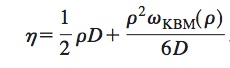
Long ago Maxwell showed that for a dilute gas that the viscosity eta increases linearly with the mean-free path (which is proportional to the the self-diffusion constant D) and eta is independent of the density. A more rigorous derivation was given by Chapman and Enskog's solution of the Boltzmann equation. The exact relation is
where rho is the density and C(T)=0.83 for hard spheres. This is also what one finds for a Fermi liquid (which makes sense since it involves weakly interacting quasi-particles with long mean-free paths).

However, in the dense limit, one finds that the Stokes-Einstein relation holds
where R is the size of a molecule and c a constant of order 1.
Now, the viscosity is inversely proportional to the mean-free path, more in keeping with most people's intuition: the greater the collisions the greater the "stickiness" of the fluid.

How does one understand this crossover?
A paper by Rah and Eu is helpful. They point out how the viscosity has two contributions, the first from the kinetic energy and the second from the inter particle potential. They derive an expression for the total viscosity:
which captures both dilute and dense regimes.

I wrote this because in the luxury journal Science this week there are three experimental papers about the viscosity of the electron fluid in crystals. I found the first paragraph of one paper to be quite confusing. It seems to suggest that some of the issues above are unique to the electron fluid in a crystal and related to subtle issues about different kinds of scattering.

I welcome any insights about these subtle issues.

Monday, September 21, 2015

Emergence and singular asymptotic expansions, II

When is a phenomena truly emergent?
Is there some objective quantitative criteria that one might use to decide?
This is an issue because sometimes discussions of emergence are pretty fuzzy and even flaky.

by Michael Berry that I mentioned in passing in a previous post.

I highly recommend the article as I think it has a very important insight: singular asymptotic expansions provide a concrete criteria for emergence.

Berry considers the specific problem:


He then discusses these examples in detail, including discussions of the asymptotic expansions.

I recommend reading this article before the one by Hans Primas (reviewed in the previous post) as the latter is more technical and philosophical than Berry's.

One thing I think this highlights is that the problem of emergence in quantum systems is neither more or less challenging or interesting than in classical systems, something I argued before.

I have one minor addition to Berry. In quantum many-body systems the singular parameter delta may not just be 1/N, where N = number of particles. It can also be the coupling constant, lambda.  Emergent phenomena are associated with non-perturbative effects. Concrete examples are in the BCS theory of superconductivity and the Kondo effect. In both there is an emergent energy scale  exp(-1/lambda). There is no convergent expansion in powers of lambda. Taylor series around lambda =0 is singular.

Monday, August 24, 2015

Seeking definitive experimental signatures of a Weyl semimetal

Weyl and Dirac semimetals are getting quite a bit of attention. Part of this interest is because of the possible solid state realisation of the chiral anomaly from quantum field theory. One proposed signature is negative longitudinal magnetoresistance. A different, arguably more definitive, signature is in the following paper.

Quantum oscillations from surface Fermi arcs in Weyl and Dirac semimetals 
Andrew C. Potter, Itamar Kimchi, and Ashvin Vishwanath

In a thin slab of material there are "Fermi arc" states on the top and bottom surfaces. When a magnetic field is applied perpendicular to the slab, there are unusual closed orbits (shown below) where an electron can move around the arc on the  top surface, tunnel via a bulk chiral state to the bottom surface, move around the arc on the bottom surface, and then tunnel back to the top surface.

The resulting Shubnikov de Haas oscillations have some unique signatures such as the periodicity and the dependence of the phase of the oscillations on the thickness of the sample.

There is a very nice set of experiments to test these ideas.

Chirality transfer dynamics in quantum orbits in the Dirac semi-metal Cd3As2 
Philip J.W. Moll, Nityan L. Nair, Tony Helm, Andrew C. Potter, Itamar Kimchi, Ashvin Vishwanath, James G. Analytis
The main finding of this study is directly evident in the raw data: while parallel [magnetic] fields lead to a single SdH frequency , an additional higher frequency component Fermi surface associated with the surface oscillations appears for fields perpendicular to the surface. This high frequency is clearly distinguishable from higher harmonics of the low frequency Fermi surface.
Focused Ion Beams were used to prepare samples with different geometries, rectangular and triangular, shown below. In the latter the oscillations associated with chirality are washed out by destructive interference due to the dependence of phase on the slab thickness.
Aside: In Figure 3 they show experimental signatures of hydrodynamic flow.

I thank James Analytis for helpful discussions about this work.

There is a also very nice theory paper.
Axial anomaly and longitudinal magnetoresistance of a generic three dimensional metal 
 Pallab Goswami, J. H. Pixley, S. Das Sarma

It is quite pedagogical, comprehensive in scope, and contains some important new insights. One particularly significant one is that one can get negative magnetoresistance without a Weyl or Dirac metal. Furthermore, in a system with a cylindrical Fermi surface, near the Yamaji angles [normally associated with semi-classical Angle Dependent Magnetoresistance Oscillations (AMRO)] one can have only one partially full Landau level, leading to negative longitudinal magnetoresistance.

Hopefully once I have digested this paper  more I will write something. I am particularly curious as to whether this theory can explain the unusual angle-dependent interlayer magnetoresistance seen in a diverse set of strongly correlated electron metals.

Friday, August 14, 2015

New proposals to measure the shear viscosity of an electron fluid

Recently, several new approaches have been suggested to experimentally measure the viscosity of the electron fluid in a metallic crystal. Previously, I posted about how ultrasound attenuation can be used to indirectly measure the viscosity. However, that method is arguably not sensitive enough for the small viscosities [of the order  n hbar, where n is the electron density] that are of particular relevance to possible quantum limits to the viscosity.

Forcella, Zaanen, Valentinis, and van Der Marel considered electromagnetic properties of viscous charged fluids, finding new possible signatures due to the viscosity such as negative refractive index, a frequency dependent peak in the reflection coefficient, and a strong frequency dependence of the phase. However, they note that these effects may be difficult to observe for viscosities of the order
of the quantum limit, n hbar.

Tomadin, Vignale, and Polini considered a two-dimensional electron fluid in a Corbino disk device
in the presence of an oscillating magnetic flux. They showed that the viscosity could be determined from the dc potential difference that arises between the inner and the outer edge of the disk.  In particular, for viscosities of the order of n hbar, the potential difference varied significantly  oscillation frequencies in the MHz range.

Levitov and Falkovich recently considered the flow of an electron fluid in a micrometer scale channel in the hydrodynamic regime, where the electron-electron collision rate is much larger than the momentum relaxation rate. They found that when the viscosity to resistance ratio is  sufficiently large viscous flow occurs producing vorticity and a negative nonlocal voltage. [See the figure below].
Spatially resolved measurements of the voltage allow determination of the magnitude of the viscosity.

Torre, Tomadin, Geim, and Polini  considered the electron liquid in graphene in the hydrodynamic regime and showed that the shear viscosity could be determined from measurements of non-local resistances in multi-terminal Hall bar devices.

Although these last three proposals are promising for the two-dimensional electron fluids in graphene and semiconductor heterostructures fabrication of the relevant micron-scale devices will be particularly challenging for bad metals such as cuprates and organic charge transfer salts.

Wednesday, August 12, 2015

Shear viscosity: from dilute gases to dense liquids

I have received a lot of helpful feedback on a recent paper about shear viscosity in strongly interacting quantum fermion fluids. As a result I have learnt some interesting things that I will post about. Here is the first one.

The shear viscosity can be written in terms of a Kubo formula which is an unequal time correlation function of the stress energy tensor.
In a general fluid there are two terms in the stress energy tensor: one associated with the kinetic energy and the second with the interparticle interaction. In dense classical liquids the term in the Kubo formula due to the interaction term dominates and are associated with the Einstein-Stokes relation where the viscosity is inversely proportional to the particle self-diffusion constant.

In contrast, in dilute gases and fluids the kinetic term dominates and the shear viscosity scales with the diffusion constant and scattering time. The crossover from the dilute to the dense case in a classical fluid is discussed here.

The case of the dilute classical gas is of particular historical interest. The viscosity scales with the density and the mean-free path. In a dilute gas the mean free path is inversely proportional to the density and the molecular cross section. This means that the viscosity is independent of the density (and pressure at fixed temperature). When Maxwell obtained this theoretical result from kinetic theory he found it so surprising that he tested it experimentally. According to this site,
In the attic of his house in Kensington, with the help of his wife, he carried out experimental measurements of gas viscosities in order to confirm the conclusions he had drawn about the effects of pressure and temperature. Many of these experiments were made between 51 °F (10.6 °C) and 74 °F (23.3 °C), and it appears that these temperatures were obtained simply by changing the temperature of the attic! This was arranged by Mrs. Maxwell, who organized the appropriate stoking of the fire. Some work was also done at 185 °F (85 °C), and this temperature was achieved by a suitably directed current of steam.
The results are described in this 1866 paper.

For a zero-range interaction, as in the unitary Fermi gas (and presumably the Hubbard model), it can be shown that the potential term does not contribute to the shear viscosity. For a succinct discussion of these issues and relevant references see the section of this paper that I reproduce below. I thank Thomas Schafer for pointing this out to me.

Thursday, June 4, 2015

Violation of quantum bounds on the viscosity of strongly interacting fermion fluids

Nandan Pakhira and I just finished a paper
Shear viscosity of strongly interacting fermionic quantum fluids

Eighty years ago Eyring proposed that the shear viscosity of a liquid, η, has a quantum limit η larger than n hbar where n is the density of the fluid. Using holographic duality and the AdS/CFT correspondence in string theory Kovtun, Son, and Starinets (KSS) conjectured a universal bound η/s ≥ hbar/4πk_B for the ratio between the shear viscosity and the entropy density, s.

Using Dynamical Mean-Field Theory (DMFT) we calculate the shear viscosity and entropy density for an fermion fluid described by a single band Hubbard model at half filling. Our calculated shear viscosity as a function of temperature is compared with experimental data for liquid 3He. At low temperature the shear viscosity is found to be well above the quantum limit and is proportional to the characteristic Fermi liquid 1/T^2 dependence, where T is the temperature. With increasing temperature and interaction strength U there is significant deviation from the Fermi liquid form.

Also, the shear viscosity violates the quantum limit near the crossover from coherent quasi-particle based transport to incoherent transport (the bad metal regime). Finally, the ratio of the shear viscosity to the entropy density is found to be comparable to the KSS bound for parameters appropriate to liquid 3He. However, this bound is found to be strongly violated in the bad metal regime for parameters appropriate to lattice electronic systems such as organic charge transfer salts.

We welcome any comments.

Tuesday, May 19, 2015

Measuring the viscosity of the electron fluid in a metal

Previously I posted about the theoretical issue of the viscosity of the electron fluid in strongly correlated metals. This interest is partly motivated by claims from string theory techniques [AdS-CFT] that there is a universal lower bound for the viscosity.  A recent experimental paper estimated the viscosity in the cuprates by an indirect method from ARPES data.

I only became aware recently that there is a somewhat direct way to measure the viscosity of the electron fluid in a metallic crystal. This has a long history going back to Mason and Pippard who in 1955 related the viscosity to the attenuation of sound. A more sophisticated and general theory was developed by Kahn and Allen.

The connection between shear viscosity and ultrasound attenuation can be loosely motivated as follows. In a viscous fluid the attenuation of a shear wave is given by Stokes law

where \eta is the shear viscosity of the fluid, \omega is the sound's frequency\rho is the fluid density, and V is the speed of sound in the medium.

This equation has been used to determine the shear viscosity as a function of temperature for helium three [a correlated neutral fermion fluid]. Extensive experimental data is reviewed here.

In a metal, provided the wavelength of sound is much larger than the electronic mean free path, then one is in the hydrodynamic limit, and the attenuation is given by a similar expression to that above (with appropriate indices for crystal axes), with \rho the solid density (not the electron fluid).

One can show from the Boltzmann equation that in a simple free electron model that the electronic viscosity is proportional to the scattering time, just like the conductivity. Hence, the ultrasound attenuation should scale with the conductivity.

Indirect evidence for this idea is from the data below that shows the temperature dependence of ultrasound attenuation of aluminium (taken from here).


In clean metals, such as for the data shown above, the attenuation [and viscosity] becomes very large at low temperatures, making it easier to measure.
Also, for high frequency ultrasound, one can reach the "quantum regime" where the mean free path becomes comparable to the sound wavelength. Pippard worked out a general theory describing the crossover from the hydrodynamic regime to this quantum regime.

In bad metals could one experimentally see the small viscosity, of the order of n hbar [where n is the density]? First, the small mean free path, characteristic of bad metals, means one will always be in the hydrodynamic regime. However, the small viscosity means that the sound attenuation due to the electron fluid will be small and possibly dominated by other sources of attenuation such as crystal dislocations. A rough estimate for an electron viscosity of order of n hbar and a sound frequency of 1 GHz gives an attenuation of less than 0.1 cm-1, of the order of typical sensitivity, such as in these measurements for heavy fermion compounds.

Tuesday, May 12, 2015

The challenging interface of science, policy, and politics

Last week I went to an interesting talk What are the effects of dredging on the Great Barrier Reef?
by Laurence McCook, at the Global Change Institute at UQ.

I went because I knew Laurence in my undergraduate days at ANU. In first year we had all the same lectures, tutorials, and labs. (I guess groups were assigned based on the alphabet.) We became friends and he introduced me to many beautiful places for bushwalking [backpacking] and cross country skiing near Canberra.

There is a piece on the Conversation that gives a brief summary of the issues associated with the report from the expert panel that Laurence and  Britta Schaffelke co-chaired. Basically, it involved a "cat herding" exercise with 17 experts from industry, government, and universities. I am always impressed by people who manage such enterprises and can produce concrete useful outcomes. I think it requires considerable patience, political skills, and leadership. 

A helpful figure is below.
Aside: it would be interesting to try and do an exercise like this for topics such as cuprate superconductors, topological quantum computing, water, glasses, quantum molecular biophysics......

So what effect does dredging have?
Specifically, which of the effects is most likely to do the greatest environmental damage?

It seems that the ongoing turbidity [cloudy water] and sedimentation associated with sediment dynamics could be the biggest problem. But, this is also one of the most poorly understood processes. 
The figure below summarises some of the complex processes involved. Modelling this presents a major challenge (and some interesting science).

A problem with these exercises where science meets policy meets politics, particularly on controversial issues, is that they can highlight uncertainty and the general public does not like that. Science is meant to be certain. People want black and white answers. "Dredging is harmless and we should not worry about it vs. Dredging is an environmental disaster and should be banned".

It is interesting that of "10 scientific ideas that scientists wish you would stop mis-using" the first is Proof.

Monday, February 2, 2015

Quantum limits to the shear viscosity in the unitary Fermi gas

Previously, I posted about possible quantum limits to the shear viscosity in quantum many-body systems. This has attracted a lot of interest because of claims, based on string theory techniques [AdS-CFT correspondence] that there is a universal lower bound for the ratio of the shear viscosity to the entropy.

There are two interesting papers

Hydrodynamic fluctuations and the minimum shear viscosity of the dilute Fermi gas at unitarity
Clifford Chafin and Thomas Schäfer

Temperature evolution of the shear viscosity in a unitary Fermi gas 
 Gabriel Wlazłowski, Piotr Magierski, Aurel Bulgac, and Kenneth J. Roche

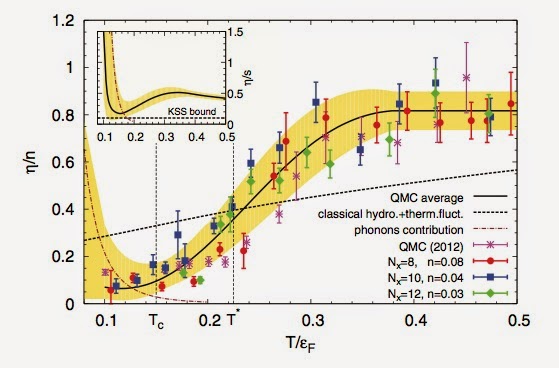
The main result of the latter is shown in the Figure below. The error bars arise because the results are based on a Quantum Monte Carlo simulation with imaginary time data that must be analytically continued to real frequencies [a thorny problem]. Tc is the superfluid transition temperature and T* the pseudogap temperature.


A few reasons why this is interesting.

1. In 1936 the legendary theoretical chemist Henry Eyring proposed a lower bound for the viscosity of n hbar, where n is the particle density. Here, we see that bound is violated.

2. The inset shows that the string theory bound is respected.

3. At low temperatures, the "classical" bound of about 0.2 n hbar, proposed in the first paper is violated.

4. The temperature dependence shows this is a strongly correlated fermion fluid, a long way from a Fermi liquid. For the latter, such as liquid 3He, the viscosity at low temperatures goes like 1/T^2, i.e. increases as the temperature decreases, and is much larger than n hbar. The fermion fluid here is something like a "bad metal" since these small viscosities correspond to mean free paths comparable to the Fermi wavelength.

Saturday, November 22, 2014

Investing in soft matter

I really enjoyed my visit to the TIFR Centre for Interdisciplinary Sciences (TCIS) of the Tata Institute for Fundamental Research in Hyderabad. This is an ambitious and exciting new venture. Higher education and basic research is expanding rapidly in India, with many new IITs, IISERs, and Central Universities. These are all hiring and so it is wonderful time to be looking for a science faculty job in India.

The initial focus of hiring of the new campus of TIFR (India's premier research institution in Mumbai) has been on soft condensed matter (broadly defined) with connections in biology and chemistry. There are many good reasons for this focus. Foremost, is that there excellent Indian's working in this area. However, I see many other reasons why choosing this area is a much better idea than quantum condensed matter, ultra cold atoms, quantum information, cosmology, elementary particle physics, string theory (yuk!), ...

Other reasons why I think investing in soft matter is wise and strategic include:
  • this is exciting and important inter-disciplinary research
  • there are real world applications ranging from to foams to medicine to polymer turbulence drag reduction [used in oil pipelines and in fire fighter hoses]
  • these types of applications are particularly important in Majority World countries
  • in public outreach one can talk about flocking and do simple and impressive demonstrations such the Briggs-Rauscher oscillating chemical reaction or sand flowing through channels.
  • the experimental infrastructure and start up costs are relatively small. most experiments are "table top" and at room temperature. this allows a new institution to get some momentum and "runs on the board" as quickly as possible.
Having said that I think there are significant obstacles and challenges with such interdisciplinary initiatives. These challenges are scientific, intellectual, and cultural (in the disciplinary sense).
Excellent inter-disciplinary teaching and research is a just plain hard work and slow. Getting people to put in the time and keep sticking at is difficult. It requires special individuals (both faculty and students) to build bridges, learn each others languages, respect, and persevere.


The TCIS Director, Sriram Ramaswamy is co-author of a nice RMP article, Hydrodynamics of soft active matter.

I am looking forward to seeing how this exciting new adventure develops over the years. India is leading the way.

What does this movie tell us about the modern university?

Last night, my wife and I watched the movie, Wit. You can watch the full movie here  (free with ads). I should warn that some of the conten...