Showing posts with label diabatic states. Show all posts

Tuesday, July 21, 2026

Rudolph Marcus (1923-2026): theoretical chemical physicist

Rudolph Marcus died last week. He was 102. There is a nice obituary in The New York Times. He was best known for his theory of electron transfer, for which he was the sole recipient of the Nobel Prize in Chemistry in 1992.

Although the theory was proposed for electron transfer in a polar solvent it applies to a wide range of other systems, where two quantum states are coupled to one another and to an environment. One example is for Forster transfer of excitons between molecules, which is central to photosynthesis.

I will give a physics perspective, based on a talk I gave in Slovenia back in 2013. Slides are here.

Basically, Marcus proposed an effective Hamiltonian for two diabatic states and calculated a transition rate in a limit that is relevant to most chemical contexts.

The Hamiltonian can be viewed as the spin-boson model, in which a two-level system is coupled to a bath of harmonic oscillators. 

[The dense book by Weiss on Quantum Dissipative Systems makes the connection explicit in detail. A more accessible treatment may be chapter 16 in the book Chemical Dynamics in Condensed Phases by Nitzan.]

The Hamiltonian is 

This defines a spectral density, which is important for quantum decoherence, but not so much here, except it defines a timescale that determines the classical limit, which Marcus assumed.


This can be used to define a quantity central to Marcus' theory, the reorganisation energy.


The transition rate between the two quantum states is given by

I consider this to be one of the most important equations in chemical physics, particularly for the understanding and design of functional materials.

Aside. Much of this is equivalent to Holstein's 1959 treatment of incoherent polaron transport (see Mahan, Many-body physics).

A key experiment by John R. Miller, Lidia T. Calcaterra and Gerhard L. Closs in 1984 showed how good the theory was and how its predictions were counter-intuitive. The authors considered a family of molecules that allowed them to tune epsilon, the energy difference between the two electronic states. [On the graph below epsilon = - Delta G].


The vertical scale is the reaction rate on a logarithmic scale. It varies by four orders of magnitude.

What is surprising? As stated at the Nobel prize award ceremony:

"The quadratic equation predicts that electron transfer reactions will occur more slowly the larger the driving force of the reaction is. This phenomenon received its own name, “the inverted region.” To a chemist, the phenomenon is just as unexpected as when a skier finds himself gliding more slowly down a slope the steeper it is."

The theory implies an important design principle for functional materials: if optimising functionality means maximising the reaction rate, then tune the energy difference epsilon to equal the reorganisation energy E_R.

The theory illustrates two important aspects of emergence: effective theories and universality. Many different systems can be described by the same theory. The environment may involve many degrees of freedom and its coupling to the system is characterised by many parameters (the M_alpha above). However, only one parameter matters, the reorganisation energy.

For Australians, there is some ambivalence about the way Marcus' name is often solely associated with electron transfer theory. We often refer to it as Marcus-Hush or Hush-Marcus theory because Noel Hush did similar work around the same time. Some of the history is recounted here by Ian Rae and Jeff Reimers. There are also subtle debates about whether the electron transfer is adiabatic or non-adiabatic.

My only personal interaction with Marcus was in 2011 when I visited the chemistry department at Caltech. Marcus kindly took me to lunch at the faculty club, along with his research group. Then he was 84 years old. He kept publishing papers until he died.

Thursday, November 25, 2021

Role of quantum nuclear motion in biomolecular systems

 Total I am giving a talk, "Effect of quantum nuclear motion on hydrogen bonds in complex molecular materials" at Light-matter Interactions from scratch: Theory and Experiments at the Border with Biology 

Here are the slides

The talk provides a concrete example of the tutorial on constructing simple model Hamiltonians for complex materials that I give before the talk. It relates to the bio theme of the meeting through work on isotopic fractionation in proteins and the recent paper below. It makes use of the simple model that I talk about.

Unusual Spectroscopic and Electric Field Sensitivity of Chromophores with Short Hydrogen Bonds: GFP and PYP as Model Systems

Chi-Yun Lin and Steven G. Boxer

Tuesday, November 23, 2021

Tutorial on modelling quantum dynamics in biomolecules

This week I am giving two (virtual) talks at a meeting

Light-matter Interactions from scratch: Theory and Experiments at the Border with Biology 

supported by the ICTP (International Center for Theoretical Physics) in Trieste.

In the ICTP tradition, one talk is a tutorial and the second talk is about my research.

Here are the slides for the tutorial on Effective Model Hamiltonians for Quantum Dynamics in Complex Molecular Materials. Feedback is welcome.

The research talk is about hydrogen bonding. I will post slides for that later.


Tuesday, March 26, 2019

Noel Hush (1924- 2019): pioneering theoretical chemist

I was sad to hear last week that Professor Noel Hush died at age 94. Noel [also known as Prof.] was a pioneer in theoretical chemistry and chemical physics. He had a profound influence on both fields, particularly in their development in Australia.

Arguably his greatest scientific contribution was in the theory of electron transfer. Depending on where you are from this is called Hush-Marcus theory, Marcus-Hush theory, or Marcus theory. In particular, in 1958 Hush derived one of the most important equations in chemical physics, which can be used for design principles for functional electronic materials. A key concept here is the notion of diabatic states.

I had the privilege of knowing and working with Prof. Hush on and off over the past decade. As I made an adiabatic transition from condensed matter into chemical physics Prof. Hush provided a lot of encouragement, wisdom, perspective, and ideas. He strongly believed that theoretical chemists and condensed matter theorists could have mutually beneficial interactions. Together with Jeff Reimers and Laura McKemmish, we co-authored seven papers together. The last papers were published when Noel was 90 years old!

Besides his significant legacy of scientific knowledge, there is an incredible legacy of people that he taught, supervised, mentored, encouraged, and collaborated with.

There is an interesting interview of Prof. Hush about his life by Robyn Williams from 2011.

Saturday, February 3, 2018

Seth Olsen (1975-2018): theoretical chemist

I was very sad to learn last week of the tragic death of Seth Olsen in an accident. He was a former collaborator and colleague at UQ.

Seth was an outstanding and energetic scientist who easily crossed discipline boundaries, especially between chemistry, physics, and molecular biology.

Much of what I know about computational quantum chemistry, fluorescent proteins, conical intersections, and diabatic states, I learnt from Seth. He played a significant role in this blog. A search revealed that his name is mentioned in more than 70 posts. Many posts were stimulated by his work, his questions, or his suggestions. He often wrote comments, covering a wide range of topics. I found his interest helpful and stimulating.

Seth grew up in the USA. He was a physics major at the College of William and Mary. In 2004 he completed a Ph.D in in Biophysics and Computational Biology at The University of Illinois at Urbana-Champaign. His thesis was entitled, ` Electronic Excited States of Green Fluorescent Protein Chromophore Models,'' and his advisor was Todd Martínez, now at Stanford.

I first met Seth in 2005 when he was a postdoc with Sean Smith at the Centre for Computational Molecular Science at University of Queensland. During that time he met Louise Kettle, a Ph.D student in chemistry, who he later married.

I was very happy when in 2008 I was able to persuade Seth to join my group as a Research Fellow. He helped my group expand from condensed matter into chemical physics.  In 2010 I was pleased when Seth was awarded a 5-year Australian Research Fellowship. We continued to collaborate, although in many ways I was the junior author.

A significant contribution of Seth was to use high-level quantum chemistry calculations to show that the low-lying excited electronic states of the chromophore molecule in the green fluorescent protein has a natural description in terms of the resonant colour theory of organic dyes developed in the middle of the twentieth century by Brooker, Platt, and Moffitt. In different words, he used quantum chemistry to justify and parametrise a simple effective Hamiltonian for a complex system. Furthermore, he provided a rigorous quantum chemical justification for the colour theory description of a very wide class of organic dyes based on the methine motif. These results provide chemical and physical insight, an understanding of trends, elucidate design principles, and make modeling in condensed environments such as proteins, solvents, and glasses much more feasible.

I had great respect for Seth's integrity, both personal and scientific. He carefully checked calculations and arguments, would not rush to publish, and would not indulge in hype. Much of my skepticism and caution about computational materials science I gained from Seth's critiques.

Seth had his priorities right, putting family first.
My kids thought Seth was pretty cool, particularly when he came to a group social at our house with a backpack that contained a home brew beer set up!

My sincere condolences to Louise and their three young children.

Don't know what else to say. This is the saddest blog post I have had to write.

Monday, November 21, 2016

The "twin" excited electronic state in strong hydrogen bonds

One of the key predictions of the diabatic state picture of hydrogen bonding is that there should be an excited electronic state (a twin state) which is the "anti-bonding" combination of the two diabatic states associated with the ground state H-bond.
Recently, I posted about a possible identification of this state in malonaldehyde.

The following recent paper is relevant.

Symmetry breaking in the axial symmetrical configurations of enolic propanedial, propanedithial, and propanediselenal: pseudo Jahn–Teller effect versus the resonance-assisted hydrogen bond theory
Elahe Jalali, Davood Nori-Shargh

The key figure is below. The lowest B2 state is the twin state.
In the diabatic state picture, Delta is half of the off-diagonal matrix element that couples the two diabatic states.
Similar diagrams occur when O is replaced with S or Se.


The paper does not discuss twin states, but interprets everything in terms of the framework of the
 (A1 + B2) ⊗ bpseudo-Jahn-Teller effect. 

Two minor issues might be raised about this work.
It uses TD-DFT (Time-dependent Density Functional Theory). It is contentious how reliable that is for excited states in organic molecules.
The diabatic states are not explicitly constructed.
These issues could be addressed by using higher level quantum chemistry and constructing the diabatic states by a systematic procedure, as was done by Seth Olsen for a family of methine dye molecules.

Friday, September 16, 2016

A basic quantum concept: energy level repulsion (avoided crossings)

When I learnt and later taught basic quantum mechanics I don't think the notion of energy level repulsion (or equivalently avoided crossings) was emphasised (or even discussed?).

Much later I encountered the idea in advanced topics in theoretical physics such as random matrix theory and in theoretical chemistry  (non-adiabatic transitions and conical intersections).

Yet level repulsion is a very simple phenomena that can be illustrated with just a two by two matrix describing two coupled quantum states, as nicely discussed on the Wikipedia page.


Last semester when I was teaching Solid State Physics I realised just how central and basic the phenomena is and that the students did not appreciate this.

Level repulsion is the origin of several key phenomena in chemistry and physics.

In solid state physics, it is the origin of the appearance of band gaps at the zone boundary and thus the all important distinction between metals and insulators.


Previously, I posted how Chemistry is quantum science because chemical bonding (the lowering of energy due to interacting atoms) arises due to the superposition principle. This could also be viewed as level repulsion.

Another key idea in chemistry is that of transition states and activation energies for chemical reactions. When one uses a diabatic state picture, particularly as emphasised by Shaik and Warshel, the transition state emerges naturally in terms of level repulsion.


The figure is taken from here.

Can you think of any other nice examples?

Thursday, June 16, 2016

Hydrogen bonds and infrared absorption intensity

I just posted a preprint
Bijyalaxmi Athokpam, Sai G. Ramesh, Ross H. McKenzie

We consider how the infrared intensity of an O-H stretch in a hydrogen bonded complex varies as the strength of the H-bond varies from weak to strong. We obtain trends for the fundamental and overtone transitions as a function of donor-acceptor distance R, which is a common measure of H-bond strength. Our calculations use a simple two-diabatic state model that permits symmetric and asymmetric bonds, i.e. where the proton affinity of the donor and acceptor are equal and unequal, respectively. The dipole moment function uses a Mecke form for the free OH dipole moment, associated with the diabatic states. The transition dipole moment is calculated using one-dimensional vibrational eigenstates associated with the H-atom transfer coordinate on the ground state adiabatic surface of our model.

Over 20-fold intensity enhancements for the fundamental are found for strong H-bonds, where there are significant non-Condon effects

The isotope effect on the intensity yields a non-monotonic H/D intensity ratio as a function of R, and is enhanced by the secondary geometric isotope effect.

The first overtone intensity is found to vary non-monotonically with H-bond strength; strong enhancements are possible for strong H-bonds.
(see the figure below)
This is contrary to common assertions that H-bonding decreases overtone intensity.

Modifying the dipole moment through the Mecke parameters is found to have a stronger effect on the overtone than the fundamental. We compare our findings with those for specific molecular systems analysed through experiments and theory in earlier works. Our model results compare favourably for strong and medium strength symmetric H-bonds. However, for weak asymmetric bonds we find much smaller effects than in earlier work, raising questions about whether the simple model used is missing some key physical ingredient in this regime.

Comments are welcome.

Wednesday, September 30, 2015

A very useful formula: diagonalisation of 2 x 2 matrix

It is amazing to me how much theoretical physics and chemistry ends with diagonalising a 2 x 2 Hermitian matrix!
e.g. from Marcus-Hush theory of electron transfer to the BCS theory of superconductivity...

Yet I find I am often scrambling to get the algebra right. Finally, I have written down the eigenvalues and eigenvectors in a form that I find the most useful. I give them below (partly so I won't have to keep finding them...). The version below is actually taken from this paper


Saturday, September 5, 2015

The challenge of excited state proton transfer

What is excited state proton transfer (ESPT)?
Consider a hydrogen bond A-H...B in a molecular system.
Suppose the system absorbs a photon (usually in the visible to near UV range) and undergoes a transition to an electronic excited state. In most cases A-H is an organic molecule containing conjugated bonds and the transition is a pi to pi* transition. Then on the time scale of picoseconds [within a factor of one thousand] the proton transfers from the donor A to the acceptor B,
i.e. (A-H)*...B evolves to something like (A-)*...(H-B)+.
If A and B are part of the same molecule then this is intramolecular ESPT.
If A and B are distinct molecules then this is intermolecular ESPT.
If A-H is dissolved in water, and significant ESPT occurs then A-H is called a photoacid.

I have started to work on this rich and diverse subject.
My goal is to develop several simple diabatic state models that might give a more unified picture of the phenomena and provide some physical insight. Given the chemical complexity, this may be a mistake, reflecting a physicists naivety and/or hubris. But I am encouraged by the "success" of the simple two diabatic state model that I have promoted for hydrogen bonding (and proton) transfer in the ground state.

I am working my way through the extensive chemical literature and so here is my attempt to organise some of what I have learnt. Comments and corrections are particularly welcome.

In a short review [focusing mostly on solvent effects] from 1986 Michael Kasha presented the following picture. It shows the energy of the ground state (S_0) and the excited state (S_1) as a function of the hydrogen co-ordinate Q_H. For example this might be an OH stretch.

One can clearly see that in the excited state proton transfer is both energetically and kinetically more favourable. What might a diabatic state model look like?
The ground state surface could be described in terms of the usual two diabatic states: A-H,B-  and
A-,H-B.   Similarily the excited state surface could be described in terms of a separate but analogous model involving two diabatic states that differ by transfer of a proton.
The difference between the two models is simply the relative energy of the two diabatic states, i.e. the relative proton affinity of the donor and acceptor is reversed between the ground and excited states.
Furthermore, the barrier to proton transfer could be reduced, or even removed, if the coupling of the two diabatic states increases in the excited electronic state. This could happen if the donor-acceptor distance is reduced in the excited state.

This natural "explanation" of ESPT was widely promoted for a long time, probably going back to Weller in 1952. The basic idea is that in the excited state there is charge redistribution leading to weakening of the O-H bond, making it easy for the H to "pop off". A related claim is that in a photoacid the pKa of the excited state is much less than that of the ground state.

However, there are multiple problems with the picture presented above.

A. It is arguably not really an explanation but a description. It almost says "ESPT happens because ESPT happens." Specifically, it does not really explain why the relative energy of the donor and acceptor diabatic states reverses upon photo excitation.

B. It assumes there is no relationship (or interaction) between the ground and excited electronic states. In reality they can be intimately connected. Striking examples include that of twin states or resonance assisted H-bonds, such as in malonaldehyde.

C. Based on the energy surfaces above Forster presented a simple equation relating the S0-S1 energy difference (and the associated absorption and emission frequencies) between the two tautomers [i.e. molecules differing in the location of the proton] and the pKa's [a measure of acidity] in the ground and excited states.
However, Tolbert and Solntsev report many violations of this equation.

D. Actual high level quantum chemistry calculations for specific molecules that do exhibit ESPT do find that for some there is little charge redistribution in the excited state relative to the ground state; or more importantly, the proton affinity does not necessarily change significantly.

E. It may be omitting a role for different excited states (e.g. charge transfer states or n-pi* states) and conical intersections.

D. and E. are emphasised this calculation by Grannuci, Hynes, Milli, and Tran-Thi.

E. is emphasised by Sobolewski and Domcke who present the diabatic state picture below for cases where the proton transfer is coupled to an electron transfer.


A particularly interesting and widely studied case of ESPT is in the green fluorescent protein (GFP). More on that later...

I thank Seth Olsen for introducing me to some of the literature. If some of the above is not as coherent as it might be that is because of my limited reading and understanding. But, I think it also reflects the diversity of the subject and the lack of a comprehensive picture.

I welcome comments.

Saturday, August 29, 2015

Basic, bold, and boring: a claim about enzyme mechanism

This post concerns a basic but bold claim about the effects of a protein or solvent environment on chemical structure and reactivity. I am not clear on how original or how radical or controversial the claim is. In some sense, I think it is largely consistent with what Ariel Warshel has being saying for a long time. [See here for example].

I would be interested to hear feedback on the claim.

Consider some chemical reaction

A + B to C + D

One can consider the reaction is the gas phase [i.e. without an environment] or in a solvent [polar or non-polar] or in a protein environment. The relative stability of the reactants and the products, the rate of the reaction, and the reaction mechanism [i.e. the reaction co-ordinate and transition state geometry] can vary significantly and dramatically.
This is what is amazing about enzymes: you can increase the rate of a reaction by a factor of a billion.

So what is the most basic hypothesis about the effect of the environment? It can do two significant things.

1. The bond lengths of A and/or B and/or their relative geometry is changed by the environment. For example, A and B are forced closer together.

2. A polar environment [e.g. water or a protein] can change the relative energies of the transition state, and/or the reactants and products. This is highly likely because most molecules have non-uniform charge distributions and significant dipole moments.

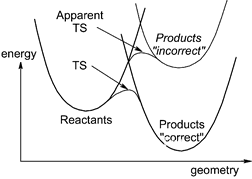
This claim has a natural understanding in terms of a simple diabatic state picture for the reaction. The environment can change the shapes of the diabatic potential energy surfaces and/or change the strength of the coupling of the two surfaces. [For example, in the figure below replace "incorrect" with "no environment" and "correct" with "environment"].


Why is this claim boring?
Well it means that there is nothing that "special" or unique about proteins. There is no new physics or chemistry.
It rules out exotic mechanisms such as dynamic effects and particularly collective quantum effects.

Finding out how an environment does change specific parameters is highly non-trivial.

Furthermore, outstanding, fascinating, and difficult problems remain understanding and describing:

  • how the protein "engineers" the changes in the reaction potential energy surface,
  • how mutations distant from the "reaction centre" can sometimes have such a significant effect,  
  • the role of the hundreds of amino acids not close to the "reaction centre", i.e. why do proteins need be so big? is there a lot of redundancy? or does one really need all those amino acids to produce a highly "tuned" and exquisite tertiary structure?
So is this claim "controversial" or "dogma" or "obvious"? 

Tuesday, August 4, 2015

Searching for conical intersections for singlet fission

Previously I have posted about the fascinating challenge of understanding singlet fission [and the inverse process of triplet-triplet annihilation] in large organic molecules.  A key feature to understand is how fission can occur in less than 100 femtoseconds, suggestive of a conical intersection between excited state potential energy surfaces.

In Telluride Nandini Ananth gave a nice talk about work described in the paper

The Low-Lying Electronic States of Pentacene and Their Roles in Singlet Fission 
Tao Zeng,  Roald Hoffmann , and Nandini Ananth

Diabatic states provide a natural and powerful approach to understanding what is going on.
The authors perform high level quantum chemistry calculations to describe the relevant electronic excited states. They claim that for a pair of pentacene molecules one needs to include at least six diabatic states. Their dominant electronic configuration is shown in the schematic below.
We find that only one of the two charge-transfer states, ac, is engaged in the SF [singlet fission] in pentacene; it is the low-lying charge-transfer state that gets closer to the multi- and single-exciton states. Moreover, the ac diabat can move into degeneracy with the single-exciton states, more effectively mediating the mixing of the bright single- to and dark multiexciton diabats. This finding is different from the basic assumption of high-lying charge-transfer states in the superexchange model, emphasizing the need to adapt the general SF model to specific cases.
Aside: I wonder if this is one the few papers that Hoffmann has co-authored where strong electron correlations are central.

In more recent work, the authors have tried to pin down what is the relevant nuclear co-ordinate [vibrational mode] associated with a conical intersection. It is not the intermolecular separation but may be instead the relative orientation [twisting] of the two penatacene molecules. This has included some constructive interaction with the experimental group of Luis Campos.

Wednesday, July 29, 2015

Coupled electron-proton transfer: adiabatic or non-adiabatic?

Sharon Hammes-Schiffer gave an interesting talk in Telluride last week about coupled electron-proton transfer.
[A couple of my earlier posts on this fascinating subject are here and here].

Here are a few things that stood out.

There are a lot more people working on this problem now than twenty years ago. This is because of possible solar energy applications.

Diabatic states are the key to understanding. There are four relevant states. Simply the proton can be on the donor or acceptor. The electron can be on the donor or the acceptor. Whether the process is concerted or sequential depends on the relative energy of these four states.

A key question is whether the process is adiabatic or non-adiabatic.
What are the key experimental signatures of each?
One contrast is coupled electron-proton transfer (EPT) and hydrogen atom transfer (HAT).

The two cases are nicely embodied respectively in the model systems
HAT - benzyl/toluene
EPT - phenoxly/phenol
The theoretical details are worked out here.

In some enzymes such as soybean lipoxygenase (SLO) there are very large kinetic isotope effects (~80) for proton transfer, orders of magnitude larger than expected. Many people, including me, have struggled to understand this in terms of proton tunnelling in an adiabatic picture with coupling to an environment. 
However, the relevant reactions are actually coupled electron-proton transfer, in the non-adiabatic regime. The key equation to understand both the magnitude and temperature dependence of the isotope effect is

taken from this paper.

A recent paper compares the theory to a mutant of SLO in which the isotope effect becomes ~500 as a result of the increase in the proton donor-acceptor distance R.

One minor point on how this relates to my talk. I said that quantum nuclear effects [and H/D isotope] effects were largest [and very subtle] in hydrogen bonding for donor-acceptor distances of R= 2.4-2.5 Angstroms. In contrast, here the isotope effects actually get larger with increasing R, with R=2.7 A for the wild-type SLO and increasing to 2.8-2.9 A with the selected mutations. I thank Sharon for pointing out this difference to me.

Thursday, July 16, 2015

Common challenges with constructing diabatic states and tight-binding models

I wish to highlight some common issues that occur in the construction, justification and parametrisation of effective Hamiltonians in both theoretical chemistry and solid state physics.
The basic issue is one needs to keep in mind that just because one gets the energy eigenvalues of a quantum system "correct" does not mean that one necessarily has the correct wave function.
Previously, I posted how sometimes a variational wave function can give  a good ground state energy but be qualitatively incorrect.

For molecular systems a powerful approach to understanding the potential energy surfaces of the ground state and the lowest lying electronic states is to construct a Hamiltonian matrix based on a few diabatic states.

For crystals in which the electronic degrees of freedom are strongly correlated a powerful approach is to construct a Hubbard model where the non-interacting band structure is described by a tight-binding model. The latter describes hopping of electrons between orbitals that are localised on individual lattice sites.

Quantum chemistry
There are two strategies that are used to construct and parametrise a diabatic state model.

1. Based on chemical insight one writes down a Hamiltonian of the form
One assumes some functional form for the Hamiltonian matrix elements, with several free parameters.
One calculates the adiabatic potential energy surfaces using an ab initio method and fits these surfaces to the adiabatic energies from the diabatic model.
An example is shown below for a two-state diabatic model for fluorescent protein chromophores.


The  example below concerns five electronic states of XH3 and the associated torsional potential, taken from this paper. There are 11 free parameters in the Hamiltonian.

A different approach by Nangia and Truhlar considers a multi-dimensional potential surface for ammonia, two diabatic states, and hundreds of free parameters.

Important questions arise.
Are the diabatic states physical?
Or is all this curve fitting just making the elephants trunk to wiggle? 
As one includes more diabatic states how does one deal with the confusion and ambiguity that arises because of the close proximity to one another of many excited states?

2. A more rigorous approach is to use some well-defined procedure to actually construct the diabatic states from a knowledge of the many-body wave functions of the low lying states. An example is the approach pioneered by Cederbaum. Seth Olsen has nicely used this approach to construct diabatic states for fluorescent protein chromophores and other organic dyes. Furthermore, the diabatic states can be related to chemically intuitive valence bond structures.
However, subtle issues still arise, particularly as one includes more excited states.

Solid state physics
Similarly, there are two strategies that are used to construct and parametrise a tight-binding model for a specific material.

1. One writes down a tight-binding model Hamiltonian with a few parameters describing hopping integrals and calculates the associated band structure. One then calculates the band structure for a specific material, using an ab initio method, usually some approximation of Density Functional Theory (DFT). One then fits this band structure to the tight-binding model in order to determine the hopping integrals.

An example is shown below, taken from this paper. The green dots are from an DFT based calculation and the solid black lines are a fit to a tight-binding model with a few free parameters.


This procedure gets messy and ambiguous when in order to improve the quality of the fit one starts to introduce extra parameters representing beyond next-nearest neighbour hopping. 
Are such long range hoppings justified? Furthermore, the parameter values obtained can vary significantly as one introduces extra parameters.

2. A more rigorous approach is to construct Wannier orbitals and then calculate the actual overlap integrals that are input into a tight-binding model.
An example is in this paper concerning the Fabre salts. In particular it shows how some longer range hoppings are actually justified.
However, there are many subtleties and ambiguities in this approach as discussed in a recent Reviews of Modern Physics. This tends to work well when there are a couple of well isolated bands, but not otherwise.

Clearly, 2. is always preferable because it has a stronger physical basis. However, it is not easy. People tend to be just do 1. with a fixed number of parameters and not worry about whether they are justified or stable.

I thank Seth Olsen and Anthony Jacko for teaching me about these issues.

Thursday, July 9, 2015

Diabatic states rock!

Physical Chemistry Chemical Physics has just published a series of four articles by Jeff Reimers, Laura McKemmish, Noel Hush, and myself.

A unified diabatic description for electron transfer reactions, isomerization reactions, proton transfer reactions, and aromaticity"

Non-adiabatic effects in thermochemistry, spectroscopy and kinetics: the general importance of all three Born-Oppenheimer breakdown corrections

Electron-vibration entanglement in the Born-Oppenheimer description of chemical reactions and spectroscopy

Bond angle variations in XH3 [X=N,P,As,Sb,Bi]: the critical role of Rydberg orbitals exposed using a diabatic state model

It took a number of years to finish these papers. I am certainly the junior co-author and I commend my co-authors for all their hard work and perseverance.

The four papers have two common related themes, that are hopefully not lost in all the technical detail.

1. Diabatic states provide a powerful scheme, both conceptually and quantitatively, to describe a wide range of chemical phenomena.
2. This can be nicely illustrated using a simple model Hamiltonian describing the coupling of two electronic states to a single vibrational mode.
In chemistry language this is a E x beta Jahn-Teller model. In condensed matter language, is a two-site spinless fermion Holstein model.

We welcome comments.

Update (24 September, 2015). The papers made it to the cover of the print edition.

Monday, July 6, 2015

Genetically engineering short hydrogen bonds in a fluorescent protein

There is a very nice article in the new journal, ACS Central Science
Short Hydrogen Bonds and Proton Delocalization in Green Fluorescent Protein (GFP) 
Luke M. Oltrogge and Steven G. Boxer

This is an impressive piece of work spanning from molecular biology to chemistry to quantum physics.
There is also a commentary on the paper by Judith Klinman, placing it in the context of the controversial issue of low-barrier hydrogen bonds in enzymes.

An extensive study was made of mutants of the Green Fluorescent Protein with a short hydrogen bond between the chromophore and the amino acid Asp148. The donor-acceptor bond length estimated from X-ray structures was 2.4 +/- 0.2 Angstroms. This is in the range of low-barrier H-bonds.

What is particularly new here is that through ingenious molecular biology techniques [nonsense suppression] the acidity [pK_a = measure of tendency to give up protons] of the chromophore was systematically varied by 3.5 units through halogen substitutions.


This range covers the pK_a matching required for strongest H-bonds, as discussed in this earlier post. The experimental results were compared to calculations based on a one-dimensional proton transfer potential based on a diabatic state model I have advocated. It was very satisfying for me to see this simple model being used by experimentalists.

To me what is most striking about the paper is the UV absorption spectra below. It is very different from what one normally sees in GFP spectra.
There are generally two absorption bands, denoted A and B, associated with GFP. The A-state and B-state are identified with the neutral chromophore and anionic [i.e. deprotonated] chromophore, respectively. The corresponding spectra are similar to the black and grey curves shown above. The green spectrum above is for the Cl1Y substituted chromophore, which is close to pK_a matching, and is rather broad and intermediate between the A-state and B-state spectra. This is arguably because the proton is delocalised between the chromophore and neighbouring Asp amino acid.

The authors also substituted protons (H) with deuterium (D) to see the extent of quantum nuclear effects. These are normally very small in GFP. However, here they are noticeable.
The measured isotopic fractionation factors Phi (deduced from analysis of the UV absorption spectra) were in the range 0.54 - 0.9, taking a minimum value for pK_a matching. This observation and a value of Phi=0.54 for R=2.4 +/- 0.2 Angstroms are consistent with a recent theoretical analysis.

There is one point where I disagree with the theoretical analysis of the authors. I am confused that they average over the vibrational eigenstates to get an electronic absorption spectrum. This seems to me this goes against the Franck-Condon principle.  If one followed this same procedure for other molecules the UV spectra would all be much broader than they are, particularly in gas phase.
It is not clear to me how one should proceed in this situation where the proton is quite delocalised and the absorption spectra is significantly different for protonated and de-protonated chromophores. There may be significant Herzberg-Teller effects. One way forward to could be to combine the two-diabatic state H-bond model with a two-state resonance model for the chromophore, such as those advocated by Seth Olsen and I, and then do a full non-adiabatic treatment of the model.

I thank Luke Oltrogge and Seth Olsen for helpful discussions about this work.

Thursday, May 28, 2015

NF - mysteries of a small molecule

Nitrogen fluoride (NF) seems like a very simple molecule and you would think it would very well understood, particularly as it is small enough that it is accessible to high level quantum chemistry calculations. However, the molecule exhibits some subtle properties that present a theoretical challenge. There is limited experimental data because the molecule is only found as an intermediate in some chemical reactions.

Just like oxygen (O2), to which it is isoelectronic, the ground state is a triplet due to Hund's rule, as discussed for O2 here.

I just read a nice paper
A Valence Bond Study of the Low-Lying States of the NF Molecule 
Peifeng Su, Wei Wu, Sason Shaik, and Philippe C. Hiberty

Given that F is more electronegative than N one might expect the ground state to have a large electric dipole moment and this to increase as the molecule is stretched.
However, the ground state has only a small moment, it has the opposite direction to that expected from the electronegativity, and the direction changes sign when the bond is stretched.

Furthermore, unlike most molecules, the bond length is shorter and the dissociation energy larger in the low-lying excited states [which are singlets] than in the ground state.

The ground state has one sigma bond and six electrons in two pi orbitals.
The latter form three-electron bonds, which in the Valence Bond picture, involve exchange in position of an electron pair and an unpaired electron, where one goes from T1 above to the configurations shown below.
The authors consider 9 valence bond structures for the triplet ground state and 12 singlet VB structures for the two lowest singlet states. Their calculations lead to the following picture in terms of Lewis structures.

What insights are gained by the VB approach? Key is the idea of back donation or back bonding.

In a nutshell, the three lowest-lying states of NF can be considered as primarily bonded by a polar two-electron σ bond, complemented by Ï€-bonding contributions of the three-electron bonding type for the ground state, and of the classical two-electron type for the excited states. In all three cases, the Ï€-bonding contributions correspond to charge transfer from F to N, thus counterbalancing the σ polarization by back-donation. The tendencies of the bond lengths in the various electronic states comply with this simple model. Thus, all the computations and experimental measurements show that the bond length decreases consistently from the 3Σ state to 1Δ, and from 1Δ to 1Σ+. This counterintuitive tendency, which implies that the more excited the molecule is, the more strongly it is bonded, is easily explained by the weights of the Ï€-bonding Lewis structures, that sum up to 19 % in 3Σ state, to 28 % in the 1Δ state, and to 37 % in the 1Σ+ one (Figure 1 and Table 1 and Table 3). The same increase in the Ï€-bonding contribution accounts again for the unusual fact that the bonding energy is far larger in the first excited state than in the ground state (96.4 vs 72.0 kcal mol−1 at the VBCISD level). On the other hand, the bonding energy of the second excited state is now smaller than that of the first, as expected, since both excited states dissociate to the same products.

The tendencies in the dipole moment values of the various states are also readily rationalized by the simple VB model. The polar σ bond tends to tip the electron density towards the fluorine atom, and thus to favour negative values of the dipole moment (in the direction N+F), while backdonation from the Ï€ systems has the opposite effect. The two effects compensate for each other in the ground state, where backdonation is moderate (19 % of Ï€ charge transfer). In the 1Δ state, as the Ï€ charge transfer is increased relative to the ground state (28 % vs 19 %), backdonation wins over σ polarization, leading to a significant positive dipole moment, in the direction F+N. The effect is further reinforced in the 1Σ+ state, in which the Ï€-charge transfer Lewis structure has such a large weight (37 %) that it completely overwhelms the σ polarization, ending up at a positive dipole moment of 0.728 D at the BOVB level.
I would like to see a basic description of these essential features in terms of a polarised two site Hubbard model with multiple orbitals and Hund's rule coupling, generalising the unpolarised two-orbital model here.

I got interested in this paper because of thinking about improper hydrogen (and halogen) bonds and wondering whether there is an "excited" diabatic state that has a shorter and stronger X-H bond than in the ground state. A general "ionic" (X^-H+) state will not have this property but if there is the option of back donation maybe something can happen....

Thursday, May 21, 2015

A unified picture of weak chemical bonds: hydrogen, halogen, carbon...

Previously I posted about improper hydrogen bonds. These are weak hydrogen bonds that have the unusual property that in the X-H...Y system H-bonding leads to a shortening and hardening (blue shift) of the X-H bond. In contrast, for "proper" bonds, X-H lengthens and softens (red shift).

The past few years has seen a rapid increase in interest in an even broader class of weak bonds such as "halogen bonds",  denoted X-Z...Y where Z can now be not just H but a halogen (F, Cl, Br), chalcogen (O, S, Se, Te), or pnictogen (N, P, As, ..)....

There is an interesting paper that contains the helpful summary figure below
Negative hyperconjugation and red-, blue or zero-shift in X-Z---Y complexes
Jyothish Joy, Eluvathingal D. Jemmis and Kaipanchery Vidya


In trying to understand the paper I found reading the following older paper helpful
Electronic Basis of Improper Hydrogen Bonding:  A Subtle Balance of Hyperconjugation and Rehybridization
Igor V. Alabugin, Mariappan Manoharan, Scott Peabody, and Frank Weinhold

[Aside: note the senior author is Weinhold who has featured in some previous posts]

The basic idea is that there are two competing interactions. "Hyperconjugation" is Weinhold's view of proper H-bonds, via the Natural Bond Orbital donor-acceptor picture where the H-bond arises due to charge transfer from the lone pair orbital on Y to the σ* (anti-bonding) orbital associated with X-H. This lengthens and hardens X-H.
When this interaction is weak there is “X-H bond shortening” due to increase in the s-character (rehybridisation of the atomic orbital on X) and polarization of the X−H bond. This is associated with a shorter and harder X-H bond.

Bent's rule is central. It is one of the most general rules governing structure of organic molecules.
atoms tend to maximize the amount of s-character in hybrid orbitals aimed toward electropositive substituents and direct hybrid orbitals with the larger amount of p-character toward more electronegative substituents.
Increasing s-character generally leads to shorter bonds.
As the donor acceptor distance (X-Y) decreases the X-Z bond becomes more polarised and the s-character increases.
The authors note it should be possible to test predicted trends since the amount of s character in the X-Z bond can be measured from the relevant NMR coupling constant.

My question is whether this subtle competition can be captured by generalising my simple 2 diabatic state model for H-bonds to a 3 state model that includes the ionic character of the X-Z bond.

Monday, December 15, 2014

Finding the twin state for hydrogen bonding in malonaldehyde


I was quite excited when I saw the picture above when I recently visited Susanta Mahapatra.

One of the key predictions of the diabatic state picture of hydrogen bonding is that there should be an excited electronic state (a twin state) which is the "anti-bonding" combination of the two diabatic states associated with the ground state H-bond.
Recently, I posted about how this state is seen in quantum chemistry calculations for the Zundel cation.

The figure above is taken from
Optimal initiation of electronic excited state mediated intramolecular H-transfer in malonaldehyde by UV-laser pulses 
K. R. Nandipati, H. Singh, S. Nagaprasad Reddy, K. A. Kumar, S. Mahapatra

The figure hinted to me that for malonaldehyde the twin state is the S2 excited state, because of the valence bond pictures shown at the bottom of the figure and because the shape of the two potential energy curves is similar to that given by the diabatic state model.
Below I have plotted the curves for a donor-acceptor distance of R=2.5 Angstroms, comparable to that in malonaldehyde.

The vertical scale is such that D=120 kcal/mol, leading to an energy gap between the ground and excited state of about 4 eV, comparable to that in the top figure [which is in atomic units, where Energy = 1 Hartree = 27.2 eV].
Note that in the first figure, there is a gap on the vertical scale and the top and bottom part of the figures involve a different linear scale.
Hence, to make a more meaningful comparison I took the potential energy curves and replotted them on a linear scale using the polynomial fits given in the paper. The results are below.


There is reasonable agreement, but only at the semi-quantitative level.
[With regard to units the distances are in atomic units (Bohr radius = 0.5 Angstroms] and comparable].

The figure below shows how the calculated transition dipole moment between the ground state and the first excited state. I was surprised that it only varied by about five per cent with change in nuclear geometry.
However, Seth Olsen pointed out to me that this small variation reflects the Franck- Condon approximation [which is very important and robust in molecular spectroscopy].
I also calculated this with the diabatic state model, assuming that the dipole moment of diabatic states did not vary with geometry and the Mulliken-Hush diabaticity condition [that the dipole operator is diagonal in the diabatic state basis] held (see Nitzan for an extensive discussion).
[The units here are 1 atomic unit = 2.6 Debye].


The vertical scale here is the magnitude of the dipole moment in one of the diabatic states. This is also the approximate value of the dipole moment of the molecule at "high" temperatures above which there is no coherent tunnelling between the two isomers, i.e. the proton is localised on the left or right side of the value. The experimental value reported here is about 2.6 Debye.
This is consistent with the claim that the diabatic state model gets the essential physics of the electronic transition.

But, of course the real molecule is more complex. For example, between the S0 and S1 states there is a "dark" S1 state, characterised as a n to pi* transition where n is the lone pair orbital on the oxygen. The three states and their associated conical intersections are discussed in a nice paper by Joshua Coe and Todd Martinez.

I think a good way to more rigorously test/establish/disprove the diabatic state picture is to use one of the "unbiased" recipes to construct diabatic states, such as that discussed here, from high-level computational chemistry.

Wednesday, December 10, 2014

Strong non-adiabatic effects in a prototype chemical system

This post concerns what may be the fast known internal conversion process in a chemical system, non-radiative decay times in the range of 3-8 femtoseconds. Internal conversion is the process whereby in a molecule there is a non-radiative transition between electronic excited states (without change in spin quantum number). This is by definition a break-down of the Born-Oppenheimer approximation.

Much is rightly made of the fascinating and important fact that excited states of DNA and RNA undergo "ultra-fast" non-radiative decay to their electronic ground state. This photo-stability is important to avoid mutations and protect genetic information. Conical intersections are key. The time scale for comparison is the order of a picosecond.

The figure below is taken from

It shows the wavelength dependence of the intensity of emission from a 3d (Rydberg) excited state.

There are several things that are noteworthy about the experimental data, given that this is a gas phase spectra.

1. The large width of the spectra. In energy units this is of the order of an eV. Gas phase spectra for electronic transitions in typical molecules are usually extremely sharp (See here for a typical example). 

2. The two peaks, suggesting the presence of two electronic transitions.

3. The strong isotope effects. For strictly electronic transitions between adiabatic states, there should be no dependence on the nuclear masses. This suggests strong vibronic and quantum nuclear effects.

So what is going on?
The key physics is that of the Jahn-Teller effect, conical intersections, and non-adiabatic effects.
For H3 there is geometry of an equilateral triangle which has C3 symmetry. There are then two degenerate electronic ground states with E symmetry, and experience E x epsilon Jahn-Teller effect leading to the two adiabatic potential energy surfaces shown below. They touch at a conical intersection. The two peaks in the spectra above correspond to transitions to these two different surfaces.

Non-adiabatic coupling leads to rapid transitions between the surfaces leading to the ultra-ultra-fast internal conversion and the very broad spectra. This is calculated in the paper, leading to the theoretical curves shown in the top figure.


More recently, Susanta and some of his students, have considered the relative importance of (off-diagonal) non-adiabatic effects, the geometric phase [associated with the conical intersection], and Born-Huang (diagonal) corrections to explaining the spectra.
They find that the first has by far the most dominant effect. The latter two have very small effects that look like they will be difficult to disentangle from experiment. I discussed the elusiveness of experimental signatures of the geometric phase in an earlier post.
  
I thank Susanta Mahapatra for explaining this nice work to me, on my recent visit to his group.

What does this movie tell us about the modern university?

Last night, my wife and I watched the movie, Wit. You can watch the full movie here  (free with ads). I should warn that some of the conten...