There is a nice helpful review
Biochemistry and Theory of Proton-Coupled Electron Transfer
Agostino Migliore, Nicholas F. Polizzi, Michael J. Therien, and David N. Beratan
Here are a few of the (basic) things I got out of reading it (albeit on a long plane flight a while ago).
There are a diverse range of biomolecules where coupled electron-proton transfer plays a key role in their function. The electron transfer (ET) and proton transfer (PT) are usually spatially separated. [See blue and red arrows below].
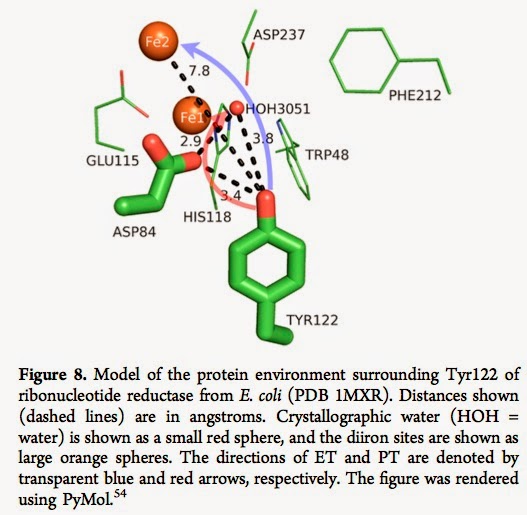
There are fundamental questions about whether the transfer is concerted or sequential, adiabatic or non-adiabatic, and how important the protein environment (polar solvent) is.
Often short hydrogen bonds are involved and so the nuclear degrees of freedom need to be treated quantum mechanically, in order to take into account tunnelling and/or zero-point motion.
Diabatic states are key to understanding and theoretical model development.
Although there are some "schematic" theories, they involve some debatable approximations (e.g. Fermi's golden rule), and so there is much to be done, even at the level of minimal model Hamiltonians.
Showing posts with label e-p transfer. Show all posts
Friday, September 5, 2014
Tuesday, January 28, 2014
Concerted vs sequential processes in chemistry
A basic but important and interesting question in physical chemistry concerns a chemical reaction or process that involves two steps: A to B to C.
Do they occur sequentially or can they occur simultaneously, i.e., in a concerted or co-operative manner?
Two examples of particular interest are coupled electron-proton transfer and double proton transfer.
The figure below shows a carboxylic acid dimer involving two hydrogen bonds
Do they occur sequentially or can they occur simultaneously, i.e., in a concerted or co-operative manner?
Two examples of particular interest are coupled electron-proton transfer and double proton transfer.
The figure below shows a carboxylic acid dimer involving two hydrogen bonds
The configuration above has the same energy as the tautomer with the top H moved to the right and the bottom H moved to the left. But, does this reaction occur by simultaneously moving the protons or first moving one and then the second.
For the case of double proton transfer in dimers of a model of a DNA base pair [shown in the picture below] there has been some controversy about whether the process is concerted or sequential. This brief letter by Kwon and Zewail in PNAS gives the relevant references. They stress that some of the controversy seems to stem from confusion about clearly defining what one means by the two options. They argue the weight of the evidence is for sequential.
Another example concerns the role of intermediate electronic states in charge separation processes in molecular photovoltaic materials.
I am interested in exploring simple effective Hamiltonians that might be used to come up with some general criteria and experimental signatures for discriminating between concerted and sequential processes.
Tuesday, June 19, 2012
Coupled electron-proton transfer II
I had a nice visit this morning at University of Washington with Jim Mayer who has worked extensively on coupled electron-proton transfer [see this post for an earlier discussion]. Here are a few things I learnt.
CPET is involved in one of the most important processes in biology, whereby we get all of our oxygen! This is the Kok S-state mechanism of Photosystem II: the amino acid tyrosine-Z is oxidised to yield a neutral tyrosyl radical. Specifically, the electron is transferred 14 Angstroms (i.e. a long way!) to a photoexcited chlorophyll radical and the proton is transferred across a hydrogen bond to a nearby histidine residue (e.g. see this 2003 PNAS paper for evidence).
It is important to note that the proton and the electron are spatially separated and "attached" to different atoms. Nevertheless, their motion is concerted, i.e. the transfer is not sequential.
A major question concerns whether this process is adiabatic or non-adiabatic. Uncertainty about the answer is highlighted in a recent issue of Chemical Reviews. One article is by Hammes-Schiffer and Stuchebrukov which advocates a non-adiabatic approach.
A different article by Siegbahn and Blomberg considers DFT based calculations and implicitly assumes an adiabatic approach.
We agreed there is a need for some simple models to describe this fascinating phenomena.
Aside: a recent Science paper from Mayer's group shows that similar chemistry occurs in transition metal oxides which are important in energy research. Titanium dioxide has been the subject of 58,000 papers!
Subscribe to:
Posts (Atom)
Lecture on Debye model for solids
I just finished preparing my undergraduate lecture on the Debye model for solids. Here are my slides . The course is a third-year course on...
-
An interesting and controversial question for Ph.D's in science and engineering is too what extent students should be expected to have ...
-
This week Nobel Prizes will be announced. I have not done predictions since 2020 . This is a fun exercise. It is also good to reflect on w...
-
Is it something to do with breakdown of the Born-Oppenheimer approximation? In molecular spectroscopy you occasionally hear this term thro...


