Showing posts with label COPE. Show all posts

Monday, November 1, 2010

Dielectric relaxation in organic electronic devices

A recent post mentioned the paper Low-k insulators as the choice of dielectrics in Organic Field-Effect Transistors [by Veres et al.], in the context of the sticky point of how to determine the relative importance of disorder and polaronic effects in molecular conducting materials used in semiconductor type devices. 

A major point of the paper is something different: how the mobility measured by time of flight (TOF) measurements is distinctly different [it has a larger magnitude and smaller activation energy] from in FETs, and that the mobility in FETs can decrease significantly with increasing the dielectric constant of the material used in the gate insulator material.

The paper discusses extensively how this may be associated with different kinds of disorder at the interface [which was followed by a theoretical paper in J. Chem. Phys. by Richards, Bird, and Sirringhaus]. It is not clear to me that invoking disorder is necessary to explain the gate dielectric dependence sure this is necessary. The reorganisation energy (polaron binding energy) associated with charge transfer between neighbouring molecules varies significantly with the dielectric constant of the surrounding medium. [Reminder: the activation energy for the mobility is 1/4 of this reorganisation energy].

For molecules close to the interface between the gate insulator and organic semiconductor, this reorganisation energy will decrease with a decrease in the dielectric constant of the insulator. Furthermore, if the organic semiconductor has a dielectric constant less than the gate dielectric, the reorganisation energy associated with a bulk measurement such as TOF will be less than a FET measurement which measures charge transport close to the interface.
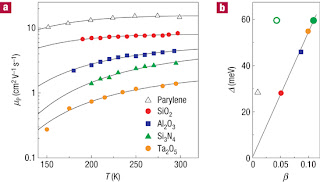
Indeed the observed dependence of the FET mobility on the gate dielectric constant is observed explained within the framework of small polaron theory in a 2005 Nature Materials paper, Tunable Frohlich polarons in organic single-crystal transistors [see Figure above].

Friday, October 29, 2010

Deconstructing charge transport in organic semiconductors

A key question about charge transport in organic molecular materials is:

What is the relative importance of disorder and dielectric relaxation [small polarons = Marcus-Hush theory] in determining the charge mobility?

There is a nice clear and succinct review article in Chemical Reviews from 2007 by Coropceanu et al.

The view that disorder is dominant has been advocated by Bassler and collaborators, in
terms of a Gaussian density of states. This leads to a  mobility with the temperature dependence

[I have not seen an analytical derivation, this seems to be based on curved fitting to the results of Monte Carlo simulations].
This is in contrast, to an activated form.


Aside: Coropceanu et al. claim "there is no full theoretical justification for such an Arrhenius like expression". I am mystified by this claim. Small polaron theory [and equivalently Marcus-Hush theory, together with the fluctuation-dissipation theorem] give such a form. Indeed, in the review article they later give such expressions.
But, that is not my main point.

It is also pointed out that distinguishing between these two models is difficult
with experimental data from a limited temperature range.
This can be seen clearly in the Figure below taken from a 2003 paper Low-k insulators as the choice of dielectrics in Organic Field-Effect Transistors


Hence, just because one can fit the data to one of the models one should NOT conclude that model is correct. Unfortunately, this is often forgotten...

Presumably measurements down to 1 K may help distinguish the two models, although apparently these devices can malfunction at lower temperature.

I have more to say about this data, and what it may say about the charge transport mechanism,  but will leave that for another day...

Wednesday, October 20, 2010

A decent theory for characterising some organic solar cells

The current-voltage characteristics of organic heterojunctions (HJs) are often modeled using the generalized Shockley equation derived for inorganic diodes. However, since this description does not rigorously apply to organic semiconductor donor-acceptor (D-A) HJs, the extracted parameters lack a clear physical meaning. Here, we derive the current density-voltage (J-V) characteristic specifically for D-A HJ solar cells and show that it predicts the general dependence of dark current, open-circuit voltage (Voc), and short-circuit current (Jsc) on temperature and light intensity as well as the maximum Voc for a given D-A material pair....


 This is the beginning of the abstract for a recent PRB paper from Stephen Forrest and collaborators, that I want to understand. I certainly agree with the first two sentences!

Tuesday, October 19, 2010

Lawrie Lyons (1922-2010): a pioneer in organic photonics and electronics

Professor Lawrie Lyons died last thursday in Brisbane. He was the Foundation Professor of Physical Chemistry at University of Queensland from 1963 until his retirement in 1987. Long before it became a "hot" field he made many of the first measurements the optical and electronic properties of organic molecular crystals such as anthracene.  
In 1967 with Felix Gutmann (UNSW) he published, Organic Semiconductors  (Wiley, 1967) 858 pages. This work was of sufficient influence and importance that in 1983 Hendrik Keyzer revised and expanded it, Organic Semiconductors: Part 2 (Wiley, 1983). [I think it is the ultimate compliment if you write a book and someone else publishes a later edition. Other famous examples include Coulson's Valence and Lehringer's Biochemistry].
In 1971 he was elected a Fellow of the Australian Academy of Science. 
Lawrie was the scientific "grandfather" of Andrew Taylor, Head of Rutherford Appleton Laboratory and a driving force in making ISIS the world's leading neutron and muon source. At Sydney University, Laurie supervised the B.Sc. (Honours) thesis of John White (now at ANU), who was subsequently, Taylor's D.Phil supervisor at Oxford.
Following retirement, Lawrie pursued full-time a life-long passion. In 1989  he founded ISCAST, the Institute for the Study of Christianity in an Age of Science andTechnology.


I thank John Mainstone for providing some of the chronology.

Saturday, July 31, 2010

Floppy organic LEDs

In Telluride last week Peter Rossky gave a nice talk about work in his group on electronic properties and excited state dynamics of conjugated molecules such as PPV used in LEDs and Organic Photovoltaics. One thing he emphasized was that cartoon pictures of these molecules as rigid and planar are not accurate. At room temperature molecules such a PPV can flop around substantially, as described in this paper.

Friday, July 9, 2010

Computational photochemistry tutorial


A very effective way to start learning what computational chemistry can and cannot do is to start doing hands on tutorials of concrete examples. Last week, at the I2CAM workshop on photovoltaics, Jeff Reimers ran a hands on workshop where participants calculated photochemical properties associated with charge separation and recombination in a specific donor-acceptor molecule. Here is the tutorial sheet and you can run Jeff's CNDO (Complete Neglect of Differential Overlap) [something like a Hubbard model..] code on the nanohub.
Besides being hands on, and very chemically focused, I also like the tutorial because it discusses solvent effects, kinetics, and Marcus-Hush theory.

Thursday, July 8, 2010

Opportunities for theorists

A nice gentle review is

Molecular Understanding of Organic Solar Cells: The Challenges

by Bredas, Norton, Cornil, and Coropceanu.


It reviews our limited understanding of five key processes in an organic solar cell

(i) optical absorption and exciton formation,
(ii) exciton migration to the donor−acceptor interface,
(iii) exciton dissociation into charge carriers, resulting in the appearance of holes in the donor and electrons in the acceptor,
(iv) charge-carrier mobility, and
(v) charge collection at the electrodes.

Friday, July 2, 2010

Deconstructing excited state dynamics in conjugated polymers

Joseph Shinar (Ames Lab, Iowa State) gave a nice talk today about using optically detected magnetic resonance (ODMR) to elucidate the dynamics of optically excited states in conjugated polymers.

First, two "human interest" asides.
1. The results of this research led to share prices of some companies going up and down.
2. Shinar said he build his first ODMR spectrometer using an ESR spectrometer he got from a dumpster outside the chemistry building at the Technion in Israel.

Basically what one does in this experiment is to monitor an optical property (such as photoluminescence) at the same time that one applies a microwave field and magnetic field. When the microwave field frequency is on resonance with that required to induce transitions between different Zeeman levels on sees changes in the optical property.
Seeing any detectable change may be surprising because one does not necessarily expect optical properties to be so spin dependent. It turns out understanding why one gets a signal at all and the physical mechanism took almost 20 years.

There are many possible competing processes following photoexcitation of a singlet (exciton) state.

S1 --> P+ + P-
or T1 + T1
where P+ is a positive polaron (this is just a cation with a significant bond relaxation
in the neighbourhood of the charge)
and T1 denotes a triplet state.
The polarons have unpaired spins and will produce an ESR signal. But how does flipping these spins enhance the photoluminescence?

Some of the key results to understanding what goes on are in this PRL.
Shinar considered 2 scenarios [note the method of multiple hypotheses].
The one that is consistent with experiment is

Enhanced spin-dependent annihilation of Triplet excitons by polarons
T1 + P+ --> P+ (note this conserves charge and spin)
TPQ [triplet polaron quenching] model
(This is discussed in the classic book by Pope and Swenberg)

Shinar claims TPQ is one of the most important interactions in organic photonic materials and devices.

The picture that emerges of the photoexcitation dynamics is that in the "steady state" the number of triplet excitons and the number of polarons is about 10,000 times larger than the number of singlet excitons.
Eventually the polaron pairs recombine into a singlet exciton which decays radiatively.

Thursday, July 1, 2010

Charge transport in organic photovoltaic materials

Today I am chairing a session on charge transport at an I2CAM Exploratory Workshop, Complex Interactions and Mechanisms in Organic Photovoltaics being held here at UQ.
I have written quite a few posts on this topic before. I believe some of the key questions concerning charge transport in molecular materials are:
  • What is the mechanism of charge transport?
  • What is the origin of the observed electric field dependent mobility?
  • What determines the relative magnitude of electron and hole mobilities?
  • How does mobility depend on the intermolecular separation and relative orientation?
  • Would thermopower measurements be helpful in determining the charge transport mechanism?

Friday, June 25, 2010

Quantifying the effect of "small" chemical changes

Physicists say the details don't matter. Chemists say they do. Biologists say the details are a matter of life and death.

If you make a "small" change in a molecule what effect will it have on its properties?

Long ago Hammett found a fairly robust and empirical way [the Hammett equation] to quantify the answer, at least for organic chemical reactions involving aromatic molecules.

A nice J. Phys. Chem. A paper by Cordes et al. considers the following important problem in photophysics. Consider the molecule below which upon irradiation can undergo a conformational change (photoisomerisation).

If the substituents R1 and R2 are changed what effect does that have on the rate of photoisomerisation (non-radiative decay)?


They find the rate of both the forward and backward photochemical reactions [which varies by two orders of magnitude] can be correlated with Hammett's parameters for the substituents.


Thursday, June 10, 2010

Basics of organic photonics

Today I am giving the "cake meeting" talk. I will mostly go through some key ideas about excited states of organic molecules, that I mentioned in the previous post.

The figure below nicely illustrates a few key ideas.
It shows the absorption and emission spectrum of anthracene.
The high energy feature is associated with the lowest "bright" singlet state.
The low energy feature is associated with the lowest triplet state.

Note
  • the vibrational satellites (these are mostly aromatic C-C stretches)
  • the "mirror-image" symmetry of the absorption and emission spectrum.
  • the singlet absorption is 8 orders of magnitude larger than the triplet
  • the large singlet-triplet energy gap
I will then flag how the full machinery of quantum many-body theory can attack some (but far from all) of these issues: vibronic structure, mirror-image rule, Huang-Rhys factor, Stokes shifts....
The relevant formalism is contained in a section of Mahan's tome, Many-Particle Physics. It allows one to treat many-modes, temperature dependence, and strong coupling, ...

Monday, May 31, 2010

Is there more than one way to get grounded?

Thinking more about my earlier post, Key questions about organometallic materials for LEDs, I realised there is a subtlety that is sometimes overlooked when interpreting experimental data on these materials. The radiative and non-radiative decay rates of the emitting state are never directly measured. Rather, one actually measures the total lifetime tau (or decay rate) of the emitting state and the PLQY (PhotoLuminescence Quantum Yield). This is the ratio of the number of emitted photons to the number of absorbed photons (see the blue and red arrows below).

One then uses the following two equations to deduce the radiative and non-radiative decay rates.
For just one of many examples, of how this is done, see this paper, by Lawrence Lo and collaborators.

However, this analysis assumes that one hundred per cent of the 1MCLT state decays to the 3MLCT state. i.e., that there is NO significant non-radiative decay of this state via other channels (e.g., the MC state shown above).

Friday, May 28, 2010

Key questions about organometallic LED materials

The figure below, taken from a JACS paper, is a possible schematic for photo-physics of the excited states of Ru(bpy)3 which is a model compound for attempting to understand materials used in phosphorescent organic LEDs.


My 5 biggest questions concerning this class of materials are:

1. What is the character of the triplet emitting state?
To what extent is it a metal-to-ligand charge transfer state (MLCT) and to what extent is it ligand centred (LC)?

2. What is the non-radiative decay path from the emitting state?
What are the relevant vibrational co-ordinates?

3. What is the physical mechanism for the ultra-fast (tens of fsec) transition from the singlet to the triplet MLCT state?
Is there are conical intersection associated with this intersystem crossing?

4. Are the excited states delocalised over all the ligands or localised on single ligands?
For example, the equation below (from the same JACS) suggests that the singlet state is delocalised and the triplet is localised on a single ligand.

5. Is there a metal-centred (MC) state that is relevant to the non-radiative decay, as suggested by the above figure?
The idea of a t2g->eg state being relevant has recently been proposed, and has some support from quantum chemistry calculations, described here. Hopefully, I will blog about this later.

Monday, May 24, 2010

A spherical cow model for organometallics?


As discussed in many other posts on this blog, organometallic complexes, exhibit rich photophysics and find application in a new generation of plastic LEDs and photovoltaic cells. To what extent do chemical and structural details matter?

Anthony Jacko, Ben Powell, and I just completed a paper which considers a simple model effective Hamiltonian which may describe the essential states and their interactions.

A key issue for OLED materials is the character of the emitting state, particularly to what extent it is centred on the organic ligands (LC) versus a metal-to-ligand charge transfer (MLCT) state. We identify the key parameters that determine this character.

Saturday, May 22, 2010

Watching excited state structural changes

Organometallic complexes are a key functional component of many organic LED's and photovoltaic cells. Understanding their excited state dynamics is a major challenge. Two key questions:

What is the mechanism of the ultrafast (10-100 fsec) intersystem crossing from the singlet to triplet metal-ligand charge transfer state (MLCT) state?

What is the non-radiative decay path of the (phosphorescent) triplet state to the ground state?

What structural changes are associated with these transitions?

A paper in Science last year helps answer the second and third questions for an Fe(II) complex. The results are summarised in the Figure below. This experiment is based on new advances which allow monitoring X-ray Absorption Near Edge Structure (XANES) as a function of the time delay between laser pump and x-ray probe.


A key reaction co-ordinate is the Fe-N distance. Increasing it reduces the crystal field splitting which allows excitation of high spin states associated with excitation of the eg states.

We now need an effective Hamiltonian (backed up by quantum chemistry calculations) to describe this schematic of potential energy surfaces.

Monday, May 17, 2010

A primer of excited state dynamics of organic molecules


I just read through a section of Excited states and photochemistry of organic molecules by Martin Klessinger and Josef Michl. [You can buy your own copy for US$260! But value for money is extremely high].

The section I read gives a very nice succinct, clear, and concrete summary of the basic phenomenology of radiation-less deactivation of excited states and emission (fluorescence and phosphorescence).

I particularly like the way it discusses and shows real data.

Key concepts discussed include Kasha's rule, the mirror image rule, intersystem crossing, internal conversion, El Sayed's rules, the "energy gap" law, ...

These are basic concepts everyone interested in the photophysics of organic molecules should be familiar with.

Saturday, April 24, 2010

Deconstructing charge transport in complex materials III

Previously I have written posts about the important issue of understanding (and enhancing) the charge mobility of molecular materials. Key questions include:

What determines the relative magnitude of electron and hole mobilities?

How does mobility depend on the intermolecular separation and relative orientation?

I have tried to emphasize the charge transport is largely incoherent and that consequently a quantitative and qualitative understanding can be achieved via Marcus-Hush electron transfer theory [which is essentially equivalent to Holstein's small polaron theory]. I really don't think these points are appreciated enough (or at all) by people working on these materials.

This week at the conference I was delighted to become aware of the nice work of the group of Swapan Pati (one of the organisers) on this problem. [Their work precedes my rantings on this blog].

In this 2007 J. Chem. Phys. paper they take such approach and perform electronic structure calculations to calculate the two key physical quantities H_DA, (the matrix element for charge transfer = the Huckel parameter t) and the reorganisation energy for both electron and hole transport in different single crystal polymorphs of benzene and napthalene. H_DA falls off rapidly with distance and can vary significantly with the relative orientation and position of aromatic rings. The relative mobility of electrons and holes is determined by the relative magnitude of both H_DA and the reorganisation energy. Contrary to the standard dogma there are situations where the electron mobility is larger than the hole mobility.

Mohakud and Pati also have a J. Materials Chemistry paper applying a similar approach to octathio[8]circulene.

To me, important open questions include:
  • How will these results be modified by the screening and polarisation associated with bulk crystal? [I suspect H_DA may not change much but the reorganisation energy may increase significantly].
  • How does the experimental activation energy for the mobility compare to 1/4 of the reorganisation energy?
  • Can this approach be extended to describe the observed field-dependent mobility? [see for example this 2008 PRL by Emin].

Tuesday, March 30, 2010

An equation you should know

Next month I am going to India to speak at a School and Conference on “Emergent Properties and Novel Behavior at the Nanoscale” organised by I2CAM and the Jawaharlal Nehru Centre for Advanced Scientific Research (JNCASR) in Bangalore.

In the school I will give a one hour long lecture. Here is the abstract I have submitted. Any feedback welcome. Some related material is discussed in this talk I gave last year in the Black Forest.

Quantum design principles for functional electronic materials

In a complex material how does one optimise the quantum efficiency of the transition
between two different quantum states when there are many alternative transitions available to a system?

Regardless of whether or not it is explicitly stated this is the question which is at the heart of a wide range of research. Prominent examples include understanding biomolecular function, designing organic photovoltaic cells, and catalysis.

I will discuss how this optimisation problem involves a subtle interplay between quantum coherence and decoherence induced by the system environment. The essential physics involved can be understood in terms of the spin-boson model which describes two quantum states which are coupled to one another with an environment which is modelled by a collection of an infinite number of harmonic oscillators.

Qualitatively different dynamics occurs depending on the relative magnitude of the key energy and time scales in the problem: the thermal energy, energy difference between the two states (epsilon), the coupling of the two states (and the associated Rabi frequency), the reorganisation energy of the environment, and the typical relaxation time of the environment.

Perhaps it is not appreciated enough that for most systems of interest all of these energy scales are well-characterised.

The incoherent "classical" regime of the spin-boson model gives a simple expression for the transition rate which is the same as the Marcus-Hush expression for the electron-transfer rate. I consider this is one of the most important equations in chemical physics and particularly for the understanding and design of functional materials.

I will discuss several important applications of this equation.

1) A design principle:
The rate is a maximum for a specific non-zero value of the coupling to the environment where epsilon equals the reorganisation energy.

2) The temperature dependence of the charge mobility in molecular materials.
[This is the same expression as given by small polaron theory].

3) Forster resonant energy transfer between chromophores.

Friday, March 26, 2010

Deconstructing excitons in organic materials

Previously, I asked is organic semiconductors a misnomer?

One needs to be very careful about trying to apply the same concepts from inorganic semiconductors to organic materials used to make devices such as photovoltaic cells.

An important example is excitons.
In inorganic semiconductors these arise from the Coulomb interaction between an electron and a hole and that have binding energies of much less than an electron Volt and they have a spatial extent of many lattice constants. They are sometimes called Wannier-Mott excitons.
Because they are so large variation of the dielectric constant of the material has a significant effect on the binding energy and spatial extent. As a first approximation one solves the hydrogen atom problem with the band effective mass and material dielectric constant.

However, the excitons (i.e., low lying singlet excited states are produced by photon absorption and can decay radiatively) in organic materials are VERY different. They are usually spatially localised on a single molecule. They are sometimes called Frenkel excitons.
The localisation can be seen by making a dilute "solution" of the molecules in a glass or matrix. They differ little from a thin film of just the molecules. The binding energy (i.e., the energy difference between the excited state and that of an electron and a hole on two neighbouring molecules) can be of the order of an electron Volt and reflects electronic correlations on the molecule. Except in very clean single crystals, there are usually no bands (and so an effective mass cannot be defined) and the dielectric constant does not determine the binding energy or the spatial extent of the exciton.

Monday, March 15, 2010

Trends in organometallic complexes

As a physicist trying to understand what makes a good organic LED material it is easy to get lost in all the chemical details. Today I came across a review, Light-emitting iridium complexes with tridentate ligands, by W^3 (Williams, Wilkinson, and Whittle!) which has the cute and useful abstract picture below


If you wade through the paper Figure 17 (below) suggests how to understand differences between different ligands in terms of frontier orbitals. They also discuss how the character of the emitting triplet state changes for the different complexes.

What does this movie tell us about the modern university?

Last night, my wife and I watched the movie, Wit. You can watch the full movie here  (free with ads). I should warn that some of the conten...