Showing posts with label phonons. Show all posts

Monday, July 6, 2026

What is a quasiparticle?

 An example of emergent entities in condensed matter physics are quasiparticles. The concept can be described with the following analogue. When a horse gallops through the desert it stirs up a dust cloud that travels with it. The motion of the horse cannot be separated from the accompanying dust cloud. They act as one entity. Similarly, in a system consisting of many interacting particles, when one particle moves it carries with it a “cloud” of other particles. This composite entity is referred to as a quasiparticle. It turns out to be easiest to understand the whole system of particles in terms of the quasiparticles rather than in terms of the individual particles.

Quasiparticles are composite objects. Like the constituent particles in the system, quasiparticles each have properties such as charge, mass, and spin. However, these properties of a single quasiparticle may be different from those of the individual particles of which it is constituted. An example is holes in semiconductors; the many electrons in a crystal act collectively to produce a hole (the absence of a single electron), a quasiparticle with the opposite charge to that of a single electron. A more striking example is for the fractional quantum Hall states; the charge of the quasiparticles can be a fraction of the charge on a single electron.

Different musical instruments produce distinct sounds because they are made of different materials, and they vibrate in different ways in response to different stimuli. In general, the vibrations of a medium reflect something about the medium itself. Chapter 3 discussed how in a crystal the number of distinct ways that sound can travel through a crystal reflects the symmetry and ordering of the atoms in the crystal.

When the skin on a drum is hit by a drumstick the skin vibrates at particular frequencies. Similarly, a state of matter responds to external stimuli such as light, sound or heat, by oscillating at particular frequencies. These vibrations travel through the matter as waves. The properties of these waves reflect the particular order present in the state of matter. Here is a specific example. When a neutron with a particular energy and momentum is absorbed by a ferromagnetic crystal the interaction of the magnetism of the neutron with that of the atoms in the crystal produces a collective oscillation of the magnetic state of the crystal in time and space. Known as a spin wave, this oscillation has a particular frequency and wavelength. In quantum theory, waves and particles are equivalent to one another. The energy and momentum of a particle are related to the waves’ frequency and wavelength, respectively. Particles equivalent to light waves are known as photons; particulate equivalents of sound waves are known as phonons. And similarly, the particle equivalent of a spin wave is known as a magnon. These collective excitations are quasiparticles. Whereas the particles in a system may interact strongly with one another, the quasiparticles may interact weakly with one another. This makes analysis and understanding of the relevant theories more tractable.

The quasiparticle concept is a powerful theoretical tool in condensed matter physics. It is the basis for the construction of models that enable emergent phenomena to be understood in terms of the effective interactions between components such as quasiparticles, rather than in terms of the actual constituent particles and their interactions. This approach requires profound physical insight in order to discern what the truly essential components of a system are. Lev Landau was one of the first theoretical physicists to take this approach, introducing the idea of quasiparticles in his theories of superfluidity in 4He and of liquid 3He. This approach was also central to the BCS theory of superconductivity. Phil Anderson was also a master of the approach, using intuition to propose models that were simple enough for analysis and yet complex enough to capture the essential physics associated with a particular state of matter. In 1977 he was awarded the Nobel Prize for work using this approach to understand two specific systems: magnetic atoms in metals and the motion of electrons in materials that are not crystals and are dirty in the sense of containing many impurities.

An extract from Chapter 9, "Emergence: More is Different", in Condensed Matter Physics, A Very Short Introduction

A more detailed and technical discussion is in Section 8.2 of my review article on emergence.

Friday, August 22, 2025

The two-state model for spin crossover in organometallics

Previously, I discussed how spin-crossover is a misnomer for organometallic compounds and proposed that an effective Hamiltonian to describe the rich states and phase transitions is an Ising model in "magnetic field".

I introduce the two-state model that defines the model without the Ising interactions. To save me time on formatting in HTML, here is a pdf file that describes the model and what comparisons with experimental data (such as that below) tells us.

Future posts will consider how elastic interactions produce the Ising interaction and how frustrated interactions can produce multi-step transitions.

Tuesday, May 6, 2025

Characteristics of static disorder can emerge from electron-phonon interactions

Electronic systems with large amounts of static disorder can exhibit distinct properties, including localisation of electronic states and sub-gap band tails in the density of states and electronic absorption. 

Eric Heller and collaborators have recently published a nice series of papers that show how these properties can also appear, at least on sufficiently long time scales, in the absence of disorder, due to the electron-phonon interaction. On a technical level, a coherent state representation for phonons is used. This provides a natural way of taking a classical limit, similar to what is done in quantum optics for photons. Details are set out in the following paper 

Coherent charge carrier dynamics in the presence of thermal lattice vibrations, Donghwan Kim, Alhun Aydin, Alvar Daza, Kobra N. Avanaki, Joonas Keski-Rahkonen, and Eric J. Heller

This work brought back memories from long ago when I was a postdoc with John Wilkins. I was puzzled by several related things about quasi-one-dimensional electronic systems, such as polyacetylene, that underwent a Peierls instability. First, the zero-point motion of the lattice was comparable to lattice dimerisation that produced an energy gap at the Fermi energy. Second, even in clean systems, there was a large subgap optical absorption. Third, there was no sign of the square-root singularity expected in the density of states, predicted by theories which treated the lattice classically, i.e., calculated electronic properties in the Born-Oppenheimer approximation.

I found that on the energy scales relevant to the sub-gap absorption, the phonons could be treated like static disorder and make use of known exact results for one-dimensional Dirac equations with random disorder. This explained the puzzles.

Effect of Lattice Zero-Point Motion on Electronic Properties of the Peierls-Fröhlich State

The disorder model can also be motivated by considering the Feynman diagrams for the electronic Green's function perturbation expansion in powers of the electron-phonon interaction. In the limit that the phonon frequency is small, all the diagrams become like those for a disordered system, where the strength of the static disorder is given by 

I then teamed up with another postdoc, Kihong Kim, who calculated the optical conductivity for this disorder model.

Universal subgap optical conductivity in quasi-one-dimensional Peierls systems

Two things were surprising about our results. First, the theory agreed well with experimental results for a range of materials, including the temperature dependence. Second,  the frequency dependence had a universal form. Wilkins was clever and persistent at extracting such forms, probably from his experience working on the Kondo problem.

Tuesday, August 27, 2024

What symmetries distinguish liquids, crystals, glasses, and isotropic solids?

 One of the most important ideas in condensed matter physics is that different states of matter are associated with different symmetries. These different symmetries result in different types of elementary excitations such as the Goldstone bosons associated with continuous symmetry breaking. The symmetries of the low-lying excited states reflect the symmetries of the ground state.

For example, consider the transition from a liquid to a cubic crystal. The continuous rotational and translational symmetry of the liquid is broken to the discrete rotational and translational symmetry of the crystal. Long-wavelength sound waves reflect these changes in symmetry. In the crystal, there are three distinct sound waves: one longitudinal and two shear modes. In contrast, in the liquid, there are only longitudinal modes. 

An isotropic solid, such as studied in elasticity theory, supports two types of distortions: compression and shear. Consequently, there are three types of sound waves (longitudinal and transverse phonons. The latter can have two different polarisations). The isotropic solid has continuous, not discrete, rotational and translational symmetries. A glass is an example.

This leads to a fundamental question:

What is the difference between liquids and solids at the level of fundamental symmetries?

In different words, what is the order parameter for the liquid-solid transition? A possible answer is the shear modulus G, which vanishes in the liquid state.

A related question is: What is the fate of the transverse phonons upon transitioning from the solid state to the liquid state?

I would have thought that these questions would have been settled decades ago. However, they have not. Just two years ago, Physical Review E published a 22 page article that aims to address the questions above.

Deformations, relaxation, and broken symmetries in liquids, solids, and glasses: A unified topological field theory

Matteo Baggioli, Michael Landry, and Alessio Zaccone


The paper immediately drew a Comment claiming the paper
"contradicts the known hydrodynamic theory of classical liquids." The authors have a Reply.

I do not have the expertise to give insight on the subtle technical issues in this debate. My only comment is that it is amazing how we are struggling to answer such basic questions.

I thank Jean-Noel Fuchs for getting me interested in these subtle questions. This happened when he kindly pointed out an error in Condensed Matter Physics: A Very Short Introduction. On page 40, I erroneously stated that shear sound waves exist in a liquid. This was part of a confused discussion about how sound waves can be used to distinguish different states of matter.  I have drafted a corrected paragraph and inserted it in my post listing the errors in my book.

I welcome any comments about the issues discussed above.

Monday, May 15, 2023

Two distinctly different routes to a quantum theory of gravity

 Emergence in condensed matter physics may provide some valuable insights into the elusive search for a quantum theory of gravity. There was a helpful discussion by Bei Lok Hu  in Emergent/quantum gravity: macro/micro structures of spacetime

Hu makes a distinction between two approaches that he characterises as "bottom-up" and "top-down". Both have the common goal of understanding how space-time and Einstein's classical theory of gravity can emerge from some more "fundamental" theory that describes physics at higher energies and shorter distances, such as the Planck scale.

1. Going from the micro- to the macro-

Examples of this approach are string theory (a la Schwarz, Green, and Witten) and loop quantum gravity. The respective microscopic entities are strings and spin foam. This approach is motivated by the success of the standard model of elementary particles and gauge fields. One starts with a well-defined "classical" action inspired by symmetry (and broken symmetry) and uses quantum field theory to calculate observable properties. Generally, one is quantising the classical theory of gravity. Perhaps, we should not be surprised that this approach has not borne fruit as we know from condensed matter that deducing emergent (macro-)properties from microscopic theory is extremely hard.

This picture is taken from a recent Scientific American article

Hu also has the following valuable insight about whether quantising classical theory is the right approach.

[quantising the classical theory of spacetime] will not lead to a microscopic theory of spacetime. In the analogy of a crystal made of atoms quantizing the vibrational models yields phonons, not atoms. Finding the atomic structure of matter does not come from simply quantizing its collective degrees of freedom, but takes a very different path.

àMä?ÍaËdÌMä£ã􏰹î2Ê􏰅à­Ò?ÍEÊVáHu calls this approach "top-down" as it involves going from high energies down to low energies. I found this confusing as I tend to think of this approach means going up in distance, i.e. from the bottom structures (small distances) up to the top structures (long distances). 

2. Going from the macro- to the micro-

This approach is also ambitious. By considering the macroscopic theory (classical space-time and General Relativity) and the associated observed structures the goal is to deduce something about the microscopic theory, even without probes to investigate reality on very short distance scales. 

History suggests this is not completely fanciful. Consider for example the path to the belief that liquids and crystals were actually made of atoms. Einstein's theory of Brownian motion and Perrin's experiments were not at the atomic scale. People had deduced that crystals were made of arrays of atoms before the discovery of x-ray diffraction from crystals.

Space-time and the metric are viewed as collective variables, like order parameters in condensed matter.

Hu calls this approach "bottom-up", advocates it, and explores some possible ways to pursue it.

I thank Gerard Milburn for rekindling my interest in these issues.

Friday, August 21, 2020

Minimal effective Hamiltonian for spin-crossover materials

My colleagues and I just put a preprint on the arXiv. I am particularly proud of it.  As always, comments would be appreciated.

Equivalence of elastic and Ising models for spin-crossover materials

Gian Ruzzi, Jace Cruddas, Ross H. McKenzie, Ben J. Powell 

Spin crossover (SCO) materials are reversible molecular switches; and occur in a wide range of near octahedral transition metal complexes and frameworks with d4−d7 electron configurations. SCO systems present collective spin-state phase transitions that show hysteresis, multistep transitions, gradual transitions, and anti-ferroelastic phases. Ising models have often been employed to model these behaviors, as they are far easier to solve than more realistic elastic models. However, previously Ising models have required phenomenological parameters that do not have a clear physical origin. 

We present an exact mapping from an elastic model of balls and springs to the Ising model. The resulting Ising coupling constants arise only from the elastic interactions, and are independent of the lattice dynamics, i.e., there are no isotope effects. The elastic interactions, and hence the Ising coupling constants can be determined from the measurements of the bulk and shear moduli. The Ising coupling constants can be frustrated, their signs can be negative or positive, and their magnitude agrees well with previous estimates from fits of experimental spin-transition curves. The Ising coupling constants follow a power law for large separations between metal centers, in particular an inverse square law for the square lattice. For the square lattice with nearest neighbor elastic interactions this model predicts a diverse range of spin-state orders including multistep transitions.


Tuesday, August 6, 2019

What is the mass of a molecular vibration?

This is a basic question that I have been puzzling about. I welcome solutions.

Consider a diatomic molecule containing atoms with mass m1 and m2. It has a stretch vibration that can be described by a harmonic oscillator with a reduced mass mu given by
.
Now consider a polyatomic molecule containing N atoms.
It will have 3N-6 normal modes of vibration.
[The 6 is due to the fact that there are 6 zero-frequency modes: 3 rigid translations and 3 rotations of the whole molecule].
In the harmonic limit, the normal mode problem is solved below.
[I follow the classic text Wilson et al., Molecular Vibrations].
The problem is also solved in matrix form in Chapter 6 of Goldstein, Classical Mechanics].


One now has a collection of non-interacting harmonic oscillators. All have mass = 1. This is because the normal mode co-ordinates have units of length * sqrt(mass).

The quantum chemistry package Gaussian does more. It calculates a reduced mass mu_i for each normal mode i using the formula below.
This is discussed in these notes on the Gaussian web site. From mu_i and the normal mode frequency_i it then calculates the spring constant for each normal mode.

I have searched endlessly, and tried myself, but have not been able to answer the following basic questions:

1. How do you derive this expression for the reduced mass?
2. Is this reduced mass physical, i.e. a measurable quantity?

Similar issues must also arise with phonons in crystals.

Any recommendations?

Wednesday, June 12, 2019

Macroscopic manifestations of crystal symmetry

In my view, the central question that Condensed Matter Physics (CMP) seeks to answer is:
How do the properties of a distinct phase in a material emerge from the interactions between the atoms of which the material is composed? 
CMP aims to find a connection between the microscopic properties and macroscopic properties of a material. This requires determining three things: what the microscopic properties are, what the macroscopic properties are, and how the two are related. None of the three is particularly straightforward. Historically, the order of discovery is usually: macroscopic, microscopic, connection. Making the connection between microscopic and macroscopic can take decades, as exemplified in the BCS theory of superconductivity.

Arguably, the central concept to describe the macroscopic properties is broken symmetry, which can be quantified in terms of an order parameter. Connecting this microscopics is not obvious. For example, with superconductivity, the sequence of discovery was experiment, Ginzburg-Landau theory, BCS theory, and then Gorkov connected BCS and Ginzburg-Landau.

When we discuss (and teach about) crystals and their symmetry we tend to start with the microscopic, particularly with the mathematics of translational symmetry, Bravais lattices, crystal point groups, ...
Perhaps this is the best strategy from a pedagogical point of view in a physics course.
However, historically this is not the way our understanding developed.
Perhaps if I want to write a coherent introduction to CMP for a popular audience I should follow the historical trajectory. This can illustrate some of the key ideas and challenges of CMP.

So let's start with macroscopic crystals. One can find beautiful specimens that have very clean faces (facets).


Based on studies of quartz, Nicolas Steno in 1669 proposed that ``the angles between corresponding faces on crystals are the same for all specimens of the same mineral".  This is nicely illustrated in the figure below which looks at different cross-sections of a quartz crystal. The 120-degree angle suggests an underlying six-fold symmetry. This constancy of angles was formulated as a law by Romé de l'Isle in 1772.


Rene Just Hauy then observed that when he smashed crystals of calcite that the fragments always had the same form (types of facets) as the original crystal. This suggested some type of translational symmetry, i.e. that crystals were composed of some type of polyhedral unit. In other words, crystals involve a repeating pattern.

The mathematics of repeating units was then worked out by Bravais, Schoenflies, and others in the second half of the nineteenth century. In particular, they showed that if you combined translational symmetries and point group symmetries (rotations, reflections, inversion) that there were only a discrete number of possible repeat structures.

Given that at the beginning of the twentieth century, the atomic hypothesis was largely accepted, particularly by chemists, it was also considered reasonable that crystals were periodic arrays of atoms and molecules. However, we often forget that there was no definitive evidence for the actual existence of atoms. Some scientists such as Mach considered them a convenient fiction. This changed with Einstein's theory of Brownian motion (1905) and the associated experiments of Jean Perrin (1908). X-ray crystallography started in 1912 with Laue's experiment. Then there was no doubt that crystals were periodic arrays of atoms or molecules.

Finally, I want to mention two other macroscopic manifestations of crystal symmetry (or broken symmetry): chirality and distinct sound modes (elastic constants).

Louis Pasteur made two important related observations in 1848. All the crystals of sodium ammonium tartrate that he made could be divided into two classes: one class was the mirror image of the other class. Furthermore, when polarised light traveled through these two classes, the polarisation was rotated in opposite directions. This is chirality (left-handed versus right-handed) and means that reflection symmetry is broken in the crystals. The mirror image of one crystal cannot be superimposed on the original crystal image. The corresponding (trigonal) crystals for quartz are illustrated below.


Aside. Molecular chirality is very important in the pharmaceutical industry because most drugs are chiral and usually only one of the chiralities (enantiomers) is active.

Sound modes (and elasticity theory) for a crystal are also macroscopic manifestations of the breaking of translational and rotational symmetries. In an isotropic fluid, there are two distinct elastic constants and as a result, two distinct sound modes. Longitudinal and transverse sound have different speeds. In a cubic crystal, there are three distinct elastic constants and three distinct sound modes. In a triclinic crystal (which has no point group symmetry) there are 21 distinct elastic constants. Hence, if one measures all of the distinct sound modes in a crystal, one can gain significant information about which of the 32 crystal classes that crystal belongs too. (See Table A.8 here).

Aside: the acoustic modes in a crystal are the Goldstone bosons that result from the breaking of the symmetry of continuous and rotational translations of the liquid.

This post draws on material from the first chapter of Crystallography: A Very Short Introduction, by A.M. Glazer.

Tuesday, May 28, 2019

Spin-crossover in geophysics

Most of my posts on spin-crossover materials have been concerned with organometallic compounds. However, this phenomena can also occur in inorganic materials. Furthermore, it may be particularly relevant in geophysics. A previous post discussed how strong electron correlations may play a role in geomagnetism and DMFT calculations have given some insight.

A nice short overview and introduction is
Electronic spin transition of iron in the Earth's deep mantle 
Jung‐Fu Lin Steven D. Jacobsen Renata M. Wentzcovitch

[It contains the figure below]
The main material of interest is magnesiowüstite, an alloy of magnesium and iron oxide,
(Mg1xFex)O


Experimental studies and DFT calculations suggest that as the pressure increases the iron ions undergo a transition from high spin to low spin. The basic physics is that the pressure reduces the Fe-O bond lengths which increases the crystal field splitting.
In geophysics, the pressure increases as one goes further underground.

DFT+U calculations are reported in
Spin Transition in Magnesiowüstite in Earth’s Lower Mantle 
Taku Tsuchiya, Renata M. Wentzcovitch, Cesar R. S. da Silva, and Stefano de Gironcoli

The main result is summarised in the figure below.
There is a smooth crossover from high spin to slow spin, as is observed experimentally. However, it should be pointed out that this smoothness (versus a first-order phase transition with hysteresis) is built into the calculation (i.e. assumed) since the low spin fraction n is calculated using a single site model.  On the other hand, the interaction between spins may be weak because this is a relatively dilute alloy of iron (x=0.1875).
Also, the vibrational entropy change associated with the transition is not included. In organometallics, this can have a significant quantitative effect on the transition.

The elastic constants undergo a significant change with the transition. This is important for geophysics because these changes affect phenomena such as the transmission of earthquakes.

Abnormal Elasticity of Single-Crystal Magnesiosiderite across the Spin Transition in Earth’s Lower Mantle 
Suyu Fu, Jing Yang, and Jung-Fu Lin


A previous post considered changes in the elasticity and phonons in organometallic spin-crossover. Unfortunately, that work did not have the ability to resolve different elastic constants.

Saturday, May 18, 2019

Phonons in organic molecular crystals.

In any crystal the elementary excitations of the lattice are phonons. The dispersion relation for these quasi-particles relates their energy and momentum. This dispersion relation determines thermodynamic properties such as the temperature dependence of the specific heat and plays a significant role in electron-phonon scattering and superconductivity in elemental superconductors. A nice introduction is in chapter 13 of Marder's excellent text. [The first two figures below are taken from there].

The dispersion relation is usually determined in at least one of three different ways.

1. The classical mechanics of balls and harmonic springs, representing atoms and chemical bonds, respectively. One introduces empirical parameters for the strengths of the bonds (spring constants).

2. First-principles electronic structure calculations, often based on density functional theory (DFT). This actually just determines the spring constants in the classical model.

3. Inelastic neutron scattering.

The figure below shows the dispersion relations for a diamond lattice using parameters relevant to silicon, using method 1. I find it impressive that this complexity is produced with only two parameters.

Furthermore, it produces most of the details seen in the dispersion determined by method 3. (Squares in the figure below.) which compare nicely with method 2. (solid lines below).

What about organic molecular crystals?
The following paper may be a benchmark.

Phonon dispersion in d8-naphthalene crystal at 6K 
I Natkaniec, E L Bokhenkov, B Dorner, J Kalus, G A Mackenzie, G S Pawley, U Schmelzer and E F Sheka

The authors note that method 3. is particulary challenging for three reasons.
  • The difficulties in growing suitable single-crystal samples. 
  • The high energy resolution necessary to observe the large number of dispersion curves (in principle there are 3NM modes, where N is the number of atoms per molecule and M is the number of molecules per unit cell). 
  • The high momentum resolution necessary to investigate the small Brillouin zone (due to the large dimensions of the unit cell).
The figure below shows their experimental data for the dispersions. The solid lines are just guides to the eye.

The authors also compare their results to method 1. However, the results are not that impressive, partly because it is much harder to parameterise the intermolecular forces, which are a mixture of van der Waals and pi-pi stacking interactions. Hence, crystal structure prediction is a major challenge.

A recent paper uses method 2. and compares the results of three different DFT exchange-correlation functionals to the neutron scattering data above.
Ab initio phonon dispersion in crystalline naphthalene using van der Waals density functionals
Florian Brown-Altvater, Tonatiuh Rangel, and Jeffrey B. Neaton


What I would really like to see is calculations and data for spin-crossover compounds.

Tuesday, May 7, 2019

Fun facts about phonons

Today we just take it for granted that crystals are composed of periodic arrays of interacting atoms. However, that was only established definitively one hundred years ago.
I have been brushing up on phonons with Marder's nice textbook, Condensed Matter Physics.
There are two historical perspectives that I found particularly fascinating. Both involve Max Born.

In a solid the elastic constants completely define the speeds of sound (and the associated linear dispersion relationship). In a solid of cubic symmetry, there are only three independent elastic constants, C_11, C_44, and C_12.
Cauchy and Saint Venant showed that if all the atoms in a crystal interact through pair-wise central forces then C_44=C_12. However, in a wide range of elemental crystals, one finds that C_12 is 1-3 times larger than C_44. This discrepancy caused significant debate in the 19th century but was resolved in 1914 by Born who showed that angular forces between atoms could explain the violation of this identity. From a quantum chemical perspective, these angular forces arise because it costs energy to bend chemical bonds.

The first paper on the dynamics of a crystal lattice was by Born and von Karman in 1912. This preceded the famous x-ray diffraction experiment of von Laue that established the underlying crystal lattice. In 1965, Born reflected
The first paper by Karman and myself was published before Laue's discovery. We regarded the existence of lattices as evident not only because we knew the group theory of lattices as given by Schoenflies and Fedorov which explained the geometrical features of crystals, but also because a short time before Erwin Madelung in Göttingen had derived the first dynamical inference from lattice theory, a relation between the infra-red vibration frequency of a crystal and its elastic properties.... 
Von Laue's paper on X-ray diffraction which gave direct evidence of the lattice structure appeared between our first and second paper. Now it is remarkable that in our second paper there is also no reference to von Laue. I can explain this only by assuming that the concept of the lattice seemed to us so well established that we regarded von Laue's work as a welcome confirmation but not as a new and exciting discovery which it really was.
This raises interesting questions in the philosophy of science. How much direct evidence do you need before you believe something? I can think of two similar examples from more recent history: the observation of the Higgs boson and gravitational waves. Both were exciting, and rightly earned Nobel Prizes.
However, many of us were not particularly surprised.
The existence of the Higgs boson made sense because it was a necessary feature of the standard model, which can explain so much.
Gravitational waves were a logical consequence of Einstein's theory of general relativity, which had been confirmed in many different ways. Furthermore, gravitational waves were observed indirectly through the decay of the orbital period of binary pulsars.

Tuesday, April 9, 2019

Coupling of the lattice to spin-crossover transitions

There is a very nice paper
Complete Set of Elastic Moduli of a Spin-Crossover Solid: Spin-State Dependence and Mechanical Actuation 
Mirko Mikolasek, Maria D. Manrique-Juarez, Helena J. Shepherd, Karl Ridier, Sylvain Rat, Victoria Shalabaeva, Alin-Ciprian Bas, Ines E. Collings, Fabrice Mathieu, Jean Cacheux, Thierry Leichle, Liviu Nicu, William Nicolazzi, Lionel Salmon, Gábor Molnár, and Azzedine Bousseksou

It investigates the spin-crossover in a specific compound with a suite of techniques, including x-ray diffraction, inelastic neutron scattering, and micro-electromechanical systems (MEMS).

The nice results reflect significant advances over the past few decades in neutron scattering and microfabrication.

The graph below shows the vibrational density of states of the Fe nuclei and the low-spin (LS) and high-spin (HS) states. Note how the LS modes around 50 meV (400 cm-1) soften significantly in the HS state. These modes are the Fe-N stretches in the octahedron. This softening is associated with a significant increase in entropy which helps drive the spin-crossover transition.
Note that there is a small parabolic part at low energies of a few meV.


The figure below is a "blow up" of the low energy data. 
The energy resolution is amazing! 
The graph shows the density of states divided by E^2. 
Why?
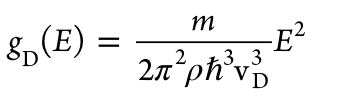
In an isotropic solid (or a powder such as used here) in the Debye model for phonons, the density of states is proportional to E^2 and the proportionality is determined by the speed of sound, v_D.


One clearly sees several things.
1. For E less than about 3 meV, the DOS is quadratic in E, as predicted by Debye.
2. The lattice softens with the spin-crossover.
3. The deviation from quadratic occurs at a smaller E for HS than LS.

The values of the speed of sound can be combined with the lattice constant to estimate the Debye frequency, which is roughly where the deviation from quadratic dependence should occur.
I have done this (since the authors don't appear to have) and one gets values of the order of a few meV, consistent with experiment.

From the speed of sound, one can also determine the Young's modulus. This can then be compared to the bulk modulus, which can be determined from MEMS. The values obtained by these different methods are consistent with one another.
Overall, the values of the bulk modulus for different spin-crossover complexes, of order 5-10 GPa, are comparable to those for organic molecular crystals.

What does this movie tell us about the modern university?

Last night, my wife and I watched the movie, Wit. You can watch the full movie here  (free with ads). I should warn that some of the conten...