Showing posts with label tunneling. Show all posts

Wednesday, May 20, 2026

Are chemical isomers emergent?

In discussions of emergence, particularly in chemistry, isomers are often given as an example of an emergent phenomenon. In Anderson's original "More is Different" article, he discussed the chirality of sugar molecules as an example of symmetry breaking. More recently, isomers (and the associated concept of molecular structure) are invoked to justify contentious claims about strong emergence and downward causality.

Here, I explain what isomers are and consider whether they are emergent in the sense of novelty, i.e., they have properties that are qualitatively different from their constituents.

In a later post, I hope to address the more general and knotty problems of molecular structure and the Born-Oppenheimer approximation.

Structural isomers

These occur when a specific collection of atoms (chemical formula) can have more than one molecular structure. An example, shown below, is C3H4.


Each structure has different chemical and physical properties. Aggregates of each molecule can have different properties such as boiling and melting points.

Some isomers are more stable than others. They may be able to interconvert, but sometimes not on laboratory time scales.

From the point of view of a ground state potential energy surface, the different isomer structures correspond to different local minima on the surface.

Stereoisomers

The simplest example is HFClBr. There are two stable structures shown below. They are related by a chiral (mirror) symmetry. They differ physically in that they rotate the plane of polarisation of incident light in opposite directions. 
The isomers, known as enantiomers, have the same ground state energy. In terms of a potential energy surface, they correspond to two different minima and are separated by a high-energy barrier. In principle, the two forms can quantum-tunnel between each other.

Chemically, the two isomers differ in how they react with other chiral molecules.

Chirality is central to molecular biology. Proteins are made of amino acids, and in nature they all have the L-form. Most forms of DNA involve double helices with right-handed chirality. 

The chirality of drug molecules matters, as tragically found with thalidomide in the 1950s. 

Emergence?

The constituent components of these molecules can be viewed as electrons and atomic nuclei. Alternatively, the components could be viewed as the atoms they are made of. In both cases, the parts of the system do not have the structure and properties that the system does. The atoms, nuclei, and electrons all have spherical symmetry, whereas the molecules do not. Another argument is that since the isomers are qualitatively different from one another, at least one of them must be qualitatively different from the components. Hence, these molecular structures can be viewed as emergent.

However, this goes against the view that we generally associate emergence with systems with many interacting parts. If we take two massive particles interacting by gravity, they can form a stable orbit. Neither particle has this property, but we don't generally claim that such orbits are emergent.
[I am grateful to a commenter on an old post who pointed this out].


There are subtleties associated with the stability of enantiomers and the associated breaking of chiral symmetry. This is similar to the issue of ammonia having a stable pyramidal structure. (Also discussed by Anderson in "More is Different"). An isolated molecule in a vacuum will have no chirality. The ground state is a quantum superposition of both enantiomers. However, in the laboratory, the interaction of each molecule with its environment, such as other molecules, leads to decoherence that prevents quantum tunnelling. In that case, there are an infinite number of degrees of freedom associated with the environment, and they are crucial for the emergence of enantiomers.

Wednesday, October 8, 2025

2025 Nobel Prize in Physics: Macroscopic quantum effects

John Clarke, Michel H. Devoret, and John M. Martinis received the prize  “for the discovery of macroscopic quantum mechanical tunnelling and energy quantisation in an electric circuit.”

The work was published in three papers in PRL in 1984 and 1985. The New York Times has a nice discussion of the award, including comments from Clarke, Martinis, Tony Leggett, and Steve Girvin.

There is some rich, subtle, and beautiful physics here. As a theorist, I comment on the conceptual and theoretical side, but don't want to minimise that doing the experiments was a technical breakthrough.

The experiments were directly stimulated by Tony Leggett, who, beginning in the late 70s, championed the idea that Josephson junctions and SQIDs could be used to test whether quantum mechanics was valid at the macroscopic level. Many in the quantum foundations community were sceptical. Leggett and Amir Caldeira, performed some beautiful, concrete, realistic calculations of the effect of decoherence and dissipation on quantum tunneling in SQUIDs. The results suggested that macroscopic tunneling should be observable.

Aside: Leggett rightly received a Nobel in 2003 for his work on the theory of superfluid 3He. Nevertheless, I believe his work on quantum foundations is even more significant.

Subtle point 1. What do we mean by a macroscopic quantum state?

It is commonly said that superconductors and superfluids are in a macroscopic quantum state. Signatures are the quantisation of magnetic flux in a superconducting cylinder and how the current through a Josephson junction oscillates as a function of the magnetic flux through the junction. I discuss this in the chapter on Quantum Matter in my Very Short Introduction.

Leggett argued that these experiments are explained by the Josephson equations, which treat the phase of the superconducting order parameter as a classical variable. For example, in a SQUID, it satisfies a classical dynamical equation. 

If the state is truly quantum, then the phase variable should be quantised.

Aside: a nice microscopic derivation, starting from BCS theory and using path integrals, of the effective action to describe the quantum dynamics was given in 1982 by Vinay Ambegaokar, Ulrich Eckern, Gerd Schön

Subtle point 2. There are different signatures of quantum theory: energy level quantisation, tunnelling, coherence (interference), and entanglement.

In 1984-5, Clarke, DeVoret, and Martinis observed the first two. Macroscopic quantum coherence is harder to detect and was only observed in 2000. 

In a nice autobiographical article
Leggett commented in 2020,
Because of the strong prejudice in the quantum foundations community that it would never be possible to demonstrate characteristically quantum-mechanical effects at the macroscopic level, this assertion made us [Leggett and Garg, 1985] the target of repeated critical comments over the next few years. Fortunately, our experimental colleagues were more open-minded, and several groups started working toward a meaningful experiment along the lines we had suggested, resulting in the first demonstrations (29, 30) of MQC [Macroscopic Quantum Coherence] in rf SQUIDs (by then rechristened flux qubits) at the turn of the century. However, it would not be until 2016 that an experiment along the lines we had suggested (actually using a rather simpler protocol than our original one) was carried out (31) and, to my mind, definitively refuted macrorealism at that level.  
I find it rather amusing that nowadays the younger generation of experimentalists in the superconducting qubit area blithely writes papers with words like “artificial atom” in their titles, apparently unconscious of how controversial that claim once was.

Two final comments on the sociology side.

Superconductivity and superfluidity have now been the basis for Nobel Prizes in six years and four years, respectively.

The most widely cited of the three PRLs that were the basis of the Prize is the one on quantum tunnelling with about 500 citations on Google Scholar. (In contrast, Devoret has more than 20 other papers that are more widely cited). From 1986 to 1992 it was cited about a dozen times per year. Between 1993 and 2001 is was only cited a total of 30 times. Since, 2001 is has been cited about 20 times per year.

This is just one more example of how citation rates are a poor measure of the significance of work and a predictor of future success.

Friday, July 18, 2025

Emergence in Chemistry

It is important to be clear what the system is. Most of chemistry is not really about isolated molecules. A significant amount of chemistry occurs in an environment, often within a solvent. Then the system is the chemicals of interest and the solvent. For example, when it is stated that HCl is an acid, this is not a reference to isolated HCl molecules but a solution of HCl in water, and then the HCl dissociates into H+ and Cl- ions. Chemical properties such as reactivity can change significantly depending on whether a compound is in the solid, liquid, or gas state, or on the properties of the solvent in which it is dissolved.

Scales

The time scales for processes, which range from molecular vibrations to chemical reactions, can vary from femtoseconds to days. Relevant energy scales, corresponding to different effective interactions, can vary from tens of eV (strong covalent bonds) to microwave energies of 0.1 meV (quantum tunnelling in an ammonia maser).

Other scales are the total number of atoms in a compound, which can range from two to millions, the total number of electrons, and the number of different chemical elements in the compound. As the number of atoms and electrons increases, so does the dimensionality of the Hilbert space of the corresponding quantum system.

Novelty

All chemical compounds are composed of a discrete number of atoms, usually of different type. For example, acetic acid, denoted CH3COOH, is composed of carbon, oxygen, and hydrogen atoms. The compound usually has chemical and physical properties that the individual atoms do not have.

Chemistry is all about transformation. Reactants combine to produce products, e.g. A + B -> C. C may have chemical or physical properties that A and B did not have.

Chemistry involves concepts that do not appear in physics. Roald Hoffmann argued that concepts such as acidity and basicity, aromaticity, functional groups, and substituent effects have great utility and are lost in a reductionist perspective that tries to define them precisely and mathematicise them.

Diversity

Chemistry is a wonderland of diversity, as it arranges chemical elements in a multitude of different ways that produce a plethora of phenomena. Much of organic chemistry just involves three different atoms: carbon, oxygen, and hydrogen.

Molecular structure

Simple molecules (such as water, ammonia, carbon dioxide, methane, benzene) have a unique structure defined by fixed bond lengths and angles. In other words, there is a well-defined geometric structure that gives the locations of the centres of atomic nuclei. This is a classical entity. This emerges from the interactions between the electrons and nuclei of the constituent atoms.

In philosophical discussions of emergence in chemistry, molecular structure has received significant attention. Some claim it provides evidence of strong emergence. The arguments centre around the fact that the molecular structure is a classical entity and concept that is imposed, whereas a logically self-consistent approach would treat both electrons and nuclei quantum mechanically.

The molecular structure of ammonia (NH3) illustrates the issue. It has an umbrella structure which can be inverted. Classically, there are two possible degenerate structures. For an isolated molecule, quantum tunnelling back and forth between the two structures can occur. The ground state is a quantum superposition of two molecular structures. This tunnelling does occur in a dilute gas of ammonia at low temperature, and an associated quantum transition (at a wavelength of 1.2 cm) is the basis of the maser, the forerunner of the laser. This example of ammonia was discussed by Anderson at the beginning of his seminal More is Different article to illustrate how symmetry breaking leads to well-defined molecular structures in large molecules. 

Figure is taken from here.

Born-Oppenheimer approximation 

Without this concept, much of theoretical chemistry and condensed matter would be incredibly difficult. It is based on the separation of time and energy scales associated with electronic and nuclear motion.  It is used to describe and understand the dynamics of nuclei and electronic transitions in solids and molecules. The potential energy surfaces for different electronic states define effective theory for the nuclei. Without this concept, much of theoretical chemistry and condensed matter would be incredibly difficult.

Singularity. The Born-Oppenheimer approximation is justified by an asymptotic expansion in powers of (m/M)^1/4, where m is the mass of an electron and M the mass of an atomic nucleus in the molecule. This has been discussed by Primas and Bishop.

The rotational and vibrational degrees of freedom of molecules also involve a separation of time and energy scales. Consequently, one can derive separate effective Hamiltonians for the vibrational and rotational degrees of freedom.

Qualitative difference with increase in molecular size

Consider the following series with varying chemical properties: formic acid (CH2O2), acetic acid (C2H4O2), propionic acid (C3H6O2), butyric acid (C4H8O2), and valerianic acid (C5H10O2), whose members involve the successive addition of a CH2 radical. The Marxist Friedrich Engels used these examples as evidence for Hegel’s law: “The law of transformation of quantity into quality and vice versa”.

In 1961, Platt discussed properties of large molecules that “might not have been anticipated” from properties of their chemical subgroups. Table 1 in Platt’s paper lists “Properties of molecules in the 5- to 50-range that have no counterpart in diatomics and many triatomics.” Table 2 lists “Properties of molecules in the 50- to 500-atom range and up that go beyond the properties of their chemical sub-groups.” The properties listed included internal conversion (i.e., non-radiative decay of excited electronic states), formation of micelles for hydrocarbon chains with more than ten carbons, the helix-coil transition in polymers, chromatographic or molecular sorting properties of polyelectrolytes such as those in ion-exchange resins, and the contractility of long chains.

Platt also discussed the problem of molecular self-replication. Until 1951, it was assumed that a machine could not reproduce itself,f and this was the fundamental difference between machines and living systems. However, von Neumann showed that a machine with a sufficient number of parts and a sufficiently long list of instructions can reproduce itself. Platt pointed out that this suggested there is a threshold for autocatalysis: “this threshold marks an essentially discontinuous change in properties, and that fully-complex molecules larger than this size differ from all smaller ones in a property of central importance for biology.” Thus, self-replication is an emergent property. A modification of this idea has been pursued by Stuart Kauffman with regard to the origin of life, that when a network of chemical reactions is sufficiently large, it becomes self-replicating.

Tuesday, December 13, 2016

The challenge of an optimal enzyme

Carbonic anhydrase is a common enzyme that performs many different physiological functions including maintaining acid-base equilibria. It is one of the fastest enzymes known and its rate is actually limited not by the chemical reaction at the active site but by diffusion of the reactants and products to the active site.

Understanding the details of its mechanism presents several challenges, both experimentally and theoretically. A key issue is the number and exact location of the water molecules near the active site. The most recent picture (from a 2010 x-ray crystallography study) is shown below.

The "water wire" is involved in the proton transfer from the zinc cation to the Histidine residue. Of particular note is the short hydrogen bond (2.4 Angstroms) between the OH- group and a neighbouring water molecule.

Such a water network near an active site is similar to what occurs in the green fluorescent protein and KSI.

Reliable knowledge of the finer details of this water network really does matter.

This ties in with theoretical challenges that are related to several issues I have blogged about before. Basic questions concerning proton transport along the wire include:

A. Is the proton transfer sequential or concerted?

B. Is quantum tunnelling involved?

C. What role (if any) does the dynamics of the surrounding protein play?

A 2003 paper by Cui and Karplus considers A., highlighting the sensitivity to the details of the water wire.
Another 2003 paper by Smedarchina, Siebrand, Fernández-Ramos, and Cui looks at the both questions through kinetic isotope effects and suggests tunnelling plays a role.

In 2003 it was not even clear how many water molecules were in the wire and so the authors considered different alternatives.

One can only answer these questions definitively if one has extremely accurate potential energy surfaces. This is challenging because:

Barrier heights and quantum nuclear effects vary significantly with small changes (even 0.05 Angstroms) in H-bond donor-acceptor distances.

The potential surface can vary significantly depending on the level of quantum chemistry theory or density functional that is used in calculations.

I thank Srabani Taraphder for introducing me to this enzyme. She has recently investigated question C.

Wednesday, December 7, 2016

Pseudo-spin lattice models for hydrogen-bonded ferroelectrics and ice

The challenge of understanding phase transitions and proton ordering in hydrogen-bonded ferroelectrics (such as KDP, squaric acid, croconic acid) and different crystal phases of ice has been a rich source of lattice models for statistical physics.
Models include ice-type models (six-vertex model, Slater's KDP model), transverse field Ising model, and some gauge theories. Some of the classical (quantum) models are exactly soluble in two (one) dimensions.

An important question that seems to be skimmed over is the following: under what assumptions can one actually "derive" these models starting from the actual crystal structure and electronic and vibrational properties of a specific material?

That quantum effects, particularly tunnelling of protons, are important in some of the materials is indicated by the large shifts (of the order of 100 percent) seen in the transition temperatures upon H/D isotope substitution.

In 1963 de Gennes argued that the transverse field Ising model should describe the collective excitations of protons tunnelling between different molecular units in an H-bonded ferroelectric. Some of this is discussed in detail in an extensive review by Blinc and Zeks.
An important issue is whether the phase transition is an "order-disorder" transition or a "displacive" transition. I think what this means is the following. In the former case, the transition is driven by the pseudo-spin variables and there is no soft lattice mode associated with the transition.
Perhaps, in different language, is it appropriate to "integrate out" the vibrational degrees of freedom?
[Aside: this reminds me of some issues that I looked at in a Holstein model about 20 years ago].

There are a lot of papers that make quantitative comparisons between experimental properties and the predictions of a transverse field Ising model (usually treated in the mean-field approximation).
One example (which also highlights the role of isotope effects) is

Quantum phase transition in K3D1−xHx(SO4)2 
Y. Moritomo, Y. Tokura, N. Nagaosa, T. Suzuki, and K. Kumagai

One problem I am puzzling over is that the model parameters that they (and others) extract are different from what I would expect from knowing the actual bond lengths, vibrational frequencies, in the system and the energetics of different H-bond states. I can only "derive" pseudo-spin models with quite restrictive assumptions.

A recent paper that looks some of rich physics associated with collective quantum effects is
Classical and quantum theories of proton disorder in hexagonal water ice 
Owen Benton, Olga Sikora, and Nic Shannon

Monday, December 5, 2016

Hydrogen bonding at Berkeley

On Friday I am giving a talk in the Chemistry Department at Berkeley.
Here is the current version of the slides.

There is some interesting local background history I will briefly mention in the talk. One of the first people to document correlations between different properties (e.g. bond lengths and vibrational frequencies) of diverse classes of H-bond complexes was George Pimentel. 
Many correlations were summarised in a classic book, "The Hydrogen Bond" published in 1960.
He also promoted the idea of a 4-electron, 3 orbital bond which has similarities to the diabatic state picture I am promoting.
There is even a lecture theatre on campus named after him!


Thursday, April 7, 2016

Review of nuclear quantum effects in water

Chemical Reviews just published an article

Nuclear Quantum Effects in Water and Aqueous Systems: Experiment, Theory, and Current Challenges 
Michele Ceriotti, Wei Fang, Peter G. Kusalik, Ross H. McKenzie, Angelos Michaelides, Miguel A. Morales, and Thomas E. Markland

(Trivia: 4 out of 7 authors have a surname beginning with M!)


One of the unifying themes in the review is that of competing quantum effects, illustrated above.

This article is a direct outcome of the NORDITA program, "Water - the most anomalous liquid" that I attended about 18 months ago.
Other reviews from the program will appear together in a special issue of the journal.
I must confess I was skeptical that we were going to be able to pull off these reviews, written by large teams of busy and opinionated individuals.
For ours, we are greatly in debt to Tom Markland for his perseverance and leadership.

We welcome any comments about the contents of the review.

Wednesday, January 27, 2016

Dynamical tunneling and overtone spectroscopy

In a molecule one can observe excitation by infra-red photons of overtones of vibrational modes, i.e. if nu is the fundamental vibrational frequency, the absorption of photons with frequency of about 2 nu, 3 nu, ... can be observed. The quantum picture is below for a 4nu absorption.


I recently learnt that overtone absorption is classically forbidden, i.e. it is intrinsically quantum mechanical (just like tunnelling, reflection above a barrier, interference, entanglement, ...). It does not occur in the limit that Planck's constant goes to zero.
Explicitly if you take an anharmonic oscillator and drive it with an external field of frequency 2 nu, you cannot get the oscillator to go at 2 nu.
Furthermore, this involves dynamical tunnelling, i.e. there is no potential barrier in real space, but rather tunnelling occurs in phase space.

There is a nice article by Eric Heller where he shows that overtone excitation is like reflection above a potential barrier.


The figure below shows the classical phase space (and Poincare surfaces) for an anharmonic (Morse) oscillator coupled to a driving field with 4 times the harmonic frequency of the oscillator.
Heller states "the local phase space structure near the [resonance] islands is the same as the above-barrier problem". See the Figure below.

Works by Lehmann and by Medvedev, explicitly shows how the transition probability for overtone excitation (i.e. the relevant matrix element) is dominated by the semi-classical dynamics in the classically forbidden region of the potential, particularly the inner wall.

This is currently of interest to me because I am working on a paper about the intensity of overtone modes in hydrogen bonded systems. In the Condon approximation overtone excitation can only occur if the potential is anharmonic. Alternatively it can arise due to non-linear terms in the dipole surface (i.e. electrical anharmonicity) (equivalent to the break-down of the Condon approximation). It does seem that the matrix element for the overtone intensity is quite sensitive to the finer details of the potential and thus the nuclear wave functions.

Wednesday, July 29, 2015

Coupled electron-proton transfer: adiabatic or non-adiabatic?

Sharon Hammes-Schiffer gave an interesting talk in Telluride last week about coupled electron-proton transfer.
[A couple of my earlier posts on this fascinating subject are here and here].

Here are a few things that stood out.

There are a lot more people working on this problem now than twenty years ago. This is because of possible solar energy applications.

Diabatic states are the key to understanding. There are four relevant states. Simply the proton can be on the donor or acceptor. The electron can be on the donor or the acceptor. Whether the process is concerted or sequential depends on the relative energy of these four states.

A key question is whether the process is adiabatic or non-adiabatic.
What are the key experimental signatures of each?
One contrast is coupled electron-proton transfer (EPT) and hydrogen atom transfer (HAT).

The two cases are nicely embodied respectively in the model systems
HAT - benzyl/toluene
EPT - phenoxly/phenol
The theoretical details are worked out here.

In some enzymes such as soybean lipoxygenase (SLO) there are very large kinetic isotope effects (~80) for proton transfer, orders of magnitude larger than expected. Many people, including me, have struggled to understand this in terms of proton tunnelling in an adiabatic picture with coupling to an environment. 
However, the relevant reactions are actually coupled electron-proton transfer, in the non-adiabatic regime. The key equation to understand both the magnitude and temperature dependence of the isotope effect is

taken from this paper.

A recent paper compares the theory to a mutant of SLO in which the isotope effect becomes ~500 as a result of the increase in the proton donor-acceptor distance R.

One minor point on how this relates to my talk. I said that quantum nuclear effects [and H/D isotope] effects were largest [and very subtle] in hydrogen bonding for donor-acceptor distances of R= 2.4-2.5 Angstroms. In contrast, here the isotope effects actually get larger with increasing R, with R=2.7 A for the wild-type SLO and increasing to 2.8-2.9 A with the selected mutations. I thank Sharon for pointing out this difference to me.

Monday, July 27, 2015

Quantum biology smells bad

I am skeptical of the grand and speculative claims of "quantum biology". 
There is a nice paper in PNAS which systematically considers the specific claim that smell is based on sensing the vibrational frequencies of particular molecules, and rebuts it from both theoretical and experimental points of view.

Implausibility of the vibrational theory of olfaction
Eric Block, Seogjoo Jang, Hiroaki Matsunami, Sivakumar Sekharan, Bérénice Dethier, Mehmed Z. Ertem, Sivaji Gundala, Yi Pan, Shengju Li, Zhen Li, Stephene N. Lodge, Mehmet Ozbil, Huihong Jiang, Sonia F. Penalba, Victor S. Batista, and Hanyi Zhuang.

I thank Suggy Jang for bringing the paper to my attention.

Monday, July 20, 2015

Quantum nuclear effects in condensed phase chemistry

I am currently in Telluride for a meeting on Quantum effects in condensed phase systems. Two years ago I attended a similar meeting and in preparing it has been helpful to re-read several posts I wrote stimulated by that meeting.

In my first post, I listed possible quantum effects [zero-point motion, tunnelling, geometric phases, entanglement, ...] and pointed how generally one expects a condensed phase environment [protein, glass, solvent] for a molecular system will tend to reduce these quantum effects by decoherence.

I then asked two big questions.
Are there any instances where the environment can
A. enhance quantum effects?
B. lead to qualitatively new effects (e.g. associated with collective degrees of freedom) that are absent in the gas phase?

I clarified what I meant by a trivial vs. non-trivial enhancement of a quantum effect, from a physics point of view. An example of a "trivial" enhancement is where the environment changes the molecular geometry to enhance the effect. But I stressed that such an enhancement may be highly valuable from a chemistry or biochemistry point of view.

In a comment, Gautam Menon suggested that the Surface Enhanced Raman scattering was a nice example of a non-trivial enhancement. It is certainly spectacular, with enhancements as large as 10^11. However, I am not sure this is the type of quantum effect I am thinking of. The actual mechanism of the effect is still debated [see this paper] and I am not qualified to consider the relative merits of the alternative explanations, but it does look to me like it could be viewed as a semi-classical effect.

Tom Miller suggested to me that the solvation of single electrons and the associated polarons may be a suitable example of B.

I suggested that there were two important organising principles for describing and understanding quantum nuclear effects
1. Competing quantum effects
2. Rate processes can be dominated by rare quantum events.

I am looking forward to the meeting.

Thursday, July 9, 2015

Diabatic states rock!

Physical Chemistry Chemical Physics has just published a series of four articles by Jeff Reimers, Laura McKemmish, Noel Hush, and myself.

A unified diabatic description for electron transfer reactions, isomerization reactions, proton transfer reactions, and aromaticity"

Non-adiabatic effects in thermochemistry, spectroscopy and kinetics: the general importance of all three Born-Oppenheimer breakdown corrections

Electron-vibration entanglement in the Born-Oppenheimer description of chemical reactions and spectroscopy

Bond angle variations in XH3 [X=N,P,As,Sb,Bi]: the critical role of Rydberg orbitals exposed using a diabatic state model

It took a number of years to finish these papers. I am certainly the junior co-author and I commend my co-authors for all their hard work and perseverance.

The four papers have two common related themes, that are hopefully not lost in all the technical detail.

1. Diabatic states provide a powerful scheme, both conceptually and quantitatively, to describe a wide range of chemical phenomena.
2. This can be nicely illustrated using a simple model Hamiltonian describing the coupling of two electronic states to a single vibrational mode.
In chemistry language this is a E x beta Jahn-Teller model. In condensed matter language, is a two-site spinless fermion Holstein model.

We welcome comments.

Update (24 September, 2015). The papers made it to the cover of the print edition.

Tuesday, April 21, 2015

Calibrating a ruler for hydrogen bond lengths

I have just finished a paper with Bijyalaxmi Athokpam and Sai  Ramesh,
Isotopic fractionation in proteins as a measure of hydrogen bond length

If a deuterated molecule containing strong intramolecular hydrogen bonds is placed in a hydrogenated solvent it may preferentially exchange deuterium for hydrogen. This preference is due to the difference between the vibrational zero-point energy for hydrogen and deuterium.  It is found that the associated fractionation factor $\Phi$  is correlated with the strength of the intramolecular hydrogen bonds. This correlation has been used to determine the length of the H-bonds (donor-acceptor separation) in a diverse range of enzymes and has been argued to support the existence of short low-barrier H-bonds.

Starting with a potential energy surface based on a simple diabatic state model for H-bonds we calculate $\Phi$ as a function of the proton donor-acceptor distance $R$.  For numerical results, we use a parameterization of the model for symmetric O-H.... O bonds.  We consider the relative contributions of the O-H stretch vibration, O-H bend vibrations (both in plane and out of plane), tunnelling splitting effects at finite temperature, and the secondary geometric isotope effect. We
compare our total $\Phi$ as a function of $R$ with NMR experimental results for enzymes, and in particular with an empirical parametrisation $\Phi(R)$, used previously to determine bond lengths.

I welcome any comments or suggestions.

Friday, March 27, 2015

Future challenges with nuclear quantum effects in water

Last October I enjoyed attending a meeting, Water: the most anomalous liquid at NORDITA. One of the goals of the workshop was to produce a review article, co-authored by about a dozen working groups, each covering a specific aspect of water. I was in the group on "Nuclear quantum effects in water", led by Tom Markland. I was worried that this goal was a bit too ambitious. After all, I am into modest goals! However, it is all coming together, a great credit to the organisers. Our group is now finalising our "chapter". An important and difficult task is to write something concrete and useful about future challenges and directions.

Here I give a few of my own biased tentative thoughts. Comments and suggestions would be very welcome.

Over the past decade there have been several significant advances that are relevant to understanding nuclear quantum effects in water. It was only by writing this summary that I realised just how tangible and significant these advances are. I am not sure other fields I am familiar with have experienced comparable advances.

Experiment.
Deep inelastic neutron scattering reveals the momentum distribution of protons, and can be compared to path integral simulations, as described here. Furthermore, this has illuminated competing quantum effects, as described here.

Quantum chemistry.
New accurate intermolecular potential energy surfaces and force fields, such as MB-pol.

Computational.
Path integral simulations. Besides significant increases in computational power [Moore's law] making simulation of much larger systems and better "statistics" possible, there have been significant methodological advances, such as Ring Polymer Molecular Dynamics, and PIGLET.

New concepts and organising principles.
Competing quantum effects associated with the zero-point energy of O-H stretching and bending modes. The competition is particularly subtle in water, to the point that it can change the sign of isotope effects.
Dynamical properties such as proton transport being dominated by extremely rare events, associated with short hydrogen bonds.

Simple models.
The coarse-grained monatomic Water (mW) model captures many anomalies of classical water, showing their origin is in the tetrahedral bonding. A diabatic state model captures essential features of the potential energy surface of single hydrogen bonds, particularly the variation with the distance between oxygen atoms. The model does describes competing quantum effects.

These advances present some significant opportunities and challenges.

Experiment.
Resolving the ambiguity associated with interpreting the deep inelastic neutron scattering experiments. Going from the data to robust (i.e. non-controversial) spatial probability distributions for protons, particularly ones involving proton delocalisation would be nice.

Simulation.
The path integral simulations will only be as good at the potential energy surfaces that they use. For example, recent work shows how calculated isotope effects vary significantly with the DFT functional that is used. This is because the potential energy surface, particularly with respect to the proton transfer co-ordinate, is quite sensitive to the oxygen atom separation, and to the level of quantum chemical theory. This becomes particularly important for properties that are determined by rare events [i.e. thermal and quantum fluctuations to short hydrogen bonds].

Simple models.
Monatomic Water (mW) is completely classical. It would be nice to have a quantum generalisation that can describe how the water phase diagram changes with isotope (H/D substitution). Note there is already a problem because mW is so coarse-grained that it does not contain the O-H stretch. On the other hand, mW does describe the librational modes, and these do make a significant contribution to quantum nuclear effects in water, as described here.

I welcome suggestions and comments.

Wednesday, March 11, 2015

A brilliant insight about quantum decoherence in electronic circuits

Yesterday, Matthew Woolley gave an interesting Quantum science seminar at UQ about some of his recent work on Photon assisted tunnelling with non-classical light.

I just want to focus on one point that was deeply imbedded in the talk. It is a idea that is profound and central to the physics of quantum electronic circuits. The idea is so old now its profoundness and brilliance may be lost on a new generation.
The idea and result is easiest for me to explain in terms of the figure below which describes a superconducting (Josephson junction) qubit connected to an electrical circuit. It is taken from this review.

One can quantise the electromagnetic field and consider a spin-boson model to describe decoherence and dissipation of the qubit. This is associated with a spectral density that is proportional to frequency with a dimensionless pre factor alpha, which for this circuit is given by
where R_V is the electrical resistance of the circuit, R_K is the quantum of resistance, and the C's are capacitances.
Similar physics is at play in normal tunnel junctions (see for example this important paper, highlighted by Matthew in his talk).

Why do I find this profound?
First, this is a very simple formula that depends only on macroscopic parameters of the electrical circuit. One does not have to know anything about the microscopic details of  all the different electronic degrees of freedom in the circuit or how they individually couple to the qubit. I find this surprising.
Second, the underlying physics is the fluctuation-dissipation theorem. The quantum noise in the electronic circuit is related to fluctuations in the current. By Kubo and the fluctuation-dissipation relation tell us the fluctuations in the current are essentially the conductivity [the inverse of the resistivity].

Who was the first to have this insight and calculate this?
I feel it was Caldeira and Leggett, but I can't find the actual equation with the circuit resistance in their 1983 paper.
Or did someone else do this earlier?

Because of the above, whenever the spectral density depends linearly on the frequency, Leggett (and now everyone) calls it ohmic dissipation.

I first learnt this through the thesis work of my student Joel Gilmore, and described in this review. There we considered a more chemical problem, two excited electronic states of a molecule that are in a polar dielectric solvent. The coupling to the environment is completely specified in terms of the frequency dependent dielectric constant of the solvent (and some geometric factors).

Update: Caldeira answers the question in a comment below.

Thursday, January 22, 2015

Quantum protons in enzymes

A number of proteins involve short strong hydrogen bonds [also known as low-barrier bonds] and there is considerable debate about how important or relevant they are for functionality. A particularly interesting enzyme is KetoSteroid Isomerase (KSI) which features such bonds. Its structure and mechanism has recently been elucidated by some beautiful experiments using mutants near the active site.

There is a nice paper
Quantum delocalization of protons in the hydrogen-bond network of an enzyme active site
Lu Wang, Stephen D. Fried, Steven G. Boxer, and Thomas E. Markland

This is a combined experimental and theoretical study of isotope substitution effects where the protons are replaced with deuterium. This allows one to probe the effects of the zero-point motion of the protons in hydrogen bonds. You can see zero-point energy with a pH meter.

The authors measure the change in the pKa [acidity] with H/D substitution of the different amino acid residues in the active site of KSI. Significantly, they find that for one of the KSI tyrosine's the pKa change is much larger than the change in water. Furthermore, they calculate this change using an ab initio path integral molecular dynamics simulation, obtaining a value in reasonable agreement with experiment.

The large isotope effect arises because of the significant quantum delocalisation of the protons in the H-bond network near the tyrosine's. This is illustrated in the figure below, showing the probability of finding a proton along the co-ordinate associated with proton transfer between the two different tyrosine's [when nu_16=0 the proton is equidistant between the Tyr16 and Tyr57 residues].


The simulation is a real tour de force. It uses a "force field" calculated "on the fly" from density functional theory with the B3LYP-D3 functional.
These simulations treat both the nuclear and electronic degrees of freedom quantum mechanically in the active-site QM region and also incorporate the fluctuations of the protein and solvent environment in the MM region. The simulations consisted of between 47 and 68 QM atoms and more than 52,000 MM atoms describing the rest of the protein and solvent. 
These simulations, which until recently would have been computationally prohibitive, were made possible by 
accelerating the path integral molecular dynamics convergence using a generalized Langevin equation, 
using new methods to accelerate the extraction of isotope effects, and 
exploiting graphical processing units (GPUs) to perform efficient electronic structure theory evaluations through an interface to the TeraChem code. 
Such a combination yielded almost three orders of magnitude speedup compared with existing AI-PIMD approaches.
Being able to perform such detailed stimulations will allow critical examination of controversial claims that short hydrogen bonds and proton tunnelling is a key ingredient in the functionality of specific enzymes.

Thursday, September 25, 2014

When is water quantum? II

A previous post focused on quantum effects largely associated with hydrogen bonding associated with the O-H stretch vibration. Here, I consider effects largely associated with angular motion, known as librational modes.

Feynman Path Integral computer simulations performed by Peter Rossky, Bruce Berne, Greg Voth, and Peter Kusalik have led to the following key ideas.

1. Quantum water is less structured than classical water.

This is seen in the figure below taken from a 2004 paper by Hernandez de la Pena and Kusalik.

2. This is largely do to quantisation of orientational rather than translational degrees of freedom.

The clear evidence for this is from Kusalik's path integral simulations. There, the water molecules are rigid and only the orientational motion of the molecules is quantised. Similar results for the structure factor, (translational) diffusion constant, and orientational relaxation times (and their isotope effects) are obtained from simulations with flexible molecules and quantised translational modes.

3. Many of these quantum effects are similar to those of classical water with a higher temperature by 50 K. 

The figure below taken from a 2005 paper by Hernandez de la Pena and Kusalik. The structure functions are virtually identical for quantum water at 0 degrees C and classical water at 50 degrees C.

The temperature dependence of the potential energy is shown below. The quantum energy is larger than the classical by about 350 cm^-1.

N.B. one should not use this result to justify the claim that ALL quantum effects are similar to raising the temperature by 50 K. For example, none of the quantum effects discussed in the earlier post can be understood in these terms.

What is going on?

Here is one idea about the essential physics. I think it is similar to earlier ideas going back to Feynman and Hibbs (page 281) about effective "classical potentials", and discussed in detail by Greg Voth.

Consider a simple harmonic (angular/torsional) oscillator of frequency Omega and moment of inertia I at temperature T. The RMS fluctuation in the angle Phi are given below for the quantum and classical cases.


The two temperature dependences of the quantum case [purple curve] and classical curve [straight red line] are plotted below. The temperature [horizontal scale] is in units of the zero point energy.  The vertical scale is in units of the zero-point motion.


The RMS is about the same [horizontal line] when the quantum temperature (273 K) is such that
Omega/k_B T ~ 3 and the classical temperature is about 15 per cent larger.

This suggests that Omega ~ 3 k_B T ~ 600 cm^-1.

Is this reasonable?

The figure below shows the spectrum of the librational modes.

This frequency scale is also consistent with the differences in potential energy.

How do the quantum fluctuations lead to softening of the structure?

Quantum fluctuations lead to "swelling" of the polymer beads in the discrete path integral or the new effective classical potential, a la Feynman-Hibbs/Voth...
This swelling reduces the effective interaction between molecules and reduces structure

Some of the papers mention the role of tunnelling.
It is not clear to me what this is about.
Can anyone clarify?

Thursday, September 11, 2014

When is water quantum?

Many properties of bulk water, including its many anomalous properties, can be described/understood in terms of the classical dynamics of interacting "molecules" that consist of localised point charges. However, there is more to the story. In particular, it turns out some of the success of classical calculations arise from a fortuitous cancellation of quantum effects. Some quantum effects can just be mimicked by using a higher temperature or a softer potential in a classical simulation.

Properties to consider include thermodynamics, structure, and dynamics. Besides bulk homogeneous liquid water, there is ice under pressure, and water in confined spaces, at surfaces, and interacting with ions, solutes, and biomolecules.

Distinctly quantum effects that may occur in a system include zero-point motion, tunnelling, reflection at the top of a barrier, coherence, interference, entanglement, quantum statistics, and collective phenomena (e.g. superconductivity). As far as I am aware only the first two are relevant to water: they involve the nuclear degrees of freedom, specifically the motion of hydrogen atoms or protons. A definitive experimental signature of such quantum effects in seen by substitution of hydrogen with deuterium.

Although there have been exotic claims of entanglement, from both experimentalists and theorists, I think these are based on such dubious data and unrealistic models they are not worthy of even referencing. More positively, there may also be some collective tunnelling effects involving hexagons of water molecules, as described here.

When are quantum nuclear effects significant? 
What are the key physico-chemical descriptors?

I believe there are two:
the distance R between a proton donor and acceptor in a hydrogen bond and
epsilon, the difference between the proton affinity of the donor and the acceptor.

Quantum nuclear effects become significant when both R is less than 2.6 Angstroms and epsilon is less than roughly 20 kcal/mol.

In bulk water at room temperature the average value of R is about 2.8 Angstroms and epsilon is of the order of 20 kcal/mol and so quantum nuclear effects are not significant for properties that are dominated by averages. However, there are significant thermal fluctuations than can make R as small at 2.4 Angstroms and epsilon smaller, for times less than hundreds of femtoseconds. More on that below. Furthermore, when water interacts with protons, to produce entities such as the Zundel cation, or with biomolecules, the average R can be as small at 2.4 Angstroms and epsilon can be zero. Also, in high pressure phases of ice (such as in Ice X) average values of R of order 2.4 Angstrom  occur.

This way of looking at quantum nuclear effects is discussed at length in this paper.

[Image from here]

What are the key organising principles for understanding quantum nuclear effects?

I proposed before these two.

1. Competing quantum effects: O-H stretch vs. bend

Hydrogen bonding changes vibrational frequencies and thus the zero-point energy. As the H-bond strength increases (e.g. due to decreasing R) the O-H stretch frequency decreases while the O-H bend frequencies increases. These changes compete with each other in their effect on the total zero-point energy. Also, the quantum corrections associated with the two types of vibrations have the opposite sign reducing the total quantum effects.
I think this idea was first clearly stated by Markland, Habershon, and Manolopoulos.

2. Dynamics dominated by rare events

For example, consider proton transfer in water. When R is at the average value of 2.8 Angstroms the energy barrier is very large. However, if there a very short fluctuation in R so that it reduces to 2.4 Angstroms the barrier disappears and the proton transfers.

What are the implications of these two organising principles for computer simulations?

Pessimism and caution!

1. Subtracting two numbers of about the same size can be error prone.
Suppose that we can calculate the quantum effects of each of the vibrational modes to an accuracy of about 10 per cent. Then we add the contributions (picking some representative numbers):
100 - 50 - 30 = 20. The problem is that the total error is about +/-20.

2. The probability of the rare events is related to the tails of the nuclear wave function. The problem is that this is very sensitive to the exact form of the effective potential energy surface (PES) for the nuclear motion. Tunneling is very sensitive to the height and shape of energy barriers. The problem is that is very difficult, particularly for hydrogen bonding, to calculate these PES accurately, especially at the level of Density Functional Theory. These issues are nicely illustrated in a recent paper by Wang, Ceriotti, and Markland.

This post is motivated by preparing to be part of a working group on quantum water at a Nordita workshop.

My questions are:
Is the picture above valid? Is it oversimplified? Are there exceptions?
Are the two organising principles valid and important? Are there other relevant principles?

Wednesday, September 10, 2014

Double proton transfer rates vs. distance

There is a nice paper
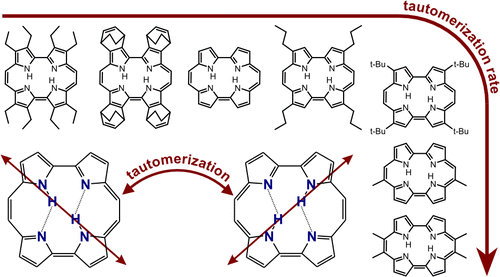
Tautomerism in Porphycenes: Analysis of Rate-Affecting Factors
Piotr Ciąćka, Piotr Fita, Arkadiusz Listkowski, Michał Kijak, Santi Nonell, Daiki Kuzuhara, Hiroko Yamada, Czesław Radzewicz, and Jacek Waluk

They look at nineteen different porphycenes, which means that R, the distance between the nitrogen atoms that donate and accept a proton varies.
[This is a testimony to the patience and skill of synthetic organic chemists to produce 19 different compounds.]

The rate of tautomerization [i.e. double proton transfer] can be measured my monitoring the time dependence of the fluorescence anisotropy because the transition dipole moment of the two tautomers is in different directions, as illustrated below, in the graphical abstract of the paper.

The key result is below: the rate of tautomerization [i.e. double proton transfer] versus R. Note the vertical scale varies by three orders of magnitude.


For single hydrogen bonds many correlations between R and observables such as bond lengths and vibrational frequencies have been observed.

The natural explanation for this correlation is that as R decreases so does the energy barrier for double proton transfer. At least at the qualitative level this is captured by my simple diabatic state model for double proton transfer [which just appeared in J. Chem. Phys.]. However, my model only predicts a correlation is the ratio of the proton affinity of the donor with one and two protons on the donor does not change as one makes the chemical substitutions that change R.

(I think) all these experiments are done at room temperature in a solvent.
Two open questions concern whether the double proton transfer is sequential or concerted, and whether it is activated or involves tunnelling. At low temperatures in supercooled jets there is evidence of tunnel splitting and concerted transfer.

What does this movie tell us about the modern university?

Last night, my wife and I watched the movie, Wit. You can watch the full movie here  (free with ads). I should warn that some of the conten...