Showing posts with label bad metals. Show all posts

Thursday, February 5, 2026

The legacy of 40 years of cuprate superconductivity

In February 1986, Bednorz and Müller made a stunning discovery: superconductivity at a temperature of 35 K in a doped copper oxide (cuprate). Arguably, this discovery changed condensed matter physics. In April 1986, they submitted their results to Z. Phys. B. Only nineteen months later, they were awarded the Nobel Prize in Physics, the shortest time ever between a discovery and the award. A nice and short review of the history is here.

One measure of my estimate of the influence of this discovery is that it received about 5 pages of coverage in my Condensed Matter Physics: A Very Short Introduction. (See Chapter 5, Adventures in Flatland).

How things have developed over the past forty years, for better and worse, may be representative of how science advances: discovery by serendipity, hype about applications, unexpected secondary benefits, foundational questions, new concepts, unification, and incremental advances.

Hype about technological applications

On March 20, 1987, The New York Times had a front-page article, DISCOVERIES BRING A 'WOODSTOCK' FOR PHYSICS, by James Gleick. This followed the 1987 APS March meeting. It began 

"Physicists from three continents converged on the New York Hilton for a hastily scheduled special conference on a string of discoveries that seem certain to produce a rapid cascade of commercial applications in electricity, magnetism and electronics.There are many things we know and understand that we did not when they were first discovered."

This has largely been unfulfilled. There are a few niche applications, but cuprates are not used in electricity distribution or even in the superconducting magnets in hospital MRI machines, which are probably the main commercial application of superconductors. One of the significant obstacles is that it is hard to make wires from these materials, as they are ceramics. This is an example of the common gap between research laboratory science and commercially viable technology.

After 40 years, do we have a successful theory?

It depends on who you ask. But I would say there is a lot we do understand.

We have a phenomenological theory for all the macroscopic phenomena associated with the superconducting state: Ginzburg-Landau theory!

Properties of the superconducting state are well-described by a BCS wavefunction with a d-wave order parameter and the associated Bogoliubov quasiparticles. [This is somewhat puzzling, as in the metallic state quasi-particles are not well defined].

Although not everyone agrees, I think it is fair to say that the essential physics is in a one-band Hubbard model, and the key physics is:

strong electronic correlations,

a doped antiferromagnetic Mott insulator,

d-wave pairing that is "mediated"/caused from some mixture/variant of antiferromagnetic spin fluctuations or RVB spin singlets,.....

We certainly don't understand the cuprates at the same level as elemental superconductors. But we do understand the essential physics.

What is harder to describe and understand are the states adjacent to the superconducting state in the phase diagram: the pseudogap state and the strange metal.


Strongly correlated electron materials became a large, vibrant and unified field

Before 1986, there were small, disconnected communities intermittently interested in transition metal oxides, rare earths, Kondo impurities, Mott metal-insulator transitions, organic superconductors, heavy fermions, and quantum antiferromagnets.

The discovery of the cuprates brought together these communities as they found common interests, challenges, questions, concepts, and techniques.

The discovery of superconductivity in strontium ruthenate, alkali fullerides, iron pnictides and chalcogenides, twisted bilayer graphene and more cuprates, organic charge-transfer salts, and heavy fermions has shown how rich these systems are. The challenge is to understand the similarities and differences between these chemically and structurally diverse systems. In many of them, superconductivity is proximate to a Mott insulating state.

The unity and excitement were probably stimulated and enhanced by the activities and ideas of high-profile theorists such as Anderson, Schrieffer, Scalapino, Pines, Rice, and Varma. On the other hand, their acrimonious disagreements probably did not help.

Secondary theoretical benefits

The things I list below were not new ideas when the cuprate discovery happened. However, interest in the cuprates led them to become major research themes and ideas.

Importance of phase diagrams, including as a function of interaction parameters in toy models

Highlighting the limitations of electronic structure methods based on Density Functional Theory with approximate Exchange-Correlation functionals (i.e., anything computational). In the presence of strong correlations, DFT methods have spectacular failures. For example, predicting a metallic state instead of the Mott insulator.

Low dimensionality leads to qualitatively different behaviour, including the possibility of new types of order and quasiparticles. This is most dramatic in one dimension, where one has Luttinger liquids and spin-charge separation.

Spin liquids. Landau was wrong. Spontaneous symmetry breaking does not always occur in antiferromagnets.

Non-Fermi liquids. Landau was wrong. Not all metals are Fermi liquids.

Quantum criticality. Although this is a robust concept for certain toy models, whether it is relevant to the cuprates remains contentious.

Systematic improvements in approximation schemes and numerical techniques - exact diagonalisation, DMRG, DMFT, quantum Monte Carlo,...

Emergence. Chemical complexity and strong interactions can lead to new states of matter.

Secondary experimental benefits

Better probes. The desire to characterise the cuprates helped drive significant improvements in the resolution of ARPES (Angle-Resolved PhotoEmission Spectroscopy), STM (Scanning Tunnelling Microscopy), and inelastic neutron scattering. These advances have born fruit in the study of a wide range of other materials, beyond the cuprates.

Growth of single crystals. The early days of the cuprates produced a lot of junk experimental results because of the poor quality of the samples produced by "shake and bake". However, the involvement of solid-state chemists has improved things. The techniques have also led to the production of single crystals for a wide range of strongly correlated materials.

Why is there so little research on cuprates today?

Today, there is little research directly on cuprates, both theoretically and experimentally. It is hard to get funding to work on them, even though there is a lot we don't understand really well.

This is because of the problem of fashion in science. The low-lying fruit has been picked. There is a continuous new stream of materials being discovered with exotic properties, the latest being twisted bilayer van der Waals compounds.

Monday, September 13, 2021

Vertex corrections do matter

For an experimentalist one of the "easiest" quantities to measure for a metal is the electrical resistivity. Yet, for a many-body theorist working on models for strongly correlated electron systems this is one of the most difficult quantities to calculate, without making strong and debatable assumptions. One of the key questions is whether vertex corrections do matter. Ten years ago I summarised some of the issues.

This issue is nicely addressed in this nice paper from 2019.

Conductivity in the Square Lattice Hubbard Model at High Temperatures: Importance of Vertex Corrections

J. Vučičević, J. Kokalj, R. Žitko, N. Wentzell, D. Tanasković, and J. Mravlje

Besides the general issue of understanding the importance of vertex corrections, the paper is partly motivated by recent experiments on ultracold atoms that were compared to the results of calculations for a Hubbard model, using the finite-temperature Lanczos method (which essentially gives exact results on small finite lattices (e.g. 4 x 4)) and cluster Dynamical Mean-Field Theory (DMFT) (which does not include vertex corrections and has some momentum dependence in the self energy).

Before looking at the results I should point out the parameter values for the calculations. They are done for a Hubbard model on a square lattice. The half-bandwidth D=4t where t is the hopping parameter and U=10t. For the graphs below the doping p=0.1 (comparable to optimal doping in the cuprates).

Most importantly, the lowest temperature for which reliable calculations can be performed is T=0.2D=0.8t. In the cuprates, t is about 0.3 eV and so this lowest temperature corresponds to about 3000 K!, i.e. well above the superconducting Tc and the range of resistivity measurements on real materials. Most solids melt at these high temperatures.

Nevertheless, the results are important for two reasons. 

First, the experiments on ultracold atoms are in this temperature regime. [Aside: again this shows how fermion cold atom experiments are a long long way from simulating cuprates, contrary to some hype a decade ago]. 

Second, we are desperate for reliable results, and so it is worth knowing something about the possible importance of vertex corrections, even at very high temperatures. [Aside: my first guess would have been that they are not very important since I would have thought that correlations would be short-range and hand waving from Ward's identity would suggest that it follows the vertex corrections are small. This is wrong.]

In the figure above the top panel is the charge compressibility versus temperature. This is a thermodynamic quantity and the results show that most of the methods give similar results suggesting that the corresponding vertex corrections are small, at least above 0.1D.

The lower panel shows the temperature dependence of the resistivity and suggests that vertex corrections do lead to quantitative, but not qualitative differences. I guess the resistivity is in units of the quantum of resistance. Each rectangle has a vertical dimension of 5 units and so the resistivity is in excess of the Mott-Ioffe-Regel limit, i.e. the system is a bad metal. 

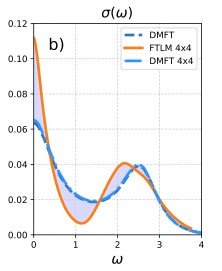
The figure above shows the frequency dependence of the optical conductivity for T=0.5D. There is a Drude peak at zero frequency and the broad peak near omega=2.5D=U corresponds to transitions between the lower and upper Hubbard band. DMFT is qualitatively correct but does differ from FTLM, showing the importance of vertex corrections.

Tuesday, March 19, 2019

Orbital-selective bad metals

Alejandro Mezio and I just posted a preprint
Orbital-selective bad metals due to Hund’s rule and orbital anisotropy: a finite-temperature slave-spin treatment of the two-band Hubbard model

The central result is shown in the Figure below. It shows the phase diagram of the metallic phase as a function of temperature and the Hund's rule interaction J in a system with two bands of differing bandwidth. Uc1 ~ W1 is the critical interaction for a Mott insulator in a one band system with bandwidth W1.
The system is a Hund's metal in that the strong correlations arise from J and not from proximity to a Mott insulating phase (note that U=0.5Uc1).
In the orbital-selective bad metal, one of the bands is a coherent Fermi liquid (with well-defined Fermi surface) and the second (narrower) band is a bad metal.

Two things that I find particularly interesting are the following.

Stability of the bad metal and the orbital-selective bad metal are enhanced by increasing J and/or by increasing band anisotropy.

The temperatures at which the bad metals occur is orders of magnitude smaller than the Fermi temperature for the corresponding non-interacting system (being of the order of W1~ Uc1).

We welcome comments.

Monday, November 5, 2018

Bad metallic behaviour in ultracold atoms

There is a nice paper
Bad metallic transport in a cold atom Fermi-Hubbard system 
Peter T. Brown, Debayan Mitra, Elmer Guardado-Sanchez, Reza Nourafkan, Alexis Reymbaut, Simon Bergeron, A.-M. S. Tremblay, Jure Kokalj, David A. Huse, Peter Schaus, and Waseem S. Bakr

The paper represents a significant experimental advance in using ultracold atoms to investigate questions directly relevant to strongly correlated electron systems. In this case, the system Hamiltonian can be tuned to be a Hubbard model on a square lattice, such that the model parameters, U and t, and the doping, n are known.
One limitation is that current experiments can only be performed down to the lowest temperature of T/t =0.3. [For comparison, for cuprates this is of the order of 1000 K!].
Using imaging techniques the authors are able to directly extract the density (charge) diffusion constant D and the density susceptibility, chi, shown below. The experimental data are red dots. The blue curve is the result of calculations based on the Finite Temperature Lanczos Method (FTLM). Green dots the results of Dynamical Mean-Field theory. Gamma is the density relaxation rate.

Both the experiment and the ability to make such a detailed comparison with concrete theoretical calculations is a significant and exciting achievement.


The dashed curve in the upper panel is the value of the diffusion constant associated with the Mott-Ioffe-Regel limit below which one expects bad metal behaviour.
Aside: one should always keep in mind that for the MIR limit, different authors use different criteria, leading to different factors of pi, sqrt(pi), ...

Using the Nernst relation, sigma = chi * D,  the data above gives the conductivity (sigma) and resistivity (rho), shown below.
The blue and green curves correspond to the predictions, of FTLM and DMFT, respectively. The dashed grey line is the Mott-Ioffe-Regel limit.

One comment I have concerns an additional comparison that the authors could make. Based on heuristic arguments and results from AdS-CFT, Hartnoll conjectured a lower bound for the diffusion constant, hv_F^2/T.
Previously, Nandan Pakhira and I showed that this bound was significantly violated in the bad metallic regime, as described by DMFT.

There is also a commentary on the paper by Ehud Altman at the Journal Club of Condensed Matter.
I thank Matt Davis for bringing the paper to my attention.

Wednesday, September 5, 2018

Superconductivity in a Hund's metal

The BCS theory of superconductivity is one of the towering intellectual achievements of the twentieth century. There are many ingredients to the theory and many significant results. One key step is to consider an effective interaction that is responsible for the Cooper pairing. A key result is that many properties are universal in that one can rescale temperatures and energies by the energy gap (at zero temperature), Delta(0) or the transition temperature Tc. In the limit of weak-coupling there is a universal ratio
2 Delta(0)/kTc = 3.5
Most elemental superconductors are consistent with this value. Some such as Hg and Pb have larger values, but these can actually be calculated when strong coupling effects are taken into account, via the Eliashberg equations.

Unconventional superconductors (cuprate, organic, heavy fermion, iron based) have resisted a simple unifying theory and universal trends, comparable to the stellar success of BCS theory. For example, the gap/Tc ratio is all over the place. However, there has been some progress for the iron-based superconductors. Recent ARPES results (summarised in the figure at the bottom below) have shown a universal ratio, of about 7.2 for a wide range of materials.

A fascinating feature of these iron-based materials is the nature of the metallic state that undergoes the superconducting instability. I have written several blog posts about the Hund's metal. One important feature is that there is relatively low coherence temperature below which a Fermi liquid metal forms, and there is a correspondingly low energy scale Omega0 associated with spin fluctuations, which become very slow. This arises from the rich Kondo physics associated with the multi-orbital character of the system. Furthermore, the spin fluctuation spectrum has a power law dependence above Omega0.

The above ideas come together in an interesting preprint
On the Superconductivity of Hund's Metals 
Tsung-Han Lee, Andrey Chubukov, Hu Miao, Gabriel Kotliar

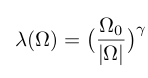
They consider a single band superconductor described by the strong-coupling Eliashberg equations where the frequency dependence of the (effective) electron-electron attraction is given by
where the exponent gamma is treated as a variable. The Eliashberg equations are solved (for a single band) and give the following relationship between the gap ratio and the exponent gamma.
The value of gamma=1.2 is that associated with the relevant Kondo problem above the coherence temperature. The gap ratio corresponds to the black dashed line in the graph below.

One thing should be stressed here is that one is observing a transition from an incoherent metal into a superconductor, unlike in the BCS situation where the transition is from a coherent Fermi liquid.
I thank Alejandro Mezio for bringing the paper to my attention.

Thursday, August 9, 2018

Emergent temperature scales and spin-orbital separation in the Hund's metal

An important and fascinating issue in many-body physics is the emergence of new energy scales, particularly scales that are orders of magnitude smaller than the energy scales in the underlying Hamiltonian. One example is the coherence temperature associated with the crossover from a Fermi liquid (with coherent quasi-particles) to a bad metal.

Recently, I posted about the crossover from a Hund's metal to a bad metal, seen in the collapse of the Drude peak in the optical conductivity, and the issue of capturing this slave-particle theories. One commenter mentioned the relevance of the paper below and another asked about the claim that the Kondo effect is associated with the collapse.

I agree that Kondo physics is associated with the crossover. Although, far from obvious this is also the case in the single-band Hubbard model. The Kondo effect was first studied with isolated magnetic impurities in metals and can be described by a single-impurity Anderson model (SIAM). Although there are no magnetic impurities in the Hubbard model, it turns out that when studied at the level of Dynamical-Mean-Field Theory (DMFT), the model is described by a self-consistent SIAM and close to the Mott metal-insulator transition Kondo physics does emerge. Specifically, the Kondo temperature for the self-consistent SIAM corresponds to the temperature at which there is a crossover from local unscreened local magnetic moments (associated with the almost-localised electrons near the Mott phase; the bad metal) to a Fermi liquid where the "magnetic moments" are screened.

What happens in a two-band Hubbard-Kanamori model with Hund's rule coupling?
The physics is richer because there is now the possibility screening of spin and/or orbital degrees of freedom, and of a orbital-selective Mott phase (or bad metal). 
This is nicely investigated in the following paper.

Dynamical Mean-Field Theory Plus Numerical Renormalization-Group Study of Spin-Orbital Separation in a Three-Band Hund Metal
K. M. Stadler, Z. P. Yin, J. von Delft, G. Kotliar, and A. Weichselbaum

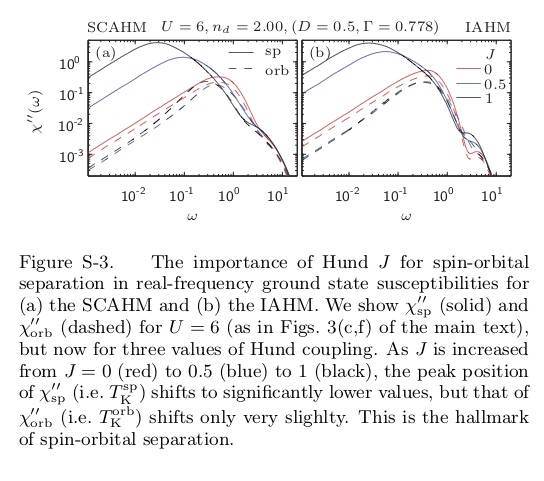
For me, the figure below is the most interesting and illuminating. It shows how due to the Hund's rule coupling, two distinct energy scales (differing by about two orders of magnitude) emerge and associated with screening the spin and orbital degrees of freedom, respectively.

This is Kondo physics, but there are no magnetic impurties.

Monday, July 30, 2018

Experimental observation of the Hund's metal to bad metal crossover

A definitive experimental signature of the crossover from a Fermi liquid metal to a bad metal is the disappearance of a Drude peak in the optical conductivity. In single band systems this occurs in proximity to a Mott insulator and is particularly clearly seen in organic charge transfer salts and is nicely captured by Dynamical Mean-Field Theory (DMFT).

An important question concerning multi-band systems with Hund's rule coupling, such as iron-based superconductors, is whether there is a similar collapse of the Drude peak. This is clearly seen in one material in a recent paper

Observation of an emergent coherent state in the iron-based superconductor KFe2As2 
Run Yang, Zhiping Yin, Yilin Wang, Yaomin Dai, Hu Miao, Bing Xu, Xianggang Qiu, and Christopher C. Homes


Note how as the temperature increases from 15 K to 200 K that the Drude peak collapses. 
The authors give a detailed analysis of the shifts in spectral weight with varying temperature by fitting the optical conductivity (and reflectivity from which it is derived) at each temperature to a model consisting of three Drude peaks and two Lorentzian peaks. Note this involves twelve parameters and so one should always worry about the elephants trunk wiggling.
On the other hand, they do the fit without the third peak, which is of the greatest interest as it is the sharpest and most temperature dependent, and claim it cannot describe the data.

The authors also perform DFT+DMFT calculations of the one-electron spectral function (but not the optical conductivity) and find it does give a coherent-incoherent crossover consistent with the experiment. However, the variation in quasi-particle weight with temperature is relatively small.

Saturday, July 21, 2018

Questions about slave-particle mean-field theories of Hund's metals

One of most interesting new ideas about quantum matter from the last decade is that of a Hund's metal. This is a strongly correlated metal that can occurs in a multi-orbital material (model) as a result of the Hund's rule (exchange interaction) J that favours parallel spins in different orbitals.
Above some relatively low temperature (i.e. compared to the bare energy scales such as non-interacting band-widths, J, and Hubbard U) the metal becomes a bad metal, associated with incoherent excitations.
An important question concerns the extent to which slave mean-field theories can capture the stability of the Hund's metal, and its properties including the emergence of a bad metal above some coherence temperature, T*.

In a single-band Hubbard model, the strongly correlated metallic phase that occurs in proximity to a Mott insulator is associated with a small quasi-particle weight and suppression of double occupancy, reflecting suppressed charge fluctuations. This is captured by slave-boson mean-field theory, including the small coherence temperature.

In contrast, to a "Mott metal", a Hund's metal is associated with suppression of singlet spin fluctuations on different orbitals, without suppression of charge fluctuations and is seen in a Z_2 slave-spin mean-field theory at zero temperature.

Specific questions are whether slave mean-field theories at finite temperature can capture the following?
  • The coherence temperature, T*.
  • A suppression of spin singlet fluctuations at T increases towards T*.
  • An orbital-selective bad metal may occur in proximity to an orbital selective Mott transition. This is where at least one band (orbital) is a Fermi liquid and another is a bad metal. This would mean that there are two different coherence temperatures. 
  • The emergence of a single low-energy scale, common in both bands, as is seen in DMFT.
  • The spin-freezing temperature.
Finally, how does the stability of the Hund's metal change with the number of orbitals?
Figures in this post suggest that the Hund's physics is more pronounced with increasing the number of orbitals. However, that may be because the critical U (and thus proximity to the Mott insulator) changes with the number of orbitals and all the curves are for the same U.

Monday, May 14, 2018

Conducting metallic-organic frameworks

Update. 14 Jan. 2026. I just learned that the paper discussed in this post was retracted last year.

"following concerns raised about the temperature-dependent resistivity data. The authors recharacterized the samples and determined that the anomalous temperature-dependent maxima reported were not due to metallic conductivity. Instead, it was found that ohmic contact was lost during cooling. This resulted in a significant reduction to the current passing between the electrodes, which could not be detected using the equipment available at the time."

--------

Thanks to the ingenuity of synthetic chemists metallic-organic frameworks (MOFs) represent a fascinating class of materials with many potential technological applications.
Previously, I have posted about spin-crossover, self-diffusion of small hydrocarbons, and the lack of reproducibility of CO2 absorption measurements in these materials.

At the last condensed matter theory group meeting we had an open discussion about this JACS paper.
Metallic Conductivity in a Two-Dimensional Cobalt Dithiolene Metal−Organic Framework 
Andrew J. Clough, Jonathan M. Skelton, Courtney A. Downes, Ashley A. de la Rosa, Joseph W. Yoo, Aron Walsh, Brent C. Melot, and Smaranda C. Marinescu

The basic molecular unit is shown below. These molecules stack on top of one another, producing a layered crystal structure. DFT calculations suggest that the largest molecular overlap (and conductivity) is in the stacking direction.
Within the layers the MOF has the structure of a honeycomb lattice.


The authors measured the resistivity of several different samples as a function of temperature. The results are shown below. The distances correspond to the size of the compressed powder pellets.


Based on the observation that the resistivity is a non-monotonic function of temperature they suggest that as the temperature decreases there is a transition from an insulator to a metal. Since there is no hysteresis they rule out a first-order phase transition, as is observed in vanadium oxide, VO2.
They claim that the material is an insulator about about 150 K, based on fitting the resistivity versus temperature to an activated form, deducing an energy gap of about 100 meV. However, one should note the following.

1. It is very difficult to accurately measure the resistivity of materials, particularly anisotropic ones. Some people spend their whole career focussing on doing this well.

2. Measurements on powder pellets will contain a mixture of the effects of the crystal anisotropy, random grain directions, intergrain conductivity, and contact resistances. This is reflected in how sample dependent the results are above.

3. The measured resistivity is orders of magnitude larger than the Mott-Ioffe-Regel limit. suggesting the samples are very "dirty" or one is not measuring the intrinsic conductivity or this is a very bad metal due to electron correlations.

4. It is debatable whether one can deduce activated behaviour from only an order of magnitude variation in resistance, due to the narrow temperature range considered.

The temperature dependence of the magnetic susceptibility is shown below, and taken from the Supplementary material.


The authors fit this to a sum of several terms, including a constant term and a Curie-Weiss term. The latter gives a magnetic moment associated with S=1/2, as expected for the cobalt ions, and an antiferromagnetic exchange interaction J ~ 100 K. This is what you expect if the system is a Mott insulator or a very bad metal, close to a Mott transition.

Again, there a few questions one should be concerned about.

1. How does this relate to the claim of a metal at low temperatures?

2. The problem of curve fitting. Can one really separate out the different contributions?

3. Are the low moments due to magnetic impurities?

The published DFT-based calculations suggest the material should be a metal because the bands are partially full. Electron correlations could change that. The band structure is quasi-one-dimensional with the most conducting direction perpendicular to the plane of the molecules.

All these questions highlight to me the problem of multi-disciplinary papers. Should you believe physical measurements published by chemists? Should you believe chemical compositions claimed by physicists? Should you believe theoretical calculations performed by experimentalists? We need each other and due diligence, caution, and cross-checking.

Having these discussions in group meetings is important, particularly for students to see they should not automatically believe what they read in "high impact" journals?

An important next step is to come up with a well-justified effective lattice Hamiltonian.

Wednesday, April 4, 2018

What do you call a mixture of a bad metal and a good metal?

It is fun to come up with clever names for new physical phenomena: quark, big bang, Janus, slepton,  chromodynamics, inflation, squashon, ...
There is an amusing article by David Mermin about how he managed to get boojum  accepted as a scientific term.
Can you think of others?

What is a good synonym for something that has both good and bad qualities?
A curate's egg?

I was wondering about this because of thinking about a metal that is a mixture of a good metal and a bad metal. This is relevant close to an orbital-selective Mott transition. There it may be possible to have multiple Fermi liquids (associated with multiple bands) at low temperatures with different coherence temperatures. For example, this does occur in strontium ruthenate.  As a result, when the temperature is increased one can enter a state in which one of the bands has coherent quasi-particles (and a well-defined Fermi surface) and another does not, i.e. it is a bad metal.

A relevant paper is
Observation of Temperature-Induced Crossover to an Orbital-Selective Mott Phase in AxFe2-ySe2 (A 1⁄4 K, Rb) Superconductors 
M. Yi, D. H. Lu, R. Yu, S. C. Riggs, J.-H. Chu, B. Lv, Z. K. Liu, M. Lu, Y.-T. Cui, M. Hashimoto, S.-K. Mo, Z. Hussain, C. W. Chu, I. R. Fisher, Q. Si, and Z.-X. Shen

They present ARPES data, including that below, that shows how the spectral intensity changes as the temperature increases. The blue and red curves are identified with different d-orbital bands.


Being cautious, I am a bit wary about how clearly the data do support the conclusions. Nevertheless, ...
The authors also present a slave-spin theory calculation for a five-band Hubbard-Kanamori model that is consistent with the experimental data.

I thank Alejandro Mezio for helpful discussions about this topic.

Wednesday, March 14, 2018

"Bad fluids" near the superfluid transition

There is an interesting preprint
Viscosity Bound Violation in Viscoelastic Fermi Liquids 
 Matthew P. Gochan, Hua Li, Kevin S. Bedell

They consider the unitary Fermi gas within the framework of Fermi liquid theory. This system undergoes a superfluid transition at a temperature of about 0.17 times T_F (the Fermi temperature). They calculate the shear viscosity as a function of temperature. (I think) the complete temperature dependence is obtained by interpolating between the low-temperature and high-temperature limits.

The motivation for the study is the conjectured universal bound for the ratio of the shear viscosity to the entropy density, based on the AdS-CFT conjecture, beloved by string theorists.

The authors find that the conjectured bound is violated because the viscosity can become arbitrarily small near the superfluid transition due to large scattering from superfluid fluctuations. This is because the mean free path becomes arbitrarily small, i.e. the system is similar to a bad metal.
Unfortunately, the preprint does not reference some earlier relevant work on the shear viscosity of the unitary Fermi gas or on the bad metal near a Mott transition.

I thank Alejandro Mezio for bringing the preprint to my attention.

Friday, January 19, 2018

Observation of renormalised quasi-particle excitations

A central concept of quantum-many body theory is that of coherent quasi-particles. Their key property is a well-defined relationship between energy and momentum (dispersion relation). Prior to the rise of ARPES (Angle-Resolved Photo-Emission Spectroscopy) over the past three decades, the existence of electronic quasi-particles was only inferred indirectly.

A very nice paper just appeared which shows a new way of measuring quasi-particle excitations in a
strongly correlated electron system. Furthermore, the experimental results are compared quantitatively to state-of-the-art theory, showing several subtle many-body effects.

Coherent band excitations in CePd3: A comparison of neutron scattering and ab initio theory 
Eugene A. Goremychkin, Hyowon Park, Raymond Osborn, Stephan Rosenkranz, John-Paul Castellan, Victor R. Fanelli, Andrew D. Christianson, Matthew B. Stone, Eric D. Bauer, Kenneth J. McClellan, Darrin D. Byler, Jon M. Lawrence

The mixed valence compound studied is of particular interest because with increasing temperature it exhibits a crossover from a Fermi liquid with coherent quasi-particle excitations to incoherent excitations, an example of a bad metal.

The figure below shows a colour intensity plot of the dynamical magnetic susceptibility
at a fixed energy omega, and a function of the wavevector Q. The top three panels are from the calculations of DFT+DMFT (Density Functional Theory + Dynamical Mean-Field Theory).

The bottom three panels are the corresponding results from inelastic neutron scattering.
A and B [D and E] are both at omega=35 meV and in two different momentum planes. C [F] is at omega=55 meV.
The crucial signal of coherence (i.e. dispersive quasi-particles) is that the shift of the maxima between the G and R points at 35 meV to the M and X points at 55 meV.

It should be stressed that these dispersing excitations are not due to single (charged) quasi-particles, but rather spin excitations which are particle-hole excitations.

The figure below shows how the dispersion [coherence] disappears as the temperature is increased from 6 K (top) to 300 K (bottom). The solid lines are theoretical curves.
The figure below shows that the irreducible vertex corrections associated with the particle-hole are crucial to the quantitative agreement of theory and experiment. The top (bottom) panel in the figure below shows the calculation at low (high) temperatures. The black (blue) curves are with (without) vertex corrections. The red curves are a rescaling of the blue curves by a numerical factor.
The correction has two effects: First, it smooths out some of the fine structure in the energy dependence of the spectra while broadly preserving both the Q variation and the overall energy scale; and second, it produces a strong enhancement of the intensity that is both energy and temperature dependent, for example, by a factor of ~6.5 at w = 60 meV at 100 K. This shows that the Q dependence of the scattering is predomi- nantly determined by the one-electron joint density of states, as expected for band transitions, whereas the overall intensity is amplified by the strong electron correlations. 
This landmark study is only possible due to recent parallel advances in theory, computation, and experiment. 
On the theory side, it is not just DMFT but also including particle-hole interactions in DMFT.
On computation, it is new DMFT algorithms and increasing computer speed. 
On the experimental side, it is pulsed neutron sources, and improvements in the sensitivity and spatial and energy resolution of neutron detectors.

Wednesday, March 15, 2017

The power and limitations of ARPES

The past two decades have seen impressive advances in Angle-Resolved PhotoEmission Spectroscopy (ARPES). This technique has played a particularly important role in elucidating the properties of the cuprates and topological insulators. ARPES allows measurement of the one-electron spectral function, A(k,E) something that can be calculated from quantum many-body theory. Recent advances have included the development of laser-based ARPES, which makes synchrotron time unnecessary.

A recent PRL shows the quality of data that can be achieved.

Orbital-Dependent Band Narrowing Revealed in an Extremely Correlated Hund’s Metal Emerging on the Topmost Layer of Sr2RuO4 
Takeshi Kondo, M. Ochi, M. Nakayama, H. Taniguchi, S. Akebi, K. Kuroda, M. Arita, S. Sakai, H. Namatame, M. Taniguchi, Y. Maeno, R. Arita, and S. Shin

The figure below shows a colour density plot of the intensity [related to A(k,E)] along a particular direction in the Brillouin zone.  The energy resolution is of the order of meV, something that would not have been dreamed of decades ago.
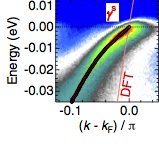
Note how the observed dispersion of the quasi-particles is much smaller than that calculated from DFT, showing how strongly correlated the system is.

The figure below shows how with increasing temperature a quasi-particle peak gradually disappears, showing the smooth crossover from a Fermi liquid to a bad metal, above some coherence temperature.
The main point of the paper is that the authors are able to probe just the topmost layer of the crystal and that the associated electronic structure is more correlated (the bands are narrower and the coherence temperature is lower) than the bulk.
Again it is impressive that one can make this distinction.

But this does highlight a limitation of ARPES, particularly in the past. It is largely a surface probe and so one has to worry about whether one is measuring surface properties that are different from the bulk. This paper shows that those differences can be significant.

The paper also contains DFT+DMFT calculations which are compared to the experimental results.

Friday, February 10, 2017

Instability of the Fermi liquid near the Mott transition

In the metallic state of many strongly correlated electron materials, Fermi liquid properties are only observed at relatively low temperatures, at a scale (the coherence temperature T_coh) that can be orders of magnitude less than the Fermi temperature that is estimated from the relevant electronic band structure. Above T_coh one observes a "bad metal" and the absence of quasi-particles.

These features are nicely captured by Dynamical Mean-Field Theory (DMFT).
An interesting question is whether this low-temperature scale can be captured in simpler theories.

Alejandro Mezio and I just finished a paper


The phase diagram at half filling is shown below. Note how near the Mott insulator T_coh is orders of magnitude smaller than W/2, the scale of the Fermi temperature for U=0. It is also much smaller than this scale multiplied by Z, the band renormalisation due to interactions.
We welcome comments.

Friday, November 18, 2016

Desperately seeking Weyl semi-metals

In 2011 it was proposed that pyrochlore iridates (such as Y2Ir2O7) could exhibit the properties of a Weyl semi-metal, the three-dimensional analog of the Dirac cone found in graphene.
Since the sociology of condensed matter research is driven by exotica this paper stimulated numerous theoretical and experimental studies.
However, as often is the case, things turn out to be more complicated and it seems unlikely that these materials  exhibit a Weyl semi-metal.

This past week I have read several nice papers that address the issue.

Variation of optical conductivity spectra in the course of bandwidth-controlled metal-insulator transitions in pyrochlore iridates
K. Ueda, J. Fujioka, and Y. Tokura

There is a very nice phase diagram which shows systematic trends as a function of the ionic radius of the rare earth element R=Y, Dy, Gd, ...
Most of the materials are antiferromagnetic insulators.


The colour shading describes the low energy spectral weight in the optical conductivity up to 0.3 eV.
Blue is an insulator and red actually means a very small low energy spectral weight.
N can be thought of as the number of charge carriers per unit cell. Specifically, if this was a simple weakly interacting Fermi liquid N=1. Thus, the value of 0.05 for Pr signifies strong electron correlations. [Unfortunately, the paper talks about this as "weak correlations"].

In fact, as shown below even in the metallic phase at T=50 K one cannot see the Drude peak down to 10 meV.
This presents a theoretical challenge to explain this massive redistribution of spectral weight.


Slater to Mott Crossover in the Metal to Insulator Transition of Nd2Ir2O7
M. Nakayama, Takeshi Kondo, Z. Tian, J. J. Ishikawa, M. Halim, C. Bareille, W. Malaeb, K. Kuroda, T. Tomita, S. Ideta, K. Tanaka, M. Matsunami, S. Kimura, N. Inami, K. Ono, H. Kumigashira, L. Balents, S. Nakatsuji, and S. Shin

This ARPES study does find band touching at the magnetic metal-insulator transition temperature but as the temperature is lowered the spectral weight is suppressed and there is no sign of Weyl points.

Phase Diagram of Pyrochlore Iridates: All-in–All-out Magnetic Ordering and Non-Fermi-Liquid Properties 
H Shinaoka, S Hoshino, M Troyer, P Werner

This LDA+DMFT study shows that a three-band description is important for the R=Y compound.
This sets the stage for describing the phase diagram above.

I thank Prachi Telang for discussions at IISER Pune about these materials and bad semi-metals that stimulated this post.

Tuesday, September 27, 2016

Tutorial on bad metals

After yesterday's colloquium a large group of IISER students (both undergraduate and graduate) expressed an interest in having a tutorial on more of the subject of emergent quantum matter.
It is today at 6pm after they are done with the days lectures. This tells you something about the quality of the students and institution!

I am going to give a tutorial about bad metals. I will probably cover half of these slides. Hopefully there will be lots of questions and side discussions on the blackboard.


Tuesday, August 30, 2016

Bad metals, Mott insulators, and superconductivity in fullerenes

Last week in Ljubljana, I had a nice discussion with Denis Arčon about this paper concerning fullerenes, A3C60 where A = alkali metal.

Optimized unconventional superconductivity in a molecular Jahn-Teller metal
Ruth H. Zadik, Yasuhiro Takabayashi, Gyöngyi Klupp, Ross H. Colman, Alexey Y. Ganin, Anton Potočnik, Peter Jeglič, Denis Arčon, Péter Matus, Katalin Kamarás, Yuichi Kasahara, Yoshihiro Iwasa, Andrew N. Fitch, Yasuo Ohishi, Gaston Garbarino, Kenichi Kato, Matthew J. Rosseinsky and Kosmas Prassides

This is a rich system and is summarised in the (temperature vs. volume) phase diagram below. Superconductivity appears in proximity to a Mott (Jahn-Teller) insulator.

The JT metal is a bad metal. The novel signature here is that because the electrons are almost localised on individual molecules there is Jahn-Teller effect. This is seen in the Fano line shape of the associated vibrational spectra.

Aside: I have often wondered about a good theoretical description of the Fano line shape for vibrational spectra in metals because it is quite common in organic charge transfer salts. There is an old theory by Michael Rice.  However, it does not even mention Fano. 
Yesterday, Darko Tanaskovic brought to my attention a nice paper which explicitly relates the Rice theory, the relevant Feynman diagrams, to the Fano form for the spectral density. (See especially, Section III).

Charged-phonon theory and Fano effect in the optical spectroscopy of bilayer graphene 
 E. Cappelluti, L. Benfatto, M. Manzardo, and A. B. Kuzmenko

For these fullerenes the minimal effective Hamiltonian is a three band Hubbard model with Hund's rule coupling and electron-phonon interaction (which leads to the Jahn-Teller effect on isolated C60 molecules. Extensive calculations based on Dynamical Mean-Field Theory (DMFT) describe this phase diagram and have been reviewed by Massimo Capone, Michele Fabrizio, Claudio Castellani, and Erio Tosatti

Tuesday, August 23, 2016

Violation of AdS-CFT bounds on the shear viscosity

Tomorrow I am giving a seminar on the absence of quantum limits to the shear viscosity in the Theoretical Physics department at the Stefan Institute in Ljubljana, Slovenia.

Here is the current version of the slides.
The main results are in this paper.


This is Lake Bled, a popular tourist destination outside the city.


What does this movie tell us about the modern university?

Last night, my wife and I watched the movie, Wit. You can watch the full movie here  (free with ads). I should warn that some of the conten...