Showing posts with label DNA. Show all posts

Tuesday, June 30, 2026

Biological evolution and emergence

 The theory of evolution explains the origin of biological diversity and levels of similarity between species. A characteristic of emergence is that many iterations of a simple law (natural selection of the fittest to reproduce) can produce novel, diverse and rich structures. In biological evolution many generations in a population can produce new traits and species. 

Many of the most debated issues about evolution relate to the different characteristics of emergence and are briefly discussed below.

Scales

Central to emergence are the ideas of “many” and of scales. The former can take two forms: a system composed of many interacting components, or a system that undergoes many iterations according to a rule that is repeated many times. For evolution, both forms of “many” are relevant and have several dimensions. Evolution occurs in a population, i.e., a community of many members of a species living in a specific environment. Each member of the population has a specific genotype (many genes), which largely determines biological characteristics, from proteins to organs, defined as the phenotype. The environment also consists of many interacting species. Natural selection can act at multiple levels: on genes, cells, organisms, species, and groups of species.

Microscopic and macroscopic scales can also manifest in different ways. In terms of length, the micro- and macro- scales can be defined in terms of genotypes and phenotypes, respectively. In terms of time, microevolution and macroevolution roughly correspond to directly observable timescales and geological timescales, respectively. They are associated with the emergence of new traits within a species and new species, respectively.

Novelty

Development of new traits and species occurs over many generations, due to the repetition of the rule of natural selection.

Evolution theory uses concepts such as natural selection, survival of the fittest, niches, and hierarchical trees, that are not present in chemistry and physics. 

Connecting micro- and macro- properties

As for other systems, this is one of the great challenges of emergence. Genotypes and phenotypes are extremely well characterised. Genotype-phenotype maps seek to connect these micro- and macro- levels. A detailed understanding of how microevolution leads to macroevolution is a challenge.

Discontinuities

In microevolution, new traits occur within a species due to (continuous) adaptation to the environment. In contrast, in macroevolution, new organs and species can occur suddenly (at least on geological timescales). An example is the Cambrian explosion of new life forms. Extinctions can also represent discontinuities.

Evolution of a population occurs in response to changes in an environment. New traits, new species, and extinctions can be viewed as qualitative changes due to quantitative changes. For example, small changes in the oxygen concentration in the atmosphere is one (among many) hypotheses for the cause of the Cambrian explosion.

Using techniques from statistical physics, the transition of a species from survival to extinction can be viewed as a non-equilibrium phase transition to an absorbing state. The order parameter is the population and a toy model is directed population.1

Diversity with limitations

All species are based on the same biochemistry of DNA and proteins. Yet from these same building blocks there is an incredible diversity: more than 8 million distinct species, including more than 10,000 species of birds and more than 15,000 species of ants. Darwin said nature produces “endless forms most beautiful.”

But there are limitations. For example, the number of species with more than one head, brain, heart, or liver is limited. There are many more genotypes than phenotypes. 

The dominant view is that evolution is driven by random genetic mutations. Debates have arisen about how much evolution is limited (constrained) by morphology and environment.

Ball stated: (p. 332)

“convergent evolution is often regarded as a sign that certain shapes or structures are ideal adaptations to particular environments for physical reasons: wings consisting of flat, thin membranes are best for flying, torpedo-shaped bodies a streamlined for efficient swimming, and so on… There is a tendency in evolutionary biology to regard natural selection as a process with an infinite palette: anything is possible so long as it doesn't break the laws of physics. But the laws of physics might impose more constraint than that, precisely because biology uses rather than merely suffers them.”

Universality

Not all mutations produce a change in phenotype. There are neutral mutations. There are many more genotypes than phenotypes. In other words, genotype-phenotype maps are many-to-one.

Species that are unrelated or distantly related (in the tree of life) sometimes have traits or behaviours that are similar. Convergent evolution is the hypothesis that natural selection produced the same outcome in a different context. 

Modularity at the mesoscale

The economist Simon pointed out that evolution can occur on much faster time scales than might be expected because of modularity. According to Clune et al.

“A long-standing, open question in biology is how populations are capable of rapidly adapting to novel environments, a trait called evolvability [1]. A major contributor to evolvability is the fact that many biological entities are modular, especially the many biological processes and structures that can be modelled as networks, such as metabolic pathways, gene regulation, protein interactions and animal brains [1–7].”

Ball highlighted how domains in proteins provide functional modules that evolution uses: (pp. 174-5)

“the evolution of metazoan proteins is not so much a slow affair of letting random genetic mutations change one amino acid for another and seeing what effect it produces. Rather, it constitutes a reshuffling of already functional modules to produce multidomain molecules with new potential - a strategy much more likely to yield successful results…  the “unit” of molecular evolution here is not really the base pair of DNA or the amino acid or protein, or the gene itself, by the peers at a scale intermediate between the two: the module of a domain. It seems that this shuffling, rather than the slow mutation of primary base sequences, is what has driven the evolution of animals.”

Johnston et al. considered an algorithmic picture of evolution that 

“suggests that symmetric structures preferentially arise not just due to natural selection but also because they require less specific information to encode and are therefore much more likely to appear as phenotypic variation through random mutations… many genotype–phenotype maps are exponentially biased toward phenotypes with low descriptional complexity. A preference for symmetry is a special case of this bias… Lower descriptional complexity also correlates with higher mutational robustness, which may aid the evolution of complex modular assemblies of multiple components.”

Self-organisation

Complex biological structures, from proteins to organisms, have formed spontaneously due to evolution over millions of years. Their intricacy and functionality have led to claims of purpose and design. However, this is argued to be an “apparent” design, just like an economy whose self-organisation appears “as if” it is guided by an “invisible hand.”

Kauffman claimed that self-organisation is as important as natural selection in driving evolution.

Unpredictability

A contested question about evolution is the role of contingency (historical accidents) and whether the evolution of complex life forms, particularly humans, was an accident of history or inevitable.

Irreducibility

Until recently, evolutionary biology has been dominated by a reductionist gene-centric view, popularised by Dawkins. However, recent discussions about systems biology, evo-devo, and epigenetics have questioned this view. Some characterise these alternative views as a form of structuralism.

Complexity

An algorithmic picture of evolution suggests that simplicity spontaneously emerges as many genotype-phenotype maps may be biased towards phenotypes with low descriptional complexity. 

Toy models

An earlier post discussed the key role that toy models, such as “bean bag” genetics, have played in evolutionary theory.

Cross-fertilisation of fields

Ideas from evolution have stimulated the development of genetic algorithms in computer science.

Drossel has reviewed connections between evolution and statistical physics, including a wide range of toy models. Examples include spin glass models that give rise to rugged landscapes for fitness and can describe hierarchical structures, comparable to Darwin’s tree of life. Goldenfeld and Woese argued that evolution can be viewed as a collective phenomenon far from equilibrium. The toy model central to their discussion is directed percolation.

I welcome comments. My knowledge of biology is limited, and scientifically some the ideas above can be contentious. (Never mind philosophy, politics, or theology!)

Sunday, September 15, 2024

Biology is about emergence in subtle ways

Biology is a field that is all about emergence. It exhibits a hierarchy of structures from DNA to proteins to cells to organs to organisms. Phenotypes emerge from genotypes. At each level of the hierarchy (stratum) there are unique entities, phenomena, principles, methods, theories, and sub-fields. But there is more to the story. 

Philip Ball is probably my favourite science writer. Earlier this year, he gave a beautiful lecture at The Royal Institution, What is Life and How does it Work?


The lecture presents the main ideas in his recent book,  How Life Works: A User's Guide to the New Biology

Here are a few things that stood out for me from the lecture.

1. The question, "What is life?" has been and continues to be notoriously difficult to answer.

It was originally stated by Francis Crick, and some commonly assumed corollaries of it are wrong. In simple terms, the Dogma states that DNA makes RNA and RNA makes proteins. This is a unique and unidirectional process. For example, a specific code (string of the letters A,G,T, and C) will produce a specific protein (sequence of amino acids) which will naturally fold into a unique structure with a specific biochemical function. 


The central dogma has undergirded the notion that genes determine everything in biology. Everything is bottom-up.
However, Ball gives several counterexamples.
A large fraction of our DNA does not code for proteins.
Many proteins are disordered, i.e., they do not have a unique folded structure.

Aside: An earlier failure of (some versions of) the central dogma was the discovery of reverse transcriptase by the obscure virus club, essential for the development of HIV drugs and covid-19 vaccines.

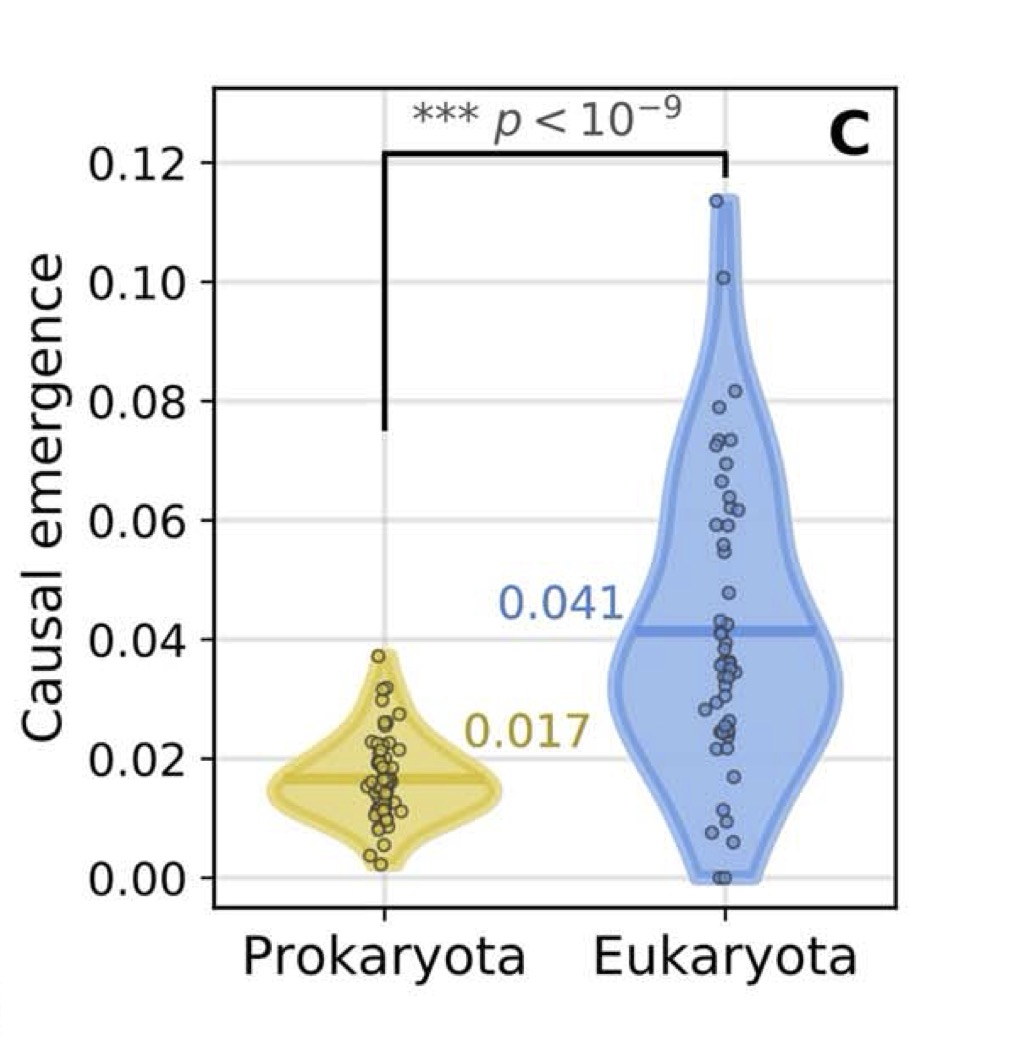
3. The role of emergence can be quantified in terms of information theory, helping to understand the notion of causal emergence: the cause of large-scale behaviour is not just a sum of micro-causes, i.e., the properties of and interactions between the constituents at smaller scales. Entities at the level of the phenomena are just as important as what occurs at lower levels.
(page 214 in the book). Causal emergence is concerned with fitting the scale of the causes to the scale of the effects.
The figure above is taken from this paper from 2021.


The authors quantify casual emergence in protein networks in terms of mutual information (between large and small scales) and effective information (a measure of the certainty in the connectivity of a network).

Aside: These quantitative notions of emergence have been developed more in recent work by Fernando Rosas and collaborators and discussed in a Quanta article by Philip Ball.

4. Context matters.  A particular amino acid sequence does not define a unique protein structure and function. They may depend on the specific cell in which the protein is contained.

5. Causal spreading.  Causality happens at different levels. It does not always happen at the bottom (genetic level). Sometimes it happens at higher levels. And, it can flow up or down.

6. Levels of description matter. This is well illustrated by morphology and the reasons that we have five fingers. This is not determined by genes.

7. Relevance to medicine. There has been a focus on the genetic origin of diseases. However, many diseases, such as cancer, do not predominantly happen at the genetic level. There has been a prejudice to focus on the genetic level, partly because that is where most tools are available. For cancer, focussing on other levels, such as the immune system, may be more fruitful.

8. Metaphors matter. Biology has been dominated by  metaphors such as living things are "machines made from genes" and "computers running a code". However, metaphors are metaphors. They have limitations, particularly as we learn more. All models are wrong, but some are useful. Ball proposes that metaphors from life, including the notion of agency, may be more fruitful.

9. The wisdom of Michael Berry. Ball ends with Berry's saying that the biggest unsolved problem in physics is not about dark matter (or some similar problem), but rather, "If all matter can be described by quantum theory, where does the aliveness of living things come from?" In other words, "Why is living matter so different from other matter?"

There is also an interesting episode of the How To Academy podcast, where Ball is interviewed about the book.

Wednesday, April 3, 2024

Is biology better at computing than supercomputers?

Stimulated by discussions about the physics of learning machines with Gerard Milburn, I have been wondering about biomolecular machines such as proteins that do the transcription and translation of DNA in protein synthesis. These are rather amazing machines.

I found an article which considers a problem that is simpler than learning, computation.

The thermodynamic efficiency of computations made in cells across the range of life

Christopher P. Kempes, David Wolpert, Zachary Cohen and Juan Pérez-Mercader


It considers the computation of translating a random set of 20 amino acids into a specific string for a specific protein. Actual thermodynamic values are compared to a generalised Landauer bound for computationBelow is the punchline. (page 9)

Given that the average protein length is about 325 amino acids for 20 unique amino acids, we have that pi=p=1/20325=1.46×10−423, where there are 20325 states, such that the initial entropy is Inline Formula , which gives the free energy change of kT(SI−0)=4.03×10⁻¹⁸ (J) or 1.24×10⁻²⁰ (J per amino acid). This value provides a minimum for synthesizing a typical protein. 

We can also calculate the biological value from the fact that if four ATP equivalents are required to add one amino acid to the polymer chain with a standard free energy of 47.7 (kJ mol−1) for ATP to ADP, then the efficiency is 1.03×10⁻¹⁶ (J) or 3.17×10⁻¹⁹ (J per amino acid).  

This value is about 26 times larger than the generalized Landauer bound.

These results illustrate that translation operates at an astonishingly high efficiency, even though it is still fairly far away from the Landauer bound. To put these results in context, it is interesting to note that the best supercomputers perform a bit operation at approximately 5.27×10⁻¹³ (J per bit). In other words, the cost of computation in supercomputers is about eight orders of magnitude worse than the Landauer bound of Inline Formula (J) for a bit operation, which is about six orders of magnitude less efficient than biological translation when both are compared to the appropriate Landauer bound. Biology is beating our current engineered computational thermodynamic efficiencies by an astonishing degree.

Friday, October 20, 2023

Opening the door for women in science

 I really liked reading Transcendent Kingdom by Yaa Gyasi. She is an amazing writer. I recently reread some of it for an extended family book club. Just check out some of these quotes. 

A colleague suggested I might like Lessons in Chemistry, a novel by Bonnie Garmus. I have not read the book yet, but I have watched the first two episodes of the TV version on AppleTV. I watched the first episode for free.

The show contains a good mix of humour, love of science, and feminism. The chemistry dialogue seems to be correct. The show chronicles just how in the 1950s how awful life was for a young woman who aspired to be a scientist. Things have improved. But there is still a long way to go... 

Friday, January 27, 2023

Science and the universe are awesome

Since we are surrounded by scientific knowledge. We are so used to it that we can take science for granted and not reflect on how amazing science truly is. And how amazing the universe is that science reveals. Things that we know, learn, and do today in science would have been inconceivable decades ago, let alone centuries ago.

What specific things do you think are particularly awesome? This question was stimulated by Frank Wilczek's recent book, Fundamentals: Ten Keys to Reality. In writing the book, he says "what began as an exposition grew into a contemplation."

 My answer to the question has some significant overlap with Wilczek's ten. 

Below I list some of the things that I find awesome. I consider two classes: what science can do and what we learn about the universe from science.

Science works! It is amazing what science can do.

We can understand the material world.

Einstein said, "The most incomprehensible thing about the world is that it is comprehensible." In a previous post, I explored some different dimensions of the fact that the universe is comprehensible. The mystery includes human capabilities, both intellectual and physical, and the malleability of the material world.

We can make precise measurements.

Scientists have created incredibly powerful and specialised instruments for making very precise measurements such as spectrometers, telescopes and microscopes. Scientists can measure the tension in a single strand of DNA, the magnetic moment of an electron to a precision of one part in one billion billion, the spectrum of light emitted by a galaxy that is ten billion light years away, ...

We can predict the outcome of new experiments.

Scientists construct theories in their minds, on pieces of paper, in mathematical equations, and in computers. One way to evaluate the possible validity of a theory is to propose new experiments and predict the outcome. Famous examples include the existence of the chemical element aluminium, the existence of the planet Neptune, radio waves, a specific excited quantum state of the atomic nucleus of carbon atoms, the pollinator moth for Darwin's orchid, the deflection of the path of light from a distant star by our sun, gravitational waves, the Cosmic Microwave Background, quarks, the Higgs boson, the Berezinskii-Kosterlitz-Thouless phase transition, the hexatic phase, edge states in integer spin antiferromagnetic chains, topological insulators, ... Predictions are particularly impressive when they are unexpected and controversial.

We can use mathematics. 

Eugene Wigner received the Nobel Prize in Physics in 1963. In 1960 he published an essay "The Unreasonable Effectiveness of Mathematics in the Natural Sciences that concludes

The miracle of the appropriateness of the language of mathematics for the formulation of the laws of physics is a wonderful gift which we neither understand nor deserve. 

We can manipulate and control nature.

Scientists and engineers can move single atoms, design drugs, make computers, build atom bombs, heart pacemakers, and mobile phones, manipulate genes, ......

We know so much but we know so little. 

On the one hand, the achievements of science are amazing. Yet, in spite of this, there are still significant mysteries and challenges. Examples include the nature of dark matter or human consciousness, a quantum theory of gravity, fine-tuning of fundamental constants, the quantum-classical boundary, protein folding, the nature of glasses, and how to calculate the properties of complex systems.

It is awesome what science reveals to us about the universe.

The immense scales of the observable universe

Our sun is just one star among the more than two hundred billion that make up our galaxy, the Milky Way. And that is just one of one trillion galaxies in the whole universe. It takes light from the most distant galaxies tens of billions of years to travel to us.

Length, time, and energy scales over many many orders of magnitude

These go far beyond our everyday experience and what we can see with the naked eye (from a millimetre to a kilometre). On the large scale, the visible universe involves distances of billions of light years (10^25 metres). On the small scale, there is the sub-structure of nucleons, which is smaller than femtometres (10^-15 m).  This wide range of length scales is nicely illustrated in the wonderful movie Powers of Ten and its update, The Cosmic Eye. There are corresponding time, energy, and temperature scales varying over many many orders of magnitude. For example, as one goes from ultracold atomic gases to quark-gluon plasmas, the  relevant energy and temperature scales vary over more than 20 orders of magnitude! At every scale, there are distinct phenomena and structures. 

Universal laws that are simple to state

The universe exhibits a diversity of rich and complex behaviour. Yet it can understand much of it in terms of simple universal laws that are easy to state, e.g., Newton's laws of motion, the laws of thermodynamics, Maxwell's equations of electromagnetism, Schrodinger's equation of quantum mechanics, the genetic code, ....  And, these are just a few of these laws. One does not need a multitude of laws to describe a multitude of instances of a multitude of phenomena.

Just a few building blocks

There are just a few fundamental particles in the standard model (leptons, neutrinos, and gauge bosons). Everything is made of them. They are the building blocks of atoms. They each have just a few physical properties: charge, spin, mass, and colour. Every single particle of a particular type in the universe has exactly the same properties. Exactly. As far as we know, they have been exactly the same throughout time, going back to the beginning of the universe, and whether they are in your body, or in a star in a distant galaxy.

Atoms are the building blocks of chemical compounds. Every single atom of a particular chemical element (and nuclear isotope) is absolutely identical. This allows astronomers to determine the chemical composition of distant stars, galaxies, and dust clouds.

Humans, plants, and animals all have the same molecular building blocks and there are just a few of them. Any DNA molecule is composed of just four different base pairs (denoted A, G, T, C) and proteins are composed of just twenty different amino acids.

There are two amazing things here. First, there are just so few building blocks. Second, every one of these building blocks is absolutely identical.

Emergence: simple rules produce complex behaviour

Humans, cells, and crystals can be viewed as systems composed of many interacting components. The components and their interactions can often be understood and described in simple terms. Nevertheless, from these interactions complex structures and properties can emerge.

Nature appears to be fine-tuned for life

This covers not just the values of fundamental physical constants that lead to the notion of fine-tuning and the anthropic principle. Water has unique physical and chemical properties that allow it to play a crucial role in life, such as the surface of lakes freezing before the bottom and aiding protein folding.

The intricate and subtle "machinery" of biomolecules

Proteins have very unique structures that are intimately connected to their specific functions, whether as catalysts or light sensors.


What do you think are the most amazing things about science and what we learn from it?


Tuesday, September 7, 2021

Biology in a nutshell: emergence at many levels

 One of the many great things about The Economist magazine is that they run "Briefing" articles that give brief readable introductions and analyses to important topics, ranging from racism to taxation to climate change. Last year they ran a series about new ideas in economics.

They are currently running a series, Biology Briefs. Each week, for six weeks, there is a two-page article on one key topic in modern biology. They are naturally divided by different scales: molecules, cells, organs, individual lives, species, and living planets. 

The most important idea in molecular biology: DNA encodes information that is used to make specific proteins.

Replication: the protein DNA polymerase makes new DNA molecules with the same sequence of base pairs

Transcription: the protein RNA polymerase makes single strands of RNA that have the same genetic information.

Translation: the protein ribosome reads the information in the mRNA and uses it to make chains of amino acids (with specific sequences determined by the RNA sequence). These polymers then fold spontaneously into proteins with specific functions.

There is much that is amazing and awesome about this, including that people have been able to figure all this out. What I find most amazing/miraculous/awesome/cool is not the software but rather the hardware, i.e. the proteins that act as nanoscale biochemical factories, particularly the ribosome.

Monday, April 6, 2020

Emergence and the pandemic


I love this video. I also found very helpful an article in The Economist, Anatomy of a killer, that gives a basic introduction to the biology. [Unfortunately, it is behind a pay-wall. I subscribe to the hard copy, which I highly recommend.]. The New York Times also has a helpful tutorial How coronavirus hijacks your cells.

So what do a new virus, an epidemic, social distancing, and panic buying have in common?
They are all examples of emergent phenomena as they all have three particular properties.

First, each phenomenon involves a system with many interacting components.

Second, the system possesses a property, an ability to exhibit a specific phenomenon, that the individual components of the system do not have.

Third, the phenomenon is hard to predict, even with a knowledge of the details of the system components and of the interactions between the different components.

Consider the four examples I gave.

An epidemic arises when a few people are infected with a virus who in turn infect others who infect more people until a significant fraction of the whole population is infected. With a single human or even a few, the concept of an epidemic does not make sense.
Even though we do know a lot about epidemiology it's very hard to predict the scale of an epidemic and to decide on the most effective measures to ``flatten the curve.’’
Associated with epidemics there are emergent concepts such as tipping points (R0 larger than 1), super spreaders, and herd immunity [Scott Page gives a nice 9 minute lecture on this].

The concept of panic buying does not make sense if there is only a single customer. The phenomenon arises not just from the actions of one shopper or even a group of shoppers. Individual shoppers in a store don’t just interact with each other in a single shop but also interact with their social and informational networks.  Who would have predicted that we would see such silly things as panic buying of toilet paper?

Many of us had not heard of social distancing until this year. At first, you might think that social distancing is just something that arises from a government regulation, i.e., it is  ``top-down ‘’ rather than ``bottom-up’’. However, it occurs as a result of interaction between all the individuals in the society and with scientific advisors and then the government, but this does not mean that they will and we do see this in certain countries certain cultures and in certain demographics even though
If the government ordains social distancing, it does not mean it is practiced. Certain cultures and demographics will not follow government edicts. Rather, society self-organises to produce social distancing. Some people practice it, voluntarily or in response to a government edict, others see them doing it and then they follow. You can go to the park and you see people only talking in pairs and more than two metres apart and so then you're more likely to practice it.

 SARS-CoV-2 is a new virus. As far as we are aware it did not exist previously in humans. New viruses emerge through evolution. [There is a nice video from Stated Clearly ] 
Coronaviruses are common in animals and can gradually mutate in interaction with their environment. At some point this virus crossed the species barrier to humans; it is still adapting to its environment. There are many components of the system; the individual viruses don't interact with each other but with their environments.

A single virus also has emergent properties (its ability to infect specific cells, reproduce itself, and to survive inside a water droplet). Central to a single SARS-CoV-2 virus particle is an RNA molecule with about 30,000 base pairs.  All of those together provide the genetic information that is used to reproduce. Having the individual base pairs, or a subset of them, or the RNA without the six
proteins and membrane.  Knowing all the genetic information is useful but cannot necessarily be used to predict the structure of the virus, its function, or how to develop a vaccine.


Why does an emergent perspective matter? 
From a purely scientific point of view, there are many interesting and fascinating phenomena that would be nice to understand, from the biochemistry of a single virus to the spread of the virus by international travel. If we understand these phenomena better, particularly at all the different scales discussed below, then we have a better chance of taking effective action to stop the spread of the virus, whether it is as individuals washing their hands, practicing social distancing, government policies, or development of vaccines.

There are many scales to the pandemic problem: length scales, time scales, and number scales.
The distance scales cover a range of about 15 orders of magnitude.
A single virus particle is about 10 nanometers in diameter (10^-8 m). A cell in the human respiratory tract is about 100 times larger.
Then we can keep on going up to 10,000 km (10^7 m), the distance that some people flew to carry the virus around the world.
The range of timescales is from microseconds (?) for a single virus particle to attach itself to a human cell, up to several hours to produce thousands of copies of the virus inside that cell, to the weeks for infected individuals to develop symptoms, to the time for new government policies to take effect.
And, the time scales many are particularly interested in: how long we will be in self-isolation? how long until the economy ``recovers''?
The numbers range from reproduction numbers for a single virus in a single cell, numbers infected from a single human to the millions of people infected, to the trillions of cells in a human body.

There is a stratification of reality or hierarchy associated with these different scales to length, time, and number.
RNA, Virus, Cell, immune system, organs, individual human, individual’s (physical) social contacts, city, country.

An emergent perspective is helpful in at least three ways.

First, it highlights the limitations of reductionism. Even if we know the details of the individual components of a system and how they interact with each other that does not necessarily mean we have an understanding of the properties of the whole system. For example, we already know the nucleic acid sequence of the RNA for SARS-CoV-2, the associated genes, and the physical structure of a single virus particle, including its six proteins.
This is helpful and wonderful. However, it does mean we really understand the virus, including how to develop a vaccine. Knowing the genome does not enable the prediction of the structure of the virus.  This is similar to the problem of predicting a protein structure from a knowledge of its amino acid sequence.
In biology there is a helpful and common paradigm: structure determines property which determines function. This is why there is so much emphasis on protein structure determination.
But knowing the structure does not always enable us to predict the property and particularly the function. Function is an emergent property.

Second, an emergent perspective highlights the tension between universality and particularity.
For example, COVID-19 is one of the hundreds in the coronavirus family. They have quite similar structures and properties. But this coronavirus is very particular in a devastating way. Small changes in the genetic code or proteins could make it even more dangerous, or impotent. 

Thirdly, an emergent perspective highlights the significance of the stratification of reality. At each stratum there are unique entities, phenomena, concepts, techniques, and theories. This is the origin of different scientific disciplines.
Observing phenomena at one stratum does not reveal what is going on at a lower stratum.
This is what Laughlin and Pines call the ``protectorate''. 
This applies whether considering a single RNA molecule, a virus particle, a respiratory cell, or groups of shoppers.
Panic buying is unique to the stratum of groups of consumers. The underlying causes from the psychology of individuals and groups are hidden.
Studies of consumer behaviour provide no insights for immunology and visa versa.

A pandemic and its aftermath is a wicked problem: it is complex and difficult to solve.
There is some intellectual beauty in the multi-disciplinarity of the problem; it involves biochemistry, cell biology, immunology, medicine, public health, sociology, psychology, politics, economics, and mathematical modeling. It does not even end there as the humanities come in to play. Responses to the crisis, from individuals to governments, involve fundamental philosophical and theological questions about ethics, values, meaning and purpose, suffering and death. 

Saturday, August 11, 2018

Hype, DNA, drugs, and emergence

Unfortunately, hype in science reflects hype in broader society, including in business. The complete DNA sequencing of the human genome was an amazing scientific achievement. Unfortunately, it was also associated with a lot of hype about what this would mean for medicine and for the pharmaceutical industry. This issue is made painfully and succinctly in a recent column in the business section of  The Guardian by Nils Pratley.
It has been almost two decades since the first bosses of the newly merged GlaxoSmithKline talked up the medical wonders that would flow from the unravelling of the human genome. GSK would become the “Microsoft of the pharmaceutical industry”, they said.  
To put it mildly, the corporate vision hasn’t been realised. GSK’s share price stood at £20 at the time of the turn-of-the-century merger and is £15.42 today. Lack of productivity in the labs has been a constant complaint. The genetics revolution is happening, but not at the pace originally promised, at least not at GSK.
These challenges could have been forseen by filtering the hype through a emergentist perspective, such as that presented beautifully by Denis Noble in a 2006 book, The Music of Life: Biology beyond the Genome.  Knowing a DNA sequence is about as useful, for better or worse, as knowing the many-body Schrodinger equation for a plutonium crystal. A great place to start, but ....

Wednesday, December 10, 2014

Strong non-adiabatic effects in a prototype chemical system

This post concerns what may be the fast known internal conversion process in a chemical system, non-radiative decay times in the range of 3-8 femtoseconds. Internal conversion is the process whereby in a molecule there is a non-radiative transition between electronic excited states (without change in spin quantum number). This is by definition a break-down of the Born-Oppenheimer approximation.

Much is rightly made of the fascinating and important fact that excited states of DNA and RNA undergo "ultra-fast" non-radiative decay to their electronic ground state. This photo-stability is important to avoid mutations and protect genetic information. Conical intersections are key. The time scale for comparison is the order of a picosecond.

The figure below is taken from

It shows the wavelength dependence of the intensity of emission from a 3d (Rydberg) excited state.

There are several things that are noteworthy about the experimental data, given that this is a gas phase spectra.

1. The large width of the spectra. In energy units this is of the order of an eV. Gas phase spectra for electronic transitions in typical molecules are usually extremely sharp (See here for a typical example). 

2. The two peaks, suggesting the presence of two electronic transitions.

3. The strong isotope effects. For strictly electronic transitions between adiabatic states, there should be no dependence on the nuclear masses. This suggests strong vibronic and quantum nuclear effects.

So what is going on?
The key physics is that of the Jahn-Teller effect, conical intersections, and non-adiabatic effects.
For H3 there is geometry of an equilateral triangle which has C3 symmetry. There are then two degenerate electronic ground states with E symmetry, and experience E x epsilon Jahn-Teller effect leading to the two adiabatic potential energy surfaces shown below. They touch at a conical intersection. The two peaks in the spectra above correspond to transitions to these two different surfaces.

Non-adiabatic coupling leads to rapid transitions between the surfaces leading to the ultra-ultra-fast internal conversion and the very broad spectra. This is calculated in the paper, leading to the theoretical curves shown in the top figure.


More recently, Susanta and some of his students, have considered the relative importance of (off-diagonal) non-adiabatic effects, the geometric phase [associated with the conical intersection], and Born-Huang (diagonal) corrections to explaining the spectra.
They find that the first has by far the most dominant effect. The latter two have very small effects that look like they will be difficult to disentangle from experiment. I discussed the elusiveness of experimental signatures of the geometric phase in an earlier post.
  
I thank Susanta Mahapatra for explaining this nice work to me, on my recent visit to his group.

Wednesday, September 17, 2014

The challenge of writing books on water

Biman Bagchi has just published a new book,
Water in Biological and Chemical Processes: From Structure and Dynamics to Function 

Cambridge University Press sent me a complimentary copy to review. I am slowly working through it and will write a detailed review when I am done.

I think this is a very challenging subject to write a book on for at least three reasons. First, the scope of the topic is immense. Furthermore, it is multi-disciplinary spanning physics, chemistry, and biology, with a strong interaction between experiment, theory, and simulation. Second, although there have been some significant advances in the last few decades there is real state of flux, with a fair share of controversies, advances, and fashions. Finally, which audience do you write for? Experimental biochemists or theoretical physicists or somewhere in between.

Although this is an incredibly important and challenging topic few authors have taken up the challenge. One who has is Arieh Ben-Naim

Molecular Theory of Water and Aqueous Solutions, Part I: Understanding Water (2009)

Molecular Theory of Water and Aqueous Solutions Part II: The Role of Water in Protein Folding, Self-Assembly and Molecular Recognition (2011)

This was a topic of great interest to my late father. He wrote two comprehensive reviews with John Edsall, published in Advances in Biophysics

Water and proteins. I. The significance and structure of water; its interaction with electrolytes and non-electrolytes (1977) [does not seem to be available online]

Water and proteins. II. The location and dynamics of water in protein systems and its relation to their stability and properties (1983)

Classic earlier books include:

The Structure and Properties of Water
 by David Eisenberg and Walter Kauzmann
(1969, reissued in 2002 by Oxford UP in their Classic Texts in the Physical Sciences)

A seven volume series, Water: A comprehensive treatise, edited by Felix Franks

At the popular level there is
Life's Matrix: A Biography of Water 
(2001) by Philip Ball


Tuesday, April 29, 2014

What are the ten most remarkable scientific ideas?

Feynman said the most important idea is that all things are made from atoms. On the weekend I listened to a short and fascinating talk by Bill Bryson The four most remarkable things I know.
So, I wondered what do I think? What are the ten most remarkable scientific ideas?

I have used the following rough criteria. The idea
  • is far from obvious
  • is often not thought about because we have become so used to it that we take it for granted 
  • may evoke not just an intellectual response but also a somewhat emotional one of wonder and awe
  • is profound but can be simply stated
  • is a specific law, principle, or property, rather than a general scientific idea such as that laws can be encoded mathematically, experiments must be repeated, the same laws apply everywhere in the universe.
Here is my first rough attempt at a list of the top ten, in no particular order. I hope it will generate some discussion.

1. The universe had a beginning.

2. Time has a direction.

3. The fundamental constants of nature are fine-tuned for life.

4. All elementary particles are identical.

5. Energy is quantised.

6. Particles are fields and fields are particles.

7. All of life has a common molecular template (DNA and proteins).

8. Everything is made from atoms. The periodic table of chemistry.

9. Evolution: many small genetic variations can produce biological diversity.

10. Emergence and reductionism. Complexity can emerge from simplicity.

Here are some runners up. Some are more specific versions of those above.

A. The genetic code. DNA prescribes protein synthesis.

B. Genetic information is encoded in DNA.

C. Water is a unique liquid with remarkable properties with important implications for biomolecular function.

D. Diffraction of waves [x-rays, electrons, neutrons] can be used to determine the atomic structure of materials.

E. The geometry of molecules and chemical reactivity is determined by quantum mechanics [and can be described by potential energy surfaces].

F. The second law of thermodynamics: entropy is a state function. Free energy determines stability of open systems.

G. Symmetry constrains physical laws; spontaneously broken symmetry leads to different physical interactions and states of matter.

H. Macroscopic properties are determined by microscopic properties.

I. Protein folding. Amino acid sequence uniquely determines protein structure which determines function.

I am missing anything about earth science due to my ignorance.

Presumably, others have compiled such lists and taught courses based on them. Please let me know. One example is a course by Robert Hazen and James Trefil. Each chapter is centred around a great idea.

What do you think?
How would you change the above lists?

Wednesday, February 5, 2014

Quantum fluctuations protect your genetic code


Yesterday I read an interesting paper
Enol Tautomers of Watson−Crick Base Pair Models Are Metastable Because of Nuclear Quantum Effects
Alejandro Pérez, Mark Tuckerman, Harold Hjalmarson, and Anatole von Lilienfeld

A key to the double helix structure of DNA and its ability to provide reliable stable storage of genetic information is hydrogen bonding between base pairs [G-C and A-T].
However, it is possible to switch around the positions of the protons on each of the base pairs, producing different tautomers of T, A, C, and G]. 
This is an example of double proton transfer.

This could lead to problems with correctly storing genetic information. 
An important question concerns just how rare this is. For example, what is the free energy of these tautomers relative to the Watson-Crick ones?
Over the past two decades a number of classical molecular dynamics simulations, using potentials derived from quantum chemistry suggested that the tautomers of DNA could be a problem.


Well, the paper above actually shows/argues [based on ab initio path integral molecular dynamics] that the quantum motion of the protons destabilises the mutant tautomers.

Monday, September 20, 2010

Stretching our understanding of biomolecules

Cooperative transitions in macromolecules is the title of Chapter 9 in Biological Physics by Phil Nelson and this weeks reading for BIPH3001.

Biological question: Why aren’t proteins constantly disrupted by thermal fluctuations?
The cartoons in cell biology books show proteins snapping crisply between definite conformations, as they carry out their jobs. Can a floppy chain of residues really behave in this way?

Physical idea: Cooperativity sharpens the transitions of macromolecules and their assemblies.

As usual the section headings are informative.

9.1 Elasticity models of polymers

9.1.1 Why physics works (when it does work)

Here he gets to the heart of emergence and effective Hamiltonians introducing the important idea.
When we study a system with a large number of locally interacting, identical constituents, on a far bigger scale than the size of the constituents, then we reap a huge simplification: Just a few effective degrees of freedom describe the system’s behavior, with just a few phenomenological parameters.
9.1.2 Four phenomenological parameters characterize the elasticity of a long, thin rod

9.1.3 Polymers resist stretching with an entropic force

9.2 Stretching single macromolecules

9.2.1   The force–extension curve can be measured for single DNA molecules


The lines are the predictions of a simple model for the length of a polymer versus the force applied to stretch it. The circles are actual experimental data for DNA molecules.

9.2.2 A simple two-state system qualitatively explains DNA stretching at low force

more later.....

What does this movie tell us about the modern university?

Last night, my wife and I watched the movie, Wit. You can watch the full movie here  (free with ads). I should warn that some of the conten...