A science fiction fantasy is that we should be able to make "materials by design" that have any physical property (density, thermal conductivity, hardness, thermoelectric figure of merit, heat capacity...) that we desire. However, it seems that there are certain physical constraints that determine the overall scale of many physical properties.
I find it helpful to have a feel for typical orders of magnitude. What is particularly interesting is that sometimes these magnitudes are related to fundamental constants [electronic charge (e), Boltzmann's constant (k_B), Planck's constant (hbar)] and basic length scales such as the lattice constant a of a crystal.
Here are three scales I have emphasised before
Resistivity ~ hbar a / e^2 ~ 100 microohm-cm which is associated with the Mott-Ioffe-Regel limit.
Thermoelectric power, S ~ k_B/e ~ 86 microvolt/K
Mobility, mu ~ e a^2/ hbar ~ 1 cm^2 V/sec
One can find these scales by dimensional analysis or by doing things like looking a formulas from transport theory and (assuming a bad metal) setting the mean-free path comparable to the lattice constant. One can debate whether one uses hbar or h, but for little purpose.
How about the Nernst signal, nu?
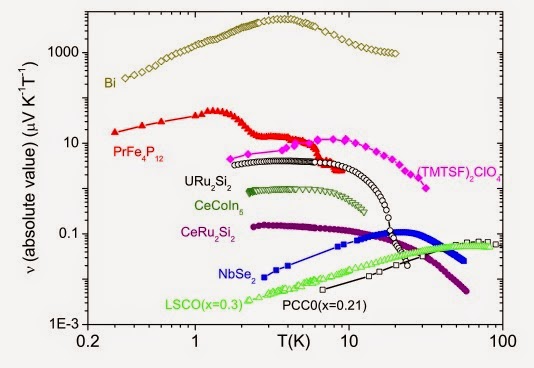
nu ~ k_B a^2 / hbar ~ 0.01 microV/KT
A few minor notes.
1. One can get this scale from the above expressions for S and mu if one uses the observation that in some strongly correlated materials
nu ~ S * Hall mobility.
2. One Volt/Tesla = m^2/sec [One can see this easily from F = q(E + vxB)].
3. Given that the Nernst effect involves charge transport I find it surprising that the electronic charge does not appear.
The figure below, taken from a nice review by Behnia, shows that this is the right scale for bad metals such as cuprates, and heavy fermions above the coherence temperature.
One also sees this scale in recent DMFT calculations for a doped Hubbard model (see Figure 2d in this PRL ) and recent measurements (see Figure 4) on organic charge transfer salts.
Showing posts with label Nernst effect. Show all posts
Thursday, August 14, 2014
Tuesday, April 1, 2014
The challenge of colossal thermoelectric power in FeSb2
There is an interesting paper
Highly dispersive electron relaxation and colossal thermoelectricity in the correlated semiconductor FeSb2
Peijie Sun, Wenhu Xu, Jan M. Tomczak, Gabriel Kotliar, Martin Søndergaard, Bo B. Iversen, and Frank Steglich.
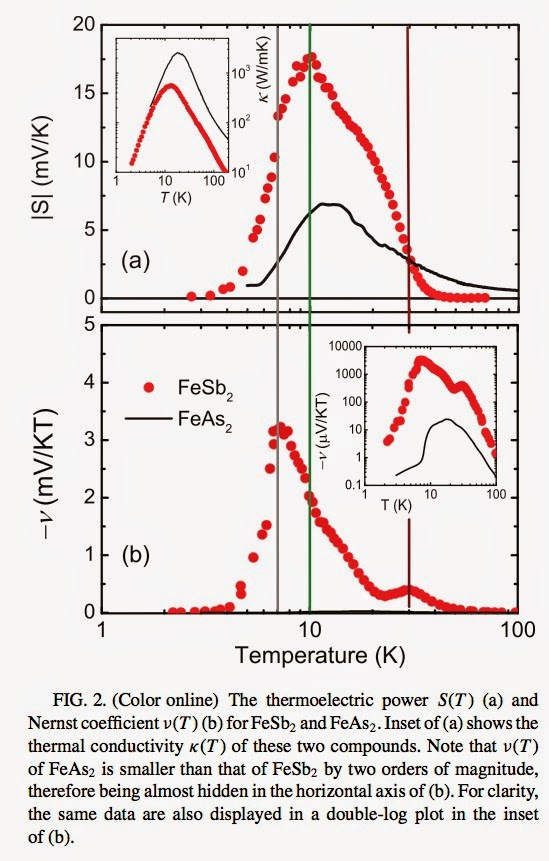
The main results that are a struggle to explain are in the figure below.
The top panel shows the temperature dependence of the thermopower [Seebeck coefficient] of FeSb2 [red] and the isoelectronic FeAs2.
First, notice the vertical scale is tens of mV/K. In an elemental metal the thermopower is less than a microV/K. In a strongly correlated metal it can be tens of microV/K. [see for example this earlier post].
Why is it so large? Why is the Sb compound so much larger than the As compound?
In a simple model of a band semiconductor S ~ k_B/e * gap/k_B T. But here the Sb compound has the smaller gap.
Also, why is there a maximum in the temperature dependence, S(T) going to zero with decreasing temperature.
In an attempt to elucidate these subtle issues the authors have also measured the Nernst effect and the magnetoresistance. The Nernst signal is also colossal, being of the other of mV/KT for FeSb2, which is two orders of magnitude large than that for FeAs2.
The authors also consider a simple analytical model of a semiconductor with an energy dependent scattering rate to see what properties that can explain: some but not all. A strongly energy dependent scattering rate is also needed; this can occur in the case of Kondo physics, for example.
They also find some interesting relations between Seebeck, Nernst, Hall mobility, magnetoresistance, and the thermal mobility.
It is helpful to read the paper in conduction with an experimental review and this earlier theory paper,
Thermopower of correlated semiconductors: Application to FeAs2 and FeSb2
Jan M. Tomczak, K. Haule, T. Miyake, A. Georges, and G. Kotliar
To further complicate all of the above it seems that the results can be quite sample dependent, and the results varying significantly, even by orders of magnitude between different groups. One clue is that it seems that FeSb2 is very close to a metal-insulator transition, seen in some samples but not others…
Much remains to be done...
Highly dispersive electron relaxation and colossal thermoelectricity in the correlated semiconductor FeSb2
Peijie Sun, Wenhu Xu, Jan M. Tomczak, Gabriel Kotliar, Martin Søndergaard, Bo B. Iversen, and Frank Steglich.
The main results that are a struggle to explain are in the figure below.
The top panel shows the temperature dependence of the thermopower [Seebeck coefficient] of FeSb2 [red] and the isoelectronic FeAs2.
First, notice the vertical scale is tens of mV/K. In an elemental metal the thermopower is less than a microV/K. In a strongly correlated metal it can be tens of microV/K. [see for example this earlier post].
Why is it so large? Why is the Sb compound so much larger than the As compound?
In a simple model of a band semiconductor S ~ k_B/e * gap/k_B T. But here the Sb compound has the smaller gap.
Also, why is there a maximum in the temperature dependence, S(T) going to zero with decreasing temperature.
In an attempt to elucidate these subtle issues the authors have also measured the Nernst effect and the magnetoresistance. The Nernst signal is also colossal, being of the other of mV/KT for FeSb2, which is two orders of magnitude large than that for FeAs2.
The authors also consider a simple analytical model of a semiconductor with an energy dependent scattering rate to see what properties that can explain: some but not all. A strongly energy dependent scattering rate is also needed; this can occur in the case of Kondo physics, for example.
They also find some interesting relations between Seebeck, Nernst, Hall mobility, magnetoresistance, and the thermal mobility.
It is helpful to read the paper in conduction with an experimental review and this earlier theory paper,
Thermopower of correlated semiconductors: Application to FeAs2 and FeSb2
Jan M. Tomczak, K. Haule, T. Miyake, A. Georges, and G. Kotliar
To further complicate all of the above it seems that the results can be quite sample dependent, and the results varying significantly, even by orders of magnitude between different groups. One clue is that it seems that FeSb2 is very close to a metal-insulator transition, seen in some samples but not others…
Much remains to be done...
Tuesday, June 25, 2013
Nernst effect as a probe of quasi-particle coherence
There is an interesting PRL
Nernst Effect: Evidence of Local Kondo Scattering in Heavy Fermions
by Peijie Sun and Frank Steglich
They measure the temperature dependence of the Nernst coefficient for two different heavy fermion compounds and compare them to an isostructural compound without 4f electrons.
The temperature dependence is correlated with that of the thermoelectric power.
An important question is Nernst signal is related to the coherence temperature associated with the formation of quasi-particles associated with the Fermi liquid.
But there is a complexity associated with this identification.
They argue that Nernst effect is largely a reflection of the single-ion Kondo effect and is measuring the strong energy dependence of the scattering rate.
They suggest the low temperature minimum and the high temperature maximum should be respectively identified with the Kondo temperature for the doublet ground state of the crystal effective field
and the Kondo temperature of the Hund's rule J=5/2 state of Ce3+.
An important question is Nernst signal is related to the coherence temperature associated with the formation of quasi-particles associated with the Fermi liquid.
But there is a complexity associated with this identification.
They argue that Nernst effect is largely a reflection of the single-ion Kondo effect and is measuring the strong energy dependence of the scattering rate.
They suggest the low temperature minimum and the high temperature maximum should be respectively identified with the Kondo temperature for the doublet ground state of the crystal effective field
and the Kondo temperature of the Hund's rule J=5/2 state of Ce3+.
Wednesday, May 8, 2013
Long live Fermi liquid theory!
There is a very nice preprint
Hidden Fermi Liquid, Scattering Rate Saturation and Nernst Effect: a DMFT Perspective
by Wenhu Xu, Kristjan Haule, and Gabriel Kotliar
I think it is original and important. I wish I had written it!
Hidden Fermi Liquid, Scattering Rate Saturation and Nernst Effect: a DMFT Perspective
by Wenhu Xu, Kristjan Haule, and Gabriel Kotliar
I think it is original and important. I wish I had written it!
They consider the metallic phase of a two-dimensional Hubbard model at (close to optimal) hole doping 0.15 away from the Mott insulator, within Dynamical Mean Field Theory (DMFT).
The surprising result (to me) is that one can talk about quasi-particles (i.e. poles in the one electron Green's function) up to much high temperatures than one might expect (specifically, far beyond the temperature T_FL, below which the scattering rate has a quadratic temperature dependence).
One just has to allow the quasi-particle weight Z to be temperature dependent, as shown in the Figure below.
This leads to a temperature dependent band structure.
Furthermore, most of the transport properties calculated within DMFT are quantitatively described by a quasi-particle approximation and Sommerfeld expansion, even into the bad metal region. The graph below shows the temperature dependence of the thermopower. Note the change of sign.
A few comments:
1. The authors suggest there may be a connection to Nigel Hussey's phenomenology of the cuprates, particularly with regard to saturation of the scattering rate at high temperatures.
These ideas are developed more in a recent PRB by Jure Kokalj, Nigel and I.
[But as the authors point out DMFT cannot capture the anisotropy observed in the cuprates].
2. I am not sure about calling this a "Hidden Fermi liquid" since that terminology is associated with a specific idea of Phil Anderson which I discussed here. It is not clear to me that these "Fermi liquids" are the same thing. In particular, Anderson's seems much more exotic.
3. The emergence of the different temperature scales and "strange metal" behaviour confirms my prejudice (and Anderson's) that the AdS/CFT approach is not relevant.
4. Minor quibble: It would be helpful to have units on the axes in Figure 2. I can see that the thermopower S is in units of k_B/e but have no idea about the Nernst signal. This would help in comparing the magnitude to experimental values for the cuprates.
I welcome more comments on this work.
Thursday, February 16, 2012
Deconstructing the Nernst effect in electron doped cuprates
The graph below shows the temperature dependence of the Nernst signal measured in the normal metallic state of a family of electron doped cuprates Pr_{2-x}Ce_xCuO_4. It is taken from a 2007 PRB by Li and Greene.
A few noteworthy features-the signal is proportional to B and so not due to superconducting fluctuations
-the signal is proportional to temperature at low temperatures but has a non-monotonic temperature dependence
-the magnitude of the linear temperature dependence is an order of magnitude smaller than predicted by the simple quasi-particle theory of Behnia.
The authors consider how the data can be explained by a two-band with both electrons and holes, but point out such a model is inconsistent with the single hole Fermi surface seen in ARPES.
It would be interesting to re-consider this data in light of the recent experiments on these materials which showed a linear temperature dependence of resistivity (and thus a quasi-particle scattering rate) with a magnitude proportional to Tc [as in overdoped hole doped cuprates].
Tuesday, January 24, 2012
Probing fluctuating superconductivity
An important paper for understanding the pseudogap state of the cuprates is Diamagnetism and Cooper pairing above Tc in cuprates by Lu Li, Yayu Wang, Seiki Komiya, Shimpei Ono, Yoichi Ando, G. D. Gu, and N. P. Ong.
Physics has a helpful commentary by Kivelson and Fradkin.
Diamagnetic response of the superconducting state is orders of magnitude larger than other states of matter. [Due to the Meissner effect superconductors are sometimes said to be perfect diamagnets]. A state with no long range superconducting order but large fluctuations can produce a significant diamagnetic response. The authors find that for a wide range of underdoped cuprates that there is significant diamagnetism for a wide temperature regime above Tc. Moreover, this signal co-exists with a large Nernst signal.
This is important because it tends to rule out a proposed alternative explanation for the large Nernst signal that it could be produced by quasi-particles in small hole pockets associated with a density wave state.
A key signature of superconducting fluctuations is a non-linear dependence of the magnetisation on the magnitude of the magnetic field. For small fields it must be linear in field, but there must be some field scale, of the order of the upper critical mean-field H_c2 above which there is no diamagnetic response. This means there is some field scale H_min at which the magnetisation is a minimum. The non-linearity of the field dependence is seen in the Figure below. (The different curves correspond to different temperatures).
The Nernst signal shows a similar non-linear field dependence (see this PRB). The authors argue that if it is due to quasi-particles it should be linear in field up to a much higher field scale, e.g. comparable to the band width.
Aside: Are there any measurements of non-linear diamagnetism on organic charge transfer salts?
Physics has a helpful commentary by Kivelson and Fradkin.
Diamagnetic response of the superconducting state is orders of magnitude larger than other states of matter. [Due to the Meissner effect superconductors are sometimes said to be perfect diamagnets]. A state with no long range superconducting order but large fluctuations can produce a significant diamagnetic response. The authors find that for a wide range of underdoped cuprates that there is significant diamagnetism for a wide temperature regime above Tc. Moreover, this signal co-exists with a large Nernst signal.
This is important because it tends to rule out a proposed alternative explanation for the large Nernst signal that it could be produced by quasi-particles in small hole pockets associated with a density wave state.
A key signature of superconducting fluctuations is a non-linear dependence of the magnetisation on the magnitude of the magnetic field. For small fields it must be linear in field, but there must be some field scale, of the order of the upper critical mean-field H_c2 above which there is no diamagnetic response. This means there is some field scale H_min at which the magnetisation is a minimum. The non-linearity of the field dependence is seen in the Figure below. (The different curves correspond to different temperatures).
The Nernst signal shows a similar non-linear field dependence (see this PRB). The authors argue that if it is due to quasi-particles it should be linear in field up to a much higher field scale, e.g. comparable to the band width.
Aside: Are there any measurements of non-linear diamagnetism on organic charge transfer salts?
Tuesday, December 13, 2011
The Nernst effect in strongly correlated electron materials
The Nernst effect is a thermal conduction analogue of the Hall effect for electrical conductivity, i.e., it measures the transverse electrical current induced by a longitudinal thermal current in the presence of a magnetic field perpendicular to both currents.
It was considered an obscure (and very small) effect in elemental metals. However, the past 15 years it has become a powerful probe of strongly correlated metals, initially because of its sensitivity to superconducting fluctuations, as discussed by Ong.
A nice helpful review is The Nernst Effect and the Boundaries of the Fermi Liquid Picture by Kamran Behnia.
He argues that the magnitude of the Nernst signal at low temperatures for a wide range of materials is proportional to the ratio of the charge carrier mobility to the Fermi energy. This is supported by the Figure below. Note the logarithmic scales.
A few notes.
1. The simple Fermi liquid expression [equation (8)] gives the Nernst signal as proportional to the energy derivative of the scattering time. For a Fermi liquid form of the scattering rate, the energy dependence is quadratic, and the signal will vanish. Essentially Behnia's replacement of the the energy derivative by the ratio of the scattering time and the Fermi energy means he is assuming that the scattering has a marginal Fermi liquid form. This is worth considering in more detail.
2. As the temperature increases there should be a crossover from a Fermi liquid with coherent quasi-particles with well-defined wavevectors to a "bad metal" with incoherent excitations. How this is manifested in the Nernst signal is an outstanding question.
3. A PRB by Kontani has given a general expression for the Nernst coefficient in a Fermi liquid including vertex corrections. A detailed analysis (within the framework of FLEX) claims that vertex corrections are important and due to antiferromagnetic fluctuations a large Nernst signal is possible in the pseudogap phase. [See Section 5.2 of this review].
It was considered an obscure (and very small) effect in elemental metals. However, the past 15 years it has become a powerful probe of strongly correlated metals, initially because of its sensitivity to superconducting fluctuations, as discussed by Ong.
A nice helpful review is The Nernst Effect and the Boundaries of the Fermi Liquid Picture by Kamran Behnia.
He argues that the magnitude of the Nernst signal at low temperatures for a wide range of materials is proportional to the ratio of the charge carrier mobility to the Fermi energy. This is supported by the Figure below. Note the logarithmic scales.
A few notes.
1. The simple Fermi liquid expression [equation (8)] gives the Nernst signal as proportional to the energy derivative of the scattering time. For a Fermi liquid form of the scattering rate, the energy dependence is quadratic, and the signal will vanish. Essentially Behnia's replacement of the the energy derivative by the ratio of the scattering time and the Fermi energy means he is assuming that the scattering has a marginal Fermi liquid form. This is worth considering in more detail.
2. As the temperature increases there should be a crossover from a Fermi liquid with coherent quasi-particles with well-defined wavevectors to a "bad metal" with incoherent excitations. How this is manifested in the Nernst signal is an outstanding question.
3. A PRB by Kontani has given a general expression for the Nernst coefficient in a Fermi liquid including vertex corrections. A detailed analysis (within the framework of FLEX) claims that vertex corrections are important and due to antiferromagnetic fluctuations a large Nernst signal is possible in the pseudogap phase. [See Section 5.2 of this review].
Monday, September 19, 2011
Seeking a new phase of matter in organic charge transfer salts
An important finding of recent cluster DMFT studies concerns the nature of the metallic state in the Hubbard model at half filling. Near the Mott transition it is found that the scattering rate is anisotropic over the Fermi surface (a Fermi liquid with momentum space differentiation) just as it is in the doped Hubbard model.
Emanuel Gull showed a general phase diagram (U/t vs. doping) in his talk at the Ringberg meeting.
(I could not find it in any of his papers, such as this PRB, but he kindly provided a copy). This "momentum space differentiated" phase is intermediate between the pseudogap state and the isotropic Fermi liquid, both as a function of doping and U/t.
This (temperature dependent) anisotropy should be observable in angle dependent magnetoresistance (ADMR) measurements on organic charge transfer salts in the kappa-(BEDT-TTF)2X family. These materials are all at half filling. A candidate material is X= Cu[N(CN)2]Br which lies close to the Mott transition. [By deuteration it can be tuned into the Mott phase]. Previous papers [e.g. see Section 3.4 in a recent review article I wrote with Ben Powell] have considered evidence for a pseudogap state in the organics. However, I am unaware of any significant attention being paid to this distinct idea of an anisotropic scattering rate in the organics.
Emanuel Gull showed a general phase diagram (U/t vs. doping) in his talk at the Ringberg meeting.
(I could not find it in any of his papers, such as this PRB, but he kindly provided a copy). This "momentum space differentiated" phase is intermediate between the pseudogap state and the isotropic Fermi liquid, both as a function of doping and U/t.
This (temperature dependent) anisotropy should be observable in angle dependent magnetoresistance (ADMR) measurements on organic charge transfer salts in the kappa-(BEDT-TTF)2X family. These materials are all at half filling. A candidate material is X= Cu[N(CN)2]Br which lies close to the Mott transition. [By deuteration it can be tuned into the Mott phase]. Previous papers [e.g. see Section 3.4 in a recent review article I wrote with Ben Powell] have considered evidence for a pseudogap state in the organics. However, I am unaware of any significant attention being paid to this distinct idea of an anisotropic scattering rate in the organics.
In a 2007 PRL Singleton et al. found that that experimental data for X=Cu(SCN)2 can be adequately modelled by an isotropic scattering rate with a Fermi liquid temperature
dependence. Is the co-efficient for the quadratic temperature dependence consistent with what Dressel finds for the quadratic frequency dependence of the scattering rate from
the optical conductivity? [This earlier post discusses the general issue of the relation between the temperature and frequency dependence of the scattering rate in Fermi liquid theory].
Thus, in order to see the variation in the scattering rate one may have to go even closer to the Mott insulating phase by considering X= Cu[N(CN)2]Br, (as in this Nature paper on the Nernst effect).
Subscribe to:
Posts (Atom)
What does this movie tell us about the modern university?
Last night, my wife and I watched the movie, Wit. You can watch the full movie here (free with ads). I should warn that some of the conten...
-
This week Nobel Prizes will be announced. I have not done predictions since 2020 . This is a fun exercise. It is also good to reflect on w...
-
The Ising model is a paradigm in both statistical mechanics and condensed matter physics. Today for most theorists it is so familiar that so...
-
Nitrogen fluoride (NF) seems like a very simple molecule and you would think it would very well understood, particularly as it is small enou...