Showing posts with label water. Show all posts

Wednesday, May 27, 2026

Symmetry matters in condensed matter physics

 Snowflakes form incredibly diverse structures, seen when they condense onto a plate of glass. Every snowflake is different. On the other hand, every snowflake is the same. They are all composed of ice, a solid state of water. Every snowflake is composed of units that have a six-fold symmetry (Figure 8). Every snowflake is composed solely of water molecules. This paradox of the particular and the universal is at the heart of condensed matter physics. Although diversity prevails anything is not possible. No snowflake has five-fold symmetry. Snowflakes have enchanted scientists for a long time. The astronomer Johannes Kepler studied them and in 1611 wrote a small book about them as a gift for his patron. Kepler suggested snowflakes provided clues to deeper questions about the composition of matter. Today, Kenneth Libbrecht, a physicist at Caltech, has spent most of his career studying snowflakes and has produced beautiful volumes of photographs of them.

Figure 8. A snowflake shows a six-fold symmetry, just like a hexagon. The snowflake appears identical when it is rotated by an angle of sixty degrees about an axis passing through its centre and perpendicular to the page.

Condensed matter physicists ask several questions about snowflakes. What is the reason for the six-fold symmetry of the snowflake? What is the connection between the macroscopic properties of snowflakes and the properties of the underlying microscopic constituents, molecules of H2O? How is the diversity of snowflake shapes possible? Is there a phase diagram that defines the external conditions under which the different shapes form?

There is a long history in art, architecture, philosophy, and science, of associating symmetry with beauty and perfection. The ancient Greek philosopher Plato was a proponent of this view. He studied a particular class of solid shapes: cube, tetrahedron, octahedron, icosahedron, and dodecahedron. Plato identified the first four shapes with the four “elements”: earth, wind, fire, and water, respectively, and the fifth with the heavens. Each of these solid shapes is highly symmetric. Every face of a Platonic solid is the same shape (square, triangle, pentagon,...) and each of those shapes has edges of equal length. 

Like Plato, Kepler believed that “God is a geometer” and that God’s creation should reflect the perfection of God. These convictions led Kepler to propose in 1597 that the orbits of the planets around the Sun were circular and that the Platonic solids determined the relative size of the orbits. Later this model for the solar system was shown not to be true. In fact, Kepler himself became famous because he showed that the planets moved in elliptical, not circular orbits. Nevertheless, Kepler’s model was the beginning of a long history of successfully relating physical laws to symmetry and geometry.

A key discovery in physics from the past century is that symmetry is central to understanding a wide range of physical phenomena, whether colliding billiard balls, the allowed energies of an atom, the fundamental forces of nature, or different states of matter. Symmetries determine what is physically possible. For example, that energy cannot be created or destroyed is a consequence of the fact that physical laws do not change with time.

In this Chapter I explore three key ideas. First, transitions between different states of matter are associated with changes in symmetry. Thus, symmetry provides a criterion for specifying the qualitative difference between distinct states of matter. Second, for a specific state of matter the relevant symmetry constrains what is physically possible. Third, symmetry is central to making connections between the macroscopic and microscopic properties of a state of matter. The next chapter will explore how symmetry is associated with the type of ordering that occurs in a state of matter.

Friday, May 15, 2026

How many states of matter are there?

Diamond and graphite are distinct solid states of carbon. They have qualitatively different physical properties, at both the microscopic and the macroscopic scale. Condensed matter physics is all about states of matter. In science classes at school, you were probably taught that there are only three states of matter: solid, liquid, and gas. Like other things you were told in school, this is incorrect. There are endless, unlimited, distinct states of matter. 

Consider the “liquid crystals” that are the basis of LCDs (Liquid Crystal Displays) in the screens of televisions, computers, and smartphones. How can something be both a liquid and a crystal? A liquid crystal is a distinct state of matter. Solids can be found in many different states. We have already seen that there are two different solid states of carbon: graphite and diamond. In everyday life ice means simply solid water. But there are in fact eighteen different solid states of water, depending on the temperature of the water and the pressure that is applied to the ice. In each of these eighteen states there is a unique spatial arrangement of the water molecules and there are qualitative differences in the physical properties of the different solid states. Welcome to the world of condensed matter...

Extract from Chapter 1, Condensed Matter Physics: A Very Short Introduction

Classifying objects, people, and societies requires making qualitative distinctions. One book is easy to understand, and another is hard. One person is kind, and another is mean. One society is egalitarian, and another is not. Justifying such qualitative distinctions is hard. Not everyone will agree. Are there definitive criteria to justify a particular quality? Some claim they can quantify qualities such as these but that is contentious. In contrast, in condensed matter physics it is possible to give objective criteria that distinguish different states of matter. A state can only exist under specific external conditions, including defined ranges of parameters such as temperature and pressure. This chapter describes the clear signatures of transitions between different states that are observed as these parameters are varied. Some of the many known states of matter will be introduced including superconductors, superfluids, and magnets. On the way we will learn about “dry ice”, how to convert graphite into diamond, and how freeze-dried food is made.

Abrupt changes in properties

If you put some ice cubes in one empty glass and water in another, the ice does not change its shape, whereas water takes the shape of the glass. Solids are rigid and liquids are not. The distinct change from one state to another can be detected by observing an abrupt change or discontinuity in physical properties. For example, ice (solid water) has a different density to liquid water. This is evident because ice floats. The solid state of water has a lower density than the liquid state. To put it another way, water expands when it freezes. That’s why water pipes can burst if they freeze in cold weather.

A transition between two distinct states of matter is an example of a tipping point: a small change in a system variable can produce large changes in the system. For example, changing the temperature of water from +1 °C to -1 °C can produce a qualitative change in the system's properties. The water changes from liquid to solid. Tipping points occur in a wide range of physical, biological, and social systems. Examples include a stock market crash, the outbreak of an epidemic, and the operation of a room thermostat. Tipping points show that quantitative differences can become qualitative differences.

Extract from Chapter 2, Condensed Matter Physics: A Very Short Introduction


Tuesday, November 26, 2024

Emergent gauge fields in spin ices

Spin ices are magnetic materials in which geometrically frustrated magnetic interactions between the spins prevent long-range magnetic order and lead to a residual entropy similar to in ice (solid water).

Spin ices provide a beautiful example of many aspects of emergence, including how surprising new entities can emerge at the mesoscale. I think the combined experimental and theoretical work on spin ice was one of the major achievements of condensed matter physics in the first decade of this century.

Novelty

Spin ices are composed of individual spins on a lattice. The system exhibits properties that the individual spins and the high-temperature state do not have. The novel properties can be understood in terms of an emergent gauge field. Novel entities include spin defects reminiscent of magnetic monopoles and Dirac strings.

State of matter

Spin ices exhibit a novel state of matter, the magnetic Coulomb phase. There is no long-range spin order, but there are power-law (dipolar) correlations that fall off as the inverse cube of distance.

Toy models

Classical models such as the Ising or Heisenberg models with antiferromagnetic nearest-neighbour interactions on the pyrochlore lattice exhibit the emergent physics associated with spin ices: absence of long-range order, residual entropy, ice type rules for local order, and long-range dipolar spin correlations exhibiting pinch points. These toy models can be used to derive the gauge theories that describe emergent properties such as monopoles and Dirac strings.

Actual materials that exhibit spin ice physics such as dysprosium titanate (Dy2Ti2O7) and holmium titanate (Ho2Ti2O7are more complicated. They involve quantum spins, ferromagnetic interactions, spin-orbit coupling, crystal fields, complex crystal structure and dipolar magnetic interactions. Chris Henley says these materials

"are well approximated as having nothing but (long-ranged) dipolar spin interactions, rather than nearest-neighbor ones. Although this model is clearly related to the “Coulomb phase,” I feel it is largely an independent paradigm with its own concepts that are different from the (entropic) Coulomb phase..."

Effective theory

Gauge fields described by equations analogous to electrostatics and magnetostatics in Maxwell’s electromagnetism are emergent in coarse-grained descriptions of spin ices. 

Consider a bipartite lattice where on each site we locate a tetrahedron. The "ice rules" require that two spins on each tetrahedron point in and two out. We can define a field L(i) on each lattice site i which is the sum of all the spins on the tetrahedron. The magnetic field B(r) is a coarse-graining of the field L(i). The ice rules and local conservation of flux require that 

The classical ground state of this model is infinitely degenerate. The emergent “magnetic” field [which it should be stressed is not a physical magnetic field] allows the presence of monopoles [magnetic charges]. These correspond to defects that do not satisfy the local ice rules in the spin system.

It can be shown that the total free energy of the system is

K is the "stiffness" or "magnetic permeability" associated with the gauge field. It is entirely of entropic origin, just like the elasticity of rubber.

[Aside: I would be curious to see a calculation of K from a microscopic model and an estimate from experiment. I have not stumbled upon one yet. Do you know of one? Henley points out that in water ice the entropic elasticity makes a contribution to the dielectric constant and this "has been long known."]

  A local spin flip produces a pair of oppositely charged monopoles. The monopoles are deconfined in that they can move freely through the lattice. They are joined together by a Dirac string.

This contrasts with real magnetism where there are no magnetic charges, only magnetic dipoles; one can view magnetic charges as confined within dipoles.

There is an effective interaction between the two monopoles [charges] that has the same form as Coulomb’s law.  There are only short-range (nearest neighbour) direct interactions between the spins. However, these act together to produce a long-range interaction between the monopoles (which are deviations from local spin order).

Universality

The novel properties of spin ice occur for both quantum and classical systems, Ising and Heisenberg spins, and for a range of lattices. The same physics occurs with water ice, magnetism, and charge order.

Modularity at the mesoscale

The system can be understood as a set of weakly interacting modular units. These include the tetrahedra of spins, the magnetic monopoles, and the Dirac strings. The measured temperature dependence of the specific heat of Dy2Ti2O7  is consistent with that calculated from Debye-Huckel theory for deconfined charges interacting by Coulomb's law, and shown as the blue curve below. The figure is taken from here.

Pinch points.

The gauge theory predicts that the spin correlation function (in momentum space) has a particular singular form exhibiting pinch points [also known as bow ties], which are seen experimentally.

Unpredictability

Most new states of matter are not predicted theoretically. They are discovered by experimentalists, often by serendipity. Spin ice and the magnetic Coulomb phase seems to be an exception. Please correct me if I am wrong.

Sexy magnetic monopoles or boring old electrical charges?

I am hoping a reader than clarify this issue. What is wrong with the following point of view. In the discussion above the "magnetic field" B(r) could equally well be replaced with an "electric field" E(r). Then the spin defects are just analogous to electrical charges and the "Dirac strings" become like a polymer chain with opposite electrical charges at its two ends. This is not as sexy. 

Note that Chris Henley says Dirac strings are "a nebulous and not very helpful notion when applied to the Coulomb phase proper (with its smallish polarisation), for the string's path is not well defined... It is only in an ordered phase... that the Dirac string has a clear meaning."

Or is the emergent field actually "magnetic"? It describes spin defects and these are associated with a local magnetic moment. Furthermore, the long-range dipolar correlations (with associated pinch points) of the gauge field are detected by magnetic neutron scattering and so the gauge field should be viewed as "magnetic" and not "electric".

Emergent gauge fields in quantum many-body systems?

In spin ice, the emergent gauge field is classical and arises in a spin system that can be described classically. This does raise two questions that have been investigated extensively by Xiao-Gang Wen. First, he has shown how certain mean-field treatments of frustrated antiferromagnetic (with quantum spin liquid ground states) and doped Mott insulators lead to emergent gauge fields. As fascinating as his work is, it needs to be stressed that there is no definitive evidence for these emergent gauge fields. They just provide appealing theoretical descriptions. This is in contrast to the emergent gauge fields for spin ice.

Second, based on Wen's success at constructing these emergent gauge fields he has pushed provocative (and highly creative) ideas that the gauge fields and fermions that are considered "fundamental" in the standard model of particle physics may be emergent entities. This is the origin of the subtitle of his 2004 book, Quantum Field Theory of Many-body Systems: From the Origin of Sound to an Origin of Light and Electrons.

To prepare this post I found the articles below helpful.

Emergent particles and gauge fields in quantum matter

Ben J. Powell

Maxwell electromagnetism as an emergent phenomenon in condensed matter

J. Rehn and R. Moessner

The “Coulomb Phase” in Frustrated Systems

Chris Henley

Saturday, December 23, 2023

Niels Bohr on emergence

Until this week, I did not know that Bohr ever thought about emergence.

Ernst Mayr was one of the leading evolutionary biologists in the twentieth century and was influential in the development of the modern philosophy of biology. He particularly emphasised the importance of emergence and the limitations of reductionism. In the preface to his 1997 book, This is Biology: the Science of the Living World, Mayr recounts the development of his thinking about emergence.

At first I thought that this phenomenon of emergence, as it is now called, was restricted to the living world, and indeed, in a lecture I gave in the early 1950s in Copenhagen, I made the claim that emergence was the one of the diagnostic features of the of the organic world. The whole concept of emergence at the time was considered to be rather metaphysical. When Niels Bohr who was who was in the audience, stood up during the discussion, I was fully prepared for an annihilating refutation. However, much to my surprise, he did not at all object to the concept of emergence, but only to my notion that it provided a demarcation between the physical and the biological sciences. Citing the case of water whose "aquosity" could not be predicted from the characteristics of its two components, hydrogen and oxygen, Bohr stated that emergence is rampant in the inaminate world.  (page xii).

Later in the book Mayr pillars Bohr for his support of vitalism, including claims that vitalism has a "quantum" foundation.

Thursday, August 12, 2021

Springy stringy molecular crystals

Perfect crystals are elastic. When a stress is applied and then removed the crystal will bounce back to its original shape. However, in reality no crystal is perfect. If the applied stress is too large the crystal will fracture. Understanding fracture is a big deal in materials science and involves some fascinating physics, including the role of topological defects. 

There are two distinct properties: elasticity and plasticity. They are associated with temporary and permanent changes in shape in response to an applied stress.
They are quantified by the elastic stiffness and the tensile strength, respectively. They reflect material properties at quite different length scales. 

A beautiful and accessible short introduction is 
Bart Kahr & Michael D. Ward 

This is a commentary of some work by a few of my UQ chemistry colleagues, who have made and studied a molecular crystal that is incredibly flexible, as seen in this movie.


Anna Worthy, Arnaud Grosjean, Michael C. Pfrunder, Yanan Xu, Cheng Yan, Grant Edwards, Jack K. Clegg & John C. McMurtrie 

A particular advance is that they use a synchrotron to perform spatially resolved X-ray crystallography to determine how the crystal structure varies spatially within a bent crystal. 

The material of interest has quasi-one-dimensional antiferromagnetic interactions and has been studied theoretically by my condensed matter theory colleagues.

Elise P. Kenny, Anthony C. Jacko, Ben J. Powell

But there is more...
A recent Science paper describes ice fibers that were particularly flexible.


Peizhen Xu, Bowen Cui, Yeqiang Bu, Hongtao Wang, Xin Guo, Pan Wang, Y. Ron Shen, Limin Tong

Thursday, August 2, 2018

Phase diagram of snowflakes

I like "collecting" interesting phase diagrams, partly because they are fun to show students when teaching introductory thermodynamics. I recently discovered the one below that I feel I really should have known about. It shows the morphology of different snow crystals as a function of temperature and water supersaturation (relative to ice).
It should be pointed out that this is a non-equilibrium phase diagram as it involves supercooled liquid water.

The figure below is taken from the beautiful review
The physics of snow crystals 
Kenneth G Libbrecht

This diagram was originally constructed by Ukichiro Nakaya in the 1930's. The physics behind it is still poorly understood.

I came across the diagram while browsing through the Forces of Nature book by Brian Cox and Andrew Cohen.

While on the subject here is a nice video.


Sunday, July 8, 2018

Square ice on graphene?

As I have written many times before, water is fascinating, a rich source of diverse and unusual phenomena, and an unfortunate source of spurious research reports.
Polywater is the classic example of the latter.
I find the physics particularly interesting because of the interplay of hydrogen bonding and quantum nuclear effects such as zero-point motion and tunneling.

There is a fascinating paper
Polymorphism of Water in Two Dimensions
Tanglaw Roman and Axel Groß

The paper was stimulated by a Nature paper that claimed to experimentally observe square ice inside graphene nanocapillaries. Such a square structure is in contrast to the hexagonal structure found in regular three-dimensional ice.
Subsequent, theoretical calculations claimed to support this observation of square ice.
Here the authors use DFT-based methods to calculate the relative energies of a range of two-dimensional structures for free-standing sheets of water (both single layer and bilayers) and for sheets bounded by two layers of graphene.

The figure below summarises the authors results for free-standing layers showing how the relative stability of the different water structures depends on the area density of water molecules [which varies the length and strength of the hydrogen bonds].

On the science side, there are several interesting questions arise.
How much do the results depend on the choice of DFT functional used [RPBE with dispersion corrections]?
Would inclusion of the nuclear zero-point energy modify the relative stability of some of the structures, as it does for the water hexamer?
Quantum nuclear effects are particularly important when the hydrogen bond length [distance between oxygen atoms] is about 2.4 Angstroms. [I am not quite sure what area density this corresponds to for the different structures].

On the sociology side, this paper is another example of a distressingly common progression:
1. A paper in a luxury journal reports an exotic and exciting new result.
2. More papers appear, some supporting and some raising questions about the result.
3. A very careful analysis reported in a solid professional journal shows the original claim was largely wrong. This paper attracts few citations because the community has moved on to the latest exciting new "discovery" reported in a luxury journal.

I thank Tanglaw Roman for helpful discussions about his paper.

Friday, February 23, 2018

Spin ice in a nutshell

What is spin ice? What its definitive and experimental signatures?

A good place to start is the lucid discussion by Roderich Moessner and Art Ramirez in a 2006 article on Geometrical Frustration. They emphasise two organising principles: local constraints on neigbouring spins and the emergence of new entities such as gauge fields.

First, let's discuss the "ice" bit since this involves some beautiful chemistry, physics, statistical mechanics, and history. In the solid phase of water at atmospheric pressure (ice Ih) the water molecules form a hexagonal lattice, with the oxygen atoms located a the vertices of the lattice. The molecules interact with one another via hydrogen bonds.


Now the key point is that there are many different ways of orienting the water molecules (arranging the protons). The only constraint is that one has to have two protons covalently bonded to the oxygen and two protons on next-nearest neighbour water molecules hydrogen bonded to the oxygen. This is known as the ice rule. Suppose we assign an Ising spin variable (+1,-1)=(in, out)  = (covalent, Hbond) to each "bond" on the lattice. Then the ice rule is that on each tetrahedron the sum of the four "spins" must be zero.

How much degeneracy is there?
There are 2^4= 16 possible spin states on a tetrahedron. But, only six (a fraction of 3/8) satisfy the ice rule. To see this, put +1 on site one, then one must put +1 on one of the other three sites, and -1 on the other two. This gives 6 = 2 x 3 options.
If one neglects the interaction between vertices, the thermodynamic entropy per tetrahedron (water molecule) is

S = k ln (3/2)

Historical asides.
This "residual" entropy in ice was observed experimentally by William Giauque in the chemistry department at Berkeley in the 1930s.
Linus Pauling explained this in 1935, even arguing it as evidence for a specific crystal structure of ice.
Pauling's picture led to the ice-type models that are very important  (from a mathematical and conceptual point of view) in classical statistical mechanics as they are exactly soluble in two dimensions.
In 1956 Phil Anderson (who else!) noted that Pauling's problem was equivalent to that of Ising spins on a pyrochlore lattice.
It was not until four decades later than an experimental realisation was observed in a magnetic material. The experimental data is shown below.


But there is much more to spin ice. The local constraints lead naturally to an emergent gauge field (a pseudo-magnetic field), analogues of "magnetic monopoles", and unusual spin correlations (algebraic correlations without criticality). I now discuss the latter as they can be viewed as a "smoking gun" of spin ice.

The "magnetic field" B satisfies the constraint Div B =0. As a result the spin correlations have a dipolar form, i.e. they have a distance and directional dependence similar to the magnetic field associated with a magnetic dipole. This means the spin correlations fall off algebraically. This is in contrast to conventional magnets where spin correlations decay exponentially, except at a critical point. Furthermore, if one plots or measures the static spin structure factor S(q) one finds "pinch points" occur in high symmetry planes. The figure below shows an experimental measurement for Holonium Titanate, taken from here.

Tuesday, January 10, 2017

The shape of nature

I watched the first episode of The Forces of Nature narrated by Brian Cox, The Universe in a Snowflake.
[Unfortunately, I don't think the whole episode is free online. It should be! I watched it streamed through my university library website].

The imagery and creativity are stunning.
The episode focuses on shapes that occur in nature: spherical planets, human towers in Spain, hexagonal snowflakes, honeycomb beeswax, and "spherical" manatees, animals with bilateral symmetry,  ...
Cox nicely discusses some of the underlying principles, including how complexity emerges from simple underlying laws.


How do bees "know" that a honeycomb structure is optimal? This relates to a simple example of symmetry breaking and the much more difficult honeycomb conjecture that was only solved in 1999.

Tuesday, December 13, 2016

The challenge of an optimal enzyme

Carbonic anhydrase is a common enzyme that performs many different physiological functions including maintaining acid-base equilibria. It is one of the fastest enzymes known and its rate is actually limited not by the chemical reaction at the active site but by diffusion of the reactants and products to the active site.

Understanding the details of its mechanism presents several challenges, both experimentally and theoretically. A key issue is the number and exact location of the water molecules near the active site. The most recent picture (from a 2010 x-ray crystallography study) is shown below.

The "water wire" is involved in the proton transfer from the zinc cation to the Histidine residue. Of particular note is the short hydrogen bond (2.4 Angstroms) between the OH- group and a neighbouring water molecule.

Such a water network near an active site is similar to what occurs in the green fluorescent protein and KSI.

Reliable knowledge of the finer details of this water network really does matter.

This ties in with theoretical challenges that are related to several issues I have blogged about before. Basic questions concerning proton transport along the wire include:

A. Is the proton transfer sequential or concerted?

B. Is quantum tunnelling involved?

C. What role (if any) does the dynamics of the surrounding protein play?

A 2003 paper by Cui and Karplus considers A., highlighting the sensitivity to the details of the water wire.
Another 2003 paper by Smedarchina, Siebrand, Fernández-Ramos, and Cui looks at the both questions through kinetic isotope effects and suggests tunnelling plays a role.

In 2003 it was not even clear how many water molecules were in the wire and so the authors considered different alternatives.

One can only answer these questions definitively if one has extremely accurate potential energy surfaces. This is challenging because:

Barrier heights and quantum nuclear effects vary significantly with small changes (even 0.05 Angstroms) in H-bond donor-acceptor distances.

The potential surface can vary significantly depending on the level of quantum chemistry theory or density functional that is used in calculations.

I thank Srabani Taraphder for introducing me to this enzyme. She has recently investigated question C.

Monday, December 12, 2016

Bouncing soap bubbles

My wife and I are often looking for new science demonstrations to do with children. The latest one she found was "bouncing soap bubbles".


For reasons of convenience [laziness?] we actually bought the kit from Steve Spangler.
It is pretty cool.

A couple of interesting scientific questions are:

Why do the gloves help?

The claim is that the grease on your hands makes bursting the bubbles easier.

Why does glycerin make the soap bubbles stronger?

Why does "ageing" the soap solution for 24 hours lead to stronger bubbles?

Journal of Chemical Education is often a source of good ideas and science discussions. Here are two relevant articles.

Clean Chemistry: Entertaining and Educational Activities with Soap Bubbles 
Kathryn R. Williams

Soap Films and the Joy of Bubbles
Mary E. Saecker

Friday, July 29, 2016

Another example of competing quantum effects in hydrogen bonds

Previously, I have highlighted how one of the organising principles for understanding quantum nuclear effects in hydrogen bonding is that of competing quantum effects.
This idea features in this talk and this recent review about water.

Basically, as the strength of the hydrogen bond in an X-H...Y systems increases, the zero point energy associated with the X-H stretch (bending) vibrational modes increases (decreases).
The effect manifests in a wide range of isotope effects where hydrogen is replaced with deuterium.
The relative magnitude of these competing effects changes with the bond strength, and so the sign of the isotope effects can be positive or negative.

This week I learned of another nice example of competing quantum effects in the paper.

Why Does Argon Bind to Deuterium? Isotope Effects and Structures of Ar·H 5O 2 + Complexes Laura R. McCunn, Joseph R. Roscioli, Ben M. Elliott, Mark A. Johnson, and Anne B. McCoy

The figure below shows the ground state geometry of the system before deuterium substitution.

When one H is replaced by a D it prefers to be one of the end H's not the central one, again due to zero point energy considerations. The paper answers the question as to where the Ar binds: to one of the end H's or the D? It turns out it is due to the D.
The H-bonding (or D-bonding) to the Ar lowers the stretch frequency and increases the bend frequency. It turns the zero point energy is lowered the most by D-bonding.

The conclusion nicely puts the work in a broader context.
in the case of deuterated water dimer, the deuterium-bound conformers of H2O · D2O or (HOD)2 have lower ZPEs than the H-bound conformers. 
Likewise, in the case of I-·DOH, for example, the D atom is preferentially in the bound position, whereas in F- · HOD, the H atom is in the bound position...  Cl- · DOH behaves like the I- complex. The OH-stretch frequency of the halide-bound OH bond in F- · H O is considerably lower than the OH-stretch frequency in water. This large difference in ZPE is the driving force for the H being in the shared position. This is analogous to the situation of the shared H in Zundel. In I-·H2O, the difference between the OH-stretch frequencies is small, and it is the dependence of the lower frequency in-plane and out-of- plane bends upon the location of the D atom that determines the energy ordering of the two isomers.

Thursday, April 7, 2016

Review of nuclear quantum effects in water

Chemical Reviews just published an article

Nuclear Quantum Effects in Water and Aqueous Systems: Experiment, Theory, and Current Challenges 
Michele Ceriotti, Wei Fang, Peter G. Kusalik, Ross H. McKenzie, Angelos Michaelides, Miguel A. Morales, and Thomas E. Markland

(Trivia: 4 out of 7 authors have a surname beginning with M!)


One of the unifying themes in the review is that of competing quantum effects, illustrated above.

This article is a direct outcome of the NORDITA program, "Water - the most anomalous liquid" that I attended about 18 months ago.
Other reviews from the program will appear together in a special issue of the journal.
I must confess I was skeptical that we were going to be able to pull off these reviews, written by large teams of busy and opinionated individuals.
For ours, we are greatly in debt to Tom Markland for his perseverance and leadership.

We welcome any comments about the contents of the review.

Monday, January 18, 2016

Infrared spectroscopy: What is the Condon approximation?

How do you calculate the absorption intensity associated with a molecular vibration?
First, why might you care?
This is not just a basic scientific issue that is only of interest to people working in molecular spectroscopy.
It actually lies at the heart of global warming. For example, why is methane a much worse greenhouse gas than carbon dioxide? It is because it has a much larger infrared (IR) absorption intensity in the relevant frequency range.

In the electronic ground state consider a transition from a vibrational level with quantum number j to one with i. The absorption intensity is given by


where the dipole matrix element between the two vibrational states is
I  use r to denote all the nuclear co-ordinates.
mu_g (r)  is the dipole moment of the molecule in the electronic ground state.
For notational simplicity I neglect the vector character of the dipole moment.

One can now make an approximation to greatly simplify evaluation of this matrix element and to provide some physical insight. One approximates the dipole moment by its first derivative term in a Taylor expansion.
This is known as the Condon approximation.

Aside: I can't find the original reference. Please let know if you know it.

This is a very useful approximation. First, it give some insight.

a.
It tells us that the IR intensity is dominated by the variation in the dipole moment of the electronic ground state with nuclear co-ordinates.

b.
If the nuclear wave functions are harmonic, then the only non-zero IR transition is that of the fundamental (i.e. from the ground state i=0 to the first vibrational excited state, i=1). There are no overtones, i.e. higher harmonics. This is known as the double harmonic approximation. (The first is the Condon approximation).
In reality, all potential energy surfaces are slightly anharmonic and so this leads to the presence of weak overtones in IR spectra. Their intensity can be used to estimate the amount of anharmonicity, both in the potential and the dipole moment surface (i.e. deviations from Condon).

Second, the Condon approximation makes calculations of intensities a lot easier. One does not need to calculate the full dipole surface, mu_g(r) just its first derivative at the equilibrium geometry. This is what almost all computational quantum chemistry codes do.

How reliable is the Condon approximation?
It seems to be very good for most molecules. Corrections are often only a few percent.
Here is one study by Juana Vazquez and John Stanton.
One can measure vibrational frequencies extremely accurately (especially in the gas phase), e.g. to within 0.01 per cent. In contrast, one can usually only measure vibrational intensities to within about 10 per cent. This provides less motivation to worry about corrections to Condon.

However, there are exceptions. Jim Skinner and collaborators have shown how for the OH stretch in liquid water one needs to take into account the dependence of the dipole moment on the nuclear co-ordinates of the surrounding water molecules.

Monday, November 16, 2015

Hydrogen bonding talks in Delhi

Today I am giving a seminar "Effect of Quantum Nuclear Motion on Hydrogen Bonding" in the Chemistry Department at IIT Delhi. My host is Charusita Chakravarty.

On thursday I am giving a similar talk in a seminar in the School of Physical Sciences at JNU (Jawaharlal Nehru University). There my host is Brijesh Kumar.

Here is the current version of the slides.

Saturday, September 5, 2015

The challenge of excited state proton transfer

What is excited state proton transfer (ESPT)?
Consider a hydrogen bond A-H...B in a molecular system.
Suppose the system absorbs a photon (usually in the visible to near UV range) and undergoes a transition to an electronic excited state. In most cases A-H is an organic molecule containing conjugated bonds and the transition is a pi to pi* transition. Then on the time scale of picoseconds [within a factor of one thousand] the proton transfers from the donor A to the acceptor B,
i.e. (A-H)*...B evolves to something like (A-)*...(H-B)+.
If A and B are part of the same molecule then this is intramolecular ESPT.
If A and B are distinct molecules then this is intermolecular ESPT.
If A-H is dissolved in water, and significant ESPT occurs then A-H is called a photoacid.

I have started to work on this rich and diverse subject.
My goal is to develop several simple diabatic state models that might give a more unified picture of the phenomena and provide some physical insight. Given the chemical complexity, this may be a mistake, reflecting a physicists naivety and/or hubris. But I am encouraged by the "success" of the simple two diabatic state model that I have promoted for hydrogen bonding (and proton) transfer in the ground state.

I am working my way through the extensive chemical literature and so here is my attempt to organise some of what I have learnt. Comments and corrections are particularly welcome.

In a short review [focusing mostly on solvent effects] from 1986 Michael Kasha presented the following picture. It shows the energy of the ground state (S_0) and the excited state (S_1) as a function of the hydrogen co-ordinate Q_H. For example this might be an OH stretch.

One can clearly see that in the excited state proton transfer is both energetically and kinetically more favourable. What might a diabatic state model look like?
The ground state surface could be described in terms of the usual two diabatic states: A-H,B-  and
A-,H-B.   Similarily the excited state surface could be described in terms of a separate but analogous model involving two diabatic states that differ by transfer of a proton.
The difference between the two models is simply the relative energy of the two diabatic states, i.e. the relative proton affinity of the donor and acceptor is reversed between the ground and excited states.
Furthermore, the barrier to proton transfer could be reduced, or even removed, if the coupling of the two diabatic states increases in the excited electronic state. This could happen if the donor-acceptor distance is reduced in the excited state.

This natural "explanation" of ESPT was widely promoted for a long time, probably going back to Weller in 1952. The basic idea is that in the excited state there is charge redistribution leading to weakening of the O-H bond, making it easy for the H to "pop off". A related claim is that in a photoacid the pKa of the excited state is much less than that of the ground state.

However, there are multiple problems with the picture presented above.

A. It is arguably not really an explanation but a description. It almost says "ESPT happens because ESPT happens." Specifically, it does not really explain why the relative energy of the donor and acceptor diabatic states reverses upon photo excitation.

B. It assumes there is no relationship (or interaction) between the ground and excited electronic states. In reality they can be intimately connected. Striking examples include that of twin states or resonance assisted H-bonds, such as in malonaldehyde.

C. Based on the energy surfaces above Forster presented a simple equation relating the S0-S1 energy difference (and the associated absorption and emission frequencies) between the two tautomers [i.e. molecules differing in the location of the proton] and the pKa's [a measure of acidity] in the ground and excited states.
However, Tolbert and Solntsev report many violations of this equation.

D. Actual high level quantum chemistry calculations for specific molecules that do exhibit ESPT do find that for some there is little charge redistribution in the excited state relative to the ground state; or more importantly, the proton affinity does not necessarily change significantly.

E. It may be omitting a role for different excited states (e.g. charge transfer states or n-pi* states) and conical intersections.

D. and E. are emphasised this calculation by Grannuci, Hynes, Milli, and Tran-Thi.

E. is emphasised by Sobolewski and Domcke who present the diabatic state picture below for cases where the proton transfer is coupled to an electron transfer.


A particularly interesting and widely studied case of ESPT is in the green fluorescent protein (GFP). More on that later...

I thank Seth Olsen for introducing me to some of the literature. If some of the above is not as coherent as it might be that is because of my limited reading and understanding. But, I think it also reflects the diversity of the subject and the lack of a comprehensive picture.

I welcome comments.

Tuesday, May 12, 2015

The challenging interface of science, policy, and politics

Last week I went to an interesting talk What are the effects of dredging on the Great Barrier Reef?
by Laurence McCook, at the Global Change Institute at UQ.

I went because I knew Laurence in my undergraduate days at ANU. In first year we had all the same lectures, tutorials, and labs. (I guess groups were assigned based on the alphabet.) We became friends and he introduced me to many beautiful places for bushwalking [backpacking] and cross country skiing near Canberra.

There is a piece on the Conversation that gives a brief summary of the issues associated with the report from the expert panel that Laurence and  Britta Schaffelke co-chaired. Basically, it involved a "cat herding" exercise with 17 experts from industry, government, and universities. I am always impressed by people who manage such enterprises and can produce concrete useful outcomes. I think it requires considerable patience, political skills, and leadership. 

A helpful figure is below.
Aside: it would be interesting to try and do an exercise like this for topics such as cuprate superconductors, topological quantum computing, water, glasses, quantum molecular biophysics......

So what effect does dredging have?
Specifically, which of the effects is most likely to do the greatest environmental damage?

It seems that the ongoing turbidity [cloudy water] and sedimentation associated with sediment dynamics could be the biggest problem. But, this is also one of the most poorly understood processes. 
The figure below summarises some of the complex processes involved. Modelling this presents a major challenge (and some interesting science).

A problem with these exercises where science meets policy meets politics, particularly on controversial issues, is that they can highlight uncertainty and the general public does not like that. Science is meant to be certain. People want black and white answers. "Dredging is harmless and we should not worry about it vs. Dredging is an environmental disaster and should be banned".

It is interesting that of "10 scientific ideas that scientists wish you would stop mis-using" the first is Proof.

Friday, March 27, 2015

Future challenges with nuclear quantum effects in water

Last October I enjoyed attending a meeting, Water: the most anomalous liquid at NORDITA. One of the goals of the workshop was to produce a review article, co-authored by about a dozen working groups, each covering a specific aspect of water. I was in the group on "Nuclear quantum effects in water", led by Tom Markland. I was worried that this goal was a bit too ambitious. After all, I am into modest goals! However, it is all coming together, a great credit to the organisers. Our group is now finalising our "chapter". An important and difficult task is to write something concrete and useful about future challenges and directions.

Here I give a few of my own biased tentative thoughts. Comments and suggestions would be very welcome.

Over the past decade there have been several significant advances that are relevant to understanding nuclear quantum effects in water. It was only by writing this summary that I realised just how tangible and significant these advances are. I am not sure other fields I am familiar with have experienced comparable advances.

Experiment.
Deep inelastic neutron scattering reveals the momentum distribution of protons, and can be compared to path integral simulations, as described here. Furthermore, this has illuminated competing quantum effects, as described here.

Quantum chemistry.
New accurate intermolecular potential energy surfaces and force fields, such as MB-pol.

Computational.
Path integral simulations. Besides significant increases in computational power [Moore's law] making simulation of much larger systems and better "statistics" possible, there have been significant methodological advances, such as Ring Polymer Molecular Dynamics, and PIGLET.

New concepts and organising principles.
Competing quantum effects associated with the zero-point energy of O-H stretching and bending modes. The competition is particularly subtle in water, to the point that it can change the sign of isotope effects.
Dynamical properties such as proton transport being dominated by extremely rare events, associated with short hydrogen bonds.

Simple models.
The coarse-grained monatomic Water (mW) model captures many anomalies of classical water, showing their origin is in the tetrahedral bonding. A diabatic state model captures essential features of the potential energy surface of single hydrogen bonds, particularly the variation with the distance between oxygen atoms. The model does describes competing quantum effects.

These advances present some significant opportunities and challenges.

Experiment.
Resolving the ambiguity associated with interpreting the deep inelastic neutron scattering experiments. Going from the data to robust (i.e. non-controversial) spatial probability distributions for protons, particularly ones involving proton delocalisation would be nice.

Simulation.
The path integral simulations will only be as good at the potential energy surfaces that they use. For example, recent work shows how calculated isotope effects vary significantly with the DFT functional that is used. This is because the potential energy surface, particularly with respect to the proton transfer co-ordinate, is quite sensitive to the oxygen atom separation, and to the level of quantum chemical theory. This becomes particularly important for properties that are determined by rare events [i.e. thermal and quantum fluctuations to short hydrogen bonds].

Simple models.
Monatomic Water (mW) is completely classical. It would be nice to have a quantum generalisation that can describe how the water phase diagram changes with isotope (H/D substitution). Note there is already a problem because mW is so coarse-grained that it does not contain the O-H stretch. On the other hand, mW does describe the librational modes, and these do make a significant contribution to quantum nuclear effects in water, as described here.

I welcome suggestions and comments.

Tuesday, October 28, 2014

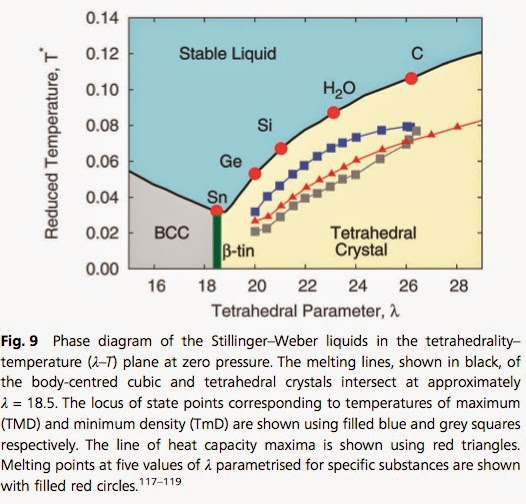
A unified phase diagram for tetrahedral liquids

At the NORDITA water meeting Charusita Chakravarty gave a nice talk that featured the phase diagram below.


The figure is taken from a nice Perspective paper in PhysChemChemPhys.
Water and water-like liquids: relationships between structure, entropy and mobility 
Divya Nayara and Charusita Chakravarty

The article gives a nice overview, putting the anomalous properties of water in a broad context, comparing and contrasting to the properties of other liquids for which tetrahedral interactions are dominant. Possible relations between thermodynamics, transport, and structure are also discussed.

Key anomalous properties of water [compared to simple isotropic liquids] include
-the negative slope of the melting line in the temperature-pressure phase diagram
-the temperature of maximum density [277.15 K at 1 atm]
-increase in diffusion with increasing density
-increase in specific heat, thermal expansion, compressibility upon isobaric supercooling.

Water is actually not as unique as I thought. Other tetrahedral liquids exhibit similar anomalies. Furthermore, it is not the hydrogen bonding (per se) that makes water anomalous, but rather the tetrahedral interactions associated with the hydrogen bonding.

The figure above is based on the Stillinger-Weber model, a coarse-grained model that captures the competition between two-body interactions and three-body (tetrahedral) interactions. The version of the model for water is termed monatomic Water (mW) and is described in this previous post. At the meeting Jibao Lu described recent work which gave an objective scoring of the successes and failures of different mW models and atomistic models.

What does this movie tell us about the modern university?

Last night, my wife and I watched the movie, Wit. You can watch the full movie here  (free with ads). I should warn that some of the conten...