Showing posts with label solvation. Show all posts

Saturday, August 29, 2015

Basic, bold, and boring: a claim about enzyme mechanism

This post concerns a basic but bold claim about the effects of a protein or solvent environment on chemical structure and reactivity. I am not clear on how original or how radical or controversial the claim is. In some sense, I think it is largely consistent with what Ariel Warshel has being saying for a long time. [See here for example].

I would be interested to hear feedback on the claim.

Consider some chemical reaction

A + B to C + D

One can consider the reaction is the gas phase [i.e. without an environment] or in a solvent [polar or non-polar] or in a protein environment. The relative stability of the reactants and the products, the rate of the reaction, and the reaction mechanism [i.e. the reaction co-ordinate and transition state geometry] can vary significantly and dramatically.
This is what is amazing about enzymes: you can increase the rate of a reaction by a factor of a billion.

So what is the most basic hypothesis about the effect of the environment? It can do two significant things.

1. The bond lengths of A and/or B and/or their relative geometry is changed by the environment. For example, A and B are forced closer together.

2. A polar environment [e.g. water or a protein] can change the relative energies of the transition state, and/or the reactants and products. This is highly likely because most molecules have non-uniform charge distributions and significant dipole moments.

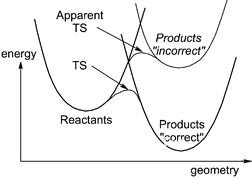
This claim has a natural understanding in terms of a simple diabatic state picture for the reaction. The environment can change the shapes of the diabatic potential energy surfaces and/or change the strength of the coupling of the two surfaces. [For example, in the figure below replace "incorrect" with "no environment" and "correct" with "environment"].

Why is this claim boring?
Well it means that there is nothing that "special" or unique about proteins. There is no new physics or chemistry.
It rules out exotic mechanisms such as dynamic effects and particularly collective quantum effects.

Finding out how an environment does change specific parameters is highly non-trivial.

Furthermore, outstanding, fascinating, and difficult problems remain understanding and describing:

  • how the protein "engineers" the changes in the reaction potential energy surface,
  • how mutations distant from the "reaction centre" can sometimes have such a significant effect,  
  • the role of the hundreds of amino acids not close to the "reaction centre", i.e. why do proteins need be so big? is there a lot of redundancy? or does one really need all those amino acids to produce a highly "tuned" and exquisite tertiary structure?
So is this claim "controversial" or "dogma" or "obvious"? 

Monday, July 27, 2015

Quantum biology smells bad

I am skeptical of the grand and speculative claims of "quantum biology". 
There is a nice paper in PNAS which systematically considers the specific claim that smell is based on sensing the vibrational frequencies of particular molecules, and rebuts it from both theoretical and experimental points of view.

Implausibility of the vibrational theory of olfaction
Eric Block, Seogjoo Jang, Hiroaki Matsunami, Sivakumar Sekharan, Bérénice Dethier, Mehmed Z. Ertem, Sivaji Gundala, Yi Pan, Shengju Li, Zhen Li, Stephene N. Lodge, Mehmet Ozbil, Huihong Jiang, Sonia F. Penalba, Victor S. Batista, and Hanyi Zhuang.

I thank Suggy Jang for bringing the paper to my attention.

Monday, July 20, 2015

Quantum nuclear effects in condensed phase chemistry

I am currently in Telluride for a meeting on Quantum effects in condensed phase systems. Two years ago I attended a similar meeting and in preparing it has been helpful to re-read several posts I wrote stimulated by that meeting.

In my first post, I listed possible quantum effects [zero-point motion, tunnelling, geometric phases, entanglement, ...] and pointed how generally one expects a condensed phase environment [protein, glass, solvent] for a molecular system will tend to reduce these quantum effects by decoherence.

I then asked two big questions.
Are there any instances where the environment can
A. enhance quantum effects?
B. lead to qualitatively new effects (e.g. associated with collective degrees of freedom) that are absent in the gas phase?

I clarified what I meant by a trivial vs. non-trivial enhancement of a quantum effect, from a physics point of view. An example of a "trivial" enhancement is where the environment changes the molecular geometry to enhance the effect. But I stressed that such an enhancement may be highly valuable from a chemistry or biochemistry point of view.

In a comment, Gautam Menon suggested that the Surface Enhanced Raman scattering was a nice example of a non-trivial enhancement. It is certainly spectacular, with enhancements as large as 10^11. However, I am not sure this is the type of quantum effect I am thinking of. The actual mechanism of the effect is still debated [see this paper] and I am not qualified to consider the relative merits of the alternative explanations, but it does look to me like it could be viewed as a semi-classical effect.

Tom Miller suggested to me that the solvation of single electrons and the associated polarons may be a suitable example of B.

I suggested that there were two important organising principles for describing and understanding quantum nuclear effects
1. Competing quantum effects
2. Rate processes can be dominated by rare quantum events.

I am looking forward to the meeting.

Wednesday, March 11, 2015

A brilliant insight about quantum decoherence in electronic circuits

Yesterday, Matthew Woolley gave an interesting Quantum science seminar at UQ about some of his recent work on Photon assisted tunnelling with non-classical light.

I just want to focus on one point that was deeply imbedded in the talk. It is a idea that is profound and central to the physics of quantum electronic circuits. The idea is so old now its profoundness and brilliance may be lost on a new generation.
The idea and result is easiest for me to explain in terms of the figure below which describes a superconducting (Josephson junction) qubit connected to an electrical circuit. It is taken from this review.

One can quantise the electromagnetic field and consider a spin-boson model to describe decoherence and dissipation of the qubit. This is associated with a spectral density that is proportional to frequency with a dimensionless pre factor alpha, which for this circuit is given by
where R_V is the electrical resistance of the circuit, R_K is the quantum of resistance, and the C's are capacitances.
Similar physics is at play in normal tunnel junctions (see for example this important paper, highlighted by Matthew in his talk).

Why do I find this profound?
First, this is a very simple formula that depends only on macroscopic parameters of the electrical circuit. One does not have to know anything about the microscopic details of  all the different electronic degrees of freedom in the circuit or how they individually couple to the qubit. I find this surprising.
Second, the underlying physics is the fluctuation-dissipation theorem. The quantum noise in the electronic circuit is related to fluctuations in the current. By Kubo and the fluctuation-dissipation relation tell us the fluctuations in the current are essentially the conductivity [the inverse of the resistivity].

Who was the first to have this insight and calculate this?
I feel it was Caldeira and Leggett, but I can't find the actual equation with the circuit resistance in their 1983 paper.
Or did someone else do this earlier?

Because of the above, whenever the spectral density depends linearly on the frequency, Leggett (and now everyone) calls it ohmic dissipation.

I first learnt this through the thesis work of my student Joel Gilmore, and described in this review. There we considered a more chemical problem, two excited electronic states of a molecule that are in a polar dielectric solvent. The coupling to the environment is completely specified in terms of the frequency dependent dielectric constant of the solvent (and some geometric factors).

Update: Caldeira answers the question in a comment below.

Thursday, October 30, 2014

Excited state potential energy surfaces for organic dyes

Sean McConnell, Seth Olsen, and I just finished a paper
A Valence-Bond Nonequilibrium Solvation Model for a Twisting Cyanine Dye


We study a two-state valence-bond electronic Hamiltonian model of non-equilibrium solvation during the excited-state twisting reaction of monomethine cyanines. These dyes are of interest because of the strong environment-dependent enhancement of their fluorescence quantum yield that results from suppression of competing non-radiative decay via twisted internal charge-transfer (TICT) states. For monomethine cyanines, where the ground state is a superposition of structures with different bond and charge localization, there are two twisting pathways with different charge localization in the excited state. The Hamiltonian designed to be as simple as possible consistent with a few well-enumerated assumptions. It is defined by three parameters and is a function of two π-bond twisting angle coordinates and a single solvation coordinate. For parameters corresponding to symmetric monomethines, there are two low-energy twisting channels on the excited-state surface that lead to a manifold of twisted intramolecular charge-transfer (TICT) states. For typical monomethines, twisting on the excited state will occur with small or no barrier. We show that changes in the solvation configuration can differentially stabilize TICT states in channels corresponding to different bonds, and that the position of a conical intersection between adiabatic states moves in response to solvent to stabilize either one channel or the other. We show that there is a conical intersection seam that grows along the bottom of the excited-state potential with increasing solvent polarity. For solvents of even moderate polarity, we predict that the intersection seam should completely span the bottom of the excited-state potential in these systems.

We welcome any comments.

Friday, September 5, 2014

The challenge of coupled electron-proton transfer

There is a nice helpful review
Biochemistry and Theory of Proton-Coupled Electron Transfer 
Agostino Migliore, Nicholas F. Polizzi, Michael J. Therien, and David N. Beratan

Here are a few of the (basic) things I got out of reading it (albeit on a long plane flight a while ago).

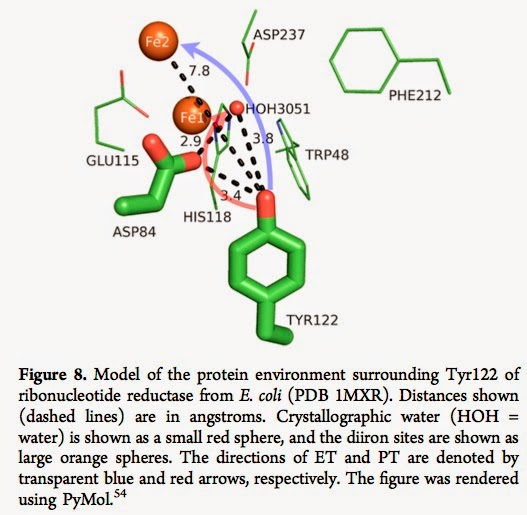
There are a diverse range of biomolecules where coupled electron-proton transfer plays a key role in their function. The electron transfer (ET) and proton transfer (PT) are usually spatially separated. [See blue and red arrows below].

There are fundamental questions about whether the transfer is concerted or sequential, adiabatic or non-adiabatic, and how important the protein environment (polar solvent)  is.

Often short hydrogen bonds are involved and so the nuclear degrees of freedom need to be treated quantum mechanically, in order to take into account tunnelling and/or zero-point motion.

Diabatic states are key to understanding and theoretical model development.

Although there are some "schematic" theories, they involve some debatable approximations (e.g. Fermi's golden rule), and so there is much to be done, even at the level of minimal model Hamiltonians.

Wednesday, June 25, 2014

Condensed phase dynamics in Telluride

Last night I was stranded at Denver airport en route to the bi-annual Condensed phase dynamics meeting at the Telluride Science Research Center.  This is the third time I have been to this wonderful meeting. Getting there can be a real hassle. But, then you look at the scenery and enjoy the science and it seems worth it.


Unfortunately, due to the travel delays I missed the first two talks, by Joe Subotnik and Nandini Ananth.

Dominika Zgid gave a chemist's perspective on "How to make dynamical mean theory quantitative". Some of her work was discussed in a my last post. Today she mostly discussed a generalisation of iterative perturbation theory as an "impurity solver" for DMFT problems with multiple orbitals. See this preprint.

Peter Rossky discussed quantum chemical simulations of exciton dynamics in conjugated polymers.

This was motivated by an experiment reported in Science that claimed evidence for quantum coherent transport of excitons along a polymer chain at room temperature. Several oscillations were seen in the fluorescence polarisation anisotropy  as it decays in about a picosecond. These oscillations were identified with quantum inference [Rabi oscillations] between different exciton states delocalised over the polymer chain.

It turns out the experimental results have a much more mundane explanation.
The simulations of Adam Willard and Rossky are of classical dynamics on the adiabatic excited state potential energy surface calculated from a parameterised PPP [Pariser-Parr-Pople] model [basically a Hubbard model with long-range Coulomb interactions. They see oscillations similar to those in the experiment and can identified simply with classical nuclear motion associated with the polymer backbone stretching [phonons] in response to photo-excitation.

Much-hyped experiments claiming to show quantum coherence in photosynthetic complexes, probably also have a similar classical explanation in terms of nuclear dynamics rather than electronic coherences. A concrete interpretation in terms of vibrational coherences is in this PNAS paper. My skepticism of these "quantum biology" experiments has been expressed in many earlier posts.

Hopefully, tomorrow I will blog about talks from Eran Rabani, Todd Martinez, and Dvira Segal.

Thursday, January 16, 2014

Experiencing the heat of solution

It is always fascinating to me when one can experience some scientific concept in everyday life. I particularly like it when one can see things with the naked eye. Recently I realised that a macroscopic manifestation of spin-orbit coupling is ferromagnetic domains and hysteresis. This is because they arise from spin anisotropy which is due to spin-orbit coupling. But I digress.

The other day I was maintaining my pool [a bain of my existence] and I mixed some solid "Hardness increaser" in water. It got really warm! I had noticed this before but not thought about it much. Why does this happen? The chemical is mostly Calcium chloride. It turns out that this has a particularly large "heat of solution" [the enthalpy change associated with dissolving it in water] of -83 kJ/mol. For this reason it is used in "hot packs" and some undergraduate chemistry labs to illustrate heat of solution. [See articles one and two in the Journal of Chemical Education]. In thermal isolation dissolving 100 grams in 1 liter of water should raise the water by 18 degrees C. This is why I experienced it directly.

I am embarrassed that much of the chemistry involved in swimming pool maintenance remains a mystery to me. [e.g. What is the point of increasing the alkalinity and decreasing the pH at the same time?] But hopefully once I read this J. Chem. Ed. paper it will all become crystal clear.


Monday, October 7, 2013

Tutorial on effective Hamiltonians for quantum dynamics in functional molecular materials

Today I am giving a seminar in the Theoretical Physics Department of the Stefan Institute. The abstract is below. The slides are here. The most important equation [the general form of the Hamiltonian] is missing (!) because I will write it on the white board and discuss at length. It is included below.

This informal tutorial will introduce some of the key concepts and approaches associated with modelling and understanding quantum dynamical processes in complex molecular materials.
This will provide background and motivation for understanding some of my work [1-4].

1. Examples of functional materials: optically active biomolecules, organic light emitting diodes and solar cells, enzymes, …
2. Examples of dynamical processes: charge separation, proton transfer, exciton transport, …
3. Partition: discrete quantum system + environment (solvent or protein)
4. Form of Model Hamiltonians
5. Diabatic states and potential energy surfaces
6. Example: spin boson model
7. Outstanding questions: quantum coherence, sequential vs. concerted, breakdown of Born-Oppenheimer, ...

[1] J. Gilmore and R.H. McKenzie, J. Phys. Chem. A 112, 2162 (2008).
[2] J. Bothma, J. Gilmore, and R.H. McKenzie, New. J. Phys. 12, 055002 (2010).
[3] S.C. Olsen and R.H. McKenzie, J. Chem. Phys. 130, 184302 (2009).
[4] R.H. McKenzie, Chem. Phys. Lett. 535, 196 (2012).

Tuesday, September 24, 2013

Essential state models for complex organic dye molecules

Tomorrow I am giving a seminar, "Essential state models for fluorescent protein chromophores and methine dyes," in the Chemistry department at Parma University, Italy. Here is  the current version of the slides.

My host is Anna Painelli. Over the past few years she and her collaborators have done some very nice work showing that the optical properties of a diverse range of complex chromophores can be described by "essential state models" that are effective Hamiltonians acting on a just a few valence bond states. These models include dominant molecular vibrations and the effect of the solvent.
For example, an earlier post mentioned their work on crystal violet.

This work nicely complements work done by Seth Olsen giving a rigorous quantum chemical justification for such essential state models, as in this J. Chem. Phys. paper.

Thursday, July 11, 2013

Organising principles for quantum effects in condensed phases

At the workshop a couple of talks have brought home to me two important organising principles for understanding and describing quantum effects involving hydrogen bonding in condensed phases. These are relevant to a wide range of problems from properties of bulk water to proton transfer in enzymes.

1. Competing quantum effects.
In hydrogen bonding as the donor acceptor distance decreases the hydrogen bonding gets stronger. This decreases the frequency of the O-H stretch on the donor and increases the frequency of the O-H bend.
[This can be seen in Figures 5 and 6 in my CPL]. Consequently, their are two competing contributions to the zero-point energy. These reduce the total quantum effect and also make it more challenging to calculate accurately.
This idea was highlighted in a 2007 JCP by Scott Habershon, Tom Markland, and David Manolopoulos and a 2012 PNAS by Tom Markland and Bruce Berne.
On tuesday, Tom Markland highlighted how these competing quantum effects were important for understanding isotope effects in the enzyme Ketosteroid isomerase.

2. Rate processes dominated by rare quantum events
If one looks at the average bond lengths in aqueous systems one might think that the hydrogen bonds are weak. However, due to quantum and thermal fluctuations there are rare events where oxygen atoms are sufficiently close together that there are transient strong hydrogen bonds where protons can be delocalised between two oxygen atoms.
This was highlighted in a talk by Michele Ceriotti.
These ideas were first developed by Dominik Marx and Mark Tuckerman and are nicely summarised in Section 2 in this review. The key figure is below. The left and right plots correspond to a quantum and a classical simulation, respectively.

Tuesday, July 2, 2013

Are quantum effects ever enhanced in condensed phases?

Previously, I asked the question: are there any condensed phase systems in chemistry where quantum effects [e.g. tunneling, interference, entanglement] are enhanced compared to the gas phase?

Let me clarify. Suppose we take a molecular system X and consider the magnitude of some quantum effect Y in the gas phase. We then put X in some condensed phase environment [e.g., solvent, protein, or glass] and measure or calculate Y.
It is quite possible that Y increases due to what I would call "physically trivial" effects, e.g. a change in the geometry of X which makes Y larger. For example, the polarity of a solvent can decrease the donor-acceptor distance for proton transfer in a molecule and thus increase quantum tunnelling.

To me a physically "non-trivial" effect is where the environment enhances the quantum effect for the same reference system X [e.g., one uses the same geometry of the molecule in the gas and condensed phases]. I am not sure this ever happens. Generally, environments decohere quantum systems.

But I stress that such environmental effects can be far from "trivial" to chemists and biologists. e.g., they can make an enzyme work!

Historically, this distinction between "trivial" and "non-trivial" environmental effects was important and confusing for the Caldeira-Leggett model for quantum tunneling in the presence of an environment. To clarify this issue Caldeira and Leggett added a "counter-term" to the Hamiltonian to subtract off the renormalisation of the potential barrier by the environment. This is discussed in detail in the book by Weiss [page 19 in the second edition]. Chemists call this "counter-term" the solvation energy.

Aside: in nuclear physics these renormalisation effects are observable and calculable, as described in this PRL.

Thursday, May 30, 2013

Quantum effects in condensed phase chemistry

I am looking forward to attending a workshop on Quantum effects in condensed phase systems at the Telluride Science Research Centre in July.
I thank Scott Habershon and Tom Markland for organising what looks like a great meeting. I don't normally do the crazy thing of flying to USA for just one week, but I think this meeting should be worth it.

Much of chemistry is "classical" in the sense that it can be described by semi-classical dynamics of the nuclear degrees of freedom moving on potential energy surfaces that can be calculated in the Born-Oppenheimer approximation.
But, there are important exceptions.

I list below some of the quantum nuclear effects that need to be considered. They are listed roughly in the order of increasing exoticness and decreasing frequency of attention they receive.
  • zero-point energy
  • tunneling
  • non-adiabatic, breakdown of the Born-Oppenheimer approximation
  • interference
  • entanglement (of nuclear and electronic degrees of freedom)
  • geometric (Berry) phases
  • collective coherent effects
These effects can all be present in small molecules in the gas phase.
A key question is how are the above effects modified in a condensed phase environment (e.g. a solvent, glass, or protein)?
Generally, interaction with the many degrees of freedom of the environment will decohere the small molecule degrees of freedom and reduce the quantum effects.

Here are some big questions.
Are there any instances where the environment can 
-enhance any of above quantum effects?
-lead to qualitatively new effects (e.g. associated with collective degrees of freedom) that are absent in the gas phase?

Monday, January 14, 2013

Deconstructing excited state dynamics in a solvent

A key question about excited state dynamics in a solvent is the relative importance of the solvent polarity and the viscosity.
This is examined experimentally in the paper
Ultrafast Photoisomerization of Photoactive Yellow Protein Chromophore Analogues in Solution: Influence of the Protonation State
Agathe Espagne, Daniel Paik, Pascale Changenet-Barret, Monique Martin, Ahmed H. Zewail

The photoisomerization corresponds to the twisting of the double bond shown below.

The figure above shows the de-protonated (anionic) form. The protonated (neutral) form has a proton attached to the oxygen anion on the right end of the molecule.

They find that the excited state lifetime of the protonated (de-protonated) chromophore varies significantly with the solvent viscosity (polarity) but not the polarity (viscosity).

It is not surprising to me that the shape of the excited state potential energy surface varies significantly with the protonation state. Seth Olsen has shown this clearly for the chromophore of the green fluorescent protein in high level quantum chemistry calculations. These surfaces can be described by a simple two-state effective Hamiltonian (see here). The key physics is that de-protonation tunes the system away from "resonance" between the two underlying valence bond states. Generally, when one is close to resonance the ground and excited state have small net dipole moments and one expects a weak coupling to the polarity of the solvent.

A key challenge is constructing the simplest possible effective Hamiltonian which can describe the excited state dynamics including the effective of the solvent viscosity and polarity.

Thursday, December 20, 2012

Deconstructing excited state dynamics in a solvent

What determines the excited state lifetime of a chromophore in a solvent?
What are the relative importance of the polarity of the solvent [dielectric relaxation time] and the viscosity?

The key physics associated with the solvent polarity is that the dipole moment in the ground and excited states are usually different and so the solvent relaxes and there is an associated redshift of the emission. The viscosity is particularly relevant when there is intramolecular twisting and this motion is usually overdamped.

This problem is of fundamental interest because it concerns overdamped quantum dynamics.
It is of applied interest because significant biomolecular sensors make use of the sensitivity of specific chromophores [e.g. Thioflavin-T binding to amyloid fybrils].

Two recent papers from Dan Huppert's group raise three important questions for me.

An Accounts in Chemical Research
Molecular Rotors: What Lies Behind the High Sensitivity of the Thioflavin-T Fluorescent Marker?
raises the question:
1. What is unique about Thioflavin-T? 
How are the photophysical properties fine tuned?

The authors give convincing arguments as to why Thioflavin-T works. Some of these are reviewed in this earlier post.

However, given there are lots of other chromophores which undergo excited state twisting to dark states [see e.g., this review] it is not clear to me why all these other molecules don't work just as well as Thioflavin-T?

The excited state dynamics is interpreted in terms of the figure below where there are two distinct excited singlet states:
A local excited state (LE) and a twisted intramolecular charge-transfer (TICT) state.


2. Are the LE and TICT states distinct? 
In the simplest two-diabatic state picture there is a single excited state and as the chromophore twists this smoothly evolves from a bright state at the Franck-Condon point to a dark TICT state. This is what Seth Olsen and I found for the chromophore of the Green Fluorescent Protein [see our recent J. Chem. Phys. paper].

The paper
Temperature and Viscosity Dependence of the Nonradiative Decay Rates of Auramine-O and Thioflavin-T in Glass-Forming Solvents
reports that over more than three orders of magnitude the excited state lifetime is proportional to the viscosity and to the dielectric relaxation time.

This raises a subtle issue: causality vs. correlation. The authors point out that in the simple theory of a dielectric liquid the viscosity and the dielectric relaxation time are proportional to one another.

3. Can one separate out the respective contribution of the polarity of the solvent and of the viscosity?

There are two distinct reaction co-ordinates here: the motion associated with each is overdamped. One co-ordinate is the intra-molecular twisting of the solute and which couples to the viscosity of the solvent. The other co-ordinate is the local electric polarisation of the solvent which couples to the dipole moment of the excited state.

Monday, December 17, 2012

My questions about condensed phase photochemistry?


For the excited state dynamics of a specific chromophore in a solvent what are the essential degrees of freedom (electronic, vibrational, and solvent) that must be included in a model Hamiltonian?

What determines if the excited state dynamics is classical, semi-classical, or fully quantum? Under what conditions does the Born-Oppenheimer approximation break down?

For a specific photochemical reaction what are the relevant vibrational degrees of freedom? What determines the relative importance of stretching, torsional, and pyramidal vibrations?

What determines the branching ratio for passage through a conical intersection? Relevant parameters may be the slope at the intersection, slanting, size of the wavepacket, and the distance of closest approach (impact parameter)

What is the interplay of the electronic, vibrational and solvent degrees of freedom in excited state dynamics?

What determines the relative importance of the viscosity and the polarity of the solvent for the dynamics? What is the role of the spatial inhomogeneity of the solvent?

In the presence of a solvent what are respective criteria for the localization/delocalization of electronic and/or vibrational excitations over different parts of the chromophore?
What are definitive experimental signatures of delocalization?

What are definitive experimental signatures of breakdown of the Born-Oppenheimer approximation?

What is the role of the solvent in non-adiabatic processes?

Tuesday, June 26, 2012

Condensed phase dynamics in the Rockies

This week I am in Colorado at the Telluride Science Research Center for the workshop on Condensed Phase Dynamics. Many of my favourite theoretical chemical physicists are here so I am really looking forward to it. I am going to give a talk based on my recent paper about hydrogen bonding.


Thursday, May 24, 2012

Effect of a solvent on excited state dynamics

Last two days I have read through a nice paper Modeling the Nonradiative Decay Rate of Electronically Excited Thioflavin T
by Yuval Erez, Yu-Hui Liu, Nadav Amdursky, and Dan Huppert

The relevant molecule [chromophore] is shown below. It is of particular interest because its fluorescence intensity increases significantly when bound to amyloid fibrils which are associated with Parkinson's, type II diabetes, and Alzheimer's disease.
The key photophysics is associated with twisting about the central carbon-carbon bond.
The experimental results that need to be explained are
-the non-radiative life time increased linearly with the solvent viscosity over 3 orders of magnitude
-the fluorescence intensity decreases with time on the scales of tens of picoseconds

The calculated [via TDFT = Time-Dependent Density Functional Theory] dependence of the ground and excited state energies as a function of the twist angle is shown below.
As the twist angle increases from zero to 90 degrees the transition dipole moment between the ground and excited states decreases by 2 orders of magnitude.

Much the above can be qualitatively understood in terms of a two-site Hubbard model where the two sites correspond to two orbitals localised on the two opposite sides of the molecule.

Excitation from S0 to S1 at 30 degrees then leads to downward movement on the S1 potential energy surface towards the minimum at 90 degrees [referred to as the TICT =Twisted Intra-molecular Charge Transfer] state.
Hence, with increasing time the fluorescence intensity decreases due to decreasing oscillator strength for the S1-S0 transition. However, the twisting motion of the large rings is opposed by friction (viscosity) arising from the solvent.

The paper applies a theory due to van der Meer, Zhang, and Glasbeek that I discussed in an earlier post, to give a quantitative description of the experiment. It is assumed that the viscosity is sufficiently large that the twisting motion is classical and over-damped and so can be described by a Smoluchowski diffusion equation. This is solved to given emission line shapes as a function of time. For times larger than 3 picosecond a diffusion constant of D=0.1/psec gives results consistent with experiment. This value is nicely consistent with that predicted by combining the Einstein relation [fluctuation-dissipation relation]
D= k_B T/friction
with a Stokes formula relating the viscosity to the friction for a rotating disc with the size of a phenyl ring.

A few open issues
  • it would be nice to see a plot showing the calculated relationship between the non-radiative lifetime and the solvent viscosity with a comparison of the correlations seen experimentally.
  • describing the short time dynamics (greater than 3 psec) requires a larger diffusion constant (smaller friction) consistent with the idea of a frequency dependent friction due to the finite relaxation time of the solvent.
  • I assume the classical dissipative dynamics is justified because the timescales of interest are much larger than the relevant thermal time ~ hbar/k_B T ~ 20 fsec.
  • A very broad "line shape function characteristic of the Frank-Condon factor" is used. The width is 3300 cm-1. It is not clear what the physical origin of this large width is.

Friday, March 25, 2011

Overdamped quantum molecular dynamics

How do quantum states in organic molecules couple to their environment (e.g., a solvent and/or protein)?
Is the dynamics of excited states quantum or classical or something in between?

These questions are not just of fundamental scientific interest. Dye molecules are now widely used as a means to monitor biomolecules and nanoconfined water.

A nice way to investigate the above questions experimentally is with ultrafast laser spectroscopy.  For example, to optically excite a molecule and monitor the emission (fluorescence) in real time. A nice combined theoretical/experimental study is in the paper
Femtosecond fluorescence upconversion studies of barrierless bond twisting of auramine in solution by van der Meer, Zhang, and M. Glasbeek.

Upon photoexcitation the auramine dye molecule (below) is believed to undergo twisting of the phenyl (benzene) rings on the left and right side of the central C=NH2 bridge. With increasing time [1-100 psec] this leads to redshift in the light emission frequency [dynamic Stokes shift] and a reduction in the intensity of emission. As the temperature decreases and the viscosity of the solvent increases the time scale on which these changes occur increases.

Here are a few of the key ideas and things I found interesting about the paper.

They consider four alternative physical models to explain the experiments and rule out three of them. The best model consists has the excited state being a superposition of a two diabatic states: one fluorescent F and one dark D. As the reaction proceeds (the molecule twists) the character of the state changes from F to D.

Dynamics on the excited state potential energy surface is described by a Schmoluchowski equation with a rotational diffusion constant Dr.

Comparing the predictions of the model with experimental data they find that the diffusion constant Dr  increases with the temperature and with the inverse of the solvent viscosity. The magnitude of this dependence is consistent with the Einstein-Stokes relation. This shows that the twisting motion of the molecule is overdamped by collisions with the solvent molecules. [Since the solvent is non polar dielectric relaxation is not involved].

A key next step is to provide a quantum chemical justification for the model, both the existence of the dark excited state and the relevant parameters in the effective Hamiltonian for the excited state.

What does this movie tell us about the modern university?

Last night, my wife and I watched the movie, Wit. You can watch the full movie here  (free with ads). I should warn that some of the conten...