Showing posts with label cuprates. Show all posts

Sunday, March 15, 2026

Tony Leggett (1938-2026): condensed matter theorist

Tony Leggett died last week. The New York Times has a nice obituary. One measure of his influence on me is that more than 20 posts on this blog feature his work. He received the Nobel Prize in 2003 for developing the theory of superfluid 3He.

In 1972, a graduate student at Cornell, Doug Osheroff, discovered a phase transition around a temperature of 2 mK in liquid 3He. In the 1960s liquid 3He was established to be a Fermi liquid that was beautifully described by Landau's theory. Osheroff and his advisors, David Lee and Robert Richardson, incorrectly identified the phase transition as arising from antiferromagnetic order in the solid phase of 3He.

However, Leggett argued that it was actually due to superfluidity that there were two distinct superfluid phases, A and B, with different order parameters. 

Lee, Osheroff, and Richardson shared the Nobel Prize in 1996 for their discovery.

Leggett was primed to make rapid progress, as in 1965 and 1966 he had written three papers about superfluidity in liquid 3He, albeit assuming s-wave pairing. Indeed, by 1975 he wrote a comprehensive review article on the two superfluid phases.

For many reasons superfluid 3He was significant for the broader field of condensed matter. BCS showed that in elemental metals, superconductivity resulted from Cooper pairing of electrons due to an attractive electron-phonon interaction.  The order parameter (Cooper pair wave function) had s-wave spin singlet symmetry.

In contrast, superfluid 3He showed that Cooper pairing could also occur in a neutral Fermi liquid, and have non-trivial symmetry, i.e., p-wave symmetry and spin triplet. The order parameter has 18 components, compared to only 2 for elemental superconductors. There is spontaneous symmetry breaking of the local gauge symmetry, and spin or orbital rotational symmetries. 

The Cooper pairing in superfluid 3He is not due to a fermion-phonon interaction but due to spin fluctuations.

The fact that Cooper pairing was possible for different symmetries and mechanisms than for elemental superconductors was significant in that it meant it was reasonable to consider this possibility for superfluidity in neutron stars, and superconductivity in cuprates, strontium ruthenate, heavy fermions, and organic charge transfer salts.

There is rich physics associated with the symmetry breaking: 18 collective modes of the order parameter, textures such as boojums, and exotic vortex cores. For vortices, there is also some (controversial) connection to cosmic strings, including experiments that test the Kibble-Zurek mechanism and the electro-weak phase transition in the early universe.

Aside: My Ph.D. thesis was on the theory of the non-linear interaction of zero sound with the order parameter collective modes in the B-phase.

Leggett's development of the theory of superfluid 3He was amazing and certainly worthy of a Nobel. However, I think he made an even greater contribution to physics through his work on the theory of macroscopic quantum effects in Josephson junctions. This work was the basis for the experimental work that was honoured with the Nobel Prize last year.

With his student Amir Caldeira, Leggett performed concrete calculations of the effects of decoherence on quantum tunnelling in Josephson junctions.

[The NY Times obituary mistakenly says this work began after Leggett moved to Urbana. It was done while he was still at Sussex].

The formalism they developed involving the spectral density is the basis for most theoretical treatments of decoherence in superconducting qubits. A relevant toy model is the spin-boson model, and in 1987 Leggett published a seminal (but rather dense) review on the subject.

Leggett aided our understanding of cuprate superconductors. He contributed to the theoretical ideas that were the basis of the phase-sensitive measurements that established the d-wave nature of the order parameter. He also showed that experiments with inconsistent with  Anderson's interlayer tunneling theory.

I recommend reading Leggett's own scientific autobiography, Matchmaking Between Condensed Matter and Quantum Foundations, and Other Stories: My Six Decades in Physics and his book, The Problems of Physics

Thursday, February 5, 2026

The legacy of 40 years of cuprate superconductivity

In February 1986, Bednorz and Müller made a stunning discovery: superconductivity at a temperature of 35 K in a doped copper oxide (cuprate). Arguably, this discovery changed condensed matter physics. In April 1986, they submitted their results to Z. Phys. B. Only nineteen months later, they were awarded the Nobel Prize in Physics, the shortest time ever between a discovery and the award. A nice and short review of the history is here.

One measure of my estimate of the influence of this discovery is that it received about 5 pages of coverage in my Condensed Matter Physics: A Very Short Introduction. (See Chapter 5, Adventures in Flatland).

How things have developed over the past forty years, for better and worse, may be representative of how science advances: discovery by serendipity, hype about applications, unexpected secondary benefits, foundational questions, new concepts, unification, and incremental advances.

Hype about technological applications

On March 20, 1987, The New York Times had a front-page article, DISCOVERIES BRING A 'WOODSTOCK' FOR PHYSICS, by James Gleick. This followed the 1987 APS March meeting. It began 

"Physicists from three continents converged on the New York Hilton for a hastily scheduled special conference on a string of discoveries that seem certain to produce a rapid cascade of commercial applications in electricity, magnetism and electronics.There are many things we know and understand that we did not when they were first discovered."

This has largely been unfulfilled. There are a few niche applications, but cuprates are not used in electricity distribution or even in the superconducting magnets in hospital MRI machines, which are probably the main commercial application of superconductors. One of the significant obstacles is that it is hard to make wires from these materials, as they are ceramics. This is an example of the common gap between research laboratory science and commercially viable technology.

After 40 years, do we have a successful theory?

It depends on who you ask. But I would say there is a lot we do understand.

We have a phenomenological theory for all the macroscopic phenomena associated with the superconducting state: Ginzburg-Landau theory!

Properties of the superconducting state are well-described by a BCS wavefunction with a d-wave order parameter and the associated Bogoliubov quasiparticles. [This is somewhat puzzling, as in the metallic state quasi-particles are not well defined].

Although not everyone agrees, I think it is fair to say that the essential physics is in a one-band Hubbard model, and the key physics is:

strong electronic correlations,

a doped antiferromagnetic Mott insulator,

d-wave pairing that is "mediated"/caused from some mixture/variant of antiferromagnetic spin fluctuations or RVB spin singlets,.....

We certainly don't understand the cuprates at the same level as elemental superconductors. But we do understand the essential physics.

What is harder to describe and understand are the states adjacent to the superconducting state in the phase diagram: the pseudogap state and the strange metal.


Strongly correlated electron materials became a large, vibrant and unified field

Before 1986, there were small, disconnected communities intermittently interested in transition metal oxides, rare earths, Kondo impurities, Mott metal-insulator transitions, organic superconductors, heavy fermions, and quantum antiferromagnets.

The discovery of the cuprates brought together these communities as they found common interests, challenges, questions, concepts, and techniques.

The discovery of superconductivity in strontium ruthenate, alkali fullerides, iron pnictides and chalcogenides, twisted bilayer graphene and more cuprates, organic charge-transfer salts, and heavy fermions has shown how rich these systems are. The challenge is to understand the similarities and differences between these chemically and structurally diverse systems. In many of them, superconductivity is proximate to a Mott insulating state.

The unity and excitement were probably stimulated and enhanced by the activities and ideas of high-profile theorists such as Anderson, Schrieffer, Scalapino, Pines, Rice, and Varma. On the other hand, their acrimonious disagreements probably did not help.

Secondary theoretical benefits

The things I list below were not new ideas when the cuprate discovery happened. However, interest in the cuprates led them to become major research themes and ideas.

Importance of phase diagrams, including as a function of interaction parameters in toy models

Highlighting the limitations of electronic structure methods based on Density Functional Theory with approximate Exchange-Correlation functionals (i.e., anything computational). In the presence of strong correlations, DFT methods have spectacular failures. For example, predicting a metallic state instead of the Mott insulator.

Low dimensionality leads to qualitatively different behaviour, including the possibility of new types of order and quasiparticles. This is most dramatic in one dimension, where one has Luttinger liquids and spin-charge separation.

Spin liquids. Landau was wrong. Spontaneous symmetry breaking does not always occur in antiferromagnets.

Non-Fermi liquids. Landau was wrong. Not all metals are Fermi liquids.

Quantum criticality. Although this is a robust concept for certain toy models, whether it is relevant to the cuprates remains contentious.

Systematic improvements in approximation schemes and numerical techniques - exact diagonalisation, DMRG, DMFT, quantum Monte Carlo,...

Emergence. Chemical complexity and strong interactions can lead to new states of matter.

Secondary experimental benefits

Better probes. The desire to characterise the cuprates helped drive significant improvements in the resolution of ARPES (Angle-Resolved PhotoEmission Spectroscopy), STM (Scanning Tunnelling Microscopy), and inelastic neutron scattering. These advances have born fruit in the study of a wide range of other materials, beyond the cuprates.

Growth of single crystals. The early days of the cuprates produced a lot of junk experimental results because of the poor quality of the samples produced by "shake and bake". However, the involvement of solid-state chemists has improved things. The techniques have also led to the production of single crystals for a wide range of strongly correlated materials.

Why is there so little research on cuprates today?

Today, there is little research directly on cuprates, both theoretically and experimentally. It is hard to get funding to work on them, even though there is a lot we don't understand really well.

This is because of the problem of fashion in science. The low-lying fruit has been picked. There is a continuous new stream of materials being discovered with exotic properties, the latest being twisted bilayer van der Waals compounds.

Monday, November 3, 2025

Overdoped cuprates are not Fermi liquids

They are anisotropic marginal Fermi liquids.

A commenter on my recent AI blog post mentioned the following preprint, with a very different point of view.

Superconductivity in overdoped cuprates can be understood from a BCS perspective!

B.J. Ramshaw, Steven A. Kivelson

The authors claim:

" a theoretical understanding of the "essential physics" is achievable in terms of a conventional Fermi-liquid treatment of the normal state...

...observed features of the overdoped materials that are inconsistent with this perspective can be attributed to the expected effects of the intrinsic disorder associated with most of the materials being solid state solutions"

On the latter point, they mention two papers that found the resistivity versus temperature can have a linear component. But there is much more.

The authors appear unaware of the experimental data and detailed theoretical analysis showing that the overdoped cuprates are anisotropic marginal Fermi liquids. 

Angle-dependent magnetoresistance measurements by Nigel Hussey's group, reported in 2006, were consistent with a Fermi surface anisotropy in the scattering rate.

Papers in 2011 and 2012 pushed the analysis further.

Consistent Description of the Metallic Phase of Overdoped Cuprate Superconductors as an Anisotropic Marginal Fermi Liquid, J. Kokalj and Ross H. McKenzie

Transport properties of the metallic state of overdoped cuprate superconductors from an anisotropic marginal Fermi liquid model, J. Kokalj, N. E. Hussey, and Ross H. McKenzie 

The self-energy is the sum of two terms with characteristic dependencies on temperature, frequency, location on the Fermi surface, and doping. The first term is isotropic over the Fermi surface, independent of doping, and has the frequency and temperature dependence characteristic of a Fermi liquid. 

The second term is anisotropic over the Fermi surface (vanishing at the same points as the superconducting energy gap), strongly varies with doping (scaling roughly with 𝑇𝑐, the superconducting transition temperature), and has the frequency and temperature dependence characteristic of a marginal Fermi liquid. 

The first paper showed that this self-energy can describe a range of experimental data including angle-dependent magnetoresistance and quasiparticle renormalizations determined from specific heat, quantum oscillations, and angle-resolved photoemission spectroscopy. 

The second paper, showed, without introducing new parameters and neglecting vertex corrections, that this model self-energy can give a quantitative description of the temperature and doping dependence of a range of reported transport properties of Tl2Ba2CuO6+𝛿 samples. These include the intralayer resistivity, the frequency-dependent optical conductivity, the intralayer magnetoresistance, and the Hall coefficient. The temperature dependence of the latter two are particularly sensitive to the anisotropy of the scattering rate and to the shape of the Fermi surface.

For a summary of all of this, see slides from a talk I gave at Stanford back in 2013.

I am curious whether the authors can explain the anisotropic part of the self-energy in terms of disorder in samples.

Friday, April 25, 2025

Phase diagrams elucidate emergence

Phase diagrams have been ubiquitous in materials science for decades. They show what states of matter are thermodynamically stable depending on the value of external parameters such as temperature, pressure, magnetic field, or chemical composition. However, they are only beginning to be appreciated in other fields. Recently, Bouchaud argued that they needed to be used more to understand agent-based models in the social sciences.

For theoretical models, whether in condensed matter, dynamical systems, or economics, phase diagrams can show how the state of the system predicted by the model has qualitatively different properties depending on the parameters in the model, such as the strength of interactions. 

Phase diagrams illustrate discontinuities, how quantitative changes produce qualitative changes (tipping points), and diversity (simple models can describe rich behaviour). Phase diagrams show how robust and universal a state is, i.e., whether it only exists for fine-tuning of parameters. Theoretical phase diagrams can expand our scientific imagination, suggesting new regimes that might be explored by experiments. An example is how the phase diagram for QCD matter (shown below) has suggested new experiments, such as at the RHIC.

For dynamical systems, I recently illustrated this with the phase diagram for the Lorenz model. It shows for what parameter ranges strange attractors exist.

Today, for theoretical models for strongly correlated electron systems it is common to map out phase diagrams as a function of the model parameters. However, this was not always the case. It was more common to just investigate a model for specific parameter values that were deemed to be relevant to specific materials. Perhaps, Anderson stimulated this new approach when, in 1961, he drew the phase diagram for the mean-field solution to his model for local moments in metals, a paper that was partly the basis of his 1977 Nobel Prize.

At a minimum, a phase diagram should show the state with the emergent property and the disordered state. Diagrams that contain multiple phases may provide hints for developing a theory for a specific phase. For example, for the high-Tc cuprate superconductors, the proximity of the Mott insulating, pseudogap, and non-Fermi liquid metal phases has aided and constrained theory development.

Phase diagrams constrain theories as they provide a minimum criterion of something a successful theory should explain, even if only qualitatively. Phase diagrams illustrate the potential and pitfalls of mean-field theories. Sometimes they get qualitative details correct, even for complex phase diagrams, and can show what emergent states are possible. Ginzburg-Landau and BCS theories are mean-field theories and work extremely well for many superconductors. On the other hand, in systems with large fluctuations, mean-field theory may fail spectacularly, and they are sometimes the most interesting and theoretically challenging systems.

Tuesday, March 25, 2025

Superconductivity: a poster child for emergence

Superconductivity beautifully illustrates the characteristics of emergent properties.

Novelty. 

Distinct properties of the superconducting state include zero resistivity, the Meissner effect, and the Josephson effect. The normal metallic state does not exhibit these properties.

At low temperatures, solid tin exhibits the property of superconductivity. However, a single atom of tin is not a superconductor. A small number of tin atoms has an energy gap due to pairing interactions, but not bulk superconductivity.

There is more than one superconducting state of matter. The order parameter may have the same symmetry as a non-trivial representation of the crystal symmetry and it can have spin singlet or triplet symmetry. Type II superconductors in a magnetic field have an Abrikosov vortex lattice, another distinct state of matter.

Unpredictability. 

Even though the underlying laws describing the interactions between electrons in a crystal have been known for one hundred years, the discovery of superconductivity in many specific materials was not predicted. Even after the BCS theory was worked out in 1957 the discovery of superconductivity in intermetallic compounds, cuprates, organic charge transfer salts, fullerenes, and heavy fermion compounds was not predicted.71

Order and structure. 

In the superconducting state, the electrons become ordered in a particular way. The motion of the electrons relative to one another is not independent but correlated. Long-range order is reflected in the generalised rigidity, which is responsible for the zero resistivity. Properties of individual atoms (e.g., NMR chemical shifts) are different in vacuum, metallic state, and superconducting state.

Universality. 

Properties of superconductivity such as zero electrical resistance, the expulsion of magnetic fields, quantisation of magnetic flux, and the Josephson effects are universal. The existence and description of these properties are independent of the chemical and structural details of the material in which the superconductivity is observed. This is why the Ginzburg-Landau theory works so well. In BCS theory, the temperature dependences of thermodynamic and transport properties are given by universal functions of T/Tc where Tc is the transition temperature. Experimental data is consistent with this for a wide range of superconducting materials, particularly elemental metals for which the electron-phonon coupling is weak.

Modularity at the mesoscale. 

Emergent entities include Cooper pairs and vortices. There are two associated emergent length scales, typically much larger than the microscopic scales defined by the interatomic spacing or the Fermi wavelength of electrons. The coherence length is associated with the energy cost of spatial variations in the order parameter. It defines the extent of the proximity effect where the surface of a non-superconducting metal can become superconducting when it is in electrical contact with a superconductor. The coherence length turns out to be of the order of the size of Cooper pairs in BCS theory.  The second length scale is the magnetic penetration depth (also known as the London length) which determines the extent that an external magnetic field can penetrate the surface of a superconductor. It is determined by the superfluid density. The relative size of the coherence length and the penetration depth determines whether  the formation of an Abrikosov vortex lattice is stable in a large enough magnetic field.

Quasiparticles. 

The elementary excitations are Bogoliubov quasiparticles that are qualitatively different to particle and hole excitations in a normal metal. They are a coherent superposition of a particle and hole excitation (relative to the Fermi sea), have zero charge and only exist above the energy gap. The mixed particle-hole character of the quasiparticles is reflected in the phenomenom of Andreev reflection.

Singularities. 

Superconductivity is a non-perturbative phenomenon. In BCS theory the transition temperature, Tc, and the excitation energy gap are a non-analytic function of the electron-phonon coupling constant lambda, Tc \sim exp(-1/lambda).

A singular structure is also evident in the properties of the current-current correlation function. Interchange of the limits of zero wavevector and zero frequency do not commute, this being intimately connected with the non-zero superfluid density.

Effective theories.

These are illustrated in the Figure below. The many-particle Schrodinger equation describes electrons and atomic nuclei interacting with one another. Many-body theory can be used to justify considering the electrons as a jellium liquid of non-interacting fermions interacting with phonons. Bardeen, Pines, and Frohlich showed that for that system there is an effective interaction between fermions that is attractive. The BCS theory includes a truncated version of this attractive interaction. Gorkov showed that Ginzburg-Landau theory could be derived from BCS theory. The London equations can be derived from Ginzburg-Landau theory. The Josephson equations only include the phase of order parameter to describe a pair of coupled superconductors.

The historical of the development of theories mostly went downwards. London preceded Ginzburg-Landau which preceded BCS theory. Today for specific materials where superconductivity is known to be due to electron-phonon coupling and the electron gas is weakly correlated one can now work upwards using computational methods such as Density Functional Theory (DFT) for Superconductors or the Eliashberg theory with input parameters calculated from DFT-based methods. However, in reality this has debatable success. The superconducting transition temperatures calculated typically vary with the approximations used in the DFT such as the choice of functional and basis set, and often differ from experimental results by the order of 50 percent. This illustrates how hard prediction is for emergent phenomena.

Potential and pitfalls of mean-field theory. 

Mean-field approximations and theories can provide a useful guide as what emergent properties are possible and as a starting point to map out properties such as phase diagrams. For some systems and properties, they work incredibly well and for others they fail spectacularly and are misleading. 

Ginzburg-Landau theory and BCS theory are both mean-field theories. For three-dimensional superconductors they work extremely well. However, in two dimensions as long-range order and breaking of a continuous symmetry cannot occur and the physics associated with the Berezinskii-Kosterlitz-Thouless transition occurs. Nevertheless, the Ginzburg-Landau theory provides the background to understand the justification for the XY model and the presence of vortices to proceed. Similarly, the BCS theory fails for strongly correlated electron systems, but a version of the BCS theory does give a surprisingly good description of the superconducting state.

Cross-fertilisation of fields. 

Concepts and methods developed for the theory of superconductivity bore fruit in other sub-fields of physics including nuclear physics, elementary particles, and astrophysics. Considering the matter fields (associated with the electrons) coupled to electromagnetic fields (a U(1) gauge theory) the matter fields can be integrated out to give a theory in which the photon has mass. This is a perspective on the Meissner effect in which the magnitude of an external magnetic field decays exponentially as it penetrates a superconductor. This idea of a massless gauge field acquiring a mass due to spontaneous symmetry breaking was central to steps towards the Standard Model made by Nambu and by Weinberg. 

Friday, October 7, 2022

Probing the relationship between superexchange and superconductivity in cuprates

One of the most basic ideas in science is the controlled experiment. A single "independent" variable is changed while all others are held fixed. One then observes how the properties of the system change. Unfortunately, reality is more complicated and there are rarely any truly independent variables, particularly in materials science.

Since the discovery of cuprate superconductors one-quarter of a century ago there has been a constant struggle to tease out systematic trends that can provide insight into the underlying physics causing the superconductivity. This is a challenge because it is difficult to change only one variable. For example, a key property is how the superconductivity changes with the chemical composition of the material, particularly with regard to the doping level, i.e., the density of charge carriers. The problem is that with changes in doping, many other things change as well: the amount of disorder, the periodicity and strength of magnetic interactions, crystal structure, ... 

There is a beautiful experimental paper that recently overcomes these problems. 

On the electron pairing mechanism of copper-oxide high temperature superconductivity

Shane M. O’Mahony, Wangping Ren, Weijiong Chen,  Yi Xue Chong, Xiaolong Liu, H. Eisaki, S. Uchida, M. H. Hamidian, and J. C. Séamus Davis 

In a very clever way they can do all their measurements on a single material of fixed chemical composition, and yet vary a key parameter, the size of the energy difference between the relevant oxygen and copper electronic states, Epsilon.

In the material under study,  Bi2Sr2CaCu2O8+xthere are CuO5 units, as pictured below. In the crystal there is a modulation of delta, the distance at which the fifth oxygen sits above the CuO4 squares that form the square lattices that comprise the layers responsible for the superconductivity.

Due to electrostatics, the distance delta has an effect on the energy Epsilon. This in turn changes the size of the magnetic superexchange between neighbouring copper spins, as pictured below.

In the experiment, a STM is used to measure how Epsilon varies as delta varies (see the red dots in the Figure below). We then expect this to vary the superexchange.

An electron-pair (Josephson) STM is used to measure the magnitude of the superfluid density (electron-pair density) and how it changes with delta (see the blue dots in the figure below).

These two sets of measurement are combined in the second figure below. 

The yellow band in the figure above is the range of values expected from theory, including the recent paper.

Oxygen hole content, charge-transfer gap, covalency, and cuprate superconductivity

Nicolas Kowalski, Sidhartha Shankar Dash, Patrick Sémon, David Sénéchal, and André-Marie Tremblay

The theory is based on DMFT calculations for a three-band Hubbard model, following earlier work including by Weber, Haule, Kotliar, and independently by Maier.

Quanta magazine has a popular report on the experiment. The headline, "High-Temperature Superconductivity Understood at Last", overstates the significance of the experiment.

There are still issues of correlation versus causality. I would also like to see what other theories predict for the relationship between Epsilon and the pairing density. Nevertheless, it is a beautiful experiment and marks a significant advance.

Monday, January 24, 2022

Angle-Dependent Magnetoresistance as a probe of Fermi surface properties in cuprates

About twenty-five years ago I became interested in how the Fermi surface of the metallic state of organic charge-transfer salts could be mapped out by measuring the interlayer resistance as a function of the direction of a large applied magnetic field. [A nice review from 2004 is by Mark Kartsovnik]. Later this technique was used for a range of other metals including strontium ruthenate, iron pnictides, semiconductor heterostructures, and finally cuprates, mostly in the overdoped region.

For the cuprates, it was discovered that one could not only map out the shape of the intralayer Fermi surface, but also anisotropies in the scattering rate and the interlayer hopping integral. Of particular interest was the finding that the overdoped cuprates were not simple Fermi liquids, as usually claimed, but more like anisotropic marginal Fermi liquids.

It should be stressed that the Fermi surface information is extracted indirectly by comparing experimental curves of angle-dependence to calculations based on different models for the shape of the Fermi surface, anisotropies in the scattering rate, and interlayer hopping. Thus, there is a fair bit of curve fitting to determine the parameters of the model. However, when one has observations at several magnetic fields, temperatures, and curves for the angle dependence in all directions, there are a lot of constraints, and specific anisotropies tend to produce some specific qualitative features in the shapes of the curves. Examples are shown below, taken from the Nature paper referenced below.

Recently, measurements have been reported on samples of the cuprate Nd-LSCO 

[La1.6xNd0.4SrxCuO4] at dopings of p=0.21 and p=0.24, lying on both sides of the putative quantum critical point at p=0.23. 

The differences between the ADMR at these two dopings are analysed quantitatively in a preprint, which claims to show that at p=0.21 the Fermi surface is reconstructed due to (pi,pi) ordering. This is important as it relates to the fundamental question as to the origin of the pseudogap state.

Fermi surface transformation at the pseudogap critical point of a cuprate superconductor

Yawen Fang, Gael Grissonnanche, Anaelle Legros, Simon Verret, Francis Laliberte, Clement Collignon, Amirreza Ataei, Maxime Dion, Jianshi Zhou, David Graf, M. J. Lawler, Paul Goddard, Louis Taillefer, B. J. Ramshaw

Submitted on 3 Apr 2020 (v1), last revised 26 Nov 2020 (v2)

Aside: There is also a Nature paper, Linear-in temperature resistivity from an isotropic Planckian scattering rate, by the same group that compares the p=0.24 observations to those on the overdoped cuprate Tl2201 [p=0..29]. The arxiv notes "substantial text overlap" between the preprint above and the preprint for the Nature paper. [Figure 2 in v1 of the preprint above is in the Nature paper].

Here I focus on the first preprint as it stimulated a nice theory preprint

Interpreting Angle Dependent Magnetoresistance in Layered Materials: Application to Cuprates

Seth Musser, Debanjan Chowdhury, Patrick A. Lee, T. Senthil

They present a strong case against the main claim of Fang et al. that their ADMR data supports a reconstructed Fermi surface for the p=0.21 system.

There are several nice things about this preprint.

1. It shows how one should be careful about interpreting ADMR

2. It highlights the possible role of an anisotropic quasi-particle weight, Z(phi), where phi denotes the position on the intralayer Fermi surface, not the direction of the field. Anisotropy can arise from correlation effects and or "coherence factors" associated with Fermi surface reconstruction due to an ordered state. 

2. In their modeling, Fang et al. did not include the effects of Z(phi) and Musser et al. show that when it is included the qualitative differences in the ADMR that they claim arise due to the ordered state do not appear.

3. The authors consider a "toy" model for which some analytical results can be obtained. 

4. This provides some physical insight into the origins of the different features in the data, such as the peak around theta=40 degrees [It is just the magic angle associated with the average radius of the Fermi surface] and how the behaviour near theta=90 degrees depends on the relative size of different parameters [see especially equation (16)].

5. What is happening in this material may not be generic to the cuprates. "The van Hove filling in Nd-LSCO is located between the two dopings, p = 0.21 and p = 0.24, respectively. Thus what was a large Fermi surface centered at the Γ-point on the overdoped side will become a Fermi surface centered at (π, π) on the underdoped side, assuming no reconstruction occurs"

6. The most important insight is at the beginning of Section V. When the value of of the interlayer hopping integral t_perp(phi) averaged over the Fermi surface, changes from non-zero to zero an upturn in the ADMR at low angles (i.e. fields almost parallel to the layers) to a downturn. This suggests an alternative explanation for the transition seen in the preprint.

7. It highlights the often overlooked fact that observation of ADMR is not conclusive evidence of a three-dimensional Fermi surface. Using the parameters from the experimental preprint gives typical values of t_perp * tau ~ 0.1, and so the materials are far from the regime of a coherent three-dimensional Fermi surface.

I have a few minor comments

a. Like many others, the authors incorrectly credit with Yamaji explaining the magic angles associated with ADMR. However, Yamaji's explanation is not the correct one because it involves quantised orbits, whereas the effect is semi-classical, as explained by Kartsovnik, Laukhin, Pesotskii, Schegolev, and Yakovenko. 

b. Investigation of the role of small closed orbits when the magnetic field is almost parallel to the layers is credited to Schofield and Cooper. However, there was earlier and more detailed work by Hanasaki et al. Albeit, both of these papers consider the clean high field limit and so are of debatable relevance.

c. It would be nice to know the status of Fang et al., preprint on which this paper is based, particularly as the first authors of both are in the same department.

Monday, October 4, 2021

What do we really understand about cuprate superconductors?

 At a recent meeting of the condensed matter theory group at UQ we watched the first half of a Harvard (online) seminar that Steve Kivelson gave (at the end of 2020), What do we know about the essential physics of high temperature superconductivity after one third of a century?


As a springboard he takes Phil Anderson's final posting of the arXiv, Last Word's on the Cuprates, from the end of 2016. He was 93 years old then!

Kivelson considers that there are two things we really understand about the cuprates. The first, is that the d-wave superconductivity is intimately connected with the antiferromagnetism of the undoped materials.

The second, is that Tc, the superconducting transition temperature, is determined by thermal disordering of the phase of the order parameter for the superconducting state. This is in contrast to conventional superconductors, where Tc is determined by the amplitude of the order parameter vanishing. 

Kivelson's argument for the first point is based on nice work done a decade ago with Sri Raghu and Doug Scalapino, and that led to other work I have blogged about. It should be stressed that this work is a weak-coupling renormalisation group treatment and so the question remains as to whether the phase diagram for weak-coupling is adiabatically connected to that for strong coupling, which is the regime of the actual cuprate materials. In different works, as U/t increases from very small values to large values there are no phase transitions. Cluster Dynamical Mean-Field Theory (DMFT) studies give some confidence that this is the case. However, not everyone will be convinced by that.

The talk is worth watching, even if at times it gets a bit too technical. It is very important that we have such honest and open reflections about how much progress is (not) being made in a field. I largely agree with Kivelson, but do find the lack of progress rather discouraging and cannot see that this will be inspiring bright young graduate students to enter the field or for funding agencies to put more money into it.

Monday, September 13, 2021

Vertex corrections do matter

For an experimentalist one of the "easiest" quantities to measure for a metal is the electrical resistivity. Yet, for a many-body theorist working on models for strongly correlated electron systems this is one of the most difficult quantities to calculate, without making strong and debatable assumptions. One of the key questions is whether vertex corrections do matter. Ten years ago I summarised some of the issues.

This issue is nicely addressed in this nice paper from 2019.

Conductivity in the Square Lattice Hubbard Model at High Temperatures: Importance of Vertex Corrections

J. Vučičević, J. Kokalj, R. Žitko, N. Wentzell, D. Tanasković, and J. Mravlje

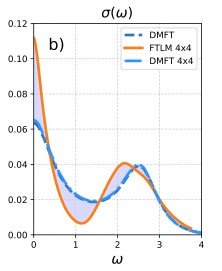
Besides the general issue of understanding the importance of vertex corrections, the paper is partly motivated by recent experiments on ultracold atoms that were compared to the results of calculations for a Hubbard model, using the finite-temperature Lanczos method (which essentially gives exact results on small finite lattices (e.g. 4 x 4)) and cluster Dynamical Mean-Field Theory (DMFT) (which does not include vertex corrections and has some momentum dependence in the self energy).

Before looking at the results I should point out the parameter values for the calculations. They are done for a Hubbard model on a square lattice. The half-bandwidth D=4t where t is the hopping parameter and U=10t. For the graphs below the doping p=0.1 (comparable to optimal doping in the cuprates).

Most importantly, the lowest temperature for which reliable calculations can be performed is T=0.2D=0.8t. In the cuprates, t is about 0.3 eV and so this lowest temperature corresponds to about 3000 K!, i.e. well above the superconducting Tc and the range of resistivity measurements on real materials. Most solids melt at these high temperatures.

Nevertheless, the results are important for two reasons. 

First, the experiments on ultracold atoms are in this temperature regime. [Aside: again this shows how fermion cold atom experiments are a long long way from simulating cuprates, contrary to some hype a decade ago]. 

Second, we are desperate for reliable results, and so it is worth knowing something about the possible importance of vertex corrections, even at very high temperatures. [Aside: my first guess would have been that they are not very important since I would have thought that correlations would be short-range and hand waving from Ward's identity would suggest that it follows the vertex corrections are small. This is wrong.]

In the figure above the top panel is the charge compressibility versus temperature. This is a thermodynamic quantity and the results show that most of the methods give similar results suggesting that the corresponding vertex corrections are small, at least above 0.1D.

The lower panel shows the temperature dependence of the resistivity and suggests that vertex corrections do lead to quantitative, but not qualitative differences. I guess the resistivity is in units of the quantum of resistance. Each rectangle has a vertical dimension of 5 units and so the resistivity is in excess of the Mott-Ioffe-Regel limit, i.e. the system is a bad metal. 

The figure above shows the frequency dependence of the optical conductivity for T=0.5D. There is a Drude peak at zero frequency and the broad peak near omega=2.5D=U corresponds to transitions between the lower and upper Hubbard band. DMFT is qualitatively correct but does differ from FTLM, showing the importance of vertex corrections.

Wednesday, April 22, 2020

Mean-field theories: helpful or misleading? From Hubbard to COVID-19 models

Mean-field theory (self-consistent field theory) is incredibly valuable. It gives significant insights into what is possible with a particular model.
What kind of phases and broken symmetries may be possible?
How does the phase diagram depend on different parameters in a model?
Indeed, mean-field theory is the basis of the whole Landau paradigm for spontaneous symmetry breaking and phase transitions.
Implementations of Density Functional Theory (DFT) in computational materials science are basically mean-field theories. Most of computational quantum chemistry involves some sort of mean-field theory.

Mean-field theories do not take into account fluctuations, dynamic or spatial.
Basically, a many-body problem is reduced to a one-body problem.

A good mean-field theory can win you a Nobel Prize. That's what Anderson, BCS, Ginsberg, Abrikosov, and Leggett all did!
Can you think of others?

However, mean-field theory does have its limitations.
It is usually quantitatively wrong. It often gives unreliable values for transition temperatures. In spatial dimensions less than four, mean-field theory gives the wrong values for the critical exponents near a phase transition.

An even bigger problem is that mean-field can be qualitatively wrong.
For many models (e.g. the Ising model or Heisenberg model) mean-field theory always gives a transition from a disordered to an ordered phase at a non-zero temperature.
However, in one dimension the Ising model has no phase transition in one dimension. For a Heisenberg ferromagnet or antiferromagnet, there is no transition at finite temperature in two dimensions.
The Mermin-Wagner theorem states that in two dimensions a superconductor or superfluid never has long-range order at finite temperature. Instead, there is a Kosterlitz-Thouless transition, to a distinct state of matter, with power-law correlations.

Mean-field theory can also fail to predict the existence of states of matter. For example, for Hubbard models, mean-field theory can produce several states: a Fermi liquid metal, a ferromagnetic metal, an antiferromagnetic metal, and a spin-density-wave insulator. But it is quite possible the model also can have non-magnetic Mott insulating phases, superconductivity, non-Fermi liquid metals, and pseudogap states.

In the next post, I will discuss some issues that arise in mean-field theories used in modeling the COVID-19 epidemic.

Friday, March 13, 2020

The significance of the discovery of cuprate superconductivity


This is some draft text for Condensed Matter Physics: A Very Short Introduction. 
Feedback appreciated.

A big change in condensed matter physics occurred in the late 1980s due to an unexpected discovery that led to whole new areas of research. Why was this discovery so significant?

Superconductivity is amazing. At extremely low temperatures, many metals can conduct electricity without generating any heat. A ``holy grail’’ of physics is to discover a material that is a superconductor at room temperature. This could revolutionise the transmission of electricity. Until 1986, the highest temperature at which superconductivity was possible was about 23 K (-250 °C), in Nb3Ge, a combination of the elements Niobium and Germanium. This requires cooling the material with liquid helium, which is expensive, and consequently limits commercial applications, such as MRI machines in hospitals.

In 1986, Alex Bednorz and Karl Muller, working at an IBM laboratory in Switzerland, investigated whether a chemical compound composed of the elements lanthanum, barium, copper, and oxygen (La, Ba, Cu, O) would be superconductor at a higher temperature. They were motivated by theoretical arguments that strong interactions between the electrons and the vibrations of the atoms could enhance the superconducting transition temperature, Tc. They found superconductivity below a Tc of 36 K, a new record. The material consisted of layers of copper and oxygen atoms and this lead to many other groups investigating similar classes of material. Within a year, materials were discovered with a Tc of 120 K (-150 °C). This was significant because superconductivity could be achieved by cooling with liquid nitrogen, which is about the same price as beer. Unfortunately, over the past thirty years, there has been little progress at increasing Tc to higher temperatures. Room temperature superconductivity remains a holy grail.

The discovery of Bednorz and Muller generated considerable excitement in the physics community, attracting many new researchers to superconductivity research. In March 1987 a special session was held during a regular meeting of the American Physical Society in New York City. A large ballroom was overflowing with more than one thousand physicists. I was one of thousands more outside watching on a TV monitor. Each speaker was only allowed three minutes to present their work and the session went long past midnight. This event was described on the front page of The New York Times as the ``Woodstock of Physics’’, in honour of the famous rock music festival held in New York state, and considered as emblematic of the 1960s.

Scientific history is full of serendipity. Some discoveries are accidental. It is now known that the reason that Bednorz and Muller chose to focus on this class of materials (strong interaction of electrons with atomic vibrations) was actually wrong. The high Tc does not arise from this interaction, but rather from a strong magnetic interaction between the electrons and from the two-dimensionality of the materials. The latter is a result of the layered crystal structure shown in Figure 5.2. Although the discovery was arguably somewhat serendipitous, its profound significance was shown in 1987, when Bednorz and Muller were awarded the Nobel Prize. In contrast, most scientists receive the prize decades after their ground-breaking discovery.


Figure 1. The repeat unit for the crystal structure of a superconducting copper oxide, BiSrCaCuO. A key ingredient is the layers of copper and oxygen atoms, which are isolated from each other by a large number of other atoms. The chemical complexity is reflected in the unit cell containing more than 50 atoms, including 5 different chemical elements.

From a fundamental physics point of view the superconductivity of these materials is not the only interesting and theoretically challenging property. The materials exhibit two new states of matter, known as the pseudogap state and the strange metal (see the phase diagram in Figure 5.3.). These conducting states have properties distinctly different from those found in common metals such as copper and gold.


Figure 2. Phase diagram of copper oxide superconductors. Temperature (T) versus doping. Doping describes the chemical composition of the material, particularly the density of charge carriers. The different states are antiferromagnet (AF), superconductor (SC), regular metal (FL), strange metal, and pseudogap.

Since 1986 more than ten thousand scientific papers have been published concerning possible theories to describe the different states in the phase diagram (Figure 5.3). Although some progress has been made, there is still no single accepted theory, and particularly no theory that has the simplicity and predictive power of the BCS theory of superconductivity in simple metals such as lead and tin. Developing a comprehensive theory remains one of the outstanding problems in Condensed Matter Physics.

Both experimental and theoretical studies suggest that all this rich new physics requires the low-dimensionality of these materials, i.e., they are almost living in Flatland.

But, why is low-dimensionality crucial? There is no simple explanation for this, but generally as the dimension of a system gets lower, the constituents fluctuate more (e.g. the atoms move around more), conventional orders become less stable, and new states of matter become possible.

Any comments?
Particularly how to make this more accessible and interesting to a general audience.

What does this movie tell us about the modern university?

Last night, my wife and I watched the movie, Wit. You can watch the full movie here  (free with ads). I should warn that some of the conten...