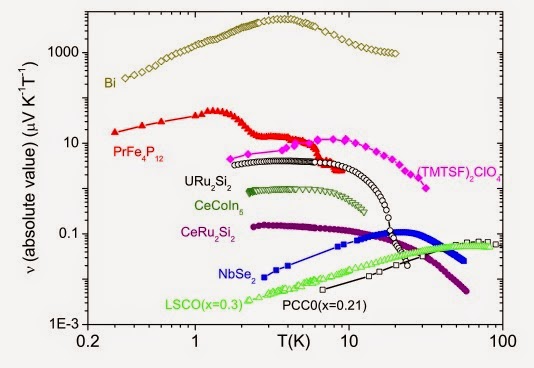
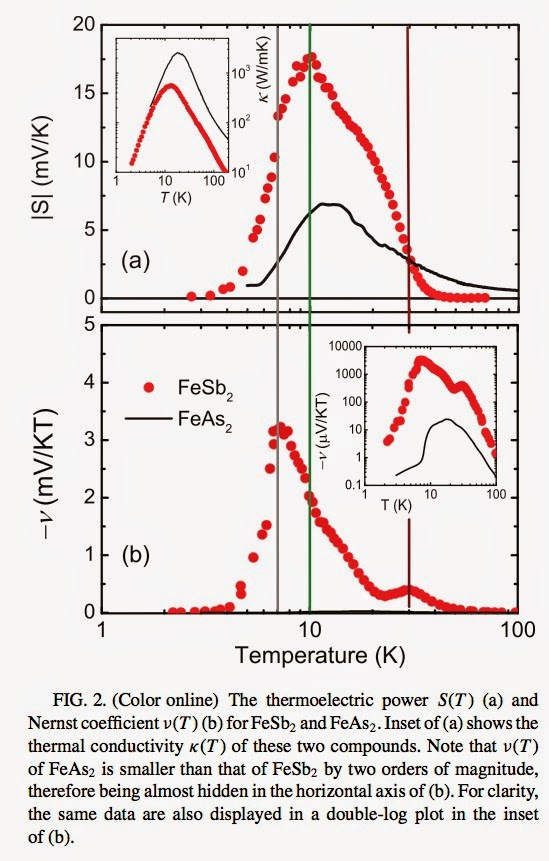
Such a monograph is overdue. I think the topic is particularly important and interesting for several reasons. (This is illustrated by the fact that I have written almost 40 blog posts on the topic).
- The thermoelectric power is a transport property that presents a number of rich and outstanding puzzles.
- The sign, magnitude, spatial anisotropy, and temperature dependence of the thermopower can put significant constraints on theories because the thermopower is so sensitive to particle-hole asymmetry. In comparison, often it may not be too hard to cook up a theory can get a resistivity that agrees with experiment. However, the thermopower is another story.
- Thermoelectric materials are technologically important. Furthermore, if someone can find a material with a "Figure of merit" that is just twice that of the best current materials we could throw out all our refrigerators with moving parts!
To many readers of this book, it should be a surprise to learn that a consistent and unified theory for phonon drag is still missing....
Three chapters devoted to a survey of experimental facts aim to revive a number of forgotten puzzles...
But the embarrassment [discussed below] has vanished thanks for our forgetfulness and not to our cleverness....
Even more enigmatic than the positive Seebeck coefficient of noble metals at room temperature is their thermoelectric response at very low temperatures....
Before beginning to write this book, I did not know that there is an three-orders -of-magnitude gap between theory and experiment regarding the thermoelectric response of Bogoliubov quasi-particles of a superconductor....
Why such facts have gradually faded from the collective memory of the condensed matter physics community is another question that deserves to be raised but is not addressed by this book.Section 6.5 "Origin of the Positive Seebeck Coefficient of Noble Metals"
begins with the following quote from Robinson in 1967.
For more than thirty years the absolute thermoelectric power of pure samples of monovalent metals has remained a nagging embarrassment to the theory of the ordinary electronic transport properties of solids. All familiar simple theory has promised us that in these materials the sign of the electron-diffusion contribution to the thermopower should be that of the charge carriers as determined by the Hall effect, i.e. negative; but instead it turns out to be positive for Cu, Ag, Au and—even more perversely—for Li alone of the solid alkalies. At least two generations of experimentalists have remained completely unshaken in testifying to these results as obstinate facts of life.A great value of the book is that it brings together a diverse set of experimental data from a wide range of materials.
I have a few minor quibbles.
I could find no mention of:
a. the Kelvin formula and the associated nice treatment of it by Michael Peterson and Sriram Shastry.
b. Dynamical Mean-Field Theory (DMFT) and how it nicely describes the thermopower as there is a crossover with increasing temperature from a Fermi liquid to a bad metal.
c. experimental techniques. What are the challenges, problems and obstacles to accurate and reliable measurements?
The caption of Figure 8.5 claims that for an organic charge transfer salt kappa-(BEDT-TTF)2Cu(NCS)2 "The expectations of a tight-binding model is in good agreement with the experimental data". The text says this is a "rare achievement in the case of correlated metals".
However, this "agreement" requires an arbitrary and unjustified rescaling of all the band energies by a factor of about five! This data and the theoretical challenge it presents is discussed in detail here.
The book is written by an experimentalist. I learnt from the back cover that there is also a new book, Modern Theory of Thermoelectricity by Zlatic and Monnier. I am looking forward to reading that.
Kamran Behnia has done a great service to the community by writing the book. Thank you!