Showing posts with label cold atoms. Show all posts

Monday, September 13, 2021

Vertex corrections do matter

For an experimentalist one of the "easiest" quantities to measure for a metal is the electrical resistivity. Yet, for a many-body theorist working on models for strongly correlated electron systems this is one of the most difficult quantities to calculate, without making strong and debatable assumptions. One of the key questions is whether vertex corrections do matter. Ten years ago I summarised some of the issues.

This issue is nicely addressed in this nice paper from 2019.

Conductivity in the Square Lattice Hubbard Model at High Temperatures: Importance of Vertex Corrections

J. Vučičević, J. Kokalj, R. Žitko, N. Wentzell, D. Tanasković, and J. Mravlje

Besides the general issue of understanding the importance of vertex corrections, the paper is partly motivated by recent experiments on ultracold atoms that were compared to the results of calculations for a Hubbard model, using the finite-temperature Lanczos method (which essentially gives exact results on small finite lattices (e.g. 4 x 4)) and cluster Dynamical Mean-Field Theory (DMFT) (which does not include vertex corrections and has some momentum dependence in the self energy).

Before looking at the results I should point out the parameter values for the calculations. They are done for a Hubbard model on a square lattice. The half-bandwidth D=4t where t is the hopping parameter and U=10t. For the graphs below the doping p=0.1 (comparable to optimal doping in the cuprates).

Most importantly, the lowest temperature for which reliable calculations can be performed is T=0.2D=0.8t. In the cuprates, t is about 0.3 eV and so this lowest temperature corresponds to about 3000 K!, i.e. well above the superconducting Tc and the range of resistivity measurements on real materials. Most solids melt at these high temperatures.

Nevertheless, the results are important for two reasons. 

First, the experiments on ultracold atoms are in this temperature regime. [Aside: again this shows how fermion cold atom experiments are a long long way from simulating cuprates, contrary to some hype a decade ago]. 

Second, we are desperate for reliable results, and so it is worth knowing something about the possible importance of vertex corrections, even at very high temperatures. [Aside: my first guess would have been that they are not very important since I would have thought that correlations would be short-range and hand waving from Ward's identity would suggest that it follows the vertex corrections are small. This is wrong.]

In the figure above the top panel is the charge compressibility versus temperature. This is a thermodynamic quantity and the results show that most of the methods give similar results suggesting that the corresponding vertex corrections are small, at least above 0.1D.

The lower panel shows the temperature dependence of the resistivity and suggests that vertex corrections do lead to quantitative, but not qualitative differences. I guess the resistivity is in units of the quantum of resistance. Each rectangle has a vertical dimension of 5 units and so the resistivity is in excess of the Mott-Ioffe-Regel limit, i.e. the system is a bad metal. 
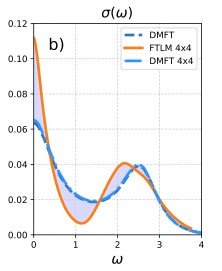
The figure above shows the frequency dependence of the optical conductivity for T=0.5D. There is a Drude peak at zero frequency and the broad peak near omega=2.5D=U corresponds to transitions between the lower and upper Hubbard band. DMFT is qualitatively correct but does differ from FTLM, showing the importance of vertex corrections.

Thursday, December 10, 2020

Emergence and a heap of sand

A piece of gold metal is shiny but a single gold atom is not.
Tin is a superconductor but a single tin atom is not.
Water is wet but a single water molecule is not.
A brain thinks but a single neuron does not.
Shininess, wetness, and thinking are all emergent phenomena. The whole is greater than the sum of the parts. More is different. Although these ideas come from twentieth-century science I recently learn that there are ancient antecedents. According to Wikipedia

The sorites paradox (/soʊˈraɪtiːz/; sometimes known as the paradox of the heap) is a paradox that arises from vague predicates. A typical formulation involves a heap of sand, from which grains are individually removed. Under the assumption that removing a single grain does not turn a heap into a non-heap, the paradox is to consider what happens when the process is repeated enough times: is a single remaining grain still a heap? If not, when did it change from a heap to a non-heap?

What is the minimum number of gold atoms needed to produce shininess?

How large must a grain of tin be for it to superconduct?

When spontaneous symmetry breaking is involved there are subtleties. Strictly, speaking it only occurs in the thermodynamic limit, i.e. for an infinite system. However, for a finite system, one can observe some properties associated with symmetry breaking such as rigidity. These issues can be addressed in the laboratory with ultracold atoms and with metallic grains of superconductors, both of which can be produced with controlled numbers of particles, ranging from a few hundred to billions. There also are some resonances with the problem of trying to identify the quantum-classical boundary. 

Finally, piles of sand were central to the discovery of self-organised criticality.

Monday, November 5, 2018

Bad metallic behaviour in ultracold atoms

There is a nice paper
Bad metallic transport in a cold atom Fermi-Hubbard system 
Peter T. Brown, Debayan Mitra, Elmer Guardado-Sanchez, Reza Nourafkan, Alexis Reymbaut, Simon Bergeron, A.-M. S. Tremblay, Jure Kokalj, David A. Huse, Peter Schaus, and Waseem S. Bakr

The paper represents a significant experimental advance in using ultracold atoms to investigate questions directly relevant to strongly correlated electron systems. In this case, the system Hamiltonian can be tuned to be a Hubbard model on a square lattice, such that the model parameters, U and t, and the doping, n are known.
One limitation is that current experiments can only be performed down to the lowest temperature of T/t =0.3. [For comparison, for cuprates this is of the order of 1000 K!].
Using imaging techniques the authors are able to directly extract the density (charge) diffusion constant D and the density susceptibility, chi, shown below. The experimental data are red dots. The blue curve is the result of calculations based on the Finite Temperature Lanczos Method (FTLM). Green dots the results of Dynamical Mean-Field theory. Gamma is the density relaxation rate.

Both the experiment and the ability to make such a detailed comparison with concrete theoretical calculations is a significant and exciting achievement.


The dashed curve in the upper panel is the value of the diffusion constant associated with the Mott-Ioffe-Regel limit below which one expects bad metal behaviour.
Aside: one should always keep in mind that for the MIR limit, different authors use different criteria, leading to different factors of pi, sqrt(pi), ...

Using the Nernst relation, sigma = chi * D,  the data above gives the conductivity (sigma) and resistivity (rho), shown below.
The blue and green curves correspond to the predictions, of FTLM and DMFT, respectively. The dashed grey line is the Mott-Ioffe-Regel limit.

One comment I have concerns an additional comparison that the authors could make. Based on heuristic arguments and results from AdS-CFT, Hartnoll conjectured a lower bound for the diffusion constant, hv_F^2/T.
Previously, Nandan Pakhira and I showed that this bound was significantly violated in the bad metallic regime, as described by DMFT.

There is also a commentary on the paper by Ehud Altman at the Journal Club of Condensed Matter.
I thank Matt Davis for bringing the paper to my attention.

Wednesday, August 15, 2018

Solid State or Condensed Matter Physics?

The two terms are often used interchangeably, but that is not appropriate. Condensed matter physics does not just involve solids but also phenomena in liquids, liquid crystals, superfluids, and polymer melts.  Solid state physics is a subset of condensed matter physics. The latter term was arguably coined by Phil Anderson, when he and Mott renamed their research group at Cambridge in the 1970s. One can view research fields or course titles as a list of topics or as a way of thinking about certain parts of reality. Solids exhibit rich phenomena including magnetism and superconductivity. However, it is best to actually view the solids as (an almost irrelevant) substrate for the phenomena.

Like many things, this perspective arguably started with Landau. His theory of phase transitions in the 1930s did not consider atomic structure or chemical composition. Even structural phase transitions were viewed in terms of symmetry change, not in terms of explicit microscopic details. In 1950 this led to the Ginzburg-Landau theory of superconductivity. This all suggested a unified approach to phase transitions.
Furthermore, Landau's Fermi liquid theory papers were originally concerned with understanding liquid 3He, not electrons in metallic crystals.

This idea was further highlighted in the 1970s with the study of critical phenomena and the associated idea of universality. Specifically, the critical behaviour of an XY magnet, a superconductor, and a superfluid, are the same (i.e. they have the same critical exponents). The critical behaviour of the liquid-gas transition, an Ising magnet, and the order-disorder transition in a binary alloy are the same. The view that the solid state might actually not be the key feature for understanding and describing superconductivity was highlighted in the 1950s by Fritz London in his two-volume book, Superfluids, which suggested the two phenomena were intimately connected. Beginning in 1968, De Gennes took a condensed matter perspective in applying order parameters and scaling ideas to “soft matter”: liquid crystals, polymers, wetting, …

The important element to this conceptual view of condensed matter is that it provides a unifying perspective on phenomena in a diverse range of materials. It also brings to the fore how a wide suite of powerful theoretical and experimental tools (esp. neutron and x-ray scattering) can be used to study diverse materials. One of the key theoretical strategies is that of effective Hamiltonians, which is not unique to condensed matter, because it just reflects the hierarchy of energy, length, and times scales that result from emergence. This then leads to an intellectually rich interchange of ideas and techniques from other fields of physics, particularly quantum field theory.

More recently, this unity is illustrated by ultracold atomic gases which can be used to study some phenomena that had previously only been studied in solids.

Wednesday, March 14, 2018

"Bad fluids" near the superfluid transition

There is an interesting preprint
Viscosity Bound Violation in Viscoelastic Fermi Liquids 
 Matthew P. Gochan, Hua Li, Kevin S. Bedell

They consider the unitary Fermi gas within the framework of Fermi liquid theory. This system undergoes a superfluid transition at a temperature of about 0.17 times T_F (the Fermi temperature). They calculate the shear viscosity as a function of temperature. (I think) the complete temperature dependence is obtained by interpolating between the low-temperature and high-temperature limits.

The motivation for the study is the conjectured universal bound for the ratio of the shear viscosity to the entropy density, based on the AdS-CFT conjecture, beloved by string theorists.

The authors find that the conjectured bound is violated because the viscosity can become arbitrarily small near the superfluid transition due to large scattering from superfluid fluctuations. This is because the mean free path becomes arbitrarily small, i.e. the system is similar to a bad metal.
Unfortunately, the preprint does not reference some earlier relevant work on the shear viscosity of the unitary Fermi gas or on the bad metal near a Mott transition.

I thank Alejandro Mezio for bringing the preprint to my attention.

Friday, July 8, 2016

Status of the fermion Hubbard model in cold atoms

A major achievement of ultra cold atoms was to simulate the Bose Hubbard model 14 years ago.
Progress towards the fermion Hubbard model (beloved in the strongly correlated electron community) has been slower. 
Cooling fermionic atoms is much more difficult.

There is a recent PRL which gives some indication of where things are at.
Observation of 2D Fermionic Mott Insulators of K40 with Single-Site Resolution 
Lawrence W. Cheuk, Matthew A. Nichols, Katherine R. Lawrence, Melih Okan, Hao Zhang, and Martin W. Zwierlein

The figure below shows the measured local magnetic moment as a function of temperature. The upper curve is at half filling and the bottom for a strongly doped system. The solid lines are theoretical curves obtained from high temperature series expansions.
The temperature is scaled by the hopping integral t in the Hubbard model.


The authors note they have reached entropies as low as k_B.

Although this is significant progress it should be noted that these are still very high temperatures from a solid state physics perspective. For the high T_c cuprate superconductors, these temperatures correspond to tens of thousands of Kelvin, two orders of magnitude about the superconducting transition temperature.

On a more promising note, there is interesting physics to access in the Hubbard model at temperatures of order of some fraction of t and at entropies of order k_B . ln(2).
These are the characteristic scales of the bad metal regime.
A particularly interesting experiment would be to measure the viscosity in this regime and see whether it violates the conjectured quantum limits.

I thank my UQ colleague, Matt Davis for stimulating my interest in these issues.

Update. August 1, 2016
Thierry Giamarchi has a helpful commentary at the Journal Club for Condensed Matter Physics on two recent preprints that report similar experiments from two other groups.

Wednesday, August 12, 2015

Shear viscosity: from dilute gases to dense liquids

I have received a lot of helpful feedback on a recent paper about shear viscosity in strongly interacting quantum fermion fluids. As a result I have learnt some interesting things that I will post about. Here is the first one.

The shear viscosity can be written in terms of a Kubo formula which is an unequal time correlation function of the stress energy tensor.
In a general fluid there are two terms in the stress energy tensor: one associated with the kinetic energy and the second with the interparticle interaction. In dense classical liquids the term in the Kubo formula due to the interaction term dominates and are associated with the Einstein-Stokes relation where the viscosity is inversely proportional to the particle self-diffusion constant.

In contrast, in dilute gases and fluids the kinetic term dominates and the shear viscosity scales with the diffusion constant and scattering time. The crossover from the dilute to the dense case in a classical fluid is discussed here.

The case of the dilute classical gas is of particular historical interest. The viscosity scales with the density and the mean-free path. In a dilute gas the mean free path is inversely proportional to the density and the molecular cross section. This means that the viscosity is independent of the density (and pressure at fixed temperature). When Maxwell obtained this theoretical result from kinetic theory he found it so surprising that he tested it experimentally. According to this site,
In the attic of his house in Kensington, with the help of his wife, he carried out experimental measurements of gas viscosities in order to confirm the conclusions he had drawn about the effects of pressure and temperature. Many of these experiments were made between 51 °F (10.6 °C) and 74 °F (23.3 °C), and it appears that these temperatures were obtained simply by changing the temperature of the attic! This was arranged by Mrs. Maxwell, who organized the appropriate stoking of the fire. Some work was also done at 185 °F (85 °C), and this temperature was achieved by a suitably directed current of steam.
The results are described in this 1866 paper.

For a zero-range interaction, as in the unitary Fermi gas (and presumably the Hubbard model), it can be shown that the potential term does not contribute to the shear viscosity. For a succinct discussion of these issues and relevant references see the section of this paper that I reproduce below. I thank Thomas Schafer for pointing this out to me.

Tuesday, May 5, 2015

Not seeing the pseudogap in ultra cold 2D atoms

Two weeks ago it was nice to have Meera Parish visit UQ and give a colloquium Fermions in Flatland. She recently moved to Monash University from University College London.

One important point she made was the comparison of the two figures below, showing a colour intensity plot of the one fermion spectral function A(E,k) for a two-dimensional Fermi gas near the unitary limit (BCS-BEC crossover).

The bottom figure is experimental data from a Nature paper, 
It makes much of the possible connection to the pseudogap seen in cuprate superconductors.

The top figure is from a theory paper
Vudtiwat Ngampruetikorn, Jesper Levinsen, and Meera M. Parish
Therefore, our results suggest that the observed pairing gap [Nature paper] effectively arises from two-body physics and does not correspond to a pseudogap regime. This view is further supported by the fact that the pairing gap in the spectrum persists to very high temperatures well above Tc, as shown in Fig. [above]. Moreover, we see that the “closure” of the gap with increasing temperature appears to be due to the thermal broadening of the two branches.
An earlier post discussed more recent measurements of the spectral function in three-dimensional ultra cold fermionic atoms near the unitary limit.

Wednesday, April 29, 2015

Probing non-equilibrium dynamics in a quantum many-body system

This week at UQ there was a fascinating Quantum Science Seminar by Jorg Schmiedmayer, describing some beautiful ultra cold atom experiments.  Much of the talk is nicely discussed in a book chapter Does an isolated quantum system relax? [Answer is yes].
Some of the most recent results are in a Science paper, Experimental observation of a generalised Gibbs ensemble that appeared this month.

The experiments involve a one-dimensional Bose gas that can be described as a Luttinger liquid. This means that many properties, even non-equilibrium ones, can be calculated analytically and compared to experiment. This is a theorists dream!

Here are a few things that stood out.

Relaxation from a non-equilibrium state to the thermal equilibrium state occurs on several different time scales. First there is rapid relaxation to a "quasi-steady state" described by a Generalised Gibbs ensemble [This idea goes back to Jaynes] that involves an effective temperature [that one can even theoretically calculate in terms of the bose gas interaction strength].

There is a characteristic length scale associated with the relaxation.

One can even directly measure higher order correlation functions (4th, 6th and 10th order!), as seen below. Furthermore, in a Luttinger liquid [a non-interacting boson field theory] these should factorise in terms of the 2nd order correlation function [reflecting Wick's theorem]. One can even test this experimentally.


One can also simulate the sine Gordon theory and vary the coupling constant and so move through the associated phase transition.

Thursday, February 19, 2015

Mapping quasi-particles in strongly interacting ultra cold fermionic gases

There is an interesting preprint
Breakdown of Fermi liquid description for strongly interacting fermions 
Yoav Sagi, Tara E. Drake, Rabin Paudel, Roman Chapurin, Deborah S. Jin

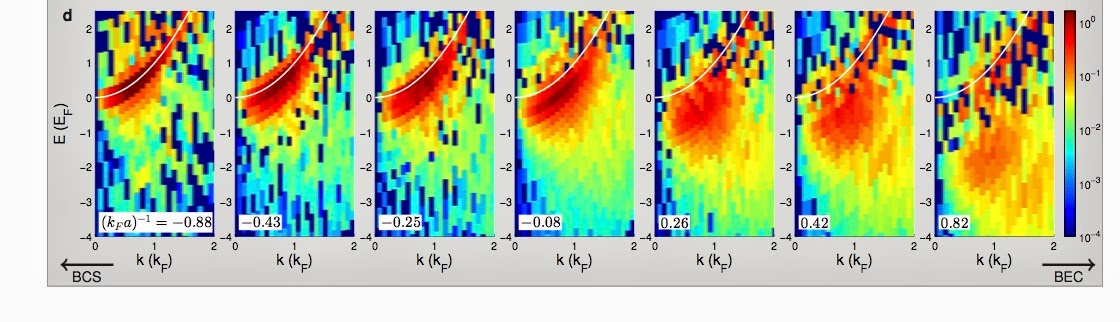
It describes some nice ultra cold atom experiments that tune through the BEC-BCS crossover with a Feshbach resonance, focusing on the properties of the normal (i.e. non-superfluid) phase. All the measurements are at a temperature of T=0.2T_F, just above the superfluid transition.
It is like an ARPES [Angle Resolved PhotoEmission Spectroscopy] experiment in the solid state.
Specifically, the one-fermion spectral function A(k,E) is measured, shown in the colour intensity plots below.

The left and right side correspond to the BCS and BEC limits respectively. The unitary limit [i.e. infinite interaction occurs close to the middle].

On the left one can clearly see dispersing quasi-particle excitations, as one would expect in a Fermi liquid. As the interaction strength increases this feature is broader and there is more incoherent spectral weight at lower energies.

Some caution is in order as there is quite a bit of curve fitting involved in the analysis of the above data. [Solid state ARPES also suffers from this problem to.]

Specifically, the form below is used for the spectral function, where Z is the quasi-particle weight


In an earlier post I considered the history of this type of expression.

For the incoherent part the authors make the somewhat ad hoc assumption that it is given by a
 "function that describes the normal state in the BEC limit, namely, a thermal gas of pairs."

They then find the following results for the dependence of Z and the effective mass m* [defined by the quadratic dispersion] on the interaction strength [a is the scattering length, which becomes infinite at the Feshbach resonance, i.e. for the unitary limit].
There is already a theory paper that discusses the experiments. It captures the results above at the semi-quantitative level using a Brueckner-Goldstone theory. The self energy is assumed to be frequency independent in this approximation. I found this interesting as it is the opposite to Dynamical Mean-Field Theory (DMFT) for which the self energy is assumed to be momentum independent.

I feel the paper title may be a misnomer. The quasi-particle weight is always finite, except in the BEC regime [attractive interactions] where one does not really have fermions anymore.

In future experiments, it would be nice to see the temperature dependence of the spectral function. Specifically, do the quasi-particles get destroyed with increasing temperature as in bad metals.

I thank Matt Davis for bringing the preprint to my attention.

Monday, February 2, 2015

Quantum limits to the shear viscosity in the unitary Fermi gas

Previously, I posted about possible quantum limits to the shear viscosity in quantum many-body systems. This has attracted a lot of interest because of claims, based on string theory techniques [AdS-CFT correspondence] that there is a universal lower bound for the ratio of the shear viscosity to the entropy.

There are two interesting papers

Hydrodynamic fluctuations and the minimum shear viscosity of the dilute Fermi gas at unitarity
Clifford Chafin and Thomas Schäfer

Temperature evolution of the shear viscosity in a unitary Fermi gas 
 Gabriel Wlazłowski, Piotr Magierski, Aurel Bulgac, and Kenneth J. Roche

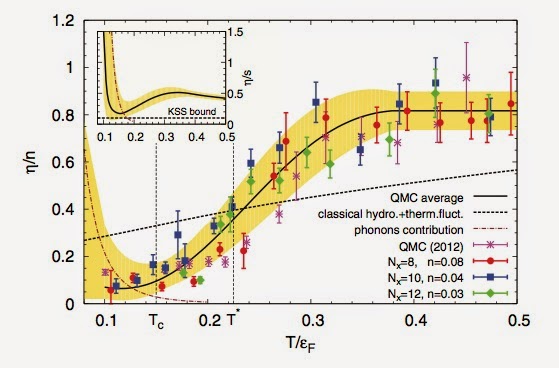
The main result of the latter is shown in the Figure below. The error bars arise because the results are based on a Quantum Monte Carlo simulation with imaginary time data that must be analytically continued to real frequencies [a thorny problem]. Tc is the superfluid transition temperature and T* the pseudogap temperature.


A few reasons why this is interesting.

1. In 1936 the legendary theoretical chemist Henry Eyring proposed a lower bound for the viscosity of n hbar, where n is the particle density. Here, we see that bound is violated.

2. The inset shows that the string theory bound is respected.

3. At low temperatures, the "classical" bound of about 0.2 n hbar, proposed in the first paper is violated.

4. The temperature dependence shows this is a strongly correlated fermion fluid, a long way from a Fermi liquid. For the latter, such as liquid 3He, the viscosity at low temperatures goes like 1/T^2, i.e. increases as the temperature decreases, and is much larger than n hbar. The fermion fluid here is something like a "bad metal" since these small viscosities correspond to mean free paths comparable to the Fermi wavelength.

Friday, December 5, 2014

Quantum capacitance is the charge compressibility

In a quantum many-body system a key thermodynamic quantity is the charge compressibility, the derivative of the charge density with respect to the chemical potential d n/d mu.

In a degenerate Fermi gas kappa is simply proportional to the density of states at the Fermi energy.
kappa is zero in a Mott insulator. As the Mott transition is approached, the behaviour of kappa is non-trivial. For a band width (or frustration) controlled Mott transition that occurs at half filling, Jure Kokalj and I showed how kappa smoothly approached zero as the Mott transition was approached. However, there is some debate as to what happens for doping controlled transitions, e.g. does kappa diverge as one approaches the Mott insulator.

One thing I had wondered about was how one actually measures kappa accurately in an experiment. Varying the chemical potential and/or charge density is not always possible or straightforward.
See for example, Figure 10 in this review by Jaklic and Prelovsek, which compares experimental results on the cuprates with calculations for the t-J model.
The experimental error bars are large.

At the recent Australasian Workshop on Emergent Quantum MatterChris Lobb gave a nice talk about "Atomtronics" where he talked about how you define R, L, and C [resistance, inductance, and capacitance] in cold atom transport experiments. He argued that the capacitance was related to
d mu/dn. This got my attention.
Michael Fuhrer pointed out how there were measurements of the "quantum capacitance" for graphene.

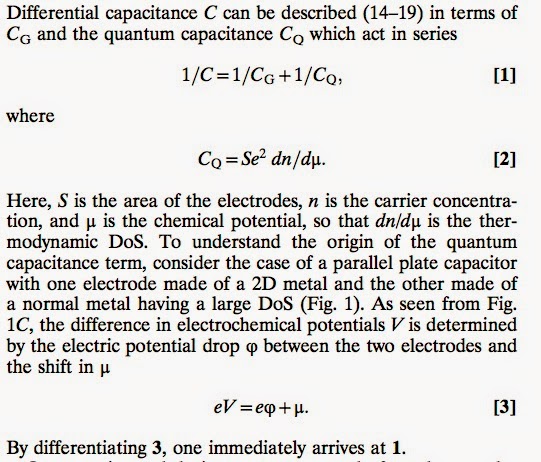
Recent measurements for graphene are in this nice paper. They give a helpful review of the technique and the relevant equations.


Personally, I don't find this "derivation" completely obvious, but can follow the algebraic steps.

Why is C_Q called the "quantum capacitance"? This wasn't at all clear to me.
But, there is a helpful discussion in a paper,
Quantum capacitance devices by Serge Luryi

For a non-interacting two dimensional fermion gas the density of states scales inversely with the square of hbar. Hence, it diverges as hbar goes to zero. This means the quantum capacitance diverges and the "quantum" term C_Q in the equation [1] disappears.

In the graphene paper, the authors extract the renormalised Fermi velocity as a function of the density [band filling] and compare to renormalisation group calculations, that take into account electron-electron interactions, and predict a logarithmic dependence, as shown below. Red and blue are the theory, and experimental curves, respectively.


As exciting as the above is, it is still not clear to me how to measure the "quantum capacitance" for a multi-layer system.

Update. (December 10, 2014)
Lu Li brought to my attention his measurements of the capacitance of the 2DEG at the LaAlO3/SrTiO3 interfaceand earlier measurements of negative compressibility of correlated two dimensional electron gases (2DEGs) by Eisenstein and by Kravchenko.
Background theory has been discussed extensively by Kopp and Mannhart.

Thursday, November 27, 2014

The challenge of moving topological defects in quantum matter

I have really enjoyed this week at the Australasian Workshop on Emergent Quantum Matter. My UQ colleague Matt Davis is to be congratulated for putting together an excellent program. There was nice balance of cold atom and solid state talks.

Is there anything that stood out to me?
Yes. Vortices, (Josephson) phase coherence, and dimensional crossovers. Vortices kept coming up and remain a fascinating and perplexing problem.
Vortices are mesoscopic, intermediate between the microscopic (atomic) and macroscopic scales. The length scale associated with them is emergent. They have some quantum properties (quantised circulation) but obey classical equations of motion, but interact with microscopic degrees of freedom (quasi-particles and phonons).

When one has a broken symmetry vortices are novel emergent low energy excitations. They are topological defects in the order parameter. Given how much they have been studied in superfluid 4He and superconductors one would think they were pretty well understood. However, this is not the case. What is particularly poorly understood is the dynamics of these objects.

Stephen Eckel described some beautiful experiments at NIST that recently investigated  Josephson type junctions in atomic BECs. My immediate question was how was this any different from landmark experiments performed by Davis and Packard in superfluid 3He?  In those experiments the superfluid "healing" (or coherence) length is quite small and there is not a single weak link but many apertures. The origin of the coupling between these links is not clear.
It was also interesting that a key consulting role in these experiments was played by Chris Lobb, an expert on solid state Josephson junctions.

Victor Galitski and Joachim Brand both described theory motivated by recent fermionic cold atom experiments which measured a large mass (both inertial and gravitational, the two are different) for solitons in a quasi-one-dimensional superfluid. Victor discussed recent theoretical calculations based on exact solution of the dynamical Bogoliubov-de Gennes (BdG) equations.

The question of how vortices and quasi-particles interact and the dynamics of a single vortex in a Bose superfluid is highly controversial. Theoretical calculations of the mass of a vortex range from zero to infinity! A brief introduction, including key references, is in this PRL.

Dimensionality matters. Solitons and Luttinger liquid only exist in strictly one dimension. The Berezinskii-Kosterlitz-Thouless transition strictly only exists in two dimensions. However, what happens in quasi-one or quasi-two-dimensional systems is not completely clear, inspite of a lot of theoretical work. Some ultra cold atom experiments may be able to address these questions of dimensional crossover.

Monday, September 22, 2014

Is there a quantum limit to diffusion in quantum many-body systems?

Nandan Pakhira and I recent completed a paper
Absence of a quantum limit to charge diffusion in bad metals

This work was partly motivated by

a recent proposal, using results from the AdS-CFT correspondence, by Sean Hartnoll that there was a quantum limit to the charge diffusion constant in bad metals,

experimental observation and theoretical calculations of a limit to the spin diffusion constant in cold atom fermions near the unitarity limit.

We calculated the temperature dependence of the charge diffusion constant in the metallic phase of a Hubbard model using Dynamical Mean-Field Theory (DMFT).

The figure below shows  the temperature dependence of the charge diffusion constant for a range of values of the Hubbard U. The temperature and energy scale is the half-bandwidth W. The Mott insulator occurs for U larger than about 3.4 W.


Violations of Hartnoll's bound occurs in the same incoherent regime as violations of the Mott-Ioffe-Regel limit on the resistivity.

We also find that the charge diffusion constant can have values orders of magnitude smaller than the cold atom bound on the spin diffusion constant.

We welcome discussion and comments.

Thursday, July 17, 2014

A quantum lower bound for the charge diffusion constant in strongly correlated metals?

Previously I posted about some interesting theory and cold atom experiments that suggest that the spin diffusion constant D has a lower bound of about hbar/m, where m is the particle mass.

Coincidentally, on the same day Sean Hartnoll posted a preprint, Theory of universal incoherent metallic transport. Based on results involving holographic duality [AdS/CFT] he conjectures that the diffusion constant satisfies the bound,

Dv2F/(kBT)

where v_F is the Fermi velocity.
I have pointed out to Sean that the ratio of this lower bound for D to the cold atom one (hbar/m) is
2 T_F/T where T_F is the Fermi temperature and T the temperature. Thus, the experiments [when normalised for trap effects] and the theory give a value of D about an order of magnitude smaller than Sean's lower bound. [My earlier post also references 2D cold atom experiments that give values for D several orders of magnitude smaller].
Sean raises the issue about how much m and T_F are renormalised by interactions. However, given that the spin susceptibility undergoes a small renormalisation it is not clear to me this will be significant.
Also, in a strongly interacting system charge and spin diffusion constants might be different.

In my post I pointed out the paucity of derivations of the central equation, the "Einstein relation", D=conductivity/susceptibility. However, Sean's preprint has a nice simple derivation of this based on conservation laws, but also showing how particle-hole asymmetry complicates things.

Wednesday, May 14, 2014

Are there quantum limits to transport coefficients?

An important and fundamental question concerning a strongly interacting many-body system is whether there are fundamental limits (lower bounds) to transport coefficients such as the conductivity and viscosity. A related issue is whether there are upper bounds on energy, phase, and momentum relaxation rates, such as the buzz-concept of planckian dissipation.

There are two basic reasons why some believe this is true.
First, a simple argument is that it "does not make sense" to have mean free paths less than a lattice constant and the wavelength of the relevant quasi-particles. This leads to the Mott-Ioffe-Regel limit for the conductivity.
Second, in calculations based on the AdS-CFT correspondence one does find such bounds do hold.

However, I remain to be convinced that such bounds must hold. One reason is the existence of bad metals. In some strongly correlated electron materials the resistivity can increase smoothly above the Mott-Ioffe-Regel limit as the temperature increases. This is also seen at the level of a Dynamical Mean-Field Theory treatment of the Hubbard model.
A second reason is that I am skeptical that AdS-CFT actually corresponds to any (and certainly not all) physically relevant Hamiltonians.

Today I read an interesting paper
Quantum Mechanical Limitations to Spin Diffusion in the Unitary Fermi Gas
Tilman Enss and Rudolf Haussmann

The paper seems to presuppose that quantum limits do/should exist.
It is motivated by some very nice recent experiments on ultra cold atoms that measure spin diffusion coefficient and spin susceptibility as a function of temperature.

The main result is the graph below. The authors calculations are the red curve. The two important points are that it is a minimum as a function of temperature and that the value is Ds≃1.3ℏ/m, close to the "quantum limit".


A few minor comments.

1. It should be noted that the experimental data has been scaled down by a factor of 4.7 to allow for the inhomogeneity associated with the trapping potential. This is not as as unreasonable or as arbitrary as I first thought. At high temperatures one can calculate the correction for a harmonic trap and it is about a factor of 5.

2. The diffusion coefficient D is calculated from the "Einstein relation", D=conductivity/susceptibility.
No reference is given. This is a rather non-trivial relation, which is discussed and proven by Sachdev on page 171 of the first edition of his Quantum Phase Transitions book.

3. The authors point out that the agreement of D with experiment involves a fortuitous cancellation of errors. Their value for both the spin conductivity and susceptibility is off by a factor of about two, compared to experiment, as shown in Figures 3 and 4 in the paper.

4. I feel calling the calculation a "strong coupling Luttinger-Ward (LW) theory" is a bit too terse. To me LW theory is just a formalism [a self-consistent theory?] and the key point is that to use it one must make an approximation and decide to include only certain Feynman diagrams in the LW functional for the free energy.  My point here is similar to my post, Green's functions are just a technique.

5. To me, the experiments highlight the complementary strengths of cold atom and solid state systems. In the latter (but not the former) it is straightforward to measure the particle conductivity, maintain a homogeneous system, have good thermometry, and cool to temperatures orders of magnitude below the Fermi temperature. However, in contrast, measurements of the spin conductivity in solids are virtually non-existent.

The authors also calculate the frequency-dependent spin conductivity and find that it exhibits a broad Drude peak [the width is of the order of the Fermi energy], with [a very small amount of] spectral weight transferred to a universal high-frequency tail that is proportional to the Tan contact density C.

It is great to see the ultra cold atom community addressing these fundamental questions.

Postscript. Today (May 16) there is a paper in Science of a new measurement [by a spin echo technique] of the spin diffusion constant D, giving a value of about hbar/m, for a three-dimensional gas. The authors also cite a paper from last year which measured a value of D for a two-dimensional gas, that is about 150 times smaller than the "lower bound" of hbar/m.

Friday, May 9, 2014

Colloquium on Emergent states of quantum matter

Here are the slides for the talk I am giving today at the UQ Physics colloquium.
I will show the video Quantum levitation, and discuss what is and isn't quantum about it.

A good discussion of some of the issues raised is Laughlin and Pines article The Theory of Everything. A more extensive and introductory discussion by Pines is at Physics for the 21st Century.


Postscript.
Based on comments and questions afterwards, particularly from some undergraduates, there are few things I would do slightly differently.

I should have said what a Hamiltonian is: a function that defines the energy as a function of the system variables, e.g., the position and velocity of all of the particles.

The stratification of reality shown by my boxes is a simplification for schematic purposes. There is no clearly defined boundary between strata. For example, at the boundary between chemistry and physics one has chemical physics and physical chemistry. The boundary between biology and biochemistry is blurred. On the other hand, anatomy is qualitatively different to enzyme mechanisms. Acid-base equilibria is chemistry not physics.

Ben Powell emphasized to me that the claim that "superconductors exhibit broken U(1) gauge symmetry" is problematic and subtle. There is a long detailed paper, Superconductors are topologically ordered that I have read several times but don't really understand.

Wednesday, February 12, 2014

Are ultracold atomic gases strongly correlated systems?

I recently heard a talk by someone working on cold atoms who kept saying again and again that these were strongly correlated systems. I may have missed it but the justification was never clear. This got me wondering, what criteria would I use as a signature of strong correlations?

Here is my tentative answer motivated by strongly correlated electron materials.

A key signature of strong correlations is a significant redistribution of spectral weight [i.e., the many-body eigenvalue spectrum] compared to the corresponding non-interacting electron problem.

Common phenomena associated with this redistribution are
  • the emergence of new low-energy scales [e.g. Kondo temperature]
  • large renormalisation of quasi-particle energies [heavy fermions]
  • separation of the energy scales for spin and charge excitations
  • incoherent spectral features [Hubbard "bands"] 
  • breakdown of quasi-particle approximations [bad metals]
This redistribution is usually poorly [never?] described by weak coupling theories, static mean-field theories or the RPA [Random Phase Approximation].

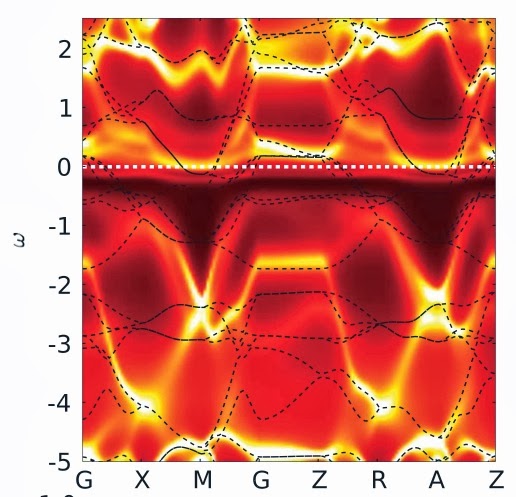
I attempt to illustrate this idea with two figures below. The first color shaded plot shows the one-particle spectral density calculated from LDA+DMFT [Local Density Approximation for DFT (Density Functional Theory) + Dynamical Mean-Field Theory] for the parent compound of the iron pnictide superconductors.
The dashed lines are the band structure calculated from pure LDA [i.e. not including the strong correlation effects captured by DMFT].
The Figure is taken from a PRL by Haule, Shim, and Kotliar.


The figure below shows the spectral density measured by ARPES [Angle Resolved PhotoEmission Spectroscopy] for the iron pnictide LaOFeP. The solid red lines are the band structure calculated from LDA.
This is Figure 6 in a recent review from Z.X. Shen's group.


In the absence of strong correlations all of the spectral weight would lie on top of the band structure.
The important point is that it does not.

In the cuprates these effects are even more dramatic.

So what about cold atomic gases?

For fermionic systems I have not seen much discussion of redistribution of spectral weight.
Often a quasi-particle picture and mean-field techniques are used in theoretical calculations.

Chris Vale's group has done a beautiful series of experiments measuring dynamical spin and density correlation functions for a strongly interacting system with a BEC-BCS crossover. The figure below is taken from this PRL. One does see differences between the density [D] and spin [S] correlation functions and there is a redistribution of spectral weight. But, to me at least, it does not appear as dramatic as in strongly correlated electron materials.


For bosons near the Mott transition there has been some discussion of the spectral weight redistribution [see this PRA and references therein].

I think the condensate fraction in the first cold atom BEC's is close to unity. In contrast, in superfluid helium 4 the fraction is about 10 per cent. The vanishing of the condensate fraction as one approaches the Mott insulator has been observed, but seems to be captured by a mean-field theory.
For reference, in cuprate superconductors the superfluid density can be much less than the charge density.

So, my questions are:

Is large redistribution of spectral weight the best signature of strong correlations?

In what cold atom systems does one see the largest redistribution?

Wednesday, May 29, 2013

Write your abstract for your audience

Next week I am giving the Quantum science seminar at UQ. This is attended by people with diverse interests and backgrounds: cold atoms, condensed matter, quantum information, and quantum optics.

Hence, I have written a talk abstract that is hopefully attractive and interesting enough to motivate people to come to the talk.

Comments welcome.

When good metals turn bad: from organic superconductors to ultracold atomic gases

Key properties usually associated with metals are that they are shiny and excellent conductors of electricity and heat. Hence, one might think that the best strategy to find a good superconductor (e.g. one that works at room temperature) is to study good metals. Actually, the opposite is true. The past few decades have shown that the most interesting and important metals are "bad metals". They often occur in proximity to a Mott insulating phase. Bad metals are characterised by a large electrical resistance of the order of the quantum of resistance h/e^2 and their theoretical description is an outstanding problem.

I will discuss the distinct experimental and theoretical signatures of bad metals [1]. They occur in a wide range of correlated electron materials, including high-Tc cuprate superconductors, heavy fermion compounds, and superconducting organic charge transfer salts [2]. A key feature is that with increasing temperature good metals turn bad, at a temperature corresponding to the loss of quantum coherence.

The simplest possible effective Hamiltonian for organic charge transfer salts is a one-band Hubbard model on an anisotropic triangular lattice at half-filling [2]. The model exhibits a transition from a Mott insulator to a bad metal as the interaction (U/t) is reduced or the frustration (t'/t) is varied.
A recent numerical study of the model [3] showed that near the Mott insulator the calculated quantum coherence temperature was much less than the non-interacting Fermi temperature, consistent with experiment. Furthermore, the bad metal is characterised by a small charge compressibility, a large spin susceptibility, and fluctuating local magnetic moments.

Finally, I will discuss the connection with the viscosity of perfect fluids, including experiments on ultracold atomic gases, and calculations based on string theory techniques!

[1] J. Merino and R.H. McKenzie, Phys. Rev. B 61, 7996 (2000).
[2] B.J. Powell and R.H. McKenzie, Rep. Prog. Phys. 74, 056501 (2011).
[3] J. Kokalj and R.H. McKenzie, Phys. Rev. Lett. 110, 206402 (2013).

From cold atoms to quark-gluon plasmas

In 2007 Gordon Baym gave a fascinating talk New States of Quantum Matter which is nicely summarised in a short conference paper. You can watch a 2010 version of the talk here.

Baym discusses similarities of the physics associated with cold atomic gases and quark-gluon plasmas. These similarities occur in spite of the fact that the relevant energy scales in the two systems differ by more than 20 orders of magnitude!

For example, the phase diagram below shows the different phases of a many-body quark system as a function of temperature and chemical potential.
Increasing the chemical potential corresponds to increasing the density. [Remember that for a non-interacting Fermi gas the Fermi energy increases with density].
Note that at "low" temperatures there is a continuous cross-over from a hadronic superconductor [roughly a BEC of paired quarks] to a quark superconductor. Baym points out that some level this is analogous to the BEC-BCS crossover that occurs in ultracold Fermi gases as one tunes the interaction from repulsion to attraction (e.g. via a Feshbach resonance). However, like all analogies this is not perfect. The quark system involves three different "colours" of fermion with different masses, whereas the cold gas one involves two with identical mass. An interesting challenge for the cold atom community is to design the corresponding three fermion system. This has been discussed by Rapp, Zarand, Honerkamp, and Hofstetter  (see the associated Nature Physics News and Views by Frank Wilczek). 

What does this movie tell us about the modern university?

Last night, my wife and I watched the movie, Wit. You can watch the full movie here  (free with ads). I should warn that some of the conten...