At the Quantum Theory and Nature of Reality conference on Tuesday night there was an interesting panel discussion with George Ellis, Sir John Polkinghorne, and Sir Roger Penrose.
I was surprised and disappointed that Sir Roger Penrose re-iterated the same argument in his book The Emperors New Mind: quantum gravity, the collapse of the wavefunction, and consciousness must all be related. Furthermore, he stood by Hameroff's proposal that a particular type of microtubules are the component with quantum coherence. He mentioned how excited he was about unpublished experimental results of a Japanese group that claim to have measured an electrical resistance of one ohm for microtubules which is comparable to the resistance of the leads. [He seemed to be hinting this implied they were superconducting!].
Why am I so skeptical?
See the following:
The Penrose-Hameroff Orchestrated Objective-Reduction Proposal for Human Consciousness is Not Biologically Feasible, published in Physical Review E.
Is the Brain a Quantum Computer?, published in Cognitive Science. A physicist, psychologist, computer scientist, philosopher, and systems engineer say NO!
Insulating Behavior of λ-DNA on the Micron Scale, this PRL showed that claims that DNA could be conducting and even superconducting were experimental artifacts.
People tend to believe what they want to believe rather than what the evidence before them suggests they should believe. I call this Kauzmann's maxim and is articulated in his Reminiscences of a Life in Protein Chemistry.
Thursday, September 30, 2010

Wednesday, September 29, 2010
The emergence of locality
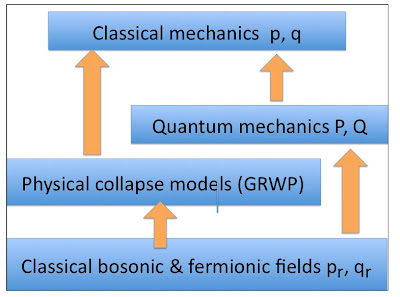
The following important question arises about Adler's proposal for the emergence of quantum field theory from an underlying statistical mechanics of bosonic and fermionic fields.
It appears to be a "hidden variables" theory. Shouldn't it obey Bell's theorem?
When asked this yesterday after my talk I said I thought that it does not because the "hidden variables" are fermionic. However, this is not the correct answer. It is because the underlying theory is nonlocal. Here is an extract (page 96 in the preprint version) of Adler's book:
It appears to be a "hidden variables" theory. Shouldn't it obey Bell's theorem?
When asked this yesterday after my talk I said I thought that it does not because the "hidden variables" are fermionic. However, this is not the correct answer. It is because the underlying theory is nonlocal. Here is an extract (page 96 in the preprint version) of Adler's book:
we note that there is a natural hierarchy of matrix structures leading from the underlying trace dynamics, to the emergent effective complex quantum field theory, to the classical limit. In the underlying theory, the matrices xr are of completely general structure.
No commutation properties of the xr are assumed at the trace dynamics level, and since all degrees of freedom communicate with one another, the dynamics is completely nonlocal. (As a consequence of this nonlocality, the Bell theorem arguments against local hidden variables do not apply to trace dynamics.)
In the effective quantum theory, the xr are still matrices, but with a restricted structure that obeys the canonical commutator/anticommutator algebra.
Thus, locality is an emergent property of the effective theory, even though it is not a property of the underlying trace dynamics. Finally, in the limit in which the matrices xr are dominated by their c-number or classical parts, the effective quantum field dynamics becomes an effective classical dynamics.
Thus, both classical mechanics and quantum mechanics are subsumed in the more general trace dynamics, as reflected in the following hierarchy of matrix structures, corresponding to increasing specialization:
general → canonical quantum → c-number, classical.
The indeterminacy characteristic of quantum mechanics appears only at the middle level of this hierarchy of matrix structures. At the bottom or trace dynamics level, there is no indeterminacy (at least in principle, given the initial conditions) because no dynamical information has been discarded, while at the top or classical level, quantum indeterminacies are masked by large system size.

A smart bird brain
Today Simon Benjamin (Oxford) gave a really nice talk, Will we succeed in creating entanglement in macroscopic quantum systems? Can it exist in living systems?
Specifically, Simon focused on recent theoretical work relating to the fascinating question of how migratory birds navigate (discussed in a previous post).
Specifically, they did a detailed analysis of decoherence and entanglement in the radical pair model for magnetoreception (where the small magnetic field of the earth causes a different decay rate for singlet and triplet channels). One thing I learnt is that a key to making this model work is that the different spins experience a different spin anisotropy associated with the hyperfine interaction. (How can we justify this asymmetry?)
Do living systems already harness quantum mechanics in a "non-trivial" way?
How do we define "non-trivial"? A good criteria is whether biologists and chemists need quantum physicists to understand the phenomena of interest?
Specifically, they did a detailed analysis of decoherence and entanglement in the radical pair model for magnetoreception (where the small magnetic field of the earth causes a different decay rate for singlet and triplet channels). One thing I learnt is that a key to making this model work is that the different spins experience a different spin anisotropy associated with the hyperfine interaction. (How can we justify this asymmetry?)
Recent experiments showed that a very weak oscillatory magnetic field resonant with the electron Larmor frequency will stop the compass working.
unknown rate = 10^4 per sec to disrupt compass
The Oxford group estimated the decoherence time must be shorter than 100 microsec.
This may seem long since N @ C60 has a decoherence time of 80 microsec.
An open question is the biomolecular justification for the radical pair model and whether the spins need to be in a protected environment.
A candidate molecule cryptochrome have too many nuclear spins.
This is fascinating. Is it "non-trivial"? Well it is worth noting that
1. all the theoretical machinery used was more than 50 years old [i.e. preceded quantum information theory].
2. the entanglement involved involves two electrons and just two molecules and so is not "macroscopic"
A question was ask about whether the bird had evolved to develop this feature because it has a survival advantage. It is important to remember that not every function of an animal has been optimised by evolution, as discussed here.
A question was ask about whether the bird had evolved to develop this feature because it has a survival advantage. It is important to remember that not every function of an animal has been optimised by evolution, as discussed here.
Emergence and quantum theory
I just finished preparing my talk, Is emergence the nature of physical reality? for the Polkinghorne birthday conference. I have really enjoyed thinking about these issues and learnt a lot.
Monday, September 27, 2010
Information is a bad word
John Bell had a list of BAD works which have been mentioned several times today. In his article, Against Measurement, Bell said:
His D. Phil thesis in on the arxiv and is forthcoming as an OUP book, Quantum Information Theory and the Foundations of Quantum Mechanics.
I found the talk refreshing.
One person at the conference who has a different view is Vlatko Vedral, who just wrote a popular book, Decoding Reality: The Universe as Quantum Information. An interview in the Observer has the title, I'd like to explain the Origin of God.
I will abstain from comment and leave you to form your own opinion.
"For the good books known to me are not much concerned with physical precision. This is clear already from their vocabulary. Here are some words which, however legitimate and necessary in application, have no place in a formulation with any pretension to physical precision: system, apparatus, environment, microscopic, macroscopic, reversible, irreversible, observable, information, measurement. .... On this list of bad words from good books, the worst of all is 'measurement'."Chris Timpson (Oxford, Philosophy) gave a nice talk, Information: more trouble than its worth, where he roundly and rightly criticised approaches to solving the quantum measurement problem which claim it is just an issue of "information" and the quantum theory is "just about information".
His D. Phil thesis in on the arxiv and is forthcoming as an OUP book, Quantum Information Theory and the Foundations of Quantum Mechanics.
I found the talk refreshing.
One person at the conference who has a different view is Vlatko Vedral, who just wrote a popular book, Decoding Reality: The Universe as Quantum Information. An interview in the Observer has the title, I'd like to explain the Origin of God.
I will abstain from comment and leave you to form your own opinion.
A divergent point of view
I am now in Oxford for the Quantum Theory and Nature of Reality conference. In their white paper, Andreas Doring and Chris Isham write about Quantum Field Theory (QFT):
Notwithstanding the success of standard quantum theory in atomic, molecular and solid-state physics, there are good reasons for wanting to see beyond it. For example, relativistic QFT is still plagued with ultra-violet divergences, and even free fields encounter the self-energy problem. No matter how sophisticated the renormalisation procedure that is adopted, the fact remains that relativistic QFT is fundamentally flawed.
This ultra-violet problem is clearly linked to the continuum model for space and time...
I may be missing their point but I would like to offer a possible alternative perspective: the divergence problems with renormalisation are not a problem with QFT but rather merely reflect the stratified nature of reality (discussed in my white paper) i.e. there is a hierarchy of energy scales and with each there emerge new interactions and phenomena which are described by some effective theory). In quantum field theory one is always working with some effective Hamiltonian/Lagrangian which describes interactions at some energy scale. To prevent divergences associated with renormalisation one introduces some high energy (or short wavelength) cutoff. This just reflects that there is other physics which becomes relevant at higher energies and is not explicitly contained with the starting Lagrangian or in its renormalised version which emerges from high energy processes.
I would argue that these problems are not unique to quantum field theory. They are also present for the renormalisation theory of classical phase transitions. In that case they also just reflect the
Sunday, September 26, 2010
Deconstructing hydrogen bonds
Hydrogen bonds are incredibly important for understanding the properties of water and for a wide range of biomolecular structures and processes. Without them you would be dead!
Unlike most chemical bonds, hydrogen bonds can range significantly in length, strength, and vibrational frequency. The graph below from a Science paper The Quantum structure of the Intermolecular Proton bond.
shows how the vibrational frequency of an asymmetric A-O-H...O-B bond varies with the proton affinity difference between A and B. Note the substantial softening as things get more symmetrical.

The figure below from another paper shows how the frequency softening is correlated with the bond length.

I am particularly interested in this because I want to know these effects depend on
- breakdown of the Born-Oppenheimer approximation
- the partially covalent character of hydrogen bonds
and whether a simple model Hamiltonian with two diabatic states and one vibrational mode treated exactly (see this earlier post) can capture the essential details and the trends above.
Subscribe to:
Posts (Atom)
What does this movie tell us about the modern university?
Last night, my wife and I watched the movie, Wit. You can watch the full movie here (free with ads). I should warn that some of the conten...

-
 This week Nobel Prizes will be announced. I have not done predictions since 2020 . This is a fun exercise. It is also good to reflect on w...
 -
 The Ising model is a paradigm in both statistical mechanics and condensed matter physics. Today for most theorists it is so familiar that so...
 -
 Nitrogen fluoride (NF) seems like a very simple molecule and you would think it would very well understood, particularly as it is small enou...