Thursday, December 31, 2009

Most viewed posts

2009 is the year I started blogging and I thought it would be interesting to see which posts on this blog have attracted the most viewers, partly because I find sometimes the results of such an analysis surprising. Thanks to Google Analytics this is easy to find out. The top 10 posts (and number of views) are below:
I found the results really encouraging: both the volume and that posts which I think were important and/or original and high on scientific content [except for 8.] attracted the most attention. I was surprised that some of the career advice and "better science" posts did not attract more attention since they potentially have a much wider readership.

So I will keep going in 2010....
Best wishes for the New Year!

Wednesday, December 30, 2009

Emergence in economics

Paul Krugman was awarded the Nobel Prize in Economics in 2008. He is also a New York Times columnist. Why mention him here? He is mentioned in Steven Johnson's book Emergence (p. 89-91) for a mathematical model which describes how spatially segregated business centres emerge. This is described in Krugman's book, The Self-Organising Economy.

Here are Krugman's "rules for research", taken from a talk, "How I work"

1. Listen to the Gentiles

2. Question the question

3. Dare to be silly

4. Simplify, simplify

1. means "Pay attention to what intelligent people are saying, even if they do not have your customs or speak your analytical language."

Emergence is universal

Last Christmas holidays I started reading Emergence: The Connected Lives of Ants, Brains, Cities, and Software, by Steven Johnson.
But the holidays ended.... and so I just got back into it.
It is a really nice book and he is a very gifted writer. I also find it helpful and fascinating because although it is about emergence it virtually never mentions physics or chemistry! Johnson's background is in software but he does a really nice job connecting emergence in software (e.g. genetic algorithms and SimCity) with emergence in ant colonies, slime moulds, formation of neighbourhoods in cities, ....

Johnson says (p. 77) there are five fundamental principles to follow "if you're building a system where macro-intelligence and adaptability derive from local knowledge"
  • More is different
  • Ignorance is useful
  • Encourage random encounters
  • Look for patterns in the signs
  • Pay attention to your neighbours

Monday, December 28, 2009

I am in more than one mind about this...

Howard Gardner is a Professor of Education and Psychology at Harvard. He is best known for developing and promoting the concept of Multiple Intelligences.
His latest book, Five Minds for the Future, defines five specific cognitive abilities that he claims will be sought and cultivated by leaders. Roughly here is my paraphrase of each of the minds, as applied to scientific research.
  • The Disciplinary Mind: You need to master a specific discipline or research area. This takes about ten years.
  • The Synthesizing Mind: You need to learn to integrate ideas from different disciplines into a coherent whole and to communicate that integration to others.
  • The Creating Mind: You need to develop the capacity to uncover and clarify new problems, questions and phenomena.
  • The Respectful Mind: You need to be aware of and appreciate different approaches and values within your discipline and between disciplines.
  • The Ethical Mind: You need to fulfill your responsibilities as a worker within your institution, your discipline, and as a citizen.

Thursday, December 24, 2009

Embrace failure?


Seth Olsen alerted me to a thought-provoking article in Wired about the importance of failure in science.

Wednesday, December 23, 2009

Think before you calculate, measure, fabricate,....

What will be your New Year's resolution for your research in 2010?

Write more papers? Get more students? Apply for more grants? Get more lab space? Get a paper published in Nature or Science? Learn a new technique?

I think mine is going to be:

Spend the first half hour of each day thinking and writing in a notebook about the important science questions I am interested in and want to try and answer. And, specifically coming up with multiple alternative hypotheses and devising ways to distinguish them.

Where did this come from?

Previously I wrote a post about a beautiful Science paper about Strong Inference by John R. Platt. He references a book he published in 1962, The Excitement of Science. Unfortunately, it is out of print and only two universities in Australia have a copy in their libraries. I got a copy on interlibrary loan and just finished reading it. I have scanned a copy of chapter 7 and chapter 8, which I found the most helpful and challenging.

Monday, December 21, 2009

Electronically driven hula dancers

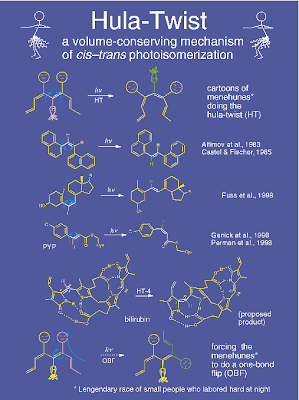
Over the 25 years Robert Liu [from the University of Hawaii!] has emphasized that the
"hula twist" is ubiquitious in photoisomerisation reactions [where after a molecule absorbs a photon it undergoes a structural change] and is beautifully summarised in the figure below.

This short review by Liu and Hammond [whose address is Aloha, Oregon!] documents this and also argues that the hula twist is driven by steric considerations because it is "volume conserving".

However, it turns out that this geometrical change can be preferred purely by an electronic mechanism and does not require steric hindrance. Seth Olsen and I show this [amongst many other results, some of which I have discussed in a previous post] in a paper just published in Journal of Chemical Physics.

We refer to the "hula twist" as disrotatory motion and discuss it briefly on page 12 of our paper.

What does this movie tell us about the modern university?

Last night, my wife and I watched the movie, Wit. You can watch the full movie here  (free with ads). I should warn that some of the conten...