Sometimes I bemoan the decline of scholarship in science, and in academia more broadly. About six years ago I posted about Ph.D's without scholarship, which generated a lot of comments.
This decline is reflected in a range of phenomena: hype, making hiring and promotion decisions based on metrics rather than actual scientific achievements, people writing more papers than they read, "review" articles merely listing references rather than providing critical analysis,...
But, this is all negative, it is what scholarship is not, ... what does real scholarship look like?
I think classic books give a feel for what scholarship is all about. For example, Eisenberg and Kauzmann on Water, Ashcroft and Mermin, Hewson's Kondo Problem, Coulson's Valence, and Mott's monographs. Consider the Oxford Classic Texts in the Physical Sciences.
Similarly, I am challenged by some of the monographs that some humanities colleagues produce. (For example, Stephen Gaukroger's three volumes on science and the shaping of modernity.)
But, today I just don't see people in physics and chemistry producing books like the above.
Am I missing something?
There is certainly a subjective element. Here are a few possible ingredients to real scholarship.
1. Acknowledge the past.
Every problem, achievement, and discipline actually normally has a long history.
Even Newton said he was standing on the shoulders of giants.
2. Acknowledge and engage with the work of others and different points of view.
3. Acknowledge ambiguity, complexity, and controversy.
4. Comprehensive.
A wide range of topics are considered. The focus is not just narrow.
5. Synthesis and coherence.
A wide range of ideas, topics, and techniques are brought together.
6. Lucidity.
Do you think scholarship is declining?
What do you think are the key ingredients?
Thursday, April 28, 2016

Tuesday, April 26, 2016
Low temperature physics without nuclear weapons
Liquid 3He is amazing stuff. Below temperatures of a few hundred milliKelvin it forms a model (and the original inspiration for) Landau Fermi liquid. Furthermore, below about 1 mK it forms two different superfluid states, involving Cooper pairs in a spin triplet state. This is the model case for unconventional superconductivity.
Liquid 3He is actually of great practical use since it the crucial ingredient of dilution refrigerations that allow cooling from a few Kelvin to temperatures as low milliKelvin.
But where do labs get 3He from?
Well, it is a very useful by-product of nuclear weapons production.
Currently, the scientific community (which consumes only about 1% of the supply) is experience supply problems and dramatic price increases (a 15-fold increase between 2004 and 2010).
Why is this happening?
Thankfully, we are cutting back on nuclear weapons production!
One practical way to solve this problem is to develop alternative materials for ultra-low temperature refrigeration; one possibility is by adiabatic demagnetisation. Indeed, this is the method that was first developed in the 1930s using paramagnetic salts to achieve temperatures below about 0.3 K (and was the basis of the 1949 Nobel Prize in Chemistry) and is the basis for nice undergraduate problems in thermodynamics and statistical mechanics. Simply the entropy is a function of B/T (where B is the magnetic field and T the temperature). One cools the system down in a fixed magnetic field, then adiabatic isolates it and reduces the magnetic field slowly. In the last step the entropy must not change and so the temperature must decrease. (This is shown as the red horizontal arrow in the figure below). This is also known as the magnetocaloric effect. The problem is that most paramagnetic materials are insulators and one would prefer to have a metallic material that is a good thermal conductor and can be "machined".
I learnt some of this from an interesting paper (that I actually looked at in preparing an undergraduate thermodynamics lecture about Maxwell relations).
Large magnetocaloric effect and adiabatic demagnetization refrigeration with YbPt2Sn
Dongjin Jang, Thomas Gruner, Alexander Steppke, Keisuke Mitsumoto, Christoph Geibel and Manuel Brando
The authors mention some basic unanswered science questions about why this material is a good candidate. Specifically, why is the Kondo temperature (associated with interaction of the magnetic moments of the Yb3+ ions with the conduction electrons) and the inter-ion magnetic interactions so low? This ensures that the spins act essentially like non-interacting spins (with a large entropy) down to less than 1 K.
A key figure is below, showing the entropy versus temperature at several different magnetic fields.

Liquid 3He is actually of great practical use since it the crucial ingredient of dilution refrigerations that allow cooling from a few Kelvin to temperatures as low milliKelvin.
But where do labs get 3He from?
Well, it is a very useful by-product of nuclear weapons production.
Currently, the scientific community (which consumes only about 1% of the supply) is experience supply problems and dramatic price increases (a 15-fold increase between 2004 and 2010).
Why is this happening?
Thankfully, we are cutting back on nuclear weapons production!
One practical way to solve this problem is to develop alternative materials for ultra-low temperature refrigeration; one possibility is by adiabatic demagnetisation. Indeed, this is the method that was first developed in the 1930s using paramagnetic salts to achieve temperatures below about 0.3 K (and was the basis of the 1949 Nobel Prize in Chemistry) and is the basis for nice undergraduate problems in thermodynamics and statistical mechanics. Simply the entropy is a function of B/T (where B is the magnetic field and T the temperature). One cools the system down in a fixed magnetic field, then adiabatic isolates it and reduces the magnetic field slowly. In the last step the entropy must not change and so the temperature must decrease. (This is shown as the red horizontal arrow in the figure below). This is also known as the magnetocaloric effect. The problem is that most paramagnetic materials are insulators and one would prefer to have a metallic material that is a good thermal conductor and can be "machined".
I learnt some of this from an interesting paper (that I actually looked at in preparing an undergraduate thermodynamics lecture about Maxwell relations).
Large magnetocaloric effect and adiabatic demagnetization refrigeration with YbPt2Sn
Dongjin Jang, Thomas Gruner, Alexander Steppke, Keisuke Mitsumoto, Christoph Geibel and Manuel Brando
The authors mention some basic unanswered science questions about why this material is a good candidate. Specifically, why is the Kondo temperature (associated with interaction of the magnetic moments of the Yb3+ ions with the conduction electrons) and the inter-ion magnetic interactions so low? This ensures that the spins act essentially like non-interacting spins (with a large entropy) down to less than 1 K.
A key figure is below, showing the entropy versus temperature at several different magnetic fields.

Friday, April 22, 2016
KITP seminars online
A wonderful thing about the web is that now there is so much material online. A pioneer in putting all their seminars and colloquia online is the KITP at Santa Barbara. I know some people who regularly watch seminars (both old and recent). Others do not know it exist. This is a particularly valuable resource for students and those of us in distant countries.
I have to confess that until yesterday I have never actually watched a talk; just occasionally skimmed some slides. Generally I find I don't have the patience to watch talks online. I just seem to prefer to look at papers. However, yesterday I was forced to do this because at the weekly UQ condensed matter theory group meeting we watched a nice talk by Antoine Georges on Hund's metals. Although, I have read and blogged about some of the relevant papers, I really found it helpful seeing what was highlighted and going through the material at a "slow pace". Hopefully, I will do this more often.
What do you think about online talks or lectures? How often do you watch them? Are there any that you would particularly recommend?
I have to confess that until yesterday I have never actually watched a talk; just occasionally skimmed some slides. Generally I find I don't have the patience to watch talks online. I just seem to prefer to look at papers. However, yesterday I was forced to do this because at the weekly UQ condensed matter theory group meeting we watched a nice talk by Antoine Georges on Hund's metals. Although, I have read and blogged about some of the relevant papers, I really found it helpful seeing what was highlighted and going through the material at a "slow pace". Hopefully, I will do this more often.
What do you think about online talks or lectures? How often do you watch them? Are there any that you would particularly recommend?
Thursday, April 21, 2016
Cost benefit analysis of administrative policies
Administrators and senior management seem to love coming up with new policies and procedures for everything.
These are designed to make things "better".
However, a colleague recently emphasised to me that each one of these initiatives should be subject to a cost-benefit analysis. This is a point I have also heard made by my UQ law colleague, James Allen, author of a provocative essay about Australian universities.
Consider the follow examples:
* requiring grant applications to provide more information (whether reports on previous grants, details about university policies, longer project descriptions, relevance to society, ....)
* more details in course profiles
* larger committees to ensure more input, consultation, representation of diversity, accountability, and expertise
* procedures and policies to increase transparency and accountability
* broadening eligibility criteria so more people can apply for a particular grant or fellowship program.
Every one of these initiatives has benefits.
So why might they be a bad idea?
One needs to consider the cost, particularly the opportunity cost.
Specifically, if instead of faculty spending time on these tasks what might they spend time on instead?
Mentoring graduate students and postdocs, research, preparing higher quality lectures, ....
Sometimes senior faculty simply move these tasks to junior faculty, graduate students, or junior administrative staff. However, that has a cost too. Implementing all these initiatives requires more admin staff; money that could be spent instead on hiring more faculty...
It is not just time and money. All this admin. takes mental space and sometimes reduces morale, which in the end leads to reduced productivity.
These are designed to make things "better".
However, a colleague recently emphasised to me that each one of these initiatives should be subject to a cost-benefit analysis. This is a point I have also heard made by my UQ law colleague, James Allen, author of a provocative essay about Australian universities.
Consider the follow examples:
* requiring grant applications to provide more information (whether reports on previous grants, details about university policies, longer project descriptions, relevance to society, ....)
* more details in course profiles
* larger committees to ensure more input, consultation, representation of diversity, accountability, and expertise
* procedures and policies to increase transparency and accountability
* broadening eligibility criteria so more people can apply for a particular grant or fellowship program.
Every one of these initiatives has benefits.
So why might they be a bad idea?
One needs to consider the cost, particularly the opportunity cost.
Specifically, if instead of faculty spending time on these tasks what might they spend time on instead?
Mentoring graduate students and postdocs, research, preparing higher quality lectures, ....
Sometimes senior faculty simply move these tasks to junior faculty, graduate students, or junior administrative staff. However, that has a cost too. Implementing all these initiatives requires more admin staff; money that could be spent instead on hiring more faculty...
It is not just time and money. All this admin. takes mental space and sometimes reduces morale, which in the end leads to reduced productivity.
Monday, April 18, 2016
Incorporating scientist biographies into lectures
A few years ago I decided I wanted to include brief biographies of relevant great scientists in my undergraduate lectures. I posted (5 years ago!) about how I started with Landau but I lost momentum. This year I have put more effort into it. I just taught my second year undergraduate thermo class about Gibbs free energy and so I profiled Gibbs.
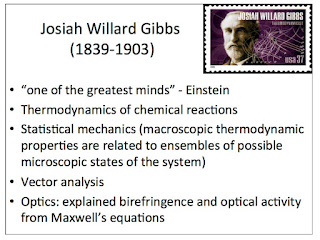 In solid state physics I have profiled Drude, Sommerfeld, von Laue, and Bloch.
I have found this quite enjoyable for myself and hopefully for the students. I have learnt quite a bit, just by reading the relevant Wikipedia pages. It also introduces students to the human dimension of science. For example, Drude died by suicide and so it is a good opportunity to flag mental health issues. Sommerfeld was a mentor of many great scientists. von Laue actively opposed the Deutsche Physik of the Nazis. Bloch was the first Director General of CERN.
 Has anyone else experience at doing similar things? Any suggestions?

I have found this quite enjoyable for myself and hopefully for the students. I have learnt quite a bit, just by reading the relevant Wikipedia pages. It also introduces students to the human dimension of science. For example, Drude died by suicide and so it is a good opportunity to flag mental health issues. Sommerfeld was a mentor of many great scientists. von Laue actively opposed the Deutsche Physik of the Nazis. Bloch was the first Director General of CERN.

Friday, April 15, 2016
Start the mechanics of producing your thesis now (not in the frantic last days!)
Producing a thesis (Ph.D, Masters, or undergraduate honours) is a monumental task that can create significant stress. Here I am just going to focus on the mechanics of producing the final document, not the greater challenge of producing the intellectual content.
In most cases there is a deadline, whether imposed by the program, funding running out, or (hopefully) a fixed date to start a job. For many students there is a big rush at the end featuring very long hours, missing "life", neglecting family and sometimes health, exhaustion, anxiety, ...
These problems are compounded if one starts "writing" and producing the thesis document at the very end, with the final deadline looming. Furthermore, this can be much slower and more frustrating if you have to do some of the mechanics (e.g. ordering and numbering references) by hand or at least learn to use software to do it automatically. Compared to 30 years ago, the mechanics is now so much easier because of software that automates many of the tedious tasks such as ordering and numbering.

Let me encourage you to start now on the mechanics.
First, you need to decide on and learn relevant software and start using it every step of the way. Talk to other students (just finished or finishing) and postdocs to find out what they used, and the relative merits.
Here are some concrete issues to consider.
Keeping track of references.
From day one you will start downloading (and hopefully reading) papers. By the end you will (hopefully) have hundreds of references. How are you going to sort them and organise them? If when you start writing you just have hundreds of PDFs in a folder on your computer, life is going to be difficult if you have to start looking at them one by one to find some particular reference you need.
I use the wonderful program Papers. Others like Endnote. The main thing is to find something that works for you, including interfacing smoothly with your word processor program.
Ordering and formatting of references.
For LaTeX, BibTeX does this nicely, provided you learn how to get it to produce the desired format.
Generating a bibliography.
Papers can easily produce a .bib file for BibTex.
Producing graphs and schematics and incorporating figures in the document.
On a previous post, commenters on a post discussed useful freeware for plotting data.
Spell and grammar check.
This is particularly important for students whose English is weak or are dyslexic. Advisors and examiners really get irritated by too many typos. I have never found a decent spell checker for LaTex. Any recommendations?
Thesis template.
This should include all the relevant sections from cover page to lists of figures to acknowledgements. It should automatically order and number everything: pages, chapters, figures, tables, equations, references, ....
Keep it simple.
Avoid personalised versions of templates and software (e.g. LaTeX macros), either from you or someone else. My limited experience is that these are often not as portable as hoped/claimed and lead to small bugs that can waste precious time trying to fix.
Backup everything regularly.
This is so easy but it is amazing and disappointing how I still hear of students losing work. Dropbox, cheap portable Terabyte drives, and Time Machine on Mac's make this inexcusable.
Don't just backup the thesis document, but all your data, codes, references, ....
Hard drives do crash and laptops do get lost or stolen...
Practise writing now.
Writing is hard work. Don't wait until the final stages of the thesis to start to learn how to write. It is too late.
Getting feedback from your advisor now.
Again during the final stages is not to learn how she likes things formatted or how to write figure captions.
What software would you recommend or avoid?
In most cases there is a deadline, whether imposed by the program, funding running out, or (hopefully) a fixed date to start a job. For many students there is a big rush at the end featuring very long hours, missing "life", neglecting family and sometimes health, exhaustion, anxiety, ...
These problems are compounded if one starts "writing" and producing the thesis document at the very end, with the final deadline looming. Furthermore, this can be much slower and more frustrating if you have to do some of the mechanics (e.g. ordering and numbering references) by hand or at least learn to use software to do it automatically. Compared to 30 years ago, the mechanics is now so much easier because of software that automates many of the tedious tasks such as ordering and numbering.
Let me encourage you to start now on the mechanics.
First, you need to decide on and learn relevant software and start using it every step of the way. Talk to other students (just finished or finishing) and postdocs to find out what they used, and the relative merits.
Here are some concrete issues to consider.
Keeping track of references.
From day one you will start downloading (and hopefully reading) papers. By the end you will (hopefully) have hundreds of references. How are you going to sort them and organise them? If when you start writing you just have hundreds of PDFs in a folder on your computer, life is going to be difficult if you have to start looking at them one by one to find some particular reference you need.
I use the wonderful program Papers. Others like Endnote. The main thing is to find something that works for you, including interfacing smoothly with your word processor program.
Ordering and formatting of references.
For LaTeX, BibTeX does this nicely, provided you learn how to get it to produce the desired format.
Generating a bibliography.
Papers can easily produce a .bib file for BibTex.
Producing graphs and schematics and incorporating figures in the document.
On a previous post, commenters on a post discussed useful freeware for plotting data.
Spell and grammar check.
This is particularly important for students whose English is weak or are dyslexic. Advisors and examiners really get irritated by too many typos. I have never found a decent spell checker for LaTex. Any recommendations?
Thesis template.
This should include all the relevant sections from cover page to lists of figures to acknowledgements. It should automatically order and number everything: pages, chapters, figures, tables, equations, references, ....
Keep it simple.
Avoid personalised versions of templates and software (e.g. LaTeX macros), either from you or someone else. My limited experience is that these are often not as portable as hoped/claimed and lead to small bugs that can waste precious time trying to fix.
Backup everything regularly.
This is so easy but it is amazing and disappointing how I still hear of students losing work. Dropbox, cheap portable Terabyte drives, and Time Machine on Mac's make this inexcusable.
Don't just backup the thesis document, but all your data, codes, references, ....
Hard drives do crash and laptops do get lost or stolen...
Practise writing now.
Writing is hard work. Don't wait until the final stages of the thesis to start to learn how to write. It is too late.
Getting feedback from your advisor now.
Again during the final stages is not to learn how she likes things formatted or how to write figure captions.
What software would you recommend or avoid?
Wednesday, April 13, 2016
How Ashcroft and Mermin quickly became irrelevant and then relevant
This week in my Solid State Physics class I taught covered weak periodic potentials (including higher Brilloiun zones and Fermi surface reconstruction) and the tight binding model. I closely follow chapters 9 and 10 in Aschroft and Mermin, which was published in 1975.
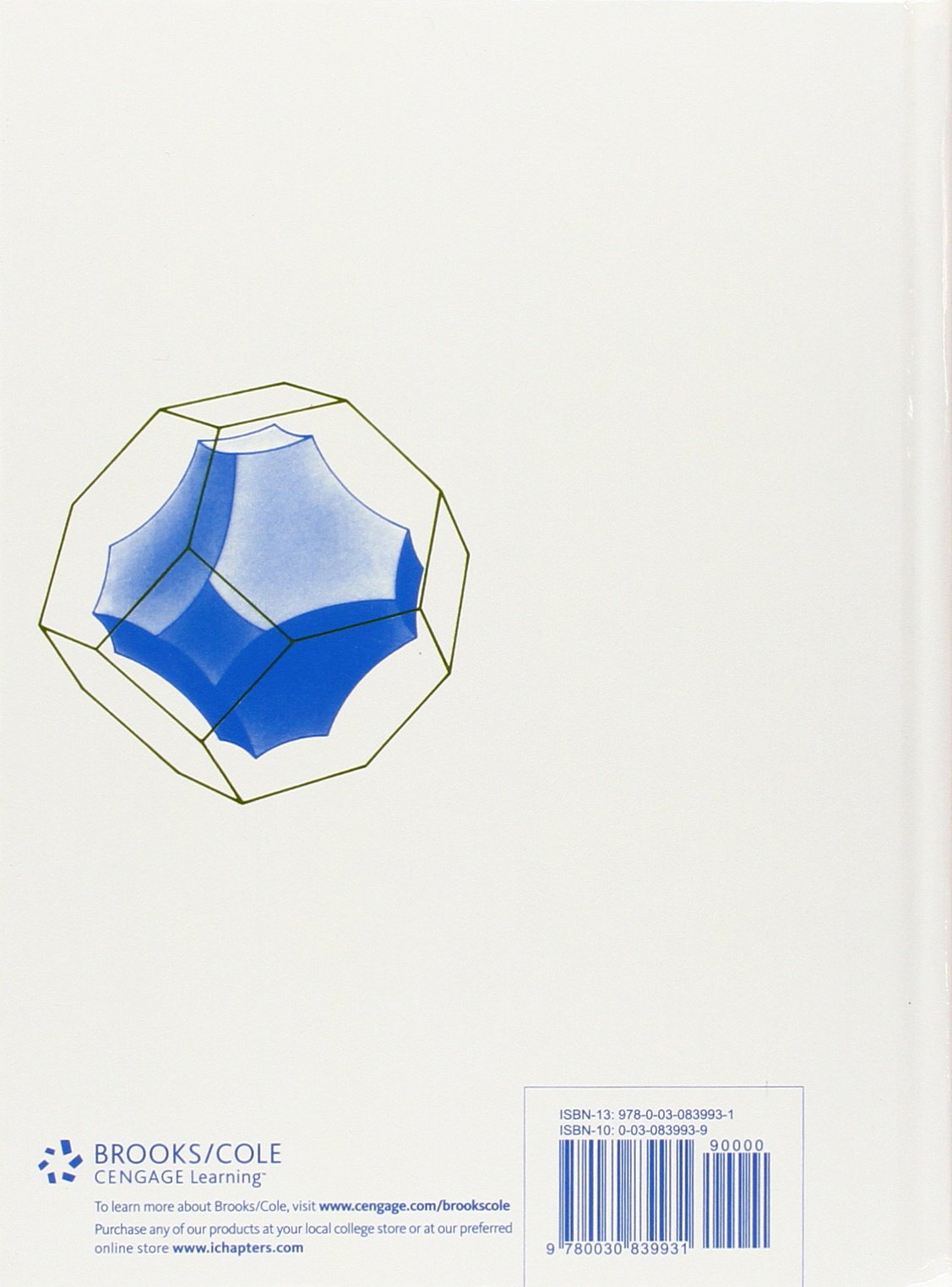
This topic is somewhat iconic in that it features on the front and back cover of the book.


I think for the first time I understood the higher Brilloiun zones (rather than being overwhelmed by the geometrical complexity) and how this leads to the complex hole Fermi surfaces for metals of valence 2, 3, and 4. The key to visualising this better is just to do the problem in two dimensions first.
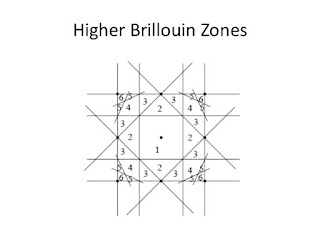 This got me wondering: why do we teach this stuff to students?
First, there is the intellectual beauty of the subject: how simple analytical and geometrical models can capture the complex band structures and Fermi surfaces of elemental metals.
However, today almost no one cares about elemental metals, or at least does research on them.
Note that most physics undergraduates and graduates don't ever take a course on nuclear physics. My department does not even teach one! Yet, the subject is a beautiful one and of great historical importance (both intellectually and politically!). The reason for this is that there is now very little research in basic nuclear physics. (I think this is a bad thing, but that is another story..)
But, metal physics is different.
A compelling reason I teach it in detail is that it provides a foundation to understand so much condensed matter research today: particularly how strongly correlated electron materials do (and do not) deviate from the Fermi liquid paradigm. Otherwise, I think Ashcroft and Mermin type courses would have been eventually sent off to the electrical engineering and materials engineering departments.
One can argue that almost happened. For the decade (1975-1985) following publication of the book, the content (not just on metals but also superconductivity) must have been largely of historical interest or considered only of interest to those working in "applied physics". But, the discovery of superconducting cuprates, heavy fermions, organic charge transfer salts, and iron pnictides, changed all that....
This topic is somewhat iconic in that it features on the front and back cover of the book.

I think for the first time I understood the higher Brilloiun zones (rather than being overwhelmed by the geometrical complexity) and how this leads to the complex hole Fermi surfaces for metals of valence 2, 3, and 4. The key to visualising this better is just to do the problem in two dimensions first.

First, there is the intellectual beauty of the subject: how simple analytical and geometrical models can capture the complex band structures and Fermi surfaces of elemental metals.
However, today almost no one cares about elemental metals, or at least does research on them.
Note that most physics undergraduates and graduates don't ever take a course on nuclear physics. My department does not even teach one! Yet, the subject is a beautiful one and of great historical importance (both intellectually and politically!). The reason for this is that there is now very little research in basic nuclear physics. (I think this is a bad thing, but that is another story..)
But, metal physics is different.
A compelling reason I teach it in detail is that it provides a foundation to understand so much condensed matter research today: particularly how strongly correlated electron materials do (and do not) deviate from the Fermi liquid paradigm. Otherwise, I think Ashcroft and Mermin type courses would have been eventually sent off to the electrical engineering and materials engineering departments.
One can argue that almost happened. For the decade (1975-1985) following publication of the book, the content (not just on metals but also superconductivity) must have been largely of historical interest or considered only of interest to those working in "applied physics". But, the discovery of superconducting cuprates, heavy fermions, organic charge transfer salts, and iron pnictides, changed all that....
Subscribe to:
Posts (Atom)
What does this movie tell us about the modern university?
Last night, my wife and I watched the movie, Wit. You can watch the full movie here (free with ads). I should warn that some of the conten...

-
 This week Nobel Prizes will be announced. I have not done predictions since 2020 . This is a fun exercise. It is also good to reflect on w...
 -
 The Ising model is a paradigm in both statistical mechanics and condensed matter physics. Today for most theorists it is so familiar that so...
 -
 Nitrogen fluoride (NF) seems like a very simple molecule and you would think it would very well understood, particularly as it is small enou...