Every grant and fellowship program comes with many pages of rules, regulations, guidelines, criteria, ... How carefully should you read them? What can you learn from them?
I have two separate points.
First, as the applicant it is your responsibility to read and to take note of these regulations. This is time consuming and boring. But it is still your responsibility. Don't expect or demand someone else to do it for you. It is not the responsibility of your supervisor, department chair, local research administrator, group secretary, or the funding agency. Don't ask questions when the answers are there in the rules if you actually read them. And don't ignore the rules. For example, if it clearly states you have to be 5 years past your Ph.D, don't apply anyway if you are 3 years past your Ph.D. This may seem inane to some readers, but it does happen. Also, just because it says you can do something does not meet it is a good idea. For example, with regard to budget requests, you may be allowed to ask for $1 million over 5 years, but if you look at the successful applicants you will find almost all get about $300-400K over 3 years.
Second, if possible find out the real inside story about priorities and preferences from the people who actually make the decisions, e.g. someone who has served on the relevant committee. Many grant and fellowship programs will make claims about priorities or preferences, whether it is for specific research fields, women and minorities, renewable energy, early career researchers, national citizens, ..
However, this is sometimes just platitudes and was inserted in the guidelines to sound good or to pacify someone. Don't get your hopes up (or down) if you do (not) fall into this sub-class of applicants. On the other hand, sometimes these are real priorities and if you don't meet this criteria you are wasting your time applying.
Also, not all parts of the application are equally important. Some applicants agonise over preparing sections that actually receive little scrutiny. I know of one program where the actually scientific project and the letters of reference get virtually no attention. It is all based on the CV. The only way you will find out what does and does not matter is to talk to someone.
Saturday, October 31, 2015

Friday, October 30, 2015
Hyderabad talks on emergent quantum matter
Today I am giving a seminar "Emergent quantum matter" in the School of Physics at Central University of Hyderabad. Here are the slides.
Next tuesday I am giving a similar talk at the new Hyderabad branch of the Tata Institute for Fundamental Research.

Next tuesday I am giving a similar talk at the new Hyderabad branch of the Tata Institute for Fundamental Research.

Thursday, October 29, 2015
Hydrogen bonding in Hyderabad
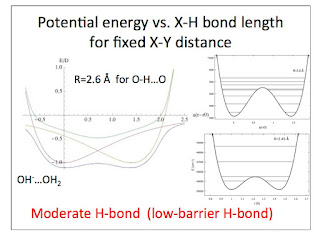
Tomorrow in the School of Chemistry at Central University of Hyderabad I am giving a talk, "Effect of quantum nuclear motion on hydrogen bonding". Here are the slides.
My host is Susanta Mahapatra.
My host is Susanta Mahapatra.

Monday, October 26, 2015
What is the origin of noise in this bad metal?
Last week I had a helpful discussion with Arindam Ghosh about this recent paper
Conductivity noise study of the insulator-metal transition and phase coexistence in epitaxial samarium nickelate thin films
Anindita Sahoo, Sieu D Ha, Shriram Ramanathan, and Arindam Ghosh
The abstract states
The normalized magnitude of noise is found to be extremely large, being nearly eight orders of magnitude higher than thin films of common disordered metallic systems, and indicates electrical conduction via classical percolation in a spatially inhomogeneous medium.
The higher-order statistics of the fluctuations indicate a strong non-Gaussian component of noise close to the transition, attributing the inhomogeneity to the coexistence of the metallic and insulating phases.The figure below shows how the non-Gaussian component [measured by the kurtosis] increases dramatically as the temperature decreases below the metal-insulator transition.

Some of the fundamental and related questions that arise are:
How much is the noise due to extrinsic disorder [i.e. due to impurities] and how much due to intrinsic disorder [inhomogeneities arising from phase separation at a first-order metal-insulator transition]?
What happens in a very clean system?
How does one actually do a microscopic calculation of this 1/f noise [e.g. from a disordered Hubbard model]?
What happens in a clean system when the temperature crosses over from a Fermi liquid at low temperatures to a bad metal with increasing temperature?
In a recent PRL there is also noise data for an organic charge transfer salt, in which the disorder and proximity to the Mott transition can be tuned with the cooling rate.
Friday, October 23, 2015
The limitations of Skype meetings
Skype and similar teleconferencing tools are great. I use them regularly to keep in touch with family while travelling and occasionally to talk to collaborators. It is much better than the phone and way better than exchanging emails.
There are some techno-enthusiasts who claim we don't need to have conferences anymore because we can do it all on line and save lots of money. In companies there are those who push for tele-commuting and only have a central office with hot desks that people occasionally use. I have even heard of Australian universities who have hired faculty members from overseas solely based on a Skype interview!
I think such enthusiasm is a big mistake. I have been at a few conferences where some "big shot" did not attend but gave their talk via tele-conferencing. It really wasn't the same as having them in the room. Even without technical glitches, it was not very engaging. Once I was even at a social event where a couple "attended" via Skype. It was inane and awkward.
Recently I attended a committee meeting via Skype. This was the first time I had done that. On a basic level it was o.k., particularly because the subjects under discussion were not that weighty. However, I did notice how different it was to actually being in the room. In particular, I had no sense of body language, facial cues, or tone of voice. I could not really tell how what I said was being received or get much sense of the mood in the room. It was also harder just to engage with the meeting. I struggle with that sometimes, even when I am in the room!
I think when you know the other parties well and the subject is not controversial this is all fine. However, I think on any sensitive subjects or with people you don't really know for important meetings there is no substitute for a face-to-face meeting. People are intrinsically relational and emotional.
There are some techno-enthusiasts who claim we don't need to have conferences anymore because we can do it all on line and save lots of money. In companies there are those who push for tele-commuting and only have a central office with hot desks that people occasionally use. I have even heard of Australian universities who have hired faculty members from overseas solely based on a Skype interview!
I think such enthusiasm is a big mistake. I have been at a few conferences where some "big shot" did not attend but gave their talk via tele-conferencing. It really wasn't the same as having them in the room. Even without technical glitches, it was not very engaging. Once I was even at a social event where a couple "attended" via Skype. It was inane and awkward.
Recently I attended a committee meeting via Skype. This was the first time I had done that. On a basic level it was o.k., particularly because the subjects under discussion were not that weighty. However, I did notice how different it was to actually being in the room. In particular, I had no sense of body language, facial cues, or tone of voice. I could not really tell how what I said was being received or get much sense of the mood in the room. It was also harder just to engage with the meeting. I struggle with that sometimes, even when I am in the room!
I think when you know the other parties well and the subject is not controversial this is all fine. However, I think on any sensitive subjects or with people you don't really know for important meetings there is no substitute for a face-to-face meeting. People are intrinsically relational and emotional.
Thursday, October 22, 2015
Engaging school students in real science experiments
Science education in schools in the Majority World faces many challenges including lack of resources, poorly trained teachers, and a fixation on rote learning from textbooks. Even at “good” schools students rarely ever do experiments or hands-on demonstrations. The focus is on preparing standard answers for exam questions.
One recent big change in school education in the Majority World is the proliferation of low-cost private schools, even in extremely poor communities. Most of these are English medium. A recent cover story in The Economist chronicled this development.
When visiting India, I enjoy reading The Hindu newspaper each day. I think the quality of journalism and the substance of the issues covered is much higher than most Western newspapers. More than once a week there is an op-ed piece or article about the problems with school education. Topics covered include the stifling of critical and creative thinking, the lack of autonomy given to teachers by all-knowing and controlling principals, …
Here is roughly what I have done for the science lesson in a school in the Majority World.
The main goal is to give a hands-on experience that will help the students see that what they read in the textbook or memorise for the exam actually has something to do with the real world.
It is centred around a baking soda and vinegar film canister rocket. Since this involves cheap household chemicals the hope is the children and/or their teachers might do it again.
I begin with a brief discussion of the scientific "method": ask a question, make a hypothesis (a big idea), design an experiment, make measurements, record data, analysis data, conclusion, and communicate results. I then illustrate this by sticking a wooden skewer in a balloon then show how you can actually put the skewer through the balloon.
I do the film canister rocket experiment. I then just mix a little vinegar and baking soda so they can see gas is being produced. Why is there gas? What gas is it?
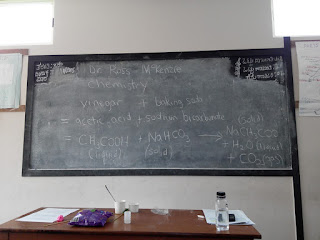
I then explain what chemistry is and illustrate with the chemical reaction of baking soda and vinegar, using full chemical names and chemical formula. Since carbon dioxide is a product we briefly discuss global warming. I highlight that different compounds in the chemical reaction are gas, solid, or liquid.

I then turn to physics. There are two relevant ideas here:
1. Newton's third law [which they all know word perfect!] and that drives the rocket.
2. When you convert a fixed mass of liquid or solid to gas the total volume increases by a thousandfold. A few grams of carbon dioxide has a volume of several hundred millilitres. Compressing that into the film canister produces a huge pressure.
Now the fun and most important part. We go outside and the students work in pairs where they systematically vary the amount of vinegar they add to the film canister and measure (estimate) the height the rocket goes to. Does more vinegar increase or decrease the height? Why or why not? They record their results. The quicker students I get to repeat their measurements.
After a lot of fun, we return to the classroom. I review the chemistry and physics again. Then we compare measurements between different groups, discuss measurement error, and try and draw some conclusions.
The second week I was really happy because a local friend came who just finished a Ph.D. He came from a similar socio-economic background to many of the students. I asked him to tell his life story to the class in the hope it would inspire the students. I don't think a wealthy white Western guy telling poor kids they should study hard and have a lofty goal such as to become a scientist is particularly effective or appropriate.
Follow up. The following week I did the same session with three high school students who were being home schooled by their parents. I was very impressed by their creativity and critical thinking. On their own initiative, they realised that it was difficult to make accurate measurements of the height that the rocket went to. Their solution was within about ten minutes to construct the launch device below. Instead of measuring the vertical distance they used a tape measure to measure the horizontal distance the rocket travelled.

One recent big change in school education in the Majority World is the proliferation of low-cost private schools, even in extremely poor communities. Most of these are English medium. A recent cover story in The Economist chronicled this development.
When visiting India, I enjoy reading The Hindu newspaper each day. I think the quality of journalism and the substance of the issues covered is much higher than most Western newspapers. More than once a week there is an op-ed piece or article about the problems with school education. Topics covered include the stifling of critical and creative thinking, the lack of autonomy given to teachers by all-knowing and controlling principals, …
Here is roughly what I have done for the science lesson in a school in the Majority World.
The main goal is to give a hands-on experience that will help the students see that what they read in the textbook or memorise for the exam actually has something to do with the real world.
It is centred around a baking soda and vinegar film canister rocket. Since this involves cheap household chemicals the hope is the children and/or their teachers might do it again.
I begin with a brief discussion of the scientific "method": ask a question, make a hypothesis (a big idea), design an experiment, make measurements, record data, analysis data, conclusion, and communicate results. I then illustrate this by sticking a wooden skewer in a balloon then show how you can actually put the skewer through the balloon.
I do the film canister rocket experiment. I then just mix a little vinegar and baking soda so they can see gas is being produced. Why is there gas? What gas is it?
I then explain what chemistry is and illustrate with the chemical reaction of baking soda and vinegar, using full chemical names and chemical formula. Since carbon dioxide is a product we briefly discuss global warming. I highlight that different compounds in the chemical reaction are gas, solid, or liquid.

I then turn to physics. There are two relevant ideas here:
1. Newton's third law [which they all know word perfect!] and that drives the rocket.
2. When you convert a fixed mass of liquid or solid to gas the total volume increases by a thousandfold. A few grams of carbon dioxide has a volume of several hundred millilitres. Compressing that into the film canister produces a huge pressure.
Now the fun and most important part. We go outside and the students work in pairs where they systematically vary the amount of vinegar they add to the film canister and measure (estimate) the height the rocket goes to. Does more vinegar increase or decrease the height? Why or why not? They record their results. The quicker students I get to repeat their measurements.
After a lot of fun, we return to the classroom. I review the chemistry and physics again. Then we compare measurements between different groups, discuss measurement error, and try and draw some conclusions.
The second week I was really happy because a local friend came who just finished a Ph.D. He came from a similar socio-economic background to many of the students. I asked him to tell his life story to the class in the hope it would inspire the students. I don't think a wealthy white Western guy telling poor kids they should study hard and have a lofty goal such as to become a scientist is particularly effective or appropriate.
Follow up. The following week I did the same session with three high school students who were being home schooled by their parents. I was very impressed by their creativity and critical thinking. On their own initiative, they realised that it was difficult to make accurate measurements of the height that the rocket went to. Their solution was within about ten minutes to construct the launch device below. Instead of measuring the vertical distance they used a tape measure to measure the horizontal distance the rocket travelled.

Monday, October 19, 2015
Seminar at IISc & a FQHE quasi-particle question
Tomorrow I am giving a seminar in the Physics Department at the Indian Institute of Science in Bangalore. The talk "Emergent states of quantum matter" is similar to the one I gave two weeks ago at JNCASR.
Then an interesting question was raised. "There are two complementary pictures of the quasi-particles in the Fractional Quantum Hall Effect: composite fermions and fractionally charged anyons. Can one explicitly show they are equivalent?"
I am not sure. One can certainly show that the overlap of the relevant variational wave functions, Laughlin's and the composite fermion ones, is significant and that for small systems that the overlap of both of these wave functions with exact numerical wave function.
However, that "black box" proof is not quite the same as establishing "adiabatic continuity" between the two different representations. Has anyone explicitly done that?
I welcome other answers to this question.
Then an interesting question was raised. "There are two complementary pictures of the quasi-particles in the Fractional Quantum Hall Effect: composite fermions and fractionally charged anyons. Can one explicitly show they are equivalent?"
I am not sure. One can certainly show that the overlap of the relevant variational wave functions, Laughlin's and the composite fermion ones, is significant and that for small systems that the overlap of both of these wave functions with exact numerical wave function.
However, that "black box" proof is not quite the same as establishing "adiabatic continuity" between the two different representations. Has anyone explicitly done that?
I welcome other answers to this question.
Subscribe to:
Posts (Atom)
What does this movie tell us about the modern university?
Last night, my wife and I watched the movie, Wit. You can watch the full movie here (free with ads). I should warn that some of the conten...

-
 This week Nobel Prizes will be announced. I have not done predictions since 2020 . This is a fun exercise. It is also good to reflect on w...
 -
 The Ising model is a paradigm in both statistical mechanics and condensed matter physics. Today for most theorists it is so familiar that so...
 -
 Nitrogen fluoride (NF) seems like a very simple molecule and you would think it would very well understood, particularly as it is small enou...