Saturday, January 31, 2015

NOVA video on emergence

NOVA is a Science TV show on PBS in the USA. 
This is a nice 12 minute segment on emergence, first shown in 2007. It focuses mostly on computing, origin of life, and has brief allusions to flocking.

Readers in the USA can watch a higher quality of the video on the NOVA site.

Friday, January 30, 2015

Spin fluctuation dynamics in bad metals

In a Mott insulator the electrons are localised leading to local magnetic moments that weakly interact with one another via superexchange. This means there is a new low-energy scale associated with spin dynamics. But, at the level of Dynamical Mean-Field Theory (DMFT) there is no superexchange and the local frequency-dependent spin susceptibility is a delta function, as discussed here.

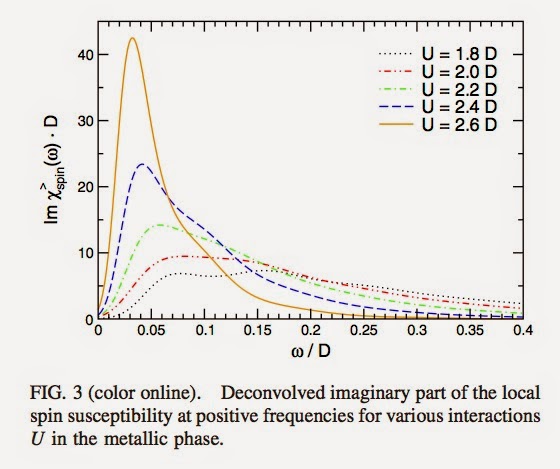
In a Fermi liquid the charge and spin degrees of freedom are both delocalised and the energy scale for spin dynamics Es is defined by the Fermi energy (or coherence temperature). As the Mott insulator is approached Es becomes small, much less than the bare Fermi energy. Furthermore, Es is associated with “kinks” in the quasi-particle dispersion relations seen in Angle Resolved PhotoEmission Spectroscopy (ARPES) experiments on strongly correlated materials. This is discussed in this post which features the graph below for zero temperature.


However, in the bad metal state, it is not clear what the spin fluctuation excitation spectrum is, as it has not been calculated yet. It is not clear to me why, although I know from conversations it is partly due to technical challenges associated with calculating real frequency correlation functions over a wide temperature range. This earlier post discusses the slow spin dynamics in a bad metal when Hund's rule matter.
I am interested in a similar calculation for a single non-degenerate Hubbard model, i.e. how does chi_s(omega) evolve with temperature.

The total spectral weight should be large due to the local magnetic moments associated with the breakdown of Kondo screening associated with the Fermi liquid to bad metal crossover that occurs with increasing temperature.

Understanding and describing the spin dynamics is particularly important, since it will may help distinguish between two alternative pictures of the bad metal,
(i) highly damped quasi-particles or
(ii) almost localised charges with localised spin degrees of freedom,
i.e. is the bad metal closer to a Fermi liquid or a Mott insulator?
In other words, is a wave vector or spatial (waves or particles) picture most appropriate?

Calculations of the specific heat and the uniform static spin susceptibility (using the Finite Temperature Lattice Method) for a Hubbard model on the triangular lattice at half filling, found little change as one went from the bad metal to the Mott insulator. My intuition is that this suggests the bad metal spin dynamics are like those in the Mott insulator, but the only way to clearly show that is through an explicit calculation of chi_s(omega).

Thursday, January 29, 2015

The cheapest and cleanest energy source is efficiency

The Economist has a good editorial
Seize the day
The fall in the price of oil and gas provides a once-in-a-generation opportunity to fix bad energy policies

Governments need to do two main things.
First, cut fuel subsidies. This is particularly important in the Majority world, as this favours the wealthy, who can afford to drive cars. Indonesia has just done this and used the saves to fund education and welfare.
Second, cut subsidies that encourage oil and gas exploration and production, rather than renewables.

There is also a 10 page special report
Let there be light 
Thanks to better technology and improved efficiency, energy is becoming cleaner and more plentiful

The two most striking graphs are those below.


Tuesday, January 27, 2015

Should I apply for this grant?

In a post last year A survival and sanity guide for new faculty I suggested that they should not apply for every grant possible or take on every prospective graduate student. I was asked to write something about what criteria might be used for making these decisions. Here, I will just focus on the grant issue. Hopefully, later I will discuss students.

First, you should acknowledge that you do have a choice. Don't let pressure from others make you think you don't. Alternatives to not applying including waiting for a year, or putting in an application jointly with another colleague.

This is a tricky and subjective issue for which there is no clear answer. Here, I will suggest some questions to ask yourself.

Do I really need the grant?
Do I actually need the money to do the research? Or do I need the grant for career reasons? If you are an experimentalist and have no ongoing funding to pay for supplies such as liquid helium then there is a very good reason to apply. On the other hand if you are a theorist and already have several students, getting a postdoc might be nice, but hardly essential.
If your institution won't give you tenure without this particular grant then you obviously should apply.  On the other hand, if you want to get the grant largely because it is "prestigious", maybe you should give it a miss.

How much work is involved in the application? 
Many applications run to 50-100 plus pages and can take up most of your time for 2 to 4 weeks. Be realistic. It will take longer than you think, particularly if you are inexperienced and don't have administrative/secretarial support. It can also be very stressful trying to write an application while juggling many other responsibilities.

What is the opportunity cost of applying?
Would all this time and energy be better spent doing something else: increasing the quality of a different grant application, writing a paper, actually doing research, spending more time with your current group members, ... going on a vacation! These alternatives may increase your chances with other funding opportunities. These alternatives may also be a lot more worthwhile and enjoyable.

What are my chances of success?
Be realistic. Many grant programs, particularly in the USA, are now down to less than ten per cent. But, it is not completely random. For some applicants, the chances will be significantly higher, for others, even lower. To help evaluate your chances ask,

Do I know someone, particularly a peer, who got one of these grants?
Look at the list of successful previous applicants. Consider their research fields, track records, "visibility", and political connections (especially to the decision makers). Are they comparable to yours?

To help decide, if possible ask the advice of a senior person without a vested interest who will be objective and honest.

I welcome comments and suggestions.


Friday, January 23, 2015

Overselling cross disciplinarity

I wrote a post How (not) to break into a field. Some of those ideas where supported when I recently started reading Paul Krugman's nice little book, The Self-Organizing Economy

Early in the book he notes:
the authors of articles and books on complexity almost never talk to serious economists or read what serious economists write; as a result, claims about the applicability of the new ideas to economics are usually coupled with statements about how economies work (and what economists know) that are so ill-informed as to make any economist who happens to encounter them dismiss the whole enterprise. 
But it does not have to be that way.
Unfortunately, you could replace "complexity" with quantum information theory and "economics" with chemistry, biology, or condensed matter physics.
Or,  astrophysicists and cancer, ... physicists and the origin of life .... string theorists and condensed matter ....

On the positive side, Krugman then discusses some nice simple "economic" models that produce spatial or temporal organisation, and power laws. He also briefly relates what he is doing to ideas of emergence and Phil Anderson.

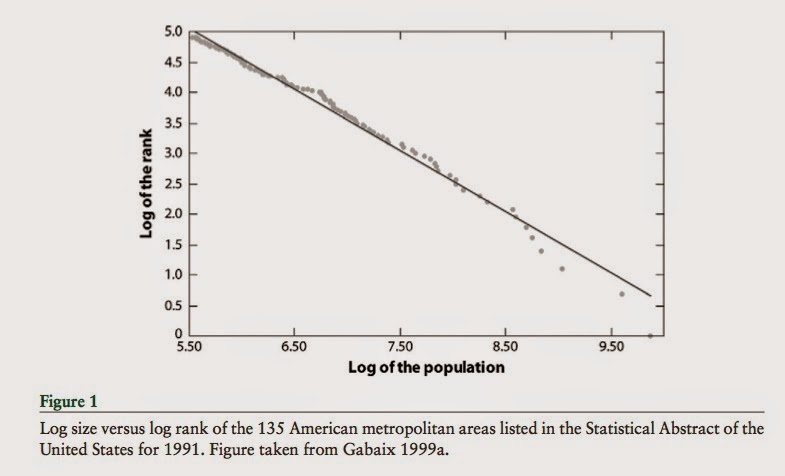
My only disappointment is that there is no real data in the book. However, if you want to see some real data for scaling laws in economics and finance see this helpful review which contains curves such as the one below.

Thursday, January 22, 2015

Quantum protons in enzymes

A number of proteins involve short strong hydrogen bonds [also known as low-barrier bonds] and there is considerable debate about how important or relevant they are for functionality. A particularly interesting enzyme is KetoSteroid Isomerase (KSI) which features such bonds. Its structure and mechanism has recently been elucidated by some beautiful experiments using mutants near the active site.

There is a nice paper
Quantum delocalization of protons in the hydrogen-bond network of an enzyme active site
Lu Wang, Stephen D. Fried, Steven G. Boxer, and Thomas E. Markland

This is a combined experimental and theoretical study of isotope substitution effects where the protons are replaced with deuterium. This allows one to probe the effects of the zero-point motion of the protons in hydrogen bonds. You can see zero-point energy with a pH meter.

The authors measure the change in the pKa [acidity] with H/D substitution of the different amino acid residues in the active site of KSI. Significantly, they find that for one of the KSI tyrosine's the pKa change is much larger than the change in water. Furthermore, they calculate this change using an ab initio path integral molecular dynamics simulation, obtaining a value in reasonable agreement with experiment.

The large isotope effect arises because of the significant quantum delocalisation of the protons in the H-bond network near the tyrosine's. This is illustrated in the figure below, showing the probability of finding a proton along the co-ordinate associated with proton transfer between the two different tyrosine's [when nu_16=0 the proton is equidistant between the Tyr16 and Tyr57 residues].


The simulation is a real tour de force. It uses a "force field" calculated "on the fly" from density functional theory with the B3LYP-D3 functional.
These simulations treat both the nuclear and electronic degrees of freedom quantum mechanically in the active-site QM region and also incorporate the fluctuations of the protein and solvent environment in the MM region. The simulations consisted of between 47 and 68 QM atoms and more than 52,000 MM atoms describing the rest of the protein and solvent. 
These simulations, which until recently would have been computationally prohibitive, were made possible by 
accelerating the path integral molecular dynamics convergence using a generalized Langevin equation, 
using new methods to accelerate the extraction of isotope effects, and 
exploiting graphical processing units (GPUs) to perform efficient electronic structure theory evaluations through an interface to the TeraChem code. 
Such a combination yielded almost three orders of magnitude speedup compared with existing AI-PIMD approaches.
Being able to perform such detailed stimulations will allow critical examination of controversial claims that short hydrogen bonds and proton tunnelling is a key ingredient in the functionality of specific enzymes.

Wednesday, January 21, 2015

Where is all this blog traffic coming from?

Normally this blog attracts about 700 page views per day, according to blogspot. However, yesterday it got 5000! I have no idea why. Presumably someone with a significant following Tweeted it.
If you know the answer, please let me know, even if you are a robot!


I have not seen a traffic increase like that this since I pointed out that Greg Scholes' "quantum biology" paper in Nature involved fitting 20 data points to a curve with 17 parameters.

What does this movie tell us about the modern university?

Last night, my wife and I watched the movie, Wit. You can watch the full movie here  (free with ads). I should warn that some of the conten...