Thursday, August 28, 2014

Hard questions about glasses

A recent book Dynamical heterogeneities in glasses, colloids, and granular media contains a fascinating chapter where four experts [Jorge Kurchan, James Langer, Thomas Witten, and Peter Wolynes] give their answers to the questions below.

I think we need more of these kind of frank discussions about scientific topics. I am slowly working through the answers. The most fascinating bit so far is Peter Wolynes inspiring response to Q9, including "I believe a young physicist who wants to work on any challenging problem in physics will eventually have to learn about glasses."
Q1) In your view, what are the most important aspects of the experimental data on the glass transition that any consistent theory explain? Is dynamical heterogeneity one of these core aspects?  
Q2) Why should we expect anything universal in the behavior of glass-forming liquids? Is the glass-transition problem well defined?  
Q3) In spin-glasses, the existence of a true spin-glass phase transition has been well established by simulations and experiments. Do you believe that a similar result will ever be demonstrated for molecular glasses? 
Q4) Why are there so many different theories of glasses? What kind of decisive experiments do you suggest to perform to rule out at least some of them? 
Q5) Can you briefly explain, and justify, why you believe your pet theory fares better than others? What, deep inside, are you worried about, that could jeopardize your theoretical construction?  
Q6) In the hypothesis that Random First-Order Theory [RFOT] forms a correct skeleton of the theory of glasses, what is missing in the theoretical construction that would convince the community?  
 Q7) Exactly solvable mean-field glass models exhibit an extraordinary complexity requiring impressive mathematical tools to solve them. 
 Q8) In your view, do the recent ideas and experimental developments concerning jamming in granular media and colloids contribute to our understanding of molecular glasses, or are they essentially complementary?  
Q9) If a young physicist asked you whether he or she should work on the glass problem in the next few years, would you encourage him or her and if so, which aspect of the glass problem would you recommend him or her to tackle 
 Q10) In twenty years from now, what concepts, ideas or results obtained on the glass transition in the last twenty years will be remembered?  
Q11) If you met an omniscient God and were allowed one single question on glasses, what would it be?
I thank Peter Wolynes for bringing this to my attention.

Wednesday, August 27, 2014

Why are quasi-particles interesting?

Last week I had a phone call from a journalist Andrew Grant at Science News, asking about quasi-particles. Why are they interesting?

1. Quasi-particles exist. It is not at all obvious why they should exist in strongly interacting quantum systems. Yet they are rather robust and found in diverse systems, ranging from atomic nuclei, to magnets, to metals, to neutron stars… Thus, they are an important organising principle in quantum many-body physics.

2. Occasionally quasi-particles have different quantum numbers to the constituent particles of a system. The most striking example is the fractional charge and statistics of quasi-particles in the fractional quantum Hall effect.

3. Many electronic materials of current interest [e.g. high-temperature superconductors] are “bad metals” that do not seem to have quasi-particles [except at low temperatures].

I find all of these are profound and surprising. They illustrate emergence.

Update. Grant's article is here.

Tuesday, August 26, 2014

A challenging ingredient in teaching

Francis Su is a mathematics Professor at Harvey Mudd College. He is teaches a course in Real Analysis, the lectures of which you can watch on Youtube. Last year he received the Haimo award from the Mathematical Association of America for excellence in teaching.

In receiving the award he gave a deeply personal talk
The Lesson of Grace in Teaching: From weakness to wholeness, the struggle and the hope

I actually wanted to post about his talk when I first read it months ago, but was hesitant to because I feel I struggle so much with the issues he talks about. Finally posting it was prompted by two events. I got my latest student teaching evaluations and they were pretty good [more on that later]. (Sadly, this also illustrates how I am struggling with what Su is talking about: performance based identity). A friend is taking a course on teaching and he told me they had a whole session discussing clarification of personal values and how they shape your own teaching philosophy and interactions with students. I thought Su was an excellent example of this.

Monday, August 25, 2014

How good should parameterisation of simple models be?

Over the past few years I have advocated a simple diabatic state model to describe hydrogen bonding in a diverse range of molecular complexes. In my first paper I suggested the following parameterisation of the matrix element coupling the two diabatic states

with two free parameters Delta1 and b, which describe the energy scale and length scale for the interaction.
R1 is just a reference distance ~ 2.4 A, introduced so that the prefactor Delta1 corresponds to a physically relevant scale.
The two parameter values I chose give a quantitative description of a wide range of properties [bond lengths, vibrational frequencies, and the associated isotope effects, when the quantum nuclear motion is taken into account.

Last week I found this nice paper
Solvent-Induced Red-Shifts for the Proton Stretch Vibrational Frequency in a Hydrogen-Bonded Complex. 1. A Valence Bond-Based Theoretical Approach 
Philip M. Kiefer, Ehud Pines, Dina Pines, and James T. Hynes

It uses a similar two-diabatic state model and references earlier work of Hynes going back to 1991. A parameterisation like that above is used.

Below is a plot of Delta (kcal/mol) vs. R (Angstroms), comparing my parametrisation to Hynes.

The curve with the smaller slope is the parameterisation of Hynes.

I found this agreement very satisfying and encouraging. I have mostly been concerned with symmetrical complexes [where the proton affinity of the donor and acceptor is equal] and bonds of strong to moderate strength [R ~ 2.3-2.6 Angstroms] and have compared the theory to experimental data for solid state materials. In contrast, Hynes has been mostly concerned with asymmetric complexes in polar solvents with weaker bonds [R ~ 2.7-2.8 Angstroms].

I also felt bad that I had not referenced Hynes work. Then I went back and checked my first paper. To my relief, I found I had explicitly stated that the parameterisation in his 1991 paper was comparable to mine. It is amazing how quickly I forget stuff!

But the main point of this post is to raise two general questions.

1. Should I really be so happy? Aren't I missing the point of simple models: to give insight into the essential physics and chemistry and describe trends in diverse set of systems. All that matters is that the parameters are "reasonable", i.e. not crazy.

2. What is a reasonable expectation for consistent parametrisation of simple models? At what point does one abandon a model because it requires some parameters that are "unreasonable"? For example, if Hynes parameters differed by a factor of ten or more I would say there is a serious problem with the model. But I would not be that concerned by a 50 per cent discrepancy.

Here is a concrete example for 2. At a recent Telluride meeting, Dominika Zgid lampooned the fact that for cerium oxides, people doing DFT+U calculations have used values of U ranging from 1 to 10 eV in order to describe different experimental properties. To me this clearly shows that there is physics beyond DFT+U in these materials.

I welcome answers. I realise that the answers may be subjective.

Saturday, August 23, 2014

Seeing enzyme catalysis with the naked eye

For my latest celebrity scientist speaking gig [at a small church youth group] my glamorous assistant [my wife] found a new demonstration to add to my repertoire, Elephants toothpaste. It is described in this Journal of Chemical Education paper.

Hydrogen peroxide is thermodynamically unstable. However, you can buy bottles of it and they will remain useful for months. It will slowly decompose into water and oxygen.
H
2
O
2
 → 2 H
2
O
 + O
2


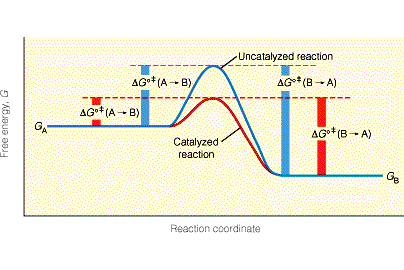
However, if you add some iron chloride it acts as a catalyst and increases the decomposition rate by a factor of a thousand. You will see some amount of "bubbling" due to the oxygen gas produced. If blood [which contains haemoglobin] is added the rate increases by a factor of a million. Even better, if you add the enzyme catalase, the rate increases by a factor of a billion. In the demonstration the catalase is present in the yeast that is added. Catalase is one of the fastest catalysts known. It performs an incredibly important biochemical function, that is essential to life existing. Hydrogen peroxide is a strong oxidant  that could destroy many biomolecules. It is also an unwanted byproduct of many biochemical reactions. Biological systems use catalase to rapidly destroy the hydrogen peroxide before it can do harm.

The demonstration I did (and described in the JCE article) makes use of a dilute aqueous solution [a few per cent] of hydrogen peroxide. The spectacular video below makes use of a highly concentrated solution that is quite dangerous because it can cause chemical burns of the skin.


The above discussion follows the beautiful introduction to enzymes in chapter 11 of my favourite biochemistry text by Matthews, van Holde, Appling, and Anthony-Cahill 
It contains the figure below, illustrating the key idea of how catalysts work: by lowering the energy barrier [the transition state] for a chemical reaction.

Thursday, August 21, 2014

Should I join this professional scientific society?

Why are they important?
Why should you join? not join?
Why are the membership numbers of some societies declining (some dramatically)?

It seems every month the American Chemical Society (ACS) sends me a letter asking me to join. I am not sure who recommended me for membership. I find it ironic because I once tried to join the Royal Australian Chemical Institute but was rejected because they did not seem to think I was a real chemist. [ouch!] Over the years I have belonged to several societies. But, some of these memberships have lapsed. Recently, I was personally asked by one, "What do we have to do to get you to rejoin?"
I did not have an answer, stimulating this post.

First, let me say why these societies can be incredibly important. They can
  • Publish good journals that are owned and run by scientists. These can avoid the problems of commercial outfits such as Nature [sensationalism over substance] and Elsevier [quantity over quality, dubious business practises].
  • Organise useful conferences.
  • Give prizes and awards to recognise excellence.
  • Provide career services, particularly for younger members.
  • Represent science and scientists to government, industry, and the community. This is not just lobbying for more funding but making important public statements on issues such as climate change.
If we don't join, we end up with the Tragedy of the Commons, whereby our long-term collective interests suffer because we prioritise our individual self-interest.

So, why not join?
  • Membership is expensive, particularly if you belong to several.
  • Your mail box (both hard and soft) will be clogged with magazines, newsletters, fund-raising appeals, announcements, elections, ...
  • You may be asked to serve on committees.
  • There are many societies to choose from, particularly if you live outside the USA and you work  at the interface of two or more disciplines [physics, chemistry, biophysics, materials science, ...]. APS, ACS, RACI, AIP, IoP, MRS, ...
  • Smaller national societies are struggling for viability in an era of internationalisation. It is not clear why some still publish journals.
  • Society conferences compete with a multitude of other conferences. Some national society conferences may not have a critical mass of people or seem a magnet for mediocrity.
  • If you don't go to the society conferences and can read their magazine online via a library subscription there is less personal incentive to join.
So, how do you decide who to join? or not join? or let your membership lapse?
What would a society have to do to convince you to join?

Wednesday, August 20, 2014

Belated recognition for early work on superconducting organic charge transfer salts

In the mid-1990s, through the influence of Jim Brooks, I became interested in organic charge transfer salts. I read a very helpful paper by Kino and Fukuyama that considered a Hubbard model for the family kappa-(BEDT-TTF)2X. This led to me writing a review article and a short piece in Science, comparing the organics to the cuprates.

Aside: Being young and naive, and living before impact factor obsessions, I made the mistake of publishing the review in Comments on Condensed Matter,  which is not even listed on ISI Web of Science. I chose that journal because I knew it had published an influential review on heavy fermions by the stellar cast of Lee, Rice, Serene, Sham, and Wilkins.
Fortunately, I put the paper on the arXiv and a lot of people read it, and the Science paper often gets cited, by association.

The review stimulated a lot of work, particularly on the Hubbard model on the anisotropic triangular lattice at half filling, and the associated Heisenberg model for the Mott insulating phase. A recent review is here, with Ben Powell.

Only recently I became aware of some related work from around the same time that is never cited, literally.

κ-(BEDT-TTF)2X organics, as seen for Hubbardists 
V.A. Ivanov

Electronic structure and superconductivity of κ-(BEDT-TTF)2X salts
V. A. Ivanov, E. A. Ugolkova, M. E. Zhuravlev

The relevant Hubbard model, the importance of correlations, and the possibility of d-wave superconductivity are all discussed. These papers may not be as clear, or crisp, and comprehensive as my review but some of the key physics is there.
Ivanov should get credit for that.

What is the sociology here? Why was I influential but Ivanov was not?
Here may be some contributing factors.
I published the Perspective in Science, but back then not many physicists actually read it.
More importantly, I put my papers on the arXiv. Back then [pre-web] most people subscribed to and read the daily email listing recently posted papers. I timed my posting so my review would be the first of the daily list.
I followed up with more papers. I gave a lot of talks, both at conferences and universities around the world. I talked to experimentalists. I encouraged theorists to use their favourite technique to study the relevant Heisenberg and Hubbard models. I had postdocs work on the subject. They then went around talking about it.

What does this movie tell us about the modern university?

Last night, my wife and I watched the movie, Wit. You can watch the full movie here  (free with ads). I should warn that some of the conten...